Bitcoin price has been consolidating between $94,000 and $100,000 since early February, hovering around $98,000 at the time of writing on Friday. Despite this consolidation, US Bitcoin spot ETFs data recorded a total net outflow of $489.60 million until Thursday, hinting signs of weakness among institutional investors.
Gold price sits at two-week lows below $2,900, awaiting US PCE inflation data.
US Dollar stands tall amid Trump’s tariff threats while US Treasury yields tank on dovish Fed bets.
Gold price finds acceptance below the 21-day SMA at $2,890, but the daily RSI stays bullish.
Gold price struggles near two-week lows below $2,900 in Friday’s Asian trading hours, looking to snap its eight consecutive weekly gains.
Gold price suffers amid US Dollar resurgence
Gold price is nursing losses as the US Dollar (USD) stands tall amid risk-off flows extending into Asia this Friday. Traders weigh the latest tariff threats from US President Donald Trump and the sharp decline in the American artificial intelligence (AI) leader Nvidia’s share price.
Trump confirmed on Thursday that his proposed 25% tariffs on Mexican and Canadian goods will take effect March 4 along with an extra 10% duty on Chinese imports as fentanyl continues to pour into the US from those countries.
His latest remarks brushed aside his Wednesday message that steep 25% tariffs on Mexican and Canadian goods could take effect on April 2.
The broader market sentiment also remains undermined due to heightening US economic concerns and the slump in Nividia and other so-called “Magnificent Seven” Wall Street mega-cap stocks, following the chipmaker’s discouraging earnings.
Data on Thursday showed that the second estimate of the fourth-quarter US Gross Domestic Product (GDP) held steady from the advance estimates, showing an annualised growth of 2.3% in Q4 2024. Meanwhile, the number of Americans filing for jobless benefits rose by 22,000 to 242,000 for the week ending Feb. 22, hitting the highest level in three months.
Against this background, the Greenback will likely keep the upper hand across the board, maintaining the downside pressure on the USD-denominated bright metal.
However, weak US economic data-led dovish Federal Reserve (Fed) interest rate cut expectations combined with increased safe-haven flows into the US government bonds remain a headwind for the US Treasury bond yields.
The benchmark 10-year US Treasury bond yields extend their losing streak, flirting with 11-week lows near 4.20% at the press time. The ongoing decline in the US yields could hinder the US Dollar recovery, cushioning the Gold price downside.
That said, the upcoming Fed’s preferred inflation gauge, the core Personal Consumption Expenditures (PCE) Price Index, will help trigger the next direction in Gold price. The annual US core PCE Price Index is set to rise 2.6% in January after increasing 2.8% in December. Any significant deviation from the forecast will likely impact the Fed rate cut bets, influencing the Greenback and the yellow metal.
Further, the end-of-the-month flows and more commentary from US President Trump could also play a pivotal role in driving the Gold price action as the week draws to a close.
Gold price technical analysis: Daily chart
The daily chart shows that Gold price closed Thursday below the critical short-term support of the 21-day Simple Moving Average (SMA) at $2,890, inducing further downward pressure.
However, Gold price remains above the 14-day Relative Strength Index (RSI), currently near 53.50, indicating that buyers refuse to give up yet.
If sellers flex their muscles, the immediate support is seen at the February 12 low of $2,864, below which the $2,850 psychological barrier will be challenged.
Additional declines will threaten the February 6 low of $2,834.
Should Gold buyers seek a weekly closing above the 21-day SMA support-tuned resistance at $2,890, a fresh uptrend could be fuelled toward the February 26 high of $2,930.
The next upside target on buyers’ radars will be an all-time high at $2,956.
Economic Indicator
Core Personal Consumption Expenditures – Price Index (YoY)
The Core Personal Consumption Expenditures (PCE), released by the US Bureau of Economic Analysis on a monthly basis, measures the changes in the prices of goods and services purchased by consumers in the United States (US). The PCE Price Index is also the Federal Reserve’s (Fed) preferred gauge of inflation. The YoY reading compares the prices of goods in the reference month to the same month a year earlier. The core reading excludes the so-called more volatile food and energy components to give a more accurate measurement of price pressures.” Generally, a high reading is bullish for the US Dollar (USD), while a low reading is bearish.
GBP/USD fluctuates near 1.2600 in the European session on Friday.
Market participants await January PCE inflation data from the US.
US President Trump hinted that they could refrain from imposing tariffs on UK imports.
GBP/USD seems to have entered a consolidation phase near 1.2600 after losing more than 0.5% on Thursday as investors move to the sidelines while waiting for January inflation data from the US.
The US Dollar (USD) benefited from safe-haven flows in the American session on Thursday and gathered strength against its major rivals.
British Pound PRICE This week
The table below shows the percentage change of British Pound (GBP) against listed major currencies this week. British Pound was the weakest against the US Dollar.
USD
EUR
GBP
JPY
CAD
AUD
NZD
CHF
USD
0.59%
0.23%
0.83%
1.49%
2.23%
2.44%
0.36%
EUR
-0.59%
-0.44%
0.09%
0.71%
1.62%
1.66%
-0.40%
GBP
-0.23%
0.44%
0.59%
1.15%
2.08%
2.10%
0.04%
JPY
-0.83%
-0.09%
-0.59%
0.64%
1.47%
1.67%
-0.38%
CAD
-1.49%
-0.71%
-1.15%
-0.64%
0.68%
0.94%
-1.10%
AUD
-2.23%
-1.62%
-2.08%
-1.47%
-0.68%
0.03%
-1.99%
NZD
-2.44%
-1.66%
-2.10%
-1.67%
-0.94%
-0.03%
-2.02%
CHF
-0.36%
0.40%
-0.04%
0.38%
1.10%
1.99%
2.02%
The heat map shows percentage changes of major currencies against each other. The base currency is picked from the left column, while the quote currency is picked from the top row. For example, if you pick the British Pound from the left column and move along the horizontal line to the US Dollar, the percentage change displayed in the box will represent GBP (base)/USD (quote).
US President Donald Trump said on Thursday that the 25% tariff package on Mexican and Canadian imports will come into effect on March 4 as planned, rather than April 2nd that he mentioned a day earlier. Additionally, Trump reiterated that another 10% tariff will be imposed on Chinese imports on that same date.
On a positive note, however, “I think there’s a very good chance that in the case of these two great, friendly countries, I think we could very well end up with a real trade deal where the tariffs wouldn’t be necessary. We’ll see,” Trump said following his meeting with British Prime Minister Keir Starmer.
Meanwhile, Bank of England (BoE) Deputy Governor Dave Ramsden said early Friday that a gradual and careful approach is needed to rate cuts, helping Pound Sterling hold its ground.
In the second half of the day, the US Bureau of Economic Analysis (BEA) will publish the Personal Consumption Expenditure (PCE) Price Index data for January. In case the reports shows a monthly core PCE Price Index increase of 0.4%, or higher, the USD could preserve its strength heading into the weekend and make it difficult for GBP/USD to stage a rebound. It’s also worth mentioning that month-end flows on the last trading day of February could ramp up market volatility toward the end of the European session and cause irregular movements in the pair.
GBP/USD Technical Analysis
GBP/USD closed below the 100-day Simple Moving Average (SMA), currently located at 1.2640, on Thursday and the Relative Strength Index (RSI) indicator on the 4-hour chart declined below 50, highlighting a loss of bullish momentum.
On the downside, 1.2560 (100-period SMA) aligns as first support before 1.2530 (Fibonacci 50% retracement of the latest downtrend) and 1.2500 (round level, static level). Looking north, resistances could be spotted at 1.2640 (100-day SMA) and 1.2700-1.2710 (round level, static level).
Pound Sterling FAQs
The Pound Sterling (GBP) is the oldest currency in the world (886 AD) and the official currency of the United Kingdom. It is the fourth most traded unit for foreign exchange (FX) in the world, accounting for 12% of all transactions, averaging $630 billion a day, according to 2022 data. Its key trading pairs are GBP/USD, also known as ‘Cable’, which accounts for 11% of FX, GBP/JPY, or the ‘Dragon’ as it is known by traders (3%), and EUR/GBP (2%). The Pound Sterling is issued by the Bank of England (BoE).
The single most important factor influencing the value of the Pound Sterling is monetary policy decided by the Bank of England. The BoE bases its decisions on whether it has achieved its primary goal of “price stability” – a steady inflation rate of around 2%. Its primary tool for achieving this is the adjustment of interest rates. When inflation is too high, the BoE will try to rein it in by raising interest rates, making it more expensive for people and businesses to access credit. This is generally positive for GBP, as higher interest rates make the UK a more attractive place for global investors to park their money. When inflation falls too low it is a sign economic growth is slowing. In this scenario, the BoE will consider lowering interest rates to cheapen credit so businesses will borrow more to invest in growth-generating projects.
Data releases gauge the health of the economy and can impact the value of the Pound Sterling. Indicators such as GDP, Manufacturing and Services PMIs, and employment can all influence the direction of the GBP. A strong economy is good for Sterling. Not only does it attract more foreign investment but it may encourage the BoE to put up interest rates, which will directly strengthen GBP. Otherwise, if economic data is weak, the Pound Sterling is likely to fall.
Another significant data release for the Pound Sterling is the Trade Balance. This indicator measures the difference between what a country earns from its exports and what it spends on imports over a given period. If a country produces highly sought-after exports, its currency will benefit purely from the extra demand created from foreign buyers seeking to purchase these goods. Therefore, a positive net Trade Balance strengthens a currency and vice versa for a negative balance.
If you’ve spent any time on social media — especially TikTok — you’ve probably seen the buzz around Bloom Greens. Touted for its convenience and packed with a blend of plant-based ingredients, this greens powder has gained a loyal following among wellness enthusiasts. But with so many greens supplements on the market, is Bloom really worth the hype?
To find out, I put it to the test myself, evaluating everything from taste and texture to ingredient quality and overall effectiveness. In this review, I’ll break down my honest thoughts on Bloom Greens, including its nutritional profile, pricing and who it’s truly best suited for.
Our registered dietitians in the Good Housekeeping Institute Nutrition Lab review and evaluate every single supplement we recommend in accordance with our dietary supplement methodology. We then have a registered dietitian on our Medical Review Board review each article for scientific accuracy. A supplement should do just that: supplement the diet, not replace high-quality, nutritious food and important healthy lifestyle practices. Check with your healthcare provider before starting any dietary supplement regimen.
What is Bloom Greens and how does it work?
After going through her own health journey and losing 90 pounds, Mari Llewellyn co-founded Bloom Nutrition with a mission to make health supplements more accessible and enjoyable. Bloom Nutrition’s Greens & Superfoods powders are designed to support digestion, boost energy and fill nutritional gaps with a blend of over 30 ingredients. Each scoop contains a mix of fruits, vegetables, fiber, prebiotics, probiotics, digestive enzymes and antioxidants. What sets Bloom apart is its variety of delicious flavors, including Strawberry Kiwi, Berry, Mango and Orange Passionfruit. Plus, according to the brand, every formula is third-party tested, non-GMO and free from gluten, dairy, soy and added sugars so it’s an option for those looking to enhance their wellness journey.
Bloom Greens & Superfoods
Now 13% Off
Credit: Bloom Greens
Cons
Contains stevia, which may cause GI discomfort for some
All the flavors have similar nutrition facts and ingredients. Below are the details for the Mango flavor (one scoop, equivalent to 5.64 grams):
Calories: 15
Total carbohydrates: 3 g (1%)
Dietary fiber: 2 g (7%)
Iron: 0.6 mg (3%)
Sodium: 5 mg (<1%)
Bloom contains seven proprietary blends, each with a listed total serving size. However, the brand does not disclose the exact amount of each individual ingredient within the blends. These blends include:
Fiber Blend (1606 g): Chicory root, fructooligosaccharides, organic flaxseed, apple fruit powder
Pre and Probiotic Blend (648 mg): Blue agave inulin, bifidobacterium bifidum, lactobacillus rhamnosus, lactobacilis acidophilus
Fruit and Vegetable Blend (572 mg): Organic carrot powder, beet root powder, kale leaf powder, blueberry powder, spinach powder, broccoli powder, ginger root extract
Antioxidant Beauty Blend (550 mg): Cranberry fruit powder, strawberry fruit powder, raspberry fruit juice powder, tart cherry fruit powder, elderberry fruit extract, açai fruit extract (euterpe oleracea), goji berry (lycium barbarum), horseradish tree leaf (moringa oleifera), grape seed Extract, matcha green tea leaf
Other ingredients: Natural flavors and citric acid.
Bloom’s Greens & Superfoods powders claim to support digestion, gut health and boost energy. The blend includes digestive enzymes, prebiotics, probiotics and greens, along with fruits and veggies for added vitamins, minerals and antioxidants. It’s marketed as a convenient way to get essential nutrients and promote a healthy gut. However, while the formula lists the total amount of ingredients per scoop, it doesn’t specify the exact quantities of each. This makes it tough to know how much of each ingredient you’re actually getting and how effective they might be.
How much does Bloom Greens cost?
Bloom Greens is priced at around $34.99 for a 30-serving tub, which breaks down to about $1.16 per serving. That’s pretty standard for greens supplements, so it’s in line with what you’d expect to pay for a high-quality option. If you like the idea of automatic deliveries, you can subscribe and have it sent to you every 30 days for $31.49, which is a little cheaper than buying it once. Plus, if you choose to subscribe for a three- or six-month supply, you’ll get a 15% discount, making it a nice option if you’re planning to stick with it long-term.
Our testing experience
Ordering
Ordering from Bloom is super easy. The website is bright, inviting and really easy to navigate — definitely makes you want to dive in and explore. The packaging is just as vibrant and eye-catching, with pictures of fresh produce like berries, spinach and mango that instantly make you curious to try it out. Once you place your order, they aim to fulfill it within five business days. After that, you’ll get an email and text with your tracking number, so you can follow your package every step of the way. Just a heads-up, their products are recommended for people 18 and older, and if you’re unsure about taking any supplements, it’s always a good idea to check with your doctor.
You can find Bloom products nationwide at Amazon, Target, Walmart, GNC and Sam’s Club. I personally found the ordering process on their website seamless and enjoyed tracking my package along the way. If you run into any issues, Bloom’s customer support is easy to reach through their inquiry form on their contact page. And if you’re not satisfied, you can return unopened, undamaged products within 15 days for a full refund—just keep in mind that return shipping is on you. Payment is flexible, too, with options like credit cards, PayPal, or installment plans through Shop Pay and Sezzle. Overall, getting your hands on this product is simple and convenient.
Taste and texture
The taste of Bloom Greens tends to get a lot of positive reviews, especially with fruity flavors like Mango, Strawberry Kiwi and Berry, which do a great job of masking the typical earthy taste of green powders. I personally enjoyed these flavors, and I saw others rave about them too, with one Amazon reviewer even giving the Orange Passionfruit flavor an “A+.” That being said, I’ve also seen a few reviewers mention that the sweetness — especially from stevia — can be a bit much and I can totally relate to that. One reviewer said it was overwhelming and suggested that a little less sweetness might go a long way.
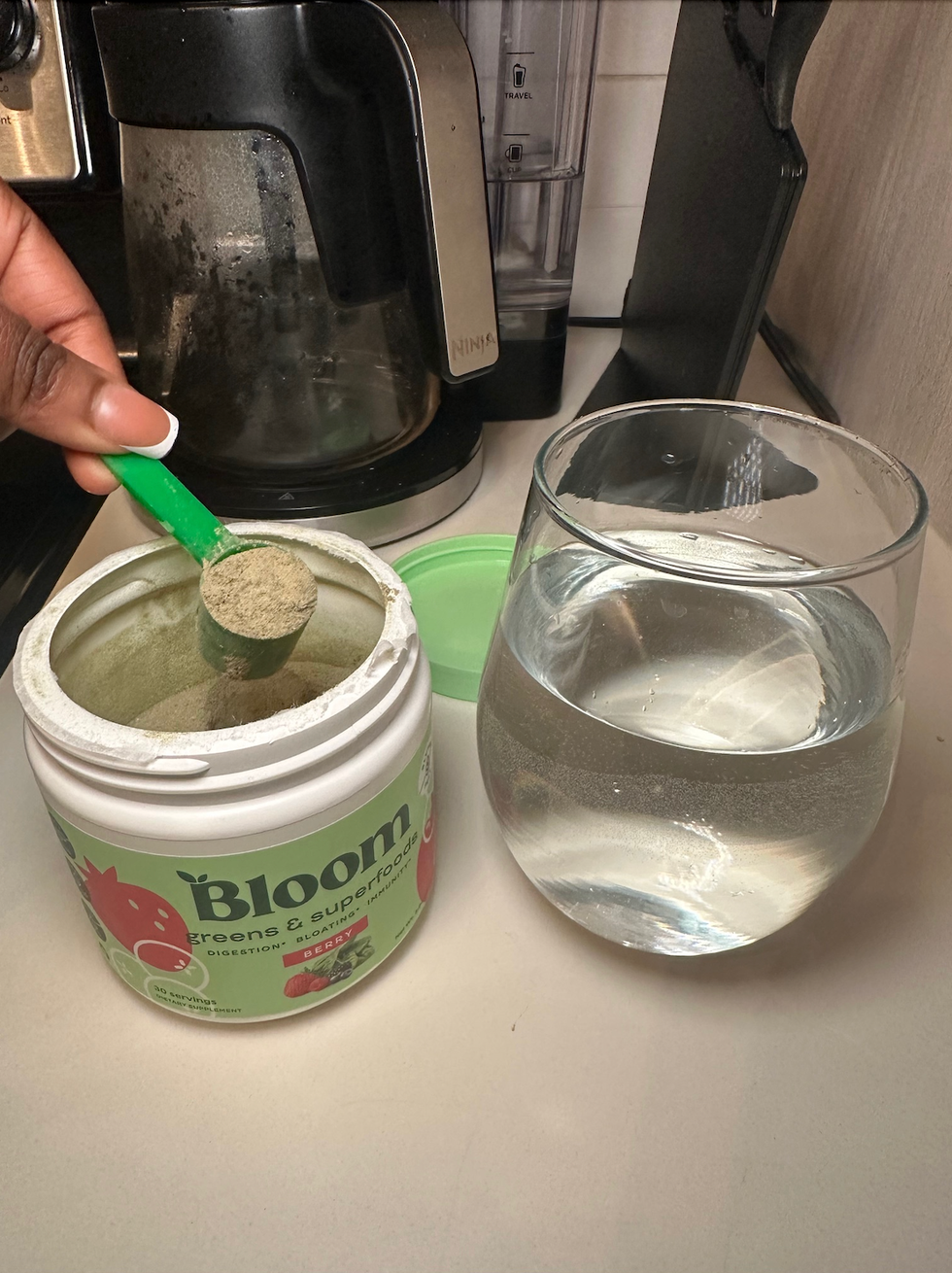
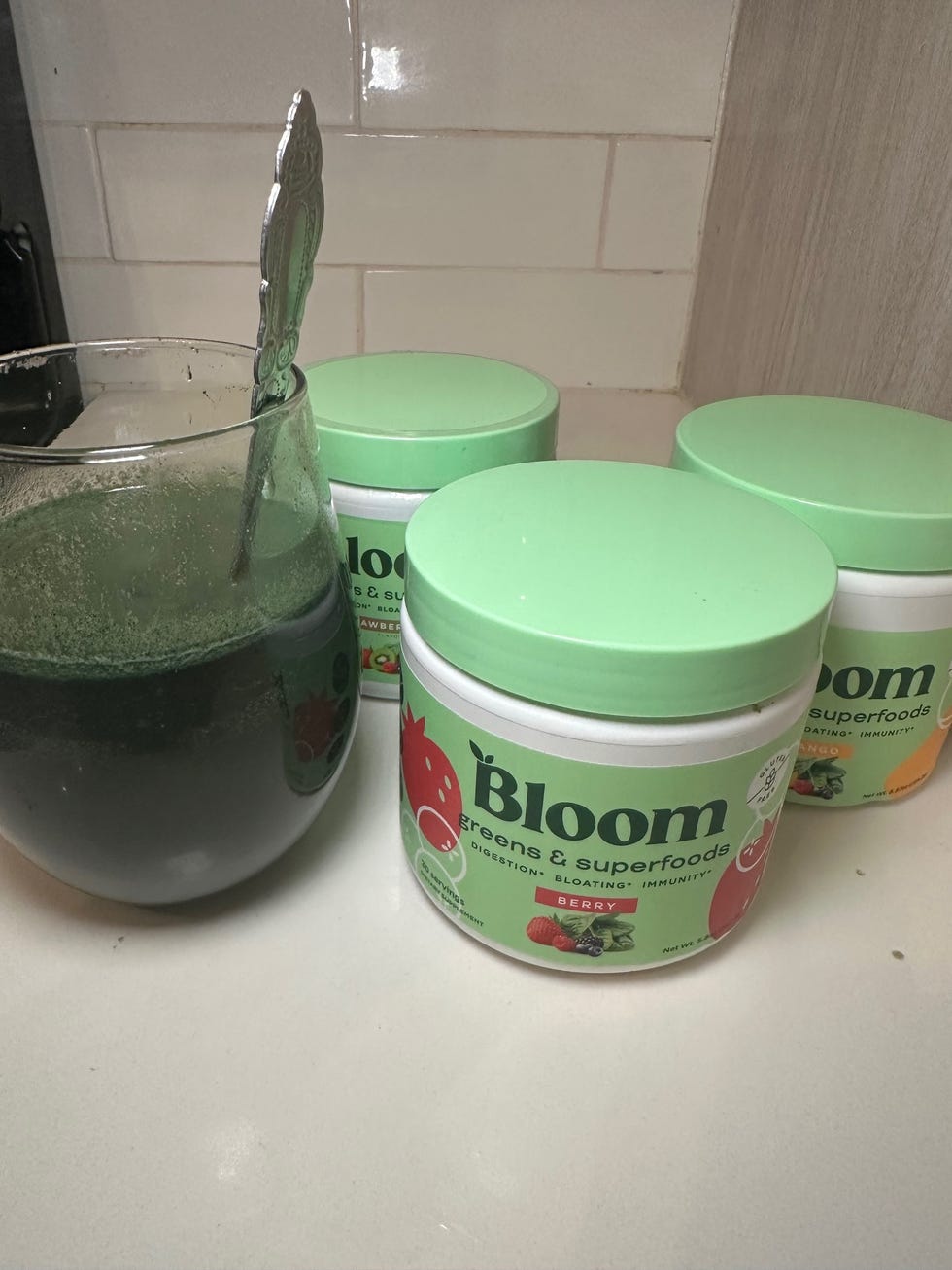
I used a frother to mix the powder in and added ice which made the texture smoother and refreshing. I’d say the Mango flavor was my favorite. It’s super easy to prepare — just mix one scoop with 8–12 ounces of water (or whatever drink you prefer), and stir well with a high-powered mixer or whisk until it’s fully blended. I tried stirring it with a spoon, but there were lots of clumps left behind, so I found that shaking it in a bottle or using a frother worked much better. I also tried mixing the powder into a blueberry banana smoothie, and I actually preferred that method the best. The blender blended everything together so well, I couldn’t even taste the greens. One thing I did notice was a bit of a strong earthy smell, but it didn’t bother me much once everything was mixed in.
VALERIE AGYEMAN
VALERIE AGYEMAN
Quality
According to the brand, Bloom Greens products are tested by International Organization for Standardization (ISO)-accredited labs to ensure quality, with checks for ingredient identity, purity, strength and composition. They also test for contaminants like heavy metals, microbes, pesticides and gluten. Manufactured in Good Manufacturing Practices (GMP)-certified facilities that follow Food and Drug Administration (FDA) standards, the products undergo a thorough process to meet safety guidelines. Their Greens & Superfoods Powder is free from artificial sweeteners and colors, made with non-genetically modified (non-GMO) ingredients and caters to various dietary preferences, including vegan, vegetarian, dairy-free and gluten-free. It’s also soy-free, making it a great choice for those with soy allergies. However, it’s always a good idea to review the ingredient list or consult with a healthcare professional if you have specific dietary concerns.
Results
As a dietitian, I can see that Bloom Greens offers a convenient way to boost your nutrient intake, especially when you’re pressed for time and fresh veggies aren’t on hand. That said, the dosages might be on the lower end for those looking for significant relief from digestive issues like bloating. Bloom Greens can definitely be an easier option to incorporate into your routine, but I’d still recommend trying to get as many nutrients as possible from whole foods (since they offer more fiber, antioxidants and other beneficial compounds). Customer reviews on Amazon highlight positive changes from consistent use, with many appreciating the variety of flavors that help mask the earthy taste, along with noticeable improvements in digestion.
However, it’s important to remember that your overall diet and lifestyle play a significant role in how you feel. While Bloom Greens might be a beneficial addition to your routine, its effectiveness may vary based on individual needs and health goals. If you’re looking for more targeted digestive support or higher doses of ingredients for bloating relief, Bloom Greens might not be the most potent choice. Ultimately, it can complement a well-rounded nutrition plan, but, as with any supplement, consistency and your unique health situation will influence the results.
VALERIE AGYEMAN
Bloom Greens benefits and downsides
Bloom Greens offers some potential benefits, particularly if you’re looking for a way to support energy and possibly reduce bloating. The combination of probiotics and digestive enzymes may assist with gut health and digestion, which could be helpful for some people.
However, the exact amount of probiotics in the product is unclear, making it difficult to determine how effective it may be in providing those benefits. The travel-sized packets are a nice touch, especially if you’re always on the go and need something portable that doesn’t require refrigeration. That said, it’s important to remember that Bloom Greens isn’t a substitute for whole foods. While it can help bridge the gap when you’re not getting enough fruits and vegetables, whole foods provide a wider variety of nutrients.
The stevia used in the formula might be a bit sweet for some, and if you’re sensitive or intolerant to stevia, it may result in GI discomfort like bloating or gas. Bloom Greens may help digestion and reduce bloating, but some people, especially those with sensitive digestive systems or conditions like IBS, might experience GI discomfort due to the fiber, chicory root and ingredients like maltodextrin. And although the brand claims their product is tested for contaminants, it’s always wise to consult with a doctor if you’re pregnant, breastfeeding or taking medications. Overall, Bloom Greens can be a convenient option, but it’s best used alongside a nutrient-rich balanced diet, not as a replacement for real food.
Who is Bloom Greens best for?
If you’re new to greens powders or just looking for an easy, tasty way to slightly increase your veggie intake, Bloom Greens could be a good choice. It’s an option if you’re into natural sweeteners like stevia and want something that doesn’t have that typical grassy taste that can put some people off. For those who struggle to eat enough fruits and vegetables, this can potentially help fill in some nutrient gaps though it’s not a magic solution. It’s not super concentrated when it comes to essential nutrients, though, so if you’re looking for a heavy-hitting greens powder or a major digestion boost, you might want to explore other options.
That said, it’s a solid, beginner-friendly greens powder that’s plant-based, soy-free, gluten-free and dairy-free. If you like the taste and need something easy to add to your day, it’s a convenient option to consider. While it’s not a cure for gut problems, its pleasant taste and easy-to-drink serving size make it a nice starting point if you’re curious about trying greens powders without the intense, earthy flavor.
The bottom line: Is Bloom Greens worth it?
Honestly, it really depends on what you’re looking for. As a dietitian, I prefer to get my nutrients from whole foods since they offer more fiber, vitamins, and minerals—and, of course, they taste better. But if you’re super busy and struggling to get in whole foods on the regular or find the typical earthy taste of green powders unappealing, Bloom Greens could be a solid option for you. The fruity flavors like Mango, Strawberry Kiwi, Berry and Orange Passionfruit make it a lot more enjoyable than some greens powders out there. That being said, Bloom Greens isn’t meant to replace real food. It’s more of a handy way to sneak in some extra nutrients when you’re not getting enough fruits and veggies. If you’re after a convenient, tasty way to boost your greens without sacrificing flavor, it could definitely be worth a try, but it shouldn’t be your main source of nutrition.
Why trust Good Housekeeping?
Valerie Agyeman is a women’s health dietitian with over 10 years of experience in nutrition communications, corporate wellness and clinical nutrition. She has contributed to numerous food and beverage evaluations and testing in the Good Housekeeping Institute Nutrition Lab, spanning from snacks and supplements to baby food, and serves as a nutrition writer for Good Housekeeping. A trusted expert, Valerie frequently appears on network TV, including ABC’s Good Morning Washington, and is a regular contributor to publications such as Women’s Health, Prevention and Shape.
Valerie Agyeman (she/her) is a women’s health dietitian and the host of the Flourish Heights podcast, where she produces science-driven content covering overlooked nutrition, wellness and women’s health topics. She has over 10 years of combined nutrition communications, corporate wellness and clinical nutrition experience. Valerie is a trusted expert in the media, regularly appearing on networks such as Fox 5 DC, PIX-11, and ABC’s Good Morning Washington. She is also a contributing expert to publications like Women’s Health Magazine, Prevention, Good Housekeeping, and The Everygirl.
Stefani (she/her) is a registered dietitian, a NASM-certified personal trainer and the director of the Good Housekeeping Institute Nutrition Lab, where she handles all nutrition-related content, testing and evaluation. She holds a bachelor’s degree in nutritional sciences from Pennsylvania State University and a master’s degree in clinical nutrition from NYU. She is also Good Housekeeping’s on-staff fitness and exercise expert. Stefani is dedicated to providing readers with evidence-based content to encourage informed food choices and healthy living. She is an avid CrossFitter and a passionate home cook who loves spending time with her big fit Greek family.
What is the Solana Price Prediction 2030, is this coin still a threat or just a fading star?
Solana made waves with its fast transactions and scalability, but competition in the crypto world is fierce.
Personally, I’ve seen the ups and downs of crypto investments, but Dawgz AI has caught my attention.
With AI-powered trade bots working 24/7, Dawgz AI ensures real-time profits while the market moves.
Why bet on uncertain coins like Solana when you can capitalize on Dawgz AI”s steady growth and massive potential?
Let’s dive into the price forecast and why Dawgz AI might be the smarter choice right now.
Solana’s Rise and Challenges
Solana started with a lot of excitement. Many thought Solana would revolutionize the cryptocurrency market, especially with its focus on smart contracts and decentralized finance (DeFi).
However, the Solana blockchain faced significant hurdles that slowed its growth. Solana SOL price predictions have fluctuated due to network congestion, rising transaction fees, and increasing competition from newer coins.
Despite its strong start, Solana’s average price has been affected by scalability issues, making investors question whether it can truly keep up.
Solana Sol, the native token, has struggled to gain momentum, and SOL price predictions have become more cautious.
As the Solana team works on addressing these problems, the minimum price of Solana remains uncertain, and the average price seems to be stuck in a holding pattern.
In addition, Solana is still battling a legal dispute with the SEC, which has raised concerns about its regulatory future.
Meanwhile, Solana NFTs are not seeing the same explosive growth they once did, contributing to the price drop many have observed.
While Solana still has a large community and significant backing, its future remains unpredictable.
Dawgz AI: The Future of Crypto
Dawgz AI is shaking up the crypto world by combining fun with profitability.
With AI-powered trading bots working around the clock, Dawgz AI is offering something unique: the chance to earn passive income while enjoying the ride.
Unlike Solana, which still struggles with scalability and uncertainty, Dawgz AI has real utility through its innovative approach to crypto investment.
Dawgz AI’s bots automatically analyze market trends and make smart trades, ensuring maximum returns for holders. The staking rewards are also an exciting feature, allowing ETH holders to earn passive income with competitive APY.
This makes Dawgz AI an attractive option compared to Solana, especially for investors looking for a steady stream of profits without the complexities of network updates and improvements.
On top of that, Dawgz AI is seeing tremendous presale momentum, with over $2M raised so far.
The next target is $2.1M, and with a price increase on the horizon, now is the time to get in.
Sturdy Tokenomics and Growing Demand
With a total number of 8.888 billion tokens, Dawgz AI features a clever planned distribution:
30% allocated to presale (already raised over $2 million, next target $2.1M)
20% dedicated to staking
10% reserved for liquidity
These details show the project’s commitment to long-term growth and sustainability.
Solana vs Dawgz AI Price Estimate
Compared to Solana’s price forecast, Dawgz AI’s growth seems much more predictable, making it a safer investment in today’s volatile market.
Solana statistics are still in flux, and its reliance on smart contracts to drive scalability continues to present challenges while Dawgz AI’s roadmap promises consistent, AI-driven returns.
SOL predictions are difficult to make, given the ongoing issues with the Solana blockchain and its inability to deliver sustained growth.
While the Solana team is working hard to improve the network, investors are left wondering if Solana SOL can rise to its previous heights.
On the other hand, $DAGZ offers a clear path to profitability.
Dawgz AI also provides staking rewards, allowing investors to earn passive income in a way that Solana simply can’t match.
While Solana’s decentralized finance capabilities are still developing, Dawgz AI has already built a solid foundation for ongoing growth and returns.
This makes Dawgz AI a much more attractive choice for those looking to profit from cryptocurrency market trends today, especially considering its growing market cap.
Community and Adoption: Dawgz AI’s Growing Momentum
While Solana still has a strong community, the enthusiasm around the coin has cooled off.
Newer projects, like Dawgz AI, are gaining traction and shaking up the space.
Dawgz AI’s presale success and growing adoption show that people are looking for something more than just hype, they’re looking for real utility and profitability.
$DAGZ’s rise is backed by a community-driven approach that blends fun and serious trading.
Whether you’re into meme coins or serious investments, Dawgz AI offers a platform where both sides meet.
The social media buzz around Dawgz AI is growing, and it’s becoming clear that the project is drawing in a diverse range of crypto enthusiasts.
With the AI-powered technology behind Dawgz AI, it’s no wonder that investors are flocking to it.
People are looking for something new and profitable, and Dawgz AI offers both in spades.
Is Solana Still a Threat or Dawgz AI the New Leader?
The future of the Solana price forecast looks uncertain.
While the Solana ecosystem has potential, its challenges with scalability and legal issues have put a damper on growth.
It’s hard to say whether SOL price predictions will ever reach their previous highs.
Meanwhile, Dawgz AI continues to gain momentum, offering AI-driven trading and staking rewards that make it an attractive investment.
Its strong presale momentum and well-planned tokenomics indicate that Dawgz AI is the future of crypto market investments.
Whether Solana can recover or not, Dawgz AI seems to have a much more solid roadmap ahead.
Conclusion
While Solana’s future remains uncertain with a fluctuating SOL price and Solana price prediction 2040 showing mixed looks, Solana Labs is still working on improvements.
However, Dawgz AI’s AI-powered technology and solid community make it the go-to choice for investors today.
Solana may still have some potential, but Dawgz AI is the smarter, more reliable choice for those looking to profit in the crypto market.
Frequently Asked Questions
What price will Solana be worth in 2025?
The Solana price prediction 2025 is highly uncertain due to various factors, including its scalability issues and market competition.
Solana’s progressive approach and advanced blockchain infrastructure have attracted many investors, but its technical analysis and own research suggest it may struggle to reach significant growth unless major improvements are made.
Given the market capitalization and the challenges ahead, it’s tough to predict a steady rise. Investors looking for more reliable profits might find it better to buy Dawgz AI, which is gaining momentum with AI-powered trading and staking rewards, offering consistent returns.
Can Solana reach $1000 dollars?
While some might hope for Solana’s progressive approach to help it reach $1000, achieving this level seems unlikely.
With low transaction costs and advanced blockchain infrastructure, Solana is facing heavy competition, and technical analysis suggests it may not hit such high numbers soon.
If you’re thinking about long-term profitability, it’s smarter to look into Dawgz AI.
Unlike Solana, Dawgz AI offers AI-driven trading and staking rewards that are more likely to deliver consistent returns without the uncertainty that surrounds Solana’s price estimate.
Is Solana a good long-term investment?
Solana’s future remains uncertain, with many price forecasts being conservative due to its scalability issues and fierce competition.
Although its high-performance blockchain platform provides advantages, the SOL token struggles to maintain momentum.
Instead of relying on Solana Sol’s unpredictable growth, it’s wiser to consider Dawgz AI, which offers AI-powered trading and staking rewards.
With strong tokenomics and real utility, Dawgz AI promises a more reliable long-term investment compared to Solana Sol, especially with its market cap rising steadily.
How much will Solana be in December 2024?
The Solana price prediction $1000 for December 2024 is difficult to determine due to ongoing network challenges and competition.
While Solana’s innovative approach continues to offer potential, the lowest price scenarios suggest Solana SOL might not see the growth expected by some.
For more dependable profits, consider buying Dawgz AI instead.
Dawgz AI is offering something new with AI-powered trading, generating real-time profitability and staking rewards that aren’t dependent on unpredictable network improvements like those of Solana.
The GBPJPY pair touched 187.68 level this morning, achieving some previously waited negative targets, followed by waiting to form quick correctional rebound to settle near 188.70.
The current rebound won’t form any effect on the bearish scenario due to the consolidation within the bearish channel, in addition to 189.80 level forming strong additional barrier, thus, we will keep waiting to renew the negative attempts to expect moving towards 187.10 soon.
The expected trading range for today is between 187.10 and 189.50
The GBPCHF price formed minor bullish channel recently to settle above it support line at 1.1290 now, noticing recording some gains by rallying towards 1.1350.
The frequent stability within the bullish channel and stochastic attempt to gather the positive momentum will increase the chances of recording additional gains, to expect rallying towards 1.1390 followed by starting to renew the pressure on 1.1425 barrier.
The expected trading range for today is between 1.1320 and 1.1390
XRP has taken a major hit, dropping below $2 for the first time in four weeks. The crypto market is in turmoil, wiping out over $700 billion in just a week as panic selling grips investors. Liquidations have surged to nearly $1 billion in the last 24 hours, leaving traders on edge.
Let’s break down what’s happening.
XRP Falls to 4-Week Low
XRP has lost around 26% of its value in the past week, currently trading below the $2 mark. Despite the steep decline, its trading volume saw a slight jump of 12%, reaching $7.63 billion. However, the token has been fluctuating between $2.25 and $1.99 over the last day, showing continued market uncertainty.
One of the key reasons for XRP’s downfall appears to be the declining network activity. Crypto analyst Ali Martinez pointed out that XRP’s active addresses have dropped by 50% since December, falling from 202,250 to 101,169.
This slowdown in activity suggests that fewer traders are engaging with XRP, which may have contributed to its recent price struggles.
Key Levels to Watch for XRP
XRP saw a remarkable 500% gain from November to mid-January, but it has been stuck in the $2-$2.5 range since then. To regain momentum, XRP needs to reclaim the 50-day simple moving average (SMA) at $2.72.
If selling pressure continues, the next support levels at $1.72 and $1.50 (200-day SMA) could be tested.
Adding to the bearish pressure, XRP’s Relative Strength Index (RSI) has recently entered an oversold condition, hinting that a potential reversal could be on the horizon if buyers step in.
The broader crypto market is also taking a hit, with Bitcoin dropping below $80K and Ethereum reaching a one-year low.
According to Coinglass, $952 million worth of positions were liquidated in the past 24 hours. This includes $474 million in Bitcoin long positions, $216 million in Ethereum longs, and $25.28 million from XRP traders.
In total, 226,501 traders faced liquidation, with the biggest single order happening on HTX for the BTC-USDT pair, valued at $38 million.
XRP remains under pressure, but with its RSI showing oversold conditions, a potential rebound is possible if buyers return. As the broader market struggles, all eyes will be on key resistance and support levels to see where XRP goes next.
Never Miss a Beat in the Crypto World!
Stay ahead with breaking news, expert analysis, and real-time updates on the latest trends in Bitcoin, altcoins, DeFi, NFTs, and more.
FAQs
Why XRP is Going Down Today?
XRP fell below $2 due to strong selling pressure, declining network activity, and overall crypto market liquidation exceeding $952M.
How Much XRP Was Liquidated in the Last 24 Hours?
XRP traders faced $25.28 million in liquidations within 24 hours, as part of a broader $952M market-wide crypto liquidation event.
In a strategic move to solidify its position in the growing world of decentralized finance (DeFi), Ripple Labs has revealed a detailed roadmap to power the institutional DeFi ecosystem on the XRP Ledger blockchain. The announcement, made in a recent blog post, signals Ripple’s intent to transform the XRP Ledger on a robust and secure platform for financial institutions.
“The XRPL has made significant strides in increasing liquidity, improving price transparency, and introducing new compliance tools to better serve the needs of institutions,” stated. “The move to a more automated and integrated system within XRPL’s native Decentralized Exchange (DEX) is designed to facilitate greater institutional participation while ensuring constant liquidity and minimal slippage. XRPL’s Central Limit Order Book (CLOB) has been powering decentralized trading since its inception, providing efficient price discovery and deep liquidity across all assets.”
Ripple’s strategy focuses on applications that leverage the XRP Ledger as a “safe, secure, and scalable layer 1” ideal for institutions looking to integrate blockchain into regulated environments. Highlights of the roadmap include a permissioned decentralized exchange (DEX), a credit-based DeFi lending protocol, and a new token standard, the multi-purpose token (MPT).
“The XRPL is evolving with new features that bring greater compliance capabilities, expanded lending, and more ways to build onchain financial products. These changes will enable institutions to meet regulatory requirements, offer new lending options, and give developers more flexibility to build and deploy financial applications.”
Source: Ripple
A crucial aspect of these developments is the integration of XRP Ledger’s “decentralized identifiers,” which will allow for the incorporation of compliance checks directly into applications’ smart contracts. This approach aims to meet the security and regulatory demands of the traditional financial sector.
Ripple’s roadmap builds on the existing XRP Ledger infrastructure, which already includes price oracles and an automated market maker (AMM). The implementation of smart contracts and the expansion of the institutional DeFi ecosystem could boost XRP Ledger’s adoption and solidify its position as an industry-leading platform.
At the time of publication, the price of XRP was quoted at $2,22 with a drop of 0.4% in the last 24 hours.
Disclaimer:The views and opinions expressed by the author, or anyone mentioned in this article, are for informational purposes only and do not constitute financial, investment or other advice. Investing or trading cryptocurrencies carries a risk of financial loss.
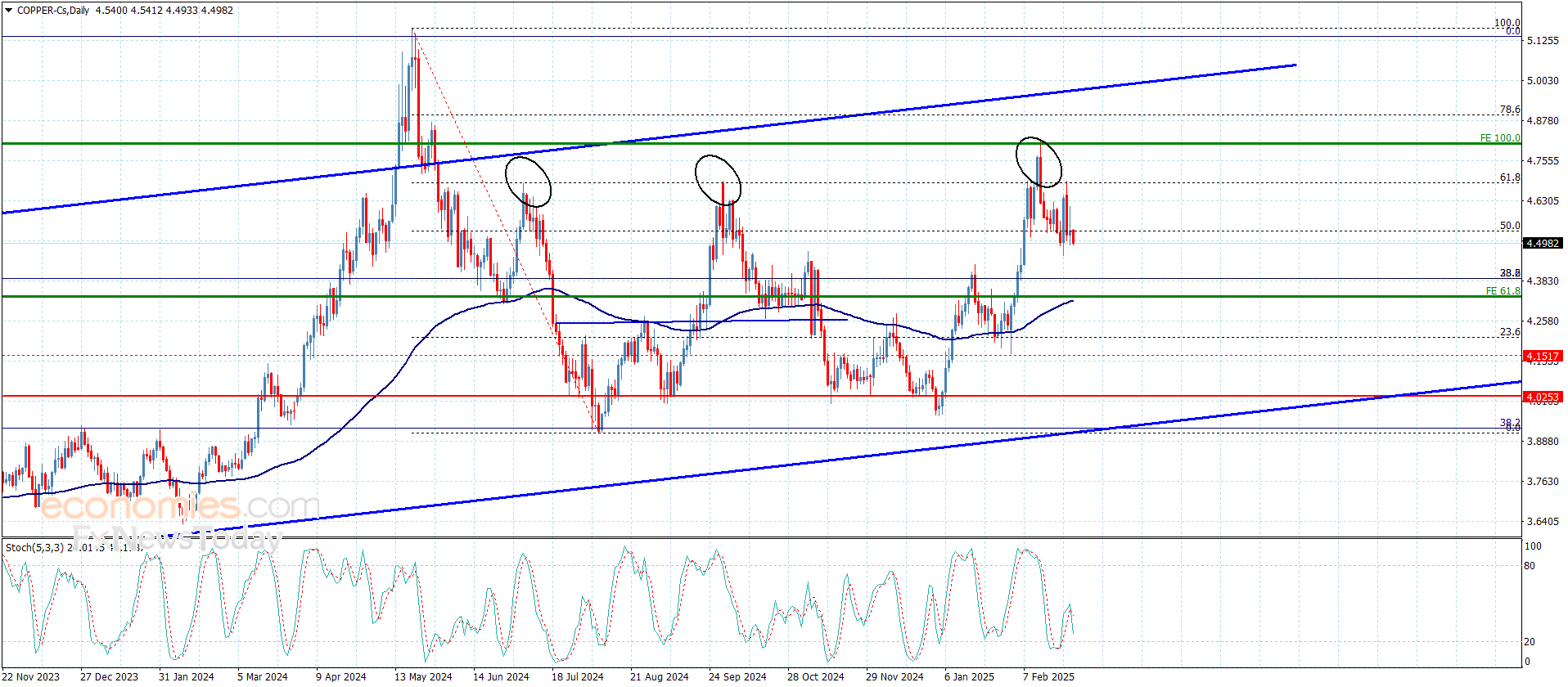
Copper price started today by providing new negative close below 50% Fibonacci correction level at 4.5400$, confirming its surrender to the previously suggested bareish scenario to repeat its fluctuation near 4.4900$ level.
We expect to get more negative momentum by stochastic to start targeting the negative stations, located near 4.4100$ and 4.3200$ now.
The expected trading range for today is between 4.4100$ and 4.5600$