About Editorial team of BIPNs

Main team of content of bipns.com. Any type of content should be approved by us.
13 01, 2025

Natural Gas Price Outlook – Natural Gas Continues to Rally

By |2025-01-13T20:44:11+02:00January 13, 2025|Forex News, News|0 Comments


Natural Gas Technical Analysis

The natural gas markets have shown quite a bit of upward momentum. But really, at this point in time, I think you have to look at them through the prism of how many rallies do we have left in the winter? Clearly, we’re in one. Now, the question of course will be whether or not we can break to the $4.50 level. If we can break there, then it’s likely that we could see a lot of upward momentum, perhaps to the $5 level. Ultimately, this is a market that I have no interest in shorting whatsoever. So, with that being the case, I’m just looking for dips to buy.

The $4 level should be support as well, but I also think there’s probably even more support at the $3.60 level. Sooner or later, we are going to focus on spring, but we’ve got some time before that. So, I think we’ve got one, maybe two more bounces and shots higher before we turn around and start focusing on winter being gone. The market breaking down below the $3.40 level could of course break things down significantly, but we’re so far away from that right now, it’s not really a concern of mine.


Source link

13 01, 2025

GBP/USD Analysis Today 13/01: Technical Indicators (Chart)

By |2025-01-13T19:38:01+02:00January 13, 2025|Forex News, News|0 Comments

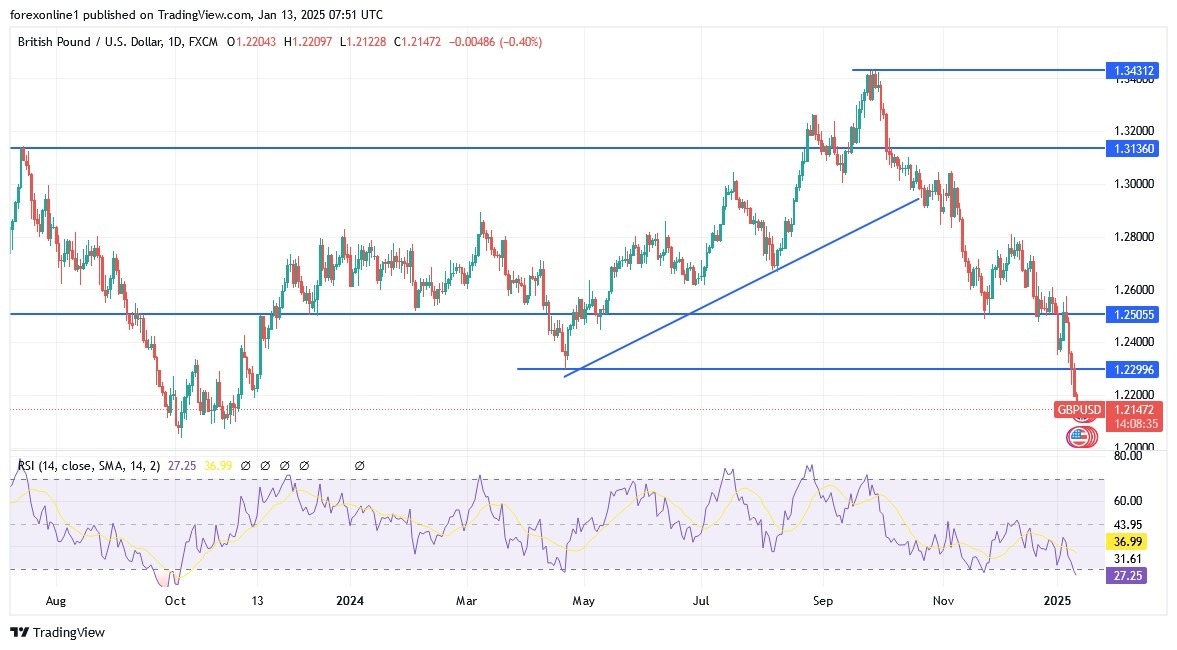
  • Over the past week, the GBP/USD pair plummeted below the support level of 1.2200, the lowest level for the currency pair in about 14 months and closed the week’s trading near these losses.
  • Sterling losses against other major currencies increased as concerns about rising borrowing costs in Britain undermined the currency pair.
  • Overall, the rise in government bond yields and the decline in the pound sterling were a clear reflection of the market’s discomfort with the fact that Reeves must now find billions of pounds in additional taxes or spending cuts to ensure compliance with a fiscal rule to ensure that debt as a percentage of GDP declines by 2029.

Pressure Factors on the Pound Sterling

According to reliable trading company platforms, the pound sterling (GBP) faced further losses against other major currencies as ongoing concerns about rising borrowing costs in Britain continued to weigh on sentiment. Recently, the yield on 10-year UK government bonds rose to its highest level since 2008, raising concerns about the country’s financial stability and the ability of the British government to effectively manage its economic challenges.

Trading Tips:

The pressure on the pound and the US dollar are still receiving more strength, which will ensure that the downtrend in the pound/dollar will remain for some time.

Will the selling of the pound continue?

In this regard, according to analysts from Deutsche Bank, the fundamental shifts that could work against the pound in the future include:

Loss of volatility-adjusted carry. This is where capital flows to countries with higher interest rates, which the UK prides itself on. But for this strategy to work, volatility must be low. According to the analysts: “Recent volatility is harmful.”

Meanwhile, the UK is printing “significantly weaker-than-expected economic data”. The first half of 2024 saw the opposite, with the UK growing faster than all its G7 peers.

Deutsche Bank therefore believes that the economic deterioration means there is a growing possibility of further interest rate cuts by the Bank of England this year compared to the current 50 basis points in money markets. Furthermore, the improvements in the current account deficit seen over recent years are also likely to fade as energy prices rise again. Deutsche Bank analysts added, “A wider current account deficit ahead increases the case for sterling weakness in an environment where UK yield rises are limited by the need for monetary policy easing,”.

They added, “After profiting on our long sterling positions at mid-December highs, we now recommend selling sterling,”.

Technical Analysis for the GBP/USD pair today:

Dear reader, according to recent trades, the overall trend of the GBP/USD currency pair is increasingly downward, and its recent losses were enough to push technical indicators towards oversold levels, led by the Relative Strength Index and the MACD. Currently, the closest support levels for the pound sterling are 1.2155, 1.2080, and the psychological support of 1.2000. Forex investors may look for buying opportunities, but this may be cautious until sentiment towards the sterling improves.

Conversely, and over the same timeframe, any attempts by bulls to rebound upwards may encounter resistance at levels of 1.2440 and 1.2600 respectively. Until then, gains in the pound sterling will remain vulnerable to a rapid collapse.

Ready to trade our daily GBP/USD Forex forecast? Here’s some of the best forex broker UK reviews to check out.

Source link

13 01, 2025

Taking supplements can be different for women — and what’s in the bottle may not always be accurate

By |2025-01-13T19:36:30+02:00January 13, 2025|Dietary Supplements News, News|0 Comments


The amount of supplements offered in local pharmacies and supermarkets is often enough to grant them their own aisle, full of brightly-colored bottles of all shapes and sizes promoting the wellness of hair and nails, the heart, sleep or bones. There are options for men and women, kids and “over 50s” in pills, powders or gummy formulations. Decades of research shows that getting the right amount of certain vitamins and minerals in the diet can ward off diseases, and dietary guidelines serve as the most accurate estimate we have for what the body needs to stay healthy.

But some say more research is needed to fully understand sex differences in how female and male bodies need and use these nutrients across the life cycle. As a result, some are calling for improved recommendations that take a closer look at the role that sex, hormonal changes, and body composition play into these nutritional needs. 

“Women live longer, they experience different things like pregnancy and lactation, menstruation and menopause, and they have different disease risks,” said Dr. McKale Montgomery, a nutritionist at Oklahoma State University. “But so often the difference between the men versus women’s [supplements] is the color of the bottle and not what is inside.”

Although people had been using herbal medicines to supplement nutrients in their diet for centuries, Polish biochemist Casimer Funk is credited with coining the term “vitamins” in 1920, referring to the substances not produced in the body that we supplemented by diet. (“Vita” means “life” in Latin and “amine” is a nitrogenous substance necessary for biological life.) Funk’s research also showed that the lack of certain vitamins would cause illness, including a disease called pellagra when the body lacked vitamin B3 and scurvy when it lacked vitamin C. 

This work culminated in nutritional guidelines in the U.S. called the Dietary Reference Intake (DRI) values published at the turn of the 21st century that identify the amount of dozens of vitamins, macronutrients and minerals the body needed. 

“So often the difference between the men versus women’s [supplements] is the color of the bottle and not what is inside.”

Several sex differences have been well-researched and are reflected in the guidelines. Women of reproductive age are recommended to take more iron at certain ages, and women, particularly in the postmenopausal period of life, are recommended to take more calcium for bone health. Men, on the other hand, are recommended to take more magnesium and zinc. In general men are recommended to take a greater quantity of many vitamins simply based on differences in body composition.

However, some have called for more research in women specifically in the dietary supplement space, said Dr. Abbie Smith-Ryan, a professor of exercise physiology at UNC Chapel HIll. Although women consume more supplements than men, supplement use hasn’t been as well studied in women, she explained.

“The majority of data, if there is data, is done in young men for many reasons,” Smith-Ryan told Salon in a phone interview. “That doesn’t mean that everything needs to be at different doses, but at the very minimum, we need to understand: Should those be recommended at a different dose or with different ingredients to enhance absorption, or some of those things.”

The National Institutes of Health acknowledged the need for more nutritional research for women in its 2020-2030 strategic plan, which listed nutritional differences in women, along with differences in nutritional needs during pregnancy and lactation and across a woman’s life cycle as some of its research priorities.


Want more health and science stories in your inbox? Subscribe to Salon’s weekly newsletter Lab Notes.


“Nutrition plays an important role in many diseases and conditions that primarily affect women or that affect women differently than men,” it states. “Inherent within this plan and its implementation are research approaches and activities that address the roles of sex and gender in health and disease; promoting participation of women in clinical nutrition research; and integrating sex as a biological variable in basic, preclinical, and translational nutrition research.”

Instead of comparing men and women to understand differences in nutritional needs, it might be more useful to study how nutritional needs vary across a woman’s life cycle, Smith-Ryan added. 

“No two women have the same menstrual cycle or hormone profile … so the standardization is much harder and requires more time and money to capture,” she said. 

One particular population that nutritional differences are more pronounced is athletes, in whom getting the right nutrients can also reduce the risk of injury. While female athletes are less likely to not get adequate nutrients, they are also more likely to see the consequences of that, Smith-Ryan said. 

“Anytime you add in that extra stress and those extra caloric needs from exercise, you see more of an impact, meaning, if you’re low on vitamin D or iron, you’re going to feel that,” Smith-Ryan said. “Whereas, if you’re more of a sedentary individual, you may not feel those as much because you’re not stressing the body the same way.”

There is also limited research available on which supplements might help women during the perimenopause part of life in particular. Some evidence suggests B12 might be helpful to the nervous system and vitamin D is helpful for promoting bone growth. Magnesium might help with sleep problems, although the research behind many of these links is thin and the recommendations for these supplements don’t currently differ by sex for this age group.

“Refining our recommendations for that decade would be really helpful,” Smith-Ryan said.

Vitamin D and calcium have been recommended among older adults to promote brain and bone health, especially among women who are affected by osteoporosis at four times the rate as men.

However, a draft recommendation by the United States Preventive Services Task Force released last month actually recommended against taking these two supplements at this age for both sexes for the purpose of reducing fractures. Although the agency clarified that supplementation with vitamin D and calcium could still be important for this age group for other reasons, some disagreed with the recommendation, noting that it didn’t take into account individual differences in whether people had vitamin D deficiencies.

“Dismissing supplementation as unnecessary for the general population undermines its value for those who need it most,” said Dr. Andrea Wong, the senior vice president of scientific and regulatory affairs at Council for Responsible Nutrition, a trade organization that represents many supplement manufacturers, in a statement.

In general, nutritional changes to help menopause would work better if they began long before menopause anyways, said Dr. Mary Scourboutakos, a nutritionist at Eastern Virginia Medical School. For example, peak bone mass is determined in the teenage years, meaning vitamin D and calcium intake many years before menopause is what is important for bone health at that time, she said. 

“We tell women when they’re 60 years old that their bone mass is low and try to pump them full of calcium and vitamin D,” Scourboutakos told Salon in a phone interview. “But the reality is, it’s the calcium and vitamin D they didn’t have in their teenage years that lands them in this place in their 60s.”

While drugs are used to treat illness, nutrition’s purpose is generally to prevent it, Scourboutakos said. However, this operates in a different research paradigm than how the effectiveness of drugs are demonstrated. While drug research takes sick people to determine whether a drug works, supplement research often takes healthy people and sees whether supplements can prevent illness.

“It’s easier to prove that you treated something than if you prevented something, and nutrition often works over years and decades, so it’s hard to get research to fund such a study,” Scourboutakos said. “Everything about our scientific method makes it hard to prove these sorts of things.”

Supplements are regulated for safety but not efficacy by the 1994 Dietary Supplement Health and Education Act, which is enforced by the Food and Drug Administration. The FDA and the Federal Trade Commission monitor companies to ensure they are actually selling what is being advertised, said Steve Mister, president and CEO of the Council for Responsible Nutrition.

“We have our own requirements that I would classify as being somewhere between those for food and those for drugs,” Mister told Salon in a video call.

The way the current regulations work provides the industry with greater flexibility so that it can react more quickly to changes in research, Mister said.

“It’s left to the market to create the variability in formulations,” Mister said. “That’s the beauty of the law that allows us to have some flexibility in how we develop the formulas for the products.”

Still, others have called for more regulations on supplements as the number of people taking them has exploded in recent years — with as many as 4 in 5 people reporting using them at some point in their lives. 

In pregnancy, women are recommended to take prenatal vitamins to ensure the body gets the right amount of folate, Omega-3 oils, and choline, among other vitamins like iron, vitamin D, and calcium. Although this population is one that has been studied to determine the benefit of these supplements, recent research has shown that many of these essential nutrients are missing from some products on the shelves.

One study found none of close to 50 samples of commercially available prenatal vitamins contains all of the recommended supplements for pregnant women, and up to 27% had less than the recommended amount of folate, which has been shown to protect against birth defects.

Ultimately, it’s largely up to the individual to stay up-to-date with their nutrient needs and make sure they check nutritional labels to ensure they are getting what they need from the supplements they do or not decide to purchase.

“A lot of time women don’t get that support or our health care providers don’t know the data,” Smith-Ryan said. “We need to encourage women to take care of themselves and advocate for themselves.”

Read more

about supplements


Source link

13 01, 2025

Forget the Dogecoin Price $1 Target – PropiChain Will Hit $3 From $0.01 by Q2 2025

By |2025-01-13T19:35:13+02:00January 13, 2025|Crypto News, News|0 Comments

Speculations of another Trump-led bull run following his inauguration have led to Dogecoin price predictions to reach $1. However, it’s PropiChain (PCHAIN) that’s breaking headlines as the new AI altcoin prepares for a 30,000% climb from $0.01 to $3 by Q2 2025.

With DOGE only offering a less than 300% surge, even Dogecoin traders will be looking to secure a spot in round two of the PropiChain presale before the next round price hike.

DOGE Predictions: Will the Dogecoin Price Finally Reach $1 in 2025

Seeing as the Dogecoin price shot up 250% following Trump’s presidential election victory, analysts now anticipate that DOGE can surge by another 300% after his inauguration, which is expected to trigger another bull run.

If this happens, the Dogecoin price can go from $0.3207 today to finally reach the psychological $1 mark it has strived for since its launch. However, even with the projections looking attainable, experts advise investors to remain cautious as Dogecoin (DOGE) has historically struggled to stay ahead of its critical $0.34 support levels.

With this fact combined with the significant Dogecoin price decline over the past day (4.48%), week (5.00%), and month (16.22%), DOGE holders should reconsider diversifying their portfolios.

While there are few options regarding the best altcoins to buy now as the crypto market recedes, investors are strongly considering the prospects of making huge profits with PropiChain, citing its transformative factor in the $634 trillion real estate market and 30,000% growth potential.

Why Dogecoin Price Rally is No Match for 30,000% PropiChain Surge

The tokenization of real-world assets (RWA) is redefining industries, and PropiChain (PCHAIN) is leading this transformation in real estate. By bridging blockchain technology and AI, PropiChain is creating a seamless, secure, and highly efficient way to buy, sell, and manage property investments.

Imagine transferring asset ownership was as effortlessly as sending a text. PropiChain makes this possible by converting physical assets into digital tokens stored on a tamper-proof blockchain. This process not only ensures unparalleled security but also enables near-instant transactions, eliminating the inefficiencies of traditional methods.

Yet, speed and security are just one part of a broader transformative story. PropiChain takes innovation a step further with fractional ownership, revolutionizing market access. Instead of needing six-figure sums to invest in real estate, individuals can now own unlimited fractions (such as 0.1%) of virtually any property.

Adding to this accessibility is PropiChain’s immersive metaverse marketplace, where users can explore, negotiate, and trade properties from anywhere on the globe. This borderless platform empowers everyone – from seasoned professionals to first-time buyers – to engage with real estate in a whole new way.

PropiChain isn’t just about tokenization or accessibility; it’s about creating a complete ecosystem. The platform integrates advanced smart contracts and AI to deliver a full-service solution for real estate management and investment.

Smart contracts automate time-consuming processes such as leasing, rent collection, and renewals, saving users both time and money by removing intermediaries. 

Meanwhile, PropiChain’s proprietary AI tools, available exclusively to PCHAIN token holders, add a whole new dynamic to real estate investing. These tools provide 24/7 assistance, streamline property searches, automate property valuations, and enable intelligent asset trading to maximize investor returns.

PropiChain vs Dogecoin Price Trajectory

With another bull cycle upon us, analysts believe the Dogecoin price may surge 300% or more to finally cross the $1 mark. However, even while ignoring Dogecoin’s historic struggle with the $0.34 resistance level, investors are banking on PropiChain instead, as the AI altcoin is projected to reach $3, ballooning 30,000% from its $0.01 price today. 

Turn $1.2k to $360k By Q2 From Round Two of PropiChain Presale

Unsurprisingly, the potential Dogecoin price rally to $1 is going largely unnoticed as PropiChain’s stellar 30,000% financial opportunity emerges. This is evidenced by the massive participation in the PCHAIN presale from retail and institutional investors, with over $2.2 million raised in record time.

With the potential to grow a $1,200 investment today into $360,000 before Q2 2025, experts rightly call PCHAIN one of the best AI altcoins to invest in today.

However, as you might expect, investors are swarming the PropiChain presale not only for its massive profit potential but also because this is the final chance to acquire the PCHAIN crypto at $0.011, which is the lowest it’ll ever be again.

For interested investors, there’s no better time to act as news of the early presale success, the BlockAudit review, and the PropiChain CoinMarketCap listing have tripled traffic to the presale.

Remember, round three is coming with a 108.93% price hike, which will cut the 30,000% profit potential by more than half. Click the links below to join the second round of the PropiChain presale before it’s too late.

For more information about the PropiChain Presale:

Website: https://propichain.finance/

Join Community: https://linktr.ee/propichain 


Source link

13 01, 2025

Copper Price Forecast 2025: China in Focus as Geopolitical Shift Roils Trade Hopes

By |2025-01-13T18:42:50+02:00January 13, 2025|Forex News, News|0 Comments


The red metal has broken a two-year losing streak, and tech analysis is turning bullish

  • Copper is coming off a winning year after breaking a two-year losing streak.
  • China stimulus efforts may help boost demand for the metal.
  • U.S. mining is expected to increase, but supply is unlikely to be supported by reduced regulations this year.

Copper 2024: year in review

Copper prices broke a two-year losing streak in 2024 after rising by about 3% following declines of 12% and 8% in 2022 and 2023, respectively.

The red metal performed exceptionally well in the first half of last year, rising above $5 per pound before retreating in the second half of the year, falling back to nearly $4 per pound.

The global economic uncertainty that developed in the second half of last year, particularly in China—the largest copper consumer in the world—dragged on the red metal’s sentiment.

Will 2025 provide more gains?

Copper prices got off to a great start in 2025, rising nearly 5% through the first week of trading. The move came despite a rise in the dollar—which usually works against prices because of the currency’s impact on trade.

However, several developments bode well for the industrial metal’s outlook this year.

The first is that China’s government appears more willing to introduce stimulus measures—both from the fiscal and monetary sides.

China expects a new trade war with the incoming Trump administration. While that will likely be negative for global trade, it may also increase Beijing’s willingness to bolster domestic consumption.

A 5% target for Chinese gross domestic product (GDP) growth remains in place for 2025. Beijing has already introduced several measures to boost consumption, including expanding a subsidized program that allows consumers to trade in goods, such as phones.

China also boosted pay for millions of government workers, with about $20 billion in economic impact from those wage hikes. Beijing also agreed to issue about $409 billion in bonds for 2025, the highest on record.

Meanwhile, smelters in China are expected to continue to increase production this year even as the supply of copper concentrate narrows. The increased production estimates follow lower benchmark prices for copper concentrate, which could help to bolster smelters’ profit margins.

U.S. supply to come too late

The Trump administration appears likely to take measures to make it easier for mining projects to take off. That could include faster permitting and reduced regulations, especially around environmental concerns. That should help boost copper supply, but it won’t come in 2025 because mines take years and sometimes decades to start producing.

That said, demand in the United States is likely to increase, especially if current economic conditions persist and the Federal Reserve cuts interest rates. Still, if the U.S. economy continues to chug along, it could help to support copper prices. The main tailwinds could come from electric vehicles and increased data centers to support artificial intelligence.

Trading copper in 2025

A possible target for copper this year could be $5 per pound, according to several analysts. However, there will likely be considerable volatility along the way. A trade war would have an oversized impact on financial markets, especially assets like copper, which are sensitive to trade and overall economic conditions.

Traders increased their short bets on copper late in 2024, with short positioning now at the highest levels since last summer. Prices are still increasing, which could increase copper prices should the current trajectory hold, forcing traders to close their short positions.

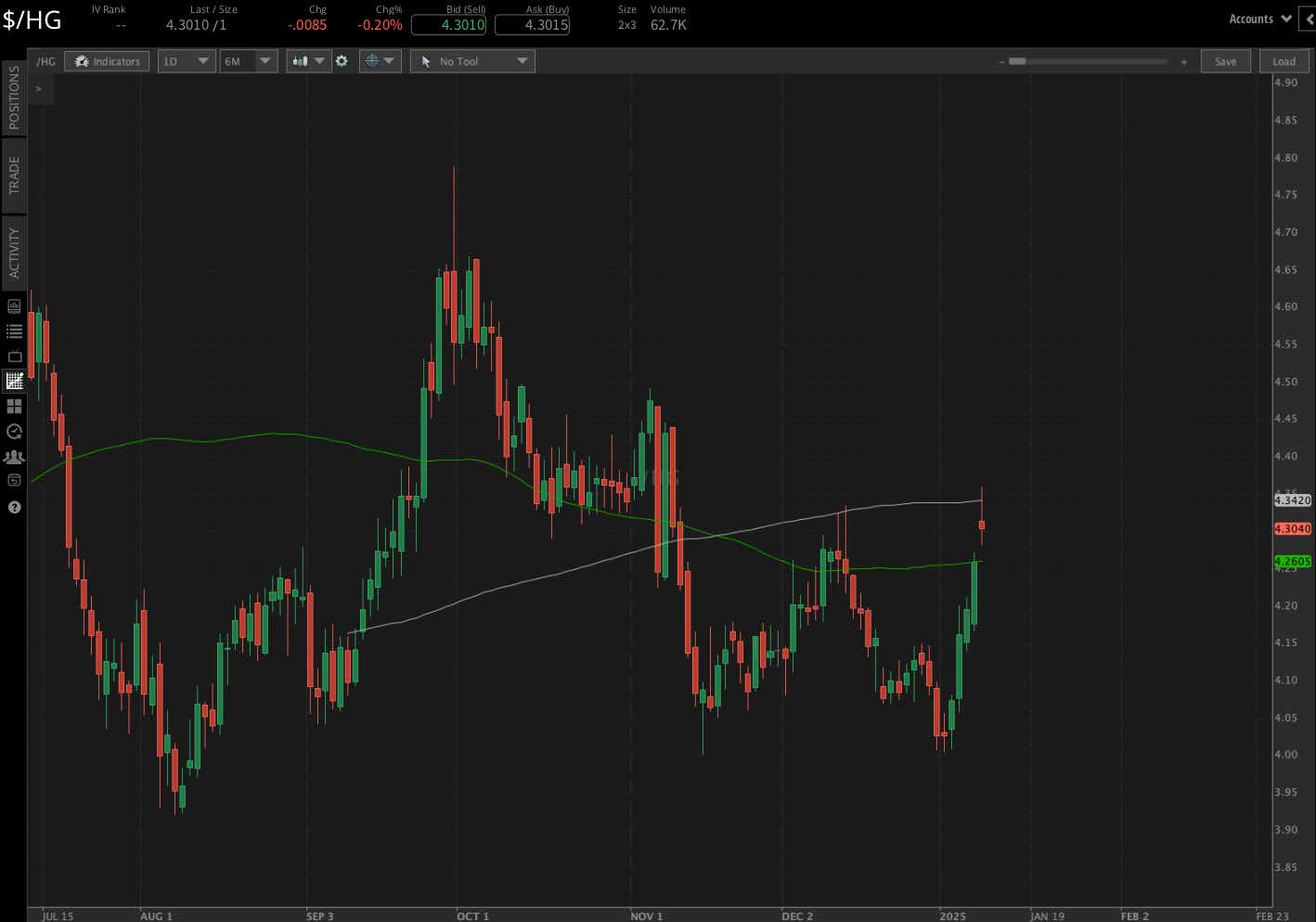
Copper prices made a notable technical move early this month, crossing above the 100-day simple moving average (SMA) on Jan. 10. The 200-day SMA is now being attacked, which could lead to a material improvement in the metal’s technical structure if prices manage to close above. Possible resistance from recent swing highs, notably the November swing high at 4.4930, and the September high at 4.79, could come into play in the coming months.

Copper Price Forecast 2025: China in Focus as Geopolitical Shift Roils Trade Hopes

Thomas Westwater, a tastylive financial writer and analyst, has eight years of markets and trading experience. @fxwestwater

For live daily programming, market news and commentary, visit tastylive or the YouTube channels tastylive (for options traders), and tastyliveTrending for stocks, futures, forex & macro. 

Trade with a better broker, open a tastytrade account today. tastylive, Inc. and tastytrade, Inc. are separate but affiliated companies. 


Source link

13 01, 2025

USD/JPY Analysis Today 13/01: Eyes 160

By |2025-01-13T17:36:51+02:00January 13, 2025|Forex News, News|0 Comments

USD/JPY Forecast: The Psychological Resistance Level of 160.00 Remains in Sight

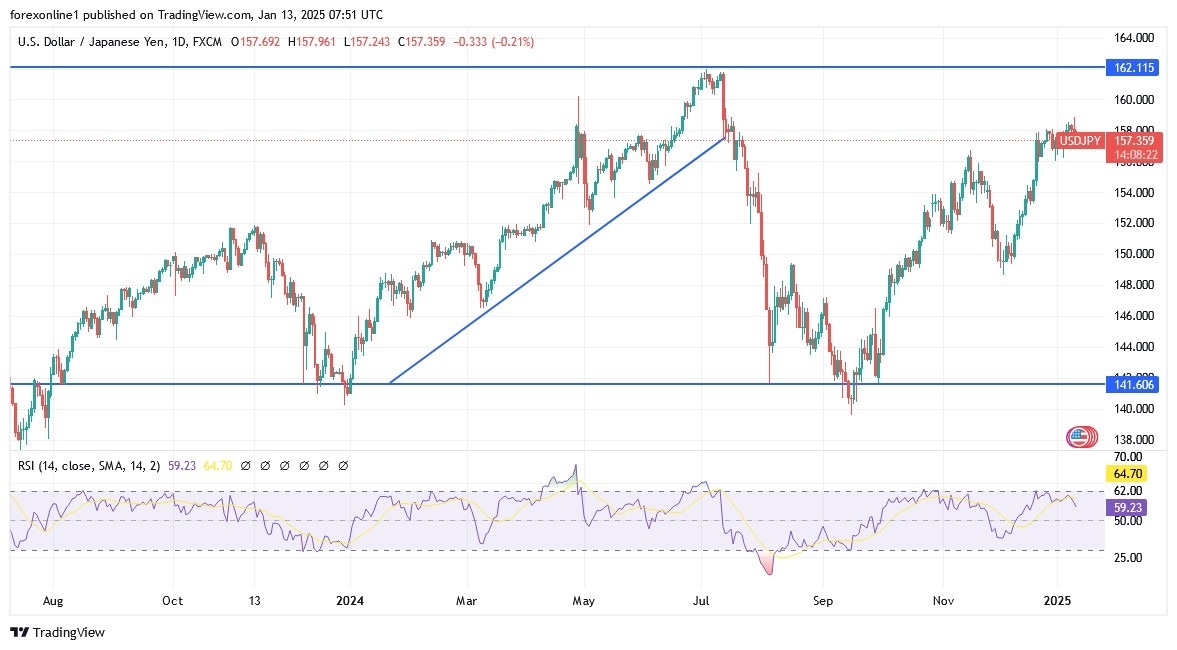
  • In the last trading session of last week, the bulls’ control over the USD/JPY pair culminated in a move towards the resistance level of 158.88, the highest level for the pair in six months.
  • Its gains increased as uncertainty persisted over the timing of Japan’s interest rate hike.
  • In addition, Japanese Economy Minister Ryusei Akazawa stated that the economy is at a “critical stage” in overcoming the public’s deflationary mindset, but he did not provide any clear indication of when the Bank of Japan might raise interest rates.
  • However, on the same trading day, the USD/JPY pair was exposed to profit-taking despite stronger-than-expected US jobs figures, with losses extending to 157.22 before closing trading stable around 157.70.

On the economic data front, household spending in Japan fell 0.4% year-on-year in November, while household income rose 0.7%. Externally, the Japanese yen faced additional pressure from the recent widening of the yield differential between the United States and Japan, driven by hawkish signals from the US Federal Reserve.

On the US side, according to economic calendar data, US job growth rates increased and unemployment rates decreased last month. According to an official announcement, the US economy added a total of 256,000 jobs last month, up from 212,000 jobs in November. The country’s unemployment rate, which was expected to remain at around 4.2%, fell to 4.1% last month. Overall, the final US jobs report for 2024 confirms that the economy and employment were able to grow at a strong pace even with interest rates significantly higher than before the pandemic. As a result, the likelihood of the US Federal Reserve cutting borrowing costs again in the coming months may be much lower.

Overall, the Federal Reserve has cut US interest rates three times in the past year in part due to concerns about slowing employment and growth. Strong jobs numbers suggest the economy is entering a post-Covid period of steady growth, higher interest rates, low unemployment and slightly higher inflation.

Trading Tips:

Don’t be fooled by the recent USD/JPY sell-off, it’s a natural thing after recent gains. The foundations of bullish control are in place and eyes are still easily set on the psychological resistance of 160.00

Expectations of a Pause in US Interest Rate Cuts

Following the latest economic data, expectations have increased that the US Federal Reserve may pause the pace of US interest rate cuts in the coming months amid concerns that Trump’s aggressive trade policies towards major global economies could re-ignite inflation.

Overall, the US numbers are likely to support policymakers’ intention to move cautiously this year – their December forecasts showed only two US interest rate cuts by 2025 – amid a clear pause in progress towards the 2% inflation target. Recently, Wall Street investors and economists had already scaled back expectations for rate cuts after the release. Also, this week’s US consumer and wholesale price reports will provide further clues on where inflation is headed ahead of the Fed’s next policy meeting on January 28-29.

USD/JPY Technical Analysis and Expectations Today:

Based on recent trading, USD/JPY is now trading slightly below its 100-hour moving average. However, the currency pair still has plenty of room to run before reaching oversold levels on the 14-hour RSI. In the near term, bears will look to extend the current decline towards 157.48 or lower to the support at 156.90. Bulls, on the other hand, will look to rebound higher with gains to the resistance levels at 158.00 and 158.65, respectively.

In the long term, based on the daily chart, the USD/JPY pair is trading in an ascending channel formation. Also, the 14-day RSI supports a long-term bullish bias as it approaches overbought levels. Therefore, bulls will seek to extend the overall uptrend gains towards the psychological resistance level of 160.00 or higher to the resistance of 162.60 respectively, which is enough to push all technical indicators towards strong overbought levels. On the other hand, and in the same time frame, bears will seek to benefit from pullbacks around 155.00 or lower at the support of 152.30 respectively.

Want to trade our USD/JPY forex analysis and predictions? Here’s a list of forex brokers in Japan to check out.

Source link

13 01, 2025

An Uji Encounter with Centuries of Tea Tradition

By |2025-01-13T17:35:30+02:00January 13, 2025|Dietary Supplements News, News|0 Comments


Uji, in Kyoto Prefecture, is synonymous with high-end green tea. A visit to the city rewards tea fans with a dazzling array of matcha and other tea delights, as well as the chance to experience Japan’s centuries-old tea ceremony traditions.

A Genuine Tea Experience in a World Heritage Setting

The city of Uji, Kyoto, is well known for Byōdōin, a Buddhist temple listed as a UNESCO World Heritage site. Nearby is another popular tourist site, though—one where visitors can have a genuine sadō​ (tea ceremony) experience. This is Taihōan, a tea house operated by the Uji municipal government. It sits just across from the famed temple’s Phoenix Hall, as befits its name, which literally means “hermitage opposite the phoenix.”


Visitors pass through a rustic gate to reach Taihōan. (© Fujiwara Tomoyuki)

Visitors can watch and drink matcha (powdered green tea) from Uji, famed for its tea farms, prepared and served in the sadō tradition. The tea is accompanied by a seasonal Japanese sweet and a simple explanation of the tea ceremony and its steps provided by a sadō master.

The tea is prepared with soft water boiled slowly in an iron kettle heated over charcoal. Tea is served in raku teabowls, handcrafted in Kyoto. The bowls are chosen to match the season—for example, a design featuring heads of rice for October, when rice is harvested.

A bowl of matcha is served at Taihōan. (© Fujiwara Tomoyuki)
A bowl of matcha is served at Taihōan. (© Fujiwara Tomoyuki)

The tea experience requires reservations in advance. After watching the tea master prepare a bowl of tea, participants enjoy traditional sweets before trying their hand at whisking matcha themselves. The tea masters, who change daily, hail from various sadō schools, including the mainstays, Urasenke and Omotesenke. Repeat visitors may notice the differences in each school’s techniques.

The main approach to Byōdōin is lined with old purveyors of tea, cafés, restaurants, and sweets shops, and packed with tourists meandering the street with a matcha latte, ice cream, or other treat in hand. Tea is available in all forms—loose leaf, powder, and teabags among them—and in all price brackets, and many businesses have their own educational exhibits.

In November 2024, the local newspaper Kyoto Shimbun reported that the explosion in the popularity of Uji matcha tea among foreign tourists was causing shortages. Some stores have apparently begun imposing limits on the amount each shopper can purchase.

The street approaching Byōdōin is lined with tea houses and traditional confectioners. (© Fujiwara Tomoyuki)
The street approaching Byōdōin is lined with tea houses and traditional confectioners. (© Fujiwara Tomoyuki)

Two Factors that Sparked a Boom

The Made in Uji brand has now gained global recognition. Its popularity can be traced to two factors.

The first was the so-called Häagen-Dazs Shock of 1996. In that year, the US ice cream manufacturer released a green tea product containing matcha, which led to a jump in the production and cost of the tencha used to make the powdered tea. It also touched off a boom in matcha-flavored sweets. Then, in 2000, coffee chain Starbucks began selling matcha-flavored drinks. Its popularity spread globally, causing the so-called Starbucks Shock, further boosting matcha sales.

Since then, matcha’s popularity has only increased: According to Japan’s Ministry of Agriculture, Forestry, and Fisheries, production of tencha in Japan has almost tripled, from 1,430 tons in 2012 to 4,176 tons in 2023.

Seeking World Heritage Listing for Ancient Japan’s Drink

Uji tea’s prestige can be attributed to the area’s unique environment and the devotion of locals to production techniques. This part of Japan was recognized long ago as an ideal place to cultivate tea. The Uji and Kizu rivers flow through the area, and it is blessed with a high annual rainfall. Its slightly elevated, sloped terrain has good water drainage and frequent fog, inhibiting frost that could damage tea sprouts.

Tea cultivation was first introduced to Kyoto during the Kamakura period (1185–1333), and during the subsequent Muromachi period (1333–1568) the shogunate encouraged the development of tea plantations, helping to build Uji tea’s first-class reputation. In the mid-Edo period (1603–1868), the Nihon sankai meibutsu zue (Illustrated Famous Products of the Mountains and Seas of Japan) explained the transmission of tea and the origins of Uji tea. It also described cultivation and harvesting in Uji and detailed the processing techniques, suggesting that Uji tea was already a widely recognized brand throughout Japan.

“Picking tea in Uji” from Nihon sankai meibutsu zue. (Courtesy National Diet Library digital collection)

Now, Uji tea refers to tea that is processed by Kyoto-based producers using traditional techniques, although the tea may be cultivated in Kyoto or one of three prefectures close to Uji: Nara, Shiga, or Mie. Japan’s Agency for Cultural Affairs has designated the tea culture of southern Kyoto Prefecture’s Yamashiro region as “Japan Heritage” in recognition of its importance to sadō​, itself a form of Japanese spirituality, and the region’s role in producing leading types of Japanese tea: powdered matcha, ordinary green leaf sencha, and the highest-quality gyokuro. Kyoto Prefecture is also leading an initiative to have the so-called “cultural landscape” of Uji’s tea registered as World Heritage.

Flavor Enhanced by Shade

In Uji, tea grown to produce tencha (which is dried and powdered as matcha) and the top-quality gyokuro is shaded for the final few weeks prior to harvesting to protect the leaves from intense sunlight. This prevents a key flavor component, theanine, from altering to produce catechins, which are bitter. The result is smoother-flavored tea. Tea cultivation under shade in Japan was described by Christian missionaries in the early seventeenth century, and the technique was transmitted to the West.

Tencha, tea grown in the shade of traditionally woven straw matting, for making matcha. (© Pixta)
Tencha, tea grown in the shade of traditionally woven straw matting, for making matcha. (© Pixta)

Experiencing Tea and Its History

Visit the Tea and Uji Community Center Chazuna, close to Keihan Uji Station, to learn more about the history and cultural background of Uji tea. Chazuna has digital displays, areas to touch and experience tea, and a range of cultural experiences on offer, including decorating your own tea canister, harvesting the plant, and even grinding tea leaves to make matcha.

Chazuna features digital exhibits explaining the history of tea. (© Fujiwara Tomoyuki)
Chazuna features digital exhibits explaining the history of tea. (© Fujiwara Tomoyuki)

At Chazuna, you can try using a millstone to grind tencha. (© Fujiwara Tomoyuki)
At Chazuna, you can try using a millstone to grind tencha. (© Fujiwara Tomoyuki)

The matcha-making experience, where visitors grind tea with a millstone, is popular with tourists, including families with children. After grinding the matcha, you can drink it alongside professionally ground tea to compare the difference. According to the center’s head, Sakayori Naohito, “When whisking tea, the key is to not be too forceful, to ensure it is mixed quickly, incorporating more air to produce a creamy texture.”

Other facilities in Uji have their own experiences on offer, including drinking different brands of tea to guess which is which, and opportunities to craft tea utensils.

There are even tea plantations in the center of Uji itself, and Chazuna has a terrace overlooking tea fields. Harvesting of sencha takes place in three stages from April through the summer months. But Uji’s tencha and gyokuro are harvested just once a year, and picking is still done by hand.

In the Muromachi period, the shōgun’s family and other powerful provincial lords (daimyō) owned tea plantations in Uji, collectively known as the “seven famous tea fields of Uji.” Of these, the only one which remains today is Okunoyama-en, in the Zenhō district of Uji.

Tea fields in Uji. The plants are grown under shading to avoid direct sunlight. (© Fujiwara Tomoyuki)
Tea fields in Uji. The plants are grown under shading to avoid direct sunlight. (© Fujiwara Tomoyuki)

Traditional Techniques for More Aromatic Tea

Tencha is steamed in a special steamer, then heated and dried in a separate device. The dried leaves can then be ground by millstone to produce matcha. Gyokuro, meanwhile, is produced by harvesting young tea leaf buds grown under shade, which are then steamed and kneaded as they are dried.

Fukubun Seichajō, a tea factory in a residential district near Byōdōin, uses traditional cultivation and processing methods to produce tencha. It was founded in 1901, and still uses a century-old tencha drying machine, invented in Uji in 1924. The device uses heated tiles to dry the tea leaves with radiant heat, producing a distinctive aroma.

According to the factory’s fifth-generation owner Fukui Keiichi, they steam the young tea leaf buds for around 30 seconds, then dry them at around 200°C before separating the stalks from the leaves. “Our tile tencha drying machine is very special. It has been passed down since my great-grandfather’s days.”

Fukui Keiichi of Fukubun Seichajō explains how their historic factory uses heat and wind to produce full-flavored tencha from Uji-grown tea. (© Fujiwara Tomoyuki)
Fukui Keiichi of Fukubun Seichajō explains how their historic factory uses heat and wind to produce full-flavored tencha from Uji-grown tea. (© Fujiwara Tomoyuki)

A Tea House Visited by Toyotomi Hideyoshi

Close to Uji Bridge is a tea house named Tsūen that looks as if it is right out of a period drama. Over 850 years ago, it played a role in guarding the bridge, while also serving tea to travelers passing through. It is mentioned in historical novels, and even in Japanese dictionaries.

Tsūen, near Uji Bridge, is Japan’s oldest tea house, tracing its history back to 1160. (© Fujiwara Tomoyuki)
Tsūen, near Uji Bridge, is Japan’s oldest tea house, tracing its history back to 1160. (© Fujiwara Tomoyuki)

The present building dates back to 1672. Inside, there is an array of tea urns on display dating back hundreds of years, and a wooden statue of Tsūen’s founder, received from the renowned Zen priest Ikkyū Sōjun (1394–1481). Records exist of visits to the tea house by such historic figures as shōgun Ashikaga Yoshimasa (1436–90), the warlord Toyotomi Hideyoshi (1537–98), and the shōgun Tokugawa Ieyasu (1543–1616).

Tsūen also stocks top-shelf matcha produced by the aforementioned Fukubun Seichajō. According to the shop’s manager, the twenty-fourth-generation owner Tsūen Yūsuke, the high-grade matcha is particularly popular among visitors from Japan and abroad alike.

Tsūen tea house, seen in the Ujigawa ryōgan ichiran (Sights on the Banks of the Uji River), printed in 1863. (Courtesy the National Diet Library digital collection)

In addition to selling various styles of Uji tea, they serve matcha-flavored sweets. There are benches outside where diners can try mildly bitter tea-flavored dumplings, matcha parfait, Uji azuki bean soft-serve ice cream, and other treats while enjoying views of the river and Uji Bridge.

Matcha served with dango dumplings at Tsūen tea house, Uji. (© Fujiwara Tomoyuki)
Matcha served with dango dumplings at Tsūen tea house, Uji. (© Fujiwara Tomoyuki)

An Old Tea Wholesaler Becomes a Popular Shop

There are many specialist tea purveyors in Uji that trace their origins back for generations. Nakamura Tōkichi Main Store is a popular establishment dating back to 1854. Located on the high street leading to Uji Bridge, it is always buzzing with tourists.

Nakamura Tōkichi Main Store, close to JR Uji Station. The shop building was originally a tea wholesaler. (© Fujiwara Tomoyuki)
Nakamura Tōkichi Main Store, close to JR Uji Station. The shop building was originally a tea wholesaler. (© Fujiwara Tomoyuki)

Nakamura Tōkichi Main Store offers a range of seasonal products and has a tasting corner. Visitors can compare the different colors, aromas and flavors of the teas for sale. (© Fujiwara Tomoyuki)
Nakamura Tōkichi Main Store offers a range of seasonal products and has a tasting corner. Visitors can compare the different colors, aromas and flavors of the teas for sale. (© Fujiwara Tomoyuki)

The store features striking white plastered walls and latticework, a typical style used by wholesalers in the Meiji era (1868–1912). In 2009, it was selected as a Cultural Landscape of Japan. Various teas are available for tasting in the former tea drying area of the wholesaler. The tea processing factory, built in the Taishō era (1912–26), has been refurbished as a café. Make a reservation to try your hand at grinding matcha, then imbibing it in the tea ceremony as either koi-cha (thick tea) or the thinner usu-cha.

The Nakamura Tōkichi Main Store café is inside a refurbished former tea processing factory. Its attractive garden is another delight. (© Fujiwara Tomoyuki)
The Nakamura Tōkichi Main Store café is inside a refurbished former tea processing factory. Its attractive garden is another delight. (© Fujiwara Tomoyuki)

The café has a central atrium in the ceiling, a legacy of the original tea processing factory, when it allowed heat from the processing to escape. The pillars still bear numbers jotted down by former employees, evoking images of the once busy workplace. The café’s most popular treat is its striking Maruto parfait. The dessert is served in a bamboo cylinder and contains matcha-flavored ice cream, chiffon cake, and jelly combined with other ingredients such as shiratama (rice flour dumplings) and raspberries. Another favorite is the namacha jelly, with a distinctive matcha taste and topped with ice cream, creating a taste (and texture) sensation. Nakamura Tōkichi operates another store and café close to Byōdōin.

Popular sweets at Nakamura Tōkichi Main Store include Maruto parfait (foreground) and namacha jelly. (© Matsumoto Sōichi)」
Popular sweets at Nakamura Tōkichi Main Store include Maruto parfait (foreground) and namacha jelly. (© Matsumoto Sōichi)」

A Mind-boggling Variety of Matcha Foods

Walking through central Uji, you cannot help but notice the incredible array of matcha-flavored food and drink on offer. Matcha takoyaki (octopus balls), croquettes, beer . . . You could spend an entire day consuming the tea in wildly diverse forms.

According to locals, a traditional favorite souvenir is the dumplings called matcha dango. There are also unusual combinations, such as mitarashi dango, or skewered dumplings with a sweet soy glaze; dumplings​ topped with roasted kinako soy flour; matcha rusk cookies; matcha kintsuba (sweetened beans wrapped in dough)’ and fruit dipped in matcha chocolate.

An endless range of matcha-related souvenirs is available in Uji. (© Matsumoto Sōichi)
An endless range of matcha-related souvenirs is available in Uji. (© Matsumoto Sōichi)

The Birthplace of Sencha Leaf Tea

Uji also has deep connections with sencha, the green tea most commonly consumed in Japan. Ōbakusan Manpukuji is a local temple established by Ingen (1592–1673), a Buddhist monk from China who introduced sencha culture to Japan. Baisaō (1675–1763), a Japanese monk from the temple, is considered to have helped popularize sencha tea culture and to have founded Senchadō, a sadō​ practice using sencha. Within the temple grounds stands Baisadō, a shrine built in Baisaō’s honor. The All Japan Senchadō Federation has its headquarters alongside the temple and holds an annual tea event here. In 2024, Japan’s Council for Cultural Affairs deemed that the temple buildings represent important culture introduced from Ming Dynasty China (1368–1644), and requested designation of its three main structures as National Treasures.

Baisadō, built in honor of the monk Baisaō, who trained at Manpukuji. (© Pixta)
Baisadō, built in honor of the monk Baisaō, who trained at Manpukuji. (© Pixta)

(Originally published in Japanese. Research and text by Matsumoto Sōichi and Fujiwara Tomoyuki, Nippon.com. Banner photo: Enjoying matcha sweets at the Nakamura Tōkichi Main Store café, near JR Uji Station. The Council for the Promotion of the Ujicha Region has certified numerous Uji tea cafés in the city. © Fujiwara Tomoyuki.)


Source link

13 01, 2025

Cardano Crashes By Over 8% Below Pivotal Support-Here’s What’s Next for the ADA Price Rally

By |2025-01-13T17:34:18+02:00January 13, 2025|Crypto News, News|0 Comments

The crypto markets are experiencing an extended bearish action as the bulls remain passive, not necessarily facing exhaustion after the latest rise. The pullback has wiped out the gains incurred in the past couple of days and may create a massive FUD among the market participants. Meanwhile, the technicals suggest the ADA price is currently consolidating but may soon trigger a massive rebound above $1. 

Now the question arises: whether the Cardano price will be able to sustain above $1? 

In recent times, it is evident that the ADA price rally has failed to defend the support at $1 and faced a pullback each time it surged above $1. This supports the claim of bears capitulate the rally at these levels and hence, after constantly exerting pressure at this range, they may soon turn weak. This may be when the price breaches the resistance but a notable rise in the volume is also required to do so. 

Adding icing to the cake, the technicals flash bearish signals that may drag the levels still lower. However, this move may trap the bears as a huge rebound is fast approaching. 

The weekly price action of ADA appears to be bearish as the token is testing the lower support without enough buying pressure. Secondly, the MACD displays a drop in the selling pressure with the lines about to undergo a bearish crossover. Besides, the RSI failed to surpass the upper threshold, resulting in the levels dropping below 70. At this point, if the bulls manage to hold the support, then the bull flag pattern could be in play, which may initiate a strong rise to the resistance. 

Otherwise, a failure could force the price to test the lower support close to $0.7, exhausting all the selling pressure. Therefore, the ADA price may then trigger a strong rebound, while the bulls may try hard to maintain a healthy ascending trend later. This could delay the token to reach $1, which may further differ the possibility of marking a new ATH in 2025. Hence, the upcoming week could be pretty important for the Cardano (ADA) price rally, as a weekly close within the range may revive the bullish possibilities. 

Source link

13 01, 2025

Trump policy concerns offset hawkish Fed bets; what’s next for XAU/USD?

By |2025-01-13T16:42:13+02:00January 13, 2025|Forex News, News|0 Comments


  • Gold price treads water below $2,700 as the US inflation week sets in.
  • Trump’s policy uncertainty outweighs strong US NFP-led hawkish Fed bets.
  • Gold buyers remain defiant amid a symmetrical triangle breakout, but profit-taking could seep in.

Gold price pauses its four-day uptrend, treading water below $2,700 in Asian trading on Monday. Gold buyers seem to face exhaustion following a relentless rise in the previous week.

Gold price stalls but upside remains intact

The US Dollar (USD) has entered a bullish consolidation phase alongside the US Treasury bond yields, leaving Gold price gyrating in a tight range below the monthly high of $2,698 set on Friday.

However, China’s efforts to stabilize the Chinese Yuan and prop up economic growth lend support to the non-yielding Gold price, keeping its downside attempts capped. Additionally, markets remain wary of the potential trade policies implemented by US President-elect Donald Trump and their impact on inflation and the economy, underpinning the safe-haven appeal of the bright metal.

Furthermore, the ongoing upsurge in WTI oil prices also adds to the inflationary concerns in the Trump 2.0 era, supporting the inflation-hedge Gold price. Oil price shot through the roof on Friday after the US Treasury imposed wider sanctions on Russian oil supply. US sanctions are expected to affect Russian crude exports to top buyers China and India.

In the day ahead, it remains to be seen if Gold price manages to resume the uptrend as traders could resort to profit-taking on their long positions heading toward Wednesday’s US Consumer Price Index (CPI) data release, which holds more relevance after Friday’s stellar Nonfarm Payrolls (NFP) report ramped up bets for just one interest rate cut by the US Federal Reserve (Fed) this year.

The Labor Department’s NFP report showed that the US economy created 256,000 jobs in December against November’s 227,000 job gains and the expected 160,000 figure. The Unemployment Rate unexpectedly fell to 4.1% versus a steady reading of 4.2% expected in the reported period.

“Markets have already scaled back expectations for Fed rate cuts to just 27 basis points (bps) for all of 2025, with the terminal level now seen around 4.0% compared to the 3.0% many had hoped for this time last year,” according to Refinitiv’s US Dollar Interest Rate Probabilities.

More so, traders will monitor the demand for physical Gold in India and China for fresh trading impulses. Reuters reported that “Gold discounts in India rose this week as consumers refrained from buying as local prices hit a month’s high.” In China, the world’s top Gold consumer, Gold buying activity seems to have picked as the Year of the Snake draws closer.

Gold price technical analysis: Daily chart

The daily chart shows that despite a Bear Cross in play, Gold buyers remained defiant and flexed their muscles on Friday, extending the symmetrical triangle breakout.

Gold price confirmed an upside break from a month-long symmetrical triangle pattern on January 8, adding credence to the ongoing bullish momentum. Meanwhile, the 21-day Simple Moving Average (SMA) crossed the 100-day SMA from above on a daily closing basis on Thursday, validiting the Bear Cross.

The 14-day Relative Strength Index (RSI) holds comfortably above the midline, currently near 60.00, backing the case for more upside in Gold price.

Gold price could extend its four-day advance to take out the $2,700 barrier should buyers regain poise.  

The next upside barriers are aligned at the $2,710 round level and the December 12 high of $2,726.

Conversely, strong support is around $2,645, where the 50-day SMA coincides with the triangle resistance.

If that cap is cracked, Gold price will find immediate respite at $2,635, the confluence of the 21-day SMA, the 100-day SMA and the triangle support.

The last line of defense for Gold buyers is seen at the January 6 low of $2,615.

(This story was corrected on January 13 at 6:50 GMT to say that a stellar NFP report ramped up bets for just one interest rate cut by the Fed this year, not a hike.)

Gold FAQs

Gold has played a key role in human’s history as it has been widely used as a store of value and medium of exchange. Currently, apart from its shine and usage for jewelry, the precious metal is widely seen as a safe-haven asset, meaning that it is considered a good investment during turbulent times. Gold is also widely seen as a hedge against inflation and against depreciating currencies as it doesn’t rely on any specific issuer or government.

Central banks are the biggest Gold holders. In their aim to support their currencies in turbulent times, central banks tend to diversify their reserves and buy Gold to improve the perceived strength of the economy and the currency. High Gold reserves can be a source of trust for a country’s solvency. Central banks added 1,136 tonnes of Gold worth around $70 billion to their reserves in 2022, according to data from the World Gold Council. This is the highest yearly purchase since records began. Central banks from emerging economies such as China, India and Turkey are quickly increasing their Gold reserves.

Gold has an inverse correlation with the US Dollar and US Treasuries, which are both major reserve and safe-haven assets. When the Dollar depreciates, Gold tends to rise, enabling investors and central banks to diversify their assets in turbulent times. Gold is also inversely correlated with risk assets. A rally in the stock market tends to weaken Gold price, while sell-offs in riskier markets tend to favor the precious metal.

The price can move due to a wide range of factors. Geopolitical instability or fears of a deep recession can quickly make Gold price escalate due to its safe-haven status. As a yield-less asset, Gold tends to rise with lower interest rates, while higher cost of money usually weighs down on the yellow metal. Still, most moves depend on how the US Dollar (USD) behaves as the asset is priced in dollars (XAU/USD). A strong Dollar tends to keep the price of Gold controlled, whereas a weaker Dollar is likely to push Gold prices up.


Source link

13 01, 2025

Hawkish Fed and dovish ECB equal parity

By |2025-01-13T15:35:42+02:00January 13, 2025|Forex News, News|0 Comments

  • Solid United States employment data smashed the odds for an interest rate cut.
  • Hotter-than-anticipated European inflation to maintain the ECB on the dovish path.
  • EUR/USD faces immediate resistance at 1.0197, the September 2022 monthly high.

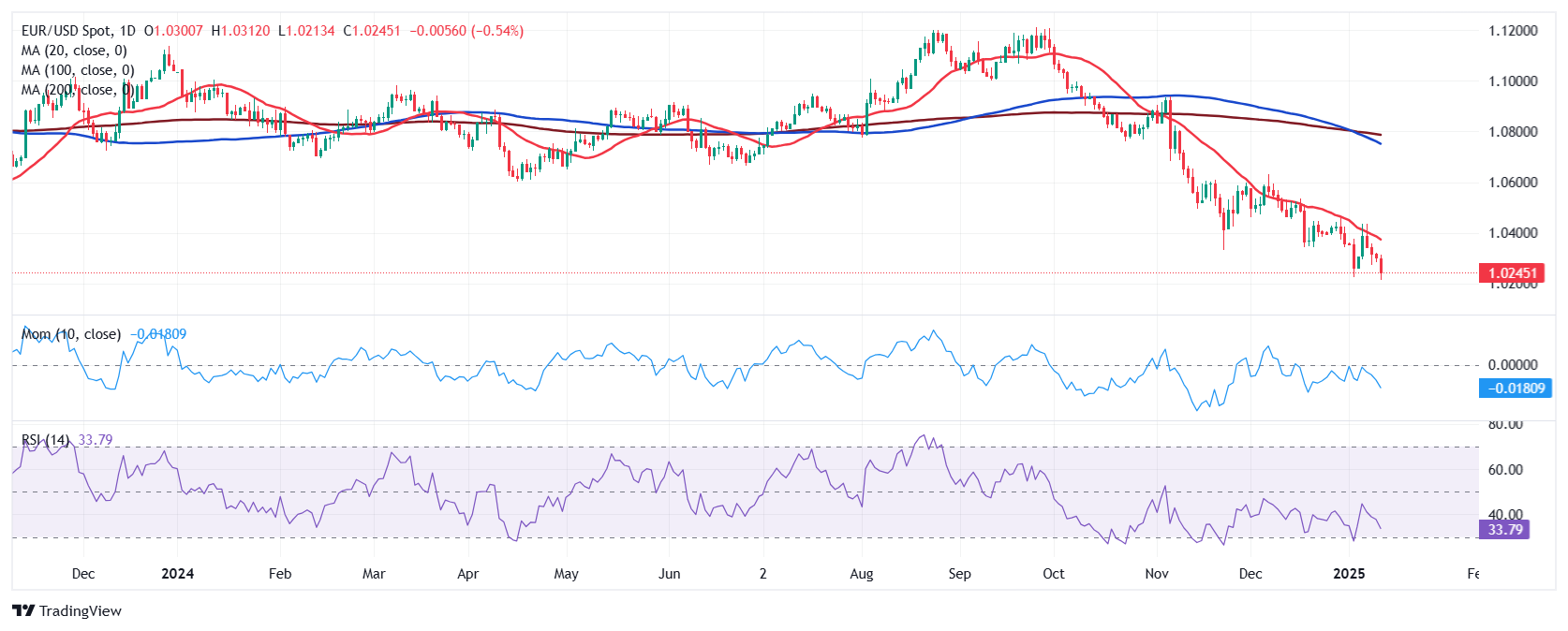
The EUR/USD pair remained under selling pressure this week, with the US Dollar (USD) retaining its overall strength. The Greenback benefited from risk-aversion bouts, triggered by United States (US) President-elect Donald Trump’s tariffs plan. The pair heads into the weekend trading at around 1.0250, not far from the multi-year low posted on Friday at 1.0212.

Trade-war: Trump tariffs heat financial boards

The Washington Post reported on Monday that Donald Trump’s transition team was working on narrowing tariffs, focusing only on key sectors deemed vital to national security, such as defence, medical supplies and energy, narrowing the universal tariffs plan that Trump anticipated during his campaign. Latter in the day, however, Trump denied the headlines, saying that the story about paring back tariffs was wrong.

The EUR/USD pair jumped to 1.0431 with the initial headlines, as markets welcomed the idea of limited tariffs. Trump’s denial, on the other hand, boosted the US Dollar (USD) while sending stocks into a selling spiral.

Fears resumed mid-week when CNN reported that Trump was considering declaring a national economic emergency to impose widespread tariffs. Using the International Economic Emergency Powers Act (IEEPA) will unilaterally authorize a president to manage imports during a national emergency.

FOMC Minutes: Politics should not be in the way, but they are

The Federal Open Market Committee (FOMC) released the Minutes of the December Federal Reserve (Fed) monetary policy meeting on Wednesday, and the document brought some negative headlines.

Yet what caught investors’ attention is that the Minutes showed almost all members judged that the upside risk to inflation has increased. Officials mentioned “potential changes in trade, immigration, fiscal, and regulatory policies” as the reasons behind their fresh growth and inflation-related concerns.  Without saying it, officials said they are concerned about what Trump’s policies would mean to the economy.

Solid US employment data

Meanwhile, the US released multiple employment figures. The December ADP Employment Report showed that the private sector added 122K new jobs in the month, missing expectations of 140K. Additionally, Initial Jobless Claims for the week ended January 3 increased by 201K, better than the 218K expected and below the previous 211K. Also, US-based employers announced 38,792 cuts in December, a 33% decrease from the 57,727 cuts announced one month prior. It is up 11% from the 34,817 cuts announced in the last month of 2023, according to the Challenger Job Cuts report.

Finally, on Friday, the US published the Nonfarm Payrolls (NFP) report, which showed 256,000 new jobs were added in December. The reading was much stronger than the 160,000 anticipated and the November 212,000 reading. Even further, the Unemployment Rate edged lower to 4.1% from 4.2%, while the Labor Force Participation remained steady at 62.5%. Finally, annual wage inflation, as measured by the change in the Average Hourly Earnings, declined to 3.9% from 4%.

Markets turned risk-averse with the news, with the US Dollar rallying and stocks plummeting, as such figures suggest the Federal Reserve (Fed) will refrain from cutting interest rates in the upcoming months.

No good news in Europe  

European data fell once again short of encouraging. The preliminary estimate of the German Harmonized Index of Consumer Prices (HICP) was higher than anticipated, as the index rose 2.8% on its yearly comparison, above the 2.6% anticipated and the previous 2.4%. Retail Sales in the country fell 0.6% in November, while Factory Orders declined by 5.4% in the same period. 

The Eurozone HICP rose 2.7% in the year to December as expected, yet the Producer Price Index (PPI) was down 1.2% YoY in November, higher than the previous -3.3% or the -1.3% expected.

The European Central Bank (ECB) will likely continue trimming interest rates. That would keep the Euro on the downside, while a hawkish Fed means a stronger US Dollar. EUR/USD at parity is in the foreseeable future.

For the upcoming week, the focus will be on the US Consumer Price Index. The country will publish it next Wednesday, and Retail Sales will be published on Thursday. Other than that, the macroeconomic calendar has little relevant to offer.

EUR/USD technical outlook  

From a technical perspective, the EUR/USD pair is down for a fifth consecutive week and there are no technical signs that suggest an interim bottom is nearby. Indeed, EUR/USD is oversold in the weekly chart, yet the Relative Strength Index (RSI) indicator keeps heading south despite being at 28. The Momentum indicator in the same chart bounced just modestly from extreme levels but remains far below its midline, not enough to suggest an upcoming bounce. Finally, the 20 Simple Moving Average (SMA) has accelerated its slump and crossed below a flat 100 SMA, reflecting sellers’ strength.

In the daily chart, EUR/USD has plenty of room to extend its slide. Technical indicators head south within negative levels, still far from oversold readings. Even further, the EUR/USD pair posted lower lows after a couple of failed attempts to overcome a bearish 20 SMA, currently providing dynamic resistance at around 1.0380. In the same chart, the 100 SMA crossed below the 200 SMA after holding above it for roughly five months. Both moving averages stand around the 1.0800 level, not only anticipating additional slides but also reflecting sellers’ strength.

September 2022 high at 1.0197 is the immediate support level, ahead of the 1.0100 figure. A break below the latter exposes parity, albeit further slides seem unlikely in the upcoming days. The 1.0300 – 1.0330 area provides near-term support ahead of the 1.0400 mark.


US Dollar PRICE Last 7 days

The table below shows the percentage change of US Dollar (USD) against listed major currencies last 7 days. US Dollar was the strongest against the British Pound.

  USD EUR GBP JPY CAD AUD NZD CHF
USD   -0.04% 1.03% -0.19% 0.02% 0.52% 0.40% 0.30%
EUR 0.04%   1.05% -0.15% 0.05% 0.54% 0.43% 0.33%
GBP -1.03% -1.05%   -1.16% -0.99% -0.50% -0.61% -0.71%
JPY 0.19% 0.15% 1.16%   0.20% 0.69% 0.58% 0.48%
CAD -0.02% -0.05% 0.99% -0.20%   0.48% 0.38% 0.28%
AUD -0.52% -0.54% 0.50% -0.69% -0.48%   -0.11% -0.21%
NZD -0.40% -0.43% 0.61% -0.58% -0.38% 0.11%   -0.10%
CHF -0.30% -0.33% 0.71% -0.48% -0.28% 0.21% 0.10%  

The heat map shows percentage changes of major currencies against each other. The base currency is picked from the left column, while the quote currency is picked from the top row. For example, if you pick the US Dollar from the left column and move along the horizontal line to the Japanese Yen, the percentage change displayed in the box will represent USD (base)/JPY (quote).


Source link

Go to Top