The nomination of Dr. Marty Makary as FDA Commissioner is another pick by President-elect Donald Trump that has the natural products industry buzzing.
Makary’s nomination comes on the heels of that of Robert F. Kennedy Jr. to head the department of Health and Human Services, which oversees FDA. In both nominees industry sources see potential officeholders who could shake up the status quo.
Makary is a board-certified surgeon and is currently Chief of Islet Transplant Surgery at Johns Hopkins University. Several papers listing Makary as a co-author can be found in the PubMed database, including a recent one examining how to curtail the number of opioid pills prescribed for post-surgery patients.
Makary has penned commentaries for the Washington Post, Wall Street Journal andthe New York Times, as well as appearing on Fox News.
Views on health care reform
Makary has also put forth his views on the medical establishment in several books. In the book “Blind Spots,” published in 2024, Makary argues that hubris and groupthink on the part of medical authorities has led to problems such as the increasing prevalence of peanut allergies, the opioid addiction epidemic and other issues that he believes could have been avoided by incorporating competing viewpoints.
In “The Price We Pay,” published in 2019, Makary tackles the convoluted economic model underpinning the way health care is delivered in the United States. It’s a model that has led to bloated hospital budgets, high costs of care compared to other industrialized nations, rising medical debt for average Americans, and other issues. Both books were bestsellers.
Another of Makary’s books, “Unaccountable,” published in 2012, was billed as “a powerful, no-nonsense, nonpartisan diagnosis for healing our hospitals and reforming our broken health care system.”
Now that the Republicans hold a majority in the Senate it’s almost a lock that both nominees will be confirmed.
Industry stakeholders appeared heartened that Makary is a practicing physician and published researcher and thus is committed to fostering evidence-based health care. What his views on dietary supplements are and how his tenure might affect the industry are things that could be elucidated in the confirmation process.
“Dr. Makary has strong academic and medical credentials, made extensive contributions to scholarly and professional publications, and has stated his commitment to evidence-based medicine,” said Scott Melville, president and CEO of the Consumer Products Healthcare Association (CHPA). “CHPA specifically hopes this nomination will help further FDA’s mission to protect and promote public health with more evidence-based self-care options for consumers. We look forward to learning more about Dr. Makary’s positions and priorities on OTC drugs, dietary supplements, and OTC medical devices as he proceeds through the confirmation process.”
Steve Mister, president and CEO of the Council for Responsible Nutrition (CRN), said Makary might help FDA move toward being a more efficient, accountable organization.
“In particular, we are eager to collaborate on ways to find regulatory efficiencies within the Dietary Supplement Health and Education Act (DSHEA), ensuring it continues to serve consumers effectively in today’s marketplace. At the same time, we welcome opportunities to engage with the FDA on strengthening oversight and maintaining the highest standards for dietary supplements and functional nutrition products. We are optimistic that under Dr. Makary’s leadership, the FDA will foster innovation while maintaining a commitment to safety, transparency and accountability,” Mister said.
“We’re excited to work with Dr. Makary — we’re hopeful that many of the reforms needed at FDA will come to fruition under his leadership,” said Daniel Fabricant, Ph.D., president and CEO of the Natural Products Association (NPA).
Cardano (ADA) is making headlines, earning an impressive “A-” rating and joining the elite ranks of bigger cryptocoins. Analysts are now eyeing a potential surge to $3, fueled by ADA’s growing adoption and its role in reshaping blockchain innovation. Many are now wondering whether ADA can hit $3 in the near future and smash through its current barriers to achieve a new all-time high.
Meanwhile, JetBolt (JBOLT) continues to gain traction, drawing attention with its groundbreaking zero-gas technology and an impressive presale performance, with over 66 million tokens sold. As JetBolt whale activity rises, many are curious whether it will position itself as the next big thing in the crypto landscape.
Let’s explore the Cardano price prediction as JetBolt whale activity continues to rise.
Cardano Price Prediction: Will ADA Hit a New ATH?
Cardano (ADA) has surged beyond the $1 mark, hitting a multi-year high, and is currently trading at $1.05. Now ranked among the top ten major cryptocurrencies, ADA’s rally showcases its growing dominance and strong market performance.
A tweet from crypto analyst Ali Charts (@ali_charts) showcasing a graph of ADA’s transactions. Source: X (Formerly Twitter)
Fueling the excitement, Cardano has achieved a prestigious “A-” rating from Weiss Crypto, elevating it to the elite ranks of leading cryptocurrencies. This recognition underscores the blockchain’s resilience, technological innovation, and growing adoption.
Analysts are now speculating on whether ADA can achieve a new all-time high (ATH) of $3, with some even forecasting a potential surge to $6. Ali Martinez, a seasoned crypto analyst, has drawn parallels between ADA’s current trajectory and its previous bull run. Based on this technical analysis, he predicts that ADA could potentially soar to heights of $6.
However, Martinez cautions that the $0.80 support level is a critical juncture. This level has seen a massive accumulation of 1.2 billion ADA tokens by 48,000 addresses, which could act as a strong bulwark against potential bearish pressures. If this support holds, it could fuel ADA’s ascent and propel it towards the $3 target.
Despite the bullish sentiment surrounding Cardano (ADA), its Relative Strength Index (RSI) currently stands at 84.15, indicating that the asset is in overbought territory. The RSI, a key technical indicator, suggests that ADA’s price may have risen too quickly and could be due for a correction or consolidation period.
The Future of Altcoins? JetBolt Sold 66M Tokens and Counting
JetBolt (JBOLT), a rising star among next-generation altcoins, is capturing the spotlight with its groundbreaking zero-gas technology and user-centric features. This innovative platform is drawing significant interest from crypto whales and the Web3 community, positioning itself as a must-watch in the blockchain space.
At the core of JetBolt’s appeal lies its revolutionary zero-gas technology, which eliminates gas fees entirely. This breakthrough not only enhances efficiency for individual users but also dismantles long-standing barriers to crypto adoption. By erasing these cost hurdles, JetBolt opens the door to new possibilities for dApps, SocialFi platforms, blockchain systems, and other Web3 projects, sparking a wave of innovation, accessibility, and creativity across the ecosystem.
JetBolt goes beyond technological innovation by transforming the user experience. JBOLT’s interactive staking platform redefines traditional staking, offering a seamless and rewarding journey for users of all levels. Users can earn more coins simply by engaging with the platform.
The excitement doesn’t stop there—JetBolt’s presale has become a hot topic, with over 66 million tokens sold and daily price hikes generating buzz. Early adopters benefit from exclusive perks like up to 25% discounts through Alpha Box bundles and batch purchases, making it an inviting opportunity.
As JetBolt whale activity rises, a growing number of buyers are taking notice, eager to leverage on JetBolt’s technological edge.
Conclusion: Can ADA Hit New ATH While JetBolt Whale Activity Rises?
As the crypto market heats up, both Cardano and JetBolt are emerging as frontrunners in their own unique ways. Cardano’s impressive “A-” rating and growing adoption position it as a force to be reckoned with, as analysts speculate on its potential to reach $3 or even higher. Meanwhile, JetBolt’s revolutionary zero-gas technology and impressive presale performance of 66 million tokens sold are paving the way for it to make a name for itself in the highly volatile altcoin space.
This content is for informational purposes only and does not constitute financial advice. Cryptocurrencies are highly volatile and carry significant risks. Always conduct thorough research and carefully evaluate your options before making any crypto-related decisions.
*This article was paid for. Cryptonomist did not write the article or test the platform.
Green tea has earned its worldwide rep as one of the healthiest beverages, and it’s easy to see why. Packed with antioxidants and beneficial compounds like catechins and L-theanine, green tea is linked to a whole host of health benefits. L-theanine, in particular, is associated with mood improvements, mental processing and reduced stress and anxiety. No wonder sipping on the best green tea has such a calming effect!
But the benefits of green tea aren’t limited to the brain. The compounds in green tea have been shown to protect your body by fighting inflammation, lowering the risk of heart disease and supporting blood sugar control. Green tea may play a role in preventing chronic conditions like cancer, Alzheimer’s disease, Parkinson’s disease and type 2 diabetes. How, exactly? One specific polyphenol, epigallocatechin-3-gallate (EGCG), acts as a strong antioxidant, helping neutralize harmful free radicals in the body. By tackling these unstable molecules, EGCG helps protect your cells from damage.
It’s easy to see why green tea is the second most consumed beverage in the world, behind only water, with two-thirds of the world population enjoying it. Its origins date back to China centuries ago, and with its light, grassy taste and impressive health profile, it’s no wonder green tea continues to be a popular choice.
However, choosing the right green tea can feel overwhelming with so many options available. From loose-leaf varieties to convenient tea bags, people are looking for both quality and simplicity. To help you find the best green tea, we consulted with three registered dietitians, the founder of Dream Tea NYC and an herbalist. We also tested over 20 different green teas to bring you our top picks for the best-tasting green tea. Whether you’re seeking a robust flavor, organic ingredients or ease of preparation, our comprehensive review has you covered.
We chose Upton Tea Imports Season’s Pick China Sencha Organic Green Tea as the best green tea overall because of its exceptional flavor profile, affordability and ease of preparation. Its grassy and slightly nutty flavor is balanced and smooth, and we didn’t notice any bitterness while sipping on this tea.
The brewing process for this tea is straightforward. Simply steep one teaspoon in 6 ounces of 180°F water for three minutes. With a caffeine content of 25 to 45 milligrams, depending on the length of steeping, it provides a gentle lift without the jitters that often accompany higher-caffeine beverages.
One thing we really love about this tea is its affordability. At just 10 cents per cup, it offers excellent value for its quality. We also feel it suits a broad demographic, appealing to green tea enthusiasts of all ages. Though we noticed a slight dryness in the mouth after drinking — a common effect with many green teas we sampled — the overall experience was positive, making this a standout choice for our best green tea for 2024.
We chose Thistle & Sprig’s Traveler Rose + Green Tea as the best organic tea because of its sweet and floral flavor and simple ingredient list. Containing just two ingredients — organic green tea and organic rose petals — this tea is soothing to sip and would be the perfect mid-afternoon pick-me-up.
There’s a hint of the grassy taste typical of green tea, but it’s nicely balanced by floral notes from the rose petals, keeping it from being overpowering. Unlike some of the other green teas we sampled, it also didn’t have any bitter aftertaste.
Green tea purists looking to switch things up might find it particularly pleasing. It tastes mostly like a single-ingredient green tea, with just a hint of floral sweetness from the rose petals. At $14 for a 1.5-oz. recyclable canister, this tea seems reasonably priced for its quality, and we’d likely buy it again.
Pros
Organic
Only two ingredients
Pleasant floral notes
No bitter aftertaste
Cons
Different steeping instructions online and on canister
When selecting the best loose-leaf green tea, we had a few to choose from. However, Herbs & Kettles Nilgiri Green Twirl stood out as the winner for several reasons. It has a delicious combination of grassy and umami flavors, making it a refreshing choice for seasoned green tea lovers and newcomers alike. We love that this tea has such a depth of flavor without being bitter. While it did dry our mouths out a bit, this was a common theme among the green teas we tried, and it didn’t take away from the drinking experience.
One of the standout features of this green tea is its ability to be steeped multiple times. For the first infusion, steep 3 grams of leaves in 5 oz. of 175°F to 185°F water for 1 to 2 minutes to begin extracting its flavors. Subsequent infusions reveal even more depth of flavor, with a quick 25 to 30 seconds for the second infusion and 45 to 60 seconds for the third. While brewing this tea is a little more labor intensive than some of the other teas we sampled, it proved to be worth it.
Priced at $14 for 30 grams, it may seem more expensive than other options, but when you consider the quality and the fact that you can steep it multiple times, it suddenly seems like a much better deal. This tea’s organic, single-origin aspect adds to its appeal, ensuring you’re choosing a thoughtfully sourced product.
Overall, Herbs & Kettles Nilgiri Green Twirl is a great choice for anyone looking to add to their loose-leaf tea collection. Its depth of flavor, steeping versatility and quality made it stand out from other teas we tested.
Form: Bag | Caffeine: 41 mg | Steep time: 1-3 minutes | Flavor profile: Grassy and nutty
We chose Stash Premium Green Tea as the best bagged tea because it stood out for its exceptional flavor and overall quality. While it may not reach the flavor heights of some premium loose-leaf teas we tried, its convenience and affordability more than compensate for any differences.
Stash Premium Green Tea comes in convenient tea bags, making it a practical choice for busy schedules. With just a single ingredient — a blend of high-quality green teas — this tea delivers a grassy and slightly nutty flavor that’s refreshing and enjoyable.
The ease of preparation is a significant point in this tea’s favor. Instructions recommend steeping one tea bag for just 1 to 3 minutes in water heated to 170°F to 190°F, making it a tea you can brew and fit seamlessly into your daily routine. Plus, with about 40 mg of caffeine per cup, it provides a gentle energy boost without the jitters.
Finally, at a retail price of less than $4 for a box of 20 tea bags (about 20 cents a cup), this tea is great value for money. The balance of quality, flavor and ease of use makes it a great choice for anyone wanting to enjoy a classic green tea experience without the hassle of emptying and washing a tea strainer.
We chose Magic Hour’s Emerald Gemstone Wellness Tea — Cherry Blossom Pineapple Cream Green Tea as our favorite flavored green tea because of all the flavored green teas we tried, it had the most soothing and distinctive flavor profile. This tea, which features a blend of Sencha, Mao Jian and matcha green tea, has a caffeine content of between 20 and 40 mg., depending on steep time, making it a suitable choice for those seeking a moderate boost of energy.
The flavor of this green tea is wonderfully sweet and floral, which we primarily attribute to the refreshing notes of moringa and pineapple. The slight sweetness from monk fruit and the floral finish create an incredibly soothing experience, making it one of the most pleasant teas we sampled. The preparation is straightforward — steep 1 teaspoon of leaves in 8 ounces of water heated to 180°F for 2 to 3 minutes. This yields a cup that remains enjoyable even as it cools.
While the retail price is a little on the higher side — approximately $33 for 60–75 cups — we feel that the exceptional quality and flavor justify the price. This tea may be particularly appealing to a younger demographic (or those new to tea drinking), as its sweet floral notes may be a bit unconventional for more traditional tea drinkers.
Yes, we know we’ve included two Magic Hour products in this roundup, but it’s because we feel these products stood out as the best in their categories. We recommend Magic Hour’s Organic Ceremonial Matcha 700 for its exceptional flavor and versatility, making it a standout choice for both casual tea drinkers and matcha enthusiasts alike.
As a loose powdered form of green tea, it offers rich grassy and buttery flavors with umami notes. While some people may find the flavor a bit strong, the rich taste can be balanced by adjusting the amount of water added. Some people even prefer to mix it with oat milk to make an oat milk matcha latte, which is delicious hot or cold.
The recommended preparation method is quite involved but stick with us. It involves whisking the matcha with warm water using a bamboo whisk to create a froth that enhances the matcha’s velvety mouthfeel. Then, you slowly add water until you reach your desired strength. Magic Hour recommends about 4 ounces of water per single bamboo matcha scoop.
Why drink matcha? Well, being made from powdered green tea leaves, you reap the benefits of consuming the whole leaf — not just an infusion made by soaking whole leaves. This means that matcha contains more of the healthful ingredients we seek in green tea, such as L-theanine, which may improve your mood, help you think more clearly and make you feel less stressed and anxious.
Finally, while Magic Hour’s Organic Ceremonial Matcha 700 is a bit pricey, at $37 for 60 grams, a little goes a long way, and the price is comparable to other premium matchas on the market.
Just Ice Tea’s Dragon Green Tea was our favorite ready-to-drink option because it had just the right amount of sweetness without overpowering the flavor of the green tea. It’s also organic and Fair Trade, so it’s a choice you can feel good about.
While it does contain 11 grams of added sugar, this is significantly less than most canned iced teas. For example, Lipton iced tea contains a whopping 29 grams of sugar per bottle. Yes, the bottle is bigger, but even if you reduce the serving size to 12 ounces (a can-size serving), it still contains more sugar than the Dragon Green Tea.
When testing the Dragon Green Tea, we found that it had that slightly grassy flavor that you come to expect with green tea. However, it wasn’t overpowering and was balanced out by the addition of organic agave syrup and organic passion fruit juice concentrate. Its slightly bitter aftertaste went away quickly, and overall, we found this to be a refreshing drink that would be perfect for a hot summer afternoon.
There are many different types of green tea, and each has its own unique characteristics. Some of the most common types include Sencha, matcha, jasmine, Genmaicha, Dragonwell (Longjing), Gunpowder and flavored blends.
We spoke with Adriana Ayales, an herbalist, medicine maker, educator and founder of Anima Mundi, to learn about the differences between varieties of green tea. Here’s what she had to say:
Sencha: This is a steamed green tea with a fresh, grassy profile. It’s commonly enjoyed throughout Japan.
Gyokuro: Known as the “dew of jewels,” it is shaded before harvest, creating a tea rich in umami flavors and higher caffeine levels.
Matcha: A ceremonial-grade powder that offers the most complete green tea experience, as the whole leaf is consumed. It provides antioxidants, vitamins and minerals that support energy and focus without the crash.
Hojicha: Roasted green tea with a nutty flavor and lower caffeine — perfect for evening enjoyment.
Bancha: A coarser green tea harvested later in the season, bringing mild flavors and minimal caffeine.
Ayales notes that caffeine content can vary significantly between types of green tea. “Shade-grown teas like Gyokuro and matcha tend to have the highest caffeine levels, offering clean energy for the mind and body,” she explains. In contrast, she notes that teas like Hojicha and Bancha have lower caffeine levels, making them gentler on the nervous system.
Factors to consider when purchasing green tea
According to Anney Norton, founder of Dream Tea NYC, there are several factors to think about when choosing a green tea. “First, consider the country of origin,” she says, “as different countries have unique processing techniques that greatly impact the flavor profile of your green tea.” For example, green tea from Japan (like Sencha and Matcha) tends to be steamed, giving the tea more of a fresh or grassy flavor paired with a subtle sweetness. In contrast, green tea from China tends to be pan-fired, which gives it a nutty/smoky flavor with notes of caramel.
Norton also recommends checking to see whether the tea is USDA organic and Fairtrade-certified. Why? “Unlike produce, which gets washed before consumption, we drink the liquid we soak our tea leaves in, and I would prefer to avoid any chemicals or pesticides in my morning cup!” she explains. She adds that Fairtrade is very important, as Fairtrade farms are more equitably compensated for their products. “This allows them to invest more money into their growing practices to produce a higher quality product and better care for their staff, as well as ensure sustainability throughout the supply chain,” she explains. She adds that while Fairtrade comes at a higher price point, it’s worth it for the difference in product quality and the community-building, ethical benefits.
Finally, Norton recommends looking at other flavorings that may have been added to the green tea blend. “I tend to like green teas that are fruity or floral,” she explains, “so I will check for add-ins like orange, peach, rose or lavender.” This allows you to find a green tea that is perfectly customized to your taste preferences.
How we chose
To choose the best green teas, we completed extensive hands-on testing. We sampled over 20 different green teas, rating them based on a range of criteria, including taste, aroma, ease of preparation and affordability. Each tea was sampled several times and brewed exactly to the individual teas’ steeping instructions. This rigorous process enabled us to choose the best-tasting green teas that delivered both flavor and value for the money.
Our research involved not only extensive testing but also garnering input from three registered dietitians, a tea entrepreneur from Dream Tea NYC and a herbalist in natural health. Plus, our tester (and writer) is also a registered dietitian and regular green tea drinker. Together, this combined expertise helped clarify what makes a green tea exceptional, from its nutritional value to its flavor profile.
FAQs
What are the health benefits of green tea?
According to Alexia Zolis, founder of the Healthy Living RD, green tea is packed with antioxidants, particularly catechins, which help protect our cells from damage like oxidative stress — an imbalance between harmful free radicals and antioxidants — and inflammation. “These powerful compounds may also reduce the risk of certain types of cancer and chronic diseases like heart disease,” she explains.
Seema Shah, owner of Seema Shah Integrative and Functional Nutrition, adds that thanks to its L-theanine content, green tea supports and protects brain health, mood and memory. Plus, its rich content of anti-inflammatory phytochemicals like EGCG also supports heart and metabolic health.
While many people tout green tea’s weight loss benefits, Leah Reitmayer Murnane, owner of Lettuce Eat Dessert, explains the benefit may be overstated. “There is limited research about the popular claim that drinking green tea can support weight management.” However, drinking green tea adds fluid to your diet without adding sugar from other liquids like soda, so it could aid with weight loss by simply reducing the total amount of sugar intake (and empty calories) you may be drinking from other beverages.
How many cups of green tea should I drink a day?
“If you’re a tea lover,” says Zolis, “it can be easy to drink multiple cups of green tea every day.” However, it’s important to remember that green tea does still contain caffeine. Similar to other caffeinated drinks, if you drink too much, it may lead to symptoms like dehydration, restlessness or dizziness, says Zolis.
“The recommended daily maximum amount of caffeine for adults to enjoy each day is 400 mg, according to the Food and Drug Administration. This translates to roughly eight to 10 cups of green tea per day. Everyone has different caffeine tolerance, so enjoying three to five cups is a safe and beneficial amount of green tea to have daily,” says Zolis. However, keep in mind that this amount can still contain up to 225 milligrams of caffeine, says Reitmayer Murnane.
How do you properly brew green tea?
“Brewing green tea is both an art and a ritual,” says Ayales. “For loose leaf teas like Sencha, 170°F to 185°F is perfect,” she explains, “as hotter water can scald the leaves, resulting in bitterness.” For best results, steep the tea for one to three minutes to extract just the right amount of flavor and nutrients.
When it comes to brewing matcha, the preparation is even more mindful, says Ayales. “Use warm water — around 158°F to 165°F — and whisk it into a vibrant froth with a bamboo whisk or hand frother,” she explains. She adds that this method allows you to fully immerse yourself in the experience and connect with the vitality of the tea. “Drinking tea can become a daily practice of presence and gratitude,” says Ayales, “deepening your connection to self and spirit.”
How much caffeine is in green tea compared to coffee?
“Green tea contains less caffeine than coffee,” says Zolis. “While a typical cup of coffee contains about 100 milligrams of caffeine, an 8-ounce cup of green tea typically contains between 30 and 50 milligrams of caffeine.” However, the caffeine content of green tea can vary significantly depending on how long you brew it, with longer brewing times leading to a higher-caffeine cup of tea. Plus, matcha, where you consume the entire leaf, is higher in caffeine than loose-leaf green tea.
What is the difference between matcha and regular green tea?
“Green tea and matcha originate from the same plant,” says Reitmayer Murnane, “but are processed and consumed differently.” Green tea comes from leaves steeped in water and then discarded, while matcha is ground into a fine powder, allowing you to consume the whole leaf, she explains. “This results in matcha having high caffeine and antioxidant levels, along with a richer flavor and texture compared to a regular green tea,” she adds.
Other products we tested
Magic Hour — Goddess Green Tea: This tea had lovely sweet and floral notes. It did make our mouth feel slightly dry, but the main reason it didn’t make our list is that we preferred Magic Hour’s Emerald Green Tea as our favorite flavored green tea.
Magic Hour — Moonlight in Marrakesh: This tea had a pleasant minty and spicy flavor from peppermint, ginger and cinnamon. While it tasted nice, we felt that you could probably get a similar-tasting tea at a lower price point.
Just Ice Tea — Moroccan Mint: This lightly sweetened iced tea was refreshing, but it had a definite minty aftertaste that almost made you feel like you’d just brushed your teeth.
Just Ice Tea — Original Green Tea: This is the brand’s unsweetened iced tea; to us, it tasted like a cup of tea we had forgotten about and let go cold. We don’t need our teas to be super sweet, but a little hint of sweetness would help balance out the bitterness of the green tea here.
Just Ice Tea — Honey Green Tea: We really enjoyed the slightly sweet honey flavor of this iced tea. However, it had a slightly bitter aftertaste and tasted more like honey than green tea.
NOW — Organic Green Tranquility Decaf Green Tea with Lemon Myrtle: We really wanted to like this tea; a decaf green tea to sip on in the evening seemed right up our alley. However, the tea was so mild in flavor (even after steeping for longer than the suggested six minutes) that we couldn’t really tell it was green tea. Plus, each bag was individually wrapped in plastic, which isn’t great for the environment.
Upton Tea Imports — Gyokuro Organic: This tea has a whopping 120 milligrams of caffeine, so it’s definitely one you should try to drink earlier in the day. However, while it had nice umami and nutty flavors, it was one of the most expensive teas we sampled at about $0.60 per cup, and we felt there were other green teas that were better value for money.
Bigelow — Green Tea with Ginger Plus Probiotics: To us, this tasted more like ginger tea than green tea. We tried it over the span of a few days and didn’t notice any changes in digestion. We would have preferred it if this tea tasted like green tea instead of ginger tea.
Meet our experts
Seema Shah, RD, owner of Seema Shah Integrative and Functional Nutrition
Assessing the XRP price prediction, as the altcoin was up nearly 200% in November.
Can the uptrend extend amid renewed whale interest?
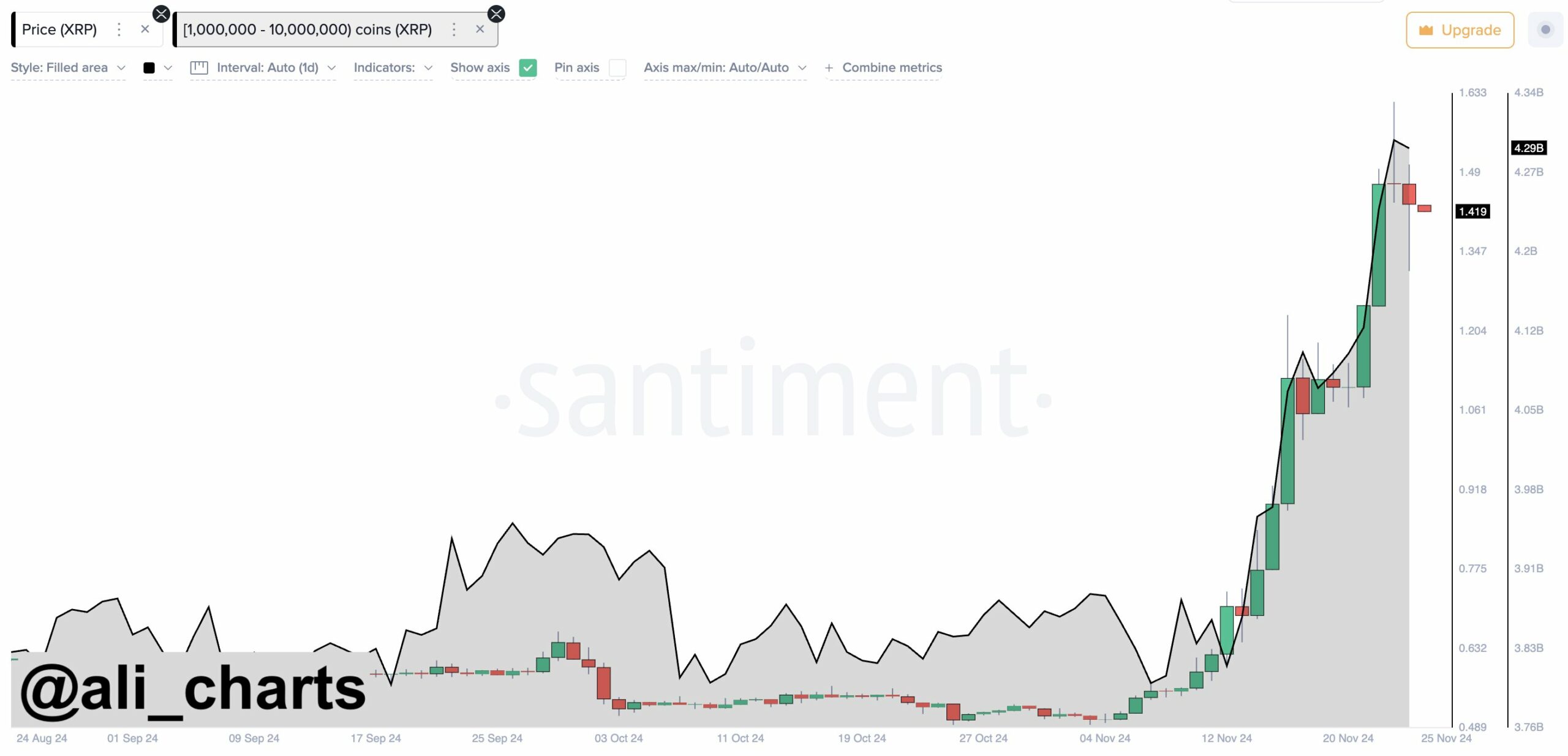
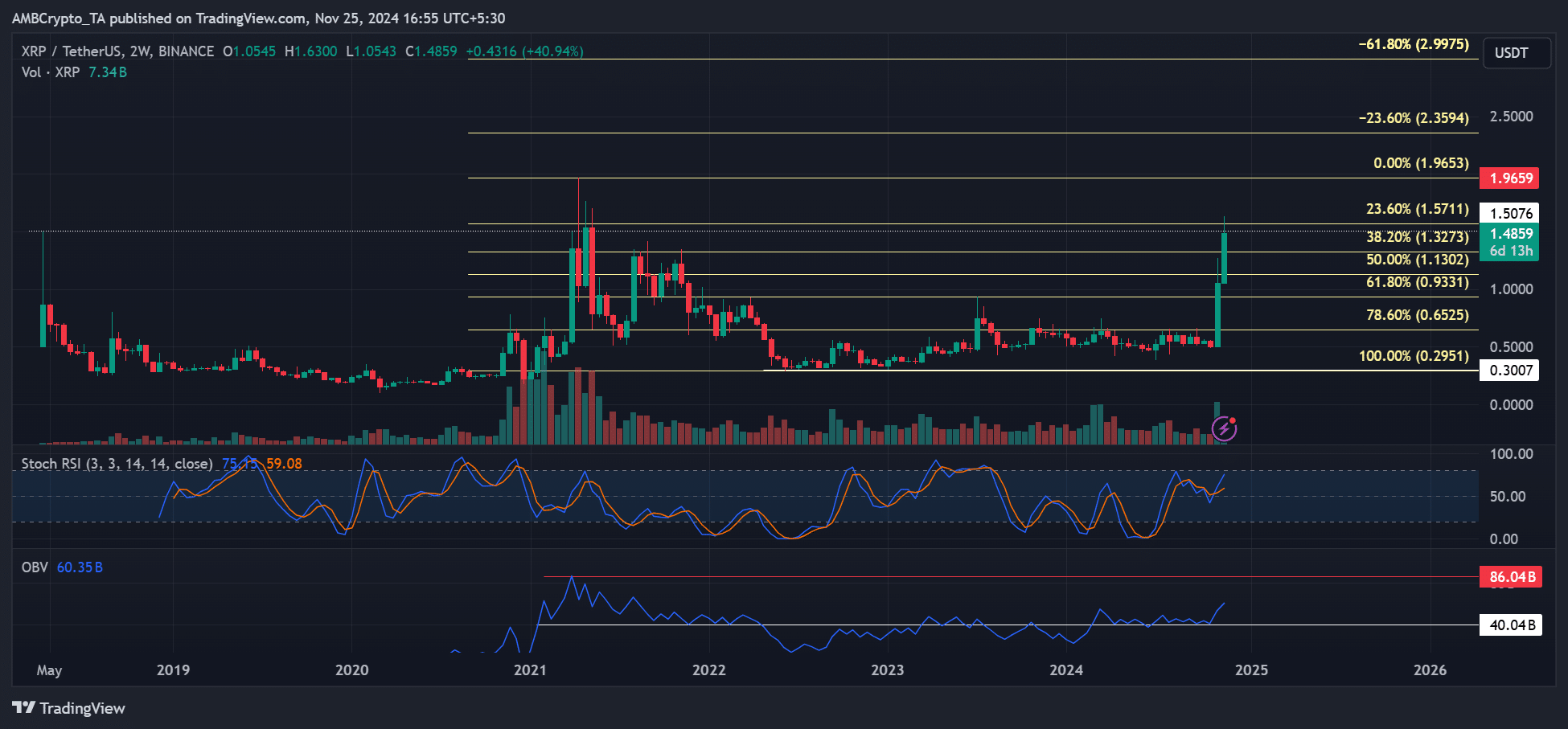
Ripple [XRP] rallied nearly 200% in November, soaring to a four-year high of $1.63 in two weeks. Such an upswing meant most holders had massive unrealized profits, which always precede a potential price decline and cool-off.
But whales’ actions suggested otherwise. Crypto market analyst Ali Martinez noted that whales grabbed over 50 million XRP over the weekend, suggesting that some large players expected the uptrend to continue.
Source: Santiment
XRP price prediction
At press time, XRP was valued at $1.5, halfway from its 2018 high above $3 and about 20% below the 2021 cycle top of $2.
So, the $2 price target was the immediate bullish target for XRP, especially if the uptrend continued.
The strong price momentum, illustrated by the Stochastic RSI and spike in OBV (On-Balance Volume), indicated strong buying pressure and the potential for hitting $2 or higher targets.
Source: XRP/USDT, TradingView
But there was a small caveat for bulls. Last week’s candlestick closed below $1.5, similar to the past two days. This meant there was a tussle for the $1.5 level, and securing it could inform the next price direction.
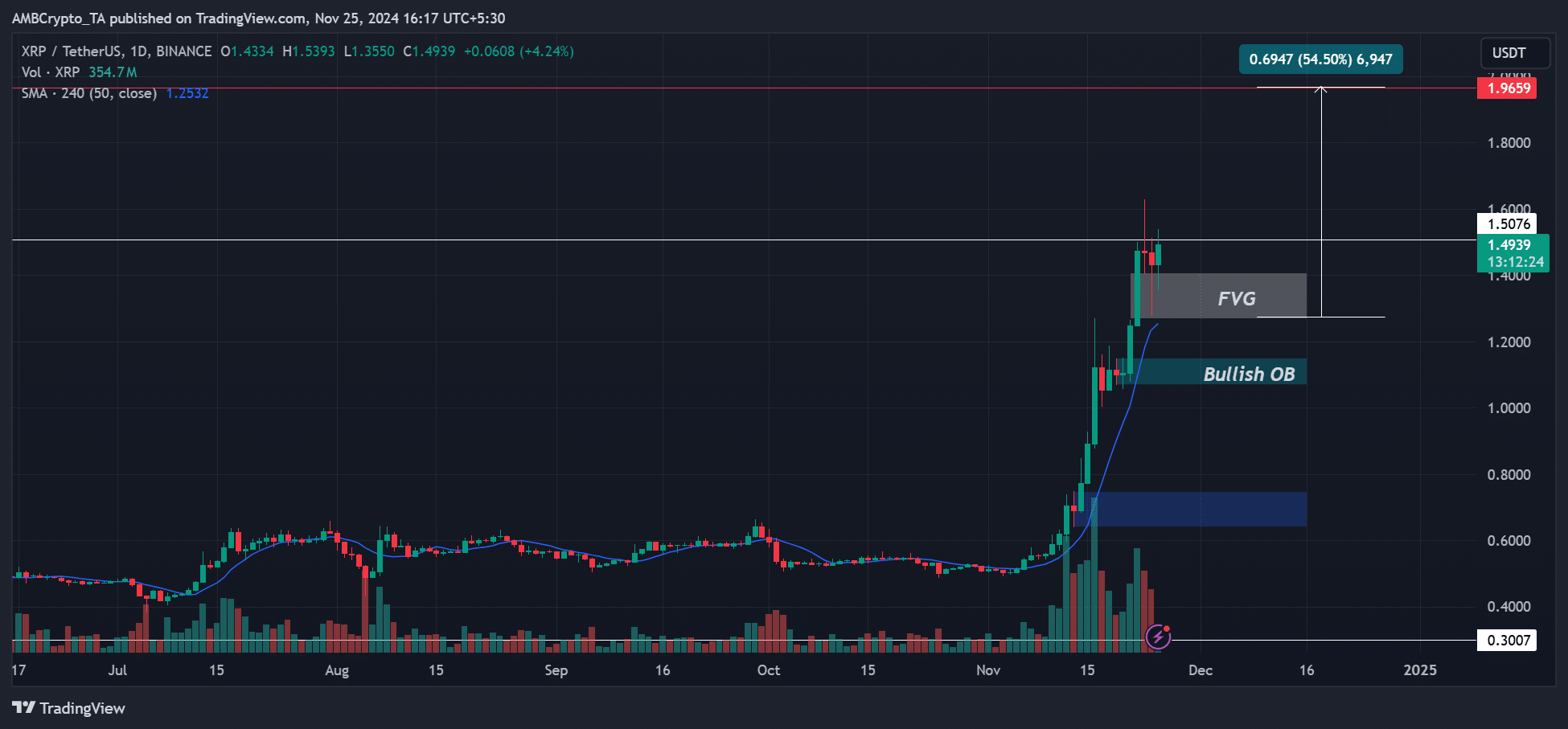
On the daily chart, bulls had the upper hand. The price imbalance (FVG-fair value gap) below $1.4 has been a key re-entry point for bulls.
A strong momentum at this level could allow the uptrend to target upper targets like the $1.96.
Source: XRP/USDT, TradingView
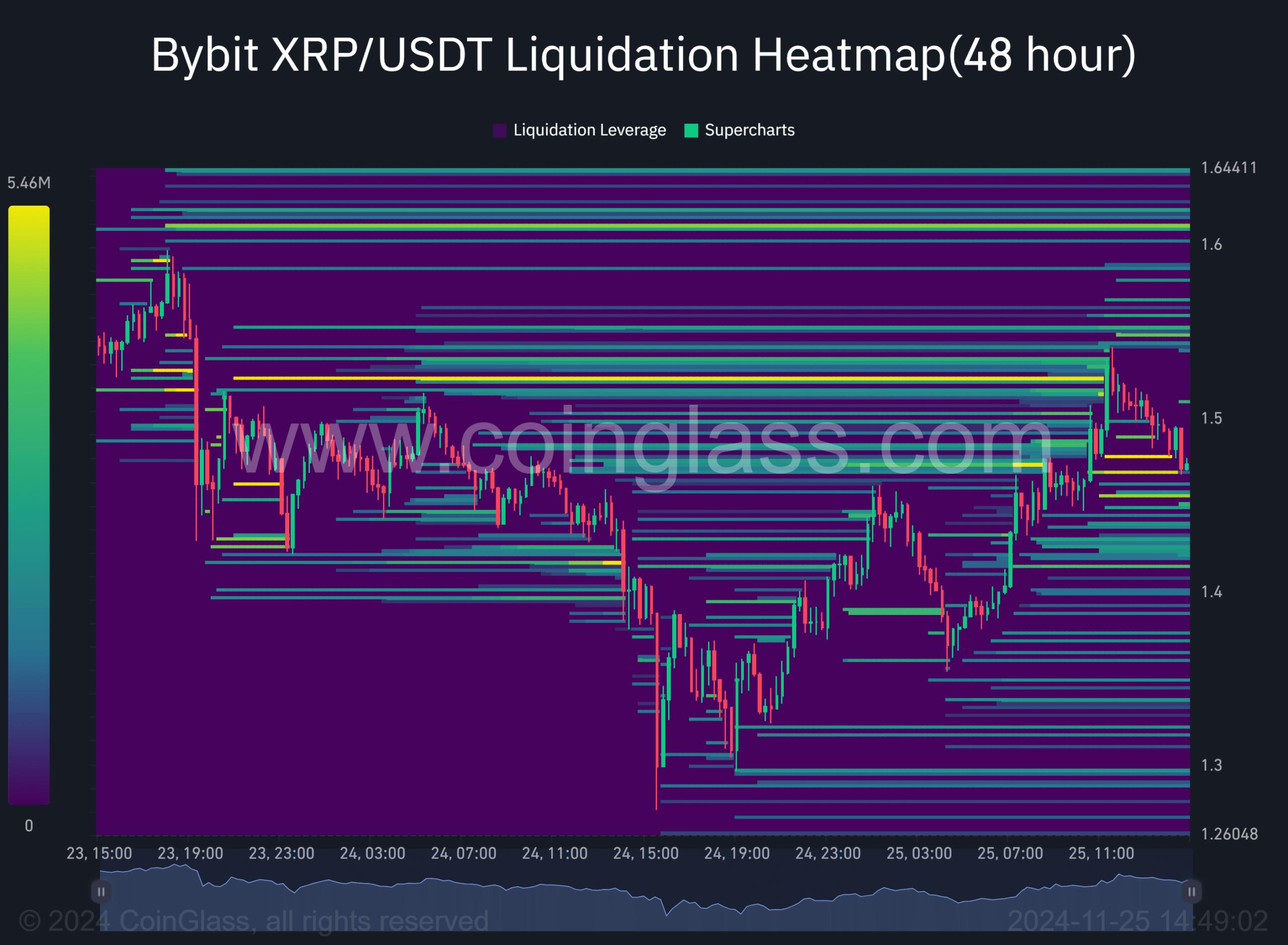
The area below $1.5 also had a build-up of leveraged longs (bright orange levels), which market makers could use to hunt for liquidity.
On the upper side of the price action, leveraged short positions were also parked above $1.6. In short, XRP could experience a liquidity sweep at or below $1.4 before eyeing $1.6 or $1.9.
Source: Coinglass
In conclusion, XRP was primed for an extra uptrend, at least based on the spike in whale demand. However, the momentum could only be validated if XRP decisively soars above $1.5.
Disclaimer: The information presented does not constitute financial, investment, trading, or other types of advice and is solely the writer’s opinion
Hopes for a cease-fire between Israel and Hezbollah boosted the mood.
Demand for safe-haven assets backs the US Dollar vs the bright metal.
XAU/USD gains bearish traction, aims to test the $2,600 price zone.
Spot GOLD trades around $2,630, having shed roughly $30 after Wall Street’s opening. The bright metal has been under selling pressure since early in Asia, maintaining a sour tone as the day comes to an end. XAU/USD fell despite the broad US Dollar’s weakness, as a better market mood pushed investors away from safe-haven assets.
Investors welcomed headlines indicating a cease-fire agreement between Israel and Hezbollah is very close, according to the Israeli ambassador to the United States (US). Authorities are expected to announce on Tuesday a 60-day cease-fire, with hopes that it could be resolved in such a pause.
Demand for the Greenback increased in the last Monday’s session, helped by the solid performance of US indexes and encouraging US data. The country reported that the Chicago Fed National Activity Index was down a modest 0.4 in October, following an upwardly revised -0.27 in September. At the same time, the November Dallas Fed Manufacturing Business Index posted -2.7, slightly better than the previous -3.
The focus this week will be on the US Personal Consumption Expenditures (PCE) Price Index, the Federal Reserve’s (Fed) favourite inflation gauge, which will be published on Wednesday. The country will release alongside the second estimate of the Q3 Gross Domestic Product (GDP).
XAU/USD short-term technical outlook
The daily chart for XAU/USD shows the risk skews to the downside. The pair accelerated south after breaking below a now bearish 20 Simple Moving Average (SMA), while technical indicators turned sharply lower within negative levels after failing to overcome their midlines. The 100 and 200 SMAs maintain their upward slopes, with the shorter one currently at around $2,563, a critical support level in the upcoming sessions.
In the near term, and according to the 4-hour chart, XAU/USD is also at risk of extending its slide. The pair fell below all its moving averages, with the 100 SMA gaining downward momentum at around $2,655. Finally, technical indicators head firmly south within negative levels without showing signs of bearish exhaustion.
GBP/JPY has fallen consistently during November, weakening by seven Yen to the Pound.
It may now be in a bear trend both in the short and medium term, suggesting the odds favor more downside still.
GBP/JPY may have reversed both its short and medium-term uptrends after the last bout of weakness. If so, the pair could see more downside on the horizon since it is a principle of technical analysis that the odds favor extensions of trends.
GBP/JPY Daily Chart
GBP/JPY began selling off on October 31 after it peaked at 199.81 on the preceding day. Since then it has staircased down, reaching a new low in the 192.80s on November 22 – seven whole Japanese Yen (JPY) to the Pound Sterling (GBP) lower than at the end of October.
It has also broken below all three major Simple Moving Averages (SMA), the 50, 100 and 200-day SMAs on a closing basis.
The (blue) Moving Average Convergence Divergence (MACD) momentum indicator line has both crossed below the red signal line and below the zero level, and taken together these are bearish signs.
A break below the 192.80 level could open the way to further losses with the next target at around 189.56, the low of the Right-Angled triangle that formed in late September and early October.
As winter approaches, it means shorter days and a dwindling amount of sunlight. This seasonal change can bring on symptoms of seasonal affective disorder (SAD), which affects about one in 20 Americans.
SAD is a form of depression—with symptoms that can affect daily functioning—and is prompted by shorter daylight hours during the winter. It’s different from the “winter blues,” where cold weather and little sunlight can bring on feelings of sadness or decreased interest in activities.
Some social media influencers claim that you can counteract these symptoms with a combination of vitamin D3 and vitamin K2 supplements.
“You need to buy vitamin D before seasonal depression hits, before the sun goes away for months on end,” said TikTok user Cirena Wilson. “And make sure you get the one with K2.”
SAD symptoms often overlap with those of depression. Common signs include persistent feelings of sadness or depression, a loss of interest in activities you once enjoyed, and excessive sleeping.
SAD is believed to be triggered by shorter daylight hours, which can affect your “internal clock.” These changes to your circadian rhythm can affect melatonin and serotonin levels, which can lead to classic symptoms of depression.
Can Vitamin D and Vitamin K Help With Seasonal Depression?
Vitamin D and vitamin K are key nutrients that everyone needs to stay healthy. But is there evidence that vitamin D and vitamin K can actually help with symptoms of SAD?
A recent study published in Nutrients examined whether vitamin D can help alleviate symptoms of SAD. While the findings were inconclusive, the authors suggested that vitamin D deficiency, specifically, may increase the risk of developing SAD.
“Vitamin D is involved in the pathways of production of melatonin and is believed to play a key role in serotonin activity, which further links serotonin, melatonin, and light exposure, but mainly deficiency of vitamin D and SAD,” the study authors wrote.
Certain health organizations, including the U.K.’s National Health Service and the U.S. National Institute of Mental Health, do list vitamin D as a treatment option for people with SAD but don’t mention the addition of vitamin K.
There has been some evidence that vitamin D may help people living very far north where there is little sun exposure in the winter, said Maya Vadiveloo, PhD, RD, FAHA, an associate professor of nutrition at the University of Rhode Island College of Health Sciences. But generally, the research doesn’t support vitamin D supplements for SAD.
“Broadly, I think that while there isn’t a strong evidence base to support dietary supplementation for prevention/treatment of SAD, there is good support to adhere to diets rich in fruits and vegetables, whole grains, nuts, seeds, legumes, and heart-healthy oils while limiting less healthy foods high in added sugars, salt, and saturated fats,” Vadiveloo said.
Also, the studies that have shown positive results with vitamin D supplements and SAD aren’t very strong, Taylor Wallace, PhD, CFS, an adjunct associate professor at the Friedman School of Nutrition Science and Policy at Tufts University said.
“There are some studies [and small clinical trials] that show vitamin D may affect mood in this regard,” Wallace said. “But they are mostly observational and the effects haven’t held true in larger clinical trials.”
It’s not clear that vitamin K would be beneficial in helping boost vitamin D in terms of stopping SAD symptoms, said Wallace, and cautioned that people should be careful not to take too much of either vitamin D or K. Instead, Wallace recommended most people stick with a daily multivitamin.
What Are Other Treatments for SAD?
If you’re looking for proven treatments for SAD, the good news is there are several that work. You can try light therapy, where you sit in front of a special light box that filters out harmful UV. Most people only need about 20 minutes a day to see results.
You can also speak with a mental health professional or consider selective serotonin reuptake inhibitors (SSRIs), a type of antidepressant medication that helps with SAD symptoms.
Also, eating a nutrient-dense diet and making an effort to go outside more to soak up sunlight can make a big difference in your overall mood.
What This Means For You
Taking vitamin D and vitamin K supplements to ward off seasonal affective disorder probably isn’t the best approach. Instead, eat nutrient-rich foods, get outside as much as possible during the day, and reach out to a mental health professional, if necessary.
Between November 20 and 23, Dogecoin (DOGE) whales reduced their holdings — the same week the cryptocurrency reached a yearly high. This decrease in exposure caused DOGE’s price to dip to $0.36.
However, that is no longer the situation today, as these key stakeholders have resumed buying. Here is how this could affect Dogecoin’s value going forward.
Big Wigs Won’t Let Dogecoin Go Without Buying
According to Santiment, the balance of addresses holding between 1 million and 10 million DOGE dropped to 10.39 billion on November 23 but has since risen to 10.59 billion.
This indicates that Dogecoin whales took advantage of the weekend dip, accumulating approximately 200 million coins. At DOGE’s current price of $0.42, this equates to $84 million worth of purchases. Such whale accumulation often indicates a reduction in selling pressure.
Consequently, this surge in buying activity suggests that Dogecoin’s price could be gearing up for a climb beyond its current $0.42 level. Should that be the case, then the prediction that the meme coin could hit $1 might come to pass.
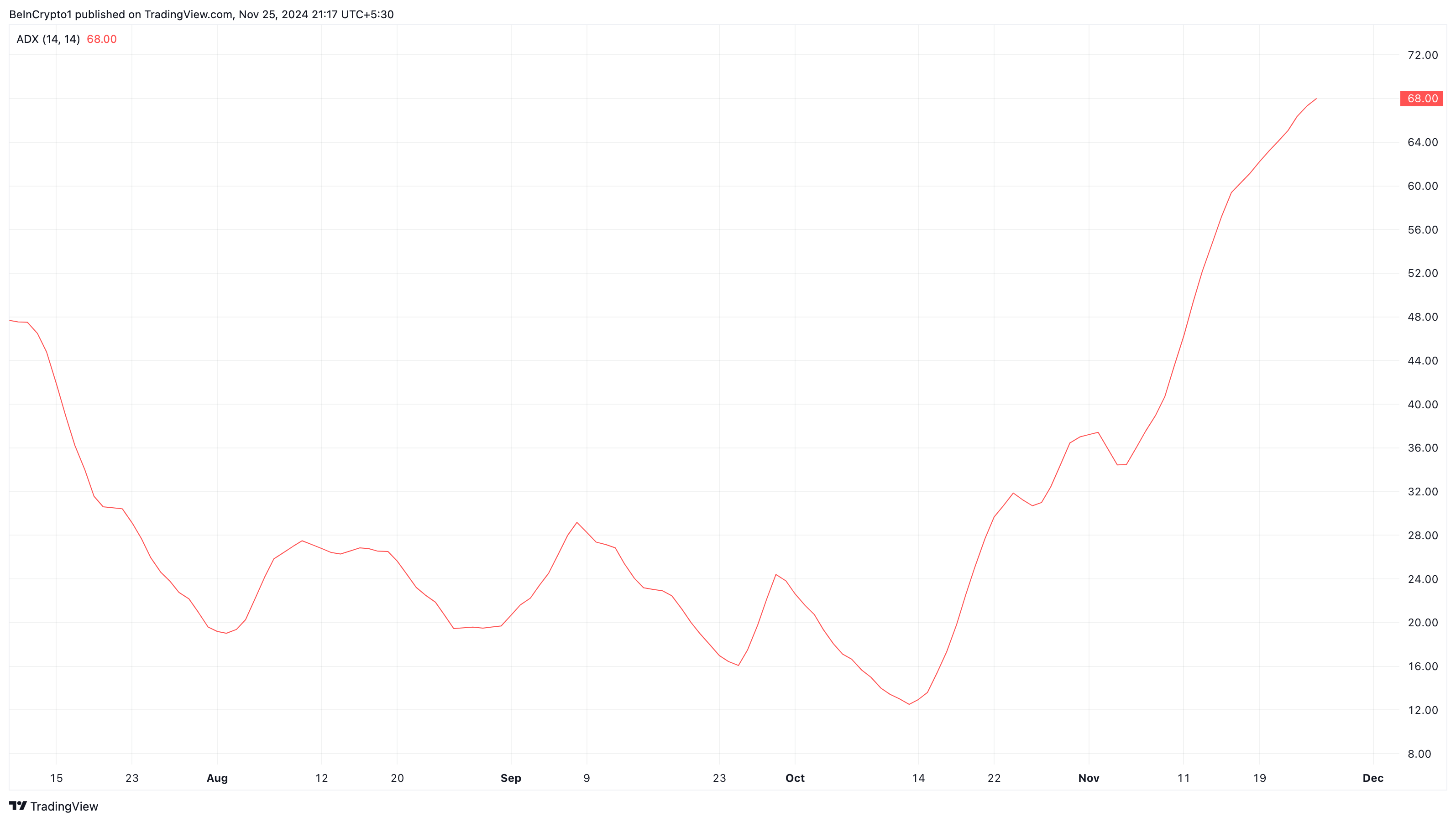
Additionally, the Average Directional Index (ADX) has been climbing steadily. The ADX is a technical analysis tool that helps traders evaluate the strength of a trend, whether bullish or bearish.
When the ADX exceeds 25, it signals strong directional momentum. Conversely, a reading below 25 suggests weak movement. On Dogecoin’s daily chart, the ADX has surged to 68.00, indicating a significant uptrend. With the coin trending higher, this suggests that DOGE’s price could continue to rise.
Dogecoin Average Direction Index. Source: TradingView
DOGE Price Prediction: $1 Still Feasible
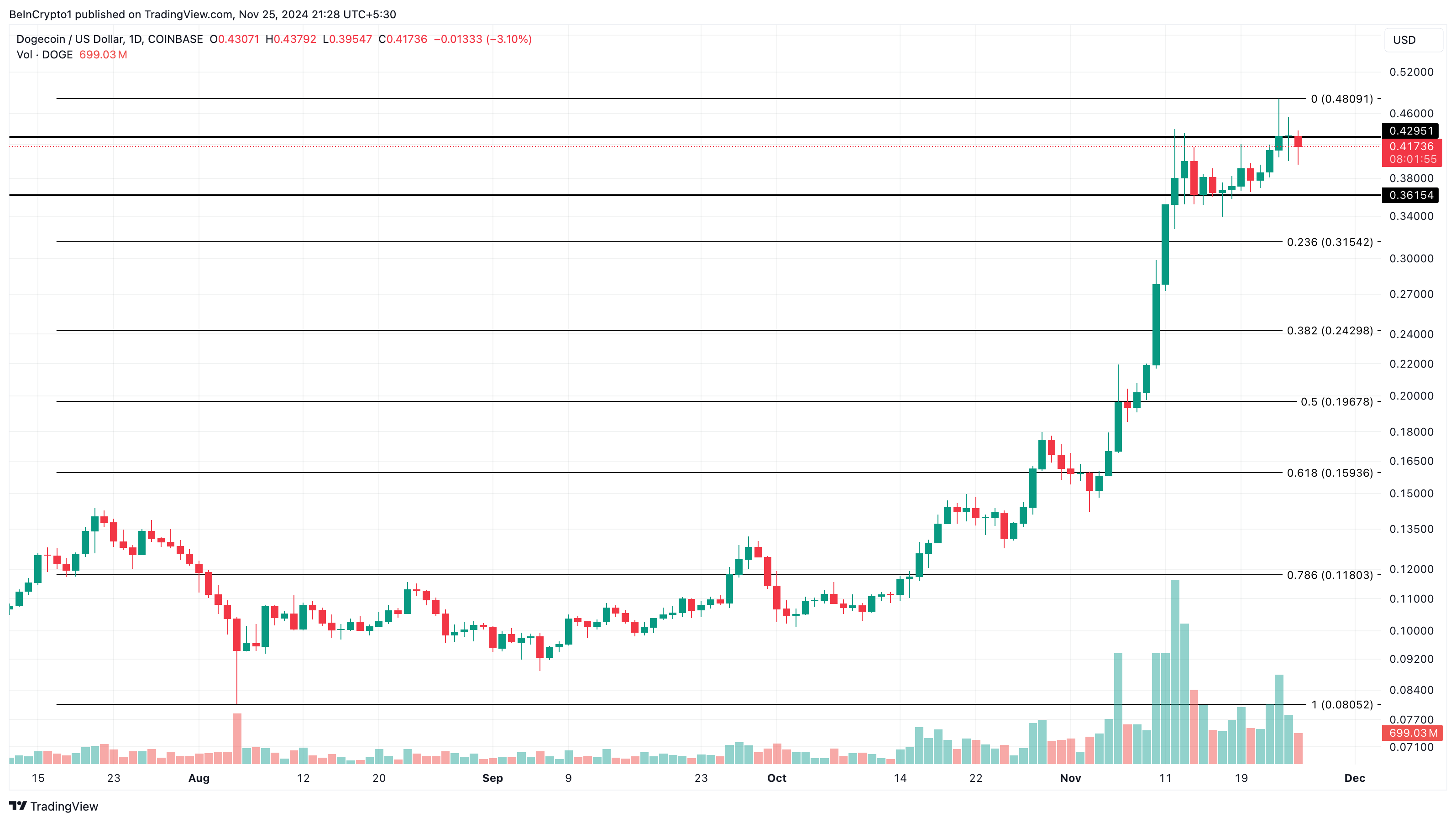
A further look at the daily chart shows that Dogecoin’s price experienced resistance at $0.43. This decline was one reason the cryptocurrency failed to rally to $0.50. It is also important to mention that trading volume dropped, making it challenging for the uptrend to continue.
Meanwhile, it appears that bulls are defending the $0.36 region. If sustained, then DOGE’s value could climb towards $0.48. In a highly bullish scenario, the meme coin could rally toward the $1 mark.
However, if DOGE whales decide to sell, this might not happen. Instead, the coin might decline to $0.32.
Disclaimer
In line with the Trust Project guidelines, this price analysis article is for informational purposes only and should not be considered financial or investment advice. BeInCrypto is committed to accurate, unbiased reporting, but market conditions are subject to change without notice. Always conduct your own research and consult with a professional before making any financial decisions. Please note that our Terms and Conditions, Privacy Policy, and Disclaimers have been updated.
Once Monday’s session is complete, pivots are at the day’s high of 3.46 and the low of 3.26. A decisive move through either has the potential to lead to a continuation in the same direction. Moreover, be cautious of false breakouts, either up or down, that quickly reverse back into today’s trading range. Natural gas rallied above three key pivots last week, indicating improving demand.
The series of lower swing highs are components of the upper boundary of a large symmetrical triangle pattern. At the same time, once the trend high of 3.56 was hit last Friday it led to a bearish engulfing day with natural gas closing below the prior day’s low after exceeding the prior day’s high earlier in the session.
Strong Advance Takes a Rest
Last week’s rally exceeded the top of a previously identified resistance zone with a high of 3.45. A decisive rally above today’s high will put natural gas in a position to possibly challenge last week’s high of 3.56. A little above that high is another potential resistance zone from 3.64 to 3.67. That zone is anchored by previous resistance at the peak for 2023 at 3.64. If natural gas can get above there, it will be trading at its highest price in around 22-months.
Weakness Points to 3.15 Next
Alternatively, a drop below today’s low will likely see further testing of lower support levels. Given the bearish engulfing day last Friday and weak close, it wouldn’t be surprising to see another test of Friday’s low of 3.07. Also, watch the 3.15 swing high area on the way down for possible support. Other key potential support areas include the prior swing high at 3.02 and the 20-Day MA at 2.90.
For a look at all of today’s economic events, check out our economic calendar.
Despite risk aversion among investors, the US dollar remains more attractive to buy than the Japanese yen, even though both currencies are among the most important safe havens in times of uncertainty.
Trump’s trade continues to support the strength of the US dollar.
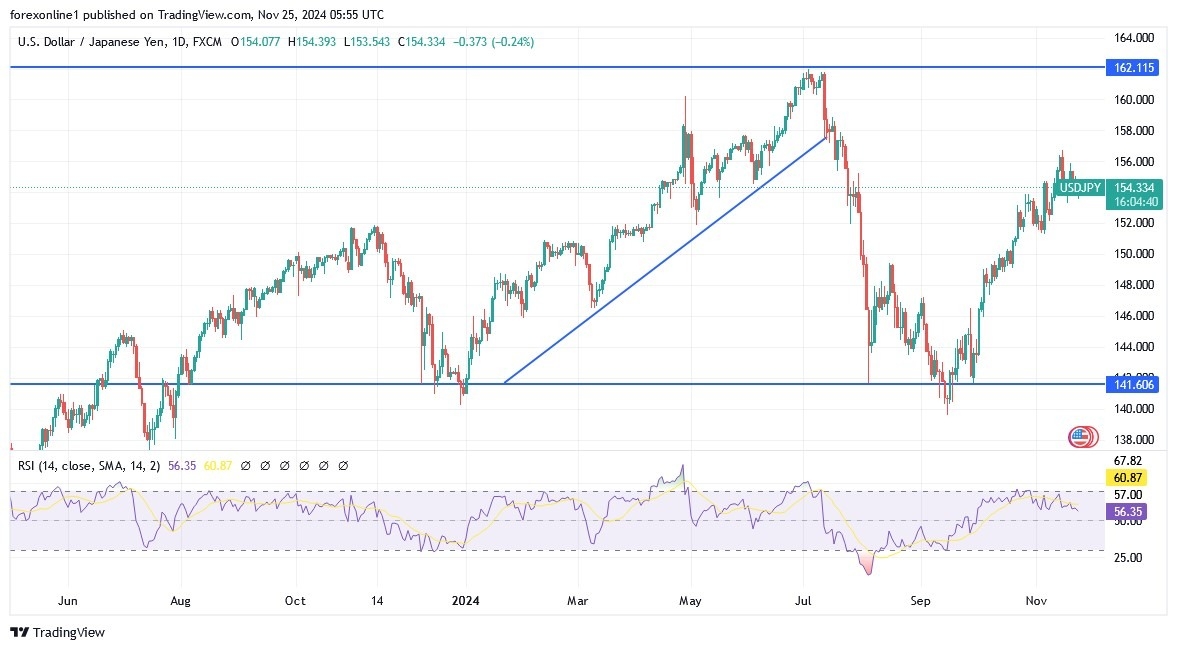
During last week’s trading, the US dollar against the Japanese yen USD/JPY pair jumped towards the resistance level of 155.88, near the highest for the currency pair in four months.
According to the Forex market trading, the price of the US dollar / Japanese yen rose by 1.79% during the trading of the current month. Moreover, the currency pair rose by 9.75% during the trading of the year 2024.
Decline in Japanese Inflation and its Impact on Central Bank Policy
According to economic data, Japan’s core inflation rate slowed to a 9-month low of 2.3% in October, while the underlying inflation rate also fell to 2.3%, the lowest in six months, and slightly above expectations of 2.2%. On the other hand, Japan’s manufacturing sector contracted more than expected in November, despite growth in services activity.
On the monetary policy front, the Bank of Japan’s governor has indicated the possibility of raising interest rates again as early as December, citing the recent weakness in the Japanese yen. In addition, the Japanese prime minister is considering a $90 billion stimulus package to ease the impact of rising prices on households. However, the strong dollar and US Treasury yields have prevented the low-yielding Japanese yen from rising more than its recent performance.
Moreover, a Japanese survey showed that Japanese companies in China have become more pessimistic about the world’s second-largest economy, with about two-thirds saying it is getting worse and nearly half cutting or halting their investments. About 64% of Japanese companies said the Chinese economy is worse than last year, according to the latest survey by the Japan Chamber of Commerce and Industry in China.
USD/JPY Technical Analysis and Expectations Today:
The overall trend of the USD/JPY currency pair remains upward. The 14-period Relative Strength Index still has room to rise before moving towards oversold levels, which could happen if the bulls manage to push the pair towards the resistance levels of 155.85 and 157.00, respectively. The USD/JPY pair will remain within its current range until the return from the US holidays this week, which may affect liquidity and investor sentiment to start trading normally.
Conversely, and on the same timeframe, the upward trend of the USD/JPY currency pair will be breached if the bears return the pair towards the support level of 151.60. Otherwise, the overall trend will remain upward. We see that any downward movement of the currency pair may be an opportunity to buy. You can follow the trading signals for the USD/JPY and other free live trading signals on our website.






:max_bytes(150000):strip_icc()/VWH-GettyImages-1223126964-3bed13e1c4ee4a3ab8216ca563f56011.jpg "How Two Common Supplements May Help Tackle Seasonal Mood Changes")