USD/JPY trades around 157.46, between support at 156.50 and resistance at 159.00, with the 10-year U.S. Treasury yield near 4.99%.
The U.S. dollar is really starting to flex its muscles against the Japanese yen over the last couple of days. That being said, it’s worth noting that we’re at the bottom of a consolidation area, with the ¥156.50 level being a bit of a floor. I still like the idea of buying short-term dips here, especially if the Federal Reserve on Wednesday ends up being relatively tight with its statement—hawkish, I should say.
The market continues to be one that waits for central banks, and of course, the Bank of Japan has an interest rate decision and statement on Friday. So, there’s that as well. Ultimately, though, I do think the Japanese are likely to do nothing. The Americans are probably going to sound a little bit more hawkish, so I do favor the upside. Traders get paid to hang on to this pair.
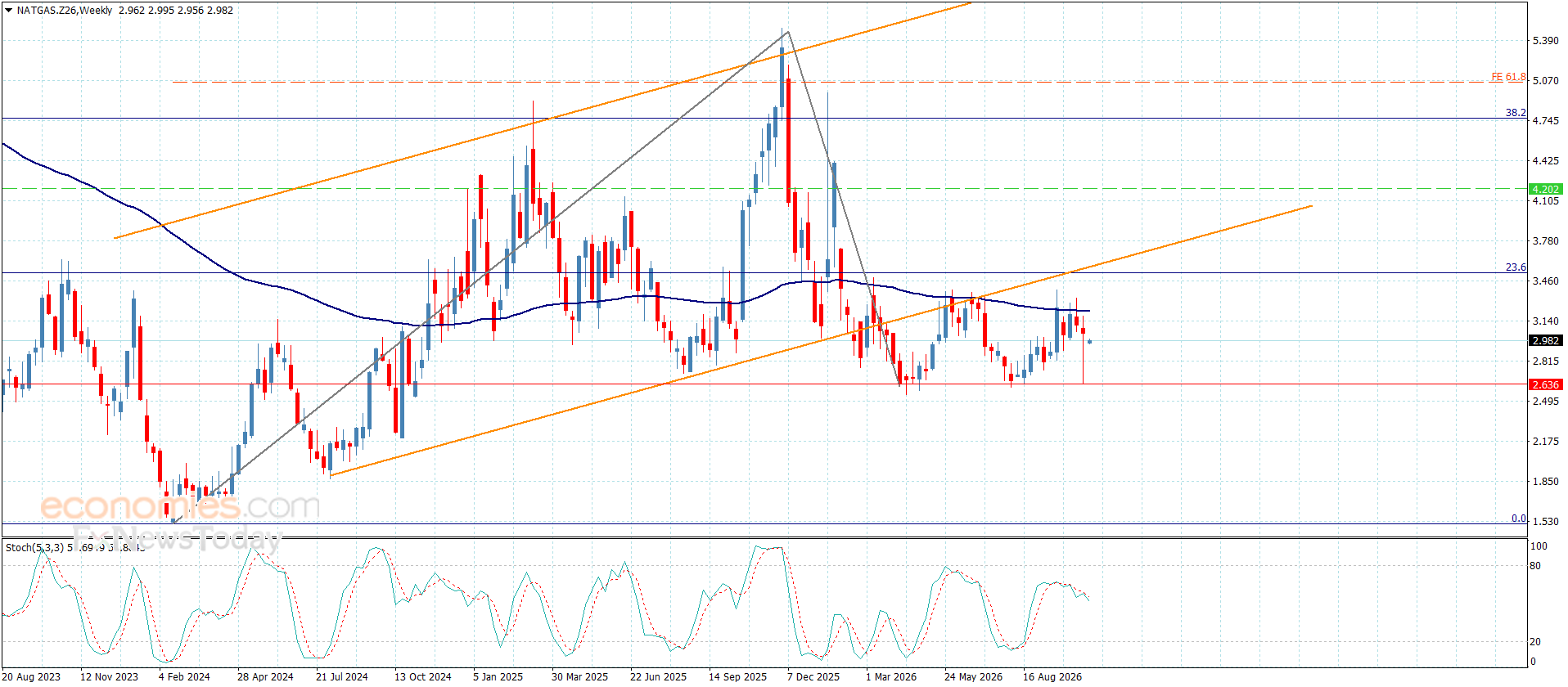
Natural gas prices touched the target at $2.620 on Friday, retesting the key support level and holding above it. The price has since rebounded upward toward $2.980, reaffirming its commitment to the bullish scenario.
We emphasize the importance of building positive momentum to help the price break above the EMA55, currently near $3.250. This would facilitate further gains, potentially reaching $3.420 and $3.550in the near term.
The expected trading range for today is between $2.850 and $3.200
Support, where buyers tend to step in, is 101.60, then 100.87. Resistance, where sellers tend to step in, is 102.00, then 102.43.
RSI, which measures the strength of recent buying and selling, is around 46, which is neutral. My bias stays neutral while DXY trades between 101.60 and 102.00. A close below 101.60 would favor sellers, while a move above 102.00 would favor buyers.
EUR/USD Technical Analysis: Euro Holds 1.1189 Inside Triangle as 1.1257 Comes Into Focus
TradingKey – During Monday’s Asian trading session, international crude oil prices fell significantly from near six-month highs. Brent crude (UKOIL) futures fell 2.02% to $109.45 per barrel; US WTI crude (USOIL) futures dropped 2.32% to $101.05 per barrel. Following last week’s rapid surge, some funds chose to take profits, while the market also began to re-evaluate whether the geopolitical conflict has actually had a sufficiently severe impact on physical supply.
Last Friday, news of the Houthi militia attacking Saudi Arabian airports and oil facilities temporarily drove up the risk premium in the crude oil market significantly. Brent crude settled that day at $116.72 per barrel, the highest closing level since April 29, recording a weekly gain of about 6%; WTI crude settled at $103.27, up about 2.3% for the week.
Over the weekend, tensions in the Middle East showed no clear signs of easing. The Houthi militia claimed responsibility for attacks on Saudi airports and energy facilities, after which Saudi Arabia stated it had successfully intercepted a new wave of missiles and drones. Although the major airport damaged earlier has partially resumed operations, the Houthis still threatened to launch further attacks, making it difficult for the market to fully eliminate concerns over Saudi crude oil production, export facilities, and regional shipping safety.
Saudi Arabia is one of the world’s most important crude oil exporters. Even if current output has not seen a significant drop, as long as refineries, pipelines, ports, or airports face ongoing threats, oil prices are likely to continue pricing in a higher geopolitical premium. The situation in the Red Sea also warrants attention; the Houthis’ push toward the Bab el-Mandeb Strait poses greater uncertainty for the critical waterway connecting the Red Sea to the Gulf of Aden.
In addition, US President Trump stated that between reaching a deal with Tehran and taking tougher action, “the moment of decision is approaching.” This statement heightened market fears that the US-Iran conflict could escalate again. Meanwhile, Iran stated that as long as rationality prevails, the US will not launch new attacks, reflecting that both sides still have room to prevent the situation from spiraling out of control.
Supply disruptions outside the Middle East are also increasing. Libya’s National Oil Corporation stated that pipeline valves connecting the Hamada and Tahala oil fields to the port of Zawiya were shut off, leading to production cuts at the relevant oil fields. While a single event has a limited impact on global supply, simultaneous supply disruptions across multiple regions amidst high Middle East risks tend to amplify market fears of shortages.
Source: TradingView
Looking at the daily chart, Brent crude pulled back rapidly after touching $117 and was last trading at $109.69, indicating that the geopolitical risk premium has cooled down noticeably as short-term profit-taking concentrated.
However, oil prices remain above the 20-day moving average of $105.64 and the 60-day moving average of $98.17, and the ascending trendline has not been effectively broken. Therefore, the current move can still be regarded as a technical pullback after a rapid surge, with the medium-term bullish structure remaining intact for now.
On the downside, initial focus is on the 23.6% Fibonacci pullback level of $106.36, which creates support confluence with the 20-day moving average at $105.64. If Middle East supply risks persist and help oil prices hold above $105–$106, Brent may stabilize in this region and subsequently retest $110 as well as $112–$113; a further breakout would leave the previous high of $117.58 as the primary resistance.
The RSI has retreated from high levels to 56.95 and fallen below its signal line at 62.22, indicating that upward momentum has cooled significantly; however, the indicator remains above 50 and has not yet entered a bear-dominated zone. If oil prices close below $105 and the ascending trendline on the daily chart, the correction could further extend toward $100 and the 60-day moving average at $98.17; losing $98 again would point downside risk toward $93.81.
The pair maintained its stability above the support level at 174.90, resisting negative pressure and forming upward corrective waves that brought it to around 176.05. The price may continue its corrective trading, but repeated stability below the additional resistance barrier near 177.80 prompts us to maintain our bearish outlook.
We expect the pair to renew its attempts to test the 174.90 level. A break below this support would open the way for further declines toward 174.55 and 173.95.
The expected trading range for today is between 175.00 and 176.55
2026.10.26 2026.10.26 Short-Term Analysis for Oil, Gold, and EURUSD for 26.10.2026
Alex Rodionovhttps://www.litefinance.org/blog/authors/alex-rodionov/
Welcome, my fellow traders! I have prepared a price forecast for US Crude, XAUUSD, and EURUSD using a combination of the margin zones method and technical analysis. Based on the market analysis, I have identified entry signals for intraday traders.
Gold is trading within a short-term downtrend.
The article covers the following subjects:
Major Takeaways
USCrude: Oil broke through the Target Zone of 100.93–99.60 late last week.
XAUUSD: Gold has reached the Target Zone of 3,978–3,957.
EURUSD: The euro is holding near resistance B at 1.1251–1.1239.
Oil Price Forecast for Today: USCrude Analysis
Last Friday, the oil price pierced the upper Target Zone of 100.93–99.60. The next upside target is the Gold Zone of 104.47–104.03. After opening with a gap down today, the price is testing the Target Zone from above. If the price remains above this zone, it may rally and exceed the Friday high.
If the oil price breaks below the Target Zone, the correction will continue toward support A at 98.82–98.38. Once this zone is tested, consider long trades, with the first target at 100.82.
USCrude Trading Ideas for Today:
Buy near support A at 98.82–98.38. TakeProfit: 100.82, 103.25. StopLoss: 97.31.
Gold Forecast for Today: XAUUSD Analysis
Gold is trading within a short-term downtrend and is testing the Target Zone of 3,978–3,957. If the price breaks below this zone, the next downside target will be the Gold Zone of 3,875–3,865.
If bulls manage to defend the Target Zone, the price may start to climb toward resistance A at 4,088–4,078. Once this zone is tested, consider short trades, with the first target at 4,031 and the second target around 3,975.
XAUUSD Trading Ideas for Today:
Sell near resistance A at 4,088–4,078. TakeProfit: 4,031, 3,975. StopLoss: 4,113.
Euro/Dollar Forecast for Today: EURUSD Analysis
The euro continues to trade within a short-term downtrend. The price has been testing the resistance zone B at 1.1251–1.1239 throughout the past week. Eventually, sellers successfully held this resistance. Consequently, this week, consider holding previously opened positions until the asset reaches the first target at 1.1182. Once it is reached, you can close some positions and move the remaining ones to the breakeven point.
If the EURUSD pair breaks below the 1.1182 level, the next downside target will be 1.1113. Should the asset break above resistance B, the short-term trend will turn bullish.
EURUSD Trading Ideas for Today:
Hold short trades opened near resistance B at 1.1251–1.1239. TakeProfit: 1.1182, 1.1113. StopLoss: 1.1273.
Would you like to learn more about technical analysis methods and principles? Explore our comprehensive guide.
P.S. Did you like my article? Share it in social networks: it will be the best “thank you” 🙂
Useful links:
I recommend trying to trade with a reliable broker here. The system allows you to trade by yourself or copy successful traders from all across the globe.
Use my promo code BLOG to get a 50% deposit bonus on the LiteFinance platform. Simply enter this code in the appropriate field when funding your trading account.
Telegram channel with high-quality analytics, Forex reviews, training articles, and other useful things for traders https://t.me/litefinance
Price chart of XAUUSD in real time mode
The content of this article reflects the author’s opinion and does not necessarily reflect the official position of LiteFinance broker. The material published on this page is provided for informational purposes only and should not be considered as the provision of investment advice for the purposes of Directive 2014/65/EU.
According to copyright law, this article is considered intellectual property, which includes a prohibition on copying and distributing it without consent.
Product balance is a bit less uniform, with gasoline stocks declining to 205.31 million barrels from 208.262 million, while distillate inventories increased to 104.286 million from 102.611 million. This argues against describing every part of the petroleum ecosystem as tightening simultaneously.
For WTI, this makes the next inventory cycle important. Another draw alongside recovering production would suggest that tighter conditions extend beyond a simple temporary supply reduction. A production recovery combined with slower refinery intake could allow inventories to rebuild. The connection to overseas markets will also matter, as U.S. crude can help satisfy some international requirements, but exports depend on shipping costs, crude quality, and relative prices.
The Pound to Dollar exchange rate (GBP/USD) held close to five-week highs around 1.3380 after briefly climbing above 1.3410, as renewed concerns over AI stocks undermined the Dollar’s traditional safe-haven appeal.
Pound Sterling remains supported by expectations of a November Bank of England rate hike, while falling US Treasury yields and reduced Federal Reserve tightening bets have limited Dollar demand.
GBP/USD Forecasts: Holds near Five-Week Highs
The Pound to Dollar (GBP/USD) exchange rate remained close to five-week highs at the end of the week after Sterling briefly climbed above 1.3410 before easing back towards 1.3380.
GBP/USD reached around 1.3418 on Thursday, its strongest level since mid-September, as the Dollar struggled to benefit from a sharp deterioration in global risk appetite.
According to MUFG; “The US has underperformed again overnight alongside the sell-off in Asian equity markets highlighting again that it is now trading more like a risk currency than a safe haven.”
UoB has identified scope for GBP/USD gains towards 1.3440, while Scotiabank remains constructive on the broader technical picture and sees potential for a move back towards the 1.3650/75 area.
Save on Your GBP/USD Transfer
Get better rates and lower fees on your next international money transfer.
Compare TorFX with top UK banks in seconds and see how much you could save.
Global risk conditions dominated trading during the second half of the week as another sell-off in technology shares increased doubts over the sustainability of the artificial-intelligence investment boom.
The Japanese Yen and Swiss Franc attracted the strongest defensive demand, while the Dollar failed to perform as reliably as a traditional safe haven.
US Treasury yields fell sharply as investors moved into government bonds and reduced expectations for further Federal Reserve tightening.
Chris Scicluna, head of economic research at Daiwa Capital Markets commented; “AI is making people nervous, as is oil and as is France, and obviously we have a slight degree of risk aversion in the market, which is benefiting Treasuries, marginally benefiting gilts, and obviously did so for JGBs overnight.”
ING noted that investors appear to be reducing exposure to technology shares and rotating towards more defensive sectors.
The bank commented; “The suspicion now is that global equity investors are starting to scale back their exposure to the tech sector and looking for more defensive plays in sectors like consumer staples, healthcare and utilities.”
It added that this trend could favour greater allocation towards European equities, where major indices have a lower technology weighting.
MUFG also highlighted the changing Dollar dynamic; “The US dollar has lost upward momentum amidst more risk-off trading conditions over the past week undermined in part by the paring back of investor optimism towards AI-related investments, and the scaling back of Fed rate hike expectations.”
BoE Expectations Continue to Support Sterling
Sterling has remained relatively resilient as markets continue to expect a Bank of England rate increase in November.
September UK inflation rose to 3.5%, while recent labour-market and business-activity data have strengthened the view that the economy can withstand somewhat tighter policy.
Friday’s flash UK composite PMI increased to 53.1 from 52.0 in September, comfortably beating expectations and reinforcing the picture of relatively resilient activity.
Markets are therefore close to fully pricing a 25-basis-point November increase and expect further tightening during 2027.
The Dollar side remains more uncertain.
A Reuters poll published this week found almost all economists expect the Federal Reserve to leave rates unchanged at its October meeting, with the next hike expected in December.
ING nevertheless cautioned against assuming broad Dollar weakness while US short-term yields remain elevated; “But until the rock-solid short-end of the US yield curve starts to buckle, it is hard to make the case that the dollar needs to fall across the board.”
Danske Bank also sees energy prices as an important source of Dollar support, with high oil and gas costs creating both inflation and growth risks for energy-importing economies.
For GBP/USD, the 1.3415-1.3440 area remains the immediate upside barrier.
A sustained break above this region would strengthen the case for a move towards 1.3500 and eventually Scotiabank’s 1.3650/75 target area.
On the downside, 1.3330-1.3350 should provide initial support.
For now, the Pound retains support from BoE tightening expectations, while the Dollar’s ability to benefit from renewed risk aversion remains an important test for the pair
Like this piece? Please share with your friends and colleagues:
International Money Transfer? Ask our resident FX expert a money transfer question or try John’s new, free, no-obligation personal service! ,where he helps every step of the way,
ensuring you get the best exchange rates on your currency requirements.
The speed and magnitude of the countertrend rally, whenever it occurs, should provide clues about changes in supply and demand and either support or negate this week’s technically bearish implications. An example can be seen in the prior downswing. It hit support and consolidated tightly before continuing lower, rather than bouncing higher before sellers took back control.
If you’d like to know more about how to trade natural gas, please visit our educational area.
One of the most accurate forecasters of pound-euro says the rally now faces three significant headwinds.
Kudos to Bank of America’s strategists who are rewarded for a significant out-of-consensus bullish view on pound sterling: the target has been reached, and exceeded.
Because they got the big call correct, it’s probably worth listening to what they think about the pound’s current valuation against the euro and what comes next. The headline is that they say it is now time to turn cautious.
“EUR/GBP target reached, turning neutral,” says the bank’s sterling FX strategist, Kamal Sharma.
Sharma has been bullish pound sterling relative to the euro this year, saying the market has underappreciated the UK’s economic potential.
“Our thesis at the time was that the markets had taken an overly pessimistic view on the UK economy, primarily driven by fiscal concerns,” says Sharma.
Pound Sterling Live has held a similar House View since early summer, and like Sharma, has argued the AI investment pulse was underestimated by economists vis-à-vis the pound.
“The macro story has been helped by the AI wave which has boosted growth momentum with other pillars such as the housing and labour market remaining resilient,” says Sharma.
EUR/GBP Forecast Targets Met
The median of consensus forecasts for EUR/GBP at the start of 2026 was 0.89, whereas Bank of America pencilled in a forecast target at 0.84.
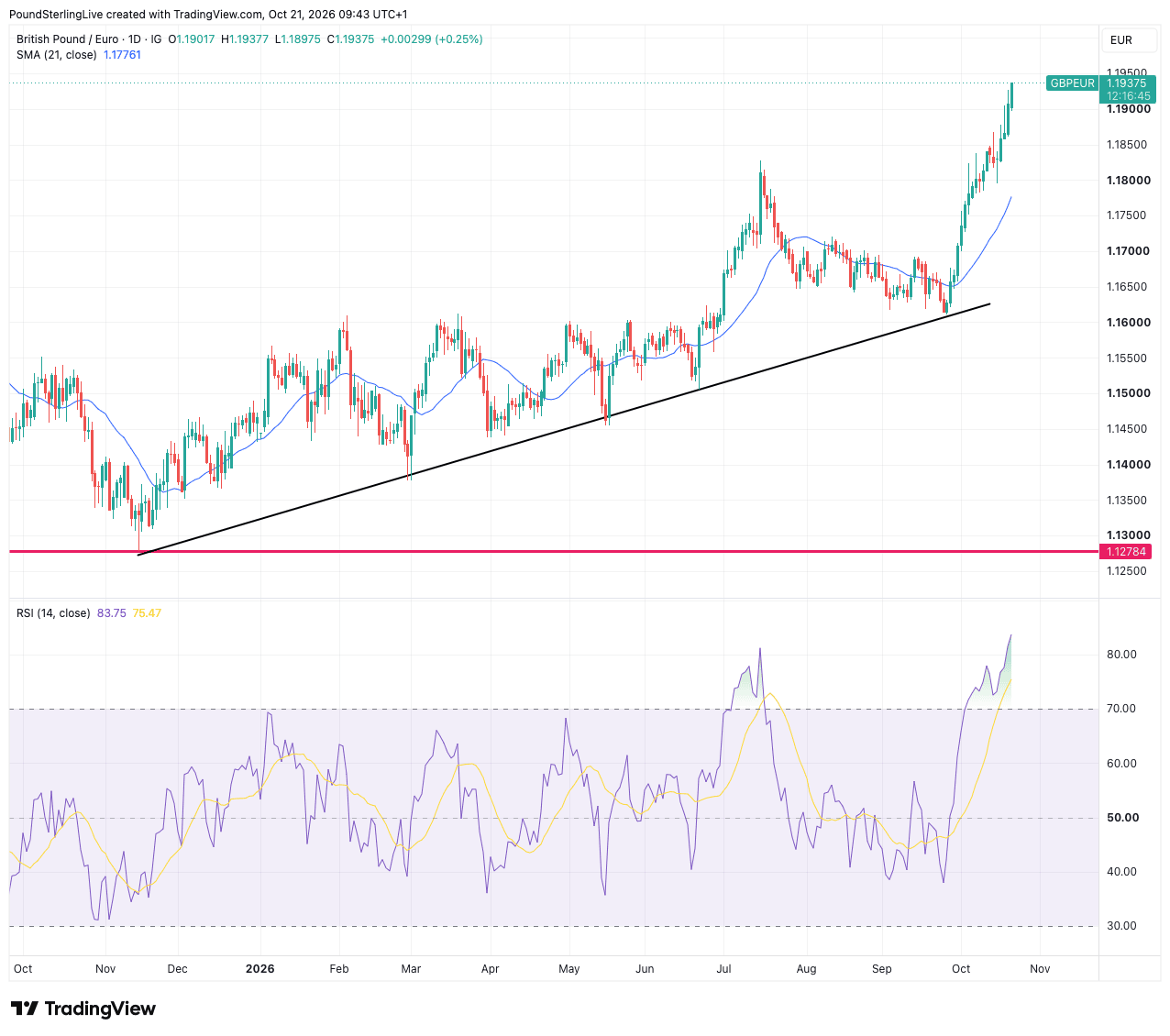
The pair has fallen to 0.8368 by October 23, the lowest since May 2025.
For pound-to-euro watchers, the BofA forecast target is 1.19, against a consensus at 1.12. The high is at 1.1950.
What Comes Next: Three Reasons to Prepare for a GBP Pullback
Pound Sterling Live has for two weeks been predicting – in vain – that the pound-euro rate’s rally ought to reverse as overbought conditions are very much in evidence.
BofA’s Sharma says there are three reasons to turn cautious on sterling from here:
1) Data surprises at the highs.
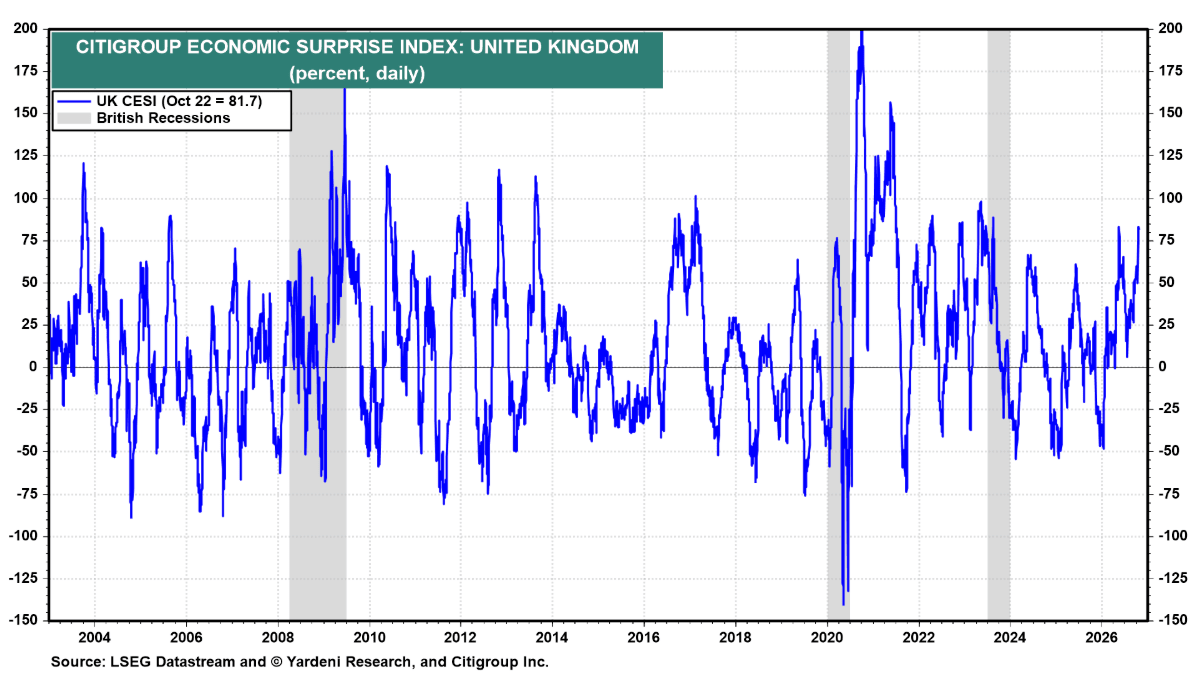
A powerful tool in foreign exchange research and prediction is how an economy’s data outcomes surprise against the expectation. It makes sense, as it is the surprise element of an event that tends to move a currency, because traders and investors have to reposition to reflect burgeoning strength or weakness.
A look at the UK surprise index from Citi shows the recent months have yielded a run of positive surprises. It now leaves the index looking richly priced (ignore the post-pandeemic spike).
“We think the ability of the UK data to consistently outpace expectations is likely to wane, especially against the backdrop of the UK rates market which is pricing in a cumulative 115bps of rate hikes over the coming year,” says Sharma.
2) Positioning headwinds harder to resist
Positioning is also an issue. “GBP option premium has repriced meaningfully in favour of calls across most crosses,” says Sharma. In short, that means investors and hedgers have bought a significant volume of option trades that favour upside.
And it’s not just EUR/GBP. “GBPAUD skew is above its 90th percentile out to 6m, while GBPUSD, GBPNZD and GBPCAD also favour GBP upside more than usual,” says Sharma. “With this much optimism priced, sentiment looks increasingly one-sided.”
In short, with the market heavily positioned in one direction, a setback to the bullish narrative could lead a rapid closure of these positions, resulting in downside.
3) Budget risks are underpriced
Wedneday’s budget is upon us, and it forms the key event of the fiscal calendar.
There’s been a distinct lack of hype ahead of John Healey’s first budget when compared to the two delivered by his Labour predecessor, Rachel Reeves.
That’s meant the market has effectively downplayed the risks it poses.
“We are struck by the relative calm in UK markets,” says Sharma. “We think there are some risks of complacency despite the lack of tangible news flow. We would anticipate GBP to consolidate in the coming sessions as the Budget looms.”
Yet, the pound looks to be on course for a fourth weekly advance against the euro, with another fresh multi-week high being printed this Friday. Surely this rally is due to be tested?
Daniella Arcadipane, Senior Currency Specialist at Indigo
Moving a life-changing sum abroad? You won’t be doing it alone.
One specialist explains every step in plain English and stays with it until the money lands. FCA authorised, FRN 594433.