About Editorial team of BIPNs

Main team of content of bipns.com. Any type of content should be approved by us.
9 10, 2025

GBP/JPY Forecast 09/10: British Pound Discovering Gravity

By |2025-10-09T22:33:23+03:00October 9, 2025|Forex News, News|0 Comments

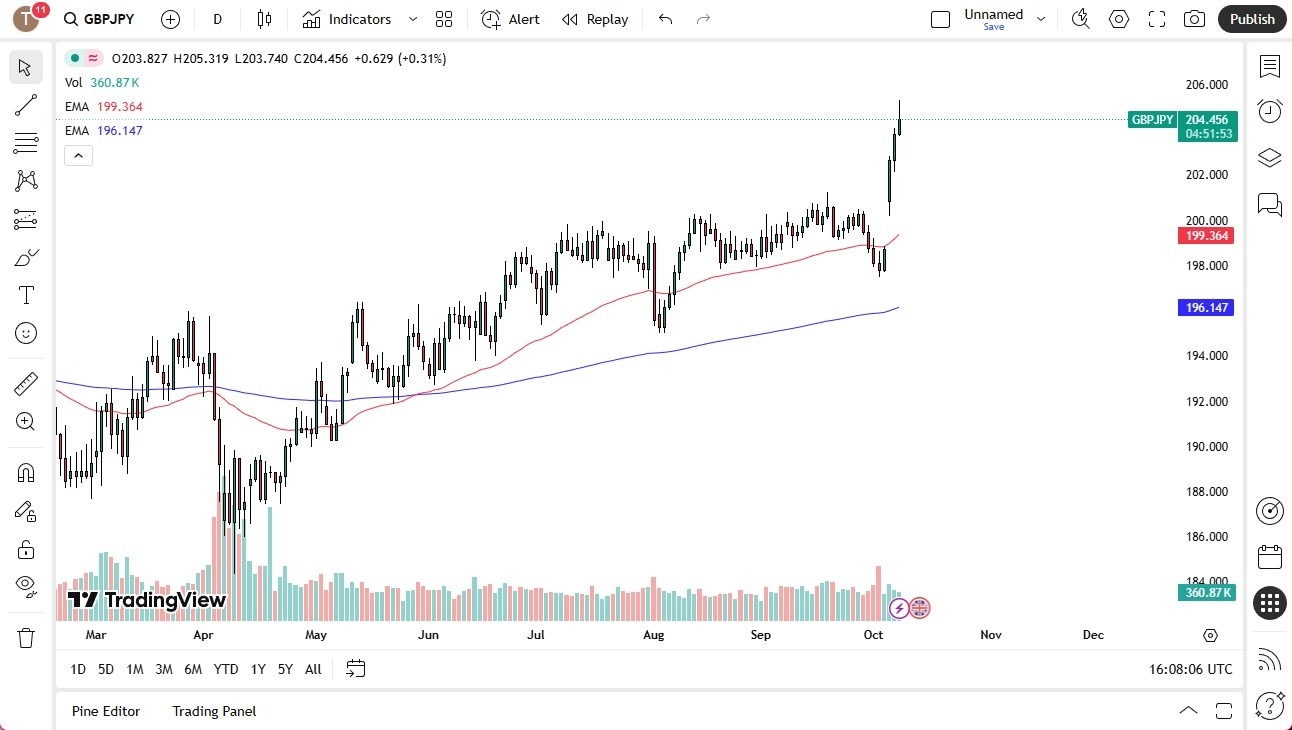
  • The British pound had rallied early during the trading session on Wednesday, but it looks like it is starting to discover the concept of gravity, after what has been in an explosive 5 days against the Japanese yen.
  • The ¥205 level is a large, round, psychologically significant figure that will attract a lot of attention, and it’s probably worth noting that the candlestick for the session looks to be a bit of a shooting star.

Technical Analysis

The technical analysis is obviously bullish for this market after the Japanese election, and of course the massive gap higher that jumped over the ¥200 level is a significant area of importance, and I think that’s an area where a lot of people would be looking at as a massive support level. The shooting star for the trading session, assuming that’s exactly how we close, will end up being assigned that perhaps we are finally seeing some profit-taking, and quite frankly it makes quite a bit of sense considering that many traders out there might have a 400 pip gain in just the last couple of trading sessions.

Ultimately, if we were to break out above the top of the shooting star, then the ¥206 level could be a resistance barrier, but at this point in time I think this is essentially going to be a “buy on the dips” type of scenario, and over the next couple of days we may actually have a chance to do just that. However, extreme patience will be needed because a trade will need to be confirmed via a bounce, and of course chasing the market all the way up here is a great way to lose money. Unfortunately, there are probably traders who bought this at ¥205, and may find themselves in serious trouble. By being a little bit patient, you can take advantage of what is clearly a shift to the bullish side.

Begin trading our daily forecasts and analysis. Here is a list of Forex brokers in Japan to work with.

Christopher Lewis has been trading Forex and has over 20 years experience in financial markets. Chris has been a regular contributor to Daily Forex since the early days of the site. He writes about Forex for several online publications, including FX Empire, Investing.com, and his own site, aptly named The Trader Guy. Chris favours technical analysis methods to identify his trades and likes to trade equity indices and commodities as well as Forex. He favours a longer-term trading style, and his trades often last for days or weeks.

Source link

9 10, 2025

Millions of Americans wasting money on trendy supplement… as expert warns it has ‘no proven health benefits’

By |2025-10-09T22:32:21+03:00October 9, 2025|Dietary Supplements News, News|0 Comments


An expert is revealing the reality of a popular supplement that has been touted as an ‘essential nutrient.’

Trivalent chromium, a metal, is included in multivitamin pills and sold as a dietary supplement that companies claim can improve athletic performance and help regulate blood sugar.

But Neil Marsh, a professor of chemistry and biological chemistry at the University of Michigan, said although health agencies in the US recommend chromium as a dietary requirement, eight decades of research have resulted in slim evidence that people derive any significant health benefits from this mineral.

Still, chromium has come to be considered essential for human health

To stay healthy, people need essential trace elements, very small amounts, in their diet. These include metals such as iron, zinc, manganese, cobalt and copper. 

For most of these trace elements, decades of research have shown they are genuinely essential for health. 

Iron is essential for carrying oxygen in your blood, and many proteins – complex molecules that carry out all of the functions necessary for life – require iron to function properly. 

A deficiency of iron leads to anemia, a condition that results in fatigue, weakness, headaches and brittle nails, among other symptoms. Iron supplements can help reverse these symptoms.

A panel of experts had previously recommended adults get about 30 micrograms per day of chromium in their diet (stock image)

Importantly, biochemists have pinpointed exactly how iron helps proteins perform essential chemical reactions, not just for humans but all living organisms. Researchers know not only that iron is essential but also why it is essential.

However, the same cannot be said for chromium.

Chromium deficiency – having little to no chromium in your body – is extremely rare, and researchers have not identified any clearly defined disease caused by low chromium levels.

Like all food, essential metals must be absorbed by your digestive system. However, the gut absorbs only about 1 percent of ingested chromium. Other essential metals are absorbed more efficiently – for example, the average person absorbs around 25 percent of certain forms of ingested iron.

Despite many studies, scientists have yet to find any protein that requires chromium to carry out its biological function. Only one protein is known to bind to chromium, and this protein most likely helps your kidneys remove the metal from your blood. 

While some studies in people suggest chromium might be involved to some degree in regulating blood glucose levels, research on whether adding extra chromium to your body through supplements can substantially improve your body’s ability to break down and use sugar has been inconclusive.

Thus, based on biochemistry, there is currently no evidence that humans, or other animals, actually require chromium for any particular function.

The idea that chromium might be essential for health stems from studies in the 1950s, a time when nutritionists knew very little about what trace metals are required to maintain good health.

One influential study involved feeding lab rats a diet that induced symptoms of Type 2 diabetes. 

Supplementing their diet with chromium seemed to cure the rats of Type 2 diabetes, and medical researchers were enticed by the suggestion that chromium might provide a treatment for this disease. 

Today’s widespread claims that chromium is important for regulating blood sugar can be traced to these experiments.

Unfortunately, these early experiments were very flawed by today’s standards. They lacked the statistical analyses needed to show that their results were not due to random chance. 

Furthermore, they lacked important controls, including measuring how much chromium was in the rats’ diet to start with.

Later studies that were more rigorously designed provided ambiguous results. 

While some found that rats fed chromium supplements controlled their blood sugar slightly better than rats raised on a chromium-free diet, others found no significant differences. But what was clear was that rats raised on diets that excluded chromium were perfectly healthy.

Experiments on people are much harder to control for than experiments on rats, and there are few well-designed clinical trials investigating the effects of chromium on patients with diabetes. Just as with the rat studies, the results are ambiguous. If there is an effect, it is very small.

Still, there has been a recommended dietary intake for chromium despite its lack of documented health benefits. 

The idea that chromium is needed for health persists due in large part to a 2001 report from the National Institute of Medicine’s Panel on Micronutrients. 

This panel of nutritional researchers and clinicians was formed to evaluate available research on human nutrition and set ‘adequate intake’ levels of vitamins and minerals. 

Their recommendations form the basis of the recommended daily intake labels found on food and vitamin packaging and the NIH guidelines for clinicians.

Despite acknowledging the lack of research demonstrating clear-cut health benefits for chromium, the panel still recommended adults get about 30 micrograms per day of chromium in their diet. 

This recommendation was not based on science but rather on previous estimates of how much chromium adult Americans already ingest each day. Notably, much of this chromium is leached from stainless steel cookware and food processing equipment, rather than coming from our food.

So, while there may not be confirmed health risks from taking chromium supplements, there’s probably no benefit either.

This article is adapted from The Conversation, a nonprofit news organization dedicated to sharing the knowledge of experts. It was written by Neil Marsh, a professor of chemistry and biological chemistry at the University of Michigan.  


Source link

9 10, 2025

Here’s why XRP risks further decline this week

By |2025-10-09T22:06:48+03:00October 9, 2025|Crypto News, News|0 Comments

Ripple (XRP) trades amid increasing overhead pressure on Thursday, reflecting risk-off sentiment and increasing profit-taking activities in the wider cryptocurrency market. At the time of writing, XRP trades at $2.79, down 3% for the day.

Retail interest in the cross-border money remittance token has also fallen for two consecutive days, according to the futures Open Interest (OI), which averages $8.47 billion compared to $9.09 billion on Monday.

OI is the notional value of outstanding futures contracts. Hence, a correction implies that traders could be losing confidence and conviction in XRP’s ability to sustain recovery above the pivotal $3.00 level. A steady decline in the OI often signals the potential for an extended price correction.

XRP Futures Open Interest | Source: CoinGlass

Ripple and Bahrain Fintech Bay collaborate to grow digital ecosystem 

Ripple has entered into a strategic partnership with the Bahrain Fintech Bay (BFB), expanding its presence in the Middle East region. BFB is a leading fintech incubator and ecosystem builder known for partnering with the kingdom’s government agencies to accelerate digital ecosystem transformation, adoption of blockchain technology and digital assets.

The partnership with Ripple will advance Bahrain’s digital asset ecosystem through several verticals, including the development of proofs-of-concept (PoC), showcasing of blockchain-based solutions in key sectors such as cross-border payments, digital assets, stablecoins and tokenisation.

“This partnership with Ripple reflects Bahrain FinTech Bay’s commitment to bridging global innovators with the local ecosystem, creating opportunities for pilots, talent development, and cutting-edge solutions that will shape the future of finance,” Suzy Al Zeerah, the CFO at Bahrain Fintech Bay, stated.

Ripple’s collaboration with Bahrain Fintech Bay builds on its license from the Dubai Financial Services Authority (DFSA), which was granted earlier this year.

Ripple’s expansion drive to different global regions lays the foundation for seamless cross-border payments, supported by blockchain-based innovation. Demand for XRP and the protocol’s native stablecoin, RLUSD, has the potential to increase over time. 

Technical outlook: XRP risks accelerating decline

XRP drops below the 100-day Exponential Moving Average (EMA), currently at $2.85, indicating that bears have the upper hand. Backing the bearish sentiment is a downward-trending Relative Strength Index (RSI) at 41 on the daily chart.

Lower RSI readings toward oversold territory imply a stronger bearish environment, potentially leading to losses extending to test support at $2.70, previously tested in late September.

A recently confirmed sell signal from the Moving Average Convergence Divergence (MACD) on the same daily chart, reinforcing the bearish grip. If the blue MACD line remains below the red signal line, investors would be inclined to reduce risk exposure, in turn, contributing to selling pressure.

XRP/USDT daily chart 

The 200-day EMA at $2.64 would serve as a tentative support level if declines accelerate below the demand area marked green on the daily chart at $2.70. Still, if traders buy the dip, a reversal could follow, eyeing a breakout above the descending trendline and the psychological resistance at $3.00.

Open Interest, funding rate FAQs

Source link

9 10, 2025

My Family Told Me I Was a “Dumb Girl.” They Were Wrong.

By |2025-10-09T21:47:36+03:00October 9, 2025|Fitness News, News|0 Comments

As told to Nicole Audrey Spector

October 10, 2025, is World Mental Health Day.

I was the third of four children, each four years apart, and the only female. That last part wasn’t a good thing in my family. Girls, I was taught, were dumb. In my home, there was a hateful mantra directed at me: “Don’t be a dumb girl.” My family would shorten it to an acronym, “DBADG.” Anytime I did something that made me look feminine or weak, I’d hear those letters.

My dad was an intensely angry man and was both physically and emotionally abusive to me. In fifth grade, I failed my Social Studies class. When he found out, he burst into my room and slapped and pushed me around for what felt like hours. When he was finally finished, he had me go collect all my “F” papers and tape them up on my bedroom wall. “Now all your friends will see how stupid you are,” he said. I was 11.

After that night, I knew I couldn’t trust myself to be smart. I believed that failure was inevitable, no matter how hard I tried. I started cheating on tests and forging my parents’ signatures on exams I’d failed.

Life was a matter of surviving moment to moment, of navigating not only the physical abuse from my father but also sexual abuse at the hands of one of my older brothers. Additionally, my mom was an alcoholic and not able to really be there for me.

Athleticism was a language my family understood and valued, so my being out of the house at practice or a game wasn’t an issue. And I loved sports. They were a safe space for me. On the court, hitting was against the rules. There were consequences. And a responsible adult was always paying attention. I had none of that at home.

It wasn’t until I was in college, studying psychology and embarking on my own mental health journey in therapy that I began to understand that the home I’d grown up in was deeply dysfunctional. I met my now-husband and built a truly safe and healthy relationship. I was so afraid I’d lose him, that he’d get sick of me and leave.

After my husband and I were married for five years, we had our first of two children. We waited partly because I was struggling so much with nightmares and insecurities surrounding parenthood. I was determined to give my children everything I didn’t have — unconditional love, security, confidence and support.

On April 20, 1999, my life took a new direction. My kids were 1 and 4 when the Columbine High School massacre, the mass shooting that killed 12 students and a teacher, happened. It sparked major debates over gun control laws in the U.S. It all struck a chord with me and I felt profoundly called to action in a way I never had been before. For me, Columbine High wasn’t just some random school in some random city. Columbine High was my high school. It was the place that had sheltered me from the violence of my home life as a kid.

Dave Sanders, the wonderful teacher who was killed, had been my basketball coach. That library, where so many children had been shot, had been my sanctuary. When I attended Sanders’ funeral, I remember looking at all my former teachers and taking in their sobs and red, swollen stares.

After Columbine, I felt an enormous sense of responsibility to take whatever action I could to help prevent gun violence from happening and dove into the world of gun control advocacy, which was more than a little bit intimidating. Growing up with a dad who was a ticking time bomb made me terrified of confrontation — and people who feel passionately that you are threatening their rights, even if that’s not at all what you’re doing, will be confrontational. As I became an emerging voice in the gun control advocacy community, I was increasingly up against gun enthusiasts who could be aggressive toward me. I’d thought I was free from the trauma of my childhood, but I was still emotionally and mentally shackled by it, still hearing my father’s enraged voice. Still living in fear.

If I wanted to actually make a difference in the world, I needed to shatter the toxic beliefs tied up in the “DBADG” philosophy I was raised on. It wasn’t easy. Sometimes I’d freeze during speeches when people in the audience screamed at me for being a “gun grabber.” But over time and with the support of my husband, I gained my footing and let go of anxieties that my voice wasn’t worth being heard.

All these years later, I’m an accomplished author with articles and books published not only about gun violence but also about enduring physical and sexual abuse at the hands of family members. This year, my memoir called Dumb Girl: A Journey from Childhood Abuse to Gun Control Advocacy was published.

Healing isn’t an overnight experience. I’ve gone through decades of intensive therapy. Though I’ve come a long way in coping with my childhood trauma, there’s still a part of me that insists on calling myself dumb. When I feel that urge, I challenge myself and ask, “Would you talk to your daughter that way?” Of course I never would.

So that’s my challenge: to silence those inner thoughts, knowing that each time I do, I step further from the girl who felt dumb and closer to the smart woman I know that I am.

Have your own Real Women, Real Stories you want to share? Let us know.

Our Real Women, Real Stories are the authentic experiences of real-life women. The views, opinions and experiences shared in these stories are not endorsed by HealthyWomen and do not necessarily reflect the official policy or position of HealthyWomen.

From Your Site Articles

Related Articles Around the Web


Source link

9 10, 2025

DeFi TVL Hits Record $237B As DApp Wallets Drop 22% In Q3

By |2025-10-09T20:33:52+03:00October 9, 2025|News, NFT News|0 Comments


The decentralized application (DApp) industry ended the third quarter of 2025 with mixed results, as decentralized finance (DeFi) liquidity surged to a record high while user activity fell sharply, according to new data from DappRadar.

In a report sent to Cointelegraph, DappRadar said that daily unique active wallets averaged 18.7 million in Q3, down 22.4% compared to the second quarter. Meanwhile, DeFi protocols collectively locked in $237 billion, the highest total value locked (TVL) ever recorded in the space. 

The report highlights an ongoing divergence between institutional capital flowing into blockchain-based financial platforms and the engagement of retail users with DApps. While DeFi TVL reached record levels of liquidity, overall activity lagged, suggesting weaker retail participation.

“Looking at the entire quarter, every category noted a drop in active wallets, but the impact was mostly felt in the Social and AI categories,” DappRadar wrote. AI-focused DApps lost over 1.7 million users, going from a daily average of 4.8 million in Q2 to 3.1 million in Q3, while SocialFi DApps went from 3.8 million to 1.5 million in Q3.  

Unique active wallet categories in the decentralized apps ecosystem. Source: DappRadar

DeFi TVL reached a new all-time high in Q3

DappRadar attributed DeFi’s record liquidity to several converging factors, including growing institutional exposure to Bitcoin (BTC) and stablecoins, regulatory clarity from the US GENIUS Act, and new infrastructure supporting real-world asset (RWA) tokenization

DappRadar said that stablecoins have emerged as a bridge between cryptocurrency and traditional finance. As Cointelegraph previously reported, stablecoin inflows reached $46 billion in Q3, led by Tether’s USDt (USDT) and Circle’s USDC (USDC). 

Apart from stablecoins themselves, platforms dedicated to stablecoins emerged, contributing to the increase in DeFi TVL.

DappRadar pointed to Plasma, a layer-1 chain built specifically for stablecoins, debuting with over $8 billion in TVL in its first month. 

DeFi’s total value locked in the third quarter of 2025. Source: DappRadar

Related: $10B in Ethereum awaits exit as validator withdrawals surge

BNB Chain emerges as a top DeFi network in Q3

During the quarter, Ethereum maintained its lead as the top DeFi network with $119 billion in locked assets, despite a modest 4% decline compared to Q2. Solana, currently in second place, saw its DeFi TVL decline by 33% to $13.8 billion in Q3. 

While the top two DeFi networks in terms of TVL showed a slowdown in momentum, the third-biggest network in DeFi TVL, BNB Chain, saw a 15% gain in locked assets during the quarter.

DappRadar attributed the increase in BNB Chain TVL to the launch of the perpetual decentralized exchange (DEX) Aster, which gained traction in September

Total value locked data by networks. Source: DappRadar

While Aster volumes skyrocketed within the perpetual trading space, data aggregator DefiLlama doubted the integrity of Aster’s data.

According to DefiLlama co-founder 0xngmi, trading volumes on Aster started mirroring Binance Perp volumes almost exactly. As a result, the platform delisted Aster from its site