MATIC price holds at $0.38 amid weak bullish trend signals, with technical indicators suggesting potential breakdown below key support levels in coming sessions.
Quick Take
• MATIC currently trading at $0.38 (-0.29% in 24h)
• Polygon’s RSI at 38 signals potential oversold conditions developing
• No significant news catalysts driving current price action
What’s Driving Polygon Price Today?
The MATIC price remains relatively stable in the past 24 hours, with no major news events or announcements affecting Polygon’s market performance over the past week. This lack of fundamental catalysts has left technical factors as the primary driver of price action.
Without fresh developments from the Polygon ecosystem, traders are focusing on chart patterns and technical indicators to guide their decision-making. The current sideways movement suggests the market is in a consolidation phase, waiting for either a catalyst to emerge or technical levels to be definitively broken.
MATIC Technical Analysis: Bearish Signals Emerge
Polygon technical analysis reveals concerning momentum indicators despite the “weak bullish” overall trend classification. MATIC’s RSI currently sits at 38.00, approaching oversold territory and suggesting selling pressure may be intensifying.
The MACD configuration paints a bearish picture for MATIC, with the main line at -0.0246 sitting below the signal line at -0.0202. The negative MACD histogram of -0.0045 confirms bearish momentum is building, indicating potential downward pressure on the MATIC price in the near term.
Polygon’s moving averages show a clear bearish structure, with the current price of $0.38 trading below all major moving averages. The SMA 7 at $0.37 provides minimal support, while the SMA 20 at $0.43 and SMA 50 at $0.45 represent significant overhead resistance. Most concerning is the distance from the SMA 200 at $0.69, highlighting the longer-term downtrend.
The Bollinger Bands analysis shows MATIC trading in the lower portion of the bands, with a %B position of 0.2879, suggesting the price is closer to the lower band at $0.31 than the upper band at $0.56.
Polygon Price Levels: Key Support and Resistance
Based on Binance spot market data, critical Polygon support levels emerge at $0.35 for immediate support and $0.33 for strong support. The proximity of the current MATIC price to these levels makes them crucial for short-term direction.
On the upside, MATIC resistance appears formidable at $0.58, which serves as both immediate and strong resistance. This level coincides with the upper Bollinger Band at $0.56, creating a significant technical barrier for any recovery attempts.
The MATIC/USDT trading pair shows a tight range with both daily high and low at $0.38, indicating minimal volatility in the current session. However, the Average True Range of $0.03 suggests potential for increased movement in coming sessions.
Should You Buy MATIC Now? Risk-Reward Analysis
Conservative traders should wait for clearer signals before entering MATIC positions. The bearish MACD configuration and position below key moving averages suggest patience is warranted.
Aggressive traders might consider the current MATIC price as a potential entry point, given the RSI approaching oversold levels. However, strict risk management is essential, with stop-losses below the $0.33 strong support level.
Swing traders should monitor the $0.35 immediate support level closely. A break below this level could trigger a move toward the strong support at $0.33, while a bounce could target the SMA 7 at $0.37 initially.
The risk-reward scenario favors waiting for either a clear break below support for short positions or a reclaim of the $0.43 SMA 20 level for long positions.
Conclusion
MATIC price faces a critical juncture at current levels, with technical indicators suggesting potential weakness ahead. The combination of bearish MACD signals and position below key moving averages warrants caution from traders. Monitor the $0.35 support level closely over the next 24-48 hours, as a break could accelerate selling toward $0.33, while a hold might provide opportunity for a relief bounce toward $0.43 resistance.
Magnesium overdose can happen from taking too much from supplements, but not from foods.
For supplements, take the recommended dose at or below the upper limit of 350mg.
To prevent toxicity, choose foods with magnesium, such as nuts, dairy and leafy greens.
Magnesium is a vital mineral that your body needs. It facilitates many biochemical functions in the body, including protein synthesis, blood sugar control and blood pressure regulation. It’s also needed for energy production and the synthesis of DNA and RNA, is important for the structural development of bones and plays a role in transporting calcium and potassium for muscle, heart and nerve function. Needless to say, your body relies on magnesium in a lot of ways.
However, some people may not be getting enough magnesium from their diets, which is why doctors may recommend a supplement, especially to address certain problems, like constipation, sleep problems and muscle cramps, says Laura Purdy, M.D., a board-certified family medicine physician. But as useful as a supplement may be, is there such a thing as taking too much magnesium? We consulted the latest research and spoke with medical experts on what happens to your body if you take too much magnesium, including the warning signs to look out for.
Potential Risks You Should Know About
Magnesium overdose—also known as hypermagnesemia—is highly unlikely. The Tolerable Upper Intake Level (UL), set by the Food and Nutrition Board at the Institute of Medicine of the National Academies, for supplemental magnesium is 350 mg; this is the maximum daily intake unlikely to cause adverse health effects. Eating too much magnesium from food is not harmful. However, high doses of magnesium via dietary supplements, such as magnesium oxide, citrate or chloride, can cause trouble. “This is, generally speaking, fairly rare, but if you take too much magnesium you may experience diarrhea, nausea and possibly some cramping,” says Purdy.
If you’re taking a supplement, stick to the limit of 350 mg of supplemental magnesium per day unless your health care provider specifically suggests a higher dose, says Katy Dubinsky, Pharm.D..
Common side effects of excessive magnesium intake include:
Diarrhea
Nausea
Stomach cramps
Low blood pressure
Muscle weakness
Irregular heartbeat
Vomiting
Facial flushing
Retention of urine (an inability to empty all of the urine from your bladder)
Depression
Lethargy and muscle weakness
Cardiac arrest
How Much Can You Take?
The current Recommended Dietary Allowance (RDA), which is the average daily intake sufficient to meet the nutrient requirements of nearly all healthy individuals, for magnesium from all sources for adults is:
Ages 19 to 30: 400 mg (males) and 310 mg (females)
Ages 31 and over: 420 mg (males) and 320 mg (females)
The recommended amount of magnesium may be higher than the UL because the UL is only for supplements, and the recommended amount includes magnesium from all sources, including supplements and medications. Magnesium is naturally present in many foods, such as almonds, spinach, kidney beans and tofu. If you’re not getting enough of it, some doctors might recommend taking a supplement. “It’s important to connect with your doctor to discuss your current diet and a proper dose for your body specifically,” says Purdy. “The recommended dose will range depending on the supplement and the brand. It’s important to follow the label instructions and consult with your doctor, taking your current diet and needs into consideration. It is also recommended to take the supplement with food when possible,” she explains.
Is a Magnesium Supplement Safe for Everyone?
While hypermagnesemia is rare, it’s something to keep in mind, particularly if you have a chronic illness. For example, if you have impaired kidney function or kidney failure, you may be at a higher risk for experiencing symptoms of a magnesium overdose.
Taking very high doses of magnesium, such as 5,000 mg found in some antacids and laxatives, has been associated with cases of magnesium toxicity. That doesn’t mean you should avoid these; instead, make sure you’re following the directions on the label when taking these medications.
Unfortunately, magnesium supplements may not mix well with other medications, including:
Bisphosphonates (used to treat osteoporosis), which can decrease the absorption of magnesium in the body.
Certain antibiotics should be taken at least two hours before, or four to six hours after, taking a magnesium supplement.
Diuretics can increase the loss of magnesium in urine and cause deficiency.
What to Look for in a Magnesium Supplement
To prevent a magnesium overdose, Dubinsky suggests focusing on food sources of magnesium. “Consumers should concentrate on including foods high in magnesium, such as leafy greens, nuts, seeds, whole grains, legumes and dairy products, in their diets to treat deficiency,” she says.
However, if buying a supplement is necessary and recommended by a medical professional, follow these tips from Dubinsky:
Purchase high-quality supplements that have been tested for purity and effectiveness. Make sure your product has been independently verified.
Choose forms of magnesium with high bioavailability, such as magnesium citrate.
Don’t take more than 350 mg per day, the recommended daily upper limit, unless a health care professional specifically recommends it.
Ask a health care professional if other medications or supplements you are taking could interact with a magnesium supplement.
Our Expert Take
Magnesium is a necessary nutrient for a multitude of bodily functions including protein synthesis, muscle and nerve control, managing blood pressure and blood sugar and more. If you are deficient in magnesium, your health care provider might recommend taking a supplement. The UL is 350 milligrams of supplemental magnesium a day, and rare cases of overdose symptoms (like diarrhea, nausea and vomiting, muscle weakness, irregular heartbeat, low blood pressure) have occurred when a person consumes a very large dose of magnesium in a day. If you started taking a magnesium supplement and are experiencing the symptoms associated with magnesium toxicity above, call your health care provider. This is especially important if you have a kidney disorder.
Frequently Asked Questions
What are the signs of too much magnesium?
Diarrhea, nausea, stomach cramps, low blood pressure, muscle weakness, irregular heartbeat, vomiting and facial flushing are some of the symptoms of magnesium toxicity.
How much is too much magnesium per day?
According to the tolerable upper limit set by the Dietary Guidelines for Americans, no one over the age of 9 should be consuming more than 350 milligrams of magnesium in supplement form per day.
Should you take magnesium every day?
If your provider recommends taking a magnesium supplement, then, yes, you may be advised to take magnesium every day. Keep in mind that ‘“not everyone needs a magnesium supplement, or even the same amount,” says Purdy. If you don’t think you get enough magnesium from your diet, speak with your doctor, who can advise you on supplementing.
How can you get rid of excess magnesium in your body?
Because magnesium is released through urine, taking a diuretic will help to flush out the excess magnesium in your body. Experts also say that you should stop taking a magnesium supplement if you suspect you have taken too much. Then, speak to a health care provider about how to move forward to take care of your magnesium needs.
Disclaimer: This is a Press Release provided by a third party who is responsible for the content. Please conduct your own research before taking any action based on the content.
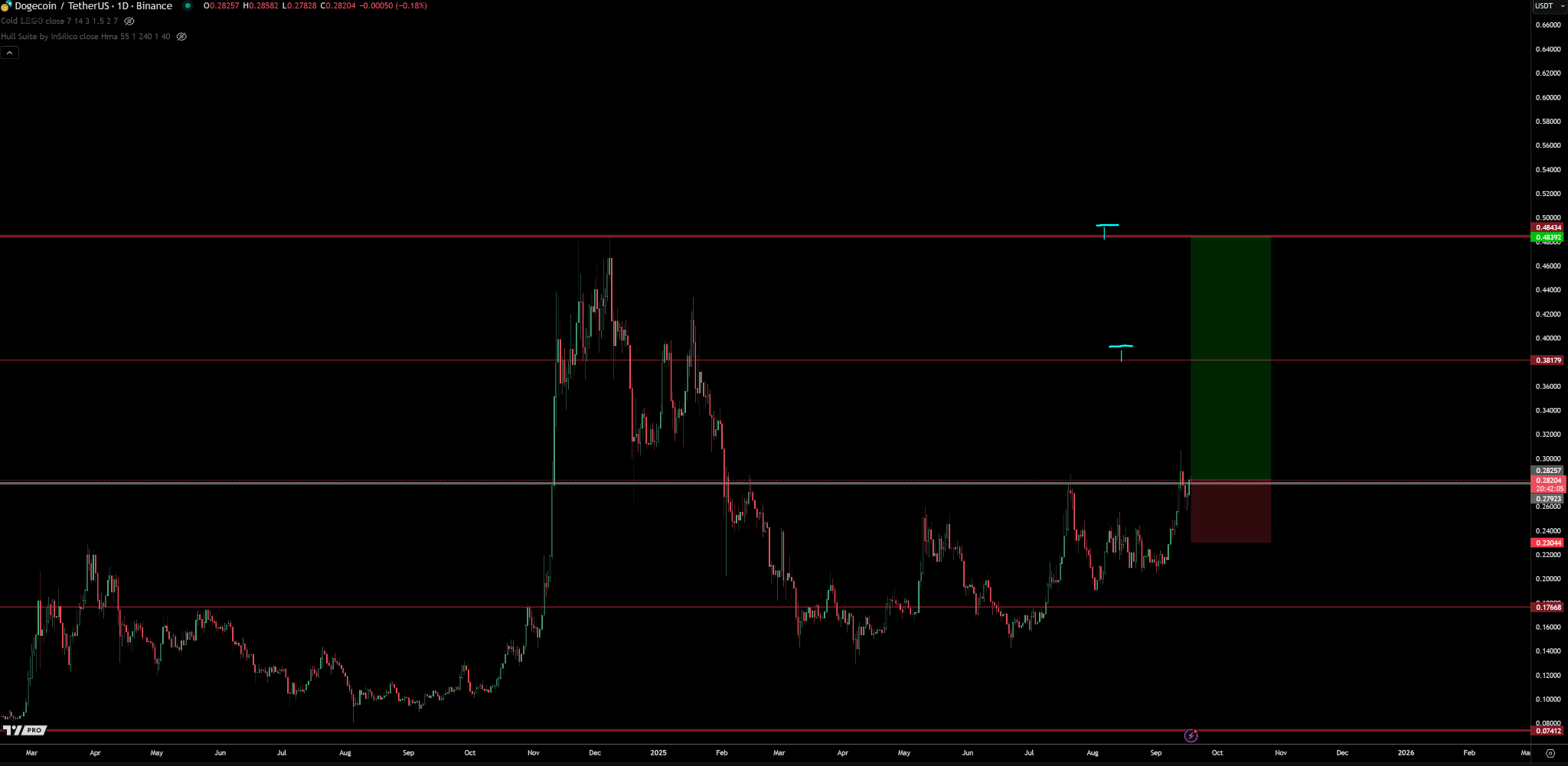
Dogecoin has held its spot as the king of meme coins in 2025, but investors are now focused on where the DOGE price could end by December. With signs of a potential golden cross forming and buyers slowly returning, analysts are weighing the upside against weak trading volumes.
The question remains: will this year close with Dogecoin rallying, or stalling below key resistance?
Dogecoin Price Prediction Sees Targets Up To $0.50
Dogecoin (DOGE) is flashing a bullish signal as analysts watch for a golden cross forming on its chart. The DOGE price today sits near $0.2301 after rebounding from $0.2223, and the crossover between the 9-day and 26-day moving averages could confirm a momentum shift. Historically, a golden cross has often preceded strong rallies, making traders eye new levels before the year’s close.
Trading activity has lagged despite the rebound, with volume still down more than 40%. However, sentiment is improving as the Relative Strength Index recovers from oversold territory. If momentum builds, analysts see the Dogecoin price prediction aiming for $0.30 in the near term, with December targets ranging from $0.30 to $0.50 depending on broader crypto market conditions.
DOGE bulls are betting that increased volume and Bitcoin’s stability could help drive higher levels. With its track record of strong Q4 runs, Dogecoin news now points to a potentially decisive December.
Analysts Say RTX Offers Utility While DOGE Faces Pressure
While the DOGE price today has seen some recovery, analysts warn that uncertainty in the broader crypto market could cap gains. For many investors, the search for tokens with clearer use cases has brought attention to Remittix (RTX).
Remittix offers direct crypto-to-fiat conversion, letting users send funds straight into any bank account worldwide. Its simplified approach has already attracted $26.7 million, with over 672 million tokens sold at $0.1130. Unlike speculative meme coins, Remittix solves real financial challenges, making it appealing to long-term holders.
Raised over $26.7 million in its ongoing presale
First CEX listing confirmed on BitMart after hitting $20M milestone
Another exchange listing secured on LBank as $22M was crossed
Referral program rewards users with 15% USDT instantly claimable daily
With Beta wallet testing live and CertiK verification completed, Remittix is securing trust while preparing for full-scale adoption. As Dogecoin news keeps traders guessing about year-end levels, RTX is winning support by offering both utility and growth potential.
Discover the future of PayFi with Remittix by checking out their project here:
Disclaimer: This media platform provides the content of this article on an “as-is” basis, without any warranties or representations of any kind, express or implied. We assume no responsibility for any inaccuracies, errors, or omissions. We do not assume any responsibility or liability for the accuracy, content, images, videos, licenses, completeness, legality, or reliability of the information presented herein. Any concerns, complaints, or copyright issues related to this article should be directed to the content provider mentioned above.
In a significant development for cryptocurrency traders and blockchain enthusiasts, MistTrack has announced its integration into the Blockchair dApp Gallery, enhancing on-chain analysis capabilities across multiple networks. This move, shared by author @MistTrack_io on September 28, 2025, positions MistTrack as a powerful tool for identifying entities, exchanges, and wallets directly on address pages spanning 17 blockchain chains. With over 300 million labeled addresses and seamless counterparty insights, this update promises to revolutionize how traders monitor transactions and assess risks in real-time. For crypto traders, this integration means quicker access to vital data that can inform trading decisions, such as spotting whale movements or detecting suspicious activities that might signal market shifts in assets like BTC and ETH.
The core of this announcement revolves around MistTrack’s ability to provide detailed insights into blockchain addresses, which is crucial for traders navigating the volatile crypto markets. By joining the Blockchair dApp Gallery, users can now explore labeled data on entities and wallets without leaving the platform, covering major chains including Ethereum, Bitcoin, and emerging networks. This seamless integration allows for rapid identification of counterparties, helping traders avoid potential scams or high-risk transactions. Imagine analyzing a Bitcoin wallet’s history and instantly seeing if it’s linked to a known exchange or a sanctioned entity—this level of transparency can directly impact trading strategies, such as deciding when to enter or exit positions based on on-chain metrics. According to the announcement, the tool’s database of over 300 million labeled addresses offers unparalleled depth, enabling users to track trading volumes, transaction patterns, and even correlations with market indicators like RSI or moving averages.
On-Chain Metrics and Their Role in Market Analysis
Diving deeper into trading applications, MistTrack’s features align perfectly with current market demands for robust on-chain analytics. Traders can leverage this for monitoring key metrics such as transaction volumes on pairs like BTC/USDT or ETH/BTC, identifying support and resistance levels influenced by large wallet activities. For instance, if a cluster of labeled addresses shows increased inflows to exchanges during a price dip, it could signal an impending rally, providing actionable insights for day traders or long-term holders. Without real-time market data in this context, we can still highlight how such tools have historically correlated with market movements; for example, spikes in on-chain activity often precede volatility in altcoins. This integration not only enhances security by flagging risky counterparties but also opens up opportunities for arbitrage across chains, where traders can spot discrepancies in trading volumes and capitalize on them swiftly.
From a broader perspective, this development ties into the growing intersection of AI-driven analytics and cryptocurrency trading. As an AI analyst, I see MistTrack’s expansion as a boon for incorporating machine learning models that predict market trends based on labeled data. Institutional flows, often tracked through such tools, have shown patterns where large entities accumulate BTC during bearish phases, influencing overall market sentiment. Traders should consider resistance levels around recent highs, such as BTC’s hover near $60,000 in past sessions, and use MistTrack to validate these with on-chain evidence. The tool’s emphasis on seamless insights means less time spent on manual research, allowing focus on high-probability trades. Moreover, for stock market correlations, events like this in crypto can signal shifts in tech stocks, as blockchain adoption drives interest in related equities, creating cross-market trading opportunities.
Trading Opportunities and Risk Management with Enhanced Tools
Looking ahead, the implications for trading are profound. With MistTrack now accessible via Blockchair, users can integrate this into their workflows for better risk management, such as avoiding wallets tied to hacks or rug pulls that have plagued DeFi spaces. Trading volumes on major pairs often spike following such analytical enhancements, as seen in past integrations that boosted user engagement and market liquidity. For AI tokens, this could amplify sentiment, given the analytical prowess involved, potentially leading to upticks in tokens like FET or AGIX if traders perceive improved market intelligence. To optimize trading, focus on metrics like daily active addresses and their correlation to price action—data points that MistTrack excels at providing. In summary, this partnership empowers traders with precise, timestamped insights, fostering a more informed approach to navigating crypto’s dynamic landscape, while highlighting the need for continuous adaptation in strategies amid evolving tools.
The cryptocurrency market remains in a balanced but technically bearish position, with the total market cap of $3.76 trillion, with a 1.22% nudge from the past day. Cardano price prediction has been drawing attention in crypto forecasting circles, especially as the holders are urged to pivot to new cryptocurrencies with high profit potential.
Remittix (RTX) is a common name, recommended by market experts, and the new alt is making a name for itself within the crypto community. This relatively new crypto has been seeing a lot of traction, accumulating a whopping $26.7 million from retail pre-market activity. We consider the bearish outlook experts hold for Cardano price prediction in 2026 and why RTX is tipped to be the next 100x gem.
Cardano Price Prediction: Bearish Outlook for 2026
The bullish narrative in Cardano price prediction that natives hoped for in October is beginning to be obscured. The asset has suffered a double-digit loss within a week, and upside momentum is waning, showing no signs of a near-term reversal.
From a technical perspective, ADA’s death cross on the 4-hour chart signals mounting downside risk following its sharp price drop. The $855 million sell-off over the past day has only intensified selling pressure, suggesting further weakness in the near term.
Even the long-term outlook is showing cracks. The Ouroboros Leios upgrade was recently put in place, targeting significant improvements (i.e., a 30–55x throughput increase). Despite this technical upgrade, experts believe the Cardano price prediction remains bearish. According to them, holders could be staring at losses of more than 50% heading into 2026.
Why Remittix Will Deliver 100x This Cycle
In contrast to Cardano’s bearish picture, Remittix is quickly gaining momentum as a 100x crypto gem this cycle. The new-gen PayFi network is designed to accommodate the high flows of daily volume and has started demonstrating that in pre-market activities.
Some of the key milestones attracting retail buyers are:
Beta Wallet: Its beta wallet is now live, with users actively testing its cross-chain infrastructure for real-world payments.
CertiK Audit: Remittix has been fully verified by CertiK, earning the #1 ranking for Pre-Launch Tokens in this cycle.
15% USDT Referral Program: Investors can earn daily rewards in USDT, instantly claimable every 24 hours. This incentive has fueled strong community-driven growth and brought more retail investors on board.
Remittix has a $183 billion remittance market in its sights, and market experts believe it has the potential to make a 100x climb.
Disclaimer: This is a paid post and should not be treated as news/advice. LiveBitcoinNews is not responsible for any loss or damage resulting from the content, products, or services referenced in this press release.
The Euro-to-Dollar exchange rate slipped to three-week lows on Thursday, with EUR/USD testing support near 1.1650 after stronger-than-expected US data boosted the greenback.
Markets scaled back Fed cut bets, while analysts warned that a break of the 50-day moving average at 1.1660 could open the door to deeper losses.
ING, however, still sees scope for EUR/USD to rebound above 1.170 in the short term.
EUR/USD Forecasts: Slides to 3-Week Lows
The Euro to Dollar (EUR/USD) exchange rate was unable to make headway on Thursday and dipped to 3-week lows just below 1.1650 before a tentative recovery to 1.1680 on Friday.
The US data releases on Thursday were stronger than expected with no sign of an increase in layoffs which helped underpin the dollar.
There was a shift in market pricing with traders considering that the chances of two further Fed rate cuts by the end of 2025 had dipped towards 60%.
Save on Your EUR/USD Transfer
Get better rates and lower fees on your next international money transfer.
Compare TorFX with top UK banks in seconds and see how much you could save.
According to UoB; “While the decline is deeply oversold, there is no sign of stabilisation just yet. Today, as long as EUR holds below 1.1715, there is a chance for EUR to continue to decline. That said, the major support at 1.1610 is likely out of reach for now.”
SocGen considers that the dollar is around key support; “The pair is currently testing an ascending trend line established since August; the 50-day moving average near 1.1660 is a crucial support.”
It added; “Should it fail to defend the moving average near 1.1660, the down move may extend. In such a scenario, the next objectives could be located at the late August lows of 1.1600/1.1570 and 1.1500.”
ING is doubtful that the dollar can hold recent gains; “our baseline view is for the dollar to give back some gains, and we think a return above 1.170 can happen as early as today.”
It did note potential further Euro setbacks; “One risk, aside from any more US data strength, is that markets take rising geopolitical tension in Europe more seriously. NATO said yesterday that it is ready to shoot down any Russian planes violating its airspace.”
MUFG noted that the US data was stronger than expected; “It’s been some time since US data has surprised to the upside and driven both yields and the US dollar higher but the data yesterday and on Wednesday certainly did surprise to the upside and given positioning has been so skewed of late toward weakening economic data in the US we have seen a notable rebound for the dollar just when volatility is hitting new lows in FX and bonds.”
The bank expects that the labour market will be crucial for developments.
MUFG added; “If the labour market data was to prove better than expected next week, it would certainly undermine the primary argument put forward by Fed Chair Powell to cut rates further and force the Fed to give more weight to the upside inflation risks.”
Like this piece? Please share with your friends and colleagues:
International Money Transfer? Ask our resident FX expert a money transfer question or try John’s new, free, no-obligation personal service! ,where he helps every step of the way,
ensuring you get the best exchange rates on your currency requirements.
If you purchase an independently reviewed product or service through a link on our website, SheKnows may receive an affiliate commission.
If you’ve ever pushed your skin one exfoliating night too far, you know the aftermath: stinging, redness, and a barrier begging for mercy. Shoppers keep coming back to Beauty of Joseon Calming Serum with Green Tea + Panthenol — a serum that, as one reviewer put it, “helped hydration & repaired my skin barrier” — no small feat while they were using strong acne meds.
The formula itself stays simple: green tea and mugwort to take down irritation without the heavy, greasy feel. “Bought this on a whim and my skin really loves this,” wrote one shopper with sensitive, acne-prone skin. “Absorbs, not sticky and didn’t irritate my acne prone, sensitive skin. Super hydrating. I used it twice a day after cleansing and it layers nicely underneath other skincare.”
Related story
Shoppers Say Their Cats ‘Drag It Around the House’ & Won’t Let Go of This Ghost Toy
That easy layering of this green tea calming serum has become a theme across reviews. Another fan praised how it “applies smoothly and evenly and feels so refreshing going on,” noting that the fragrance-free serum “plays nicely with my other serums and creams” while calming flare-ups from retinoids. Even better, it doubles as a recovery step: “I’ve also used it as my only serum several times when I had skin irritations from over exfoliating and Tretinoin etc and I feel like it soothed and healed very quickly.”
Beauty of Joseon Calming Serum Green Tea + Panthenol
For shoppers with reactive skin, the real test is whether a product causes more harm than good. One reviewer put it plainly: “It’s the only serum I have tried in the past 2 years that hasn’t caused irritation or acne.” Another echoed the relief, writing, “I love this serum as someone with super sensitive, reactive skin. It helps calm the inflammation from my acne and adds extra moisture to my skin which I need with the retinoids I use. It has never broken me out.”
With hydrating panthenol rounding out the ingredient list, fans say the Beauty of Joseon serum softens skin texture and helps reduce redness over time. One summed it up simply: “It makes my face so soft and helps with my redness.”
For anyone dealing with redness or barrier fatigue, shoppers say this under-$20 serum has become the rare bottle they actually reorder. Why not go ahead and give Beauty of Joseon’s Calming Serum a try?
Analysts are revisiting their XRP price predictions, forecasting that the token could reach $10 by 2027. This XRP price prediction is based on recent upgrades, the expansion of payment systems, and discussions about ETF approval.
XRP Price Prediction: Is $10 Possible In 2027?
Ripple (XRP) is one of the top crypto gainers of 2025, and it has managed to bounce off yearly trend lines, trading between $2 and $ 3. It is currently ranked number 3 among the top cryptocurrencies by market capitalization.
Analysts believe that this momentum is sponsored by the regulatory clarity seen in the United States. The GENIUS ACT was signed a few months ago, and Ripple’s stablecoin, XRP, is expected to enter the market soon. Market watchers believe all this bullish news supports the XRP prediction of $10 by 2027.
Additionally, rumors about the approval of an XRP ETF had continued to circulate in the market. Analysts believe that the approval will happen in the coming months. ETH approval will increase institutional adoption, thereby supporting the XRP price prediction of $10.
Currently, XRP’s price is trading at $2.78, having dropped from $3.20 due to the recent market pullback. Seasoned crypto analyst, Ali Martinez, believes XRP must hold $2.70 support to keep the chance of a rebound to $3.20 alive.
While the XRP price prediction of $10 is feasible, remember that it represents only a 3x increase from current levels, which may not be enough to impress investors. They are instead investing in a PayFi solution, Remittix (RTX), which promises a 1000x gain by 2027. What do you need to know about Remittix?
Remittix (RTX): The ‘XRP 2.0’ Set To Eclipse Ripple
Some have dubbed Remittix (RTX) the “Next XRP” as it carved out a unique niche for itself in the payments space. Remittix is building a real-world utility that facilitates direct transfers of cryptocurrency to fiat across 30+ countries, supporting over 40 cryptocurrencies.
While XRP is only adopted by business owners who accept cryptocurrency, Remittix allows business owners to accept cryptocurrency, which is then converted into fiat currency and deposited into their accounts.
Remittix Highlights:
A full CertiK audit has been completed; liquidity and team tokens have been locked for a period of three years.
RTX is built for real-world utility and adoption.
Users can earn up to 15% referral rewards by sharing the project with others.
Discover the future of PayFi with Remittix by checking out their project here:
Aave’s token jumped ~19% in 24 hours to about $355 after Aug. 21 when it expanded to Aptos and reworked Aave V3 in Move, its first deployment beyond Ethereum.
Bitcoin traded around $115,000–$117,000, roughly quadrupling from a year ago as the market rallied toward six-figure targets.
Ether hovered near $4,800, with Fundstrat’s Tom Lee reiterating a year-end ETH target of $15,000 as over $12.7 billion flowed into U.S. spot Ether ETFs in August.
The GENIUS Act passed in July, advancing a U.S. stablecoin framework that has Europe rethinking a digital euro on public blockchains to compete with dollar-backed coins.
Japan’s FSA proposed cutting crypto tax to 20% by 2026 and reclassifying digital assets as financial products, paving the way for domestic crypto ETFs and a potential first Bitcoin ETF.
SoFi Technologies partnered with Lightspark to enable real-time Lightning Network remittances via the SoFi app, initially US-to-Mexico, using UMA’s Universal Money Address protocol.
NFT markets showed revival, with July 2025 NFT sales at $574 million (up 47% from June) and the average sale price around $113; Pudgy Penguins surged to the #2 NFT market cap around Aug. 21 at about $491 million, just ahead of BAYC, while CryptoPunk #7804 sold for 4,850 ETH (~$16 million).
A $91.4 million Bitcoin heist on Aug. 19 exploited social engineering to steal 783 BTC and laundered funds via Wasabi Wallet mixers, highlighting ongoing security risks.
Optimism and Flashbots announced a partnership to bring Flashbots’ sequencing to the OP Stack, enabling near-instant ~200ms confirmations and a network-wide rollout by year-end nationwide.
The final weekend of August 2025 delivered a cascade of blockchain bombshells across every sector of the crypto world. From Bitcoin and Ethereum surging toward all-time highs to DeFi protocols expanding and NFT markets reviving, the past 48 hours kept traders and technologists buzzing. Major governments unveiled game-changing crypto regulations, Wall Street giants doubled down on digital assets, and hackers made headlines – all while cutting-edge blockchain upgrades pushed the industry forward. In this in-depth roundup, we break down all the major blockchain news from August 23–24, 2025 – spanning DeFi rallies, NFT market trends, enterprise adoption, regulatory shakeups, security incidents, and protocol innovations. Along the way, we’ll highlight expert quotes, analysis of why each development matters, and key context to make sense of this whirlwind weekend in crypto.
DeFi Developments: Aave’s Astonishing Surge and Beyond
Blue-Chip DeFi protocols saw explosive gains as crypto markets rallied. Aave (AAVE) led the charge – its token soared ~19% in 24 hours to about $355, the biggest jump among top projects [1]. Several catalysts fueled Aave’s spike. First, Aave expanded to the Aptos blockchain on Aug. 21, marking its first-ever deployment beyond Ethereum’s ecosystem. Developers rewrote Aave V3 in Move (Aptos’ language) and launched with audits and bug bounties to ensure security [2][3]. “An incredible milestone,” hailed Aave founder Stani Kulechov, highlighting the significance of moving beyond EVM-based chains after five years [4]. This cross-chain leap opens Aave to new users and liquidity, underscoring DeFi’s growing interoperability.
Secondly, macroeconomic tailwinds boosted DeFi sentiment. On Aug. 22 at Jackson Hole, Fed Chair Jerome Powell struck a dovish tone, signaling rate cuts could begin as soon as September [5]. Markets reacted swiftly: U.S. equities and crypto broadly rallied, and AAVE was “among the biggest movers” following Powell’s remarks [6]. Lower rates improve risk appetite, driving investors into yield-bearing DeFi assets.
Finally, an intriguing rumor added fuel. Market chatter suggested Aave may have exposure to World Liberty Financial (WLFI) – a DeFi venture tied to former U.S. President Trump’s family – potentially entitling Aave DAO to a significant token allocation. One analyst estimated Aave’s cut “could be worth around $1.9 billion — more than a third of [Aave’s] current $5B valuation” if WLFI’s token launches at its implied $27B valuation [7]. While the WLFI team called the 7% token allocation rumor “false and fake news” [8], the mere prospect of such an undervalued windfall may have spurred speculative buying.
The takeaway: Aave’s surge exemplified how DeFi tokens can whipsaw on real fundamentals and rumors alike. The protocol’s multichain expansion and integration into new ecosystems (like Aptos) show DeFi’s technological maturation, while macro shifts (Fed policy) and even political ties can swiftly alter investor sentiment. With AAVE now holding recent gains, traders are watching if follow-through demand materializes or if profits get pared. Either way, the past days proved DeFi is alive and kicking, innovating across chains and ready to ride broader market tailwinds.
NFT Market Revival: Blue-Chip Resilience and New Momentum
After a prolonged lull, NFT markets are showing flickers of a revival alongside the crypto rally. July 2025 saw NFT sales explode to $574 million – a 47% jump from June and the second-highest month of the year [9]. Notably, the average NFT sale price hit ~$113, a six-month high [10], suggesting a shift toward higher-value digital collectibles. By late August, that momentum continued, albeit with some turbulence as Ethereum’s price swung.
In mid-August, as Ether briefly pulled back from ~$4,700 to ~$4,260, the total NFT market capitalization dropped about $1.2 billion in less than a week[11]. This 12% slide – from ~$9.3B to $8.1B – showed how NFT valuations remain tightly coupled to ETH’s price (most NFTs being ETH-denominated) [12]. Top collections like CryptoPunks and Bored Apes saw their USD market caps dip ~12–20% during Ether’s swoon [13][14]. “Many NFTs are minted on Ethereum… bullish or bearish momentum in ETH often translates into NFT sector value,” Cointelegraph noted [15]. In other words, when ETH fell 9%, NFT caps fell in tandem as traders recalibrated valuations.
Yet blue-chip NFTs demonstrated resilience and shifting pecking orders. During the market swings, Pudgy Penguins – a once-whimsical avatar collection – climbed into the #2 spot by NFT market cap, overtaking the famed Bored Ape Yacht Club[16][17]. By Aug. 21, Penguins’ valuation hovered around $491M (down slightly from a local peak, but still just ahead of BAYC’s $482M) [18][19]. This passing of the torch, even if temporary, underscores an evolving taste among NFT collectors. Penguins’ rise was aided by strong community branding and even corporate nods – for example, Nasdaq-listed blockchain company BTCS Inc. added three Pudgy Penguin NFTs to its treasury as an investment[20]. That marked one of the first instances of a public company holding NFTs on its balance sheet, a vote of confidence in their long-term value. Companies are “beginning to recognize blue-chip NFT collections as legitimate assets for treasury diversification,” analysts noted after the BTCS move [21].
Meanwhile, other NFT sectors flashed encouraging signs. CryptoPunk #7804 reportedly sold for 4,850 ETH (≈$16M), marking one of the largest single NFT sales on record (and a reminder that NFT whales are still active even in a thinner market). Trading volumes on certain platforms ticked up when pro-creator royalty policies were announced – NFT marketplace Rarible, for instance, saw usage jump after pledging to enforce artist royalties, contrasting OpenSea’s move to make them optional (a 2023 controversy still echoing). And in the Web3 gaming arena, major brands continue to bet on NFTs: Adidas recently partnered with game studio Xociety to launch 2,600 exclusive avatar NFTs on the Sui blockchain, complete with in-game skins and revenue-sharing perks for players [22][23]. As the Sui team put it on X, “Web3 gaming isn’t coming. It’s here… built on Sui. Built for the future.”[24]
Big picture: The NFT market of August 2025 is a study in contrasts – volatile yet vibrant. On one hand, NFT valuations are still at the mercy of crypto’s price rollercoaster. On the other, collector demand is gravitating to quality and utility. Blue-chip collections like Punks, Apes, and Penguins continue to dominate (Ethereum-based NFTs now account for the vast majority of top sales [25]), but the hierarchy can shuffle as communities prove their longevity. With Ethereum itself nearing record highs, NFT enthusiasts are cautiously optimistic that a rising tide will lift their digital boats. If the crypto uptrend sustains, expect NFT trading to further reawaken – and more traditional players to explore NFTs as serious assets rather than mere hype.
Enterprise & Institutional Embrace: Banks, Fintechs and Stablecoins
Wall Street and big fintechs made major crypto strides this week, blurring the line between traditional finance and blockchain. In the U.S., several top banks revealed plans for their own stablecoins in anticipation of favorable regulations. Bank of America CEO Brian Moynihan confirmed his bank is “working on launching a stablecoin”, noting “we’ve done a lot of work” and will move forward when the time is right[26][27]. BoA is gauging client demand (currently modest) and may partner with other firms on the effort [28]. Similarly, Citigroup CEO Jane Fraser said “we are looking at the issuance of a Citi stablecoin” to enable digital payments – calling it “a good opportunity for us.”[29] Even JPMorgan’s Jamie Dimon – long a crypto skeptic – conceded JPM “will be involved in stablecoins,” according to Reuters [30]. This sudden alignment isn’t coincidental; it follows a wave of pro-crypto signals from Washington. “We feel the industry and ourselves will have responses,” Moynihan said, referencing expected clarity from Congress [31]. Indeed, a key bill establishing U.S. stablecoin rules just advanced (more on the GENIUS Act below), which President Trump has indicated he’d sign. The largest U.S. banks are effectively prepping crypto dollars, wagering that federally sanctioned stablecoins will become a new backbone of payment systems – and they don’t want to be left behind.
On the fintech side, SoFi Technologies made history as the first U.S. bank to implement Bitcoin’s Lightning Network for international transfers. The Nasdaq-listed neobank is partnering with Lightspark (headed by ex-PayPal alum David Marcus) to roll out real-time, low-cost remittances via Bitcoin’s Layer-2[32][33]. Using Lightspark’s Universal Money Address (UMA) protocol, SoFi customers will be able to send dollars through the SoFi app, convert to BTC Lightning channels under the hood, and have recipients get local fiat deposits – instantly. Crucially, fees and FX rates will be shown upfront[34], tackling the notorious hidden fees in traditional remittances. SoFi expects to launch this Lightning-powered remittance service later this year, initially focusing on US-to-Mexico transfers [35]. The move comes after SoFi’s re-entry into crypto offerings (the bank paused briefly in 2023 as it secured a banking charter). It also aligns with SoFi’s broader crypto strategy – the firm hinted at plans for blockchain-based transfers and even stablecoin support earlier in 2025 [36]. By leveraging Bitcoin’s network as a payment rail, SoFi aims to undercut legacy remittance costs and attract the $740B global remittance market [37]. “This is about competitiveness in cross-border payments,” said one analyst, noting that with 11+ million customers, SoFi could meaningfully boost Lightning Network usage [38]. For Bitcoin, it’s a high-profile validation of Lightning’s scalability; for fintech, it’s a message that crypto tech can solve real customer pain points (faster, cheaper money transfers) today.
Beyond the U.S., Asia also saw major institutional moves into crypto. In South Korea, the nation’s largest banks – Shinhan, Hana, Woori, and KB Financial – held meetings this week with stablecoin issuers Tether (USDT) and Circle (USDC)[39][40]. Their agenda: exploring partnerships to distribute dollar-pegged stablecoins in Korea and even issue a Korean won-pegged stablecoin[41][42]. This comes at the behest of Korea’s pro-crypto President, Lee Jae-myung, who campaigned on establishing a robust stablecoin market domestically [43][44]. In fact, after Lee’s recent election, the Bank of Korea shelved its own CBDC plans, shifting focus to public-private stablecoin collaboration [45]. The meetings with Circle’s President (former CFTC Chairman Heath Tarbert) and Tether officials indicate banks want in on the action. If fruitful, Koreans could soon see regulated stablecoins integrated in local banking apps – effectively bringing blockchain’s benefits (24/7, low-cost transactions) to mainstream finance. It’s a striking example of enterprise blockchain adoption driven by public policy: the government nudges, and big financial institutions mobilize.
Meanwhile in Canada, a new KPMG report struck an optimistic tone for crypto investment. Despite a global VC slowdown, Canadian fintech companies raised CAD $2.2B (USD $1.62B) in H1 2025, with “significant investments in digital assets and AI startups,” and KPMG expects a “strong second half” for fintech funding [46]. The drivers include U.S. regulatory support (likely a nod to clearer rules emerging) and broad adoption of AI. This suggests large investors are gaining confidence that the worst of the crypto bear market is over, and they’re positioning for a new cycle of innovation.
Key insight: After years of wariness, institutional players are rapidly normalizing crypto. Global banks are planning stablecoins as routinely as new credit cards. A fintech leader is using Bitcoin’s rails to disrupt remittances. National banks in Asia are courting private stablecoins instead of fearing them. All of this signals a maturation – blockchain tech is no longer a niche experiment but a core part of next-gen financial infrastructure. For users, it means the convenience and openness of crypto (24/7 transfers, instant settlement, algorithmic yields) will increasingly be delivered through familiar TradFi brands. For the crypto industry, it means new partnerships – and competition – as deep-pocketed firms enter the arena en masse. As Moynihan put it when comparing stablecoins to the rise of P2P payments like Zelle, “you would expect us all to move… our company to move on that.”[47] Move they have, and move they will.
Crypto Market Trends: Bitcoin & Ether on Fire, Altcoins Ride the Wave
The crypto market as a whole enjoyed a dramatic upswing over the past few days, driven largely by macroeconomic news and momentum from institutional optimism. Bitcoin (BTC), the bellwether asset, is in rarefied air – trading around $115,000–$117,000, it has more than quadrupled from a year ago and blasted past its previous all-time high (~$69K in 2021). Ethereum isn’t far behind: ETH is changing hands near $4,800, essentially at record levels (its prior peak was ~$4,870) [48]. “Ether (ETH) is trading at about $4,783… near its all-time highs, reflecting strong investor demand amid growing institutional adoption,” CoinDesk noted [49]. The rally is so intense that market veterans are dusting off sky-high targets – Fundstrat’s Tom Lee recently reiterated his year-end target of $15,000 ETH[50], citing Ethereum’s pivotal role in DeFi, stablecoins, and real-world asset tokenization. Likewise, some analysts see Bitcoin marching toward $140K or higher if current trends hold, especially with the prospect of new Bitcoin spot ETF approvals injecting fresh capital (multiple U.S. asset managers have filings pending).
What lit the fuse? A major spark was the Federal Reserve’s dovish pivot at Jackson Hole on Aug. 22. Fed Chair Powell’s commentary suggested inflation is now largely tamed and that rate cuts are likely imminent – with CME futures pricing in an 83% chance of a September cut, up from 75% before [51]. This “Powell rally” ignited risk assets across the board. In fact, asset managers told CoinDesk they expect Bitcoin to see a “new high” and Ether to “top $5K” thanks to the Fed’s stance and rising ETF inflows [52]. It’s a classic narrative: easier monetary policy weakens the dollar and boosts speculative investments, and crypto has been a prime beneficiary.
Another catalyst has been the shifting regulatory climate – paradoxically, bad news turning into good news. For instance, the U.S. Securities and Exchange Commission (SEC) recently lost a high-profile case that paved the way for a Grayscale Bitcoin Trust to convert into an ETF (a de facto win for crypto investors). Additionally, multiple firms (BlackRock, Fidelity, etc.) have filed amendments refining their spot Bitcoin ETF proposals, which one The Block analyst called a “very good sign” for eventual approval. The mere anticipation of U.S.-listed spot ETFs has brought a wave of institutional FOMO, as evidenced by over $12.7 billion flowing into U.S. spot Ether ETFs in August alone (making ETH ETFs a surprise hit of 2025) [53]. These developments increase liquidity and credibility for crypto, feeding the bullish cycle.
The rally has been broad-based: large-cap altcoins and even memecoins rode the upside. XRP (Ripple’s token) skyrocketed to ~$3.10 on Aug. 23, a level not seen in over 5 years, before a modest pullback [54]. XRP gained ~8.5% in a day amid a five-fold spike in trading volumes, fueled by both Fed news and a surge in on-chain activity on the XRP Ledger [55]. Notably, XRP’s settlement volumes jumped 500% week-over-week, hinting that institutions may be trialing XRP for large transfers despite ongoing “whale” holders distributing tokens [56][57]. “On-chain settlement volumes… surged 500%, indicating potential institutional adoption,” CoinDesk wrote, even as traders watch if $3.00 becomes new support [58][59].
Other majors saw similar pops: Solana (SOL) and Dogecoin (DOGE) each rallied by double digits. DOGE, for instance, broke out of a months-long range with an 11% surge, forming a bullish technical structure with high volume – a move some attributed to speculation around an upcoming SpaceX satellite launch nicknamed after Doge (Elon Musk’s memes still echo in markets). Aave, as discussed, jumped nearly 20%. Aave’s DeFi rival Maker (MKR) quietly extended a steady uptrend, gaining ~10% on the week as it approaches a token supply reduction (Maker’s “Endgame” plan). Even the much-maligned tokens of bankrupt FTX (FTT) and related projects saw speculative bumps on rumors of asset sales and recoveries. In sum, “altcoin season” vibes are creeping back – though selectively for now.
The frenzy did have side effects: derivatives markets saw a shakeout of late shorts and over-leveraged longs. As Ether ripped upward, some traders piling into Ethereum futures got caught offside. CoinDesk reported an “unusually high $400M in ETH liquidations” over 24 hours as volatility spiked [60]. Interestingly, some of that was shorts getting squeezed (accounts betting against ETH who had to buy back in a panic), but toward the top, new longs were also liquidated when ETH briefly slipped from its intraday highs. This underscores that even in bull runs, risk management is key – swift price moves can punish excess leverage in either direction.
Looking ahead: Market sentiment is the most bullish it’s been in years, but traders are debating if a short-term cool-down is due. On one hand, Fear of Missing Out (FOMO) is palpable – “We’re in a regime of positive news and catalysts, so dips are shallow,” observed one fund manager. On the other, contrarians point out that BTC at $115K and ETH near $5K represent a huge year-to-date run-up, and some profit-taking or consolidation wouldn’t be surprising. Key events on the horizon include the SEC’s decisions on those spot ETF applications (due in the fall) and any signals from the Fed’s September meeting. If an ETF gets the nod or the Fed officially cuts rates, another leg up could materialize. Conversely, any delay or hawkish surprise might trigger a pullback. For now, however, the trend is clearly upward. Seasoned analyst Michaël van de Poppe perhaps put it best in a note: “Don’t try to short a market with this much strength. Until proven otherwise, the bulls are in control.”
Regulatory Roundup: Laws and Policies Reshaping Crypto’s Future
It was a banner week for crypto regulation on multiple continents, with new laws and proposals poised to significantly influence the industry’s trajectory.
In Washington, D.C., a landmark U.S. stablecoin law gained traction, sending ripple effects across the Atlantic. In late July, Congress unexpectedly passed the “GENIUS Act” – a comprehensive framework governing stablecoins in the $288 billion market[61]. The law (formally the Stablecoin Transparency and Security Act) sets standards for reserve quality, audits, and redemption rights for issuers of dollar-pegged tokens like USDT and USDC. Its swift approval “caught many in Europe off guard,” according to the Financial Times [62][63]. Why? European officials had assumed the EU would lead on digital asset rules, but suddenly the U.S. leapfrogged in regulating stablecoins – potentially giving dollar-backed coins a big advantage. European policymakers are now racing to respond, especially as they fear “dollar-backed stablecoins could tighten America’s grip on cross-border payments if the EU doesn’t accelerate its own plans.”[64][65] One senior EU official fretted that without a European alternative, companies and even citizens might increasingly use U.S. stablecoins for international commerce, undermining the euro.
This has lit a fire under the European Central Bank and EU legislators working on a digital euro (CBDC). Discussions have shifted toward launching a digital euro sooner and perhaps in an unexpected way: by leveraging public blockchains like Ethereum or Solana instead of a closed, private network[66]. Until recently, the ECB favored a private, permissioned system for a euro CBDC, citing control and privacy concerns [67]. But sources say the U.S. stablecoin law “shifted the conversation,” and now some officials are open to decentralized networks that would let a euro token interoperate widely and “circulate more freely” to compete with dollar assets [68][69]. It’s a remarkable turn: Europe considering issuing a CBDC on Ethereum or similar chains, which would have been unthinkable a year ago. The goal is to ensure the euro remains relevant digitally – especially as China pilots its digital yuan and the UK explores a “digital pound”, heightening the pressure on the EU [70]. For now, the ECB says it’s evaluating both centralized and decentralized tech for a potential digital euro, keeping options open [71]. But insiders sense momentum toward a blockchain-based euro if it can be done securely. As one EU lawmaker put it, “We can’t afford to be left behind when others’ money goes digital.” The coming months (the ECB has hinted at a decision by end of 2025) will reveal if Europe truly pivots toward crypto rails for its CBDC – a development that would validate public blockchain tech at the highest levels of finance.
In Asia, Japan unleashed a bold regulatory overhaul aimed at making the country a crypto haven. The Japanese Financial Services Agency (FSA) announced plans to cut Japan’s crypto tax rate from as high as 55% to a flat 20% by 2026, aligning crypto taxes with stocks [72][73]. Currently, Japanese crypto investors face hefty taxes (on a sliding scale up to 55% on gains) which many argue stifles the industry. The FSA’s proposal not only slashes that burden but also reclassifies digital assets as “financial products” akin to securities [74][75]. This legal reclassification is crucial: it would clear the way for domestic crypto ETFs and other investment vehicles, since treating tokens like stocks/bonds puts them under the right regulatory umbrella for listing on exchanges [76][77]. In fact, Japan explicitly aims to launch its first Bitcoin ETF as part of this reform, likely piggybacking on the U.S. ETF approvals expected by then [78][79]. Together, these changes are designed to “boost Japan’s market competitiveness in the global digital asset landscape,” the FSA stated [80][81]. Japanese lawmakers have watched talent and startups flow to Singapore and elsewhere due to unfavorable rules; now they’re pulling out the stops to bring that activity back onshore. The flat 20% tax (with potential loss carryforwards for investors) mirrors how stocks are taxed in Japan and “offers Japan’s crypto industry a strategic edge by drawing institutional investors,” analysts say [82][83]. Furthermore, treating crypto as securities will enforce higher disclosure standards and investor protections, possibly attracting more traditional capital into the space [84]. It’s a dramatic policy pivot from just a few years ago, when Japan’s regulators were seen as overly stringent post-Mt. Gox. Now, under Prime Minister Fumio Kishida’s pro-Web3 stance, Japan clearly wants to be a leading crypto hub in East Asia. Industry groups there welcomed the proposals, though they’ve pushed for even more (like tax exemptions for unrealized gains). Public feedback on the FSA’s plan has been sparse so far [85], but anticipation is high that the 2026 implementation will be approved by the Diet. Bottom line: come 2026, Japan could have one of the most crypto-friendly tax regimes among major economies, potentially igniting a wave of Japanese yen flowing into crypto markets and products.
Other regulatory tidbits: In the United States, a notable personnel change underscored the shifting landscape. The IRS’s head of crypto enforcement, Jarrett Rees, announced his departure ahead of expected new tax rules for digital assets [86]. His exit, after spearheading crypto tax guidance, comes as the Treasury and IRS draft fresh requirements (like brokers reporting crypto transactions to the IRS) mandated by recent legislation. This suggests a changing of the guard in tax enforcement, perhaps to bring in new leadership to implement the upcoming rules in 2026. Meanwhile, at the Commodity Futures Trading Commission (CFTC), Acting Chairman Caroline Pham (a known crypto advocate) has been busy advancing crypto policy while the agency awaits a permanent chair [87]. She’s launched a strategic initiative on digital assets and met with industry to discuss clearer guidelines for crypto derivatives. Observers say this activism by an interim chief indicates the CFTC’s urgency to get a handle on crypto markets (especially after this year’s wild swings in Bitcoin futures and the growth of DeFi). Over in India, officials hinted they may reconsider the country’s punishing 30% crypto tax and removal of the transaction levy – recognizing that the current regime (among the harshest globally) has driven volume offshore. Any softening there would be significant, given India’s large base of crypto users.
The big picture on regulation: Governments are finally crafting the rules of the road for crypto, with a noticeable tilt toward integration rather than isolation. The flurry of stablecoin laws, tax reforms, and ETF allowances signal that regulators (in competitive economies at least) want to bring crypto into the fold of the existing financial system rather than push it into the shadows. That means clearer guardrails and likely higher compliance costs – but also the removal of many ambiguities that kept institutional money sidelined. As policies harmonize (e.g. Japan and the U.S. aligning on treating crypto like securities in many respects), we can expect cross-border crypto activity to grow. Of course, not all news is positive – stricter oversight is coming. The U.S. SEC, even as it loses some battles, is scrutinizing crypto exchanges and DeFi protocols under existing securities laws; the EU’s MiCA regulation will impose detailed compliance on crypto firms in 2024; and China remains largely closed to public crypto (though it experiments fervently with its digital yuan). Nonetheless, compared to the regulatory uncertainty of years past, the direction in late 2025 is clear: crypto is getting laws on the books that will ultimately legitimize it as an asset class. As industry lobbyist Perianne Boring quipped, “We’re moving from the Wild West to a regulated freeway – still open terrain, but you better follow the speed limit.”
Security and Scam Developments: Hard Lessons and New Tactics
No major protocol-crippling hacks occurred in the past two days, but crypto security was thrust into the spotlight by revelations of enormous thefts and ongoing hacker activity. The community got a stark reminder that even in bull markets, risks abound from social engineering to smart contract exploits – and that hackers are opportunistically cashing in on rising prices.
The most jaw-dropping incident disclosed this week was a $91.4 million Bitcoin heist carried out via old-fashioned social engineering. Famed on-chain sleuth ZachXBT uncovered that a victim lost 783 BTC (worth over $91M) on Aug. 19 after being conned by an attacker impersonating a hardware wallet support agent [88][89]. The fraudster likely contacted the victim under the guise of helping with an issue, then tricked them into divulging their wallet’s seed phrase or recovery credentials – an exploit of human trust rather than code. Once the credentials were obtained, the thief drained the wallet. They then laundered the funds through Wasabi Wallet’s mixer in multiple small deposits, obscuring the money trail [90][91]. Notably, this scam occurred almost exactly one year after another infamous incident – the $243M theft from dormant Genesis Trading wallets in Aug. 2024, which also involved social engineering and led to 12 arrests [92][93]. The coincidence underscores how repeated and refined these attack vectors have become. As CoinDesk lamented, 2025 has already been “woeful” for hacks and scams, with over $3.1 billion stolen in just the first half of the year[94]. (For comparison, all of 2024 saw about $1.5B in crypto exploits, so 2025 is on pace to double that [95][96].)
This latest $91M con is one of the largest individual crypto losses ever recorded from a scam. It serves as a cautionary tale: even the most security-conscious hodlers can be vulnerable to a convincing impostor or phishing attack. As ZachXBT and others warn, no legitimate support will ever ask for your seed phrase. The incident has prompted wallet makers to redouble education efforts. But with prices soaring, thieves are highly motivated – and some victims, flush with gains, may let their guard down. The community reaction has been a mix of sympathy and anger, with calls for exchanges and miners to blacklist the stolen coins (a long-shot request in a decentralized system). Ultimately, this is a painful reminder that self-custody comes with the responsibility of extreme vigilance. A single lapse can be catastrophic, and unlike in traditional finance, there’s often no recourse once coins vanish to a hacker’s wallet.
Meanwhile, on the blockchain hacking front, a new trend emerged: hackers timing their sell-offs to market rallies. CoinDesk reported that in the past week, at least three major exploiters began offloading stolen crypto as prices spiked, netting themselves an extra $72 million in “profits” thanks to the ETH rally[97][98]. The Radiant Capital hacker, who stole $53M from a Binance Smart Chain DeFi protocol in Oct. 2024, had held much of the loot in ETH. With Ether now around $4,700, that trove ballooned in value. The hacker sold nearly 9,700 ETH for $44M in stablecoins this week, on top of still holding 12,300 ETH – meaning the price appreciation alone added $48 million more to their original theft’s value [99][100]. Similarly, the Infini hacker from a Feb. 2025 exploit converted $49.5M of stolen USDC into ETH at ~$2,800, then just sold a chunk at ~$3,760, bagging an extra $25M gain versus if they’d cashed out immediately [101][102]. A third unidentified hacker who robbed Thorchain and Chainflip bridges earlier in the year also unloaded thousands of ETH during this rally for an extra ~$9.7M profit[103][104]. In short, criminals are acting like shrewd traders, holding onto stolen crypto through bear markets and strategically exiting during bull runs to maximize their take. It’s a stark illustration of how even illicit actors pay attention to Jerome Powell’s speeches!
This pattern has two major implications. First, it means big hacks can cast a shadow long after the initial incident – those funds may re-enter circulation suddenly, potentially impacting markets (though in these cases the sales were absorbed without drama, given overall bullish sentiment). Second, it complicates the work of investigators and recovery efforts. Tracing stolen funds is one thing when they move soon after the hack; it’s another when hackers sit on them for months, then use sophisticated means (like splitting into smaller tranches, using mixers or cross-chain bridges) to cash out much later. Blockchain analytics firm Elliptic noted this trend reflects “a brutal 18-month stretch for crypto security”, with over $4.6B stolen since January 2024[105][106]. They expect more dormant hackers to awaken if prices continue upward – a phenomenon akin to long-dormant whales moving. Law enforcement agencies, including the FBI’s crypto unit, are on high alert for these movements. Notably, the Radiant exploit has been linked by Binance to North Korean state hackers (Lazarus Group)[107], meaning some proceeds could be funding DPRK’s activities. The U.S. Treasury has already sanctioned many mixer addresses and will likely add any new ones used by these actors. Crypto exchanges are also on watch: any attempt by hackers to convert large stashes to fiat could trigger account freezes if detected.
On a positive note, the industry is steadily hardening itself. Audits and bug bounties are now standard for new DeFi launches (as seen with Aave’s Aptos deployment having a $500K bounty [108]). White-hat hackers are actively helping patch vulnerabilities – just this week, Immunefi reported that a researcher averted a potential $50M exploit in a popular protocol in time. And some exploited projects are innovating refund programs or token buybacks to compensate users, learning from past failures. But ultimately, as the $91M scam shows, the human element remains the weakest link. Crypto users large and small must stay vigilant: double-check domains, enable hardware wallet transaction approvals, skeptically verify anyone asking for info, and perhaps use new protections like “social recovery” wallets or multi-sigs for large holdings. As one security expert quipped, “In a gold rush, it’s not just miners and shovels – it’s bandits too. Don’t go unarmed.”
Protocol & Tech Innovations: Scaling Up and Breaking New Ground
Amid the market frenzy, the builders in blockchain haven’t missed a beat. Late August 2025 delivered several significant technical advances and initiatives that promise to make crypto networks faster, more interoperable, and more accessible than ever.
One headline-grabber was Optimism’s partnership with Flashbots to revolutionize transaction sequencing on layer-2s. Optimism – the developer of the OP Stack software that powers not only its own OP Mainnet but also Coinbase’s Base, Worldcoin’s Worldchain, and others – announced it is integrating Flashbots’ cutting-edge sequencing infrastructure across the entire OP Stack ecosystem [109][110]. In simple terms, this will dramatically speed up and customize how blocks are produced on these networks. “The partnership centers on sequencing – the behind-the-scenes process that determines how quickly a transaction confirms, which trades are prioritized, and how much users ultimately pay,” CoinDesk explained [111][112]. Flashbots, known for its Ethereum MEV-Boost software, currently helps build over 90% of Ethereum blocks by outsourcing block production to specialized builders [113][114]. Now, that expertise in fair and fast block ordering is coming to Optimism’s layer-2 chains. Near-instant confirmations (~200ms), frontrunning protection, and programmable block space (e.g. enforcing custom rules or compliance checks in block production) will become available as turnkey features for any project using the OP Stack [115][116]. This is a big deal because currently only the largest chains (like custom Solana or Binance chains) had resources to develop such features in-house. With Flashbots’ toolkit, even a small community rollup can have “ultra-fast settlement and priority gas auctions” out of the box [117][118].
Already, some OP Stack-based networks have piloted pieces of this. Coinbase’s Base and Unichain implemented “Flashblocks” to achieve 200ms block times in testing [119]. Now it will roll out network-wide. As Sam McIngvale, OP Labs head of product, put it: “With Flashbots as a core technology partner, we’re accelerating the roadmap for fast, cheap, and customizable sequencing across the OP Stack… giving builders the freedom to design their chains their way, with infrastructure that’s open, flexible, and battle-tested in production.”[120]. By year-end, Optimism plans to deploy these advanced sequencing features to its mainnet and all OP Stack chains (which collectively account for 60%+ of Ethereum’s layer-2 activity by Optimism’s estimate [121]). The upshot: users on these chains will enjoy near-instant transaction finality and fair ordering (mitigating MEV bots sniping trades), while developers can plug-and-play advanced consensus modules. It’s a significant stride toward modular blockchain design – where networks mix and match components to optimize for their needs. If successful, it could set a new benchmark for Ethereum scaling tech and give the OP Stack an edge against rival ecosystems (like Polygon’s chains or Arbitrum).
Speaking of Ethereum, the core protocol quietly reached a major milestone: its first “proto-danksharding” feature went live on testnets, bringing sharded data availability (EIP-4844) one step closer to mainnet. Expected by end of 2025, this upgrade will increase rollup throughput by orders of magnitude by introducing data blobs for cheaper L2 data storage. Ethereum developers at Devcon this week hinted that EIP-4844 (protodanksharding) could be activated in the next network upgrade (“Dencun”), pending final tests. This aligns with Ethereum’s roadmap to eventually enable full sharding. While not making headlines in mainstream news, it’s extremely bullish for layer-2 costs and capacity – a fact not lost on projects like Optimism and Arbitrum, which eagerly await it.
On the Bitcoin side, innovation is also blooming in an area once thought stagnant: Bitcoin DeFi and staking. A project called Lombard announced progress in turning Bitcoin into a yield-generating asset, launching a Liquid Bitcoin (LBTC) sidechain and the $BARD governance token to bootstrap its ecosystem [122][123]. Lombard’s approach is to create liquid staking tokens for Bitcoin, similar to how Lido popularized staked ETH (stETH). Right now, about 2.5% of all BTC (~$2.5B worth) is wrapped or staked in various DeFi contexts [124]. For comparison, Ethereum’s liquid staking market is ~$38B (over 20% of ETH supply) [125]. Clearly, there’s a lot of room for Bitcoin to be put to work. Lombard’s LBTC token aims to represent BTC 1:1 on a sidechain where it can earn yield in DeFi strategies. To promote adoption and decentralization, the team set up a Liquid Bitcoin Foundation and conducted a $6.75M community token sale of BARD, targeting over 260,000 Bitcoin holders and enthusiasts [126]. “Liquid staking tokens like Lombard’s LBTC are transforming Bitcoin from a passive store of value into a productive asset,” reported CoinDesk, noting that Bitcoin’s historically conservative community is gradually warming to DeFi opportunities [127]. It’s early days (many Bitcoiners still won’t trust anything but mainnet), but if products like LBTC gain traction, it could unlock a wave of liquidity – imagine trillions of Satoshis earning interest in lending protocols or providing collateral for stablecoins. It also indicates a broader trend of collaboration between Bitcoin and other chains: indeed, another project, Bitlayer, just partnered to bring a BTC-backed token (YBTC) into Solana’s DeFi ecosystem, using a trust-minimized bridge and vaults for yield farming [128][129]. We’re seeing the walls between blockchain silos continue to erode, as users demand the ability to utilize their assets everywhere.
In other noteworthy tech news: Nasdaq debuted its crypto custody platform for institutional clients, leveraging a permissioned blockchain to allow secure storage and settlement of Bitcoin and Ether for hedge funds (a response to client demand post-FTX). SoFi’s Lightspark partnership, discussed earlier, also deserves mention here as a technical milestone: it showcases the Lightning Network’s readiness for mainstream fintech scale, handling potentially millions of small transactions via the UMA addressing system [130][131]. And on the decentralized web front, Polygon’s zero-knowledge proof team announced a breakthrough in reducing proof generation times by 50%, which will benefit its zkEVM rollup performance.
Why these innovations matter: In sum, the technical strides of late 2025 are all about scalability, usability, and interoperability – the holy grail triad for blockchain mass adoption. Faster confirmations and fair ordering (Optimism/Flashbots) make user experiences seamless and markets fairer. Bitcoin joining the DeFi party (liquid BTC staking, Lightning integration) activates the immense capital of the crypto OG for new economic activity. Cross-chain bridges and unified standards mean a future where users might not even know (or care) which chain they’re on – value flows freely. It’s also a reminder that behind the price charts, an army of developers is solving hard problems to push this technology forward. As transactions per second climb and user frictions fall, crypto inches closer to fulfilling its potential as the decentralized backbone of Web3 and global finance. Or, as Optimism’s team framed it: the mission is “giving builders the freedom to design their chains their way” with proven infrastructure [132]. That ethos – flexibility, openness, and performance – is guiding the next generation of blockchain upgrades now coming online.
Conclusion
August 2025 is ending with cryptocurrency firmly in the global spotlight. In the span of a weekend, we witnessed remarkable scenes: Bitcoin nearly doubling its prior peak amid talk of six-figure targets, regulators from Washington to Tokyo rewriting rulebooks to accommodate digital assets, and legacy banks rushing to catch up with innovations started by cypherpunks. DeFi’s newest milestones, NFT’s renewed vigor, and cutting-edge tech deployments all illustrate an industry that has emerged from the ashes of the 2022–23 downturn stronger than ever. Challenges remain – hacks and scams remind us of risks, and markets never move up in a straight line – but the trajectory of progress is undeniable.
As this comprehensive roundup shows, blockchain is no longer a niche experiment on the fringes of finance or art; it’s integrating into core economic systems. Weekends like this one, where Jerome Powell’s interest rate hint is as impactful as a Uniswap or OpenSea announcement, demonstrate how interwoven crypto has become with the broader world. The coming months will likely amplify this trend. Expect intensifying regulatory clarity (and enforcement) as jurisdictions jockey for crypto business, more institutional product launches (ETFs, custody services, stablecoins), and continued innovation at Layer 1 and Layer 2 levels unlocking new possibilities (from Web3 gaming to decentralized social media and beyond).
For those of us tracking this space, it’s hard not to recall how far things have come. Exactly eight years ago, in August 2017, Bitcoin was $4,000 and the ICO boom was raging in an unregulated Wild West. Today, Bitcoin is a globally recognized asset held by nation-states, and ICOs have evolved into more mature (and compliant) token offerings powering real networks. The vision of a decentralized future is coming into focus – one exciting, turbulent, and ultimately transformative news cycle at a time.
In closing, whether you’re an investor, builder, or curious observer, the events of August 23–24, 2025 make one thing clear:the crypto revolution is accelerating. Keep your seatbelts fastened – and stay tuned for the next chapter in this fast-moving story, as we’ll be here to round it all up. The only constant in crypto is change, and as this weekend showed, it’s change with profound implications for finance, technology, and society at large.
XAU/USD Rally Extends as Gold Hits $3,760 and Heads Toward $3,800 Resistance
Gold (XAU/USD) continues its historic 2025 surge, climbing 43% year-to-date and trading near $3,760 per ounce, putting bullion on track for its strongest year since 1979. Futures briefly tested $3,791.26, just shy of a fresh record, while intraday support remains firm at $3,709.61. Momentum has been relentless, with inflows into global ETFs surpassing $10.5 billion in September alone, and cumulative allocations exceeding $50 billion year-to-date. On a structural level, central bank demand has created a durable price floor, with official sector buying estimated at 1,000 metric tons in 2025, following a record 1,086 tons in 2024.
Central Banks Reinforce Gold’s Bullish Structure With Relentless Accumulation
Global monetary authorities are reshaping the gold market. China has now expanded reserves for the 10th consecutive month, bringing holdings to nearly 74 million ounces, while Russia, India, and Turkey remain consistent buyers. Central banks account for 25% of annual demand, a level unseen in modern history, transforming gold from a tactical hedge into a strategic reserve asset. This “de-dollarization” trend reflects a shift away from U.S. Treasuries, with countries seeking sanction-resistant stores of value. Strategically, this behavior cements $3,600–$3,700 as a structural floor, as central banks repeatedly intervene during corrections.
The Fed’s September 25 bps rate cut provided a fresh impulse to bullion. According to CME FedWatch, traders price in an 88% probability of another cut in October and 65% odds in December. Even with August core PCE inflation at 2.9% year-over-year and GDP growth at 3.8%, investors are betting on further easing. The U.S. Dollar Index (DXY) remains resilient at 98.18, but real yields are sliding, with the 10-year Treasury holding at 4.18% and real yields at 1.80%. This macro backdrop bolsters gold, as the opportunity cost of holding non-yielding assets declines.
Alongside central bank support, investment flows have reached historic levels. Global ETF holdings climbed above 3,615 tons this year, while silver ETFs added 95 million ounces in H1 2025. Retail appetite is just as aggressive: India’s domestic gold price surged to a record ₹110,666 per 10g (approx. $3,800/oz), while imports jumped 37% in August to $5.4 billion. Local jewelers report a drying scrap supply as households refuse to sell, anticipating higher prices. In the U.S., Costco’s gold bars sell out in hours, and physical coin demand remains elevated. These signals reflect a broad, sticky bid across investor segments.
Gold’s advance is further reinforced by geopolitics. The Russia-Ukraine war continues to disrupt energy markets, while fresh U.S. tariffs — including 100% on pharmaceuticals and 40% on furniture imports — add to uncertainty. China’s green energy commitments are also reshaping demand: silver surged 14% YTD, reaching $46 per ounce, as solar manufacturing intensified. Platinum gained 50% in 2025, climbing above $1,568, its highest in 12 years, while palladium rose above $1,280. Investors are now treating bullion and its peers as systemic hedges, with analysts noting that each new conflict or tariff shock sends fresh inflows into gold.
Technical Signals Point to $3,879 Breakout or $3,700 Retest
From a charting perspective, gold remains in a strong bullish channel. A breakout above $3,791.26 would open the path to $3,879.64, while failure to hold $3,709.61 support risks a pullback toward $3,627.96. Momentum oscillators remain stretched: RSI sits near 78, signaling overbought conditions, but price action has repeatedly consolidated in bullish flags rather than topping patterns. The 200-day SMA at $3,648 reinforces a rising long-term floor, while sentiment remains far from euphoric, suggesting further upside before speculative exhaustion sets in.
Analyst Targets Cluster Around $3,800–$4,000 With Longer-Term $5,000+ Potential
Wall Street remains broadly bullish. Goldman Sachs targets $3,700 for 2025 year-end and $4,000+ in 2026, while OCBC Bank expects $3,900 by year-end. RBC strategist Nicholas Frappell and Metals Focus’s Philip Newman both highlight $3,800 as a base case with upside toward $4,000 in 2026. Longer-dated calls stretch further: forecasts for 2029–2030 range from $5,000 to $7,000 per ounce, premised on sustained central bank buying, weaker fiat credibility, and geopolitical fragmentation.
Investment Verdict: XAU/USD Remains a Strong Buy Into Year-End
The convergence of record central bank buying, ETF inflows, persistent inflation above 2.5%, and structural supply stagnation at ~4,000 tons annually creates a rare alignment for gold. With spot gold at $3,760 and technicals pointing toward $3,879–$4,000, the market retains strong bullish momentum. Risks of corrective dips remain, but structural demand support from sovereigns and institutions suggests these dips will be shallow. Based on current evidence, gold (XAU/USD) is firmly a Buy, with year-end targets clustered between $3,850–$3,950, and potential overshoots above $4,000 if U.S. jobs data and Fed cuts align in October–December.


:max_bytes(150000):strip_icc()/WHTYBW-You-Take-Too-Much-Magnesium-ca24b820c88b4e86b126d12e8f276470.jpg "What Happens to Your Body When You Take Too Much Magnesium")