USD/JPY Pushes Toward 150.00 as Fed Easing Bets Unwind
USD/JPY surged into Friday’s European session, trading as high as ¥149.96 before easing to ¥149.52 by 17:00 GMT, marking a weekly gain of 1.3%. The move was powered by a sharp reduction in expectations for aggressive Federal Reserve rate cuts after a combination of stronger-than-expected U.S. macroeconomic releases. Second-quarter GDP was revised up to 3.8% from 3.2%, while weekly jobless claims fell to 218,000, the lowest since July, countering fears of a softening labor market. The dollar index simultaneously climbed to 97.85 before easing back to 97.50, underlining broad greenback strength that lifted USD/JPY from its early-September lows of 146.90.
Tokyo CPI Miss Adds Pressure on the Yen
The Japanese yen’s weakness was exacerbated by softer-than-expected inflation data in Tokyo, where September headline CPI slowed to 2.5% year-on-year from 2.6% in August. The core measure held at 2.5% rather than accelerating to 2.6% as economists had forecast. Markets immediately trimmed the probability of an October Bank of Japan rate hike from 50% to just 35%. The moderation in Japan’s inflation gives policymakers at the BoJ further cover to maintain ultra-accommodative policy, reinforcing the divergence between U.S. and Japanese yields. The move has pushed the yen to its weakest level in eight weeks, with USD/JPY now retesting levels last seen on August 1, when the pair briefly reached 150.00.
Fed Cut Repricing Tightens Link Between Rates and USD/JPY
Correlation studies show USD/JPY tracking short-end U.S. yields and Fed funds futures with a coefficient near -0.94 over the past two weeks, a near-lockstep relationship. Futures markets now discount fewer than 50 basis points of additional easing in 2025, compared to nearly 100 basis points just a month earlier. This repricing, tied closely to resilient consumer spending and income growth in the U.S., has made USD/JPY extremely sensitive to U.S. data surprises. Traders note that while the Fed’s preferred inflation measure—the PCE deflator—rarely shocks, today’s release of spending and income details could prove more consequential for expectations and price action in USD/JPY.
Technical Levels: Resistance at 151.00, Support Near 149.00
USD/JPY’s technical picture has turned decisively bullish. The pair has broken above its 200-day moving average for the first time since June, now holding support near the ¥149.00 level. Momentum gauges confirm the strength of the move: the 14-day RSI is trending higher, and MACD remains firmly in positive territory. Bulls are eyeing resistance at ¥151.00, the October 2022 swing high, and further at ¥152.40, a level tested in late 2023. On the downside, any slip below ¥149.00 could expose the 20-day moving average near ¥148.25, while deeper pullbacks might target ¥147.50 where demand has previously emerged. Still, with Japan’s inflation losing steam and U.S. data consistently surprising to the upside, the bias remains skewed to the upside for now.
Market Sentiment and Trading Flows
Institutional accounts in Tokyo and New York have been adding to long USD/JPY positions on the break above 149.00, according to traders familiar with the flows. Options markets have shown heavy demand for 150.00 strike calls expiring next week, indicating positioning for a breakout. Meanwhile, volatility remains subdued, with one-month implied vol hovering at 9.2%, well below levels seen during past interventions by Japanese authorities. This signals that while risk of official action exists if USD/JPY sustains above 150.00, the market is not yet pricing imminent intervention.
Verdict: Bullish Bias with Near-Term Caution
Given the dovish backdrop in Tokyo, the resilience of U.S. growth, and the repricing of Fed cuts, USD/JPY remains tilted toward further upside. Support at ¥149.00 is critical, and as long as the pair holds above it, the path toward ¥151.00 appears open. Short-term traders should remain alert around today’s U.S. PCE data and subsequent Fed speakers, but the balance of risks suggests dips are likely to be bought. The current structure supports a Buy rating on USD/JPY with targets at ¥151.00 and ¥152.40, while acknowledging the risk of verbal or direct intervention should yen weakness accelerate beyond policymakers’ comfort zone.
It’s an early spring Thursday at 3pm, and the queue at Matcha Kobo in Melbourne’s CBD snakes out the door. Aproned employees tumble ice into plastic cups, whisk matcha in small bowls, and extract elaborate matcha-laced cakes from the display cabinet. Every third customer is filming the scene, engaging in the social proof that is at least as important as the products ingested.
Those products? Matcha, matcha, matcha, the Japanese green-tea powder that has overtaken coffee as the beverage of choice at many of Australia’s busiest, trending cafes. It’s whisked with not-quite-boiling water then served hot or – more frequently – over ice, layered into tall plastic cups with milk, coconut water, crushed berries, banana syrup or hazelnut foam, even coffee. It’s mixed into desserts, too: creams, cakes, crumbles, custards, crepes; all glossy, grassy green.
Further inside the cafe, young people type assignments into laptops at a long table dotted with power plugs. The State Library is a block away, but why would you study there in regal hush when you can be in the hubbub, sitting for two hours on a Berry Berry Matcha Latte for $9.50? Beyond the laptoppers, an elevated room is designed like a Japanese temple with paper-panelled walls, low tables and thin floor cushions. Customers leave their sneakers at the steps and sit with legs criss-crossed or zigzagged to the side. Most people have cold drinks with a green layer of matcha for swirling with a straw through other ingredients. You can get coffee here, too: it’s on page six of the hand-made cloth menu, after five pages of tea drinks. The Australian cafe is not what it used to be.
“Matcha is a big trend and getting more and more hyped,” says Matcha Kobo’s owner Stella Dong, who is from Shanghai and owns the fast-casual restaurant company Alleyway Group, which caters mostly to Gen Z, including many international students from Asia. “We take matcha very seriously.”
Stella Dong, owner of Melbourne cafe, Matcha KoboCredit: Bonnie Savage
Seriously means sourcing tea from Uji, a famous growing region south of Kyoto, whisking every drink to order and grinding tea leaves into matcha onsite (just about everyone else buys pre-ground powder). Four granite mills slowly rotate near the entry. “It has to be slow because we can’t let the stones heat up – keeping cool preserves the green colour,” says Dong, who paid $100,000 for the mills. Every hour, each machine produces just 40 grams of powder. With each drink using about five grams of matcha, those stones must keep turning. At first, they spun 24 hours a day to build up stock. “Someone had to sleep here,” says Dong.
Matcha powder drops into a drawer beneath the mills: it’s an eye-popping green and the smell is heady, sweet, seaweedy. At the nearby counter, staff member Nodoka sieves 4.3 grams of matcha into a ceramic jug, ladles in 60mls of 70C water, then whisks it briskly for 30 seconds using a bamboo implement shaped like a shaving brush. This part of the process feels almost holy, but the reverence is undone somewhat when Nodoka dumps the thick, foamy mixture into a plastic cup of ice and milk. The green tea sits on top, even brighter against the white.
As a food writer, my social media feeds are culinary parades. Over the past year, the content has become more and more matcha green, with a high proportion of self-described “matcha girlies” sharing drinks on Instagram, TikTok and Little Red Book, a Chinese platform. For many of these mostly 20-something, mostly female, mostly Asian matcha fans, the drink is a social movement as well as a beverage.
Ellene Win, 28, and her sister Donna, 26, started Matcha Club in Sydney last July. “COVID killed my networking skills,” says Ellene, a data analyst. “Everyone became a homebody. It was hard to make connections.” She thought matcha could be a catalyst for conversation. The sisters organise monthly events such as coastal walks, candle-painting, puppy yoga, and potluck meals where people bring matcha scones and omelettes. Their Instagram account has grown to 3500 followers, and up to 100 people attend the meet-ups. The sisters have also made friends through the club. Donna, an engineer, found her housemate through it. “It’s a new ritual,” she says. “People who move to Sydney tell us it’s hard to make friends. We’re happy we’ve been able to help them find community through something they like already.”
‘Matcha is tied to slow-living culture, balance, sitting down with a friend. It’s different to an espresso shot.’
Tara Daw, Melb Matcha Girlies
Tara Daw, 24, started her Melb Matcha Girlies community in August 2023 via TikTok. There’s now an Instagram account and a chat group of about 700 people. “I came to Australia as an international student from Myanmar,” says Daw. “I used to drink a lot of coffee but I would get jittery. Matcha didn’t give me that spike.” Daw loved exploring matcha cafes with friends, but her social life tailed off after starting a 9-to-5 job. “I posted on TikTok one day: ‘Anyone want to meet up for matcha?’ I had 50 messages.”
The club took off. “I’ve made a lot of my best friends through this group. People have become co-workers, roommates, travel and study mates.” Daw thinks matcha’s pull signals a shift in priorities. “Matcha is tied to slow-living culture, balance, sitting down with a friend. It’s different to an espresso shot. People have realised hustle-and-grind culture is not worth it. [The] 2020 [lockdowns] showed us it can stop any time. Now they prioritise taking care of themselves.”
Sisters Donna (left) and Ellene Win founded Sydney’s Matcha Club last year.Credit: Jennifer Soo
My first matcha drinking experience was in Japan, in the late spring of 2016. With the last cherry blossoms fluttering to the ground, I visit Ohara, a rural mountain town, an hour north of Kyoto and enter Hõsen-in temple with other iPhone-toting pilgrims to see the gardens and dose up on zen. The temple rules are gentle. “There is no time limit for viewing,” says its website. “You can sit on the tatami mat and contemplate your soul.” I sit cross-legged on the woven flooring to gaze through the windowless timber struts that frame a 700-year-old pine, its knotty branches supported by scaffolding, a great-grandfather tree, epic and still. The temple is famous for its gardens but also for a ceiling stained with the blood of 17th-century samurai who chose ritual suicide over dishonour.
As I contemplate my soul, a tea master brings matcha in a tactile grey-green cup. Next to the drink is a wagashi, a sweet made from pounded rice. With chanting resonating through the pavilion, I pick up my cup with two hands and let the warmth seep in before inhaling the aromas and sipping. This is my first trip to Japan and I am constantly overwhelmed. Even while brimful with what I’m experiencing – the heated box to keep nori crisp at a hotel breakfast, elaborate gift wrapping, the whoosh of a matcha whisk – I’m also sure 90 per cent of whatever is going on doesn’t strike my awareness. I feel constantly klutzy. But seated here – sipping, appreciating a sweet, admiring a tree, letting peace in – I sense that I am at least doing this exact moment properly.
Matcha has been served in temple tea ceremonies like this for centuries in Japan. As the story goes, a Buddhist monk brought tea seeds from China to Japan in 1191, and the hilly Uji region near Kyoto became known as fertile growing territory. In the 15th century, the Ashikaga shogun family that ruled the area were tea connoisseurs and encouraged more farming. Production protocols developed. All tea – black, green, matcha – comes from the same Camellia sinensis plant but growing, harvesting and processing methods create very different products.
A tea plantation in Uji, near Kyoto, which is renowned for growing matcha.Credit: Alamy Stock Photo
The best matcha is made from young, bright green leaves, handpicked during a short period during spring. Before picking, the plants are shaded for 20 days to make the flavour sweeter and richer in umami. Traditionally, the first 10 days of shading was effected by laying reed mats over scaffolding to block sunshine. For the final 10 days, straw was spread over the matting, creating a dim cave. These days, synthetic nets are used. When deemed ready, the leaves are picked, steamed and dried, ready for grinding.
On-site matcha milling at Matcha Kobo.Credit: Bonnie Savage
Each granite mill produces just 40 grams of powder an hour.Credit: Bonnie Savage
When a niche product becomes an international beverage and culinary ingredient, it radically changes the dynamics at source and causes ripples around the world. Between 2008 and 2023, Japan’s green-tea exports increased from 1701 tonnes to 7579 tonnes, with matcha being a main driver of that increase. At the same time, tea production was falling.
“Due to factors such as the ageing of producers and a shortage of successors, production volume fell [from 96,000 tonnes in 2008 to 75,000 tonnes in 2023],” according to Japan’s Ministry of Agriculture, Forestry and Fisheries. The ministry also notes, “Approximately 40 per cent of tea plantations are ageing, with trees over 30 years old, and there are concerns that the ageing of tea trees will result in a decline in yield and quality.”
It takes up to eight years for new plants to be ready to harvest. Workers are getting older too: 74 per cent of agricultural workers on tea farms are over 60. The Japanese government is providing incentives around mechanisation, improved processing facilities and encouraging a switch from growing sencha (leaf tea) to tencha (the tea that can be turned into matcha).
Ai Hasegawa runs Norm Tea House in Tokyo and studies tea ceremony. Her teacher, who prefers to remain anonymous, uses high-grade ceremonial matcha (koicha) for their classes. “We can no longer buy from the producers we used to purchase from,” the teacher says. “Instead, we’re forced to buy lower-grade matcha at higher prices than before. To avoid raising lesson fees, we’ve had to limit the number of koicha practice sessions where matcha is actually used.”
Hasegawa sources some of her tea from organic tea farmers, including a fourth-generation farmer who also doesn’t want to be named. “This year, it feels like demand for organic matcha has increased fivefold,” the farmer says. “Prices have at least doubled.” This farmer is using the increased income to purchase new machinery as a way to manage taxes. “It’s not realistic to rapidly increase production,” they say, “But we’ve started diverting raw material that used to go into sencha and gyokuro [shade-grown leaf tea] into matcha production instead.”
Loading
The farmer is cautious about the sudden surge in demand for matcha. “If the trend continues, it could be good, but big changes often create distortions, too. For example, some wholesalers have gone bankrupt this year – even while technically in profit – because of the sudden surge in procurement costs. Also, many producers are probably taking on debt to invest in expansion right now. If the trend shifts or demand drops, those moves could turn into serious failures.”
China grows more matcha than Japan, though it doesn’t have the same cachet. Could we grow it in Australia? Southern Forest Green Tea in Western Australia is trying. It sells Australian-grown matcha online and to local cafes, but Dawn Groenewald, who works with her farmer parents Ron and Maria Kemp, is quick to distinguish it from the original. “We don’t shade our tea, which means we don’t get that ultra-green colour,” she says. “It’s matcha, but Australianised.” The family tried to shade their three-hectare plantation. “But we’re seven kilometres from the ocean and every bit of wind hits us. We’d go out there in the morning and the cloth was all blown away.”
I try their product. It’s brownish-green and without the heady lift of the best ceremonial matcha, but the flavour is pretty good, maybe a little sweeter than most. It wouldn’t pop on TikTok but it’s much cheaper, at about 25 cents a gram, compared to more than $1 a gram for the good stuff. Sales are steady, says Groenewald. “We have [locally based] Japanese customers who keep ordering.”
Local matcha production at Southern Forest Green Tea in Western Australia.Credit: Google Image
Those who import matcha from Japan to Australia are feeling the pinch. Melisa Phanna runs Satori Tea House, an online supplier. “It used to take two weeks to a month to get a shipment, now it’s four to six months,” she says. “You have to lock in your shipment early: my farmer told me that I have to book the 2026 harvest now, which you never had to do before. Minimum orders used to be 5 kilograms, now they’re more like 100 kilograms, and the wholesale price has gone up from around $200 to $320.” Phanna fell into the business. She was a matcha fan who moved to Australia from Cambodia in 2020 and thought Sydney’s matcha scene was undeveloped. Being an online marketer, she created social media content to highlight good suppliers and ended up importing some herself.
“I followed my matcha journey,” she says. “Lower-quality matcha tastes like grass, is bitter and dries your tongue and throat. Higher-quality matcha tastes almost creamy, like a natural milkshake.” As tastes become more refined, there’s more pressure to supply quality matcha, which isn’t necessarily a bad thing, she says. “When people better understand matcha, they’re willing to pay a higher price for it. They connect with the culture behind it.”
I wake up thinking about coffee but the matcha girls’ talk of gentle caffeine buzz deserves investigation. This is the morning. With a fond glance at my coffee machine, I get out a tin of Phanna’s matcha. I don’t have ceremonial teacups nor a bamboo whisk but I find a doovalacky in the back of a drawer, a green plastic pickle pusher that I thought might be handy one day. I add a spoon of matcha powder to a glass, pour in enough hot water to turn it to a slurry, whisk it with my pickle pusher while saying a silent apology to all tea masters, and top it up with more water. It’s nicely foamy, a lawnkeeper’s green and smells happy and fresh. Does it do the job? After half a dozen sips, I feel the brain-brightening tension at the back of my skull. My eyes feel more open. My fingers dance across my keyboard. It’s good, but I’m back on coffee for my mid-morning jumpstart.
A matcha cake: the powder is also incorporated into pancakes, crumbles, custards and crepes.Credit: Bonnie Savage
Food and nutrition scientist Emma Beckett isn’t surprised matcha fans often report a gentler caffeine buzz than they get with coffee. “Teas have an amino acid called L-theanine, which has a calming effect,” she says. “Coffee doesn’t have it, and because matcha is powdered, the calming compound is more easily absorbed into the body than with leaf tea. People may perceive that the caffeine isn’t hitting them as hard or as fast.”
The actual amount of caffeine varies widely across different teas and coffees. “In general, I’d say there’s slightly less caffeine in matcha,” says Beckett, adding that no caffeinated drink actually gives you energy. “Caffeine binds to what you would essentially call sleepiness receptors and makes you feel less sleepy, but all you’re doing is holding off a sleepiness that will catch up with you later.”
Loading
Prior to this story, I hadn’t spoken to Beckett since 2019 when researching a story about healthy eating. We touched on all the hot-button stuff at the time: turmeric lattes, acai, keto. Matcha hadn’t yet hit the mainstream. “It’s definitely having its moment now and I think it’s going to hold its place,” she says. “There’s the cultural aspect, the pop-culture Asian aesthetic; matcha is riding various waves.”
What about the health factor? Matcha mavens often say it’s high in antioxidants, boosts liver function and heart health, promotes weight loss, the usual. “All teas are high in bioactives, the chemicals or compounds in food that have health benefits, but are not essential nutrients,” says Beckett. “Antioxidants are a bioactive compound that help prevent damage occurring to cells and DNA by blocking harmful chemical chain reactions caused by things such as alcohol, pollution and sunlight.”
Because matcha dissolves in water, more of those bioactives can be absorbed. “A standard matcha made with water is high in antioxidants, which could have health benefits similar to other plant foods, helping to reduce the risk of chronic diseases like cancers and cardiovascular disease.” A matcha latte though, not so much, Beckett says: “Milky drinks, matcha pancakes and the like carry a ‘health halo’. People say, ‘It’s got matcha in it, so it’s good for you,’ but a matcha-flavoured milkshake isn’t necessarily very healthful.”
“A standard matcha made with water is high in antioxidants, which could have health benefits similar to other plant foods,” says food and nutrition scientist Emma Beckett.Credit: Bonnie Savage
Is there any danger matcha may change from being a daily darling to passé, when influencers find their next “It” ingredient? An early warning sign came in late August when US beauty TikTokker, Lynn Shazeen, posted “RIP to my matcha obsession era” and announced matcha made her anaemic. The post shows her receiving an IV infusion. It has 6.3 million views.
“Matcha will not make you low in iron,” says Beckett. “However, tea does reduce the effectiveness of iron supplements, so if you are deficient in iron, you should separate tea from supplements or any high-iron foods you are eating to address that deficiency.”
For now, even specialty coffee guys are leaning into the green dream. “Every man, woman and dog wants matcha at the moment,” says Sam Keck, co-owner of Commonfolk, a Victorian roaster. “If people want matcha, we’re going to serve it, and we’re going to serve it to the same quality that we strive for with coffee.” So far he’s finding that coffee drinkers will sometimes add matcha to their order, or swap it in now and then.
Closer to the city, at Sana cafe in Cheltenham, owner Steve Chrun sells more matcha than coffee. “You’d be silly not to have matcha,” he says. “To open a successful venue, you have to cater to trends.” He’s noticed the creep into an older demographic, too.
Another close watcher of the matcha march is Abigail Forsyth, founder and managing director of KeepCup. The company’s best-selling reusable cups are those designed for cold beverages, such as matcha drinks, with sales up 30 per cent this year. “If you look around an Australian uni, everyone is sucking on a straw,” Forsyth says. The look is important, with most cups see-through. “It’s all about the interaction of ice and milk and colour.”
In a final strong sign of matcha’s march, Lune, a cult croissant brand, put up an Instagram post in September, showing a hand gripping an iced matcha drink with the caption: “Sorry it took us this long. Matcha now in all Lune venues.” You can only imagine the constant queries that forced the decision.
Loading
Yet, not far from Lune’s flagship in Melbourne’s Fitzroy, there’s a curious holdout. Cibi is a 17-year-old Japanese cafe and design store that serves traditional hot whisked matcha in ceramic cups. “No matcha lattes,” says owner Meg Tanaka, a Gen X-er born in Japan who also has two cafes in Tokyo. “My generation grew up with the tea ceremony, a special occasion with tradition, culture and meaning, something you have in a temple. If my mum saw me whisking matcha at home, she would be surprised.” Tanaka is bemused by the surge. “Who would have thought it was going to be this big? It’s interesting how things originate in one country and move and become something else.”
But Cibi does run matcha-making workshops, and sells all the special bits and pieces for crafting the perfect cup at home. “If people only know matcha mixed with milk, it’s nice to learn what it’s originally about,” says Tanaka. “They love the whisking, it’s so meditative, gentle and calm. I do understand the desire to take it into the home and create your own micro-teahouse. It inspires me, whether I do it or not.”
ETF headlines are loud, but many Dogecoin price prediction calls still see a flat tape. That is why buyers are widening the lens. Alongside DOGE, Remittix is getting attention for real payments, low gas fees, and a clean path to exchanges. For investors hunting the best crypto to buy now, this mix of utility and upside matters more than noise.
A popular analyst says a break of $0.29 could send DOGE to $0.36 and even $0.45, which frames today’s Dogecoin price prediction. For now, the tape is flat, so a daily close above resistance is the trigger most Dogecoin price prediction models want to see.
The ETF story is real fuel. The first U.S.-listed spot DOGE ETF, REX-Osprey’s DOGE on Cboe, has launched with strong early volume and wider access. Guided by Greg King, REX and Osprey structured the funds under the Investment Company Act of 1940, and a leadership change at the SEC that put Paul Atkins in the chair helped open the door.
This move expands regulated exposure for institutions and retail, which supports the bullish Dogecoin price prediction if flows persist. Still, price needs that clean break above $0.29 to confirm momentum.
Remittix: Cash-Flow Utility, Live Wallet Beta
Remittix has raised over $26.1 million through over 666 million tokens sold at $0.1080. Listings include BitMart and LBank, and the wallet beta has launched for real payments with low gas fees. The team is CertiK VERIFIED and ranked #1 on CertiK for Pre-Launch Tokens, giving buyers strong diligence signals for this Remittix DeFi project.
Why Investors Are Rotating From A Flat Dogecoin Price Prediction To RTX
The wallet beta has launched, bringing low-gas-fee crypto payments into real use
BitMart and LBank confirmed a clear route from decentralized exchange activity to centralized exchanges
15% back in USDT per referred buyer, claimable every 24 hours in the dashboard
Rewards are paid in USDT with unlimited potential; withdraw or reinvest to buy the RTX token
Under-$1 entry, new altcoin to watch, and cross-chain DeFi project design for scale
Signals for the best DeFi projects 2025 and the next 100x crypto screens across high-growth crypto
Remittix fits investor checklists that go beyond any Dogecoin price prediction. It blends utility with a cash-flow angle: you earn 15% back in USDT per referred buyer, claimable every 24 hours via the Remittix dashboard, paid in USDT, with the choice to withdraw or reinvest.
Trade The DOGE ETF Story, Own Utility With RTX
If your Dogecoin price prediction waits on a clean breakout, pairing DOGE with Remittix adds live payments, listings, and daily USDT rewards to your stack. For early-stage crypto investment and top crypto under $1 exposure, RTX offers a practical path while DOGE digests ETF news. Head to remittix.io, grab your referral link, and claim 15% USDT daily.
Discover the future of PayFi with Remittix by checking out their project here:
Gold (XAU/USD) Hits Historic Highs as Tariffs and Central Bank Buying Accelerate
The price of gold (XAU/USD) has stormed to unprecedented levels, with futures trading at $3,809.60 per ounce, up 1.02% intraday, after opening at $3,781.50. That marks a 45% gain since January, making gold the best-performing asset of 2025, ahead of both the Magnificent 7 tech stocks and Bitcoin (BTC-USD). For the first time in modern history, gold has surpassed its 1980 inflation-adjusted peak, a landmark that underscores just how intense the rush for safety has become amid wars, tariffs, and sticky inflation. Over the past year alone, prices have soared 42% from $2,662 per ounce. On a monthly horizon, gold is up nearly 12% since late August, when it traded near $3,379.
Central Banks Redefine Reserve Strategies and Fuel Demand
The primary driver of the rally has been sovereign demand. Central banks now hold more gold than Treasuries for the first time since 1996, and gold has overtaken the euro as the world’s second-most held reserve asset. Purchases have more than doubled compared to the previous decade. Russia, China, and India continue to accumulate as hedges against dollar dominance, but the standout in 2025 is Poland, which has added 67 tonnes this year, nearly doubling its reserves in three years. This leaves Warsaw holding more bullion than the European Central Bank itself. Unlike previous cycles, many emerging markets are buying directly from domestic miners instead of the OTC market, reducing reliance on U.S. dollars. This structural shift shows governments are determined to build resilience after sanctions on Russia’s reserves in 2022 reshaped attitudes toward financial sovereignty.
Tariff Announcements Push Gold Toward $3,820
Geopolitical catalysts amplified gold’s surge this week. President Trump unveiled fresh tariffs ranging from 25% to 100% on pharmaceuticals, heavy trucks, and furniture imports, effective October 1. Branded pharma drugs face the harshest treatment with a full 100% levy unless manufacturing shifts to U.S. plants. Trucks and furniture will be taxed at 25–50%, while reports suggest chipmakers may also face penalties if production remains offshore. These measures rattled equity markets and underscored gold’s safe-haven status, driving prices from Thursday’s $3,736.90 close to Friday’s intraday high of $3,819.60.
Inflation Data Meets Estimates, Fed Cuts Still on the Table
The rally has coincided with the release of the Fed’s preferred inflation gauge, the PCE index, which came in at 2.7% annually and 2.9% core — right on target but the highest in seven months. Monthly gains of 0.3% suggest inflation is not collapsing, but investors still expect rate cuts later this year. The Fed has already priced in at least one more 25 bps reduction, though Danske Bank warned that sticky inflation could pressure policymakers. Yields on the 10-year Treasury sit near 4.18%, while the dollar index is weakening, adding to the bullish environment for gold.
ETF Flows Lag Behind Bitcoin, Signaling More Upside Potential
Despite gold’s record-setting run, ETF flows remain muted compared to crypto. U.S. Bitcoin ETFs account for about 7% of BTC’s total market cap, while gold ETFs represent less than 1% of bullion’s market capitalization. North American gold ETFs just posted their strongest inflows since March 26, but the comparison with crypto suggests room for more institutional adoption. Commodity strategists argue that if ETF allocations to gold rise to even half of Bitcoin’s ratio, another surge beyond $4,000 per ounce becomes plausible.
Technical Analysis: Bulls Eye $3,900 While Support Holds Firm
Technically, December gold futures show strong momentum, with Wyckoff’s Market Rating at 8.5 out of 10. Resistance is set at $3,824.60 and then $3,900, while immediate support lies at $3,749.70 and $3,718.10. A sustained close above $3,800 unlocks the path to retest $3,900, with upside momentum potentially extending to $4,000. On the downside, bears would need to drag futures under $3,650 to regain control, a scenario that currently looks unlikely given both macro support and sovereign demand. Silver (SI=F) is also confirming the metals rally, climbing to $45.35 with a Wyckoff rating of 9.0, and eyeing resistance at $47.50.
Private Investors Join the Cycle Through Retail Channels
Alongside central bank accumulation, private demand is expanding rapidly. Inflows into gold-backed ETFs have accelerated, and retail access points are broadening. Costco (NASDAQ: COST) now sells not just gold bars but also silver and platinum coins, attracting mainstream investors who want convenient exposure. The club retailer’s sales mirror broader sentiment: headlines about record prices are pulling in new buyers, reinforcing the feedback loop that drives gold higher.
Strategic Perspective: Is Gold Still Cheap Against Bitcoin?
Some analysts note that even at $3,800, gold may be undervalued relative to Bitcoin when comparing reserve ratios and ETF penetration. Gold remains under-owned by retail compared to crypto, suggesting that mainstream FOMO has not yet fully arrived. Bank of America’s survey ranks gold the second most crowded trade after the Mag 7, but whether this represents the first inning of institutional participation or the ninth remains contested.
Market Call: Bias Remains Bullish With Caution Near $3,900
With gold futures at $3,809.60 and spot levels near $3,800, the metal has cemented itself as the best-performing major asset of 2025. Central banks are stockpiling, tariffs are escalating, inflation remains elevated, and retail access is broadening. Support zones around $3,750 are holding firm, while technical upside targets point toward $3,900–$4,000. Despite talk of crowded positioning, ETF inflows remain far below crypto’s scale, leaving scope for more buying pressure. Based on the breadth of these catalysts, XAU/USD is a Buy, though traders should expect turbulence around resistance as profit-taking collides with sovereign and institutional demand.
The market’s total cap has fallen by 2% in the past 24 hours, having serious implications for the crypto price prediction for XRP, Dogecoin, and Cardano.
All cryptocurrencies are now worth a combined total of $3.849 trillion, having stood at $4.2 trillion only a week ago.
And some coins – such as Aster, Story and Avalanche – have suffered more than others, cancelling out the gains they had made in previous days.
However, the ongoing selloff is likely to be positive in terms of the crypto price prediction for XRP, Dogecoin and Cardano, making a rebound increasingly likely.
Crypto Price Prediction: XRP ($XRP) – Ripple Expansion and ETFs Point to New Record Highs Soon
XRP has fallen to $2.76 today, confirming a 2.5% loss in 24 hours and a 10% decline in a fortnight.
These are steep losses, yet XRP’s fundamental position hasn’t changed during the current downturn, which has been a market-wide phenomenon (related partly to liquidations).
Given these factors, XRP’s current chart is therefore very positive, since traders who buy now may be in for big gains over the coming weeks.
Source: TradingView
Its main indicators – the RSI (yellow) and MACD (orange, blue) – are now very close to bottoming out, while it’s also forming a bullish pennant, from which it could break out soon.
This means that, as and when the SEC approves the waiting XRP ETFs, the coin’s price could rally vigorously.
It has every chance of returning to $3 in October, while an end-of-year bull rally could see it smash its ATH and rise beyond $5.
Crypto Price Prediction: Dogecoin ($DOGE) – ETFs Injecting New Life into Long-Running Meme Token
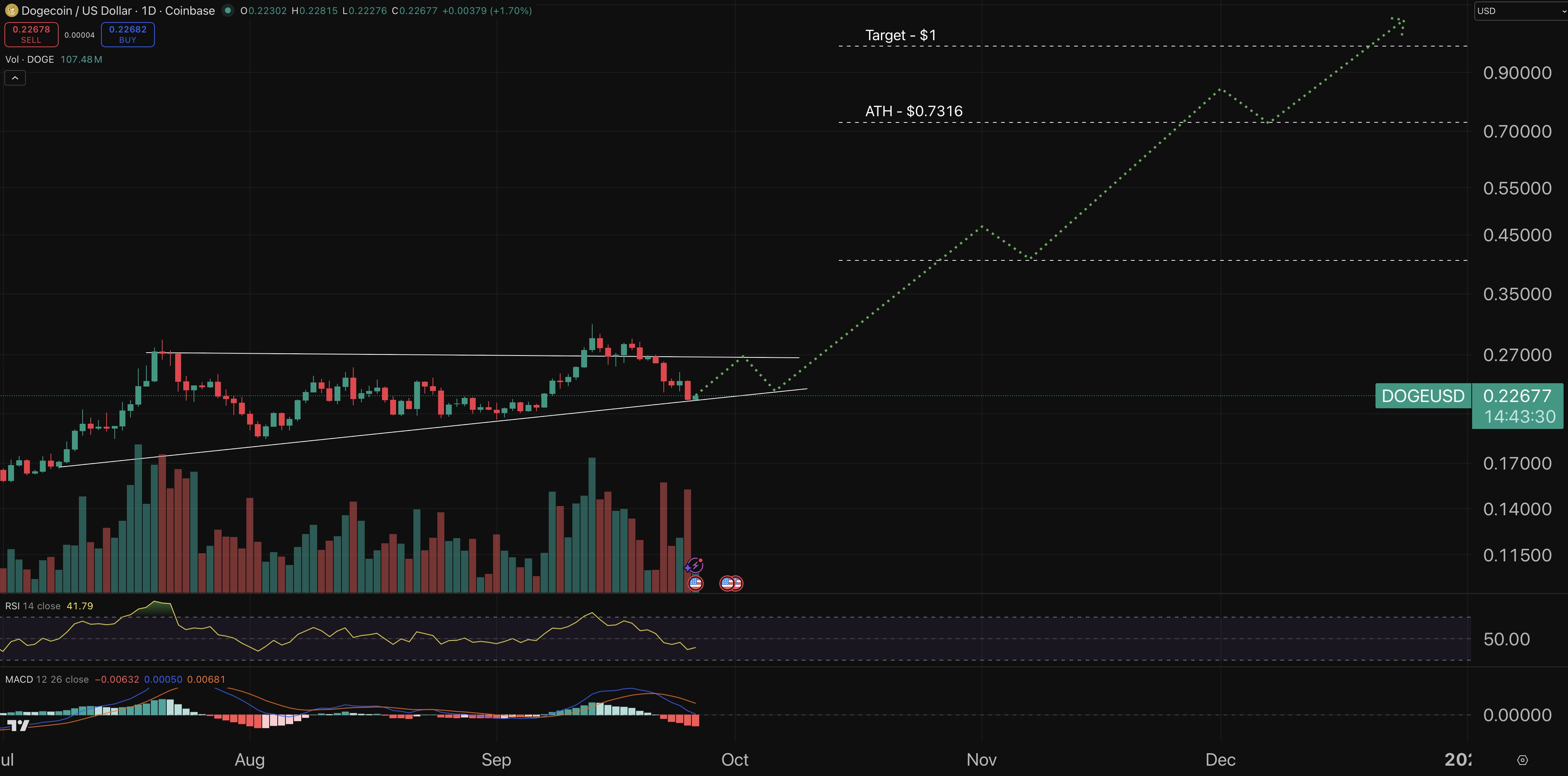
At $0.2267, Dogecoin is down by 3% in 24 hours and by 17% in the past week, although it does hold on to a 3.5% gain in a month.
Despite the recent losses, DOGE is also in a very good position, not least because the first Dogecoin ETF – the Rex-Osprey DOGE fund – launched last week.
And more Dogecoin ETFs are on the way, with Bloomberg analysts giving the waiting Grayscale, Bitwise, and 21Shares DOGE ETFs a 90% chance of approval.
This is extremely bullish, and it means that the Dogecoin price could surge in the event of the above ETFs gaining approval.
Source: TradingView
If we look at DOGE’s indicators, we see that they’re also moving towards bottoms, pulling the token towards a heavily discounted price that will eventually attract a new wave of buyers.
Assuming that the ETFs do obtain the green light, then the coin could reach $0.30 in a matter of days, before climbing back towards its ATH of $0.7316 in the final month of the year.
Crypto Price Prediction: Cardano ($ADA) – Layer-One Network Growth Lays Foundation for Big End-of-Year Gains
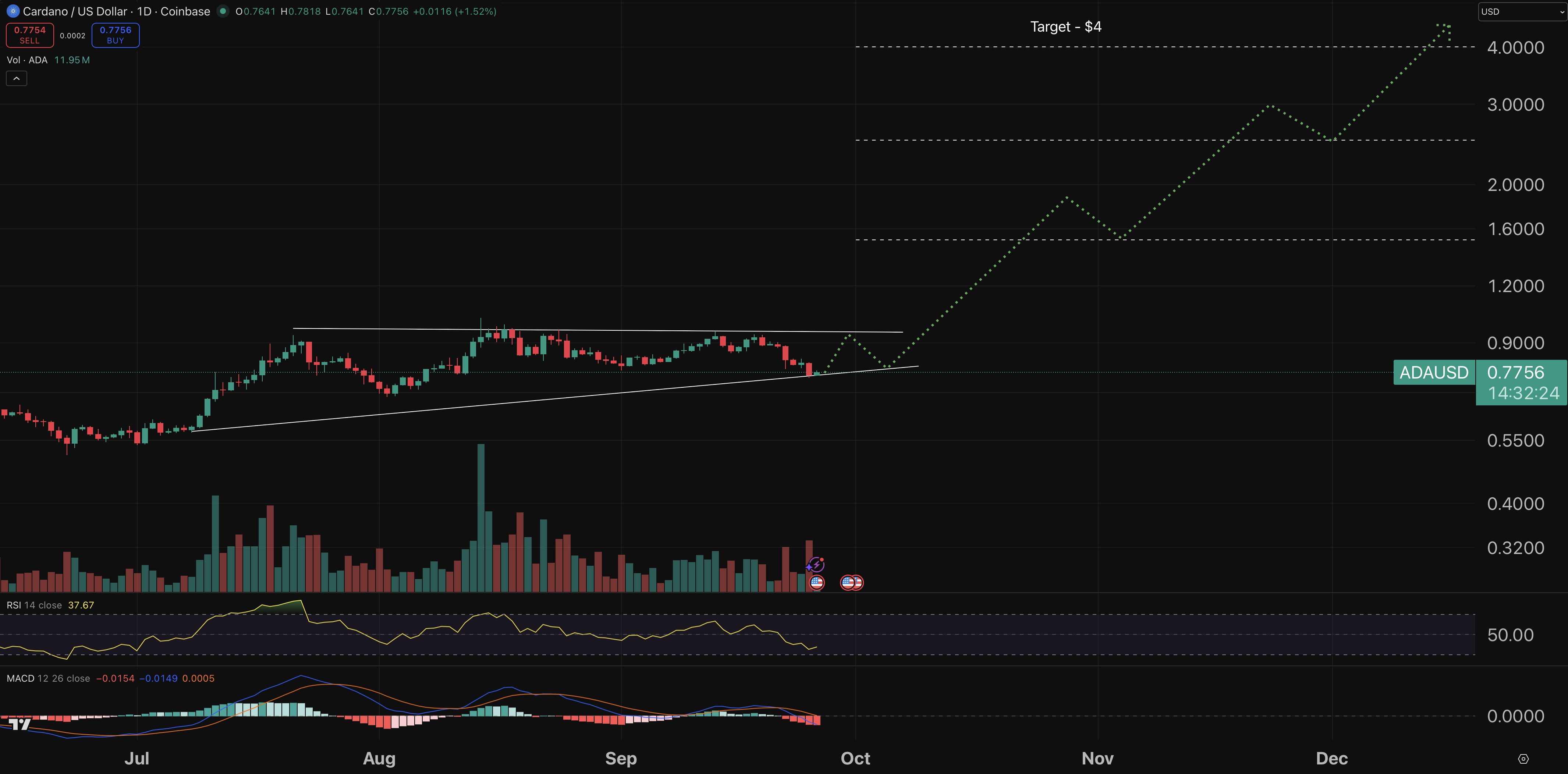
As for ADA, it too has suffered a fall in the past 24 hours, dropping to $0.7757 and also falling by 14% in a week.
It is, however, still up by 95% in the past year, providing it with a good base from which to grow further towards the end of the year.
And while it boasts only 1 ETF application, the fact that this application is from Grayscale gives it prospects for approval.
Similarly, because ADA is a relatively small major token (volume at $1.9 billion), the launch of the Grayscale ADA ETF could send it flying.
Source: TradingView
Its indicators are all sitting in oversold areas, while it remains down by 75% in relation to its ATH of $3.09, meaning that it could grow rapidly once a serious rally starts.
Based on this, the crypto price prediction for Cardano looks very good, with the alt on track to pass $1 in the next few weeks, and then close 2025 above $3.
PEPENODE Raises $1.45 Million in Fast-Paced Presale: Here’s Why Mine-to-Earn Token Could Be Big
As good as the three coins above look, traders may want to diversify their portfolios in preparation for the coming end-of-year bull rally, since smaller tokens can outperform more established cryptos.
Diversification may also include a smattering of presale coins, since the biggest and most popular of these can rally strongly once they list for the first time.
This is an encouraging figure, especially since its sale opened only a few weeks ago, and it suggests that PEPENODE could become very big once it launches.
As a mine-to-earn token, it provides holders with the ability to grow their own virtual mining rigs, which they can use to earn rewards in major tokens, such as Pepe and Fartcoin.
They can grow their rigs by buying additional nodes using PEPENODE, meaning that the coin could experience lots of demand as users make their rigs bigger.
Holders can also stake PEPENODE for big staking returns, with the current yield at just above 900%.
This is very attractive, and it could mean that demand for the coin will be massive.
Investors can get ahead of the curve by joining the token’s presale, which they can do by going to the PEPENODE website.
PEPENODE is currently selling at $0.0010745, although this price will continue to rise as the sale progresses.
The rally continues to confront resistance between $3,782 and $3,812, where at least five indicators converge. While Friday’s move suggests a continuation of the broader uptrend, momentum is visibly slowing. Price could still extend toward the upper boundary of the zone, but traders are closely watching how gold reacts within this cluster of resistance levels.
Higher Targets if Breakout Sustains
A decisive breakout above $3,812 would open the door to higher projections. The most notable is a 261.8% extension of the large ABCD pattern at $3,896, derived from a harmonic relationship of two rising measured moves. Further up is a confluence zone from $3,982 to $3,998. That would be the next next key target zone, though it remains distant unless bullish momentum strengthens meaningfully.
Signs of Slowing Momentum
Despite price strength, momentum indicators flash caution. The Relative Strength Index (RSI) shows a bearish divergence, with price at new highs but momentum failing to confirm. This divergence, alongside current resistance near the top boundary of a rising trend channel, suggests upside breakouts may struggle to sustain without consolidation.
Short-Term Support Levels
Initial support rests at today’s low of $3,734, followed by the 10-Day moving average at $3,712. More significant is the 20-Day line at $3,650, reinforced by the broader structure of the channel. A drop below these levels would increase the likelihood of a deeper retracement, potentially signaling that gold’s rally has overextended in the short run.
Outlook
For now, the trend remains bullish with buyers holding the upper hand, and the record close this week reflects robust demand. Yet weakening momentum and proximity to key resistance levels warrant caution. Until price either breaks decisively above $3,812 or drops under $3,712, gold’s next directional move remains a contest between sustained buying and the risk of correction.
For a look at all of today’s economic events, check out our economic calendar.
It’s delicious and packs a hydrating, antioxidant punch—according to nutritionists
(Photo: Cold-Brew Tea Latte: Ashia Aubourg; Design: Ayana Underwood/Canva)
Published September 26, 2025 03:00AM
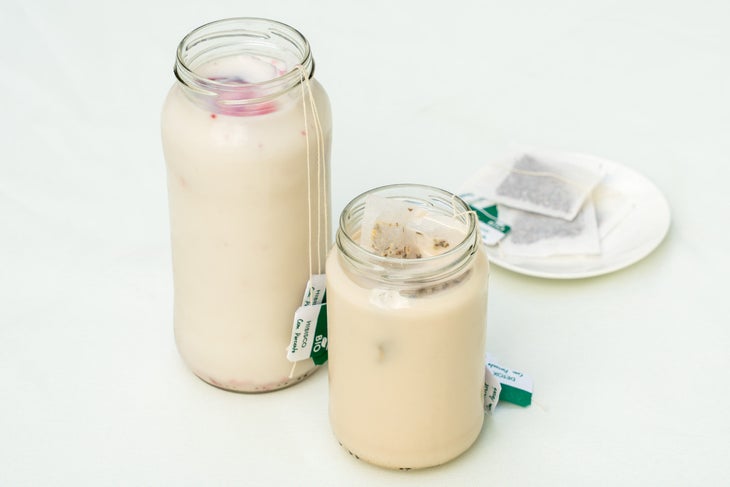
Y’all know me. Whenever a food trend starts going viral on TikTok, I jump in and test it so you don’t have to. This time, while scrolling, I stopped mid-swipe after seeing people dunking handfuls of tea bags into half-gallons of milk. The funky-looking concoction everyone’s obsessed with? Cold-Brew Tea Lattes.
Unlike your typical cold-brew, this drink doesn’t involve coffee at all (or caffeine, depending on the tea you choose). Instead, it turns that box of tea bags in your cabinet into something entirely new. Mixing them with milk creates a café-style latte that feels barista-made without the effort. Prep only takes a few seconds, and the fridge handles the rest.
Most TikTok food trends make me skeptical, but this one felt different. I already love iced tea lattes, such as matcha, so this hack caught my attention. Still, I had questions, because as an outdoor enthusiast, I wondered if this could work as an easy way to fuel up before heading outdoors. I interviewed a few experts to find out.
For Hikes and Camping, Choose Teas That Sharpen Focus and Reduce Inflammation
“If you want to try this tea trend before a hike or camping trip, consider what you’re looking for in your cup,” says Rhyan Geiger, a registered dietitian based in Phoenix, Arizona.
Planning to tackle rocky or uneven trails? Geiger recommends brews rich in L-theanine, such as green and yellow tea (a slightly fermented tea), which may sharpen focus and boost alertness during challenging hikes.
But Claire Rifkin, a registered dietitian based in New York City, points out that caffeine acts as a diuretic and can make you need to pee more, which isn’t exactly ideal when you’re out in the middle of nature.
For caffeine-free options that still offer support on the trail, Geiger recommends herbal teas. For example, both ginger and chamomile tea have been shown to combat inflammation, making them helpful if you find yourself getting sore in the wild. Herbal teas might also ward off fatigue—another practical benefit when you’re on a long trek.
How to Get the Most Out of This Cold Brew Tea Trend, According to Nutritionists
“One way to make this trend more nutritious is by focusing on your milk choice,” says Geiger. For anyone looking to increase protein intake—which supports muscle repair and recovery after strenuous activity—soy milk delivers about eight grams of protein per cup.
Your milk choice can also impact your energy level. According to Geiger, the natural sugars in dairy, almond, oat, or soy milk can give you a fast fuel-up before hitting the trail.
To round things out, Rifkin recommends bringing along a source of carbs when heading out with your cold brew. A banana or overnight oats work well. Paired with the protein and fat from the milk, you’ll create a more balanced source of energy, she explains.
Secure with a lid and refrigerate for at least 8 hours or overnight.
Remove tea bags before drinking.
The Verdict: Low Lift, High Reward
I recently traveled to the Algarve region in Portugal and planned to glamp in an area without easy access to cafés, meaning no iced latte stops. Since I had a foraging hike scheduled, it was the perfect time to try this cold brew tea hack.
Fortunately, a local market nearby had all the basics: soy milk, tea, and honey. At home, I usually have these staples on hand, so it was reassuring to see that this recipe only requires everyday pantry and fridge staples.
I chose two types of tea: Hibiscus for its tart, fruity flavor and Earl Grey for its antioxidant power.
The night before the hike, I prepped both teas. The next day, they were chilled and ready. I’m a two-beverage person in the mornings and usually reach for an iced matcha and a smoothie, so bringing both teas along fits nicely into my A.M. routine. With a three-hour hike ahead, I planned to hydrate early with these lattes.
Two hours in, I still didn’t feel thirsty, which is rare for me on long hikes. More impressive than the hydration, though, was how good the lattes tasted. They had a subtle flavor; the hibiscus offered light floral and honeyed notes, while the Earl Grey brought out earthy and warm spice flavors. Trying something different from my usual iced matcha or decaf latte turned out to be a delicious shift from my typical routine.
I have a few remote trips coming up this fall, and I’ll definitely bring this cold brew tea hack with me. It’s a simple, satisfying way to enjoy an iced latte without needing a café nearby, and it delivers a few nourishing perks along the way.
Disclaimer: This is a Press Release provided by a third party who is responsible for the content. Please conduct your own research before taking any action based on the content.
Amidst buoyant global market sentiment, XRP has once again become a hot topic. Prominent analysts predict that by 2026, XRP could break through $30 and even challenge its target price of $34. This prediction is based not only on the classic “double bottom” technical pattern, but also on the significant increase in institutional capital inflows and the probability of spot ETF approval. If these conditions are met, XRP is expected to continue its tenfold surge during the previous bull market.
Beyond holding coins: How to double your returns with leverage.
Simply waiting for price increases may not be enough to maximize investor returns. Arc Miner’s XRP mining contracts allow investors to earn a stable daily passive income while holding the token. For example, at the current price range, earning $5,800 in XRP daily is enough to generate strong cash flow. It’s worth noting that Arc Miner isn’t a platform focused solely on profitability; instead, it prioritizes compliance, environmental sustainability, and secure, long-term sustainable development:
Regulatory Approval: We hold relevant licenses and regulations from the UK Financial Services Authority and comply with local laws and regulations. Environmental sustainability: All data centers are powered by the latest solar, hydro, and wind energy.
Fund Security: Customer funds are securely held in a tier-one bank, and all personal information is protected by SSL encryption. We provide insurance on every investment, underwritten by AIG Insurance Company.
After purchasing a contract, your returns are fixed and automatically deposited into your account daily. Upon contract expiration, your principal will be automatically returned to your Arc Miner account. You can withdraw or continue investing at any time.
Zero barriers to entry – No hardware required. Start mining instantly from your phone or computer and enjoy comprehensive professional support.
High-Performance Power – Powered by the latest NVIDIA and AMD GPUs, delivering industry-leading efficiency.
Global Data Centers – Over 70 locations across Europe, North America, and Asia, ensuring maximum uptime and intelligent load balancing.
Supports multiple payment methods, including BTC, ETH, XRP, SOL, DOGE, LTC, USDT, BCH, BNB, and other mainstream assets for fast deposits and withdrawals.
Online Customer Service – 24/7 quick response to help users solve various problems.
Referral Program – Earn 3% + 2% rebates on every successful investment from each user you refer! Referral commissions and rewards can reach up to $100,000.
About Arc Miner
Arc Miner is a leading global cloud mining service provider, providing fast, secure, and environmentally friendly cryptocurrency mining solutions to 7 million users in over 100 countries. With cutting-edge technology and professional services, we have become a trusted leader in the global cloud mining industry.
In the cloud mining industry, security and trust are crucial. Arc Miner prioritizes the security of user funds and information. We maintain operational transparency and adhere to national compliance standards, providing investors with solid protection so they can focus on profitability. Furthermore, all mining operations utilize renewable energy, achieving carbon neutrality. This not only reduces environmental pollution but also provides sustainable returns for investors, ensuring economic and environmental benefits for all participants.
Disclaimer: This media platform provides the content of this article on an “as-is” basis, without any warranties or representations of any kind, express or implied. We assume no responsibility for any inaccuracies, errors, or omissions. We do not assume any responsibility or liability for the accuracy, content, images, videos, licenses, completeness, legality, or reliability of the information presented herein. Any concerns, complaints, or copyright issues related to this article should be directed to the content provider mentioned above.
The $3.35 price level carries added weight given that it coincides with the intersection of two significant trendlines — one rising and one falling. Should the market sustain strength through this zone, attention will naturally shift to the next confluence zone, around the 200-Day moving average at $3.49 and the 127.2% Fibonacci projection of the ABCD pattern at $3.51. The alignment of these levels suggests that if buyers can maintain momentum above $3.35, the path toward $3.49–$3.51 will become increasingly viable.
Moving Averages Signal Improving Demand
Another bullish development was the 20-Day moving average crossing above the 50-Day line, strengthening the short-term trend outlook. A daily close above either the rising or falling trendline near $3.35 would further validate this momentum shift, likely followed by additional signs of growing demand. On the downside, a healthy pullback could see price revisit the cluster of moving averages between $2.98 and $3.00, where the 10-Day, 20-Day, and 50-Day averages converge. That zone now represents a significant support area and could offer the foundation for a renewed leg higher once buyers return.
Weekly Chart Turns Bullish
On the weekly timeframe, natural gas is on track to close above last week’s high of $3.17, establishing a bullish outside week reversal. Importantly, this week’s price range also encompasses the ranges of the prior three weeks, emphasizing the strength of the move and signaling a clear shift in momentum. This type of price action often precedes sustained advances, particularly when accompanied by improving moving average alignment and strengthening channel dynamics.
Outlook
Overall, natural gas is showing early signs of turning the corner. A sustained breakout above $3.35 would not only confirm the rising ABCD pattern but also set the stage for a test of the longer-term resistance zone around $3.49–$3.51. Until then, traders will watch for whether the higher swing low established earlier this week holds, as that would further solidify the bullish reversal narrative.
For a look at all of today’s economic events, check out our economic calendar.
GBP/USD Slides to Seven-Week Low as U.S. Data Outpaces U.K. Recovery
The GBP/USD pair has come under sustained selling pressure, dropping to 1.3322 this week, its weakest point in nearly two months, before stabilizing just above 1.3350. The move reflects a sharp 3% decline from the September high at 1.3725 as U.S. economic strength has undercut the case for aggressive Federal Reserve rate cuts, while the Bank of England remains caught between sticky inflation and weakening domestic growth.
Impact of U.S. Growth and Inflation Data on GBP/USD
The second-quarter U.S. GDP revision to 3.8% year-on-year, coupled with weekly jobless claims falling to 218,000 and durable goods orders surging 2.9%, has provided the dollar with renewed momentum. These numbers highlight U.S. economic resilience and have reduced expectations for back-to-back Fed cuts in 2025. Meanwhile, markets await the Core PCE inflation print at 2.9% year-on-year, a figure that could cement the Fed’s cautious stance and extend downside pressure on GBP/USD if it overshoots consensus.
Bank of England Uncertainty Weighs on Sterling
Governor Andrew Bailey has acknowledged that U.K. inflation is on a downward path but linked future easing directly to progress in consumer prices. This hesitancy is complicated by other MPC members, such as Megan Greene, warning against premature cuts amid lingering upside risks. Political noise in London—calls for re-nationalization of utilities and large-scale borrowing schemes—has rattled gilt markets already strained by fragile demand. With households sitting on unusually high savings and labor conditions softening, the pound has struggled to find a solid base against the dollar.
Technical Breakdown of GBP/USD Levels
Technically, GBP/USD’s inability to reclaim 1.3390, the 23.6% Fibonacci retracement of the January–July rally, leaves bears in control. A sustained break under 1.3330 risks a slide toward 1.3255, followed by deeper targets at 1.3145 and the 200-day SMA near 1.3130. On the flip side, only a decisive recovery above 1.3470–1.3500, where the 20- and 50-day SMAs converge, would ease bearish momentum and allow a rebound toward 1.3600. Until then, the bias remains skewed to the downside with 1.3300–1.3260 acting as the next key pivot zone.
Short-Term Pound Sterling Outlook Against the Dollar
The stochastic oscillator sitting below 20 suggests the pair is oversold, and price action beneath the lower Bollinger band signals the potential for a short-lived bounce. However, with market structure deteriorating since August’s 1.3139 low and with GBP/USD still capped under the broader 1.3675–1.3720 resistance band, upside moves should be treated as corrective rallies rather than a trend reversal. A failure to sustain above 1.3400 in the coming sessions would quickly put 1.3260 back on the radar.
Final Assessment: Bearish Bias Maintained on GBP/USD
Considering the stronger U.S. macro backdrop, upcoming PCE inflation data, and the Bank of England’s indecisive tone, GBP/USD remains in a bearish setup with high probability of retesting 1.3255–1.3150 in the short term. The pair is oversold enough for tactical rebounds, but with momentum firmly on the dollar’s side, rallies are likely to be capped. Based on current dynamics, the stance remains Sell on GBP/USD, with downside risks dominating until there is evidence of U.S. data softening or the BoE signaling a firmer stance against inflation.