About Editorial team of BIPNs

Main team of content of bipns.com. Any type of content should be approved by us.
25 09, 2025

Probiotic Ingredients Market Expands with Gut Health,

By |2025-09-25T12:55:50+03:00September 25, 2025|Dietary Supplements News, News|0 Comments


Probiotic Ingredients Market Expands with Gut Health, Immunity, and Functional Food Innovation to Reach USD 1.0 Billion by 2035

Probiotic Ingredients Market is projected to grow to USD 1.0 Billion in 2035
Probiotic Ingredients Market projected to grow at a highest CAGR of 6.3% during the forecast period of 2025 to 2035

MarketGenics, a leading name in food, nutrition, and biotech research, announced a series of milestones in the rapidly expanding Probiotic Ingredients Market globally.

The market insights highlight gut health, immunity, and expanding applications in functional foods, beverages, and dietary supplements as key factors fueling demand.

Get the Detailed Industry Analysis (including the Table of Contents, List of Figures, and List of Tables) – from the Probiotic Ingredients Market Research Report: https://marketgenics.co/press-releases/probiotic-ingredients-market-64021

Recent Innovation

In January 2025, Lesaffre Group expanded its probiotic production facility in France to meet growing demand across supplements and functional foods.

In 2024, Chr. Hansen introduced its novel BB-12 probiotic strain in stick-pack formats targeting on-the-go consumers seeking gastrointestinal and immune support.

Strategic Expansion

In March 2025, Nature Made launched new probiotic-prebiotic-fiber formulations for daily digestive health.

In August 2024, Morinaga Milk Industry secured approval in China for Bifidobacterium infantis M-63 for infant and children’s nutrition, strengthening APAC’s leadership in probiotic adoption.

To know more about the Probiotic Ingredients Market – Download our Sample Report: https://marketgenics.co/download-report-sample/probiotic-ingredients-market-64021

Probiotic Ingredients Market Forecast 2035

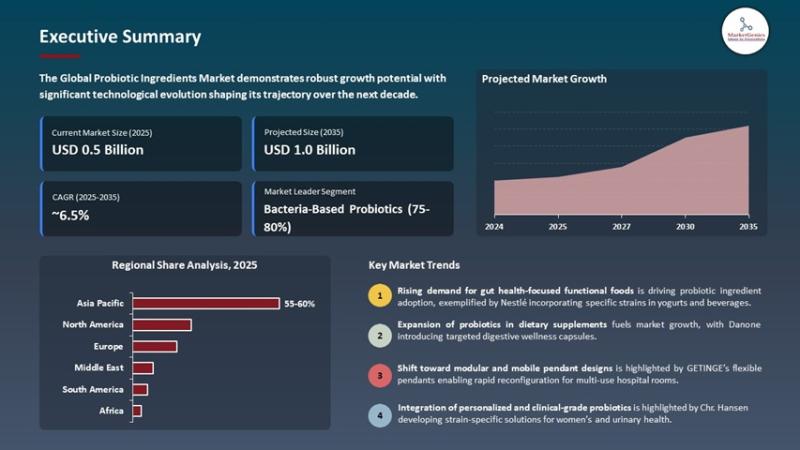
According to the report, the global Probiotic Ingredients Market is projected to expand from USD 0.5 Billion in 2025 to USD 1.0 Billion in 2035, growing at a CAGR of 6.3%.

The bacteria-based probiotics segment, accounting for ~78% of global revenue in 2025, dominates due to broad clinical validation, diverse applications, and strong consumer trust in Lactobacillus and Bifidobacterium strains.

Growing demand for gut health, immunity, maternal wellness, and infant nutrition products is boosting consumption worldwide.

“Probiotic ingredients are evolving from dairy staples into mainstream wellness, spanning supplements, beverages, and even pet health. Clinical backing and consumer trust are accelerating this shift toward personalized gut-health solutions,”

said our Senior Research Analyst at MarketGenics.

Key Driver, Restraint, and Growth Opportunity Shaping the Global Market

Driver – Expanding Applications in Non-Dairy Beverages: Shelf-stable probiotic strains like GanedenBC^30 (Kerry Group) are enabling oat-based and plant-based probiotic beverages for new consumer segments.

Restraint – Stability & Shelf-Life Challenges: Strain survivability remains a hurdle during processing and storage; innovations in microencapsulation are being developed but remain costly.

Opportunity – Animal Nutrition & Pet Health: DSM-Firmenich’s SymBright Protect probiotic for pets reflects growing investment in animal gut health as premium pet care markets expand.

“Beyond human nutrition, probiotic innovation is penetrating pet health and livestock applications – creating entirely new revenue streams for ingredient suppliers,”

added the Director of Market Strategy at MarketGenics.

Expansion of Global Probiotic Ingredients Market

“Bacteria-Based Probiotics Leading Innovation and Consumer Adoption”

Functional food & beverage companies like Nestlé and Danone are embedding clinically proven strains into yogurts and drinks for digestive health.

Probiotic supplements are gaining traction with Nature Made, Amway, and IFF Health targeting gut, maternal, and newborn wellness.

Synbiotics (probiotics + prebiotics) are emerging as premium products, with ADM’s Biome Ultra targeting athletes and healthy aging.

Buy Now: https://marketgenics.co/buy/probiotic-ingredients-market-64021

Regional Analysis of Global Probiotic Ingredients Market

Asia Pacific: The largest and most attractive region, driven by cultural preference for fermented foods and rapid urbanization. Yakult Honsha expanded probiotic production in China in 2024, reflecting surging demand.

North America: Rising adoption of functional foods, sports nutrition, and dietary supplements, with innovation from Kerry Group and DuPont (IFF).

Europe: Mature market with regulatory approvals and strong consumer trust in clinical-grade probiotics, particularly in infant and maternal nutrition.

Prominent Players

Key players operating in the global Probiotic Ingredients Market include:

Chr. Hansen Holding A/S, Koninklijke DSM N.V., Lallemand Inc., DuPont (IFF), Lesaffre S.A., Kerry Group, Probi AB, Yakult Honsha, Amway, and Other Key Players.

About Us

MarketGenics is a global market research and management consulting company empowering decision makers across healthcare, technology, and policy domains. Our mission is to deliver granular market intelligence combined with strategic foresight to accelerate sustainable growth.

We support clients across strategy development, product innovation, healthcare infrastructure, and digital transformation.

Contact:

Mr. Debashish Roy

MarketGenics India Pvt. Ltd.

800 N King Street, Suite 304 #4208, Wilmington, DE 19801, United States

USA: +1 (302) 303-2617

Email: sales@marketgenics.co

Website: https://marketgenics.co

This release was published on openPR.


Source link

25 09, 2025

XRP Price Prediction & PayFi Giant Remittix Sets New Crypto Records

By |2025-09-25T12:41:51+03:00September 25, 2025|Crypto News, News|0 Comments

Disclaimer: This is a Press Release provided by a third party who is responsible for the content. Please conduct your own research before taking any action based on the content.


XRP and Remittix have been tagged the best crypto investments for September/October for different reasons. XRP price is gaining momentum on optimism around ETF chatter.

At the same time, a fast-rising PayFi giant, Remittix (RTX), is rewriting presale records with a $26.4M haul, CertiK’s #1 pre-launch ranking, and its beta wallet now live.

XRP Price to Hit $5 in 2025

XRP is trading between $2.80 and $3.10, struggling to break resistance around $3.00–$3.10 decisively. This comes as the first U.S.-listed XRP ETF (REX-Osprey) made a record-breaking. It drew $37.7 million in opening day volume, signaling renewed institutional interest.

XRP/USD 1D Price Chart|Source: TradingView

Technical analysts say if XRP holds above its support zone near $2.75–$2.80, the path toward $3.60 could unfold in the near term.

With sustained institutional flows and strong market sentiment, XRP could reach $5 before year-end once it breaks past key resistances.


Remittix Sets New Crypto Records

Remittix has just cleared two major checkpoints. The team is fully verified by CertiK, and the project sits #1 on CertiK’s pre-launch leaderboard. The beta Remittix wallet is also live, and community testers are already using it.

Meanwhile, presale traction is real. The campaign has raised $26.4 million with 669 million tokens sold at a current price of $0.1130. That demand is coming from buyers who want more than hype.

Remittix’s core mission is to make sending and receiving digital assets as simple as a bank transfer. But faster, cheaper, and borderless.

What Remittix actually does:

  • Users can send 40+ cryptocurrencies, and recipients receive local fiat in 30+ countries.
  • Fees are flat and transparent. No hidden FX markups.
  • A Remittix Pay API lets freelancers, merchants, and businesses accept crypto and receive fiat.

These functional features are drawing serious attention to the project.

How High Could Remittix Go?

RTX is being listed on BitMart and LBank, with plans for a third major CEX. That means liquidity will be ready the moment RTX hits public markets.

Viral incentives are accelerating growth. A 15% USDT referral program, along with a $250,000 giveaway, is attracting new buyers to the token.

At a presale price of $0.1130, analysts project a 30x to 50x target in 2025 if adoption scales and CEX volume follow.

With a working wallet, major exchange entry, and aggressive community incentives, Remittix has the structural setup for multi-bag upside. Its 50x target provides a more attractive opportunity for investors than XRP at $5.

Discover the future of PayFi with Remittix by checking out their project here:

Website: https://remittix.io/

Socials: https://linktr.ee/remittix

$250,000 Giveaway: https://gleam.io/competitions/nz84L-250000-remittix-giveaway

Disclaimer: This media platform provides the content of this article on an “as-is” basis, without any warranties or representations of any kind, express or implied. We assume no responsibility for any inaccuracies, errors, or omissions. We do not assume any responsibility or liability for the accuracy, content, images, videos, licenses, completeness, legality, or reliability of the information presented herein. Any concerns, complaints, or copyright issues related to this article should be directed to the content provider mentioned above.

/div>

Source link

25 09, 2025

Oil Price Forecast: WTI $61.87, Brent $65.50 Face OPEC+ Pressure

By |2025-09-25T11:02:50+03:00September 25, 2025|Forex News, News|0 Comments


The global oil market is currently under a significant spotlight as prices fluctuate due to various geopolitical and economic factors. As of the latest reports, West Texas Intermediate (WTI) crude oil is forecasted to hover around $61.87 per barrel, while Brent crude prices are expected to reach approximately $65.50. These figures come amidst ongoing pressures exerted by OPEC+ and the broader dynamics of supply and demand in the oil market. In this article, we will delve into the factors influencing these prices, the implications of OPEC+ decisions, and what analysts predict for the future of oil prices.

Understanding Oil Price Dynamics

The Role of Supply and Demand

Oil prices are primarily determined by the basic economic principle of supply and demand. When demand for oil exceeds supply, prices tend to rise. Conversely, if supply outstrips demand, prices usually fall. Recent trends indicate a complex interplay between these two forces, especially as economies around the world continue to recover from the COVID-19 pandemic. Factors such as industrial activity, travel demand, and energy transitions are influencing these dynamics.

For instance, as countries emerge from lockdowns, travel has seen a resurgence, significantly affecting oil demand. The International Air Transport Association (IATA) reported a notable increase in passenger numbers, which in turn drives up the demand for jet fuel. Additionally, industrial production has ramped up in several regions, increasing the demand for crude oil in manufacturing processes.

Geopolitical Influences

Geopolitical events can have a profound impact on oil prices. Conflicts, sanctions, and diplomatic relations among oil-producing countries often create volatility. For example, ongoing tensions in the Middle East, including conflicts involving Iran or disruptions in Libya, can restrict supply, leading to price increases. Conversely, resolutions to these conflicts can stabilize or even reduce prices.

The recent conflict in Ukraine has also raised concerns over European energy security, given the continent’s reliance on imports. The potential for sanctions on Russian oil has caused ripples in the market, prompting European nations to seek alternative sources and pushing prices higher.

OPEC+ and Its Impact on Oil Prices

What is OPEC+?

The Organization of the Petroleum Exporting Countries (OPEC) is a coalition of oil-producing nations that collaborates to manage oil production levels and stabilize prices. In recent years, OPEC has expanded its coalition to include other major producers, such as Russia, forming what is known as OPEC+. This group plays a critical role in influencing global oil prices through its production decisions.

OPEC+ has historically aimed to balance the market by adjusting production levels. Their collective decisions can significantly sway oil prices, making them a focal point for analysts and investors alike.

Recent OPEC+ Decisions

OPEC+ has faced considerable challenges in balancing the needs of its member countries with the realities of a volatile market. Recent cuts in production aimed at stabilizing prices have put pressure on the group to maintain discipline among its members. Some countries may seek to boost output in response to rising prices, which can lead to an oversupply and subsequent price drops.

In 2023, OPEC+ announced a series of production cuts to address concerns over a supply glut caused by increased U.S. shale production. The aim was to support prices amid fears of a global economic slowdown. However, compliance among member countries has varied, leading to ongoing discussions about the future of these cuts.

Future Expectations

As WTI and Brent crude prices hover around $61.87 and $65.50 respectively, OPEC+ is expected to closely monitor market conditions. Analysts predict that continued adherence to production cuts will be necessary to support prices. However, any substantial increase in global demand, especially from major economies like the United States and China, could influence OPEC+ to adjust its strategies.

For example, if the U.S. economy continues to show resilience, it may lead to an uptick in oil consumption, prompting OPEC+ to reconsider their production strategies to capitalize on rising prices.

Economic Recovery and Oil Demand

Global Economic Factors

The global economic recovery from the pandemic plays a pivotal role in shaping oil demand. As countries reopen and industries ramp up production, oil consumption is increasing. The International Energy Agency (IEA) has projected a rise in demand, particularly in sectors such as transportation and manufacturing. This uptick could provide upward pressure on oil prices if production levels do not keep pace.

Emerging markets, particularly in Asia, are also contributing to increased demand as their economies rebound. For example, India has shown significant growth in oil consumption as its manufacturing and transportation sectors expand.

Transition to Renewable Energy

Another factor influencing oil prices is the ongoing transition to renewable energy sources. Governments worldwide are investing heavily in green technologies and reducing reliance on fossil fuels. While this transition is essential for long-term sustainability, it may create short-term demand fluctuations as the market adjusts to new energy paradigms. The shift towards electric vehicles (EVs) and alternative energy sources could reshape demand for oil in the years to come.

For instance, countries like Norway are leading the charge in EV adoption, aiming for a significant reduction in gasoline and diesel vehicle sales by 2025. As more nations pursue similar goals, traditional oil demand may face long-term challenges.

Price Predictions and Market Sentiment

Analyst Insights

Market analysts are divided in their predictions about the future of oil prices. Some believe that the current price ranges are sustainable, given the balance of supply and demand and OPEC+ strategies. Others warn that geopolitical tensions or a resurgence of COVID-19 cases could lead to abrupt changes in prices.

Recent reports from major financial institutions highlight a cautious optimism, suggesting that prices may stabilize in the coming months if OPEC+ maintains its discipline with production cuts. However, they also caution that any potential economic downturn could lead to reduced demand and lower prices.

Short-Term vs. Long-Term Outlook

In the short term, WTI and Brent prices are likely to remain volatile, influenced by immediate market factors and OPEC+ decisions. In the long term, however, the transition to renewable energy and changing consumption patterns may lead to a more stable pricing environment. Investors and stakeholders in the oil market should remain vigilant and consider a range of scenarios as they make strategic decisions.

For instance, while the short-term outlook might suggest price fluctuations due to geopolitical tensions or market adjustments, the long-term implications of energy transitions could redefine the global energy landscape.

Conclusion

The forecast for oil prices, with WTI at $61.87 and Brent at $65.50, reflects the complex interplay of global economic recovery, OPEC+ decisions, and geopolitical influences. While current prices may seem stable, the oil market remains susceptible to rapid changes due to external pressures and evolving demand dynamics. Stakeholders in the oil industry, from traders to policymakers, must stay informed and agile to navigate this landscape effectively.

FAQs

Q1: What factors can cause oil prices to rise?
A1: Oil prices can rise due to increased demand, geopolitical tensions, production cuts by OPEC+, and disruptions in supply chains.

Q2: How does OPEC+ influence global oil prices?
A2: OPEC+ influences prices by coordinating production levels among member countries to stabilize or manipulate supply in response to market conditions.

Q3: What are the long-term implications of the shift to renewable energy on oil prices?
A3: The shift to renewable energy may lead to decreased long-term demand for oil, potentially resulting in lower prices and a need for oil producers to adapt their strategies.

Q4: How does the COVID-19 pandemic affect oil demand?
A4: The pandemic has caused significant disruptions to global travel and industrial activity, leading to decreased oil demand. As economies recover, demand is expected to rise, influencing prices.

Q5: What role do economic indicators play in oil price forecasts?
A5: Economic indicators such as GDP growth, industrial activity, and consumer spending provide insights into demand trends, helping analysts predict future oil price movements.

Q6: What recent geopolitical events have influenced oil prices?
A6: Events like the Ukraine conflict, sanctions on Iran, and tensions in the Middle East have all contributed to fluctuations in oil prices by impacting global supply chains.

Q7: What are the implications of rising oil prices for consumers?
A7: Rising oil prices can lead to higher fuel costs, which may affect transportation and goods pricing, ultimately impacting consumer spending and inflation rates.

In summary, while the oil market continues to experience fluctuations, understanding the underlying factors and keeping abreast of global developments will be essential for stakeholders navigating this complex landscape.

Christiane Amanpour

Redaktur

Christiane Amanpour is CNN’s Chief International Anchor and one of the world’s most respected journalists. Born in London in 1958, she graduated in Journalism from the University of Rhode Island. With over four decades of frontline reporting — from the Gulf War and Bosnia to the Arab Spring — she is renowned for interviewing global leaders and covering major conflicts. Amanpour has received multiple Emmy, Peabody, and Edward R. Murrow awards, and was honored as a Commander of the Order of the British Empire (CBE) for her services to journalism.


Source link

25 09, 2025

US Dollar Forecast: Fed Cuts Loom, Traders Eye GDP Data – GBP/USD and EUR/USD

By |2025-09-25T10:57:46+03:00September 25, 2025|Forex News, News|0 Comments

Powell emphasized that premature cuts could undermine inflation control and potentially force a policy reversal. His comments helped steady the dollar, limiting downside momentum.

Packed U.S. Data Calendar in Focus

Attention now turns to a busy U.S. economic schedule. The final estimate for second-quarter GDP is expected to confirm growth at 3.3%, while the GDP price index is forecast to hold at 2.0%.

Weekly jobless claims are projected at 233K, a slight increase from 231K previously, suggesting labor market resilience. Core durable goods orders are expected to decline 0.1% after last month’s 1.0% gain, while headline orders are forecast to contract 0.3%.

Traders are also monitoring the U.S. goods trade balance, expected at –$95.7 billion, and wholesale inventories, seen rising 0.2%. Later in the day, remarks from several Federal Reserve officials, including Miran, Goolsbee, Schmid, and Williams, may add clarity on the policy outlook.

US Dollar Index (DXY) – Technical Analysis

Source link

25 09, 2025

Bee Pollen Market Size, Share

By |2025-09-25T10:54:46+03:00September 25, 2025|Dietary Supplements News, News|0 Comments


Report Overview

The Global Bee Pollen Market is expected to be worth around USD 1,346.1 million by 2034, up from USD 810.8 million in 2024, and is projected to grow at a CAGR of 5.2% from 2025 to 2034. With a 39.30% share, North America’s bee pollen market totaled USD 318.6 Mn.

Bee pollen is a natural substance collected by honeybees from the pollen of flowers, mixed with nectar and enzymes. It contains proteins, vitamins, minerals, and antioxidants, making it highly valued as a dietary supplement. For centuries, it has been recognized for boosting energy, supporting immunity, and improving overall wellness, while also holding cultural and traditional significance across many regions.

Bee Pollen Market Size, Share

The bee pollen market reflects the rising demand for natural health products and functional foods. Consumers seeking immunity boosters and nutrient-dense supplements are increasingly turning to bee pollen. Demand has also been supported by government and research initiatives, such as the $2 million in new funding to Montana State research labs for honeybee health, which helps safeguard the supply chain of bee-derived products.

One major growth factor is the rising awareness of sustainable and natural nutrition sources. As health-conscious populations expand, bee pollen consumption is growing steadily. Funding initiatives, including $1.7 million to strengthen Ontario’s beekeeping industry, ensure better hive management and improved productivity, supporting long-term market expansion.

Opportunities lie in technological innovations and alternatives in pollination. For example, Edete raised $3 million for bee-free pollination technology, highlighting how the ecosystem around bee products is diversifying. This not only reduces pressure on natural hives but also ensures continued demand for pollen-related products in food and wellness markets.

Key Takeaways

  • The Global Bee Pollen Market is expected to be worth around USD 1,346.1 million by 2034, up from USD 810.8 million in 2024, and is projected to grow at a CAGR of 5.2% from 2025 to 2034.
  • Wildflower holds the largest share, contributing 48.2% of the overall market.
  • Granules remain the preferred product form in bee pollen, accounting for 41.3% market share.
  • Flower pollen dominates the market by source, representing 56.7% of total bee pollen sales.
  • Nutritional supplements drive demand strongly, with 44.9% applications linked to health-focused consumers.
  • Supermarkets and hypermarkets lead distribution, capturing 31.8% of bee pollen retail sales worldwide.
  • The bee pollen market in North America reached USD 318.6 Mn, capturing 39.30%.

By Type Analysis

Wildflower bee pollen dominates the type segment, holding 48.2% of the market share.

In 2024, Wild Flower Bee Pollen held a dominant market position in the By Type segment of the Bee Pollen Market, with a 48.2% share. This strong position is linked to its wide availability, diverse nutrient profile, and consumer preference for natural wellness products.

Wildflower varieties are often considered richer in vitamins, amino acids, and antioxidants due to their collection from multiple floral sources, enhancing their appeal among health-conscious buyers. The rising interest in organic and functional food products has further contributed to the adoption of wildflower bee pollen. Its versatility in use across dietary supplements, smoothies, and natural remedies has solidified its leading market share, making it the preferred choice in the segment.

By Product Form Analysis

Granules lead product form preference, capturing 41.3% of consumer demand globally.

In 2024, Granules held a dominant market position in the By Product Form segment of the Bee Pollen Market, with a 41.3% share. This dominance is attributed to the convenience, longer shelf life, and ease of consumption that granule form offers compared to other product formats.

Granules are widely preferred for their ability to retain the natural nutritional content of bee pollen, including proteins, enzymes, and essential vitamins, making them highly attractive for daily dietary use. Their versatility in blending with smoothies, cereals, and health supplements has further boosted their adoption among consumers. This practical form has ensured strong consumer acceptance, supporting granules in maintaining the largest share within the product form segment.

By Source Analysis

Flower pollen remains the primary source, accounting for 56.7% of total sales.

In 2024, Flower Pollen held a dominant market position in the By Source segment of the Bee Pollen Market, with a 56.7% share. This leading position is driven by its widespread availability and rich nutrient content, which makes it the most commonly consumed source of bee pollen.

Flower pollen is recognized for its natural concentration of proteins, minerals, and antioxidants, aligning well with the rising demand for health-focused and functional food products. Its acceptance among consumers stems from its traditional use and proven wellness benefits, which continue to support steady demand. The strong preference for flower-derived pollen has reinforced its status as the most influential source segment, maintaining its substantial market share.

By Application Analysis

Nutritional supplements drive applications, representing 44.9% of the bee pollen market.

In 2024, Nutritional Supplements held a dominant market position in By Application segment of the Bee Pollen Market, with a 44.9% share. This dominance reflects the growing use of bee pollen as a natural source of proteins, amino acids, and vitamins that support energy, immunity, and overall wellness.

Consumers increasingly prefer supplements enriched with bee pollen due to its reputation as a functional superfood, enhancing daily nutrition without synthetic additives. The segment’s strength is further supported by rising health awareness and the adoption of natural products in dietary routines. With its recognized benefits and versatility, nutritional supplements have maintained the largest share, solidifying their role as the leading application in the bee pollen market.

Bee Pollen Market shareBee Pollen Market share

By Distribution Channel Analysis

Supermarkets and hypermarkets dominate distribution, securing 31.8% of the global share.

In 2024, Supermarkets/Hypermarkets held a dominant market position in the By Distribution Channel segment of the Bee Pollen Market, with a 31.8% share. This leadership is driven by the wide product visibility, accessibility, and consumer trust that large retail formats provide.

Shoppers prefer supermarkets and hypermarkets for their convenience of comparing multiple brands and product forms under one roof. The organized retail space ensures consistent product availability, attractive packaging displays, and promotional offers, which have played a key role in boosting sales. The strong consumer reliance on these retail outlets for health and nutritional products has helped supermarkets and hypermarkets secure the largest share, reinforcing their position as the primary distribution channel.

Key Market Segments

By Type

  • Wild Flower Bee Pollen
  • Camellia Bee Pollen
  • Rape Bee Pollen
  • Others

By Product Form

  • Granules
  • Powder
  • Capsules
  • Liquid

By Source

  • Flower Pollen
  • Plant Pollen
  • Bee Products

By Application

  • Nutritional Supplements
  • Cosmetics
  • Food and Beverage
  • Pharmaceuticals
  • Others

By Distribution Channel

  • Online Retail
  • Supermarkets/Hypermarkets
  • Health Food Stores
  • Pharmacies
  • Others

Driving Factors

Government Support for Beekeeping and Pollination Growth

One of the biggest driving factors for the Bee Pollen Market is strong government support for beekeeping and pollination activities. Many countries have introduced programs to protect honeybees and promote sustainable pollination, as they are vital for food security and biodiversity. For example, the U.S. Department of Agriculture (USDA) has invested millions of dollars in pollinator health initiatives, including habitat restoration and disease management for honeybee colonies.

Similarly, the European Union funds research and provides grants to improve beekeeping practices and protect pollinator populations. These initiatives not only strengthen bee health but also secure the steady production of bee-derived products like pollen, creating long-term market growth opportunities and building consumer confidence in natural products.

Restraining Factors

Limited Government Funding for Bee Health Research

A major restraining factor for the Bee Pollen Market is the limited government funding available for advanced bee health research and protection. While some initiatives exist, the scale of support often falls short compared to the rising challenges of climate change, pesticide exposure, and habitat loss affecting bee populations. For instance, in many developing countries, financial resources for pollinator protection are minimal, leaving beekeepers with fewer tools to manage diseases or improve hive productivity.

Even in larger economies, funding often focuses on agriculture as a whole rather than dedicated bee programs. This funding gap slows innovation in hive management, weakens pollination efficiency, and directly impacts the supply of bee pollen, restraining the market’s potential growth.

Growth Opportunity

Expanding Government Programs Supporting Sustainable Beekeeping

One key growth opportunity for the Bee Pollen Market lies in the expansion of government programs that encourage sustainable beekeeping and pollinator protection. Several governments are now recognizing the importance of bees in agriculture and nutrition, and funding schemes are being created to support beekeepers with training, modern equipment, and research.

For example, the Indian government under the National Beekeeping and Honey Mission (NBHM) has allocated funds to improve scientific beekeeping, enhance honey production, and promote bee-based products. Similar programs in other regions aim to safeguard pollinator populations and boost rural incomes. These initiatives not only secure steady pollen production but also create new opportunities for bee pollen products in health and wellness markets.

Latest Trends

Rising Government Initiatives for Organic Bee Products

A key trend in the Bee Pollen Market is the rising government focus on supporting organic and chemical-free bee products. With growing consumer demand for natural and safe nutrition, governments are encouraging organic certification programs and funding eco-friendly farming practices that protect pollinators.

For instance, the European Union provides financial support under its Common Agricultural Policy (CAP) to promote sustainable beekeeping and reduce pesticide use, helping beekeepers shift toward organic methods. These efforts not only safeguard bee health but also increase the availability of premium organic pollen in the market. As a result, the trend of linking government-backed sustainability programs with consumer demand for clean products is shaping the future of the bee pollen industry.

Regional Analysis

In 2024, North America held a 39.30% share, valued at USD 318.6 Mn.

The Bee Pollen Market shows varied performance across major regions, shaped by consumer demand and product awareness. In 2024, North America dominated the global market with a 39.30% share, valued at USD 318.6 million, supported by strong adoption of natural supplements and widespread health-conscious consumer bases.

Europe follows closely, where bee pollen consumption is supported by regulatory frameworks promoting natural food products and strong demand for functional nutrition. The Asia Pacific region demonstrates rising interest, particularly driven by increasing awareness of bee products in diets and traditional wellness practices, along with growing urban populations adopting supplement-based lifestyles.

The Middle East & Africa region shows steady but slower growth, where the market is still emerging but supported by niche demand for premium wellness products. Latin America, while smaller in scale, is gradually expanding with a rising focus on natural food and health applications.

Overall, North America remains the dominant region in this market, while Europe and the Asia Pacific reflect significant expansion opportunities, reinforcing the global potential of bee pollen as a natural and nutrient-rich health product across both developed and emerging markets.

Bee Pollen Market RegionBee Pollen Market Region

Key Regions and Countries

  • North America
  • Europe
    • Germany
    • France
    • The UK
    • Spain
    • Italy
    • Rest of Europe
  • Asia Pacific
    • China
    • Japan
    • South Korea
    • India
    • Australia
    • Rest of APAC
  • Latin America
    • Brazil
    • Mexico
    • Rest of Latin America
  • Middle East & Africa
    • GCC
    • South Africa
    • Rest of MEA

Key Players Analysis

Apicoltura Burato continues to stand out as a traditional producer with a focus on authentic, high-quality bee products sourced from carefully managed hives. Its emphasis on purity and maintaining natural nutrient content supports its appeal to consumers seeking genuine bee pollen free from artificial processes. The company’s approach strengthens its role in supplying European markets where natural authenticity is highly valued.

YS Bee Farms has positioned itself as a trusted name in the North American market, widely recognized for its range of bee-derived health products. Its strength lies in long-standing consumer trust and a consistent supply of bee pollen that meets the expectations of health-conscious buyers. By offering products that integrate easily into daily nutrition routines, the company has reinforced its relevance in a region that leads global demand.

Beekeeper’s Naturals represents the modern face of the bee pollen industry, connecting wellness with innovation. By focusing on natural remedies and clean-label supplements, it has attracted younger consumers who value transparency and functionality in their nutrition choices. The company has also benefited from the growing trend of sustainable sourcing, appealing to those who care about both personal health and environmental responsibility.

Top Key Players in the Market

  • Apicoltura Burato
  • YS Bee Farms
  • Beekeeper’s Naturals
  • Swanson Health Products
  • NOW Foods
  • BeeVital
  • Honey Pacifica
  • Sattvic Foods
  • Livemoor
  • Crockett Honey Co.

Recent Developments

  • In June 2025, Beekeeper’s Naturals launched Kids’ Fiber Lollipops, a new item combining propolis with prebiotic fiber for children’s gut and immune support.
  • In May 2024, NOW Foods introduced a store-exclusive line of products, limiting certain new SKUs (including items like 5-HTP, CoQ10, and probiotics) to physical retail stores rather than online sales.

Report Scope


Source link

25 09, 2025

Onchain Data Shows SOL Whales Heading

By |2025-09-25T10:40:47+03:00September 25, 2025|Crypto News, News|0 Comments

Solana’s on-chain flows are flashing warning signals to traders watching Solana Price Forecasts; large whale transfers to exchanges suggest downside pressure ahead. Meanwhile, buzz has grown around Remittix (RTX) https://remittix.io as the “viral presale” catches those flows and attention.

As SOL whales reallocate, Remittix becomes a focal point in predictions and narrative. This article examines SOL’s on-chain signals and then contrasts that with Remittix to see where capital might flow next.

SOL Whales Stir Up On-chain Pressure

Recent on-chain data shows that whales moved over $836 million in SOL to exchanges, mainly Binance, creating strong sell pressure across order books. Analysts believe these flows may test the strength of SOL’s support zones and push the Solana Price Forecast downward in the short term.

Whale deposits into Coinbase Institutional (about $54 million in one move) hint at repositioning or accumulation by institutional players. These patterns mean Solana Price Forecast for the coming days is clouded with risk, and many eyes are now on where the capital will flow next.

Remittix: The Viral Presale Whales Could Be Targeting

When comparing Remittix with SOL in the context of large capital movement, Remittix offers a different narrative: it sits at the intersection of utility and speculation, making it a more attractive destination than just riding SOL momentum.

With whales exiting SOL or hedging, capital might tilt toward projects like Remittix that promise growth trajectories beyond market sentiment. If money is flowing out of SOL, Remittix may absorb a portion of that reallocation.

The Remittix https://remittix.io team is now verified by CertiK, and Remittix is officially ranked #1 on CertiK for Pre-Launch Tokens. Its wallet is in beta mode, currently under testing by community users. The 15% USDT referral program allows instant claims every 24 hours.

A $250,000 giveaway supports user acquisition. Remittix has sold over 669 million tokens, is priced at $0.1130, and has raised over $26.5 million. Remittix has secured two centralized exchange listings (BitMart and LBANK) following $20M and $22M funding milestones, and is preparing for a third listing.

To build momentum further, here are some standout strengths of Remittix:

● Direct crypto to bank transfers in 30+ countries

● Audited by CertiK, built with trust and transparency

● Ranked number one among pre-launch tokens

● Ideal for freelancers, remitters, and global earners

● Mass market appeal beyond just the crypto crowd

Where Price and Narrative Collide

If whales continue to shift SOL toward exchanges, the Solana Price Forecast may trend downward, possibly revisiting $200 or lower support zones. At the same time, the narrative of whale interest in Remittix suggests capital rotation may feed a bounce in emerging tokens.

For SOL holders, that implies caution and alertness to liquidity drains. Remittix’s structural advantages may attract capital looking for the next high-growth opportunity, making it not just a presale buzzword but a real contender in changing market flows.

Discover the future of PayFi with Remittix by checking out their project here:

Website: https://remittix.io/

Socials: https://linktr.ee/remittix

$250,000 Giveaway: https://gleam.io/competitions/nz84L-250000-remittix-giveaway

Disclaimer:

This article is for informational purposes only and does not constitute financial advice. Cryptocurrency investments carry risk, including total loss of capital. Readers should conduct independent research and consult licensed advisors before making any financial decisions.

Crypto Press Release Distribution by https://btcpresswire.com

This release was published on openPR.

Source link

25 09, 2025

Australia Dietary Supplements Market Size, Share, Growth

By |2025-09-25T08:53:32+03:00September 25, 2025|Dietary Supplements News, News|0 Comments


Australia Dietary Supplements Market

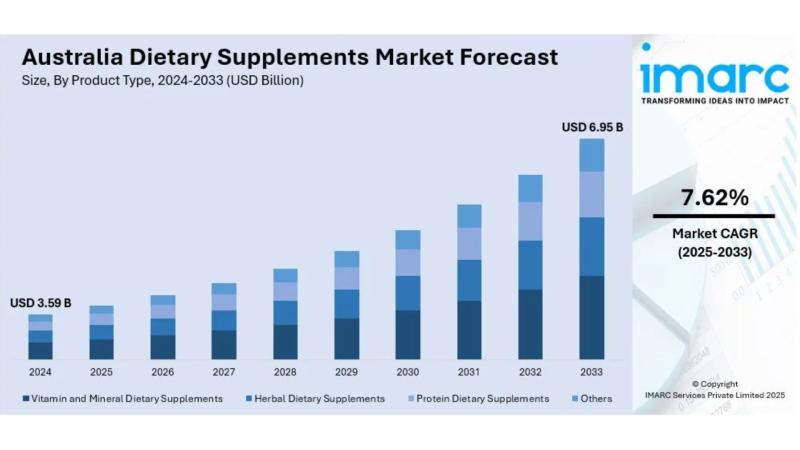
The latest report by IMARC Group, titled “Australia Dietary Supplements Market: Industry Trends, Share, Size, Growth, Opportunity and Forecast 2025-2033,” offers a comprehensive analysis of the Australia dietary supplements market growth. The report also includes competitor and regional analysis, along with a breakdown of segments within the industry. The Australia dietary supplements market size reached USD 3.59 Billion in 2024. Looking forward, IMARC Group expects the market to reach USD 6.95 Billion by 2033, exhibiting a growth rate (CAGR) of 7.62% during 2025-2033.

Report Attributes:

• Base Year: 2024

• Forecast Years: 2025-2033

• Historical Years: 2019-2024

• Market Size in 2024: USD 3.59 Billion

• Market Forecast in 2033: USD 6.95 Billion

• Market Growth Rate 2025-2033: 7.62%

For an in-depth analysis, you can refer to a sample copy of the report:

https://www.imarcgroup.com/australia-dietary-supplements-market/requestsample

How Is AI Transforming the Dietary Supplements Market in Australia?

• Personalized nutrition algorithms are revolutionizing supplement recommendations with AI-powered analysis of individual health profiles increasing customer satisfaction by 40%

• Smart manufacturing systems are optimizing quality control processes with AI-driven testing reducing contamination risks by 35% while ensuring compliance

• Predictive analytics are enhancing inventory management helping retailers reduce stockouts by 30% while minimizing expiration waste

• Digital health platforms are integrating supplement tracking with AI-powered wellness monitoring providing personalized dosage recommendations

Australia Dietary Supplements Market Overview

• High consumer adoption rates show 44.2% of Australians (nearly 9 million people) regularly take vitamins, minerals, or dietary supplements for health maintenance

• Aging population demographics are driving sustained market growth as older adults increasingly focus on preventive healthcare and nutritional gap filling

• Health consciousness trends are expanding supplement usage beyond traditional vitamins to include functional ingredients, probiotics, and targeted wellness solutions

• TGA regulatory framework provides consumer confidence through stringent quality standards and safety requirements for therapeutic goods

• Australian brand dominance continues with homegrown companies like Blackmores, Swisse, and Nature’s Own maintaining strong market leadership

Key Features and Trends of Australia Dietary Supplements Market

• Nature’s Own leads consumer preference as the most widely consumed brand, followed by established players Swisse, Blackmores, Berocca, and Cenovis

• Liquid supplement segment is accelerating with the Australia & New Zealand liquid dietary supplements market projected to grow at 12.9% annually

• Mental health and sleep products are gaining momentum as market leaders develop specialized formulations addressing stress and wellness needs

• Premium ingredient positioning dominates with brands emphasizing scientific backing, quality sourcing, and therapeutic-grade formulations

• Multi-channel distribution strategies combine traditional pharmacy sales with online platforms and health food store partnerships

Growth Drivers of Australia Dietary Supplements Market

• Aging Population Demographics: Increasing elderly population driving demand for age-related health maintenance and chronic condition management supplements

• Growing Health Consciousness: Rising awareness of preventive healthcare and nutritional wellness creating sustained demand across all age groups

• Busy Lifestyles Creating Nutritional Gaps: Time-constrained consumers seeking convenient solutions to meet daily nutritional requirements

• Post-COVID Health Focus: Pandemic-driven emphasis on immune support and overall wellness sustaining elevated supplement consumption

• Scientific Research Advancement: Increased clinical evidence supporting supplement efficacy driving consumer confidence and adoption

Browse Full Report with TOC & List of Figures:

https://www.imarcgroup.com/australia-dietary-supplements-market

Innovation & Market Demand of Australia Dietary

Supplements Market

• Functional ingredient integration is expanding beyond basic vitamins to include adaptogens, nootropics, and targeted wellness compounds

• Sustainable packaging solutions are advancing through eco-friendly bottles, biodegradable materials, and refillable container systems

• Personalized supplement formulations are emerging through genetic testing and individual health profiling services

• Clean label movement is driving demand for organic, non-GMO, and additive-free supplement options with transparent ingredient lists

• Digital health integration enables supplement tracking through mobile apps and wearable device connectivity for optimized wellness outcomes

Australia Dietary Supplements Market Opportunities

• Mental health and cognitive supplements present significant growth potential addressing stress, anxiety, and brain health concerns

• Sports nutrition integration offers opportunities for performance-enhancing supplements targeting active lifestyle demographics

• Women’s health specialization provides targeted market segments for prenatal vitamins, hormonal support, and age-specific formulations

• Therapeutic food applications create opportunities for condition-specific supplements addressing diabetes, cardiovascular health, and joint support

• Export market expansion enables Australian brands to leverage clean, quality reputation in international wellness markets

Australia Dietary Supplements Market Challenges

• Regulatory compliance complexity requires ongoing investment in TGA registration, quality assurance, and therapeutic claims substantiation

• Consumer skepticism about efficacy necessitates scientific evidence and transparent communication about supplement benefits and limitations

• Market saturation in traditional categories creates intense competition requiring differentiation through innovation and premium positioning

• Supply chain cost inflation affects raw material pricing for active ingredients, packaging, and manufacturing processes

• Healthcare professional skepticism requires evidence-based education to support supplement recommendations and professional endorsements

Australia Dietary Supplements Market Analysis

• Brand consolidation trends continue with major acquisitions like Kirin’s AUD 1.2 billion purchase of Blackmores reshaping competitive dynamics

• Innovation investment priorities focus on mental health formulations, sleep products, and functional ingredients addressing modern lifestyle needs

• Distribution channel evolution shows growth in online platforms while traditional pharmacy channels maintain dominant market share

• Consumer preference patterns reveal loyalty to established Australian brands while openness to premium and specialized product categories

• Regulatory environment maturation provides stable framework supporting market growth while maintaining consumer protection standards

Australia Dietary Supplements Market Segmentation:

1. By Product Type:

• Vitamins

• Minerals

• Herbal Supplements

• Protein Supplements

• Probiotics

• Others (Omega-3, Specialty Formulations)

2. By Form:

• Tablets/Capsules

• Soft Gels

• Liquids

• Powders

3. By End-User:

• Adults

• Elderly

• Children

• Pregnant Women

• Athletes

4. By Region:

• New South Wales

• Victoria

• Queensland

• Western Australia

• South Australia

• Others (ACT, Tasmania, Northern Territory)

Australia Dietary Supplements Market News & Recent Developments:

August 2025: Japanese company Kirin completed its AUD 1.2 billion acquisition of Blackmores, subject to regulatory approvals, marking one of the largest transactions in Australian supplement industry history.

July 2025: JSHealth Vitamins expanded its product portfolio with new mental health formulations and set strategic focus on independent chemists and specialty health stores for distribution growth.

Australia Dietary Supplements Market Key Players:

• Blackmores Limited (Kirin Holdings)

• Swisse Wellness Pty Ltd

• Nature’s Own

• Cenovis

• Berocca (Bayer)

• JSHealth Vitamins

• Caruso’s Natural Health

• Thompson’s

• Centrum (Haleon)

• Microgenics

• Healthy Care

• Nature’s Way

• BioCeuticals

• Eagle Natural Health

• Inner Health Plus

Key Highlights of the Report:

1. Market Performance (2019-2024)

2. Market Outlook (2025-2033)

3. COVID-19 Impact on the Market

4. Porter’s Five Forces Analysis

5. Strategic Recommendations

6. Historical, Current and Future Market Trends

7. Market Drivers and Success Factors

8. SWOT Analysis

9. Structure of the Market

10. Value Chain Analysis

11. Comprehensive Mapping of the Competitive Landscape

Note: If you need specific information that is not currently within the scope of the report, we can provide it to you as a part of the customization.

Ask analyst for your customized sample:

https://www.imarcgroup.com/request?type=report&id=33044&flag=E

FAQs: Australia Dietary Supplements Market

Q1: What is driving the growth of Australia’s dietary supplements market?

A: The market is primarily driven by aging population demographics, growing health consciousness, busy lifestyles creating nutritional gaps, post-COVID health focus, and scientific research advancement supporting supplement efficacy.

Q2: Which brands dominate the Australian dietary supplements market?

A: Nature’s Own leads consumer preference, followed by Swisse, Blackmores, Berocca, and Cenovis, with 44.2% of Australians (nearly 9 million people) regularly taking supplements.

Q3: How is the regulatory environment affecting the market?

A: The TGA regulatory framework provides consumer confidence through stringent quality standards while creating compliance requirements that support market maturation and professional credibility.

Q4: What are the main challenges facing Australia’s dietary supplements market?

A: Key challenges include regulatory compliance complexity, consumer skepticism about efficacy, market saturation in traditional categories, supply chain cost inflation, and healthcare professional skepticism.

Q5: Which product segments show the strongest growth potential?

A: Mental health and cognitive supplements, liquid formulations (12.9% CAGR), sports nutrition integration, women’s health specialization, and personalized supplement solutions represent the strongest growth opportunities.

Conclusion of Report:

• Australia’s dietary supplements market is experiencing robust transformation with 7.62% annual growth driven by aging demographics, health consciousness, and post-pandemic wellness focus

• Market leadership remains concentrated among established Australian brands like Blackmores, Swisse, and Nature’s Own while facing consolidation through major international acquisitions

• Innovation in mental health, sleep products, and personalized nutrition is reshaping traditional vitamin categories while liquid supplements show exceptional growth potential

• Consumer adoption rates of 44.2% demonstrate market maturity while creating opportunities for specialized formulations and premium positioning

• Continued investment in scientific research, regulatory compliance, and targeted wellness solutions will be essential for capturing growth opportunities in Australia’s evolving dietary supplements landscape

Contact Us:

134 N 4th St. Brooklyn, NY 11249, USA

Email: sales@imarcgroup.com

Tel No: (D) +91 120 433 0800

United States: +1-201971-6302

About Us:

IMARC Group is a leading market research company that provides management strategy and market research worldwide. We partner with clients in all sectors and regions to identify their highest-value opportunities, address their most critical challenges, and transform their businesses. Our solutions include comprehensive market intelligence, custom consulting, and actionable insights to help organizations make informed decisions and achieve sustainable growth.

This release was published on openPR.


Source link

25 09, 2025

Dogecoin Price Prediction, Hyperliquid Sell Off As Aster

By |2025-09-25T08:39:45+03:00September 25, 2025|Crypto News, News|0 Comments

The meme coin scene is never short of drama, but September has delivered a different kind of storyline. Dogecoin price prediction debates are turning sour as momentum fades. Hyperliquid (HYPE) is staring down a major sell-off, while Aster is quickly climbing the charts.

Yet all eyes are shifting to Layer Brett (LBRETT), where presale demand https://layerbrett.com and wallet activity are reaching levels that few tokens can match.

Layer Brett (LBRETT) Sets The Pace

Before diving into the older players, traders are locked in on LBRETT. The presale price remains at $0.0058 for now https://layerbrett.com, but with each new funding stage filling up fast, early buyers are rushing to secure their stake. More than just hype, Layer Brett is rolling out an Ethereum Layer 2 chain that can process 10,000 transactions per second with gas fees averaging just $0.001. This positions LBRETT as a full-blown utility play wrapped in culture and branding.

Unlike bearish Dogecoin price prediction or Hyperliquid fears, Layer Brett is stacking fundamentals. Around 600% staking APY is keeping long-term holders engaged, while planned NFT and DeFi integrations are creating even more buzz. FOMO is getting thicker with each round closing. Analysts are calling it one of the most aggressive presales of 2025, and traders who don’t move soon risk watching this rocket leave the launchpad without them.

Dogecoin Price Prediction Turns Bearish

Dogecoin (DOGE) may be the original meme coin, but its dominance is slipping. Multiple Dogecoin price predictions suggest DOGE could struggle to maintain current levels, with some expecting a dip in the coming weeks. While DOGE still has one of the strongest communities in crypto, the lack of major ecosystem growth has left investors questioning whether fresh capital will flow in.

DOGE charts aren’t offering much confidence. As new tokens like LBRETT and ASTER gain traction, Dogecoin price prediction targets are being revised downward, leaving long-term holders uneasy about the road ahead. Traders who once saw DOGE as the safe meme play are now rotating into newer narratives.

Hyperliquid Faces Heavy Sell Pressure

Hyperliquid (HYPE) is another token under pressure. Once a favorite for speculative traders, HYPE’s recent downturn has sparked panic. Trading volume has thinned, and many analysts believe the HYPE sell-off could accelerate if support levels break. Bearish forecasts dominate most discussions, with HYPE struggling to find new buyers in a market where alternatives like LBRETT are offering more attractive upside.

The decline in HYPE isn’t just technical. Sentiment has shifted, and without fresh catalysts, traders see little reason to hold through the slump. Unlike ASTER, which is showing bullish momentum, HYPE is firmly stuck in bearish territory for now.

Aster Emerges As A Surprise Bull

While DOGE and HYPE face turbulence, ASTER is emerging as a bullish standout. Trading activity for ASTER has been climbing, with analysts projecting significant upside if momentum holds. Unlike DOGE’s fading trend and HYPE’s heavy sell pressure, ASTER has been winning over retail and institutional players alike.

Analysts highlight ASTER’s strong development pipeline and growing liquidity as key drivers. ASTER could continue to outperform throughout September, with upside projections ranging from moderate gains to potentially explosive moves. ASTER is shaping up as the token that could deliver serious returns while others falter.

Where The Real Gains Could Land

September’s market is showing sharp divides. Dogecoin price predictions are leaning bearish, HYPE looks stuck in a sell cycle, and ASTER is one of the few bright spots in the altcoin space. Yet Layer Brett continues to dominate, with presale demand, speedy blockchain, and around 600% staking rewards.

For traders chasing asymmetric gains, the move is clear: join the LBRETT presale https://layerbrett.com while the window is still open.

Discover More About Layer Brett (LBRETT):

Presale: LayerBrett | Fast & Rewarding Layer 2 Blockchain

Telegram: View @layerbrett

X: https://x.com/LayerBrett

Disclaimer:

This article is for informational purposes only and does not constitute financial advice. Cryptocurrency investments carry risk, including total loss of capital. Readers should conduct independent research and consult licensed advisors before making any financial decisions.

Crypto Press Release Distribution by https://btcpresswire.com

This release was published on openPR.

Source link

25 09, 2025

Cardano proposes $50M to boost stablecoin, DeFi, and RWA

By |2025-09-25T07:09:26+03:00September 25, 2025|News, NFT News|0 Comments


The Cardano Foundation has proposed allocating 50 million ADA (worth about $40.5 million) to a new liquidity fund to expand stablecoin adoption and DeFi activity on the network.

The Foundation argued that deeper liquidity remains one of the blockchain network ecosystem’s most urgent needs. It added that an expanded stablecoin supply could bolster Cardano adoption and provide an adequate revenue source for its treasury.

According to the Foundation:

“This proposal not only seeks to deploy treasury funds for the good of the Cardano blockchain and create a sustainable source of revenue, but will also create additional benefits for the ecosystem.”

According to estimates, the deployments could return about 4% annually to the treasury, citing correlations between trading volume and total value locked (TVL). If liquidity deepens, trading volumes are likely to rise, generating more sustainable yields for the network.

The revenue earned through these protocols would be split: 15% would be converted to ADA and returned to the treasury each month, while 85% would stay in protocols to compound growth.

Cardano’s new roadmap

Meanwhile, the liquidity fund is only one element of a wider roadmap marking Cardano’s eighth anniversary.

In its new roadmap, the Foundation revealed plans to scale its Web3 adoption team to target exchange integrations, tokenized asset partnerships, and enterprise use cases.

By 2026, the Foundation expects to commit 2 million ADA ($1.62 million) to its Venture Hub, a program designed to back startups through collaborations with Draper University, Techstars, and CV Labs.

According to the Foundation:

“We aim to bootstrap the sustainability of the Cardano projects in the Venture Hub through direct investments and loans, technical advisory services, coaching, network advisory consultancy, integration support, and other business critical solutions.”

The roadmap also extends Cardano’s push into real-world asset (RWA) tokenization.

The Foundation revealed that Cardano has already piloted tokenized finance, with $10 million in real-world assets launched alongside Members Cap. So, its next steps include creating formal standards for real-world asset issuance and integrating Cloudflare’s x402 payments framework through Masumi Network.

Marketing and governance

Meanwhile, the Foundation said the past year’s regulatory shifts and competitive pressures have underscored the importance of visibility.

In response, Cardano will raise its marketing budget by 12% in 2026. The increase will fund inbound content, paid media, and global events that showcase the blockchain’s capabilities.

Cardano intends to maintain a strong presence at major industry conferences, including TOKEN2049 and Consensus, while co-hosting community-driven events such as the Africa Tech Summit 2026 and the Digital Asset 2026 gathering in London.

The Cardano Foundation also revealed intentions to expand the number of active governance actors shaping the blockchain network’s future.

To achieve this, the Foundation revealed that it will delegate 220 million ADA across eleven new Adoption and Operations DReps, while reducing its self-delegation to 80 million ADA.

This move will build on its earlier success in delegating 140 million ADA to seven Builder Delegated Representatives (DReps).

Mentioned in this article


Source link

25 09, 2025

XAU/USD drifts higher to near $3,750 amid rate cut bets, geopolitical risks

By |2025-09-25T06:59:51+03:00September 25, 2025|Forex News, News|0 Comments


  • Gold price gains ground to near $3,750 in Thursday’s early Asian session.
  • Geopolitical tensions and uncertainty boost the safe-haven flows. 
  • Fed Powell’s cautious remarks on potential interest rate cuts might cap the Gold’s upside. 

Gold price (XAU/USD) trades in positive territory around $3,750 during the early Asian session on Thursday. The precious metal edges higher amid expectations of further US rate cuts from the Federal Reserve (Fed) this year and persistent geopolitical risks.

The Fed cut its benchmark interest rate by 25 basis points (bps) at its September meeting, bringing the Federal Funds Rate to a target range of 4.00% to 4.25%. A Summary of Economic Projections (SEP), or ‘dot-plot’, showed that the median Fed policymakers expect two more rate reductions before the end of 2025, and one more in 2026. Lower interest rates could reduce the opportunity cost of holding Gold, supporting the non-yielding precious metal. 

Furthermore, geopolitical uncertainty boosted demand for safe-haven assets like Gold. NATO warned Russia on Tuesday that it would use “all necessary military and non-military tools” to defend itself as it condemned Moscow for violating Estonian airspace in “a pattern of increasingly irresponsible behaviour”.

On the other hand, cautious remarks from Fed Chair Jerome Powell about the timing of the next cut in US interest rates might cap the upside for the yellow metal. Powell said on Tuesday that the US central bank would continue to balance concerns over labour market weakness with worries about inflation, while Fed officials took stances on both sides of the monetary policy path divide.

Gold FAQs

Gold has played a key role in human’s history as it has been widely used as a store of value and medium of exchange. Currently, apart from its shine and usage for jewelry, the precious metal is widely seen as a safe-haven asset, meaning that it is considered a good investment during turbulent times. Gold is also widely seen as a hedge against inflation and against depreciating currencies as it doesn’t rely on any specific issuer or government.

Central banks are the biggest Gold holders. In their aim to support their currencies in turbulent times, central banks tend to diversify their reserves and buy Gold to improve the perceived strength of the economy and the currency. High Gold reserves can be a source of trust for a country’s solvency. Central banks added 1,136 tonnes of Gold worth around $70 billion to their reserves in 2022, according to data from the World Gold Council. This is the highest yearly purchase since records began. Central banks from emerging economies such as China, India and Turkey are quickly increasing their Gold reserves.

Gold has an inverse correlation with the US Dollar and US Treasuries, which are both major reserve and safe-haven assets. When the Dollar depreciates, Gold tends to rise, enabling investors and central banks to diversify their assets in turbulent times. Gold is also inversely correlated with risk assets. A rally in the stock market tends to weaken Gold price, while sell-offs in riskier markets tend to favor the precious metal.

The price can move due to a wide range of factors. Geopolitical instability or fears of a deep recession can quickly make Gold price escalate due to its safe-haven status. As a yield-less asset, Gold tends to rise with lower interest rates, while higher cost of money usually weighs down on the yellow metal. Still, most moves depend on how the US Dollar (USD) behaves as the asset is priced in dollars (XAU/USD). A strong Dollar tends to keep the price of Gold controlled, whereas a weaker Dollar is likely to push Gold prices up.


Source link

Go to Top