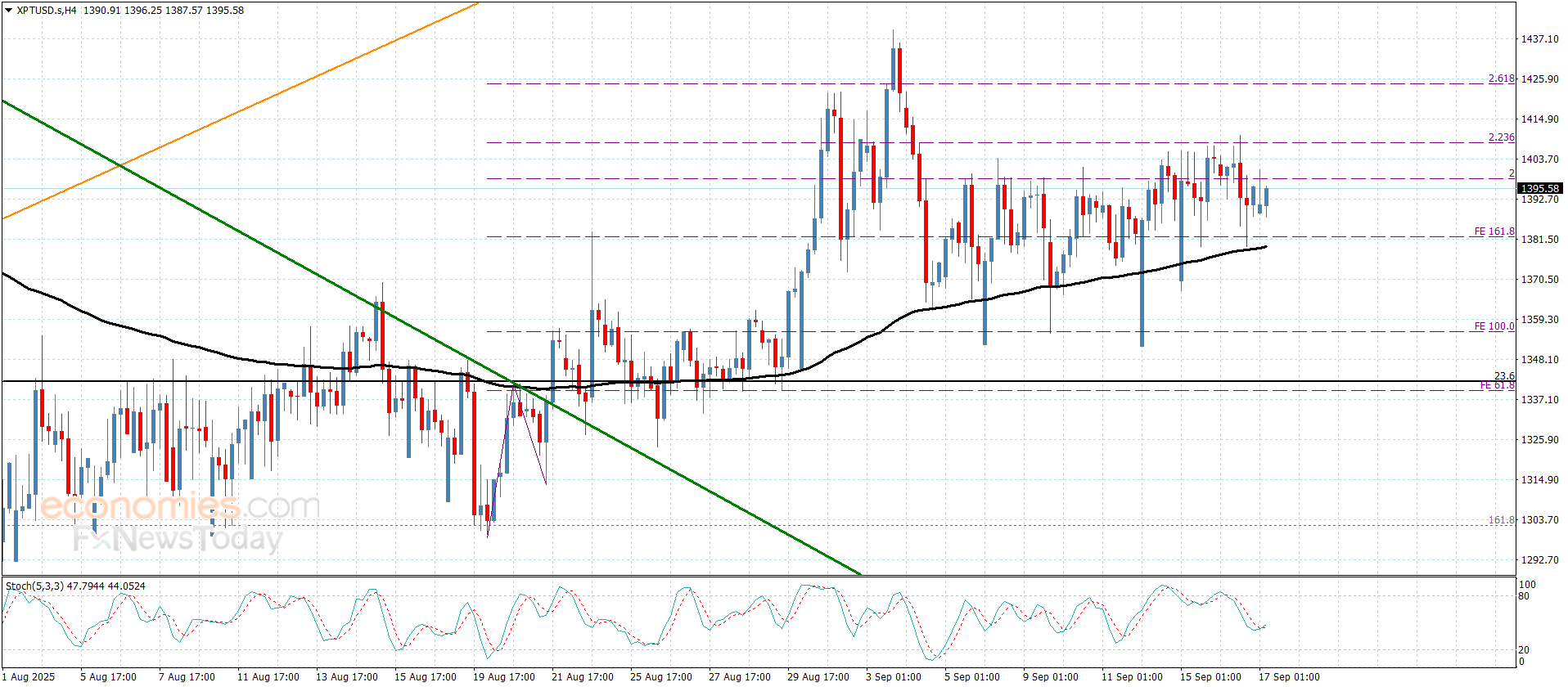
Despite the weak trading of Platinum price recently, its stability above the moving average 55 reinforces the stability of the extra support at $1382.00, besides stochastic attempt to provide positive momentum, these factors assist confirming the continuation of the positivity, to keep waiting for breaching the obstacle of $1408,00 to ease the mission of achieving the main targets that begin at $1435.00.
The risk of changing the main trend is represented by attempting to break the critical support at $1355.00, forcing it to form strong bearish waves, to expect reaching $1302.00 initially reaching to 38.2%Fibonacci correction level at $1255.00.
The expected trading range for today is between $1375.00 and $1425.00
Despite the weak trading of Platinum price recently, its stability above the moving average 55 reinforces the stability of the extra support at $1382.00, besides stochastic attempt to provide positive momentum, these factors assist confirming the continuation of the positivity, to keep waiting for breaching the obstacle of $1408,00 to ease the mission of achieving the main targets that begin at $1435.00.
The risk of changing the main trend is represented by attempting to break the critical support at $1355.00, forcing it to form strong bearish waves, to expect reaching $1302.00 initially reaching to 38.2%Fibonacci correction level at $1255.00.
The expected trading range for today is between $1375.00 and $1425.00
The crypto market is buzzing with activity as traders focus on Pi coin news and the latest Cardano price prediction updates.
Meanwhile, Remittix (RTX) has been making headlines as the best crypto to buy now, attracting attention from both retail investors and Wall Street traders.
Pi Coin News – Whales Bet Big on Pi Network Rebound
Pi is currently trading around $0.355, still down a massive 90% from its all-time high. However, Pi coin news today reveals that not everyone is bearish. Whales have been aggressively buying, with one whale spending thousands of dollars daily to build a portfolio of 373.78 million tokens, now worth over $132 million.
From a technical perspective, Pi’s chart has formed a double bottom at $0.3321, a bullish pattern that often signals a turnaround. The next major resistance sits at $0.4652. If the token breaks this level, Pi could see a 32% surge from current prices. Some analysts are even more bullish, calling for the token to reach $1.
source: TradingView
Cardano Price Prediction – Major Breakout Soon?
ADA is trading around $0.883. The Cardano price prediction remains bullish, with analysts watching a critical resistance zone between $0.90 and $0.92. This level forms the “neckline” of a cup and handle pattern, a formation that often precedes a strong price increase.
If ADA successfully passes this, it could reach $1.05, $1.15, and even $1.25. However, failure to pass $0.85 might lead to a price drop to $0.76 or $0.68 before another rally attempt.
On-chain data also supports this bullish outlook, with a steady decline in short-term supply and accumulation by long-term holders. Analysts believe that a confirmed breakout above $0.9421 could set ADA up for a strong rally heading into Q4 2025.
Remittix – The Viral Payfi Token Everyone Is Talking About
While Pi and Cardano dominate headlines, Remittix is quietly becoming the best new altcoin. The project has raised over $25,6 million with more than 662 million tokens sold at $0.1080 each. This explosive growth has caught the attention of crypto whales and Wall Street traders alike.
Remittix has announced two CEX listings, with the first on BitMart and the second on LBANK. Adding to the excitement, the Remittix Beta Wallet will officially launch on September 15th 2025, allowing users to send and receive funds seamlessly. Remittix also offers a 15% referral rewards program, giving investors extra earnings for bringing friends and family into the community.
$25,6 million raised and 662M tokens sold, showing strong investor trust.
Confirmed CEX listings on BitMart and LBANK for massive liquidity.
Beta Wallet launching September 15th 2025, proving real-world use cases.
15% referral rewards program, boosting viral growth and user adoption.
Created to change the global remittance market, a multi-billion-dollar industry.
The Bottom Line
The latest Pi coin news highlights whale activity that could trigger a major rebound, while the Cardano price prediction points to a potential breakout above key resistance levels. However, for investors seeking explosive growth, Remittix stands out as a unique opportunity with strong fundamentals and real-world utility.
Discover the future of PayFi with Remittix by checking out their project here:
In recent years, many Canadians have noticed that their daily lives feel more rushed than ever. For many people, this pace feels less like a choice and more like a routine that is hard to step away from.
Slow living is gaining attention as a meaningful way to rethink how time is spent. It is not about stepping away from responsibilities. Instead, it is about making intentional decisions that bring balance. The science behind slow living shows that when people create space in their day for mindful routines, the body and mind respond in positive ways.
This lifestyle offers an approachable path to living with more presence, enjoyment, and ease.
The Science That Supports Slowing Down
Studies show that taking time for slower routines helps maintain steady heart rate patterns and supports clear thinking. When the body is not rushed, it responds with balance. When the mind is not distracted, it can focus more effectively.
This does not mean that people need to change everything about their routines. It means that even a few slower choices during the day can have an impact. Reading for ten minutes before bed, preparing food without multitasking, or sitting quietly in a park are all examples of activities that encourage the body and mind to align with a slower rhythm.
Nourishment as a Mindful Practice
Food preparation and eating are central to slow living. Cooking at home, using fresh ingredients, and enjoying meals without rushing allows people to engage with food more fully. Studies show that preparing meals at home is linked with better nutritional outcomes because it encourages a variety of whole ingredients.
Many people are also becoming interested in exploring additional ways to support wellness alongside balanced meals. Some choose to add health-friendly supplements by brands like USANA Health Sciences to their routines. This can complement nutritious food while keeping the focus on mindful choices. What matters most is creating a pattern of nourishment that feels intentional and enjoyable.
The Value of Spending Time in Nature
Nature offers one of the simplest ways to practise slow living. Research shows that spending even a short amount of time outdoors helps maintain balanced body rhythms and supports overall feelings of wellness. Canadians are in a unique position to enjoy natural landscapes, whether that means walking in a local park, gardening in the backyard, or exploring the trails near lakes and forests.
Being outdoors allows the mind to reset from the constant demands of technology and schedules. Even in urban areas, finding a quiet bench, noticing seasonal changes, or tending to a balcony garden can create moments of connection. These small interactions with nature remind people to move at a slower pace and notice the details around them.
Simplifying Choices to Create More Ease
One of the foundations of slow living is reducing the number of small decisions that take up mental space. Research in behavioural science shows that people make an estimated 35,000 choices per day, and many of these decisions involve food, schedules, or digital activity. While these choices seem minor, they can add up and create what experts call decision fatigue.
Simplifying everyday choices helps create more room for focus. This might mean planning weekly meals in advance, choosing a small but versatile wardrobe, or organizing spaces so that items are easy to find. These actions reduce unnecessary decisions and leave more energy for meaningful activities. By making daily routines more predictable, slow living allows space for a steadier rhythm throughout the day.
Building Stronger Connections Through Intentional Time
Slow living also highlights the importance of relationships. Research from the Canadian Index of Wellbeing shows that social connections are directly linked to how satisfied people feel with their lives. When people spend time with family, friends, or their communities in intentional ways, it can create a sense of belonging and support.
Simple practices like enjoying meals together without distractions, scheduling weekly calls with loved ones, or participating in local events can nurture these bonds. The key is presence. Being fully engaged in conversations and activities, without multitasking, creates stronger and more lasting connections. In this way, slow living is not only about personal well-being but also about building supportive communities.
Finding Balance With Digital Technology
Technology has become an essential part of modern life, but it can also contribute to a sense of urgency. Canadians, on average, spend over 25 hours per week online, according to the Canadian Internet Use Survey. While technology offers many benefits, setting healthy boundaries with devices can help align with the principles of slow living.
Practical steps include turning off non-essential notifications, setting screen-free times during meals, or dedicating certain hours of the day to offline activities. Some people also find value in using apps that track screen use and encourage mindful breaks. These strategies do not require giving up technology but instead support a balanced relationship with it. Digital balance allows people to use technology as a tool while still creating room for slower and more intentional moments.
Small Steps to Begin Practising Slow Living
Adopting a slower lifestyle does not mean changing everything at once. Research on habit formation shows that making small, repeated changes is the most effective way to build lasting routines. Starting with one or two adjustments can make the process manageable and enjoyable.
Examples include beginning the day with five minutes of stretching, setting aside one evening per week for a phone-free family dinner, or taking a short walk outdoors during lunch breaks. These steps are simple, but they create a foundation for a slower rhythm. Over time, small choices begin to shape a lifestyle that feels more balanced. The goal is not perfection but consistency, which leads to steady and meaningful change.
Slow living is not about doing less. It is about choosing to do things with greater presence and intention. Research supports the idea that slowing down can help maintain balanced routines, support meaningful relationships, and create more time for activities that matter.
This approach can begin with simple actions like mindful meals, time in nature, or reduced digital distractions. It is a lifestyle that can be tailored to different needs, schedules, and preferences. The science shows that when people allow themselves to live at a slower pace, they open the door to greater awareness and enjoyment of everyday life.
By making intentional choices, anyone can begin to explore the benefits of slow living. It is not about stepping away from responsibilities but about reshaping routines so that life feels more steady, connected, and fulfilling.
Disclaimer The Content is not intended to be a substitute for professional medical advice, diagnosis, or treatment. Always seek the advice of your physician or other qualified health provider with any questions you may have regarding a medical condition.
The idea of XRP reaching $100 is currently one of the most debatable of our cryptocurrency times. XRP was one of the longest runners in cross-border payments, but there is competition, regulatory challenges, and market volatility to consider whether it is in its own good.
This XRP Price Prediction explores whether or not such a milestone is possible and what it means for investors based on new developments such as Remittix (RTX) that are transforming digital finance.
XRP Price Prediction and Market Climate
XRP has been an established remittance player globally for several years now and is among the most sought-after cryptocurrencies besides Bitcoin and Ethereum. At a sale price of $3.05, market capitalization of $181.09 billion, and 24-hour trading volume of $5.02 billion (down 15.34%), XRP remains among the most traded cryptocurrency.
For XRP to be a real possibility at $100, though, it would need enormous market growth and adoption both in the institutional and retail spaces.
Although its role in cross-border payments is monopolistic, the crypto universe is today full of upcoming crypto initiatives offering faster settlement, lower fees, and higher integration flexibility. XRP’s trajectory is also highly dependent upon regulation clarity.
In the United States, judicial proceedings have decelerated momentum, whereas other regions keep testing out regulations that would benefit or injure its progress.
The Rise of Utility-First Projects
The crypto space is moving towards real-world utility. Low gas fee crypto projects, decentralized exchanges, and new altcoins with payment use cases are making large headlines. Investors are more concerned with hype coins now and are instead focusing on crypto with real utility, long-term sustainability, and practical adoption.
This shift creates space for platforms that do not only guarantee innovation but have even working solutions. While XRP is fighting to push banking adoption, rivalry from the next big altcoin 2025 players is tough. Among such projects creating buzz is Remittix (RTX), a cross-chain DeFi platform bridging crypto and fiat payments.
The Forces Powering Remittix’s Rise
Remittix ($0.1080 per token) has already secured more than $25.9 million, selling 664Million+ tokens in presale. It solves a $19Trillion payments problem by allowing users to pay crypto straight to bank accounts in 30+ nations. Unlike most early-stage crypto investments, Remittix already possesses a real-world use case which is already being trialed through its wallet beta.
Important project highlights are:
Ranked #1 on CertiK for pre-launch tokens
First CEX listing confirmed with BitMart and second with LBank
$250,000 giveaway active for presale supporters
15% USDT referral incentives paid every day
Over $25.9Million raised in one of the best crypto presales 2025
With CertiK auditing, Remittix is a secure, open DeFi project and is increasingly viewed as the next altcoin 2025.
Final Thoughts on XRP Price Prediction
Whereas XRP is one of the top cryptos to invest in today for others, reaching $100 would require historic adoption and growth in the market. The cryptocurrency market is evolving at a fast pace, and investors are diversifying into low cap crypto gems and future cryptos that have real-world effects.
Remittix provides a fresh perspective by integrating cross-border payments with blockchain effectiveness, and therefore it is among the most realistic crypto presales that are currently running. Be it XRP hitting $100 or not, the advent of projects like Remittix is an indication that the future of crypto lies in offering practical solutions and not speculation.
Discover the future of PayFi with Remittix by checking out their project here:
WTI (CL=F) and Brent (BZ=F) Face Diverging Pressures as Oversupply Meets Geopolitical Risk
Oil markets remain in a tight tug-of-war between oversupply signals and the slow rebuilding of a geopolitical risk premium. WTI crude (CL=F) is holding near $63.86 per barrel, up 0.96% on the day, while Brent (BZ=F) trades at $67.74, adding 0.77%. Both benchmarks have rallied from last week’s lows, but upside momentum is capped by projections of a supply glut into 2026, with Goldman Sachs forecasting Brent could slump below $55 per barrel next year on the back of a 1.8 million barrels per day surplus.
EIA Data Highlights U.S. Stock Drawdowns and Resilient Demand
U.S. government data showed commercial crude inventories fell by 2.4 million barrels in the week ending August 22, extending a prior draw of 6 million barrels, leaving stockpiles at 418.3 million barrels—around 6% below the five-year average. Gasoline inventories slipped another 1.2 million barrels, while distillates fell 1.8 million barrels, now 15% below their seasonal norms. Refineries are producing 10 million barrels per day of gasoline and 5.2 million barrels of distillates, indicating that U.S. demand, which averaged 21.2 million bpd over the past month, remains higher by 2.5% year over year. This domestic strength has helped WTI avoid steeper losses despite global bearish forecasts.
China’s Oil Giants Post Record Output but Weak Profits as Brent Averages $71
China’s three state-run majors—CNOOC, PetroChina, and Sinopec—have all reported profit declines despite record upstream production. CNOOC booked $9.7 billion in first-half 2025 profit, down 13% YoY, even as output surged to 384.6 million barrels of oil equivalent, a 6.1% increase with gas production up 12%. PetroChina reported a 5.4% decline in earnings, while Sinopec posted a staggering 36% slump, both blaming lower refining margins and weaker domestic fuel demand tied to the rise of electric vehicles. The fall in average Brent prices from $83 per barrel in H1 2024 to $71 in H1 2025 underpinned the earnings squeeze.
Kazakhstan Pipeline Halt and Russia-Ukraine Conflict Complicate Flows
Kazakhstan confirmed disruptions in shipments through the Baku-Tbilisi-Ceyhan (BTC) pipeline after contamination issues in Azeri crude forced a halt in July. Exports via this route had climbed 12% YoY in H1 2025 to 785,000 tons, around 34,000 bpd, and resuming clean flows is critical for landlocked Kazakhstan, which relies on BTC to bypass Russian ports. Meanwhile, drone strikes against Russian energy infrastructure and ongoing tariff disputes between Washington and New Delhi add layers of uncertainty to supply chains. Trump’s tariffs on Indian imports, set to take effect this week, could alter Russian crude flows and reshape global pricing dynamics if India is forced to source more barrels from the Middle East.
OPEC+ Balancing Act: Saudi Arabia, Russia, and India’s Role
OPEC’s basket price stands at $70.45, while Saudi Arabia continues to lead output policy with Russia. Despite output cuts, Russia is still moving product aggressively, with Saudi Arabia and India emerging as top buyers of Russian fuel oil. Kazakhstan exceeded its OPEC+ quota in July, producing 1.827 million bpd versus its ceiling of 1.514 million bpd, underscoring the difficulty in enforcing compliance among members. The cartel faces mounting pressure as supply continues to climb globally while demand signals remain mixed, particularly in Asia where growth in petroleum product demand has slowed to zero according to Kpler data.
Technical Signals Show $62–65 as Key Range for WTI and $65–69 for Brent
Chart analysis highlights that WTI is locked in a trading band with resistance near $65 per barrel and support around $62, coinciding with its 50-day EMA ceiling. Brent crude faces a similar sideways structure, capped by resistance at $69 and support at $65. Liquidity is consolidating in these ranges as traders weigh supply-driven weakness against bursts of risk premium whenever geopolitical shocks hit. Hedge funds and speculators have cut bullish bets on crude to their lowest level in 16 years, signaling widespread skepticism that prices can sustain above current levels without a significant geopolitical trigger.
Goldman Sachs and Market Outlook: Risk of Sub-$55 Oil vs. 2026 Bull Cycle
While Goldman warns of Brent falling to the low $50s by 2026, fund managers like Eric Nuttall see the oversupply period setting the stage for a rebound later that year, driven by capex constraints and depletion of shale productivity. The International Energy Agency projects supply growth of 2.1 million bpd in 2025, with demand climbing only 700,000 bpd, cementing a surplus of 1.4 million bpd this year. Still, China’s crude imports are ticking higher sequentially, U.S. demand remains robust, and structural underinvestment in long-cycle projects could eventually reverse the trend.
Verdict: Oil (CL=F, BZ=F) Rated Hold Amid Conflicting Forces
With WTI at $63.86 and Brent at $67.74, oil prices are caught between short-term oversupply and medium-term bullish structural narratives. Inventories are tightening in the U.S. and geopolitical shocks keep adding floor support, but the macro balance tilts bearish with OPEC+ struggling to enforce quotas and analysts projecting sub-$55 Brent in 2026. Given this split picture, oil remains a Hold, with trading ranges dominating until either demand reaccelerates or supply is curbed more aggressively.
Eating a colorful range of foods helps ensure your body gets the vitamins it needs.
From vitamin A to vitamin K, experts share the ins and outs of these essential micronutrients.
While some people may still need a supplement, most can get the nutrition they need from food.
We’ve all heard dietitians say that it’s important to “eat the rainbow.” Sure, a diverse shopping cart makes our meals more novel and fun, but that’s not the only reason they emphasize the dictum. In fact, it’s really all about getting your vitamins. We’re not talking about a multivitamin supplement, either. The truth is, most healthy adults can meet their nutritional needs from the essential micronutrients in their regular diets, no supplementation necessary.
“Vitamins are the small but mighty nutrients that help our bodies function at their best. And we know that we don’t necessarily need huge amounts of vitamins, but we know that we want to get enough of each, and we can do that through our food first,” says Gina Rancourt, M.S., RD, CD.
But how do you ensure that you’re getting everything you need from your meals every day? This handy guide breaks down vitamins A through K, including all eight B vitamins. We’ll share their primary functions, what happens if you don’t get enough, and the best foods to get on your table to help you feel your best.
Vitamin A
What It Does: When your parents told you to eat your carrots for your vision, they were right. That’s because the root vegetable is among the orange-hued foods rich in vitamin A. According to Heather Fiore, M.S.Ed., RD, LD, CDCES, vitamin A also supports your immune system and skin health. You may recognize the names beta carotene and retinol. Both are converted in the body to vitamin A.
How Much You Need: 700 to 900 mcg daily
What Deficiencies Cause: Weakened immune system, dry eyes and poor night vision
Food Sources: Sweet potatoes, carrots, cantaloupe, leafy greens and eggs. Because vitamin A is fat-soluble, it’s best to combine it with healthy fats. An ideal pairing would be sautéing kale in olive oil.
Vitamin B1
What It Does: Also known as thiamin, vitamin B1 helps convert the food we eat into energy. Like all B vitamins, B1 is found mostly in animal products, but there are vegan sources, too.
How Much You Need: 1 to 1.2 mcg daily
What Deficiencies Cause: Confusion, muscle weakness, enlarged heart and short-term memory issues
Food Sources: Pork, beans, and grains (like bread and pasta) that are fortified with the vitamin
Vitamin B2
What It Does: You may already know B2 by its other name, riboflavin. Like B1, it helps turn food into fuel for our bodies, and it keeps our skin and eyes healthy, among the many other cells in the body that it helps to grow and restore.
How Much You Need: 1.1 to 1.3 mcg daily
What Deficiencies Cause: Anemia, migraines, cataracts and skin problems
Food Sources: Milk, yogurt, eggs and almonds
Vitamin B3
What It Does: Alternatively known as niacin, when vitamin B3 is absorbed, it’s converted into a form that is used by more than 400 enzymes to spur reactions. And like other B vitamins, B3 helps metabolize food into fuel.
How Much You Need: 14 to 16 mg daily
What Deficiencies Cause: Extreme deficiency can lead to pellagra, which causes skin to become rough (like a sunburn) and brown when exposed to the sun. It can also cause depression, headaches and fatigue
Food Sources: Poultry, fish, peanuts and whole grains
Vitamin B5
What It Does: Pantothenic acid, as vitamin B5 is also known, is a standout among B vitamins. “This one actually plays a bigger role in our hormones, and then again, with turning food into energy, it helps break down and metabolize our food like fats and carbohydrates,” says Rancourt.
How Much You Need: 5 mg daily
What Deficiencies Cause: Gastrointestinal issues, sleeplessness, numbness or burning in the extremities
Food Sources: Organ meats, fortified cereals, mushrooms, sunflower seeds
Vitamin B6
What It Does: Also called pyridoxine, the role of B6 is to convert food into fuel to help grow and regenerate our brain cells. It also supports immune function.
How Much You Need: 1.3 to 1.7 mg daily
What Deficiencies Cause: Low immunity, depression and anemia
Food Sources: Chickpeas, bananas, potatoes and fortified cereals
Vitamin B7
What It Does: Also known as biotin, B7 supports brain health and, like other B vitamins, helps create fuel from the carbs, protein and fat that we eat.
How Much You Need: 30 mcg daily
What Deficiencies Cause: Hair loss, brittle nails, seizures, depression and fatigue
Food Sources: Eggs (especially the yolk), nuts and seeds
Vitamin B9
What It Does: Anyone who’s been pregnant knows B9, also called folate. “This one’s especially important during pregnancy in particular, because it does help with cell growth and DNA production,” says Rancourt.
How Much You Need: 400 mcg (600 mcg during pregnancy) daily
What Deficiencies Cause: It can cause neural tube defects in fetuses. For adults, anemia and fatigue are the main potential issues
Food Sources: Leafy greens, beans and lentils
Vitamin B12
What It Does: Perhaps the most famous of the B vitamins, B12 is a powerhouse for creating energy, but it also supports nerve health and the formation of red blood cells.
How Much You Need: 2.4 mcg daily
What Deficiencies Cause: Anemia and fatigue
Food Sources: Meat, fortified cereals, blackstrap molasses and nutritional yeast
Vitamin C
What It Does: There’s more to vitamin C than staving off colds. It also helps our bodies absorb iron and plays a role in producing collagen.
How Much You Need: 75 to 90 mg daily
What Deficiencies Cause: Yes, scurvy is a possibility, but it’s more likely that you’ll notice your gums bleeding when you brush your teeth or that you bruise more easily.
Food Sources: Kiwi, citrus, strawberries, bell peppers, tomatoes and broccoli. Pairing iron-rich foods with a food rich in vitamin C can help with iron absorption.
Vitamin D
What It Does: Vitamin D helps absorb calcium, which keeps our bones and teeth strong. It also helps reduce inflammation.
How Much You Need: 15 to 20 mcg (600 to 800 IUs) daily
What Deficiencies Cause: Low energy, higher risk of depression and osteoporosis
Food Sources: Fatty fish (like salmon), egg yolks and fortified dairy
Vitamin E
What It Does: Vitamin E is an antioxidant. “These little things are these tiny warriors, if you will, that help protect our cells from damage. So it’s helpful for a number of reasons at the cellular level,” says Rancourt. This includes helping with both immunity and blood flow.
How Much You Need: 15 mg daily
What Deficiencies Cause: Low immunity and nerve damage
Food Sources: Nuts, seeds, olive oil, leafy greens and avocado. Like vitamin A, it’s best to pair vitamin E with healthy fats for optimal absorption. Making a healthy vinaigrette with olive oil for your salad will do, says Fiore.
Vitamin K
What It Does: Instrumental in our bone health and blood clotting, vitamin K might not be as much of a household name as many of the other vitamins, but we still need to include dark-green vegetables in our diets to make sure we get enough of it each day.
How Much You Need: 90 to 120 mcg daily
What Deficiencies Cause: Uncontrolled bleeding and osteoporosis
Food Sources: Kale, spinach, broccoli and Brussels sprouts. Vitamin K is also fat-soluble, so Rancourt recommends side dishes like roasted broccoli drizzled with olive oil.
Our Expert Take
The takeaway here is that you can get what you need to power your body on a daily basis through everyday foods. Each trip to the grocery store is an exercise in both art and science—planning your meals with vitamin intake in mind should be a color-filled palette for your creativity. As long as you keep your diet varied, you will likely get the vitamins you need.
Dietitians encourage mixing and matching whole, minimally processed foods to create a rainbow of flavors and nutrition that covers the entire spectrum of our vitamin needs.
The previous time Solana showed this particular bullish signal, its price continued to achieve more than 1,000% returns. With the current pullback in full swing, investors are once again on their toes to see if history would repeat itself.
While Solana Price Prediction headlines fill the airwaves, there is a new wave of interest also flowing towards early-stage ventures with strong fundamentals as well. Of them, Remittix (RTX) is quietly making a name for itself as a major contender in 2025.
Solana Price Action And Market Sentiment
At the moment, Solana is trading at around $230.80, having a 5.45% decline within the last 24 hours. Its market capitalization stands at $125.82 billion, and the trading volume has surged to $10.75 billion, up by 29.66%. This type of activity shows that interest in Solana continues to be active despite the recent decline, engaging traders in Solana Price Forecast talks.
This context highlights the broader investor interest in resilience-laden projects with innovation. Old players like Solana are still in the limelight with continued speculation, but many are exploring early-stage crypto investment projects with real-world adoption potential, lower entry and explosive utility increase.
Remittix Beta Wallet And Presale Progress
One such project is Remittix (RTX), which is trading at $0.1080 per token at the moment. Unlike most new altcoins, Remittix is not for speculation purposes but for solving an actual $19 trillion payments issue crypto-to-bank transfers.
Its beta wallet, which has recently gone live as of writing, allows people to send over 40 cryptocurrencies to 30+ fiat currencies, straight into bank accounts in a number of countries.
This cross-chain DeFi project has already recorded a presale of more than $25,8 million selling more than 664 million tokens.
Security, Listings And Growing Ecosystem
Remittix’s credibility made a giant leap when the project was deeply audited by CertiK, the top blockchain security label in the industry. And even more impressively, Remittix is currently #1 on CertiK Skynet among pre-launch tokens, which is proof of trust in its code, transparency and roadmap.
CEX listings add more fuel to the momentum. The first exchange partnership was revealed with BitMart after the $20 million presale milestone, then LBank after $22 million was hit.
Referral Program And Community Incentives
To further promote community growth, Remittix has launched a referral program where users are given 15% in USDT each time they refer a new buyer to the presale. Rewards are cashable immediately every 24 hours, offering participants their rewards on a daily basis to grow the network.
Remittix is standing out because:
Beta wallet now live with global crypto-to-bank transfers
Over $25,8 million raised and sold 664 million+ tokens
Ranking #1 on CertiK among pre-launch projects
Verified BitMart and LBank listings
As Solana Price Prediction continues to capture traders’ attention after setting a record 1,000% gain, the attention is also being given to projects like Remittix that bring real-world solutions. Its live beta wallet, verified exchange listings, CertiK verification and low presale entry point make it one of the best DeFi projects 2025.
Discover the future of PayFi with Remittix by checking out their project here:
Several leading infant formula companies have reported growth in their infant formula sales in China for the first half of this year.
Danone’s Aptamil, Yili, Friesland Campina’s Friso, The a2 Milk Company, and Biostime from H&H Group are some examples that have continued to see growth, amid concerns on fluctuating birth rates in China.
The popularity of premium products and expanding sales in both offline mother-and-baby stores and online channels form a common thread.
Nestle has launched a screening tool for detecting diabetes risk among the Chinese population.
The tool is available via WeChat Mini Program YiYang, which is also a brand of Nestle’s nutritional products launched in China.
According to Nestle, it complements the company’s range of digital tools for supporting personalized nutrition recommendations.
It is also one of Nestle’s latest initiatives in building its range of products and services for supporting blood glucose management in China.
The a2 Milk Company (a2MC) is set to buy a manufacturing facility from Yashili New Zealand in the hopes of ramping up its China label infant formula business.
The company has been seeing sales growth for both its English and China label infant formula in FY25, with the former increased by 17.2% and the latter by 3.3%.
In China, growth was said to be led by effective new user recruitment initiatives, resulting in a record market share of 4% in stage 1 products in the mother-and-baby channels.
China health supplements giant BYHEALTH has continued to see a decline in its sales and profits, and the company said it would be pumping more resources to grow its international business, especially in South East Asia.
Net profit attributed to shareholders of the company dropped 17.34% to RMB736.5m (US$102.5m), while operating revenue fell 23.43% to RMB 3.5bn (US$491.7m).
A continually fragmented retail landscape was said to be one of the reasons for the decline.
Calcium and protein were the most used health supplements among China centenarians, according to a study involving over 2,800 centenarians.
According to findings published in Geroscience, about one in 10 Chinese centenarians used dietary supplements.
The prevalence was higher in men, with 12.3% of male centenarians taking health supplements, as compared to 10.7% among females.
Ethereum (ETH-USD) Holds $4,450 as Fed Cuts and ETF Inflows Dominate the Market
Ethereum (ETH-USD) is consolidating near $4,450–$4,500, absorbing a 5.7% pullback from weekend highs around $4,766 while traders brace for the Federal Reserve’s decision. Futures markets price in a 96% probability of a 25-basis-point cut, a sharp increase from 85% one month earlier, with expectations of at least two further cuts by year-end. This macro backdrop is crucial for Ethereum’s trajectory, as easing conditions have historically fueled risk asset rallies. Despite short-term caution, Ether’s structural foundation has strengthened, with ETF inflows, whale accumulation, and expanding DeFi use cases acting as firm supports beneath the surface.
Institutional Inflows into ETH ETFs Signal Renewed Confidence
Ethereum-linked exchange-traded funds have become the headline driver of demand. Over the last week, ETH ETFs attracted $1.1 billion in inflows, with $360 million arriving in a single day on September 15. BlackRock’s ETHA vehicle absorbed $363 million, while Grayscale’s ETHE added $10 million, partly offset by outflows from Fidelity’s product. Since their 2024 launch, ETH ETFs have amassed more than $13 billion, showing sustained appetite from institutions. While Bitcoin ETFs remain larger, with $2.6 billion in inflows in the same period, Ethereum’s resilience has stood out after sharp August drawdowns. This institutional rotation, paired with whales returning to accumulation, underscores why ETH has managed to hold above $4,400 despite volatility.
Technical Structure Points Toward $5,000 and Higher Levels
Ethereum’s chart setup remains constructive. On the daily, ETH is defending the 20-day EMA at $4,450, while the 50-day EMA around $4,200 provides deeper support. Price action has carved out a bull pennant, a continuation pattern that suggests further upside. If ETH closes above the pennant’s upper boundary, projections point to a breakout toward $6,750, implying gains of more than 45% from current levels. Analysts also highlight the Fibonacci retracement “golden pocket” zone between 0.5 and 0.618, which ETH has reclaimed, confirming bullish bias. Immediate resistance is seen at $4,800, with a decisive break likely opening the door toward $5,000 in the coming weeks. The RSI sits near 54, indicating momentum is neither overbought nor oversold, leaving room for expansion.
Macro Drivers Reinforce the Bull Case for ETH-USD
Beyond technicals, macro conditions are providing the largest tailwind. Fed rate cuts lower the opportunity cost of holding non-yielding assets like ETH, while easing global financial conditions typically drive capital into higher-risk plays. Options data from Derive shows a 40% probability of ETH closing above $5,000 by year-end, and a 20% probability of hitting $6,000. At the same time, Ethereum’s total value locked (TVL) has surpassed $208 billion, while the stablecoin market on its network has grown to $157 billion, cementing Ethereum as the dominant DeFi infrastructure. These fundamentals differentiate ETH from smaller altcoins whose valuations are more narrative-driven.
Network Upgrades and On-Chain Activity Add Structural Strength
The upcoming Fusaka upgrade in November is expected to boost scalability and network security, a key factor as Ethereum processes growing institutional activity. On-chain metrics show that staking deposits remain steady following the Shapella upgrade, with more ETH locked in validators, reducing circulating supply. Whale wallets have resumed accumulation, indicating that long-term holders are confident in Ethereum’s next leg higher. This behavior is consistent with earlier market cycles where whales accumulated aggressively before large breakouts.
Market Behavior and Altcoin Rotation Parallel ETH’s Consolidation
While Ethereum consolidates, attention among retail traders has briefly shifted to speculative presales such as Maxi Doge and Mutuum Finance. These high-risk tokens are drawing flows, but institutions remain anchored to ETH, treating it as the foundational asset for DeFi and staking yield. This divergence underscores the difference between speculative altcoin hype and Ethereum’s entrenched role in the market. Even as side narratives play out, Ethereum’s liquidity and adoption levels remain unmatched.
Ethereum Price Outlook and Decisive Verdict
With Ethereum trading at $4,458, the key pivot remains whether it can hold the $4,440–$4,450 support zone ahead of the Fed’s decision. A confirmed break above $4,800 targets $5,000, while technical projections extend as high as $6,750 if the bull pennant plays out. On the downside, a failure to defend the 20-day EMA risks a slide toward $4,200, though dip-buying behavior has consistently emerged at those levels. Institutional flows, whale accumulation, network upgrades, and macro conditions all reinforce the long-term bull case. Based on these dynamics, Ethereum (ETH-USD) holds a Buy rating, with a short-term target of $5,000, medium-term upside toward $6,750, and long-term structural potential reaching $8,000 as ETF adoption and Fed easing converge.







:max_bytes(150000):strip_icc()/From-A-to-K--The-Complete-Guide-to-Vitamins-in-Everyday-Foods-929c7b1acb05425183b0097d8b7d5ab4.jpg "The Complete Guide to Vitamins in Everyday Foods")


