About Editorial team of BIPNs

Main team of content of bipns.com. Any type of content should be approved by us.
4 11, 2025

ChatGPT Predicts Price of Bitcoin, XRP, Solana by End of 2025

By |2025-11-04T00:51:20+02:00November 4, 2025|Crypto News, News|0 Comments

Last night’s crypto crash hit everyone hard, with Bitcoin falling over 2% in a matter of hours. We’re now seeing the fallout from a cocktail of Fed uncertainty around a potential December rate cut, massive ETF outflows last week, and a $470 million wave of long liquidations.

For any trader, navigating this kind of volatile price action is challenging. Is this a deep-discount buying opportunity, or is it the start of a much deeper correction? It’s hard to tell.

This is why a growing number of traders have been turning to AI for a second opinion. They’re using tools like ChatGPT to cut through the noise, seeking a non-emotional perspective on where crypto prices might be heading.

So, we decided to put this to the test. We gave ChatGPT a straightforward prompt: provide us with end-of-2025 price predictions for three cryptos – Bitcoin, XRP, and Solana. We also included one low-cap altcoin that has been getting a lot of attention during its presale phase: Bitcoin Hyper (HYPER).


This publication is sponsored. CryptoDnes does not endorse and is not responsible for the content, accuracy, quality, advertising, products or other materials on this page.


Bitcoin to $168K by Year-End? ChatGPT Says Yes

Despite Bitcoin’s current chop around $107,000, ChatGPT’s end-of-2025 target is $168,000. The model’s logic is built on a few core arguments – and it begins with the macro-level picture.

ChatGPT is looking past the current anxiety about interest rates, arguing that the real story is liquidity returning to the system. With the Fed having cut 25 basis points last month and quantitative tightening finished, the AI believes the “real fuel” is just about to hit the market.
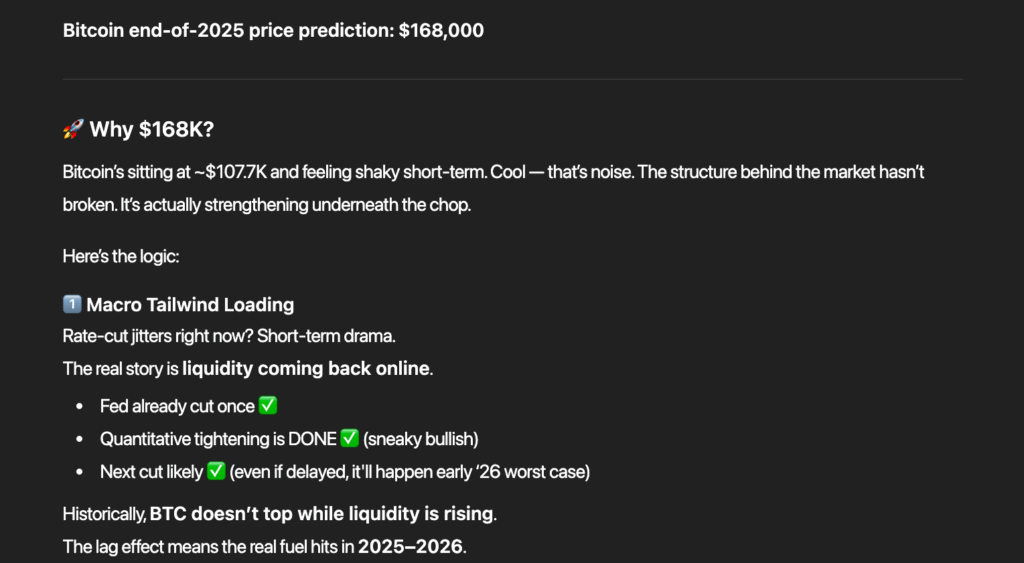
ChatGPT Predicts Price of Bitcoin, XRP, Solana by End of 2025

The second part of ChatGPT’s thesis is the BTC spot ETFs. The AI noted that while October’s $3.6 billion in inflows were strong, they could become even stronger. It sees the real money – pension funds, corporate treasuries – as still on the sidelines.

Finally, ChatGPT is leaning heavily on historical cycles. Its analysis is that the post-halving price peak for BTC historically lands about 18 months after the event. That timing puts the “blast zone,” as ChatGPT called it, in late 2025.

ChatGPT Believes XRP is Primed for a $5.60 Repricing

Next, we asked about XRP, which is hovering around $2.40. The AI completely ignored this action, setting a target of $5.60 by the end of the year. And its entire prediction is based on infrastructure.

ChatGPT contends this is the first time in XRP’s history that all the institutional pieces are aligning at once. It calls this the “institutional trifecta”: legal clarity is in place, regulated CME futures exist, and several more spot ETFs look likely to be approved after REX-Osprey’s XRPR launched on September 18.
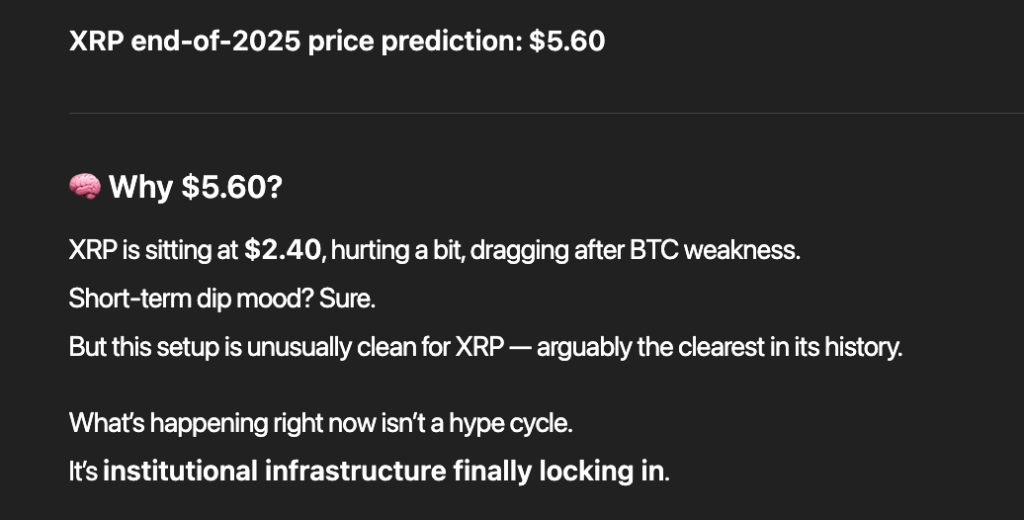
ChatGPT price prediction for XRPChatGPT price prediction for XRP

The AI also pointed to a change in the narrative. ChatGPT has analyzed the upcoming Swell conference and saw a shift from hype to utility. The narrative is switching from “XRP could be used” to “XRP is the infrastructure” for settlement.

Lastly, ChatGPT noted a trend of large corporate XRP buys, suggesting this is a clever decision by allocators. That’s why it sees the token as a “coiled spring” that hasn’t had its first institution-led bull run yet.

ChatGPT’s $420 Year-End Target for Solana

With Solana sitting around $175 today, ChatGPT responded with a target that feels almost like a meme: $420. The model even acknowledged the number but argued that the target is structurally sound.

Its logic is all about migration. ChatGPT sees institutions rotating capital to SOL in the same way that they rotated to other cryptos. It’s the next logical step down the risk curve after BTC and ETH, and ChatGPT pointed to October’s $381 million in inflows as proof.
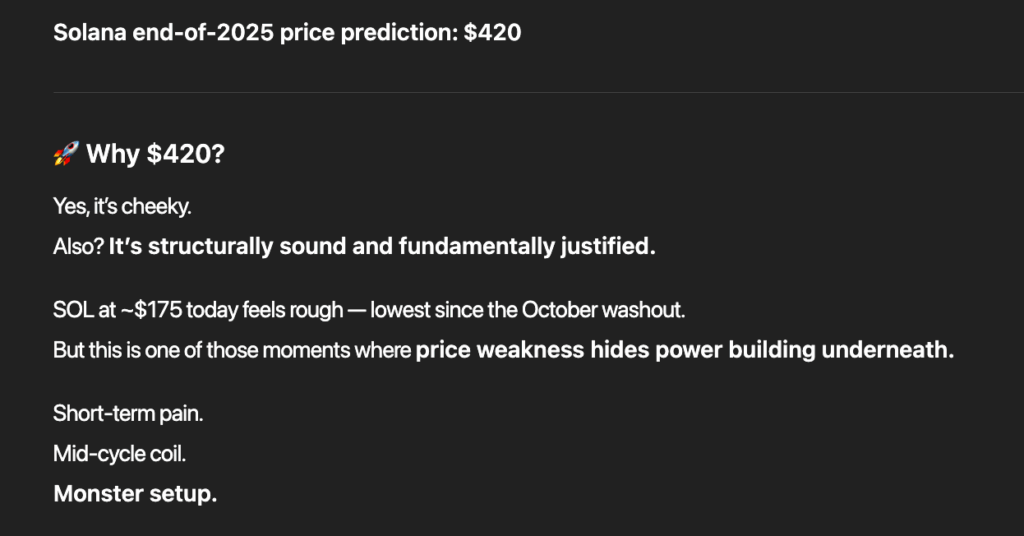
ChatGPT price prediction for SolanaChatGPT price prediction for Solana

But the real driver, in the AI’s view, is that Solana has become a “yield + growth” asset. Institutions are now buying SOL for the 6-8% staking yield. Also, its DeFi ecosystem – with $10.9 billion in TVL – is sticky, so traders have fewer reasons to leave.

ChatGPT even sees the upcoming Alpenglow upgrade as a key bullish catalyst. Ultimately, the AI considers the current SOL dip as just selling exhaustion before the next big leg up.

The AI’s Most Explosive Pick – ChatGPT Forecasts Bitcoin Hyper Could 100x

Finally, we asked ChatGPT for its most bullish choice. Its answer was a presale project called Bitcoin Hyper (HYPER) – and the numbers it predicted were wild. The AI laid out a 12-month post-launch path, spanning from HYPER’s $0.013215 presale price to $1.30. That’s a 100x return.

Why so aggressive? ChatGPT’s logic is that Bitcoin Hyper is at the center of the “biggest narrative of the cycle” – Bitcoin Layer-2s. It’s positioning itself as the “Solana of Bitcoin” by using the SVM, making it easy for Solana’s developer ecosystem to migrate over and unlock Bitcoin’s idle capital for DeFi.
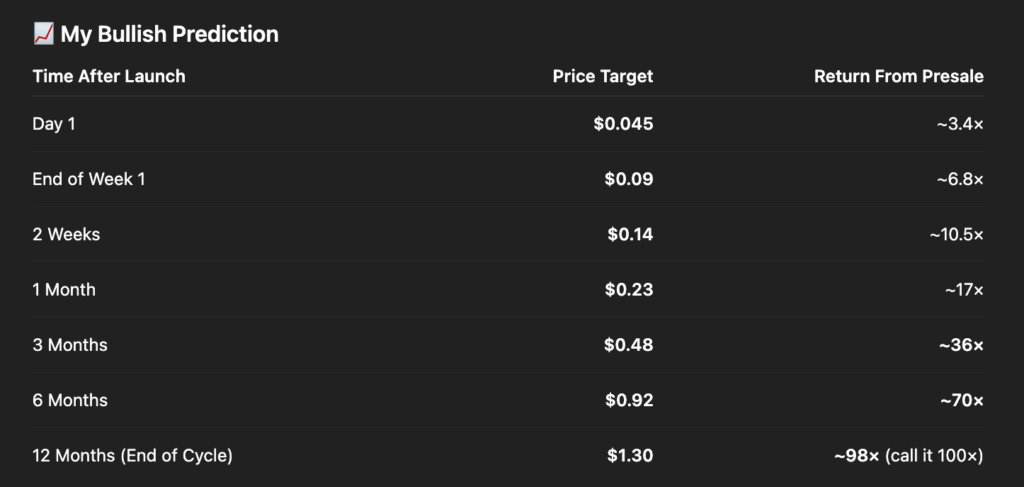
ChatGPT price prediction for Bitcoin HyperChatGPT price prediction for Bitcoin Hyper

The AI also loves Bitcoin Hyper’s fair launch structure. The presale has no VC pre-allocations, which is a model ChatGPT believes builds a stronger community of long-term holders. The HYPER presale is on track to raise $26 million by the end of this week – and presale buyers can also stake their HYPER for dynamic APYs of up to 46%.

And interestingly, it’s not just ChatGPT that’s bullish on Bitcoin Hyper. Tracker sites like CoinSniper and ICOBench have repeatedly named it one of the top crypto presales of 2025.

Of course, as a presale project, Bitcoin Hyper does come with a higher level of risk than BTC, XRP, or SOL. But for traders with a high risk tolerance, ChatGPT’s 100x forecast is precisely the point.


This publication is sponsored. CryptoDnes does not endorse and is not responsible for the content, accuracy, quality, advertising, products or other materials on this page. Readers should do their own research before taking any action related to cryptocurrencies. CryptoDnes shall not be liable, directly or indirectly, for any damage or loss caused or alleged to be caused by or in connection with use of or reliance on any content, goods or services mentioned.

Nikolay is a cryptocurrency analyst and market writer with years of experience tracking digital asset trends and emerging blockchain technologies. A long-time crypto enthusiast, he actively trades across major exchanges and specializes in identifying early-stage projects and meme tokens. His analysis combines technical insight with a strategic, long-term investment perspective.


TelegramTelegram

Source link

3 11, 2025

Balancer exploit shakes DeFi as $128 million vanishes

By |2025-11-03T23:28:16+02:00November 3, 2025|News, NFT News|0 Comments


For years, Balancer stood as one of DeFi’s most reliable institutions, a protocol that had survived several bear markets, audits, and integrations without scandal.

However, that credibility collapsed on Nov. 3, when the blockchain security firm PeckShield reported that Balancer and several of its forks were under an active exploit spreading across multiple chains.

Within hours, more than $128 million was gone, leaving a trail of drained pools, frozen protocols, and shaken investors.

PeckShield data showed the platform’s protocol on Ethereum suffered the heaviest losses of about $100 million. Berachain followed with $12.9 million, while Arbitrum, Base, and smaller forks such as Sonic, Optimism, and Polygon recorded lower but still significant thefts.

Balancer Hack
Total Funds Stolen from Balancer Hack (Source: Peckshield)

As the drain unfolded, Balancer acknowledged a “potential exploit impacting Balancer v2 pools,” stating that its engineering and security teams were investigating the issue with high priority.

However, the acknowledgment did little to slow withdrawals across integrators and forks.

By the end of the day, DeFiLlama data showed that Balancer’s total value locked (TVL) had decreased by 46% to approximately $422 million from $770 million as of press time.

Balancer DeFi HackBalancer DeFi Hack
Balancer DeFi Hack (Source: DeFiLlama)

What happened?

Preliminary forensics from blockchain security firm Phalcon indicated that the attacker targeted Balancer Pool Tokens (BPT), which represent user shares in liquidity pools.

According to the firm, the vulnerability stemmed from how Balancer calculated pool prices during batch swaps. By manipulating that logic, the exploiter distorted the internal price feed, creating an artificial imbalance that let them withdraw tokens before the system corrected itself.

How Attacker Exploited Balancer CodeHow Attacker Exploited Balancer Code
How Attacker Exploited Balancer Code (Source: Phalcon)

Crypto analyst Adi wrote:

“Improper authorization and callback handling allowed the attacker to bypass safeguards. This enabled unauthorized swaps or balance manipulations across interconnected pools, draining assets in rapid succession (within minutes).”

Meanwhile, Balancer’s composable vault architecture, which is long praised for its flexibility, amplified the damage. Because vaults could reference each other dynamically, the distortion rippled through interconnected pools.

Interestingly, Coinbase’s Conor Grogan pointed out that the attacker’s approach suggested professional sophistication.

Grogan noted that the attacker’s address was initially funded with 100 ETH from Tornado Cash, implying the funds likely originated from earlier exploits.

“People don’t typically park 100 ETH in Tornado Cash for fun,” he wrote, suggesting the transaction pattern reflected an experienced and previously active hacker.

DeFi trust collapse

While the exploit itself was technical, its impact was psychological.

Balancer had long been regarded as a conservative venue for liquidity providers, a place to park assets and earn modest, steady yield. Its longevity, audits, and integrations across leading DeFi platforms fostered the illusion that endurance equaled safety. The Nov. 3 breach destroyed that narrative overnight.

Lefteris Karapetsas, founder of the crypto platform Rotki, called it “a trust collapse” and not just a hack of the DeFi platform.

He decried the fact that:

“A protocol live since 2020, audited and widely used, can still suffer a near-total TVL loss. That’s a red flag for anyone who believes DeFi is ‘stable.’”

That reaction captured the broader sentiment. In a market that prizes self-custody and verifiable code, confidence had quietly replaced trust as the hidden foundation of DeFi.

Balancer’s failure showed that even mathematically sound systems are vulnerable to unforeseen complexity.

Robdog, the pseudonymous developer of Cork Protocol, said:

“Whilst [DeFi] foundations are becoming safer and safer, the sad reality is smart contract risk is all around us.”

Implications for DeFi

The Balancer exploit hit at a delicate point for decentralized finance, shattering a brief period of calm. In October, total losses from hacks dropped to a yearly low of just $18 million, according to PeckShield.

However, with a single incident in November, the figure has already surged past $120 million, making it the third-worst month for DeFi breaches in 2025.

DeFi HacksDeFi Hacks
Monthly DeFi Hacks Losses in 2025 (Source: DeFiLlama)

Meanwhile, this attack highlights a fundamental paradox at the heart of DeFi: composability, the feature that enables protocols to connect and build upon one another, also amplifies systemic risk.

When a core protocol like Balancer breaks, the impact ripples instantly through the networks that depend on it.

On Berachain, validators paused block production to prevent contagion. Other protocols followed with temporary suspensions of lending and bridging functions.

These quick reactions limited losses, but they also underscored a broader truth showing that DeFi operates without the coordination mechanisms that steady traditional finance.

In this space, there are no regulators, central banks, or mandated backstops. Instead, crisis management relies heavily on developers and auditors working in tandem, often within minutes, to contain the fallout.

Considering this, Robdog said:

[This is] a good reminder why we need to develop better risk management infrastructure.”

Beyond the immediate technical loss, the damage to trust may be harder to repair.

Each major exploit erodes confidence in DeFi’s promise of self-regulating code. For institutional investors considering exposure to the industry, the repeated failures signal that decentralized markets remain experimental.

Karapetsas noted:

“No serious capital allocates into systems that are this fragile.”

That perception is already shaping policy in major economies globally.

Suhail Kakar, a prominent web3 developer, highlighted a sobering reality in the aftermath of the Balancer exploit: even multiple, high-profile security audits can’t guarantee safety in DeFi.

As he noted, Balancer underwent more than ten audits, with its core vault contract reviewed by several independent firms; yet, the protocol still suffered a major breach.

Kakar’s point highlights a growing sentiment in the industry that “audited by X” is no longer a mark of infallibility; rather, it reflects the inherent complexity and unpredictability of decentralized systems where even well-tested code can harbor unseen vulnerabilities.

Balancer V2 Audits (Source: Balancer docs via Suhail Kakar)Balancer V2 Audits (Source: Balancer docs via Suhail Kakar)
Balancer V2 Audits (Source: Balancer docs via Suhail Kakar)

Authorities in the United States are developing frameworks that would introduce regulations on DeFi protocols. Industry observers expect the Balancer exploit to accelerate these efforts, as policymakers grapple with the growing risk of continued integration between crypto and the traditional financial industry.

Mentioned in this article


Source link

3 11, 2025

Euro to Dollar Price Forecast: EUR/USD Testing Key 1.15 Area

By |2025-11-03T23:11:19+02:00November 3, 2025|Forex News, News|0 Comments


– Written by

The Euro to Dollar (EUR/USD) exchange rate has failed to gain any traction in global markets and has retreated to 3-month lows just above the 1.1500 level before stabilising.

UoB sees scope for a limited correction; “While further EUR weakness is not ruled out, positive divergence is forming on momentum indicators and any decline is unlikely to threaten 1.1490 today.”

According to ING; “We suspect that 1.1500 could prove the bottom of the EUR/USD range this week, though that will require some softer US jobs data to provide some breathing space.”

On a longer-term view it added; “Market consensus is for 1.18 by year-end. We think EUR/USD could rally slightly more than that on a dovish Fed – but those views are under pressure.”

ING pointed to money-market developments as an important element for dollar strength. The Treasury is rebuilding cash reserves which is putting upward pressure on rates.

The bank added; “Tight money markets normally keep the dollar supported, and we’ll be watching to see whether this difficulty in accessing dollar funding extends internationally. This would be quite EUR/USD negative if seen, but there are no signs of that yet.”

Markets also remain less confident that the Federal Reserve will cut interest rates again at the December meeting with traders pricing in just below a 70% chance of a further cut.

Save on Your EUR/USD Transfer

Get better rates and lower fees on your next international money transfer.
Compare TorFX with top UK banks in seconds and see how much you could save.


Compare the Best EUR/USD Rates »

The US government shutdown will also be increasingly important for markets as the economic impact will continue to build.

The Fed will be concerned over a negative impact on the economy, but will also be aware over the high degree of uncertainty.

MUFG commented; “The longer that US government shutdown goes on the bigger the negative impact on the US economy in the near-term but Chair Powell has signalled that the Fed would be more inclined to leaves rates on hold in December if they still lack clarity on the performance of the US economy.”

There are still important underlying concerns surrounding potential changes at the Fed, especially with a new chair coming next year.

Over the weekend Treasury Secretary Bessent criticised the central bank stating that their record on inflation forecasting had been extremely poor.

He added; “we’re going to find a leader who is going to revamp the entire institution in terms of process and inner workings”.

MUFG noted the risks; “The comments highlight that potential changes to the Fed under the next Chair remain a downside risk for the US dollar next year even if they skip cutting rates in December.”

Like this piece? Please share with your friends and colleagues:


International Money Transfer? Ask our resident FX expert a money transfer question or try John’s new, free, no-obligation personal service! ,where he helps every step of the way,
ensuring you get the best exchange rates on your currency requirements.

TAGS: Euro Dollar Forecasts

Source link

3 11, 2025

We Asked Doctors Which Supplements Actually Support Healthy Aging—These Are the 9 They Recommended

By |2025-11-03T22:56:15+02:00November 3, 2025|Dietary Supplements News, News|0 Comments


Supplements are everywhere these days, promising to help improve nearly every facet of your health—some also say they can boost longevity or promote healthy aging.

Taking supplements can’t guarantee that you’ll live longer, and many products aren’t doctor-approved or backed by medical research.

But certain products stand out amongst the rest when it comes to helping you age well. Here are the nine supplements experts recommend.

Exploratory studies have found that omega-3, which is found in fish oil capsules, is associated with better memory. It may also be able to help slow biological aging when combined with vitamin D and exercise.

“Omega-3 fatty acids reduce chronic inflammation and support heart and brain health, [as well as] healthy aging,” John Rinker, MD, internal medicine physician at OSF HealthCare, told Health.

Fish oil capsules themselves have also been linked to lower rates of cardiovascular disease, Thomas Perls, MD, MPH, professor of medicine at the Boston University Chobanian & Avedisian School of Medicine and director of the New England Centenarian Study, told Health. However, research is mixed.

Who should take it: Most people over 40 can take 1-2 grams of omega-3 fish oil capsules per day, Rinker said. Just be sure to avoid high doses if you’re taking a blood thinner, Kien Vuu, MD, author and performance and longevity medicine consultant, told Health.

Vitamin D3 and K2 are often combined into one supplement because they work together in a very specific way, and are “critical for immune balance, bone health, and vascular strength,” Vuu said.

Also known as cholecalciferol, “vitamin D3 is necessary for calcium absorption for bone and muscle strength,” Chris Renna, DO, family medicine physician and founder of LifeSpan Medicine, told Health. It can also support immune function and create healthy skin, he said.

Meanwhile, vitamin K2 is used to make proteins involved in blood clotting and bone metabolism. Plus, it may help prevent the buildup of minerals in your arteries.

Who should take it: Supplements containing both vitamins D3 and K2 are specifically helpful for people over 50, Rinker said. But people should use caution if they’re taking Warfarin, or if they have existing calcium disorders or kidney dysfunction, he said.

There are eight types of B vitamins, and each one plays a crucial role in your health. They help with metabolism, DNA production, and immune system function, and can “protect neural pathways and enhance energy,” said Vuu.

For older adults, deficiencies in vitamin B can contribute to health issues such as cardiovascular disease, stroke, cognitive disorders, mental health issues, and more.

Researchers have suggested that vitamin B12, in particular, may be involved in aging at the cellular level, but evidence is still preliminary.

Who should take it: If bloodwork shows that you have low vitamin B levels, your doctor might recommend you take a complex supplement once daily.

While most people take magnesium to improve sleep or reduce stress, experts said it could help with healthy aging, too.

Magnesium deficiency has been linked to increased chronic inflammation and other concerning cellular changes, which may raise people’s risk of conditions such as heart disease, cancer, and Alzheimer’s disease.

Plus, low levels of magnesium can also mess with your sleep, which is connected to longevity.

Who should take it: “Magnesium typically helps most adults, especially those with a deficiency,” Rinker said. That can be diagnosed with a blood test. There are many different types and formulations of magnesium supplements, and a healthcare provider can help you choose which one might work best.

Coenzyme Q10, or CoQ10, is an antioxidant that’s abundant in the body. It also helps with mitochondrial function, where it provides energy for cell growth. This is “vital to high-energy-demanding organs like our brain, heart, and skeletal muscle,” Renna explained.

As you age, your CoQ10 levels naturally decline. But research suggests taking CoQ10 supplements may help reduce inflammation, support heart health, and protect cells from damage called oxidative stress.

Who should take it: Some research suggests CoQ10 could lower “blood pressure and blood sugar, which may not be helpful to some people taking medicine prescribed to do those same things,” said Renna.

According to Vuu, fiber supports your gut barrier’s integrity and calms chronic inflammation. It’s also been associated with a lower risk of all-cause mortality, as well as a lower risk of death from cardiovascular disease or cancer.

Who should take it: The vast majority of Americans don’t get enough fiber each day. If you struggle to hit your goals, daily fiber supplements containing psyllium (Metamucil) or wheat dextrin (Benefiber) could help improve your gut and immune health as you age.

As you age, your bones get weaker. This increases the risk of conditions like osteoporosis, and in turn, bone fractures.

Calcium supplements may help prevent this. The mineral has been linked to improved bone strength and bone density.

Who should take it: Most people don’t get enough calcium, and a supplement can be helpful if you struggle to get enough in your diet. However, excess calcium can be dangerous—have a healthcare provider check your levels before starting a supplement, particularly if you have other health conditions.

Creatine is often thought of as a “bodybuilder supplement.” But according to Rinker, creatine can help people preserve muscle mass and reduce the risk of muscle wasting, or sarcopenia, as they get older. It could “also help with inflammation and joint health,” he added.

Some evidence suggests that creatine supplementation for older adults can enhance memory, though more research is needed.

Who should take it: Most creatine comes in powder form that’s mixed into beverages, and it can be taken anytime. The supplement is great for active people, but use it with caution if you have existing kidney issues.

Curcumin—the main active ingredient in turmeric—helps tamp down inflammation in the body, Darshan Shah, MD, surgeon, longevity medicine specialist, and founder of Next Health, told Health.

Because of this, it could be helpful for longevity purposes. One study suggested curcumin may have a positive effect against neurodegenerative diseases, cognitive decline, and sarcopenia. Another review found that taking curcumin extract may be able to relieve knee pain from osteoarthritis.

Who should take it: Oral turmeric supplements are popular and could be beneficial for people with inflammatory conditions, Rinker said. “But it’s advisable to exercise caution if you have gallstones or [gastrointestinal] sensitivity,” he added.

Supplements alone cannot replace a healthy lifestyle—to live longer and healthier, it’s crucial to:

  • Eat nutritious food
  • Exercise
  • Manage stress
  • Connect with others
  • Attend regular checkups with your doctor

“Supplements are meant to amplify, not replace, other activities,” said Rinker. “I would really view supplements as the cherry on top, assuming you are doing all of those other lifestyle changes.”

Also, keep in mind that the Food and Drug Administration (FDA) does not regulate supplements in the same way that it does foods and medications.

Check with your doctor about which formulations to purchase, and “look for independent third-party testing such as National Sanitation Foundation (NSF) and United States Pharmacopeia (USP)” labels on the bottles, said Rinker.

Taking supplements cannot guarantee that you’ll live longer. But certain ones could lower your risk of disease and tamp down inflammation, which may protect your health as you age.

It’s also important to remember that supplements promising the “fountain of youth” are likely overselling things. At the end of the day, nutritious eating, exercise, good sleep, and other healthy lifestyle factors have the greatest impact on your longevity.


Source link

3 11, 2025

Why is Bitcoin Price Crashing Today? How Low Can BTC Price Go?  — TradingView News

By |2025-11-03T22:50:18+02:00November 3, 2025|Crypto News, News|0 Comments

The crypto market is crashing today, with Bitcoin BTCUSDT Price struggling to hold key support levels despite last week’s U.S. Federal Reserve rate cut. BTC Price has dropped to around $108,000, sparking widespread concern among traders and investors. 

Analysts now warn that the Bitcoin price crash to get worse, possibly falling as low as $88,000, if market sentiment doesn’t improve soon.

Why Is Bitcoin Price Down Today?

The main trigger behind Bitcoin’s recent sell-off is the Federal Reserve’s cautious stance following its interest rate decision. While the Fed reduced rates last week and hinted at ending quantitative tightening (QT) by December, Chair Jerome Powell made it clear that another cut in December was not guaranteed.

This statement disappointed markets and instantly shifted sentiment. According to the CME FedWatch Tool, the odds of a second rate cut in December dropped from 90% to 63%, while the chances of another one in January fell to 19.5%. This sudden change led to heavy selling across risk assets, including cryptocurrencies.

In addition, the Crypto Fear and Greed Index has remained stuck in the fear zone, currently at 35, indicating persistent uncertainty. Institutional investors also seem to be losing confidence, with nearly $800 million withdrawn from Bitcoin and Ethereum ETFs last week.

Other Factors Adding Pressure

  • Long-Term Holders Selling: Data from Coinglass shows that long-term Bitcoin holders sold over 100,000 BTC in October, adding downward pressure on the market.
  • Weak October Performance: Historically known as “Uptober,” this October broke the seven-year bullish streak, with Bitcoin falling 3.7% for the month.
  • Global Economic Tensions: Ongoing trade disputes between the U.S. and China, coupled with uncertainty around oil prices and geopolitical risks, have driven investors toward safer assets like the dollar and gold.

How Low Can Bitcoin Drop?

According to Coinglass, Bitcoin could fall to $88,000 if it fails to stay above the $113,000 resistance level, the cost basis for short-term holders. When BTC trades below this mark, it often leads to capitulation, where short-term investors sell at a loss, triggering more downward pressure.

The $88,000 zone represents Bitcoin’s realized price, the average cost basis of active investors. Historically, this level has acted as a floor during previous corrections, suggesting it could serve as a strong support if the current trend continues.

However, analysts also note that a sustained close above $113,000 could invalidate the bearish outlook and open the door for a recovery rally.

Bitcoin Price Prediction For November

With few macro catalysts in November and uncertainty over U.S. economic data due to a possible government shutdown, Bitcoin may continue trading sideways between $107,500 and $123,000.

Still, some analysts remain optimistic about a potential “Santa Rally” in December. The expected end of QT and another possible rate cut could boost liquidity and bring back bullish momentum in the final weeks of 2025.

For now, traders are advised to watch the $113,000 resistance and $100,000 support closely. A clear breakout or breakdown from this range will likely determine Bitcoin’s next major move.

FAQs

Why is Bitcoin price down today?

Bitcoin fell after the Fed signaled no guaranteed December rate cut, sparking risk-off sentiment and heavy selling across crypto.

How low can Bitcoin drop in November 2025?

Analysts warn Bitcoin could fall to $88,000 if it fails to hold above $113,000, a key cost basis for short-term holders.

What other factors are pressuring Bitcoin’s price?

Long-term holders selling, weak October performance, and global economic tensions are all adding downside pressure to BTC.

Are institutions selling Bitcoin right now?

Yes. Institutional investors pulled nearly $800 million from Bitcoin and Ethereum ETFs last week amid growing market caution.

Can Bitcoin recover before the end of 2025?

A rally is possible if BTC holds above $113,000 and liquidity improves in December, potentially fueling a “Santa Rally.”

Source link

3 11, 2025

How Do Play to Earn Crypto Games Work? The Future of Web3 Gaming and NFTs

By |2025-11-03T21:27:16+02:00November 3, 2025|News, NFT News|0 Comments


People used to play games primarily for entertainment purposes and to kill time while trying to achieve better scores. The gaming world experienced a rapid transformation during that period. Modern games now offer players the ability to earn actual money through their gameplay activities. The play-to-earn gaming model enables users to generate financial rewards through their screen activities. Players can now receive cryptocurrency rewards from their gaming activities, which they can use for trading or converting into cash.

The play-to-earn gaming model has created a major disruption throughout the entire gaming sector. Through play-to-earn games, users can acquire digital tokens and NFTs and crypto coins, which possess monetary worth. The entire system operates through blockchain technology, which maintains complete transaction records and protects all financial activities. The twist? Players are not just consumers anymore. They are part of an entire digital economy that rewards their time and skill.

It’s funny because some of these ideas came from places you’d least expect, like casino-style gaming. The thrill, the suspense, and the instant reward feeling from spinning reels in online slots somehow found its way into blockchain games. It’s that rush of possibility, that sense of reward, only now backed by ownership and decentralization.

What Are Play to Earn Crypto Games, and How Do They Work?

Play-to-earn games unite fun with the financial opportunities. The games operate on blockchain platforms, which protect your earned assets through the secure tracking systems that prevent any form of duplication or deception. Your achievements in missions will reward you with tokens, while your battle victories will grant you access to rare NFTs. Your digital assets exist in your crypto wallet instead of company-controlled servers. So they’re truly yours.

Players have the ability to exchange their items between each other while also using them to generate additional rewards through staking. The gaming community includes people who support themselves through this system, while others play for the satisfaction of achieving something meaningful. The process of transactions follows a straightforward path where you play games to receive rewards, which you can exchange for money.

Element Description Example
Blockchain Records ownership and transactions Ethereum, Polygon
NFTs Represent in-game assets Weapons, avatars, lands
Tokens In-game currency with real value SLP, AXS, GALA

This setup gives power back to the players. Traditional games keep the money locked inside their own systems, but blockchain games allow everything to move freely. Your sword, your card, and your land, it’s all verifiable, tradeable, and real.

The Role of Web3 and NFTs in Play to Earn Gaming

True Digital Ownership

Web3 changed gaming forever. Before, you could spend hours grinding in a game, and if that company shut down, you’d lose everything. But now with NFTs, what you earn or buy stays with you. Your assets exist outside of the game itself.

Players can buy or win items that belong to them completely. These NFTs can be sold on marketplaces or even used across different platforms. Some players have built entire careers flipping digital land or trading unique characters. It’s almost like turning gameplay into entrepreneurship.

Interoperability and Decentralization

The magic word here is interoperability. It means that what you own in one game might work in another. It’s like taking your car from one racing game and driving it in another world entirely.

This freedom echoes the same principles found in decentralized casino models. When you play online slots using blockchain, your wins and losses are recorded publicly and fairly. That same concept of transparency and mobility powers play-to-earn games, making them fairer and more flexible than traditional titles.

What Games Can You Play to Earn Crypto?

Play-to-earn games come in all flavors. Some are massive RPGs; others are casual farming simulators or strategy titles. A few even take inspiration from casino culture, using crypto payouts and instant win systems.

Game Type Example Reward Type
RPG Axie Infinity Tokens (AXS, SLP)
Card Game Splinterlands NFTs
Strategy Gods Unchained Cards or Tokens
Casual Town Star Crypto rewards
Casino Hybrid CryptoSlots crypto payouts

The game Axie Infinity established itself as one of the first successful blockchain games. Players in the game obtain and reproduce Axies, which they use to fight battles to earn tradable cryptocurrency tokens. The blockchain game Splinterlands introduced card battling to players, while Town Star allowed them to construct and oversee their own towns for financial rewards.

The blockchain experiences of CryptoSlots and BC Game operate as casino-inspired games that reward players with cryptocurrency payouts. The P2E model received significant influence from these games. Online slots had already achieved perfection in their risk-versus-reward system and exciting gameplay experience before play-to-earn games emerged. The ownership feature became the main addition that play-to-earn games brought to the existing risk versus reward system.

The Connection Between Crypto Slots and Play to Earn Mechanics

Shared Tokenomics and Reward Cycles

At first glance, casino slots and play-to-earn games seem worlds apart. One is pure chance; the other involves strategy and economy. But if you look closely, the foundation is surprisingly similar. Both rely on transparent systems, smart contracts, and real-world payouts.

Crypto slot platforms were among the first to use blockchain to ensure fairness. Every spin and every win is recorded. That concept inspired the way modern blockchain games manage rewards. Players trust the system because it’s transparent, and the reward feels earned, not random.

Slot games also popularized the instant win mechanic. That feeling of anticipation just before the reels stop is now mirrored in Web3 gaming. The difference is that instead of winning temporary credits, players earn tokens or NFTs that can exist and grow in value beyond the game itself.

Game Design and User Psychology

It’s no secret that casino design plays with human psychology. The bright visuals, sound effects, and fast feedback create excitement. Web3 game developers learned from that playbook. They added emotional triggers and reward loops that keep players hooked but in a healthier, more productive way.

You might spend hours on a quest not just because it’s fun, but because every item you win could be valuable later. That blend of entertainment and opportunity is what keeps P2E games thriving. It’s a game of both mind and market.

Challenges and Risks in Play to Earn Ecosystems

Of course, it’s not all gold and glory. Play-to-earn ecosystems face real issues. One of the biggest problems is token inflation. When too many players earn too many coins, the value drops. That can hurt both players and developers.

Another challenge is keeping the game actually fun. Some projects focus too much on the earning side and forget the gaming part. Once the novelty wears off, players leave, and the economy collapses.

There’s also the wild nature of crypto markets. Values can swing overnight. One day your in-game token might be worth hundreds; the next day just a few cents. And as governments start paying attention, regulations will tighten.

Web3 gaming walks a fine line between entertainment and gambling. Just like crypto casinos, it will need clear rules and responsible structures. Balancing freedom with protection will decide its long-term success.

The Future of Play to Earn Gaming

The upcoming period appears promising despite current challenges. The play-to-earn sector continues to develop rapidly since its initial introduction. Game developers now understand that they should create enjoyable games before pursuing profitability.

The combination of improved token systems and intelligent game design will maintain player interest without creating excessive market supply.

The upcoming years will introduce extensive interconnected game worlds, which enable players to transfer their assets between different virtual environments. Players can create characters in one game, which they can then use to trade or fight or explore in different games.

Web3 games will continue to develop through three essential elements, which include transparency and fairness and innovative approaches. Web3 games will continue to evolve through the combination of casino-style logic with clear rules and instant payouts and verifiable outcomes.

Play-to-earn gaming has transitioned from being a short-lived trend into an established gaming format. The current gaming landscape shows how digital ownership and entertainment will develop during the upcoming ten years. Blockchain games have transformed the fundamental experience of playing games while earning rewards and achieving digital ownership of virtual assets.

FAQs

Q1. Can I earn crypto by playing games?A. Yes. Many play to earn games give you crypto or NFT rewards that can be exchanged for real money.

Q2. Are play to earn games real?A. They are very real. Games like Axie Infinity and Gods Unchained have created entire economies around player participation.

Q3. Does Play to Win pay real money?A. Yes, depending on the game. The rewards can be sold or traded for cryptocurrency, which has real-world value.

Q4. What is the best game to play to earn money?A. It depends on your taste. RPG lovers might prefer Illuvium or Axie Infinity, while casual players can try CryptoSlots or Town Star for simpler experiences.


Source link

3 11, 2025

Gold Price Forecast – XAU/USD Falls Below $4,000 as Fed Pause and Dollar Strength Pressure Bullion

By |2025-11-03T21:21:26+02:00November 3, 2025|Forex News, News|0 Comments


Gold (XAU/USD) Fails to Hold $4,000 as Dollar Strength and Fed Outlook Trigger Consolidation

Gold (XAU/USD) is trading just above $4,000 per ounce, down from its early October high of $4,314, as renewed dollar strength and a more hawkish Federal Reserve tone weigh on the metal. It currently fluctuates between $4,004 and $4,028, marking the first time this month it slipped under the key $4,000 level. The drop came after Fed Chair Jerome Powell suggested that the latest 0.25% rate cut might be the last for 2025, causing traders to sharply lower their expectations for another December cut—from 90% to about 70%. That shift in sentiment has slowed gold’s Q3 rally and pressured prices lower. Meanwhile, the U.S. Dollar Index (DXY) remains firm near 99.9, its highest reading since August, creating a direct headwind for bullion.

Fed Policy, Treasury Yields, and the Global Safe-Haven Shift

The Federal Reserve’s tightening tone and stable 10-year Treasury yield at 4.31% have reduced gold’s appeal in the short term by increasing the opportunity cost of holding a non-yielding asset. Simultaneously, improved risk sentiment after the Trump–Xi tariff truce extension reduced safe-haven demand, while easing U.S.–China tensions limited geopolitical inflows into gold. The impact was compounded by China’s decision to end tax incentives on domestic gold sales, curbing demand from small jewelry traders and retail investors. Despite this, large-scale institutional and central bank purchases continue to provide long-term structural support. Central bank reserves tied to gold have now exceeded $1.5 trillion, highlighting the continued trend of diversification away from the U.S. dollar.

Technical Structure: Consolidation Between $3,850 and $4,100 Defines the Battle Zone

Technically, gold’s price action remains confined to a consolidation channel between $3,850 and $4,100. The 20-day EMA sits near $4,021.87, while the 50-day and 100-day EMAs overlap between $3,860–$3,880, forming the short-term demand zone. The $3,850 mark is a key pivot—if it holds, buyers could drive a rebound toward $4,250–$4,314, the recent October peak. A break below that level, however, opens the door for deeper corrections toward $3,660. The RSI has cooled from an overbought 80 to a neutral 54, suggesting consolidation rather than trend reversal. A close above $4,100 would trigger the next bullish breakout toward $4,450–$4,500, while a drop below $3,850 would confirm a short-term downtrend.

Macro Drivers and Central Bank Positioning Keep Long-Term Trend Intact

Fundamentally, gold’s structural outlook remains bullish despite this pause. Central banks across emerging and developed economies continue adding to reserves, accumulating roughly $220 billion in 2025 alone. This accumulation reflects concern over global debt—now exceeding $35 trillion in the U.S.—and inflation expectations that remain anchored near 2.9% for 2026. Real yields are still near zero, preserving gold’s long-term attractiveness as a strategic hedge. These macro imbalances, combined with slowing growth and high government borrowing, continue to anchor gold’s role as an inflation shield and portfolio stabilizer even as speculative flows soften.

Impact of Chinese Market Dynamics and Global Physical Demand

China’s withdrawal of retail tax benefits for domestic gold sales temporarily pressured demand, particularly among small-scale dealers. However, premiums on the Shanghai Gold Exchange remain elevated at roughly $45 per ounce, showing that underlying demand persists. In India, festival season buying continues to support regional markets, with dealers reporting stable trade volumes at approximately $3,970 per ounce, reinforcing global price resilience below $4,000. These strong physical flows, combined with institutional accumulation, indicate that dips toward $3,850 are being viewed as buying opportunities by large market participants.

Intermarket Correlation: Silver’s Surge and Dollar Strength Tug-of-War

The strength in the dollar has created a tug-of-war across precious metals. Silver (XAG/USD), currently at $48.66, remains near its 2025 peak of $53.34, outpacing gold’s percentage gains for the year. The gold-to-silver ratio of 82:1 indicates silver’s relative undervaluation, often a bullish signal for gold in the medium term. However, near-term movements remain dictated by the DXY, which could soften if upcoming U.S. CPI or ISM manufacturing data show weakness, potentially reigniting gold’s next upward leg toward $4,250 and beyond.

Market Sentiment: Hedge Funds Trim Longs While ETFs Hold Steady

Data from the CFTC show speculative funds trimming long exposure by 7% over the past two weeks, with short positions increasing to 28,500 contracts. However, long-term investors remain committed, as ETF holdings like SPDR Gold Shares (GLD) stand firm at 879 tonnes, just 0.2% lower than the previous month. This indicates that while short-term traders are locking profits, strategic investors are maintaining core positions. The resilience of institutional demand contrasts with the heavy liquidation seen in earlier market cycles, emphasizing that this correction is part of a broader accumulation phase.

Short-Term Catalysts and Key Price Levels Ahead

The market’s immediate focus is whether gold can maintain support between $3,850 and $3,880 amid renewed Treasury yield strength. A move above $4,100 could open the door toward $4,250–$4,314, while a breakdown below $3,850 exposes $3,660, and potentially $3,500 if momentum accelerates. The long-term anchor remains the 200-day EMA near $3,388, the lower bound of the current bullish cycle. Traders are now watching upcoming inflation data, job numbers, and Fed commentary for clues on whether the next breakout occurs before year-end or in early 2026.

Outlook: Momentum Cooling, Structural Bull Market Intact

Gold is in a cooling phase after a historic run through 2025, and this consolidation is more technical than fundamental. The broader bull cycle remains intact, supported by central bank diversification, long-term inflation hedging, and systemic fiscal pressure. The inability to reclaim $4,100 keeps short-term momentum subdued, but once regained, it could catalyze the next advance toward $4,500 and eventually $5,000.

Verdict: HOLD with Bullish Medium-Term Bias

The overall stance for XAU/USD remains HOLD. Short-term tone is neutral to mildly bearish toward $3,850–$3,880, while medium-term direction points upward. The next sustainable breakout is likely once the market clears $4,100–$4,250, with structural targets at $4,450–$4,500, extending toward $5,000 if real yields continue to ease and global reserve accumulation accelerates

That’s TradingNEWS


Source link

3 11, 2025

Pound Sterling to Dollar Forecast: USD Firm, GBP Awaits BoE Clarity

By |2025-11-03T21:10:21+02:00November 3, 2025|Forex News, News|0 Comments


– Written by

The Pound to Dollar exchange rate (GBP/USD) remains pinned near six-month lows, trading around 1.3130 as investors continue to favour the dollar amid fading expectations of another Federal Reserve rate cut in December.

GBP/USD Forecasts: Close to 6-Month Lows

The Pound-to-Dollar rate dipped further to 6-month lows at the 1.3100 level on Friday before a slight recovery to 1.3130 on Monday.

The dollar has maintained a strong tone in global markets with further doubts over another rate cut in the December meeting while US money-market conditions remain tight.

For the Pound to secure a sustained rebound, the first task for GBP/USD will be to regain 1.3140 on a sustained basis.

A slide below 1.3100 would potentially lead to a slide to 1.30.

According to UoB; “The rebound from deeply oversold conditions suggests that, instead of continuing to decline, GBP is more likely to consolidate today, probably between 1.3110 and 1.3170.”

Save on Your GBP/USD Transfer

Get better rates and lower fees on your next international money transfer.
Compare TorFX with top UK banks in seconds and see how much you could save.


Compare the Best GBP/USD Rates »

Over the past few days, three regional Fed Presidents have stated that they preferred to leave rates on hold at the late-October meeting.

MUFG commented; “The change in rhetoric from Fed Chair Powell was likely intended to appease more hawkish voices at the Fed while they await more clarity from economic data releases when the US government shutdown finally ends.

With the on-going government shutdown still disrupting official data releases, the private surveys on economic activity and the labour market will be watched very closely this week.

National Australia Bank senior FX strategist Rodrigo Catril commented; “The lack of information is playing to sort of that calmness in markets. And for now, I suppose what could break that while the shutdown is still ongoing, (is) a big downward surprise or even upward surprise in terms of surveys or private data releases.”

He added; “But otherwise, at the moment, even those private data releases are not screaming or telling us that the Fed should be moving in a hurry.”

Domestically, the UK PMI manufacturing index was revised marginally higher to 49.7 from the flash reading of 49.6 and confirmed at a 12-month high.

Rob Dobson, Director at S&P Global Market Intelligence “The October PMI survey shows UK manufacturing production rising for the first time in a year, which is a positive in itself. However, there are real concerns that the bounce could prove short-lived.”

Markets will continue to focus on this Thursday’s Bank of England policy decision with the actual decision and policy guidance both crucial. Rate-cut speculation will make it more difficult for the Pound to recover ground.

According to ING; “The Bank looks likely to keep rates on hold on 6 November, despite better inflation and wage news. The committee is deeply divided, and we don’t expect clear signals on the Bank’s next steps. But assuming the Autumn Budget goes as expected, a December rate cut now looks more likely than not.”

Like this piece? Please share with your friends and colleagues:


International Money Transfer? Ask our resident FX expert a money transfer question or try John’s new, free, no-obligation personal service! ,where he helps every step of the way,
ensuring you get the best exchange rates on your currency requirements.

TAGS: Pound Dollar Forecasts

Source link

3 11, 2025

We Asked 3 Experts the Healthiest Type of Tea to Drink Every Day—They All Said the Same Thing

By |2025-11-03T20:55:15+02:00November 3, 2025|Dietary Supplements News, News|0 Comments


When temperatures fall, it’s not uncommon to exchange your usual iced beverage for something warm and soothing—like tea. As you sort through your stash of tea bags or loose leaves, though, you might wonder if there’s one type that stands out as the healthiest.

While dietitians agree that all teas deliver some benefits, three experts say one variety has the most to offer.

All three dietitians Health spoke to agree: green tea tops the list for wellness. 

According to registered dietitian and The Sound of Cooking founder Cindy Chou, RDN, green tea has been studied more extensively than other varieties, providing stronger evidence for its health benefits.

Green tea contains high amounts of antioxidants—compounds that can neutralize free radicals, unstable molecules that damage cells—like L-theanine and a group of flavonoids called epigallocatechin gallate (EGCG). These antioxidants may explain research pointing to green tea’s potential benefits, experts said.

Chief among them, according to Maggie Moon, MS, RD, author of The MIND Diet: 2nd Edition, is a boost to brain health.

A 2017 review, for example, found that green tea influenced factors such as anxiety, memory, and attention, while a 2025 study reported that older adults who regularly drank green tea had fewer of the brain lesions associated with dementia compared to non-drinkers.

Green tea’s benefits may extend to the cardiovascular system as well. Studies have found that drinking green tea may help lower low-density lipoprotein (LDL, or “bad”) cholesterol and total cholesterol, indirectly supporting heart health. (That said, evidence suggests black tea may offer similar benefits.)

When it comes to cancer prevention, however, the evidence is less convincing. Still, one study found some, albeit “weak,” evidence that green tea might reduce the risk of certain cancers—including bladder, gastric, and esophageal types—but found no similar association for black tea.

In general, a cup of green tea is a healthy choice—one you can enjoy hot in the winter or iced in the summer. Just remember that it does contain caffeine—about 30 to 50 milligrams per cup, Moon said—so it might not be appropriate for everyone.

Chou noted that experts recommend that pregnant and breastfeeding women limit their caffeine intake to under 200 milligrams per day and that children under 12 avoid caffeine altogether.

People with anxiety disorders that are exacerbated by caffeine may also need to limit green tea, added Jennifer Bianchini, MS, RD, IFNCP, RYT, functional dietitian and founder of Body to Soul Health.

“For most healthy adults, less than 400 milligrams of caffeine (up to about eight 8-ounce cups of green tea) is generally considered safe,” Chou said. That said, caffeine can affect different people in different ways, and some people are especially sensitive.

All teas offer health benefits. But when you have the choice—and you’d like to make it an especially healthy one—opt for green tea. Its bevy of antioxidants may support critical areas of well-being, including your cells, brain, and heart.


Source link

3 11, 2025

ADA Set For Breakout After Long

By |2025-11-03T20:49:23+02:00November 3, 2025|Crypto News, News|0 Comments

Cardano is in the market’s eye once again, as momentum is slowly building after weeks of consolidation. With investors looking forward to the next potential rally, the Cardano Price Prediction narrative has started turning bullish, driven by consistent network growth and progress made by developers.

Market watchers believe ADA may be setting up for a breakout as sentiment improves in the larger crypto market. Meanwhile, fledgling projects such as Remittix (RTX) https://remittix.io, which recently secured private funding of $27.8 million, demonstrate that long-term blockchain growth is still about innovation and real-world use cases.

Cardano Price Prediction: Bullish Momentum Returns to ADA

Cardano changes hands at $0.6019, losing 0.83% in the last day. Its market cap is at $21.58 billion, with a trading volume of $505.67 million, down 24.33%. Despite the short-term drop, ADA might be preparing for an upward move that sees it break out of its consolidation range anytime soon. Key resistance levels are close to the $0.70 and $0.90 levels.

Continued upgrading on the chain, like enhancements with smart contracts and expanding DeFi integrations, restores optimism. Cardano’s focus on energy efficiency, scalability, and low gas fee crypto transactions continues to attract developers looking for reliable alternatives to Ethereum. Many traders now view ADA as one of the best long-term crypto investments, especially with broader adoption anticipated in 2025.

Remittix: The PayFi Innovation Powering Crypto’s Real-World Utility

As Cardano works to strengthen its ecosystem, Remittix (RTX) https://remittix.io is pushing blockchain into real-world financial infrastructure. Positioned as a Remittix DeFi project, it allows users to send crypto directly to bank accounts in over 30 countries, bridging decentralized finance with traditional payment networks.

Remittix’s approach has drawn major attention, having raised $27.8 million through private funding and sold over 682.9 million tokens. Priced at $0.1166 per token, RTX continues to grow rapidly, supported by an expanding community and cutting-edge technology. Its wallet beta is now open for iOS testers, inviting more users to test and improve the crypto-to-fiat bridge before public rollout.

Another important milestone the project has hit is its verification and ranking as #1 among pre-launch tokens on CertiK, confirming its credibility and transparency. Future CEX listings have also been confirmed on BitMart and LBank, alongside a $250,000 community giveaway.

Why Remittix Is Earning Industry Attention

● Cross-Border Payments: Crypto-to-bank transfers in over 30 countries

● CertiK Verified: Ranked #1 among pre-launch tokens

● Wallet Beta Live: Open testing phase with strong community response

● Private Funding: $27.8Milion raised shows high investor confidence

● Current Price: $0.1166 per RTX token

From Consolidation To Utility: The Broader Crypto Shift

The current crypto news cycle highlights a clear trend: investors are favoring projects with real utility over speculation. Cardano’s network improvements and Remittix’s PayFi model both illustrate how blockchain is entering a phase of measurable, scalable use. ADA’s consolidation may soon give way to renewed strength, while RTX continues to expand its global footprint through verified infrastructure and user-driven progress.

With the 50% RTX token bonus (code: RTX50) still active ahead of the $30 million milestone, and wallet testing underway, Remittix is solidifying itself as one of the best DeFi projects of 2025. Together, Cardano and Remittix reflect the future of blockchain: practical, secure, and ready for mass adoption.

Discover the future of PayFi with Remittix by checking out their project here:

Website: https://remittix.io/

Socials: https://linktr.ee/remittix

$250,000 Giveaway: https://gleam.io/competitions/nz84L-250000-remittix-giveaway

Disclaimer: This article is for informational purposes only and does not constitute financial advice. Cryptocurrency investments carry risk, including total loss of capital. Readers should conduct independent research and consult licensed advisors before making any financial decisions.

Crypto Press Release Distribution by https://btcpresswire.com

This release was published on openPR.

Source link

Go to Top