About Editorial team of BIPNs

Main team of content of bipns.com. Any type of content should be approved by us.
4 09, 2025

5 Natural Fat Burners That Work

By |2025-09-04T22:02:03+03:00September 4, 2025|Dietary Supplements News, News|0 Comments


Caffeine, green tea extract, and protein supplements are effective at burning fat, particularly when used alongside regular exercise and a healthy, nutrient-rich diet.

Fat burners are dietary supplements that claim to increase your metabolism, reduce fat absorption, or help your body burn more fat for fuel.

Manufacturers often promote them as miracle solutions for weight loss. However, according to a 2011 study, fat burners are often ineffective and may even be harmful.

There is no miracle pill for weight loss, and even “natural supplements” cannot guarantee fat loss. Everyone’s metabolism is different.

That said, several natural supplements have been proven to help you burn more fat. This article reviews those supplements and explains why they may boost your metabolism.

Caffeine is a substance commonly found in coffee, green tea, and cocoa beans. It’s also a popular ingredient in commercial fat-burning supplements — and for good reason.

A 2024 study found that caffeine can boost basal metabolic rates by increasing systemic catecholamine levels. Catecholamines are molecules that act as neurotransmitters and hormones; they include dopamine, norepinephrine (noradrenaline), and epinephrine (adrenaline).

To reap the benefits of caffeine, you don’t need to take a dietary supplement. You can try drinking strong coffee, which is an excellent source of caffeine with many health benefits.

That said, these health benefits are only temporary. Plus, it’s important to note that caffeine can interfere with quality sleep, which has negative effects on weight management.

Green tea extract is simply a concentrated form of green tea. It provides all the benefits of green tea in a convenient powder or capsule form.

In addition, these two compounds complement each other and can help you burn fat through a process called thermogenesis. In simple terms, thermogenesis is a process in which your body burns calories to produce heat.

For instance, an analysis of six studies found that taking a combination of green tea extract and caffeine helped people burn 16% more fat than a placebo.

In an earlier study, scientists compared the effects of a placebo, caffeine, and a combination of green tea extract and caffeine on burning fat. They discovered that the combination of green tea and caffeine burned roughly 65 more calories per day than caffeine alone and 80 more calories than the placebo.

Keep in mind that participants in these studies took green tea extract in combination with additional caffeine. Therefore, this does not definitively show that green tea extract alone has these same effects.

Studies have shown that while no detrimental effects have been reported from green tea itself, excess consumption may prove to be harmful to the liver, particularly if taken on an empty stomach. Do not exceed the recommended dosage.

Protein is incredibly important for burning fat.

A high protein intake can help you burn fat by boosting your metabolism and curbing your appetite. It also helps your body preserve muscle mass.

Research has also shown that protein-enriched diets can lead to greater weight loss and improvements in metabolic biomarkers.

Protein can also curb your appetite by increasing the levels of fullness hormones like GLP-1, CCK, and PYY while reducing levels of the hunger hormone ghrelin.

While you can get all the protein you need from protein-rich foods, many people still find it challenging to eat enough protein daily.

Protein powder supplements are a convenient way to increase your protein intake.

Options include whey, casein, soy, egg, and hemp protein powders. However, it’s important to choose a protein supplement that’s low in sugar and additives, especially if you’re trying to lose weight.

Keep in mind that calories are still important. Protein supplements should replace snacks or be part of a meal rather than an extra addition to your diet. This is especially true if you’re trying to lose weight by maintaining a calorie deficit.

If you’re finding it difficult to eat enough protein, try taking 1 to 2 scoops (25 to 50 grams) of protein powder per day.

The recommended daily intake of protein will vary based on your activity levels, age, sex, weight, height, etc. That said, the Recommended Dietary Allowance (RDA) for protein is 0.8 grams of protein per kilogram of body weight.

Interestingly, studies have shown that soluble fiber can help you burn fat by curbing your appetite.

In addition, soluble fiber helps slow down the delivery of nutrients to the gut. When this happens, your body takes more time to digest and absorb nutrients, which can leave you feeling full for longer.

What’s more, soluble fiber may also help you burn fat by reducing how many calories you absorb from food.

While you can get all the soluble fiber you need from food, many people find this challenging. If that’s the case for you, try taking a soluble fiber supplement such as glucomannan or psyllium husk.

Yohimbine is a substance found in the bark of Pausinystalia yohimbe, a tree found in Central and Western Africa.

It’s commonly used as an aphrodisiac, but it also has properties that may help you burn fat.

Yohimbine works by blocking receptors called alpha-2 adrenergic receptors.

These receptors normally bind adrenaline to suppress its effects, one of which is encouraging the body to burn fat for fuel. Since yohimbine blocks these receptors, it can prolong adrenaline’s effects and promote the breakdown of fat for fuel.

A 2006 study involving 20 elite soccer players found that taking 10 mg of yohimbine twice daily helped them shed 2.2% of their body fat, on average, in only 3 weeks. Keep in mind that these athletes were already quite lean, so a 2.2% reduction in body fat is significant.

A more recent 2024 study also found therapeutic potential in yohimbe for weight loss. However, researchers expressed concern about potential toxic effects, particularly at higher doses.

Because yohimbine keeps your adrenaline levels elevated, it may cause side effects like:

  • nausea
  • anxiety
  • panic attacks
  • high blood pressure

Yohimbe can also interact with common medications for blood pressure and depression. If you take medications for these conditions or have anxiety, you might want to avoid yohimbine.

More clinical research is needed on yohimbine before it can be recommended as a go-to fat-burning supplement.

Commercial fat-burning supplements are widely available and very easy to access. However, they often do not live up to their hefty claims and may even harm your health.

That’s because fat-burning supplements do not need to be approved by the Food and Drug Administration before they can be sold on the market.

Instead, it’s the manufacturer’s responsibility to ensure that their supplements are tested for safety and effectiveness. And many fat-burning supplements have been pulled off the market because they were tainted with harmful ingredients.

There have even been cases in which contaminated supplements caused dangerous side effects like high blood pressure, strokes, seizures, and even death.

Remember that a supplement cannot replace health-promoting activities like exercising and eating a balanced, nutrient-rich diet.

Talk with a doctor if you’re interested in developing a healthy program that can help you manage your weight.

There is no single “magic pill” to help you lose weight.

However, plenty of natural solutions can help you burn more fat when combined with a health-promoting lifestyle that includes eating a nutrient-rich diet and exercising.

These natural solutions include caffeine, green tea extract, protein supplements, soluble fiber supplements, and yohimbine.

Caffeine, green tea extract, and protein supplements are likely to be the most effective at helping you burn fat.

Talk with a medical professional before starting any new supplement to make sure you fully understand the risks, benefits, and potential interactions.




Source link

4 09, 2025

DOGE And SHIB Weigh Heavy As Traders Flock To 2025’s Viral Meme Coin

By |2025-09-04T22:00:55+03:00September 4, 2025|Crypto News, News|0 Comments

With dull Dogecoin price predictions circulating in the market, traders are asking whether the meme kingpin can still deliver meaningful upside. While Dogecoin and Shiba Inu have delivered some of crypto’s wildest stories, their bloated supplies and already-massive market caps narrow their growth potential.

That’s why meme whales are eyeing Layer Brett (LBRETT), a new Ethereum Layer 2 memecoin that blends culture, utility, and scarcity. Here’s why analysts project far bigger returns for LBRETT than DOGE or SHIB can realistically achieve.

Layer Brett is tipped to be the next 100x meme coin titan

Layer Brett is emerging as the most exciting presale of the year, and analysts argue it’s not just another meme token but a complete meme revolution. Built as a Layer 2 solution on Ethereum, LBRETT delivers blazing-fast transactions at minimal cost while anchoring into Ethereum’s security. This technical backbone sets it apart from first-generation meme coins, which thrive solely on hype but lack utility.

With tokens available at just $0.0053, the Layer Brett presale has already raised over $2.5 million, blessing first movers with impressive gains north of 32%! The token scarcity is the top bullish catalyst driving this historic ascent.

LBRETT is capped at 10 billion tokens, avoiding the runaway inflation and dilution seen in older memes. What’s more, 25% of the supply is dedicated to staking rewards, allowing presale buyers to earn up to 1,000% APY from day one. This combination of scarcity and yield has ignited serious FOMO among traders.

Cultural momentum adds another layer of strength. The “Brett” character has already gone viral, and the team is pushing a $1 million giveaway to accelerate adoption. Analysts see this blend of meme virality, early-stage scarcity, and powerful tokenomics as the trifecta that could propel LBRETT’s market cap to hobnob with SHIB’s, pumping the token price to the stratosphere.

DOGE and SHIB: the heavyweights of the meme world

Dogecoin and Shiba Inu have cemented themselves as the first and second titans of the meme coin market. DOGE commands a market cap of roughly $32 billion, while SHIB sits at $7.2 billion.

But their enormous circulating supplies—over 150 billion DOGE and a staggering 589 trillion SHIB—weigh heavily on price action. While both delivered parabolic gains in past bull markets, their sheer size now makes rapid appreciation far harder.

Analysts caution that growth will likely be slower moving forward and that traders chasing outsized returns may need to look beyond these heavyweights.

Dogecoin price prediction: limited upside in 2025

Analysts broadly agree that both DOGE and SHIB will likely see gains in Q4, but their upside looks capped compared to younger projects. WalletInvestor forecasts Dogecoin climbing toward $0.28, while DigitalCoinPrice sees SHIB inching to $0.000025. Both targets represent respectable growth, but nothing close to their historic moonshots.

This is where Layer Brett changes the equation. With a fixed 10 billion supply, a presale entry at $0.0053, and viral meme energy, LBRETT sidesteps the growth trap that DOGE and SHIB now face. It has room to multiply many times over without the gravitational pull of a bloated supply.

DOGE And SHIB Weigh Heavy As Traders Flock To 2025’s Viral Meme Coin

The next meme wave is forming

Dogecoin and Shiba Inu will always be meme coin royalty, but their enormous supply and market caps make them slow burners in 2025. For traders chasing explosive upside, Layer Brett offers what DOGE and SHIB can no longer deliver: scarcity, speed, staking, and cultural firepower.

The smart money is beginning to shift toward Brett as the token presale gains momentum toward $2.5M. Step in and grab your share!

Wish You Secured 100x Gains With PEPE? Secure Your LBRETT Tokens Today!

Website: https://layerbrett.com

Telegram: https://t.me/layerbrett

X: (1) Layer Brett (@LayerBrett) / X

This article is not intended as financial advice. Educational purposes only.

Source link

4 09, 2025

Harvard Hackathon Teams Build Cross-Chain DeFi Future with XRP, Flare, and Education

By |2025-09-04T20:06:58+03:00September 4, 2025|News, NFT News|0 Comments


XRPL Commons, Flare, and EasyA Join Forces at the Harvard Hackathon to Unlock the Next Generation of DeFi and Cross-Chain Finance

XRPL Commons, Flare, and EasyA have joined forces at the Harvard Hackathon to explore new possibilities in decentralized finance (DeFi) and cross-chain finance. The collaboration aims to develop innovative solutions that leverage blockchain technology to address existing limitations in financial systems. This initiative aligns with the growing interest in DeFi, which has seen significant adoption and development in recent years.

The three organizations bring distinct expertise to the project. XRPL Commons focuses on the XRP Ledger (XRPL) and its potential for fast, low-cost transactions. Flare Network, a blockchain protocol, is known for its ability to create tokenized versions of real-world assets and enable cross-chain communication. EasyA, a platform for educational resources and tools, contributes by supporting the integration of educational components into the development process. This combination of technical and educational resources creates a robust foundation for experimentation and innovation.

The hackathon environment provides a dynamic setting for rapid prototyping and collaboration. Teams from diverse backgrounds, including developers, designers, and financial experts, are working together to build scalable and secure DeFi applications. By leveraging the XRP Ledger’s speed and efficiency, participants aim to create solutions that can handle high transaction volumes without compromising on performance. This is particularly important in the context of cross-chain finance, where interoperability and speed are critical.

Flare’s role in the collaboration is pivotal. The protocol’s ability to enable smart contracts and tokenization supports the creation of new financial instruments. For instance, Flare’s use of the “Flare Network Token” (FDT) allows for the creation of wrapped tokens that can be used across multiple blockchains. This capability is essential for building a decentralized financial ecosystem that transcends individual blockchain networks. By integrating Flare’s technology, the teams are exploring ways to create asset-backed tokens that can be traded across different platforms, thereby enhancing liquidity and accessibility.

EasyA’s involvement adds an educational dimension to the project. The platform is providing resources that help participants understand the underlying technologies and financial concepts. This includes tutorials, workshops, and documentation that cover topics such as smart contract development, token economics, and decentralized governance. By ensuring that participants have a solid understanding of the fundamentals, EasyA is helping to build a more informed and capable developer community.

The collaboration also highlights the importance of community-driven development. XRPL Commons, a community-led initiative, is working closely with the teams to ensure that the solutions developed are aligned with the broader goals of the XRP Ledger ecosystem. This includes promoting open standards, fostering innovation, and ensuring that the network remains accessible to a wide range of users. By involving the community in the development process, the project is more likely to produce solutions that are both technically sound and socially impactful.

Moreover, the project reflects the increasing trend of cross-chain solutions in the blockchain space. As the number of blockchain networks continues to grow, the need for interoperability becomes more pressing. Cross-chain protocols like Flare are addressing this challenge by enabling the seamless transfer of assets and data between different networks. This is particularly relevant for DeFi, where users often need to move assets between different platforms to access the best services and yields. By building on Flare’s infrastructure, the teams are contributing to the development of a more interconnected and efficient financial ecosystem.

The collaboration between XRPL Commons, Flare, and EasyA is also aligned with the broader goals of the Harvard Hackathon. These goals include fostering innovation, promoting collaboration, and addressing real-world problems through technology. The projects developed during the hackathon have the potential to make a meaningful impact on the DeFi and cross-chain finance space. For example, the teams are exploring ways to create decentralized lending platforms, tokenized securities, and automated market makers that can operate across multiple blockchains. These solutions could significantly enhance the efficiency and accessibility of financial services.

The success of the collaboration will depend on several factors, including the technical capabilities of the teams, the availability of resources, and the level of community support. However, the initial efforts show promise. The teams have already begun to develop prototypes that demonstrate the potential of their ideas. These prototypes are being tested and refined through a combination of internal reviews and community feedback. By iterating quickly and incorporating feedback, the teams are able to improve their solutions and increase their chances of success.

In conclusion, the collaboration between XRPL Commons, Flare, and EasyA at the Harvard Hackathon represents a significant step forward in the development of DeFi and cross-chain finance. By combining technical expertise with educational resources and community support, the project is well-positioned to create innovative solutions that can drive the adoption of decentralized financial services. As the project progresses, it will be important to continue monitoring its developments and assessing its impact on the broader blockchain and financial ecosystems.

Source: [1] subscribe (https://xrpl.org/docs/references/http-websocket-apis/public-api-methods/subscription-methods/subscribe)


Source link

4 09, 2025

Natural Gas News: Prices Slip Today After EIA Report Meets Market Forecast

By |2025-09-04T20:03:44+03:00September 4, 2025|Forex News, News|0 Comments


Storage levels remain robust across all regions, with the South Central posting a modest 4 Bcf increase. The East and Midwest both added 28 Bcf, while the Pacific region saw a rare draw of 4 Bcf. The Mountain region was flat. While the report didn’t surprise, it underlines that the supply-demand balance remains tilted toward surplus.

How Is Weather and Demand Playing Into Price Action?

Recent gains in natural gas were driven by forecasts for above-normal temperatures in the Midwest and Northern U.S. during the September 8–17 period. However, the near-term forecast (Sep 2–8) shows mild conditions across key demand regions, including the Midwest and Southeast, capping electricity-driven gas demand this week.

U.S. power output, however, has been a supportive factor. According to the Edison Electric Institute, electricity generation rose 7.7% y/y for the week ending August 23, contributing to firm cooling demand. Even so, it’s unclear how much of this is already priced in given near-record gas production.

Is Surging U.S. Production Overpowering Bullish Setups?

U.S. dry gas production remains near record highs, holding at 105.7 Bcf/day, up 3.3% y/y. LNG feedgas demand came in at 15.0 Bcf/day, slightly down week-over-week. Meanwhile, active U.S. natural gas rigs declined by three to 122 last week, just below the two-year high of 124 reached in early August. Although rig counts dipped, elevated output continues to weigh on any bullish momentum, especially as inventories remain healthy and demand has not spiked.

Where Are Prices Headed Next?


Source link

4 09, 2025

Pound Sterling finds support as UK gilt yields stretch lower

By |2025-09-04T20:02:31+03:00September 4, 2025|Forex News, News|0 Comments

  • GBP/USD stays in a consolidation phase at around 1.3450 on Thursday.
  • Long-dated UK gilt yields continue to push lower following Wednesday’s decline.
  • The US economic calendar will offer employment-related data releases.

Following Tuesday’s sharp decline, GBP/USD staged a rebound and closed in positive territory on Wednesday. The pair trades in a narrow band at around 1.3450 in the European session on Thursday as market focus shifts to the next batch of macroeconomic data releases from the US.

Pound Sterling Price This week

The table below shows the percentage change of British Pound (GBP) against listed major currencies this week. British Pound was the weakest against the US Dollar.

USD EUR GBP JPY CAD AUD NZD CHF
USD 0.37% 0.37% 0.86% 0.61% 0.40% 0.51% 0.63%
EUR -0.37% -0.00% 0.41% 0.24% 0.03% 0.13% 0.26%
GBP -0.37% 0.00% 0.32% 0.24% 0.03% 0.14% 0.31%
JPY -0.86% -0.41% -0.32% -0.20% -0.45% -0.32% -0.20%
CAD -0.61% -0.24% -0.24% 0.20% -0.19% -0.12% 0.07%
AUD -0.40% -0.03% -0.03% 0.45% 0.19% 0.11% 0.28%
NZD -0.51% -0.13% -0.14% 0.32% 0.12% -0.11% 0.17%
CHF -0.63% -0.26% -0.31% 0.20% -0.07% -0.28% -0.17%

The heat map shows percentage changes of major currencies against each other. The base currency is picked from the left column, while the quote currency is picked from the top row. For example, if you pick the British Pound from the left column and move along the horizontal line to the US Dollar, the percentage change displayed in the box will represent GBP (base)/USD (quote).

Yields on the long-dated UK gilts turned south on Wednesday and supported Pound Sterling’s recovery. In the second half of the day, the US Dollar (USD) came under bearish pressure and allowed GBP/USD to stretch higher.

The US Bureau of Labor Statistics (BLS) reported that JOLTS Job Openings declined to 7.18 million in July from 7.35 million in June., missing the market expectation of 7.4 million.

Early Thursday, the yield on the 30-year UK gilt declines nearly 1% after falling 1.7% on Wednesday, helping GBP/USD keep its footing. Chancellor of the Exchequer Rachel Reeves dismissed concerns from Britain’s National Institute of Economic and Social Research (NIESR) late Wednesday. The NIESR noted that the UK faces a £50 billion budget gap and that the government may need to dip into International Monetary Fund (IMF) funding pools in the future if Parliament can’t sort out its budget issues.

The US ADP Employment Change and the Institute for Supply Management’s (ISM) Services Purchasing Managers’ Index (PMI) data for August will be featured in the US economic calendar on Thursday.

Markets expect employment in the private sector to rise by 65,000 in August. A disappointing print at or below 50,000 could be seen as a sign of a weak Nonfarm Payrolls data on Friday and weigh on the USD with the immediate reaction. On the other hand, a reading above 75,000 could be supportive for the currency and limit GBP/USD’s potential gains.

Later in the session, the Institute for Supply Management will publish the Services Purchasing Managers’ Index (PMI) report for August. If the headline PMI drops below 50 unexpectedly, the USD could come under renewed selling pressure. Conversely, a print above 50, especially if combined with an increase in the Employment Index of the survey, could cause GBP/USD to edge lower.

GBP/USD Technical Analysis

The Relative Strength Index (RSI) indicator on the 4-hour chart recovered to 50, reflecting sellers’ hesitancy.

On the upside, 1.3440-1.3460, where the 200-period SMA, Fibonacci 50% retracement of the latest downtrend and the 100-day SMA are located, remains intact as resistance. In case GBP/USD clears that hurdle, 1.3490-1.3500 (round level, 100-period SMA) could be seen as the next resistance level before 1.3535 (Fibonacci 61.8% retracement).

Looking south, support levels could be seen at 1.3390-1.3400 (Fibonacci 38.2% retracement, round level), 1.3330 (static level) and 1.3300 (Fibonacci 23.6% retracement).

Pound Sterling FAQs

The Pound Sterling (GBP) is the oldest currency in the world (886 AD) and the official currency of the United Kingdom. It is the fourth most traded unit for foreign exchange (FX) in the world, accounting for 12% of all transactions, averaging $630 billion a day, according to 2022 data.
Its key trading pairs are GBP/USD, also known as ‘Cable’, which accounts for 11% of FX, GBP/JPY, or the ‘Dragon’ as it is known by traders (3%), and EUR/GBP (2%). The Pound Sterling is issued by the Bank of England (BoE).

The single most important factor influencing the value of the Pound Sterling is monetary policy decided by the Bank of England. The BoE bases its decisions on whether it has achieved its primary goal of “price stability” – a steady inflation rate of around 2%. Its primary tool for achieving this is the adjustment of interest rates.
When inflation is too high, the BoE will try to rein it in by raising interest rates, making it more expensive for people and businesses to access credit. This is generally positive for GBP, as higher interest rates make the UK a more attractive place for global investors to park their money.
When inflation falls too low it is a sign economic growth is slowing. In this scenario, the BoE will consider lowering interest rates to cheapen credit so businesses will borrow more to invest in growth-generating projects.

Data releases gauge the health of the economy and can impact the value of the Pound Sterling. Indicators such as GDP, Manufacturing and Services PMIs, and employment can all influence the direction of the GBP.
A strong economy is good for Sterling. Not only does it attract more foreign investment but it may encourage the BoE to put up interest rates, which will directly strengthen GBP. Otherwise, if economic data is weak, the Pound Sterling is likely to fall.

Another significant data release for the Pound Sterling is the Trade Balance. This indicator measures the difference between what a country earns from its exports and what it spends on imports over a given period.
If a country produces highly sought-after exports, its currency will benefit purely from the extra demand created from foreign buyers seeking to purchase these goods. Therefore, a positive net Trade Balance strengthens a currency and vice versa for a negative balance.

Source link

4 09, 2025

Probiotics Market Hits USD 108 Billion in 2031, Driven by Preventive Healthcare Trends

By |2025-09-04T20:00:41+03:00September 4, 2025|Dietary Supplements News, News|0 Comments


AUSTIN, Texas and TOKYO, Sept. 4, 2025 /PRNewswire/ — According to the latest report by DataM Intelligence, the Probiotics Market Size was USD 71.6 billion in 2024 and is projected to expand significantly, reaching USD 108.0 billion by 2031, growing at a CAGR of 7.1% during the forecast period (2024–2031). The market trajectory highlights a sustained shift toward functional foods, preventive healthcare, and natural wellness solutions worldwide.

United States Market (2024)
The U.S. probiotics market has solidified its position as one of the most valuable globally, with an estimated value of USD 13.9 billion in 2024. Capsules, sachets, and fortified functional foods remain the dominant formats, with popular strains such as Lactobacillus acidophilus, L. reuteri, Bifidobacterium species, and S. boulardii. Demand is supported by growing consumer awareness of gut health, immunity, and preventive healthcare. Additionally, the U.S. animal husbandry sector increasingly incorporates probiotics into feed, strengthening demand beyond human nutrition. However, regulatory complexity from the FDA, coupled with limited domestic fermentation facilities, means a significant portion of probiotics are imported and then packaged locally. Recent investments-like DuPont’s $100 million probiotic fermentation facility in New York-are reshaping domestic production capacity and positioning the U.S. as a future leader in innovation and scale.

Get a Sample PDF Brochure of the Report (Use Corporate Email ID for a Quick Response): https://www.datamintelligence.com/download-sample/probiotics-market

Japan Market (2024)
Japan stands out as the largest probiotics market in Asia-Pacific, valued at approximately USD 9.1 billion in 2024. The market is deeply entrenched in daily consumer habits, with dairy-based products-especially probiotic drinks like Yakult-dominating sales. Japan’s consumers demonstrate high brand loyalty and strong trust in probiotic science, supported by long-standing companies such as Yakult Honsha and Meiji Seika. Beyond traditional yogurts, Japan is witnessing innovation in dietary supplements and disease-specific probiotic formulations with longer shelf lives, appealing to aging demographics seeking targeted digestive and immune benefits. Culturally, probiotics are positioned not only as functional foods but as integral to wellness and preventive care, giving Japan one of the highest per capita consumptions globally. With strong domestic champions and a receptive consumer base, Japan continues to lead the region in product launches, R&D, and international expansion of its probiotic brands.

Rising Global Demand for Probiotics Products

Probiotics, often referred to as “good bacteria,” have gained significant traction across consumer health and nutrition. The increasing prevalence of digestive disorders, heightened awareness about gut health, and the broader acceptance of dietary supplements are accelerating market growth. Consumers are no longer viewing probiotics solely as niche dietary products; instead, they are becoming mainstream choices across food and beverage categories, supplements, and animal feed applications.

Market Segmentation by Ingredients

The probiotics market can be segmented by ingredients into bacteria and yeast. In 2024, bacterial probiotics, particularly strains such as Lactobacillus and Bifidobacterium, are expected to dominate, capturing a major share of the market given their wide use in fermented dairy, functional beverages, and supplements. This segment continues to expand due to increasing clinical evidence supporting gut health, immunity, and even mental health benefits linked to bacterial strains.

Yeast-based probiotics, led by Saccharomyces boulardii, are also witnessing steady growth, supported by their proven role in gastrointestinal treatments and rising demand for non-dairy alternatives. Although comparatively smaller in size, the yeast segment is forecast to expand at a healthy rate, fueled by innovation in supplement formulations and growing demand among lactose-intolerant populations.

Market Segmentation by End-Use

When analyzed by end-use, the probiotics market is bifurcated into human consumption and animal nutrition. Human use continues to represent the largest share in 2024, driven by the popularity of probiotic-rich foods such as yogurts, kefir, kombucha, and fortified beverages. The global dietary supplements market, a major consumer of probiotics, is also seeing robust growth as consumers seek convenient daily health boosters.

Meanwhile, the animal probiotics market is emerging as a vital growth avenue, particularly in livestock feed. Rising concerns about antibiotic resistance in animal farming have prompted the adoption of probiotics as a natural alternative to enhance immunity, digestion, and growth performance in poultry, swine, and cattle. This trend is especially notable in countries with stringent regulations on antibiotic use, positioning animal probiotics as a sustainable solution.

Get Customization in the report as per your business requirements: https://www.datamintelligence.com/customize/probiotics-market

Market Segmentation by Application

The application landscape is broadly categorized into food and beverages, dietary supplements, and animal feed. Food and beverages dominate the market, with probiotic-infused dairy products holding a significant share in 2024. Global consumer interest in functional beverages, ranging from flavored yogurts to kombucha teas, is driving rapid innovation in this category.

Dietary supplements remain a fast-expanding application area, with capsules, powders, and gummies offering convenient intake formats. Growing scientific validation of probiotics for immunity, women’s health, and cognitive well-being is further boosting supplement adoption.

Animal feed, while smaller compared to human consumption, is gaining importance as livestock producers increasingly seek natural performance enhancers. The inclusion of probiotics in feed formulations supports healthier herds, reduces disease incidence, and ensures compliance with evolving food safety standards.

United States Market Insights

The U.S. probiotics market is among the largest globally, supported by strong consumer awareness and a mature dietary supplements industry. In 2024, the U.S. holds a commanding share of the North American probiotics market, driven by demand for functional foods and rising use of probiotics in preventive healthcare.

Recent industry news highlights increasing collaboration between food companies and biotech firms to develop advanced probiotic strains. For example, several U.S. based dairy producers have partnered with biotechnology startups in the last three months to expand their probiotic-rich product lines. The supplements sector is also witnessing heightened activity, with mergers and acquisitions aimed at consolidating market positions. These developments signal strong investor confidence in probiotics as a long-term growth sector.

Japan Market Insights

Japan has historically been a pioneer in probiotic innovation, with traditional fermented foods such as miso, natto, and kimchi deeply rooted in its dietary culture. In 2024, the Japanese probiotics market continues to grow steadily, supported by high health consciousness and a well-established regulatory framework for functional foods.

In the past three months, Japanese beverage giants have introduced new probiotic-infused teas and soft drinks aimed at younger demographics. Additionally, cross-border collaborations between Japanese nutraceutical firms and international players have intensified, particularly in developing next-generation probiotics targeting mental well-being and skin health. With government support for functional foods and a rapidly aging population seeking digestive and immunity solutions, Japan remains a vital growth hub.

Key Industry Trends

Over the last quarter, the probiotics market has seen noteworthy trends across global players, with particular emphasis on innovation, partnerships, and sustainability:

  • Mergers and Acquisitions: Several mid-sized nutraceutical companies have merged with larger global nutrition firms to enhance strain development capabilities.
  • Product Innovations: Launches of plant-based, non-dairy probiotic beverages have expanded consumer reach, particularly among vegan and lactose-intolerant groups.
  • Sustainability Drive: Producers are increasingly focusing on sustainable sourcing, eco-friendly packaging, and reduced carbon footprints in probiotic product lines.
  • Next-Generation Probiotics: Research pipelines are shifting toward psychobiotics and synbiotics, targeting not just gut health but also mental wellness and metabolic support.

Purchase This Exclusive Report at Just USD 4350 Only: https://www.datamintelligence.com/buy-now-page?report=probiotics-market

Competitive Landscape and Future Outlook

The probiotics market is characterized by strong competition among multinational players, regional brands, and biotech startups. Leading companies are focusing on research-backed strains, clinical trials, and novel formulations to differentiate themselves. Increasing consumer willingness to pay premium prices for high-quality, clinically validated probiotics is expected to sustain profitability.

Looking ahead, the market will continue its strong growth momentum, powered by scientific advances, regulatory support, and shifting consumer lifestyles. The integration of artificial intelligence and microbiome sequencing into probiotic development is also expected to reshape innovation in the coming years.

Event: DataM Intelligence + Vitafoods Asia 2025,

held 17–19 September 2025 at Bangkok’s QSNCC, unites over 650 exhibitors and 13,000+ attendees from across 38 countries, all converging on the future of nutraceuticals. As Asia’s premier nutraceutical trade show, it spotlights cutting-edge innovations in functional foods, including probiotic drinks and ingredients. With expert-led seminars on microbiome science, and a “New Ingredients & Products” zone, the event accelerates product development, fosters cross-border collaborations, and fuels industry growth in probiotics. A must-attend platform for networking, discovery, and commercial partnerships.

For more details or to schedule a meeting at the event, please contact: manjari@datamintelligence.com 

Related Report:

  1. Women Health Probiotic Supplement Market Size to Skyrocket from $1.54B in 2023 to $5.01B by 2031.
  2. Feed Probiotics Market Share to Grow at 7% CAGR Through 2031—DataM Intelligence Forecast
  3. Oral Probiotics Supplements Market Share Set for 7.5% CAGR Through 2031, Driven by Rising Oral Health Awareness

About DataM Intelligence
DataM Intelligence is a leading market research and consulting firm providing actionable insights across industries. The company specializes in delivering detailed market reports, competitive intelligence, and growth forecasts that help organizations make informed business decisions.

To find out more, visit https://www.datamintelligence.com/ or follow us on Twitter, LinkedIn and Facebook.

Contact US:

Sai Kiran
DataM Intelligence 4market Research LLP

Ground floor, DSL Abacus IT Park, Industrial Development Area
Uppal, Hyderabad, Telangana 500039
USA: +1 877-441-4866
Email: Sai.k@datamintelligence.com
Content Source: https://www.datamintelligence.com/research-report/probiotics-market
Visit Our Website: https://www.datamintelligence.com/

Logo: https://mma.prnewswire.com/media/1858619/3573087/DataM_Intelligence_Logo.jpg


Source link

4 09, 2025

Analysts Warn ADA’s Trajectory Could Be Overshadowed By Layer Brett’s Rise

By |2025-09-04T19:59:37+03:00September 4, 2025|Crypto News, News|0 Comments

Is Cardano on a tear or in a slump? Neither, really. The last two months show a quiet rebound, ADA is steady, but far from explosive. It’s treading water nicely, holding its ground without major growth waves or sharp bearish slides. While this resilience highlights its stability, it also underscores a lack of the breakout energy traders often crave in a top-tier crypto asset.

At the same time, fresh excitement is building around Layer Brett (LBRETT), a bold Ethereum Layer 2 memecoin with real utility and a buzzing community. In this article, we will see why analysts caution that ADA’s trajectory could be overshadowed as capital and hype flow toward this rising phenomenon.

Cardano faces the spotlight, but for how long?

Cardano has always had its share of loyal fans, and for good reason. Over the last two months, ADA has shown signs of life, bouncing from summer dips to hover around the $0.82–$0.84 range. 

While that recovery is encouraging, many in the market are cautious with their Cardano price prediction, pointing out that momentum feels more like consolidation than a real breakout.

The challenge? Competition is heating up. ADA’s slow climb risks being overshadowed by flashier projects. Remember when Shiba Inu suddenly stole attention from Dogecoin? That’s the same pressure Cardano might face now.

Analysts warn that the real story may not be ADA’s quiet grind upward, but how newer tokens like Layer Brett could overshadow it. In fact, some Cardano price prediction outlooks now include the possibility that ADA gets left behind if it can’t capture fresh momentum. 

For investors, this adds a layer of uncertainty, ADA may be steady, but the hype machine is moving elsewhere, making its future less clear at the moment.

Layer Brett: Early PEPE vibes, but with real staying power

While Cardano plays the long game, Layer Brett is sprinting out of the gates. At just $0.0053 per token, this ETH Layer 2 is proving that speed and affordability can win big in crypto. With over $2.5M already raised, it’s reminding investors of PEPE’s wild early days, cheap entry, viral energy, and a community-driven rocket ship.

The difference here is utility. Unlike meme coins that rely solely on hype, LBRETT comes with smooth staking and juicy 1.04k% rewards, powered by lower costs on Layer 2. Think of it like Solana’s “fast and cheap” pitch, but without the network hiccups.

Add in a $1M giveaway and over 5,500 holders already on board, and you’ve got the spark that could turn LBRETT into the headline act of 2025.

Final Thoughts: Old guard vs new wave, which one wins for investors?

Cardano has built its brand around patience, slow development, meticulous upgrades, and a “one day it will all come together” kind of narrative. That’s appealing if you’re the type who likes long-term academic bets. But in a market that thrives on speed, volatility, and fresh stories, ADA often feels like watching paint dry while others are sprinting laps.

Layer Brett, on the other hand, is tailor-made for the energy of today’s crypto scene. It’s not just riding the meme wave; it’s turning it into a functioning Layer 2 ecosystem with real community engagement. Investors aren’t just buying tokens, they’re getting immediate staking opportunities, huge growth potential, and a project that actually feels alive.

In short, if you want stability, Cardano will give you slow and steady. But if you’re chasing outsized returns in a buzzing market, Layer Brett looks like the play that could turn heads and portfolios, faster.

Wish You Secured 100x Gains With PEPE? Secure Your LBRETT Tokens Today!

Website: https://layerbrett.com

Telegram: https://t.me/layerbrett

X: (1) Layer Brett (@LayerBrett) / X

Analysts Warn ADA’s Trajectory Could Be Overshadowed By Layer Brett’s Rise

This article is not intended as financial advice. Educational purposes only.

Source link

4 09, 2025

DeFi Dev Corp Acquires 196K SOL, Holdings Top 2M Tokens

By |2025-09-04T18:06:24+03:00September 4, 2025|News, NFT News|0 Comments


DeFi Development Corp. (Nasdaq: DFDV) has significantly expanded its Solana holdings by acquiring 196,141 SOL at an average price of $202.76 per token. This strategic purchase has increased the company’s total SOL holdings to 2,027,817, valued at approximately $427 million.

The company’s key metrics include 0.0793 SOL per Share (SPS), equivalent to $16.70 in USD, with 25,573,702 total shares outstanding. The newly acquired SOL will be staked across various validators, including DFDV’s own, to generate yield. The company maintains that even after accounting for pre-paid warrants that would increase the share count to 31.4 million, the SPS is expected to remain above the pre-financing level of 0.0675.

DeFi Development Corp. (Nasdaq: DFDV) ha ampliato in modo significativo le sue partecipazioni in Solana, acquisendo 196.141 SOL a un prezzo medio di $202,76 per token. Questa operazione ha portato le disponibilità complessive della società a 2.027.817 SOL, per un valore approssimativo di $427 milioni.

I principali indicatori aziendali riportano 0,0793 SOL per azione (SPS), corrispondenti a $16,70 in valuta USD, con 25.573.702 azioni totali in circolazione. Le SOL appena acquistate verranno messe in stake su diversi validatori, incluso quello di proprietà di DFDV, per generare rendimento. La società afferma che, considerando anche le warrant prepagate che porterebbero il numero di azioni a 31,4 milioni, lo SPS dovrebbe restare al di sopra del livello precedente al finanziamento di 0,0675.

DeFi Development Corp. (Nasdaq: DFDV) ha ampliado de forma significativa sus tenencias en Solana, adquiriendo 196.141 SOL a un precio medio de $202,76 por token. Esta compra estratégica ha incrementado las tenencias totales de la compañía hasta 2.027.817, con un valor aproximado de $427 millones.

Los indicadores clave de la empresa incluyen 0,0793 SOL por acción (SPS), equivalente a $16,70 en USD, con 25.573.702 acciones en circulación. Las SOL recién adquiridas se delegarán en varios validadores, incluidos los de DFDV, para generar rendimiento. La compañía señala que, incluso teniendo en cuenta los warrants prepagados que aumentarían el número de acciones a 31,4 millones, el SPS debería mantenerse por encima del nivel previo a la financiación de 0,0675.

DeFi Development Corp. (Nasdaq: DFDV)는 평균 $202.76196,141 SOL을 추가 매수하며 솔라나 보유량을 크게 늘렸습니다. 이번 매수로 회사의 총 보유 SOL은 약 2,027,817개, 추정 가치는 약 $4.27억이 되었습니다.

주요 지표로는 주당 0.0793 SOL (SPS), 달러 기준으로는 $16.70에 해당하며, 총 유통 주식 수는 25,573,702주입니다. 새로 매입한 SOL은 DFDV 소유를 포함한 여러 검증자에 스테이킹되어 수익을 창출할 예정입니다. 회사는 선지급 워런트로 주식수가 31.4 million으로 늘어나더라도 SPS가 금융 이전 수준인 0.0675보다 높게 유지될 것으로 보고 있습니다.

DeFi Development Corp. (Nasdaq: DFDV) a considérablement augmenté ses avoirs en Solana en acquérant 196 141 SOL à un prix moyen de 202,76 $ par token. Cet achat stratégique porte les avoirs totaux de la société à 2 027 817 SOL, pour une valeur d’environ 427 millions $.

Les principaux indicateurs de la société montrent 0,0793 SOL par action (SPS), soit 16,70 $ en USD, avec 25 573 702 actions en circulation. Les SOL récemment acquises seront stakées auprès de plusieurs validateurs, y compris celui détenu par DFDV, afin de générer des rendements. La société indique que, même en tenant compte des warrants prépayés qui porteraient le nombre d’actions à 31,4 millions, le SPS devrait rester supérieur au niveau antérieur au financement de 0,0675.

DeFi Development Corp. (Nasdaq: DFDV) hat seine Solana-Bestände deutlich ausgeweitet und 196.141 SOL zu einem Durchschnittspreis von $202,76 pro Token erworben. Durch diesen strate­gischen Zukauf steigen die Gesamtbestände des Unternehmens auf 2.027.817 SOL, mit einem geschätzten Wert von rund $427 Millionen.

Zu den wichtigsten Kennzahlen gehört 0,0793 SOL pro Aktie (SPS), was $16,70 entspricht, bei insgesamt 25.573.702 ausstehenden Aktien. Die neu erworbenen SOL sollen über verschiedene Validatoren, darunter auch den eigenen von DFDV, gestakt werden, um Ertrag zu erzielen. Das Unternehmen erklärt, dass selbst unter Berücksichtigung vorab bezahlter Warrants, die die Aktienzahl auf 31,4 Millionen erhöhen würden, das SPS voraussichtlich über dem Vorkapitalisierungsniveau von 0,0675 bleiben wird.

Positive


  • Significant SOL acquisition of 196,141 tokens representing an 11% increase in holdings

  • Total treasury value reaches approximately $427 million in SOL holdings

  • Company generates additional revenue through SOL staking via validators

  • Management commits to maintaining SPS above pre-financing levels of 0.0675

Negative


  • Potential dilution from pre-paid warrants will increase share count by approximately 5.8 million shares

  • High concentration risk with significant exposure to SOL price volatility


BOCA RATON, FL, Sept. 04, 2025 (GLOBE NEWSWIRE) — DeFi Development Corp. (Nasdaq: DFDV) (the “Company”) the first public company with a treasury strategy built to accumulate and compound Solana (“SOL”), today announced the acquisition of 196,141 SOL at an average price of $202.76 per token. This purchase brings the Company’s total holdings to 2,027,817 SOL.

Below is a summary of DeFi Dev Corp.’s current SOL position and key per-share metrics as of September 4, 2025:

  • Total SOL & SOL Equivalents Held: 2,027,817, representing an 11% increase from our prior acquisition
  • Total SOL & SOL Equivalents Held (USD): Approximately $427 million
  • Total Shares Outstanding as of September 4, 2025: 25,573,702
  • SOL per Share (“SPS”): 0.0793
  • SPS (USD): $16.70

The newly acquired SOL will be held long-term and staked to a variety of validators, including DeFi Dev Corp.’s own Solana validators to generate native yield.

Note on Share Count and SPS: The reported share count reflects only issued and outstanding shares as of today. None of the pre-paid warrants from the recent equity financing are included in the current figure. Including warrants from that transaction, the adjusted share count would be approximately 31.4 million. SPS will fully reflect this in future updates, alongside the deployment of the remaining cash proceeds from the equity financing into additional SOL purchases. Based on current expectations, the Company does not anticipate SPS falling below the pre-financing level of 0.0675, even after full warrant impact — reinforcing continued SPS growth.

About DeFi Development Corp.
DeFi Development Corp. (Nasdaq: DFDV) has adopted a treasury policy under which the principal holding in its treasury reserve is allocated to SOL. Through this strategy, the Company provides investors with direct economic exposure to SOL, while also actively participating in the growth of the Solana ecosystem. In addition to holding and staking SOL, DeFi Development Corp. operates its own validator infrastructure, generating staking rewards and fees from delegated stake. The Company is also engaged across decentralized finance (“DeFi”) opportunities and continues to explore innovative ways to support and benefit from Solana’s expanding application layer.

The Company is an AI-powered online platform that connects the commercial real estate industry by providing data and software subscriptions, as well as value-add services, to multifamily and commercial property professionals, as the Company connects the increasingly complex ecosystem that stakeholders have to manage.

The Company currently serves more than one million web users annually, including multifamily and commercial property owners and developers applying for billions of dollars of debt financing per year, professional service providers, and thousands of multifamily and commercial property lenders, including more than 10% of the banks in America, credit unions, real estate investment trusts (“REITs”), debt funds, Fannie Mae® and Freddie Mac® multifamily lenders, FHA multifamily lenders, commercial mortgage-backed securities (“CMBS”) lenders, Small Business Administration (“SBA”) lenders, and more. The Company’s data and software offerings are generally offered on a subscription basis as software as a service (“SaaS”).

Forward-Looking Statements
This release contains “forward-looking statements” within the meaning of the safe harbor provisions of the U.S. Private Securities Litigation Reform Act of 1995. Forward-looking statements can be identified by words such as: “anticipate,” “intend,” “plan,” “believe,” “project,” “estimate,” “expect,” strategy,” “future,” “likely,” “may,”, “should,” “will” and similar references to future periods. Forward-looking statements are neither historical facts nor assurances of future performance. Instead, they are based only on our current beliefs, expectations and assumptions regarding the future of our business, future plans and strategies, projections, anticipated events and trends, the economy and other future conditions. Because forward-looking statements relate to the future, they are subject to inherent uncertainties, risks and changes in circumstances that are difficult to predict and many of which are outside of our control. Our actual results and financial condition may differ materially from those indicated in the forward-looking statements. Therefore, you should not rely on any of these forward-looking statements. Important factors that could cause our actual results and financial condition to differ materially from those indicated in the forward-looking statements include, among others, the following: (i) fluctuations in the market price of SOL and any associated impairment charges that the Company may incur as a result of a decrease in the market price of SOL below the value at which the Company’s SOL are carried on its balance sheet; (ii) the effect of and uncertainties related to the ongoing volatility in interest rates; (iii) our ability to achieve and maintain profitability in the future; (iv) the impact on our business of the regulatory environment and complexities with compliance related to such environment including changes in securities laws or other laws or regulations; (v) changes in the accounting treatment relating to the Company’s SOL holdings; (vi) our ability to respond to general economic conditions; (vii) our ability to manage our growth effectively and our expectations regarding the development and expansion of our business; (viii) our ability to access sources of capital, including debt financing and other sources of capital to finance operations and growth and (ix) other risks and uncertainties more fully in the section captioned “Risk Factors” in the Company’s most recent Annual Report on Form 10-K and other reports we file with the SEC. As a result of these matters, changes in facts, assumptions not being realized or other circumstances, the Company’s actual results may differ materially from the expected results discussed in the forward-looking statements contained in this press release. Forward-looking statements contained in this announcement are made as of this date, and the Company undertakes no duty to update such information except as required under applicable law.

Investor Contact:
ir@defidevcorp.com

Media Contact:
press@defidevcorp.com


FAQ


How many Solana (SOL) tokens does DeFi Development Corp (DFDV) currently hold?


DeFi Development Corp currently holds 2,027,817 SOL tokens, valued at approximately $427 million as of September 4, 2025.


What is DFDV’s current SOL per Share (SPS) ratio?


DFDV’s current SOL per Share (SPS) is 0.0793, equivalent to $16.70 USD based on current SOL prices.


How will DFDV’s pre-paid warrants affect its share count?


The pre-paid warrants will increase DFDV’s share count from 25.57 million to approximately 31.4 million shares when fully exercised.


What is DFDV’s strategy for the newly acquired Solana tokens?


DFDV plans to hold the newly acquired SOL long-term and stake them across various validators, including their own Solana validators, to generate native yield.


What was the average purchase price for DFDV’s latest SOL acquisition?


DFDV acquired the new SOL tokens at an average price of $202.76 per token.


Source link

4 09, 2025

XAG/USD bounces at $40.50, approaching $41.00 

By |2025-09-04T18:00:54+03:00September 4, 2025|Forex News, News|0 Comments


  • Silver correction from long-term highs at 41.45 has been contained right above $40.50.
  • Precious metals are trimming gains on Wednesday, but downside attempts remain limited with debt fears looming.
  • Technically, the XAG/USD is in a bearish correction within a broader bullish trend.

Silver (XAG/USD) is trimming losses during Thursday’s European session opening. The precious metal’s reversal from long-term highs at $41.45 has been contained at the $40.50 area, and the pair has returned to levels a few pips shy of $41.00. at the time of writing.

Precious metals are correcting lower on Thursday as dovish comments from Fed speakers eased market concerns about a global debt crisis. Nevertheless, investors’ appetite for risk remains subdued, which keeps XAG/USD’s downside attempts limited.

Technical Analysis: Correcting lower within a broader bullish trend

The technical picture shows a healthy downside correction, following a nearly 7% appreciation in a seven-day rally. The broader bullish trend remains in play, with the 4-hour RSI pulling back from overbought levels, but still above the key 50 line, and price action moving within an ascending channel.

Bears have been contained at the $40.55 level so far. Further down, the September 2 low, at 40.15, and the previous top, at $39.50, are seen as plausible targets for a corrective reversal.

Elliot Wave theorists would argue that the pair is on the fourth wave of a 5-wave bullish cycle. Immediate resistance is at Wednesday’s high, at the $41.45 area and the potential target of the fifth wave, at the confluence of the near-term channel top with the 127.2% Fibonacci extension of the early September rally, around $42.40.

Silver FAQs

Silver is a precious metal highly traded among investors. It has been historically used as a store of value and a medium of exchange. Although less popular than Gold, traders may turn to Silver to diversify their investment portfolio, for its intrinsic value or as a potential hedge during high-inflation periods. Investors can buy physical Silver, in coins or in bars, or trade it through vehicles such as Exchange Traded Funds, which track its price on international markets.

Silver prices can move due to a wide range of factors. Geopolitical instability or fears of a deep recession can make Silver price escalate due to its safe-haven status, although to a lesser extent than Gold’s. As a yieldless asset, Silver tends to rise with lower interest rates. Its moves also depend on how the US Dollar (USD) behaves as the asset is priced in dollars (XAG/USD). A strong Dollar tends to keep the price of Silver at bay, whereas a weaker Dollar is likely to propel prices up. Other factors such as investment demand, mining supply – Silver is much more abundant than Gold – and recycling rates can also affect prices.

Silver is widely used in industry, particularly in sectors such as electronics or solar energy, as it has one of the highest electric conductivity of all metals – more than Copper and Gold. A surge in demand can increase prices, while a decline tends to lower them. Dynamics in the US, Chinese and Indian economies can also contribute to price swings: for the US and particularly China, their big industrial sectors use Silver in various processes; in India, consumers’ demand for the precious metal for jewellery also plays a key role in setting prices.

Silver prices tend to follow Gold’s moves. When Gold prices rise, Silver typically follows suit, as their status as safe-haven assets is similar. The Gold/Silver ratio, which shows the number of ounces of Silver needed to equal the value of one ounce of Gold, may help to determine the relative valuation between both metals. Some investors may consider a high ratio as an indicator that Silver is undervalued, or Gold is overvalued. On the contrary, a low ratio might suggest that Gold is undervalued relative to Silver.


Source link

4 09, 2025

EUR/USD Analysis 04/09: Faces Neutral Performance (Chart)

By |2025-09-04T18:00:15+03:00September 4, 2025|Forex News, News|0 Comments

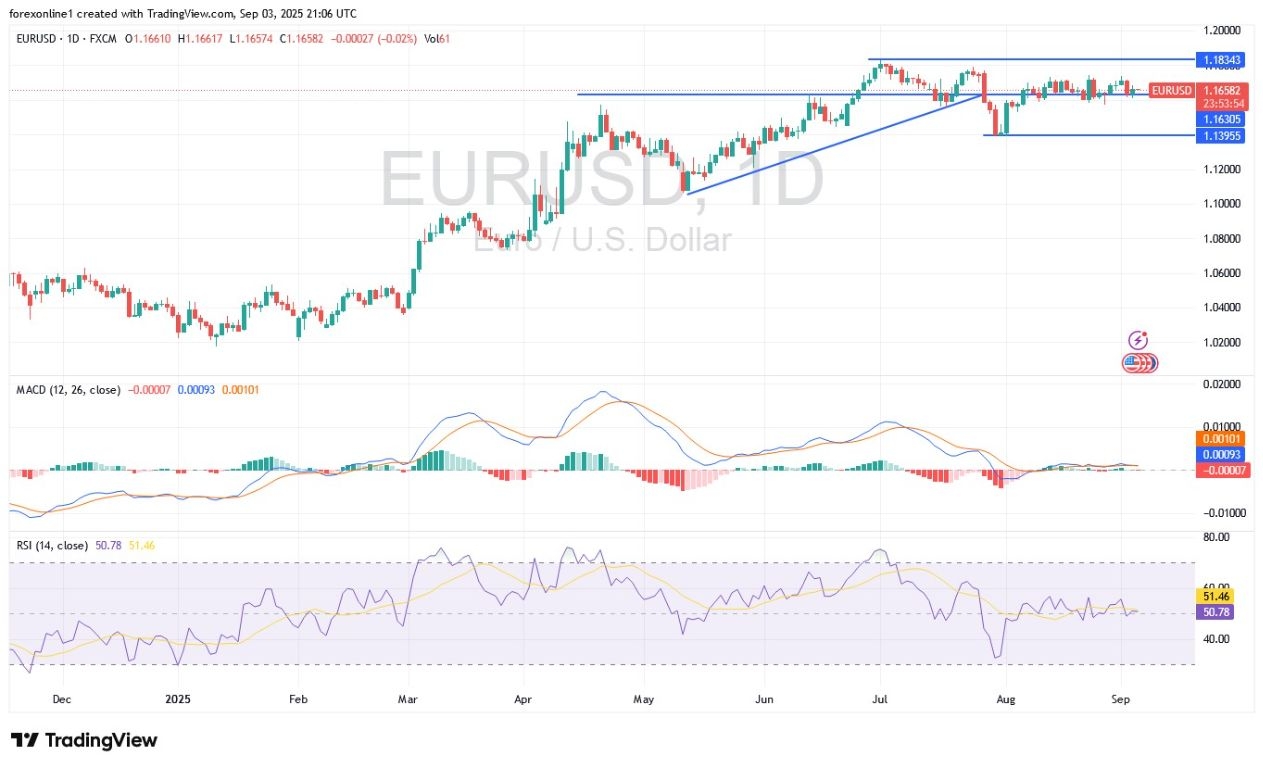
EUR/USD Analysis Summary Today

  • Overall Trend: Neutral with a downward bias.
  • Today’s Support Levels: 1.1600 – 1.1560 – 1.1470.
  • Today’s Resistance Levels: 1.1700 – 1.1770 -1.1830.

EUR/USD Trading Signals:

  • Buy EUR/USD from the 1.1540 support level, with a target of 1.1800 and a stop-loss at 1.1500.
  • Sell EUR/USD from the 1.1770 resistance level, with a target of 1.1600 and a stop-loss at 1.1820.

Technical Analysis of EUR/USD Today:

As expected, the EUR/USD pair will remain in a very tight range until financial markets and investors react to the US jobs data announced tomorrow, Friday. This data will heavily shape the future of the Federal Reserve’s decisions on interest rates this month. The EUR/USD is trading around 1.1660 at the time of writing, attempting to avoid a collapse below the 1.1600 support level to prevent a surge in sell orders for the most popular currency pair in the forex market.

Today’s EUR/USD Forecast:

Recently, according to reliable trading platforms, the EUR/USD exchange rate forecast has improved after the pair broke the 1.1700 resistance level, trading at around 1.1735, approaching its highest level in a month. However, the EUR/USD pair failed to complete its upward rebound despite continued weak US dollar sentiment, as traders assess risks of Federal Reserve independence, legal challenges regarding tariffs, and upcoming US labor market data.

Meanwhile, gains in the Chinese yuan are providing additional support for the euro, keeping the focus on whether the EUR/USD can head toward 1.1750 and test the resistance level near 1.1830.

EUR/USD Bullish Scenario:

According to forex trading, the EUR/USD exchange rate made a more successful break above the resistance level of 1.1700, trading around 1.1735 at the beginning of the week’s trading, amid a weaker US dollar and further gains in the Chinese yuan. According to trading experts, there is enough negativity in the US dollar for the EUR/USD pair to trade through the resistance level of 1.1750 and test its high this year at 1.1830. Experts believe that a breakout of the 1.1780 resistance level is necessary to signal sustainable progress.

The movement of technical indicators confirms neutral performance. The 14-day RSI is around 51, not far from the neutral midline, and the MACD lines are also in a neutral path, awaiting strong factors for bulls and bears to quickly take control. On the fundamental analysis front, the EUR/USD will be affected today by the announcement of Eurozone retail sales figures at 12:00 PM Cairo time. The most important announcement will be the ADP US non-farm payrolls at 3:15 PM Cairo time. The weekly jobless claims and US trade balance figures will be released at 3:30 PM Cairo time, concluding with the announcement of the ISM US services PMI.

Keep in mind that the main catalysts for the EUR/USD this week are US jobs data and Fed policy risks. The US labor market data will be crucial, culminating in Friday’s main employment report. Last month’s weak report, especially the significant downward revisions, was a key factor that triggered frenzied speculation about a shift in the Fed’s policy. The concerns surrounding this week’s release were exacerbated after President Trump’s decision to fire the head of the Bureau of Labor Statistics (BLS) following last month’s data.

In the forex market, the Chinese yuan has also continued to gain in global markets, which will support the EUR/USD pair. Recently, we have seen a rebound in demand for the yuan-denominated in dollars overseas, especially from hedge fund clients. By allowing the yuan to appreciate slightly ahead of the US trade talks in the fall, it could help create a more supportive environment for reaching an agreement.

Trading Tips:

Traders are advised to await the market’s reaction to the US jobs data to determine the most suitable EUR/USD trading positions.

Ready to trade our Forex EUR/USD forecast? We’ve shortlisted the best European brokers in the industry for you.

Source link

Go to Top