timesreporter.com wants to ensure the best experience for all of our readers, so we built our site to take advantage of the latest technology, making it faster and easier to use.
Unfortunately, your browser is not supported. Please download one of these browsers for the best experience on timesreporter.com
XRP chart shows a breakout pattern forming, decision point near.
Fed rate cuts could boost crypto; XRP positioned to benefit.
Ripple’s real-world use cases gaining traction in cross-border transactions.
It’s been a quiet few months for XRP, with the price mostly moving sideways after a strong start to the year. But here’s the thing about XRP: it has a habit of staying quiet just before surprising everyone with a sudden breakout. Here are three simple reasons why XRP could surge in July:
A Breakout Pattern is Forming
According to analyst Mickle, XRP’s price chart is showing a classic breakout pattern. The highs are getting lower, the lows are getting higher, and the price is getting squeezed into a tighter range. This type of “price squeeze” setup often resolves with a powerful and explosive move.
This pattern could reach a breaking point around July 25th. Of course, markets can be unpredictable, but the signs show XRP is gearing up for a big decision soon, either shooting up or dropping sharply.
EUR/USD trades above 1.1700 to start the new week.
The technical outlook suggests that the uptrend is likely to continue.
Month-end flows could ramp up market volatility later in the day.
EUR/USD holds steady and fluctuates above 1.1700 in the European morning on Monday after gaining more than 1.5% in the previous week. Although the technical outlook suggests that the pair is likely to extend its uptrend, position adjustments on the last day of the first half of the year could ramp up market volatility and trigger irregular movements.
Euro PRICE This month
The table below shows the percentage change of Euro (EUR) against listed major currencies this month. Euro was the strongest against the Japanese Yen.
USD
EUR
GBP
JPY
CAD
AUD
NZD
CHF
USD
-3.00%
-1.50%
0.03%
-0.96%
-1.41%
-1.72%
-2.95%
EUR
3.00%
1.57%
3.11%
2.10%
1.68%
1.65%
0.05%
GBP
1.50%
-1.57%
1.52%
0.54%
0.12%
-0.08%
-1.48%
JPY
-0.03%
-3.11%
-1.52%
-0.98%
-1.33%
-1.59%
-2.91%
CAD
0.96%
-2.10%
-0.54%
0.98%
-0.37%
-0.64%
-2.01%
AUD
1.41%
-1.68%
-0.12%
1.33%
0.37%
-0.03%
-1.56%
NZD
1.72%
-1.65%
0.08%
1.59%
0.64%
0.03%
-1.57%
CHF
2.95%
-0.05%
1.48%
2.91%
2.01%
1.56%
1.57%
The heat map shows percentage changes of major currencies against each other. The base currency is picked from the left column, while the quote currency is picked from the top row. For example, if you pick the Euro from the left column and move along the horizontal line to the US Dollar, the percentage change displayed in the box will represent EUR (base)/USD (quote).
The broad-based selling pressure surrounding the US Dollar (USD) fuelled EUR/USD’s rally last week. Early Monday, the USD struggles to find demand and helps the pair hold its ground as the market mood remains upbeat, with US stock index futures rising about 0.5% on the day.
Earlier in the day, the data from Germany showed that Retail Sales declined by 1.6% on a monthly basis in May, following the 0.6% contraction recorded in April. This reading came in worse than the market expectation for an increase of 0.5% but failed to trigger a noticeable market reaction. In the second half of the day, Germany’s Destatis will release preliminary Consumer Price Index (CPI) data for June.
Meanwhile, French Finance Minister Eric Lombard told newspaper La Tribune Dimanche on Sunday that he thinks that they are going to reach a trade deal with the US. “Regarding the deadline, my wish is for another postponement. I would rather have a good deal than a bad deal on July 9,” he added. In case markets remain optimistic about an EU-US trade deal, EUR/USD’s downside is likely to remain limited.
EUR/USD Technical Analysis
EUR/USD remains within the upper half of the ascending regression channel and the Relative Strength Index (RSI) indicator on the 4-hour chart holds above 60. On the upside, 1.1730 (static level) aligns as an interim resistance level before 1.1760 (upper limit of the ascending channel) and 1.1800 (static level, round level).
Looking south, 1.1700 (static level, 20-period Simple Moving Average) could be seen as the first support level ahead of 1.1660 (mid-point of the ascending channel) and 1.1620 (static level).
Euro FAQs
The Euro is the currency for the 19 European Union countries that belong to the Eurozone. It is the second most heavily traded currency in the world behind the US Dollar. In 2022, it accounted for 31% of all foreign exchange transactions, with an average daily turnover of over $2.2 trillion a day.
EUR/USD is the most heavily traded currency pair in the world, accounting for an estimated 30% off all transactions, followed by EUR/JPY (4%), EUR/GBP (3%) and EUR/AUD (2%).
The European Central Bank (ECB) in Frankfurt, Germany, is the reserve bank for the Eurozone. The ECB sets interest rates and manages monetary policy.
The ECB’s primary mandate is to maintain price stability, which means either controlling inflation or stimulating growth. Its primary tool is the raising or lowering of interest rates. Relatively high interest rates – or the expectation of higher rates – will usually benefit the Euro and vice versa.
The ECB Governing Council makes monetary policy decisions at meetings held eight times a year. Decisions are made by heads of the Eurozone national banks and six permanent members, including the President of the ECB, Christine Lagarde.
Eurozone inflation data, measured by the Harmonized Index of Consumer Prices (HICP), is an important econometric for the Euro. If inflation rises more than expected, especially if above the ECB’s 2% target, it obliges the ECB to raise interest rates to bring it back under control.
Relatively high interest rates compared to its counterparts will usually benefit the Euro, as it makes the region more attractive as a place for global investors to park their money.
Data releases gauge the health of the economy and can impact on the Euro. Indicators such as GDP, Manufacturing and Services PMIs, employment, and consumer sentiment surveys can all influence the direction of the single currency.
A strong economy is good for the Euro. Not only does it attract more foreign investment but it may encourage the ECB to put up interest rates, which will directly strengthen the Euro. Otherwise, if economic data is weak, the Euro is likely to fall.
Economic data for the four largest economies in the euro area (Germany, France, Italy and Spain) are especially significant, as they account for 75% of the Eurozone’s economy.
Another significant data release for the Euro is the Trade Balance. This indicator measures the difference between what a country earns from its exports and what it spends on imports over a given period.
If a country produces highly sought after exports then its currency will gain in value purely from the extra demand created from foreign buyers seeking to purchase these goods. Therefore, a positive net Trade Balance strengthens a currency and vice versa for a negative balance.
The Global Plant Extracts Market is projected to grow from USD 28.1 billion in 2025 to USD 63.1 billion by 2034 at a CAGR of 9.4%. Key drivers include the rising demand for natural ingredients in foods and personal care, advancements in extraction technology, and emphasis on sustainability.
Global Plant Extracts Market is valued at USD 28.1 billion in 2025. Further, the market is expected to grow at a CAGR of 9.4% to reach USD 63.1 billion by 2034.
The plant extracts market is witnessing significant growth, driven by increasing consumer demand for natural ingredients in food, beverages, pharmaceuticals, cosmetics, and personal care products. Plant extracts are derived from herbs, fruits, flowers, and other botanical sources, offering health benefits such as antioxidant properties, immune support, and anti-inflammatory effects. The rising awareness of plant-based nutrition and clean-label products is fueling the adoption of natural extracts in functional foods and dietary supplements.
Additionally, advancements in extraction technologies, such as supercritical CO2 extraction and cold-pressed methods, are enhancing the purity and efficacy of plant-derived compounds. Regulatory support for herbal and botanical ingredients in traditional medicine and dietary supplements is further propelling market expansion. However, challenges such as raw material availability, supply chain disruptions, and stringent quality control measures continue to impact the industry.
In 2024, the plant extracts market is experiencing rapid innovation in formulation, sustainability, and application diversity. The demand for adaptogenic and stress-relief botanical extracts, including ashwagandha, ginseng, and rhodiola, is rising as consumers seek natural solutions for mental well-being. The clean-label trend is driving food manufacturers to replace synthetic additives with plant-based colorants, preservatives, and flavor enhancers. The pharmaceutical sector is witnessing increased research into botanical compounds for immune-boosting and anti-inflammatory properties, leading to the development of plant-based nutraceuticals.
Sustainability is a key focus, with companies investing in organic farming, ethical sourcing, and carbon-neutral extraction processes to meet consumer preferences for eco-friendly products. Meanwhile, personalized nutrition and customized herbal supplements are gaining traction, with AI-driven platforms enabling tailored botanical formulations based on individual health profiles. However, price fluctuations of raw materials, driven by climate change and agricultural challenges, remain a concern for manufacturers.
Looking ahead to 2025 and beyond, the plant extracts market is expected to expand further with advancements in biotechnology, AI-driven ingredient discovery, and precision extraction techniques. The use of biotech fermentation to produce plant-based bioactives with higher potency and sustainability is expected to grow, reducing dependence on traditional cultivation. The rise of functional beverages, including herbal-infused waters, CBD-based drinks, and botanical elixirs, will drive demand for high-quality plant extracts with enhanced bioavailability. Additionally, regulatory frameworks for plant-based ingredients are likely to evolve, encouraging innovation in botanical medicine and functional foods.
The integration of blockchain technology in the supply chain will improve traceability and transparency, ensuring quality assurance and ethical sourcing. Furthermore, collaborations between food-tech startups and traditional herbal medicine companies will accelerate the commercialization of novel plant-based formulations. As consumer interest in holistic wellness and natural remedies continues to grow, the plant extracts market will see sustained demand and technological evolution in product development and applications.
XRP bounced sharply from the $2.07 confluence zone, signaling the end of its correction phase.
Ripple’s decision to drop its SEC appeal boosts optimism, paving the way for potential XRP breakout.
Breaking $2.25 is crucial—flipping this level to support could trigger XRP’s next major rally.
XRP recently challenged the important price of $2.07 as a confluence zone that consists of 0.618 Fib support, wave C’s 1:1 extension, and wave 5’s 0.618 extension. This important price level marked a quick recovery, and it may mark the conclusion of its correction period. Such a drastic change implies that the market has possibly reached its worst.
Possibly, momentum has continued to build up since then. XRP has now positioned itself in the path to the next significant milestone of $2.25. This mark represents the 0.382 retracement, and traders have closely monitored it over the past months. Breaking out above this resistance with conviction can lead to further advances.
Another factor contributing to optimism has been Ripple’s decision to withdraw its appeal in the court battle it was involved in with the U.S. Securities and Exchange Commission (SEC). The lawsuit that has clouded Ripple’s past few years appears to be nearing its conclusion. With a chance of the SEC backing off their case, the trust in the sector concerning Ripple is increasing further.
This legal solution perfectly matches the price activity of XRP. With the token reaching its major resistance points, the market is gearing up to drive a possible breakout. A break of more than $2.25 will possibly mark the beginning of a new bullish period for the cryptocurrency.
CasiTrades envisioned two probable short-term situations. This will be followed by a $2.30 move, which is going to be tested as a support by the pullback. And this would be a sound and good correction. In the second scenario, the coin rises above $2.30, approaches the resistance level of $2.45, and later attempts to push higher towards the new high of $2.69.
Either way, the crucial price to monitor is $2.25. With the token remaining above this level, the result could be an all-out breakout and access to even greater upside potential. The traders are currently monitoring any indication that the price can turn around and shift its resistance to support at $2.25.
The bounce on Friday was not accidental but a well-organized market structure. The price indicators show that the token has reached the end of the second wave of the correction and is in the third one. With local resistance set aside, a price increase may not be far away.
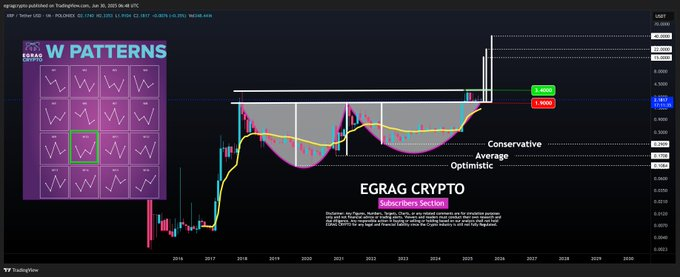
XRP’s W Pattern: Potential Gains Ahead
Egrag has explained how XRP has resulted in a typical pattern of W and that it could target anywhere between $15 and $40. These goals may seem idealistic, but they can provide a possible path forward that long-term investors may use to navigate volatility.
Nonetheless, analysts also warned, and traders are expected to take profits on the way, especially at the $6-$7 arena. In such volatile markets, the point to note is that strategically, one should sell during the hype and buy during a market dip.
The pricing of XRP has halted at important intervals, and the outcome of the legal battle that Ripple is combating could precipitate a substantial price correction. As new developments unfold, traders should be vigilant and prepared to take action.
XRP is at a crossroads. The cryptocurrency is poised to gain potential as major technical levels are met and legal uncertainty fades away. By remaining informed about these changes, traders may be placed in quite an advantageous position when the Ripple token enters a new stage.
Platinum price formed a clear correctional decline, to test the minor bullish channel’s support at $1324.75, to achieve the suggested correctional target in the previous report, then begin forming bullish waves to settle near $1363.00.
The continuation of the fluctuation within the bullish channel’s levels is expected, depending on the stability of the support to expect its rally to $1382.00 and $1400.00. While breaking the support and providing a negative close will confirm its readiness to resume the bearish correctional attack, and $1302.00 level represents the extra negative target.
The expected trading range for today is between $1330,00 and $1382.00
Platinum price formed a clear correctional decline, to test the minor bullish channel’s support at $1324.75, to achieve the suggested correctional target in the previous report, then begin forming bullish waves to settle near $1363.00.
The continuation of the fluctuation within the bullish channel’s levels is expected, depending on the stability of the support to expect its rally to $1382.00 and $1400.00. While breaking the support and providing a negative close will confirm its readiness to resume the bearish correctional attack, and $1302.00 level represents the extra negative target.
The expected trading range for today is between $1330,00 and $1382.00
At a minimalist matcha bar in Los Angeles, United States, powdered Japanese tea is prepared with precision, despite a global shortage driven by the bright green drink’s social media stardom.
Of the 25 types of matcha on the menu at Kettl Tea, which opened on Hollywood Boulevard this year, all but four were out of stock, according to the shop’s founder, Zach Mangan.
“One of the things we struggle with is telling customers that, unfortunately, we don’t have” what they want, he said.
With its deep grassy aroma, intense colour and pick-me-up effects, the popularity of matcha “has grown just exponentially over the last decade, but much more so in the last two to three years”, the 40-year-old explained.
It is now “a cultural touchpoint in the Western world” – found everywhere from ice-cream flavour boards to Starbucks.
This has caused matcha’s market to nearly double over a year, Mangan said.
“No matter what we try, there’s just not more to buy.”
A woman enjoys a cup of matcha with her book at Kettl Tea in the Los Feliz neighbourhood of Los Angeles, California [Frederic J. Brown/AFP]
In the Japanese city of Sayama, northwest of Tokyo, Masahiro Okutomi – the 15th generation to run his family’s tea production business – is overwhelmed by demand.
“I had to put on our website that we are not accepting any more matcha orders,” he said.
Producing the powder is an intensive process: the leaves, called “tencha”, are shaded for several weeks before harvest, to concentrate the taste and nutrients.
They are then carefully deveined by hand, dried and finely ground in a machine.
“It takes years of training” to make matcha properly, Okutomi said. “It’s a long-term endeavour requiring equipment, labour and investment.”
“I’m glad the world is taking an interest in our matcha … but in the short term, it’s almost a threat – we just can’t keep up,” he said.
The matcha boom has been propelled by online influencers like Andie Ella, who has more than 600,000 subscribers on YouTube and started her own brand of matcha products.
At the pastel-pink pop-up shop she opened in Tokyo’s hip Harajuku district, dozens of fans were excitedly waiting to take a photo with the 23-year-old Frenchwoman or buy her cans of strawberry or white chocolate-flavoured matcha.
“Matcha is visually very appealing,” said Ella.
To date, her matcha brand, produced in Japan’s rural Mie region, has sold 133,000 cans. Launched in November 2023, it now has eight employees.
“Demand has not stopped growing,” she said.
Andie Ella, the founder of Milia Matcha, talking to employees before the shop opening in Tokyo [Philip Fong/AFP]
Last year, matcha accounted for more than half of the 8,798 tonnes of green tea exported from Japan, according to Japan’s Agriculture Ministry data – twice as much as 10 years ago.
Tokyo tea shop Jugetsudo, in the touristy former fish market area of Tsukiji, is trying to control its stock levels given the escalating demand.
“We don’t strictly impose purchase limits, but we sometimes refuse to sell large quantities to customers suspected of reselling,” said store manager Shigehito Nishikida.
“In the past two or three years, the craze has intensified. Customers now want to make matcha themselves, like they see on social media,” he added.
The global matcha market is estimated to be worth billions of dollars, but it could be hit by US President Donald Trump’s tariffs on Japanese products – currently 10 percent, with a rise to 24 percent in the cards.
Shortages and tariffs mean “we do have to raise prices. We don’t take it lightly”, said Mangan at Kettl Tea, though it has not dampened demand so far.
“Customers are saying, ‘I want matcha before it runs out’.”
Japan’s government is encouraging tea producers to farm on a larger scale to reduce costs.
But that risks sacrificing quality, and “in small rural areas, it’s almost impossible”, grower Okutomi said.
The number of tea plantations in Japan has fallen to a quarter of what it was 20 years ago, as farmers age and find it difficult to secure successors, he added.
“Training a new generation takes time… It can’t be improvised.”
A recent post from Ripple CEO Brad Garlinghouse has stirred significant excitement among the XRP community regarding the coin’s future.
The buzz began when prominent XRP influencers resurfaced a photo of Garlinghouse revealing an XRP tattoo on his upper arm.
Notably, the original unveiling occurred in 2023, following a landmark court ruling that determined XRP is not a security, granting historic regulatory clarity to the token. During the celebratory event that followed, Garlinghouse showcased his XRP tattoo.
“Lock In”
Interestingly, Garlinghouse has now announced the official conclusion of the Ripple lawsuit. He stated it was time to close this chapter once and for all and focus on more important matters—namely, building the internet of value. He ended his statement with the phrase “Lock in,” which did not go unnoticed by the XRP Army.
In response, XRP enthusiasts once again highlighted his tattoo, interpreting it as a symbol of renewed focus and commitment to XRP’s development, now that the legal hurdles are behind them.
Commenting on the trend, popular XRP community commentator “Digital Asset Investor” shared his thoughts on the symbolic meaning of Garlinghouse’s tattoo.
He remarked that while many people regret tattoos they got when they were younger, someone with a Harvard MBA getting a tattoo after age 50, referring to Garlinghouse, has clearly thought it through and expects only positive change ahead.
“LOCK IN,” he added, concluding that Garlinghouse has zero doubt about the future of XRP.
Ripple Agrees: “1,000%”
Then came the moment that electrified the community: Ripple’s CEO replied to the post with “1,000%.”
His use of such a massive percentage figure to express agreement with the community’s optimism sparked further excitement. Alex Cobb, a well-known voice in the XRP community, interpreted Garlinghouse’s response as a clear signal that a 1,000% price surge for XRP is “confirmed.”
Price predictions like this have long been a part of the XRP community’s vision. Forecasts ranging from $1,000 to $20,000, and even higher, have been floated by holders and analysts. Some have offered ambitious short-term timelines for such outcomes.
These projections are often based on XRP’s potential to disrupt the multi-trillion-dollar payments market, a space where Ripple is working to establish a strong foothold.
XRP Price If It Soars 1,000%
Given the current buzz from Garlinghouse’s statement, what would XRP’s price be if it surged 1,000%?
At the time of writing, XRP is trading at $2.18. A 1,000% increase would bring the price to approximately $24.
Interestingly, this $24 price target aligns with a forecast from veteran Bitcoin investor Davinci Jeremie. He famously suggested that level would mark XRP’s peak in this cycle.
At $24 per coin, XRP’s market cap would reach approximately $1.4 trillion. This would place it ahead of major global companies such as Berkshire Hathaway and Tesla.
DisClamier: This content is informational and should not be considered financial advice. The views expressed in this article may include the author’s personal opinions and do not reflect The Crypto Basic opinion. Readers are encouraged to do thorough research before making any investment decisions. The Crypto Basic is not responsible for any financial losses.
Coffee price continued forming strong negative trading, to face 50%Fibonacci correctional level, which forms a strong support at 292.85, then bounces quickly towards 302.05 as appears in the above image.
We expect forming some mixed trading, but its repeated stability above the current support will reinforce the chances for gathering the positive momentum and begin recovering the losses by targeting 313.60 level, reaching the barrier at 327.05.
The expected trading range for today is between 395.00 and 313.60