About Editorial team of BIPNs

Main team of content of bipns.com. Any type of content should be approved by us.
30 06, 2025

The EURJPY loses its positive momentum– Forecast today – 30-6-2025

By |2025-06-30T09:28:00+03:00June 30, 2025|Forex News, News|0 Comments

Platinum price formed a clear correctional decline, to test the minor bullish channel’s support at $1324.75, to achieve the suggested correctional target in the previous report, then begin forming bullish waves to settle near $1363.00.


The continuation of the fluctuation within the bullish channel’s levels is expected, depending on the stability of the support to expect its rally to $1382.00 and $1400.00. While breaking the support and providing a negative close will confirm its readiness to resume the bearish correctional attack, and $1302.00 level represents the extra negative target.


The expected trading range for today is between $1330,00 and $1382.00


Trend forecast: Bullish


Source link

30 06, 2025

SOL breakout fuels optimism amid ETF buzz

By |2025-06-30T09:18:22+03:00June 30, 2025|Crypto News, News|0 Comments

  • Solana price breaks above its descending trendline, indicating a potential shift to an upward trend.
  • REX Shares files for a Solana staking ETF with the SEC, signaling that a launch could be on the horizon.
  • Technical outlook turns bullish, with SOL eyeing a rally toward the $184 resistance level and beyond.

Solana (SOL) price trades around $151 at the time of writing on Monday, after breaking above its descending trendline last week, suggesting an upward trend ahead. REX Shares files for a Solana staking ETF with the US Securities and Exchange Commission (SEC), signaling that a launch could happen soon. The technical outlook suggests a rally, targeting levels above $180.

Is Solana ETF coming soon?

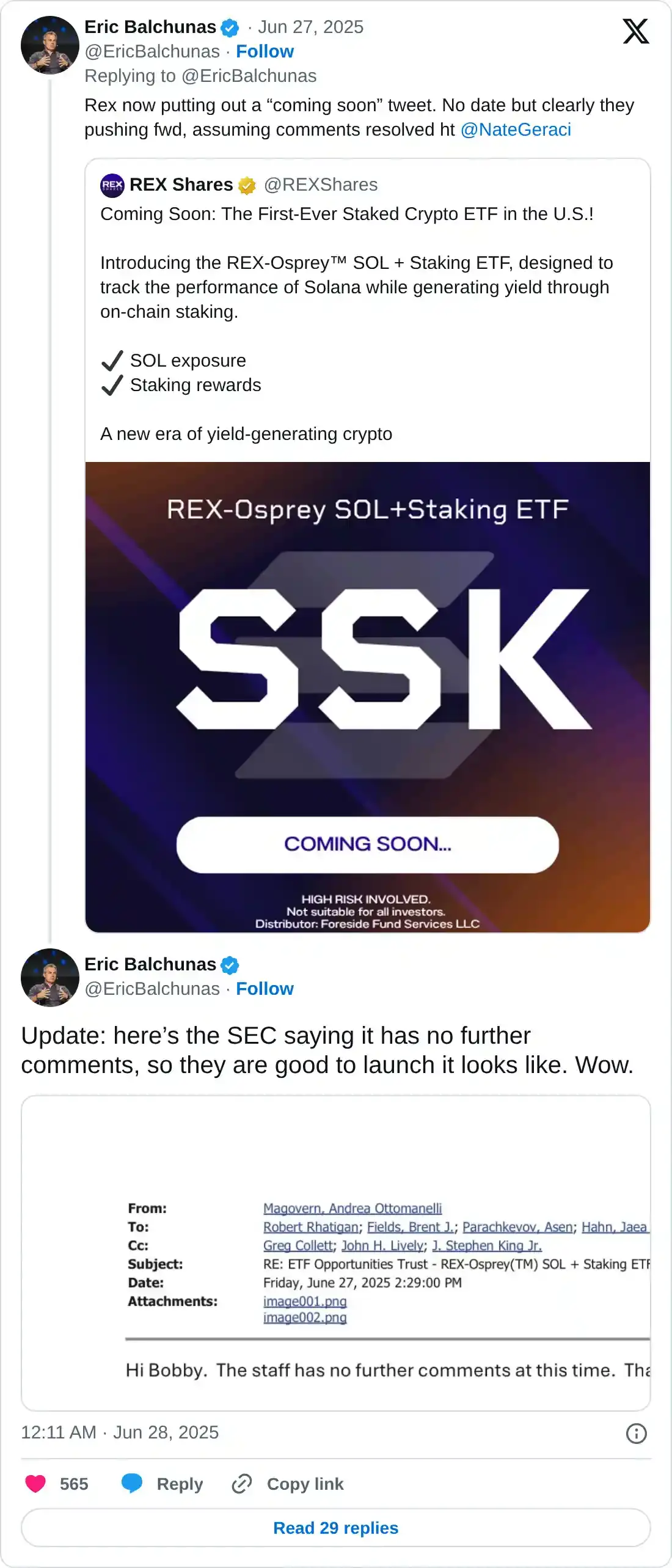
REX Shares posted on its X account on Saturday that its REX-Osprey SOL and staking ETF is designed to track the performance of Solana while generating yield through onchain staking and will be launched soon.

Eric Balchunas, Senior ETF Analyst for Bloomberg, also posted on X on the same day that the 

Rex has just filed a letter with the US SEC, asking if comments have been resolved for their ‘40 Act Solana Staking ETF. 

Balchunas posted: “They’re no doubt trying to get it to mkt ahead of the spot ones.”

He also cited an email screenshot to confirm that REX Shares has addressed the SEC’s comments.

“So they are good to launch, it looks like. Wow,” Balchunas added.

https://twitter.com/EricBalchunas/status/1938752099564560864

Solana Price Forecast: SOL breakout of the descending trendline

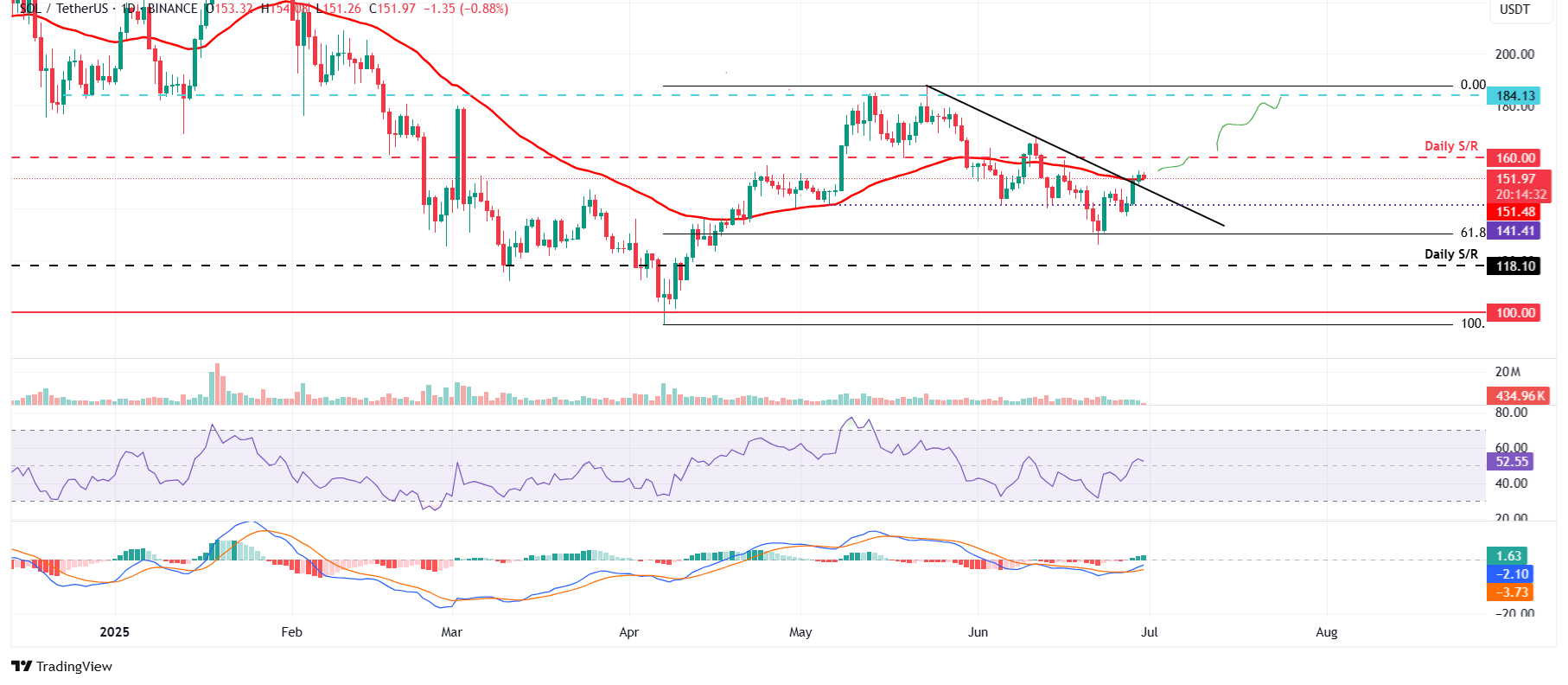
Solana price broke out and closed above the descending trendline (drawn by connecting multiple highs since May 24) on Saturday and rallied to close above its 50-day Exponential Moving Average (EMA) at $151.48 the next day. At the time of writing on Monday, it hovers around the 50-day EMA level at $151.48.

If SOL continues its upward trend, it could extend the rally toward its daily resistance level at $160. A successful close above this level could extend additional gains to retest its next daily resistance at $184.13.

The Relative Strength Index (RSI) on the daily chart reads 52, above its neutral level of 50, indicating that bullish momentum is gaining traction. The Moving Average Convergence Divergence (MACD) on the daily chart also displayed a bullish crossover on Saturday, providing a buy signal and indicating an upward trend.

SOL/USDT daily chart 

SOL/USDT daily chart 

However, if SOL faces a correction, it could extend the decline toward its next support level at $141.41.


Source link

30 06, 2025

Everything You Need to Know

By |2025-06-30T07:22:53+03:00June 30, 2025|Dietary Supplements News, News|0 Comments


  • Collagen may support skin elasticity and hydration, especially in older adults.
  • Not all collagen is equal—look for hydrolyzed peptides and independently verified.
  • It’s not a must-have; most healthy, younger people don’t need collagen supplements.

You’re scrolling through TikTok or Instagram, and stumble upon someone sharing their morning routine and a detailed list of their go-to supplements. Somewhere between the daily dose of vitamin D and a personalized discount code to snag their supplements for a fraction of the price, they grab a warm beverage and scoop powder into their morning drink, raving about how this “magic elixir” transformed their skin, joints or gut health. That scoop? Collagen.

At this point, you might be wondering if you’re missing out. Is collagen really the secret to aging gracefully, or is it just another overhyped wellness trend that has become a billion-dollar industry? We turn to dietitians, dermatologists and nutrition scientists to explore the facts behind this booming industry and uncover whether or not you should use that saved discount code and add collagen to your routine.

Collagen—Where It Started and Where It Is Now

Collagen’s story actually begins in the medical world. Back in the 1970s, collagen was used in the medical and cosmetic industries to treat wounds, aid in grafting procedures and support recovery after tooth extractions. It was typically applied in solid or gel-like form with intricate, lattice-like designs to support the body’s natural repair process and rejuvenate damaged areas.

However, that started to shift with the introduction of healthy-aging supplements. Fast-forward to the mid-2010s, and collagen leaped into the public spotlight—largely fueled by celebrity endorsements and social media. “Collagen’s rise from medical and cosmetic use to wellness staple has closely paralleled the growth of the modern supplement industry and the strategic use of social media partnerships,” says Charlotte Martin, M.S., RD. “As beauty-from-within products gained momentum, collagen brands invested heavily in influencer marketing, driving consumer demand through visually appealing content and personal testimonials,” she adds.

A few scrolls on social media and you’d come across a video of an influencer showing off their glowing skin with a bottle of collagen in hand. Remember when Vital Proteins partnered with Jennifer Aniston? That move helped make collagen coffee a household trend. Today, supplement shelves are filled with collagen pills, powders, gummies, drinks and topical formulations that promise youthful skin and improved joint health. With its boom in popularity, the collagen industry was worth over $9.9 billion in 2024 and is projected to reach $18.7 billion by 2030, with no signs of slowing down.

What Is Collagen, Exactly?

Collagen is often described as the glue that holds the body together, and for good reason. It’s the most abundant protein in the human body, providing structural support to your skin, bones, tendons and ligaments. Its incredible strength lies in its unique triple-helix structure, made primarily of the amino acids glycine, proline and hydroxyproline, which are tightly wound into three chains.

“There are over 28 different types of collagen that exist, but only a few are usually focused on in the nutrition and beauty world,” says Katey Davidson, M.Sc.FN, RD, CPT. “The three main types of collagen are type I, II and III, which are found most often in collagen supplements.”

  • Type I: This is the most abundant type, making up about 90% of the collagen in the human body. Type I collagen is primarily found in the skin, tendons, bones and ligaments.
  • Type II: Found mostly in the cartilage, Type II collagen is key in maintaining joint health and flexibility.
  • Type III: Often found alongside Type I, Type III supports the structure of the skin, muscles and blood vessels.

However, there’s more to collagen than its unique types. In fact, its natural sources are as diverse as its types and functions. “There are generally four main sources of collagen available in supplement form: bovine [cow], marine [fish], porcine [pig] and chicken and eggshell membrane,” says Gigi Kwok-Hinsley, Dr.P.H., M.S., RD. Kwok-Hinsley emphasizes that for a supplement to be considered collagen, it must be derived from an animal source. “It is important to acknowledge that there is no such thing as vegan collagen,” she says. Supplements with collagen-related amino acids aren’t collagen themselves but building blocks that support your body’s natural collagen production. She explains that these are often referred to as collagen biomimetics because they mimic the effects of collagen.

But how does the body produce collagen naturally? Naana Boakye, MD, MPH, a board-certified dermatologist, explains that your body produces collagen by utilizing amino acids from the proteins you consume, along with essential nutrients like vitamin C, zinc and copper, to accomplish this task. Specialized cells called fibroblasts, found throughout your skin, joints, bones, muscles and blood vessels, are the master builders behind collagen production. Unfortunately, Boakye shares that collagen production begins to decline with age, UV exposure, smoking and poor nutrition. To help counteract these effects, “supplementation provides hydrolyzed collagen peptides, which are essentially ‘pre-digested’ amino acid chains that may stimulate fibroblasts to boost collagen synthesis. While not a replacement for natural production, supplements may help bridge age- or diet-related gaps,” says Boakye.

The Evidence: Does It Work?

The billion-dollar question is, does collagen actually do what it claims to do? “The strongest evidence for collagen supplementation is in the area of skin health, where randomized controlled trials suggest that hydrolyzed collagen may provide modest improvements in skin elasticity, hydration, and the appearance of wrinkles,” says Martin. She shares that a comprehensive review and multiple clinical trials have demonstrated that collagen supplementation can lead to measurable, although modest, improvements in skin aging outcomes compared to a placebo. Boakye adds that these effects are typically seen in daily doses of 2.5 to 10 grams of collagen over an 8- to 12-week period.

“As for joint, bone and gut health, while collagen is theoretically beneficial due to its amino acid profile—particularly glycine, proline and hydroxyproline—the clinical evidence in these areas is still limited. Some preliminary studies suggest potential benefits, but they lack the consistency and rigor seen in skin-related research,” Boakye explains. For example, Martin notes that some studies suggest that undenatured type II collagen may reduce joint pain and improve mobility, but these findings are mixed. Similarly, studies on gut health, particularly those related to ulcerative colitis, have been conducted on animals or in test tubes. Therefore, more human research is needed to confirm the results.

In addition, Martin emphasizes that “most trials have been small, conducted primarily in healthy middle-aged to older females, raising questions about generalizability to younger populations or those with chronic disease. Many studies were also funded by collagen manufacturers, and there is considerable variability in collagen source, dosage and measurement methods across trials.” Ultimately, larger, independent and methodologically rigorous trials are needed to clearly define the benefits of oral collagen supplementation, she explains.

So, Should You Be Taking Collagen?

The answer to this question isn’t as straightforward as a simple yes or no. Truthfully, it depends.

Who Might Benefit Most And What to Look For

Since collagen synthesis declines over time, collagen supplements may be particularly beneficial for aging adults, says Kwok-Hinsley. More specifically, Martin shares that research points to middle-aged, older and post-menopausal individuals benefiting the most. “Several studies suggest that individuals over age 50 may see more pronounced improvements in skin outcomes compared to younger individuals,” she adds.

“People with joint issues, such as those with osteoarthritis or activity-related joint discomfort, may also benefit from specific forms like undenatured type II collagen. Additionally, individuals recovering from wounds or injury—where collagen plays a key role in tissue repair—may see potential benefits, although more research is needed in this area,” Martin explains.

When choosing a collagen supplement, look for options that list hydrolyzed collagen on the label. “This means that the collagen has been broken down into smaller chains of amino acids, called peptides, which are much easier for the body to absorb,” says Davidson. Claire Rifkin, M.S., RDN, notes that it’s also important to choose brands that are independently verified to ensure quality and safety.

Our Top Picks

When It Might Not Be Worth It

“If you’re already meeting your protein needs and don’t have joint or skin concerns, collagen won’t move the needle,” says Rifkin. This is especially true for younger adults. Martin explains that most studies to date have focused on older populations with lower baseline collagen levels. Younger individuals, on the other hand, typically produce enough collagen to meet their body’s needs.

“Certain individuals, particularly those with allergies to the source material, such as fish, shellfish or eggs, should avoid collagen entirely,” says Martin. Kwok-Hinsley adds that vegetarians and vegans may want to steer clear of collagen supplements due to dietary and ethical reasons. Additionally, those who are pregnant, breastfeeding or have a kidney condition should speak to their health care provider before considering supplementation to check if it’s safe and appropriate to consume.

Our Expert Take

Collagen has evolved significantly from its early use in medicine to its current status as a staple for healthy aging. Although collagen is often touted for its joint-, skin-, gut- and bone-supporting benefits, the strongest evidence supports collagen’s use for improving skin elasticity, hydration and the appearance of fine lines, as well as enhancing joint health. However, not everyone will experience drastic improvements in these areas of their health. Those who may benefit most include older adults, particularly middle-aged and older females, as well as individuals with joint concerns. However, research is still ongoing, and collagen’s full range of benefits has yet to be uncovered.


Source link

30 06, 2025

XAU/USD extends downside to near $3,250 on better risk appetite

By |2025-06-30T05:27:11+03:00June 30, 2025|Forex News, News|0 Comments


  • Gold price edges lower to near $3,265 in Monday’s early Asian session. 
  • US-China trade agreement diminished investors’ appetite for Gold. 
  • Safe-haven flows and optimism of a Fed rate cut might cap the Gold’s downside. 

The Gold price (XAU/USD) extends the decline to around $3,265 during the early Asian session on Monday. The precious metal tumbles to near one-month low after a United States (US)-China trade agreement boosted risk appetite. Investors await the Fedspeak later on Monday for fresh impetus. 

A trade deal reached between the US and China last week on how to expedite rare earth shipments to the US was viewed positively by markets. This, in turn, diminished bullion’s appeal as a safe-haven asset. Additionally, the ceasefire deal between Iran and Israel last week contributes to the yellow metal’s downside. 

“The slowdown in geopolitics has offered an opportunity for investors to start taking profit because of the forward-looking prospects of some kind of kinetic war with China and the developments in the Middle East,” said Daniel Pavilonis, senior market strategist at RJO Futures.

On the other hand, any renewed geopolitical tensions or trade uncertainty triggered by US President Donald Trump could prompt central bank buying and increasing demand for the precious metal, a traditional, safe-haven asset. 

Increased optimism of a Federal Reserve (Fed) rate cut might also lift the non-interest-bearing bullion. Traders raise bets that the US central bank will cut rates more times this year and possibly sooner than previously expected as US data released Friday showed an unexpected fall in consumer spending. 

Gold FAQs

Gold has played a key role in human’s history as it has been widely used as a store of value and medium of exchange. Currently, apart from its shine and usage for jewelry, the precious metal is widely seen as a safe-haven asset, meaning that it is considered a good investment during turbulent times. Gold is also widely seen as a hedge against inflation and against depreciating currencies as it doesn’t rely on any specific issuer or government.

Central banks are the biggest Gold holders. In their aim to support their currencies in turbulent times, central banks tend to diversify their reserves and buy Gold to improve the perceived strength of the economy and the currency. High Gold reserves can be a source of trust for a country’s solvency. Central banks added 1,136 tonnes of Gold worth around $70 billion to their reserves in 2022, according to data from the World Gold Council. This is the highest yearly purchase since records began. Central banks from emerging economies such as China, India and Turkey are quickly increasing their Gold reserves.

Gold has an inverse correlation with the US Dollar and US Treasuries, which are both major reserve and safe-haven assets. When the Dollar depreciates, Gold tends to rise, enabling investors and central banks to diversify their assets in turbulent times. Gold is also inversely correlated with risk assets. A rally in the stock market tends to weaken Gold price, while sell-offs in riskier markets tend to favor the precious metal.

The price can move due to a wide range of factors. Geopolitical instability or fears of a deep recession can quickly make Gold price escalate due to its safe-haven status. As a yield-less asset, Gold tends to rise with lower interest rates, while higher cost of money usually weighs down on the yellow metal. Still, most moves depend on how the US Dollar (USD) behaves as the asset is priced in dollars (XAU/USD). A strong Dollar tends to keep the price of Gold controlled, whereas a weaker Dollar is likely to push Gold prices up.


Source link

30 06, 2025

XAG/USD dips below $36.20 after bearish reversal, US yields rebound

By |2025-06-30T01:22:28+03:00June 30, 2025|Forex News, News|0 Comments


  • Silver retreats from a high of $36.83 and trades at $36.16 as the US Dollar and yields edge higher.
  • A bearish engulfing candle forms; weekly close above $36.00 remains key for bullish structure.
  • A breakdown below $36.00 exposes $35.68 and $35.29; bulls must retake $36.83 to resume upside.

Silver price sinks more than 1% on Friday, ahead of the weekend, after refreshing a five-day high of $36.83, ahead of $37.00. At the time of writing, XAG/USD trades at $36.16 due to a slight recovery in the US Dollar and rising US Treasury yields.

XAG/USD Price Forecast: Technical outlook

Silver price retreated, forming a ‘bearish engulfing’ candlestick chart pattern, which opens the door for testing lower prices. It should be said that achieving a weekly close above $36.00 keeps the latter at a strong support level, with buyers eyeing higher prices.

Nevertheless, for a resumption of the uptrend, bulls need to reclaim the June 26 peak at $36.83. Once surpassed, the next zone of interest would be $37.00, followed by the yearly peak of $37.31. Conversely, if Silver slides below $36.50, expect a test of $36.00. Further downside lies in the June 24 daily low of $35.68, followed by the latest cycle low of $35.29.

XAG/USD Price Chart – Daily

Silver FAQs

Silver is a precious metal highly traded among investors. It has been historically used as a store of value and a medium of exchange. Although less popular than Gold, traders may turn to Silver to diversify their investment portfolio, for its intrinsic value or as a potential hedge during high-inflation periods. Investors can buy physical Silver, in coins or in bars, or trade it through vehicles such as Exchange Traded Funds, which track its price on international markets.

Silver prices can move due to a wide range of factors. Geopolitical instability or fears of a deep recession can make Silver price escalate due to its safe-haven status, although to a lesser extent than Gold’s. As a yieldless asset, Silver tends to rise with lower interest rates. Its moves also depend on how the US Dollar (USD) behaves as the asset is priced in dollars (XAG/USD). A strong Dollar tends to keep the price of Silver at bay, whereas a weaker Dollar is likely to propel prices up. Other factors such as investment demand, mining supply – Silver is much more abundant than Gold – and recycling rates can also affect prices.

Silver is widely used in industry, particularly in sectors such as electronics or solar energy, as it has one of the highest electric conductivity of all metals – more than Copper and Gold. A surge in demand can increase prices, while a decline tends to lower them. Dynamics in the US, Chinese and Indian economies can also contribute to price swings: for the US and particularly China, their big industrial sectors use Silver in various processes; in India, consumers’ demand for the precious metal for jewellery also plays a key role in setting prices.

Silver prices tend to follow Gold’s moves. When Gold prices rise, Silver typically follows suit, as their status as safe-haven assets is similar. The Gold/Silver ratio, which shows the number of ounces of Silver needed to equal the value of one ounce of Gold, may help to determine the relative valuation between both metals. Some investors may consider a high ratio as an indicator that Silver is undervalued, or Gold is overvalued. On the contrary, a low ratio might suggest that Gold is undervalued relative to Silver.


Source link

30 06, 2025

Matcha’s moment in peril as Trump tariff threat looms over Japan industries

By |2025-06-30T01:18:23+03:00June 30, 2025|Dietary Supplements News, News|0 Comments


Volunteer tea leaf pickers queue to get bags of leaves weighed at a Kokaen tea farm in Toyota, Aichi Prefecture, on May 14, 2025. (Kyodo)


TOYOTA, Aichi (Kyodo) — A breeze carries murmurs and quiet laughter between the rows of bright green tea leaves that are growing in dappled shade as workers harvest the plants that are destined to become matcha.


The Kokaen tea farm in Toyota, Aichi Prefecture, is just one of the many across Japan that has benefited from the sudden surge in interest in powdered green tea, but the industry is now facing uncertainty caused by U.S. President Donald Trump’s tariff salvos.


“Global demand for matcha, especially from the United States is extremely high. If the tariffs are imposed, it is likely to affect sales,” said Yoshitaka Noba, the third-generation owner of Kokaen.


Founded by Noba’s grandfather Takakichi in 1945, Kokaen is one of the few remaining tea farms in the region better known for hosting Toyota Motor Corp. and its factories. Nishio, the neighboring city, is especially known for green tea.


Japanese green tea exports have surged in the past few years, marking a record 36.4 billion yen ($259 million) in 2024, more than triple the value of ten years earlier.


According to the Finance Ministry, the United States took 44.2 percent of those exports, significantly more than Germany which, at 9.2 percent, was second.

Mills are used to grind tencha into matcha powder at Kokaen in Toyota, Aichi Prefecture, on May 14, 2025. (Kyodo)


Production, however, has lagged behind demand. Some 75,200 tons were grown in 2023, down by more than 20 percent compared to 15 years ago, according to the Japanese Association of Tea Production.


Experts attribute the decrease to myriad reasons, including the country’s rapidly declining population.


The Japanese government has been incentivizing farmers to switch from other tea varieties to tencha, a tea leaf typically ground to make matcha, as international demand soars.


While tencha production in 2023 grew to 4,176 tons, more than twice that of 2014, it nonetheless only makes up 5.6 percent of all aracha, or unprocessed tea.


The shift to tencha has been slow as investing in new machinery, including what is required to powder the leaves, can cost hundreds of millions of yen. The process itself is very labor intensive, according to Noba.


“Tea farmers may hesitate to turn to matcha production as it’s difficult to ascertain whether this is a temporary fad or whether it will end up sticking around for longer,” he said.


Tencha is usually harvested between April and May. Kokaen manages eight farms totaling 1.6 hectares, hiring people to pick leaves from one of its locations spanning less than a hectare, while the remaining farms are harvested using machinery.

Yoshitaka Noba explains how matcha is made at the Kokaen factory in Toyota, Aichi Prefecture, on May 14, 2025. (Kyodo)


“Our business relies heavily on what we produce in this one month,” Noba said.


The global popularity has been a boon to the Japanese tea industry, thanks in large part to matcha being a rich source of nutrients, vitamins and amino acids.


“There was a growing interest in health during the coronavirus pandemic, and people turned to matcha as they had an impression of it as being beneficial,” said Yukiko Motohara from the Japan Food Product Overseas Promotion Center — part of the Japan External Trade Organization.


Its popularity has been supplemented by its use in sweets as well, Motohara said.


JFOODO, which specializes in promoting various Japanese foodstuffs including sake and miso, has thrown its weight behind Japanese tea since 2017.


While matcha has been mainly sold in luxury supermarkets in the United States, Motohara believes that its popularity will likely grow as it becomes more widely available.


However, despite the ever-increasing attention from abroad, businesses dependent on exports to the United States have been wary about the potential effects of tariffs on profits as uncertainty mars future decisions. Tea, for example, is currently exempt from import taxes.


In what he has labeled “reciprocal tariffs,” Trump unleashed a baseline 10 percent duty for almost all nations in the world and additional, higher country-specific levies for about 60 major trading partners that have trade surpluses with the United States.


The Organization for Economic Cooperation and Development recently cut its global economic growth outlook for 2025.

A volunteer handpicks tea leaves at a Kokaen tea farm in Toyota, Aichi Prefecture, on May 14, 2025. (Kyodo)


The tariff hikes have been paused for 90 days until early July to allow for negotiations, with Japan having sent its envoy to Washington multiple times in a bid to reach an agreement.


“Tea is not a necessity, it is considered a luxury item and is therefore influenced by economic conditions. If the U.S. economy suddenly deteriorates, the value of what we produce may also suddenly drop,” Noba said.


In order to maintain the ongoing popularity of matcha abroad, JFOODO’s Motohara suggests that consumers should focus on the rich history and artisan skills behind producing high-quality Japanese green tea — tariffs be damned.


Kokaen’s Noba agrees, but also hopes the tariff situation can be resolved sooner rather than later.


“Matcha isn’t produced in the United States, so those who want the tea will purchase it (from us) regardless of tariffs,” Noba said.


“But it would be nice for the levies to be withdrawn, for the world to become one in which we are able to deliver our product as freely as possible to anyone who wants it.”


(By Toma Mochizuki)


Source link

30 06, 2025

Buck Moon, ETF Hype Fuel Final 2025 Rally Forecast

By |2025-06-30T01:14:47+03:00June 30, 2025|Crypto News, News|0 Comments

Buck Moon, ETF Hype Fuel Final 2025 Rally Forecast

XRP is entering a high-stakes stretch in 2025, with analysts predicting a potential breakout rally fueled by bullish technicals, rising investor sentiment, and even the symbolic timing of July’s full “Buck Moon.”

As the cryptocurrency hovers near $2.18, experts say a perfect storm of catalysts—including renewed ETF speculation, strategic U.S. interest, and astrological cycles—could launch XRP into its final major surge of the year. Here’s what investors should know heading into July’s volatile stretch.

What XRP Fans Should Watch Now

  • Natural catalyst: July’s Buck Moon. Analysts at Brave New Coin expect the full moon on July 20 to act as a symbolic catalyst—sparking renewed optimism just as technical patterns mature.
  • Bullish chart alignment. XRP is trading in a tightening wedge between ~$2.18–$2.23 resistance, poised for a breakout once volume picks up.
  • ETF speculation intensifies. Institutional interest is climbing, fueled by spot XRP ETF buzz and robust derivatives volume via CME.

XRP Technical Snapshot

Current price: ~$2.18, stuck in key resistance region.

  • Holding above 20/50/100 EMAs ($2.19).
  • RSI shows bullish structure but needs a volume-backed move above $2.21–$2.23 to confirm momentum.
  • Tightening Bollinger Bands suggest volatility compression—an inflection point is near.

Forecasts: Where Could XRP Trend?

Timeframe Target range Conditions
Short term (days) $2.25–$2.30 Breakout above $2.21–$2.23 with strong volume
Q3 2025 $3.00–$3.40 ETF approval, macro positivity, triangle breakout
End of 2025 $5.00+ Bull risk scenario—ETF adoption, strategic reserve, Trump era easing

Key XRP catalysts ahead:

  • Full “Buck Moon” on July 20
  • Spot XRP ETF decision
  • U.S. crypto reserve inclusion (announced March 2025)

What Investors Are Asking

Is XRP still a strong buy?
With stable support at $2.10–$2.15 and upside potential nearing $3 short‑term, plus runway into H2 2025, many see it as a prime speculative opportunity.

Will an XRP ETF happen?
Indications point to growing institutional momentum, particularly with ETFs already trading in Brazil and futures listed on CME.

Does the U.S. holding XRP reserve matter?
The U.S. announced a strategic crypto reserve including XRP in March; this institutional demand may support price appreciation.

XRP Bull vs XRP Bear Summary

  • Bull thesis: Triangle breakout + ETF + Buck Moon = $3–$5 target in H2 2025.
  • ⚠️ Bear thesis: Failure to break $2.23 keeps XRP range-bound between $2.05–$2.20.

📌 XRP: Final Take

XRP stands at a pivotal moment—trapped in a narrowing technical setup, yet supported by macro catalysts like ETF news and symbolic Buck Moon timings.

A decisive move above ~$2.23 with strong volume could activate a rally toward $3 and beyond by Q3, while deeper breakout could target $5 by year-end.

For investors, attention to July’s full moon, ETF developments, and on-chain support levels is crucial.

FULL COVERAGE: XRP | Cryptocurrency Market


Source link

29 06, 2025

Can Bulls Protect the $0.14 Support?

By |2025-06-29T23:13:23+03:00June 29, 2025|Crypto News, News|0 Comments

Hedera (HBAR) is hovering around $0.14859 after a weak but steady rebound from the $0.133 low earlier this week. Despite persistent selling pressure throughout June, price action is stabilizing above a key accumulation zone, with short-term indicators pointing to a potential volatility breakout. 

That said, the trend remains bearish on the macro structure unless bulls manage to reclaim the 0.154–0.158 resistance confluence.

What’s Happening With Hedera’s Price?

The broader Hedera price action remains locked inside a descending structure that has held since mid-April. The latest daily candle shows a slight upward bias, with price attempting to break out from a narrowing wedge.

Price is trading just above a major demand zone at $0.133–$0.141, which has historically served as a strong support base. The bounce from this level suggests buyers are actively defending the weekly 0.786 Fibonacci at $0.11847, though follow-through remains limited for now.

On the weekly chart, Hedera continues to respect the 0.618 Fib retracement a…

The post Hedera (HBAR) Price Prediction for June 30, 2025: Can Bulls Protect the $0.14 Support? appeared first on Coin Edition.

Source link

29 06, 2025

Polygon’s USDC Activity Surges 50% Driving DeFi Adoption

By |2025-06-29T21:21:23+03:00June 29, 2025|News, NFT News|0 Comments


Polygon has emerged as a leader in the growth of active users for USDC, a prominent stablecoin. This development underscores the increasing adoption of Polygon’s network and its collaboration with Circle, which has enhanced the stability of the stablecoin ecosystem. The surge in Polygon’s activity reflects a significant shift in user preferences, drawing attention to its growing influence within the crypto landscape. This rise may also impact other blockchain ecosystems, as users and developers increasingly turn to Polygon for its scalability and cost efficiency.

Polygon’s growing integration with USDC has captured a substantial portion of the stablecoin’s activity. This trend highlights the network’s ability to attract users seeking reliable and efficient blockchain solutions. The increase in Polygon’s activity represents a notable advancement in blockchain scalability, as evidenced by a surge in its total value locked (TVL) metrics. This robust network engagement indicates that Polygon is becoming a preferred option for users and developers alike, potentially influencing the broader crypto market.

The broader trends in decentralized finance (DeFi) adoption are also reflected in the increased user activity on Polygon’s network. As Polygon’s ecosystem expands, it signals potential shifts in the use of stablecoins across various blockchain platforms. This growth in user activity may drive increased interest from developers and investors seeking cost-efficient solutions, further stabilizing Ethereum’s network congestion. Historical trends suggest that Polygon’s user growth could alleviate some of the pressure on Ethereum’s network, making it a more attractive option for those looking to avoid high transaction fees and congestion.

Polygon’s growing traction with Circle’s USDC could have broader financial implications. The trends observed underscore the potential for long-term shifts in digital asset management across crypto markets. Polygon’s role in advancing stablecoin technology may also influence future regulatory considerations, as policymakers grapple with the evolving landscape of digital currencies. The collaboration between Polygon and Circle highlights the importance of stablecoins in the broader crypto ecosystem and their potential to drive innovation and adoption in the digital asset space.


Source link

29 06, 2025

Pound to Dollar Forecast: Next up “Psychologically Important 1.40”

By |2025-06-29T21:18:21+03:00June 29, 2025|Forex News, News|0 Comments

June 29, 2025 – Written by Tim Boyer

The US Dollar has continued to dominated global currency markets and has continued to struggle amid an underlying loss of confidence in the US currency with a particular focus on Federal Reserve policy.

The Pound to Dollar (GBP/USD) exchange rate is trading just below 1.3750 and not far below 44-month highs of 1.3770 recorded on Thursday. There is scope for some trimming of GBP/USD longs into the weekend.

Scotiabank noted some worrying signs, but commented; “The 50 day MA (1.3438) remains a critical medium-term level of support and the chart offers little major resistance ahead of the psychologically important 1.40 level.”

It added; “The near-term range is likely to be defined by 1.3600 support and 1.3800 resistance.”

UoB noted the risk of correction; “While GBP could continue to advance, overbought short-term conditions may lead to a couple of days of consolidation first. All in all, the outlook for GBP remains positive, and the next technical objective is 1.3800.”

Dollar developments dominated with no major developments during the day, although traders were monitoring UK budget developments after the U-turn on welfare spending.

As far as US data is concerned, the core PCE prices index increased 0.2% for May compared with consensus forecasts of a 0.1% increase with the year-on-year rate edging higher to 2.7% from 2.6%.


The slightly higher than expected data could discourage centrist Federal Reserve members from backing any near-term cut in interest rates, but rhetoric will continue to be watched closely.

Elsewhere, personal income declined 0.4% on the month with a 0.1% decline for personal spending.

Scotiabank added; “We think risks are tilted squarely towards more immediate and significant dollar losses. The FOMC consensus remains cool on July but speculation of rate cuts will intensify if the run of US data continues to disappoint.”

Monex Europe head of macro research Nick Rees noted the risk of further Fed criticism by the White House and forecast revisions; “I’ll be perfectly honest, I’m currently rewriting them in light of what we are seeing right now.”

He added; “We had thought the dollar should stabilize around current levels because the macro data is about to turn really quite positive.”

Seema Shah, chief global strategist at Principal Asset Management, “Talk about having the next Fed chair announced within the next couple of months, that would be fairly disruptive.”

She added; “It brings up the whole concern about the credibility and reliability of U.S. institutions again, which is typically something that people don’t like.”


Investec commented; “A successor perceived by the market to be more open to accommodating Trump’s wishes risks damaging the independence of the Fed in setting policy.”

Rabobank also noted potential risks; “An early nomination could make the nominee the “de facto shadow chair” as his comments (only men are reported to be on the shortlist) would carry a lot of weight in the markets regarding monetary policy beyond May 2026 when Powell’s term expires.”

According to Pepperstone’s Chris Weston; “For the dollar to see a sustained counter-rally, I would argue we’d need US growth to pick up and implied Fed rate cuts to be repriced — perhaps with growth data in Europe and China also slowing.”

He added; “That doesn’t seem likely in the near term, and as such, rallies in the dollar are likely to be quickly sold off, with the downtrend set to continue.”

Like this piece? Please share with your friends and colleagues:


International Money Transfer? Ask our resident FX expert a money transfer question or try John’s new, free, no-obligation personal service! ,where he helps every step of the way,
ensuring you get the best exchange rates on your currency requirements.

TAGS: Currency Predictions Pound Dollar Forecasts

Source link

Go to Top