About Editorial team of BIPNs

Main team of content of bipns.com. Any type of content should be approved by us.
29 06, 2025

Polygon’s USDC Activity Surges 50% Driving DeFi Adoption

By |2025-06-29T21:21:23+03:00June 29, 2025|News, NFT News|0 Comments


Polygon has emerged as a leader in the growth of active users for USDC, a prominent stablecoin. This development underscores the increasing adoption of Polygon’s network and its collaboration with Circle, which has enhanced the stability of the stablecoin ecosystem. The surge in Polygon’s activity reflects a significant shift in user preferences, drawing attention to its growing influence within the crypto landscape. This rise may also impact other blockchain ecosystems, as users and developers increasingly turn to Polygon for its scalability and cost efficiency.

Polygon’s growing integration with USDC has captured a substantial portion of the stablecoin’s activity. This trend highlights the network’s ability to attract users seeking reliable and efficient blockchain solutions. The increase in Polygon’s activity represents a notable advancement in blockchain scalability, as evidenced by a surge in its total value locked (TVL) metrics. This robust network engagement indicates that Polygon is becoming a preferred option for users and developers alike, potentially influencing the broader crypto market.

The broader trends in decentralized finance (DeFi) adoption are also reflected in the increased user activity on Polygon’s network. As Polygon’s ecosystem expands, it signals potential shifts in the use of stablecoins across various blockchain platforms. This growth in user activity may drive increased interest from developers and investors seeking cost-efficient solutions, further stabilizing Ethereum’s network congestion. Historical trends suggest that Polygon’s user growth could alleviate some of the pressure on Ethereum’s network, making it a more attractive option for those looking to avoid high transaction fees and congestion.

Polygon’s growing traction with Circle’s USDC could have broader financial implications. The trends observed underscore the potential for long-term shifts in digital asset management across crypto markets. Polygon’s role in advancing stablecoin technology may also influence future regulatory considerations, as policymakers grapple with the evolving landscape of digital currencies. The collaboration between Polygon and Circle highlights the importance of stablecoins in the broader crypto ecosystem and their potential to drive innovation and adoption in the digital asset space.


Source link

29 06, 2025

Pound to Dollar Forecast: Next up “Psychologically Important 1.40”

By |2025-06-29T21:18:21+03:00June 29, 2025|Forex News, News|0 Comments

June 29, 2025 – Written by Tim Boyer

The US Dollar has continued to dominated global currency markets and has continued to struggle amid an underlying loss of confidence in the US currency with a particular focus on Federal Reserve policy.

The Pound to Dollar (GBP/USD) exchange rate is trading just below 1.3750 and not far below 44-month highs of 1.3770 recorded on Thursday. There is scope for some trimming of GBP/USD longs into the weekend.

Scotiabank noted some worrying signs, but commented; “The 50 day MA (1.3438) remains a critical medium-term level of support and the chart offers little major resistance ahead of the psychologically important 1.40 level.”

It added; “The near-term range is likely to be defined by 1.3600 support and 1.3800 resistance.”

UoB noted the risk of correction; “While GBP could continue to advance, overbought short-term conditions may lead to a couple of days of consolidation first. All in all, the outlook for GBP remains positive, and the next technical objective is 1.3800.”

Dollar developments dominated with no major developments during the day, although traders were monitoring UK budget developments after the U-turn on welfare spending.

As far as US data is concerned, the core PCE prices index increased 0.2% for May compared with consensus forecasts of a 0.1% increase with the year-on-year rate edging higher to 2.7% from 2.6%.


The slightly higher than expected data could discourage centrist Federal Reserve members from backing any near-term cut in interest rates, but rhetoric will continue to be watched closely.

Elsewhere, personal income declined 0.4% on the month with a 0.1% decline for personal spending.

Scotiabank added; “We think risks are tilted squarely towards more immediate and significant dollar losses. The FOMC consensus remains cool on July but speculation of rate cuts will intensify if the run of US data continues to disappoint.”

Monex Europe head of macro research Nick Rees noted the risk of further Fed criticism by the White House and forecast revisions; “I’ll be perfectly honest, I’m currently rewriting them in light of what we are seeing right now.”

He added; “We had thought the dollar should stabilize around current levels because the macro data is about to turn really quite positive.”

Seema Shah, chief global strategist at Principal Asset Management, “Talk about having the next Fed chair announced within the next couple of months, that would be fairly disruptive.”

She added; “It brings up the whole concern about the credibility and reliability of U.S. institutions again, which is typically something that people don’t like.”


Investec commented; “A successor perceived by the market to be more open to accommodating Trump’s wishes risks damaging the independence of the Fed in setting policy.”

Rabobank also noted potential risks; “An early nomination could make the nominee the “de facto shadow chair” as his comments (only men are reported to be on the shortlist) would carry a lot of weight in the markets regarding monetary policy beyond May 2026 when Powell’s term expires.”

According to Pepperstone’s Chris Weston; “For the dollar to see a sustained counter-rally, I would argue we’d need US growth to pick up and implied Fed rate cuts to be repriced — perhaps with growth data in Europe and China also slowing.”

He added; “That doesn’t seem likely in the near term, and as such, rallies in the dollar are likely to be quickly sold off, with the downtrend set to continue.”

Like this piece? Please share with your friends and colleagues:


International Money Transfer? Ask our resident FX expert a money transfer question or try John’s new, free, no-obligation personal service! ,where he helps every step of the way,
ensuring you get the best exchange rates on your currency requirements.

TAGS: Currency Predictions Pound Dollar Forecasts

Source link

29 06, 2025

5 Supplements You Shouldn’t Take to Prevent Cancer, According to a Dietitian

By |2025-06-29T21:16:24+03:00June 29, 2025|Dietary Supplements News, News|0 Comments


  • Dietary supplements shouldn’t be taken to reduce your cancer risk—some may actually increase your risk.
  • Experts encourage getting nutrients from food like fruit, veggies and whole grains instead.
  • Consider lifestyle changes like limiting alcohol and getting regular exercise to lower your cancer risk.

If there’s one thing you can take away after reading this article, it’s this: Supplements do not prevent cancer. That’s the stance of the World Cancer Research Fund, which encourages people to get their nutrients from food, not supplements. “Overwhelmingly, studies on supplements rarely pan out,” says Hillary Wright, M.Ed., RD, a senior oncology dietitian at Dana-Farber Cancer Institute. In specific situations, supplements may be useful for filling personal gaps in one’s diet, but they’re not useful when it comes to preventing cancer in the future, says Wright. 

Still, the pull to pop is understandable. “It can be easier to take a pill than think about how to incorporate more fruits and vegetables into your diet,” says Wright. Let’s address five supplements that have been suggested to help prevent cancer and what you should do instead.

1. Beta Carotene

Beta carotene is an antioxidant plant pigment that’s part of the carotenoid family. (Antioxidants are substances that neutralize cell-damaging free radicals.) Your body converts beta carotene into vitamin A, and it can be found in produce like carrots, dark leafy vegetables, sweet potatoes and cantaloupe.

“The interest in beta carotene came from the observation that people who eat more fruits and vegetables seem to get less lung cancer. However, beta carotene is one singular component of countless compounds that someone’s body is exposed to if they eat more fruits and vegetables,” Wright explains. 

When research was done on beta carotene supplements, scientists learned that people who smoke and take beta carotene get more lung cancer, and the research had to be terminated, she says. Wright adds, “From a nutritionist standpoint, it’s not surprising that when we cherry-pick a particular nutrient and take it in high doses that don’t occur in nature, there may be unintended consequences.”

2. Vitamin C

Vitamin C is another antioxidant vitamin that has had a long history of being linked to immune system support. “There’s been an interest in vitamin C ‘boosting’ the immune system for decades. I haven’t read any science that backs that up across the board,” says Wright. “There is a lack of evidence suggesting that we should take daily supplemental vitamin C.” (It’s a water-soluble vitamin, so you typically urinate the excess, and there’s less of a safety risk compared to other supplements like beta carotene.1) That said, eating foods high in vitamin C is a good idea—and in fact, a C-rich diet has been associated with a lower incidence of several cancers, including breast, cervical, endometrial, esophageal, lung, pancreatic and prostate cancer.

3. Vitamin E

Like beta carotene, taking vitamin E may cause more problems than it solves. It’s an antioxidant, which is why vitamin E supplements have been linked to cancer prevention. Although there have been studies done on the effects of vitamin E supplements on some cancers, the results have been mixed. Disappointingly, there is not enough evidence that taking vitamin E will help you prevent cancer, and it can increase your risk of certain cancers, particularly prostate cancer, when consumed in large doses.

4. Vitamin D

Vitamin D is considered a hormone that improves calcium absorption in the gut and affects bone formation. We get vitamin D from the food we eat (such as dairy), and our skin produces the vitamin in response to sun exposure. There is no doubt that adequate vitamin D is incredibly important for overall health. “We have vitamin D receptors in almost every cell in our body—but this doesn’t mean that people need to be super vitamin D’d,” says Wright. 

When it comes to cancer, while there is evidence that D may inhibit the growth of cancer cells in animal models, there is no data to suggest that this decreases the risk of cancer in humans.9 If you suspect your levels of D are inadequate (a frequent occurrence in the winter months for those in more northern climates), talk to your health care provider about being tested for vitamin D and if a supplement is right for you.

5. Calcium

Calcium is a key nutrient for bone health, muscle and nerve function, and blood clotting. In some instances, your health care provider may recommend supplemental doses if you are at risk for calcium deficiency due to your health or diet. However, excess intake of calcium—more than 1,000 milligrams from supplements daily—is associated with a 53% increased risk of cancer mortality, research has found. (Calcium from food was found to be safe.) It’s not yet clear why excess supplemental calcium may have this detrimental impact, but the amount of calcium absorbed by the body may differ when it comes from food versus supplements.

Other Strategies to Reduce Cancer Risk

Cancer prevention isn’t found in a pill. “Overwhelmingly, diet and lifestyle strategies show the most promise for reducing cancer risk and supporting survivorship,” says Wright. According to the WCRF, 40% of cancer cases are preventable. The following is an evidence-backed list of five of the WCRF’s recommendations to prevent cancer:,,

  • Maintain a healthy weight: Overweight and obesity can lead to chronic inflammation and higher than normal levels of insulin, insulin-like growth factor and sex hormones, which may lead to cancer. The more weight a person carries and the longer they do, the greater the risk.
  • Be physically active: Getting regular exercise can help manage your weight. Adults should aim for 150 to 300 minutes of moderate-intensity or 75 to 150 minutes of vigorous-intensity activity each week.
  • Eat whole grains, vegetables, fruits and beans: Vegetables (including beans) and fruits contain vitamins, minerals, fiber and other plant compounds that may help prevent cancer. These foods, in addition to whole grains, may also reduce the risk of cancer by supporting a healthy weight.
  • Limit fast foods, red and processed meats and sugar-sweetened drinks: The science is clear on the connection between increased cancer risk (especially colorectal cancer) and eating red and processed meats. Red and processed meat may also play a role in increasing the risk of breast cancer and some forms of prostate cancer. 
  • Limit alcohol and don’t smoke: Drinking can increase your risk for certain types of cancer, like throat, colon, rectum, breast and liver. Stay within the guidelines for alcohol (two drinks per day for men and one drink per day for women). Smoking is responsible for 9 out of 10 lung cancer deaths, but it also raises your risk for many cancers, including bladder, blood, colon and stomach cancer.

Also on this WCRF list? “Do not use supplements for cancer prevention.” You heard it from the experts.

Our Expert Take

Dietary supplements should not be taken to reduce your cancer risk. While many are probably completely ineffective (creating only expensive urine), some supplements have been shown to paradoxically increase your risk of cancer. That includes high intakes of antioxidant supplements, most notably beta carotene. Consuming nutrients through a healthy, balanced diet is safe and healthy. Plus, a diet that focuses on plant-based foods like whole grains, fruits, vegetables and legumes has been shown to be protective against cancers. If you need to take a supplement due to a health condition or dietary need, follow your health care provider’s recommendations.


Source link

29 06, 2025

Here’s What XRP Could Be Worth If It Becomes the Bridge Currency for CBDCs Globally

By |2025-06-29T21:12:37+03:00June 29, 2025|Crypto News, News|0 Comments

XRP may have the potential to reach three-digit prices if it becomes the go-to bridge currency for CBDCs globally.

Notably, XRP trades at $2.19 today, up over 3% this past week. However, despite the current position, many investors still see it as undervalued. This is due to its growing utility in real-world payments, especially the possibility that it could serve as a bridge currency for central bank digital currencies, or CBDCs.

Amid the growing momentum behind CBDC development, there is a rise in demand for a fast, neutral asset that can connect different currencies across borders. 

For context, more than 130 countries, representing 98% of global GDP, are actively researching or testing CBDCs. As a result, several industry commentators have pointed to XRP, with its speed and low transaction cost, as a possible candidate to bridge these CBDCs when they launch.

However, the impact on price remains uncertain. To explore what XRP could be worth if it took on the role of a global CBDC bridge, we asked ChatGPT for an estimate based on market data and reasonable assumptions.

Factors That Could Impact XRP Price

In its evaluation, ChatGPT presented three factors: transaction volume, liquidity needs, and XRP’s supply. Today, the foreign exchange market sees more than $7.5 trillion move every day. If XRP powered just 1% to 3% of CBDC-related flows within that market, it could settle between $75 billion and $225 billion daily.

Notably, supporting that level of volume would require strong liquidity. Analysts often calculate liquidity demand using a simple formula: divide the daily transaction volume by how many times each XRP moves in a day. 

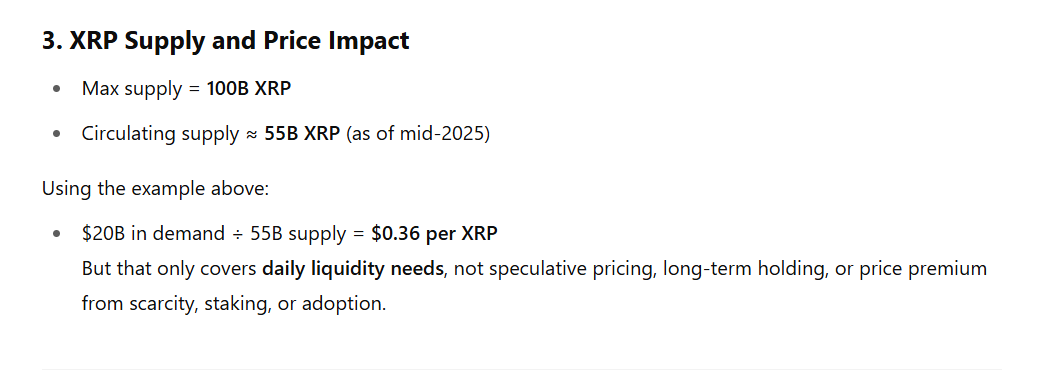
If each XRP moves five times daily, and the volume reaches $100 billion, the system would need $20 billion worth of XRP available at any given time. Spread across the current circulating supply of 55 billion XRP, this creates a base price of around $0.36 per token just to meet liquidity needs.

Here’s What XRP Could Be Worth If It Becomes the Bridge Currency for CBDCs Globally
XRP Base Price ChatGPT

XRP Price if It Bridges CBDCs Globally

However, that is only part of the assessment. According to ChatGPT, that figure does not reflect market dynamics like speculation, holding, or growing scarcity. Taking those into account, ChatGPT projected a range of potential prices. 

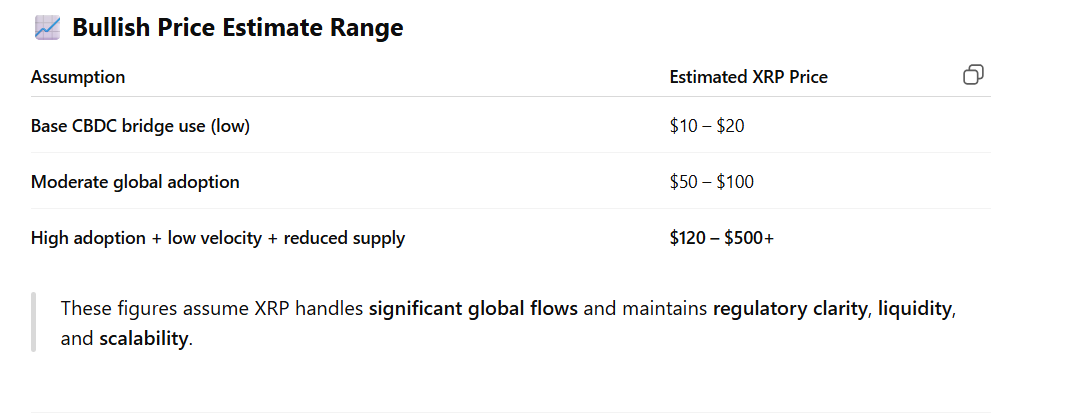
Specifically, with basic adoption as a bridge currency, XRP could rise to somewhere between $10 and $20. If global usage expands and demand for liquidity rises, the price might reach $50 to $100. And if XRP sees wide adoption, lower velocity, and reduced supply, the price could jump to $120 or even cross $500 in the most bullish scenario.

XRP Price if It Bridges CBDCs Globally ChatGPTXRP Price if It Bridges CBDCs Globally ChatGPT
XRP Price if It Bridges CBDCs Globally | ChatGPT

Nonetheless, ChatGPT stressed that all of this depends on factors such as regulatory approval, large-scale adoption, and real-world use working together. While that remains uncertain, the XRPL’s momentum in the CBDC space continues to grow.

Several national banks and global financial bodies already use the XRP Ledger in pilot programs. Ripple has teamed up with countries like Palau, Bhutan, Georgia, and Montenegro. While these projects do not rely on XRP itself, their use of a private ledger similar to the XRPL indicates the network’s appeal for CBDCs.

DisClamier: This content is informational and should not be considered financial advice. The views expressed in this article may include the author’s personal opinions and do not reflect The Crypto Basic opinion. Readers are encouraged to do thorough research before making any investment decisions. The Crypto Basic is not responsible for any financial losses.

Source link

29 06, 2025

$5 Million Closed For Launching Web3 Game On Telegram

By |2025-06-29T19:20:26+03:00June 29, 2025|News, NFT News|0 Comments


Spekter Games, a next-gen game publisher dedicated to building roguelite mobile games with seamless Web3 incentives, announced a $5 million pre-seed funding round and launched its first title, Spekter Agency. The funding round saw participation from prominent investment firms, including a16z speedrun, London Venture Partners, BRV Capital, Chamaeleon, Accelerator Ventures, Impact46, Versus Ventures, and Alumni Ventures.

This funding coincides with today’s official launch of Spekter Games’ first title Spekter Agency, a rogue-lite action game debuting on Telegram. Inspired by breakout hits like Vampire Survivors, Spekter Agency offers addictive, arcade-style gameplay tailored for mainstream audiences, planning to integrate passive blockchain rewards without the complexity associated with Web3 gaming.

Utilizing Telegram’s massive platform of over 1 billion monthly active users, Spekter Agency runs on Telegram’s Mini Apps infrastructure, enabling frictionless onboarding and instant, native gameplay. And Telegram’s built-in wallet capabilities can simplify crypto transactions, drastically reducing the barriers traditionally associated with blockchain gaming and opening it up to a wider audience.

Company founder: Spekter Games was created by industry veteran and serial entrepreneur Taehoon Kim (TK), who brings over 20 years of experience in the gaming industry with multiple exited startups. At his previous company, nWay, TK led the development of real-time, cross-play multiplayer hits like Power Rangers: Legacy Wars and Battle for the Grid, amassing 100+ million downloads. nWay was acquired by Animoca Brands, where TK stayed on to lead Web3 gaming initiative in collaboration with partners like Yuga Labs and Dapper Labs. TK and the Spekter team bring deep expertise in both Web2 and Web3 game development, uniquely positioning them to build games that seamlessly bridge both worlds for mainstream adoption.

How the funding will be used: The funding raised will enable Spekter Games to scale Spekter Agency across additional platforms, including other chat-based super apps and traditional mobile stores like the App Store and Google Play. Plus, the capital will support the ongoing development of the publisher’s second game, already underway.

KEY QUOTES:

“We’re building games that people love for the gameplay, not just the rewards. Web3 incentives can supercharge retention and virality, but they should never get in the way of the fun. By keeping these systems passive and behind the scenes, we’re showing that it’s possible to bring Web3-enhanced games to the mainstream without compromising gameplay.”

Taehoon Kim (TK), CEO and founder of Spekter Games

“We believe there is a real opportunity to improve the early tap-to-earn games on Telegram with deep mechanics that resonate with real gamers. We’re thrilled to back TK and his seasoned team as they push the boundaries of what’s possible in gaming on chat-based super apps.”

Robin Guo, investment partner at a16z speedrun


Source link

29 06, 2025

Shiba Inu and Cardano Price Predictions Leave Investors Nervous, Many Are Joining The Remittix Train After 400% Gains

By |2025-06-29T19:11:20+03:00June 29, 2025|Crypto News, News|0 Comments

keeps growing in its role in the changing payment token market. The project aims to solve a glaring need in global finance by allowing conversions from more than 100 cryptocurrencies to fiat. Its infrastructure lets people who use crypto move money straight into bank accounts, getting beyond the usual problems that come up with cross-border transfers.

Companies that use Remittix Pay will have even more options as they can take crypto payments and settle in local fiat, with more than 50 crypto pairs and 30 fiat currencies to choose from. If current trends continue, Remittix could be in a good position to get a piece of the $250 trillion in cross-border payments that are expected to happen by 2027.

Moreover, Remittix also treats its holders fairly with no taxes on buying or selling the token, so you get to keep everything you make. The project’s security structure is very strong as BlockSAFU has done a comprehensive of Remittix, which eases some investors’ worries. The squad wants to be successful in the long run, not just get out quickly.

Analysts believe Remittix is building a fast-growing crypto payment gateway market that will grow 25% annually. Projects that balance usefulness and compliance may succeed as requirements change and it appears Remittix is pursuing that goal.

Source link

29 06, 2025

Euro to Dollar Forecast: Trader Talk of 1.20 EUR/USD Increases

By |2025-06-29T17:16:24+03:00June 29, 2025|Forex News, News|0 Comments

June 29, 2025 – Written by Ben Hughes

The US Dollar has remained firmly on the defensive with further unease over Federal Reserve policy. There has been further speculation that the Administration will move to undermine central bank independence and aim directly or indirectly to force a near-term cut in interest rates.

The Euro to Dollar (EUR/USD) exchange rate is trading just above 1.1700 from 45-month highs just above 1.1740 reached on Thursday.

EUR/USD has posted seven successive daily gains which will potentially expose the pair to a limited correction.

UoB commented, “Further EUR strength still appears likely, but overbought short-term conditions could slow the pace of any further advance. The next level to monitor is 1.1780.”

ING notes that estimates of EUR/USD fair value have increased to around 1.1450 from 1.10 amid a decline in US yields.

According to the bank; “Geopolitical risk has been radically priced out, and most importantly, FOMC divisions have prompted material dovish speculation. This justifies a more bullish view on EUR/USD, but not necessarily a call for 1.20.

It added; “Markets’ enthusiasm for an earlier Fed cut may be misplaced, and EUR/USD may settle back around 1.15-1.16, awaiting conclusive information on inflation.”


According to Scotiabank; “This week it’s definitely been about the Fed, the prospect of easing sooner and potentially more rate cuts.”

Thursday’s US data recorded a decline in initial jobless claims to 236,000 in the latest week from 246,000 previously while there was a further increase in continuing claims to 1.97mn from 1.94mn and the highest figure since late 2021.

There was a downward revision to first-quarter GDP to -0.5% from -0.2%, but durable goods orders posted a stronger-than-expected increase.

Danske Bank noted; “There was a decent decline in US Treasury yields yesterday as well as a steepening of the yield curve on the back of weaker than expected Q1 GDP numbers from the US as well as speeches from various Federal Reserve officials that are indicating forthcoming easing of monetary policy despite the potential impact from Tariffs.”

There have been further rumours of a near-term move to name a successor to Chair Powell and effectively put a “shadow Fed” in play which would undermine official guidance ahead of May 2026 when Powell’s term as Chair is scheduled to end.

Commonwealth Bank of Australia commented; “The sooner a replacement is announced for Powell, the sooner he could be perceived to be a ‘lame duck’.”

She added; “For now, expectations President Trump will choose a more dovish chair will keep downward pressure on FOMC pricing and the USD.”


The leading contenders for next Fed chief reportedly include former Fed Gov. Kevin Warsh, National Economic Council head Kevin Hassett, current Fed Gov. Christopher Waller, and Treasury Secretary Scott Bessent.

RBC BlueBay Asset Management senior portfolio manager Kaspar Hense noted the risk of a dovish appointment: “This is not currently 100% in the price, and it would still move markets if someone like Hassett or Bessent would get the job in order to cut rates, ignoring fundamental risk.”

He added; “We are short the dollar in this environment, where there is an erosion of institutions.”

SocGen’s Kit Juckes added; “I think the market is pricing in President Trump appointing someone who at least at first sight appears more sympathetic to his cause.”

Scotiabank added; “The result of U.S. asset outperformance over the past decade is you’ve got a lot of asset managers that are long the U.S. dollar way more than I think they’re comfortable.”

Like this piece? Please share with your friends and colleagues:


International Money Transfer? Ask our resident FX expert a money transfer question or try John’s new, free, no-obligation personal service! ,where he helps every step of the way,
ensuring you get the best exchange rates on your currency requirements.

TAGS: Currency Predictions Euro Dollar Forecasts

Source link

29 06, 2025

What is matcha? Why more people are consuming the Japanese powdered green tea

By |2025-06-29T17:13:24+03:00June 29, 2025|Dietary Supplements News, News|0 Comments


Once a meditative Japanese ritual, matcha is now a mainstay in cafés, coolers, cocktails — and culture

Pic/iStock

Your browser doesn’t support HTML5 audio


When Gaijin’s chef-partner Anand Morwani was on a long trip to Japan in 2024, he noticed that the best matcha – the kind used in tea ceremonies in Japan – had this natural sweetness, a sort of umami depth that’s almost broth-like, and had a complete absence of bitterness when handled right. “The aroma is grassy, clean, almost floral. It’s shade-grown, handpicked, stone-milled – it’s cared for like a living thing. You don’t gulp it. You sit with it.”

(From left) Matcha in the making at Mokai: From powder to liquid ritual – beneath the froth is 800 years of tradition. Pics/Kirti Surve Parade

According to Global Info Research’s Global Matcha Supply, Demand and Key Producers, 2023-2029 Report, the global matcha market was valued at approximately USD 5.54 billion in 2023 and is expected to reach USD 11.22 billion by 2032, reflecting a projected CAGR of ~8.2%. Japan’s matcha production surged from 1471 tons in 2010 to 4176 tons in 2023 – an almost 200 per cent increase – primarily driven by export demand. The world is going wild over matcha, and Morwani has mixed feelings about it. “On one hand, I love that people are curious. Matcha deserves attention – it’s complex, it’s rooted in ceremony, and it’s one of the most meditative ingredients I’ve worked with. However, in many cases, it has become a wellness accessory. A green badge of “clean living” And the cultural context gets stripped away. At Gaijin, we offer one cocktail – Midsummer Ritual – that features matcha. We are careful of the representation, but Gaijin is an outsider viewpoint, so you won’t see it in our desserts (currently!),” he explains. The culinary-grade matcha used in lattes, desserts, and ice creams – still good – is made from older leaves, more bitter, and a little more assertive. That bitterness works better in sweets because it cuts through sugar and dairy.

Suraj Gupta

Nooresha Kably, chef-owner of Izumi, Bandra and the Goodwill Ambassador for the Promotion of Japanese Cuisine, appointed by the Japanese government, says, “During my time in Japan, I saw matcha seamlessly woven into everyday life – far beyond the tea ceremony. It popped up everywhere, from soft-serve ice cream and bubble tea to delicate desserts. While some people enjoyed it for its health benefits, others had developed an authentic taste for its nuanced, slightly bitter profile and gentle, grassy fragrance. The traditional chanoyu ceremony, however, left a lasting impression. It felt so sacred, meditative and deeply rooted in Zen culture.

Lonavala’s Fiori’s new matcha menu turns the trend into a sensory story, inspired by Yayoi Kusama’s themes of repetition and layered detail.

Following the herd

As Indian consumers become increasingly informed about the health and wellness benefits of matcha – thanks in part to social media and wellness influencers – there is a clear shift in how it’s being embraced. Tokyo Matcha Bar’s co-founder Meher Kohli shares, “From its impact on skin and hair health to its metabolism-boosting and anti-inflammatory properties, matcha is recognised for more than just being a green tea. Many also turn to it as a calmer alternative to coffee, appreciating its focus-enhancing qualities without the crash. That said, introducing matcha to the Indian palate wasn’t without its challenges. To bridge the unfamiliar, we anchored it in familiarity – starting with drinks like the Fresh Lime Matcha, a twist on a local staple. Seasonal favourites followed: Mango Matcha with milk and ice in the summer and Strawberry or Blueberry Matcha Lattes during the cooler months. These flavour-forward blends made matcha more accessible while staying true to its benefits.

Actress Sanya Malhotra has co-founded Bree Matcha, a wellness brand bringing premium Japanese matcha to India in partnership with Essenzaa Nutrition.

When Mokai launched its full-fledged matcha menu in 2024, it had actually taken them over two years of research, sourcing, and tasting before they landed on the specific blends they now serve. Working with small-batch, limited-quantity producers meant the team had to be precise and strategic in their approach. But over time, they found their rhythm.

Rugved Vartak

Inspired by founder Karreena Bulchandani’s travels across Japan, Singapore, and Hong Kong, Mokai set out to make matcha a true hero on their menu – blending traditional Japanese roots with contemporary flavours like Strawberry Elderflower Matcha to Honey Lavender Matcha. Their strawberry and blueberry matcha, made with in-house syrups is sugar-free, and natural, making it a big hit among the health-conscious. They also have collagen matcha on the menu.

Blondie in Bandra was designed as more than just a café – it’s a space where culture and community intersect. Matcha, says co-founder Natasha Hemani, fits naturally into that vision. “Wellness trends played a role, but we were driven by curiosity and the conviction that matcha, when done right, could challenge the coffee-first model.”

Meher Kohli

The café uses what is called ceremonial-grade matcha sourced from Japan – valued for its vibrant colour and umami-rich taste. “Our rule is simple: if it’s not excellent, it doesn’t make the menu. Margins are tighter, but we offset that with volume from signature drinks and limited drops.” One of those, the Mango Matcha Latte with oat milk, has become a consistent favourite.

Midsummer ritual

Blondie has also leaned on matcha to build identity and engagement. From limited-edition launches to wellness collaborations – such as the Cherry Matcha drop with The Pilates Academy and an upcoming pop-up at Nature Morte gallery – matcha serves as both a product and a platform. “It’s not just a drink. It’s a way to create atmosphere and connect with our audience in a more tactile, lasting way.”

Esha Ashar

In the hills of Lonavala, Fiori’s new matcha menu turns the craze into a sensory story – drawing inspiration from Japanese artist Yayoi Kusama’s themes of repetition, infinity, and layered detail. Founder Suraj Gupta shares how each drink mirrors the artist’s visual language: the Iced Matcha Latte, inspired by No. F, 1959, adds quiet complexity to a classic; the Mango Matcha, a nod to Polka Dots, fuses tropical mango with calming matcha; and the Apple Matcha Cloud, referencing Infinity Nets, balances apple juice and matcha foam in a smooth, gradient sip. For something more introspective, Matcha + Blueberry Jam, drawn from Infinity Mirrors, layers earthy and sweet with quiet restraint. And Matcha and OJ, inspired by Fireflies on the Water, offers a zesty, refreshing burst that’s as bold as it is bright.

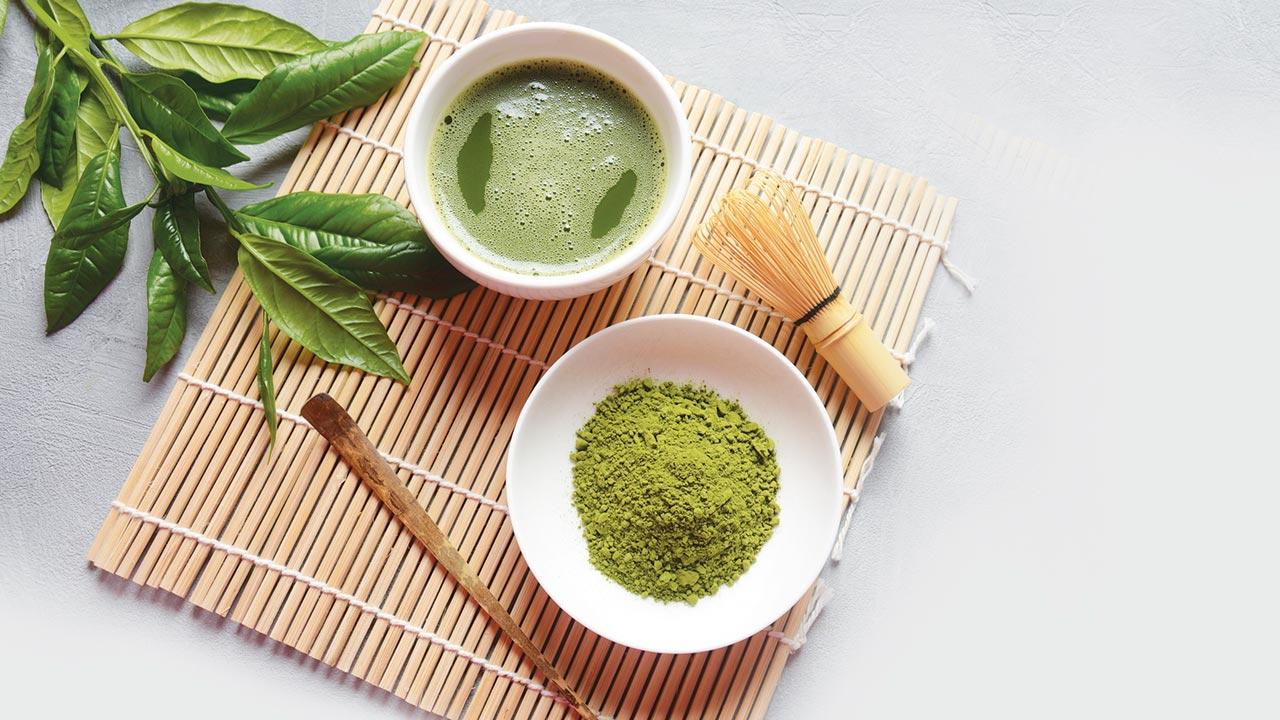
Freshly picked, shade-grown tencha leaves are steamed and dried, then cooled, de-stemmed, de-veined, and stone-ground into the fine, luminous powder we know as matcha. Pics/Yuzen Matcha

Balancing cost

Although Mokai started as a coffee-first space, matcha has steadily gained ground. What was once a 70:30 split between coffee and matcha has now shifted to nearly 50:40, with matcha taking the lead.

Collagen Matcha

“With that growth, our minimum order quantities have naturally gone up. But we remain committed to sourcing limited, high-quality batches from trusted producers in Japan,” says Bulchandani. “That sometimes puts pressure on supply, but we manage it with tight forecasting and safety ordering.”

Karreena Bulchandani

The team hasn’t shied away from investing in premium ingredients. “If the product delivers and customers come back for it, it’s worth the cost. Pricing isn’t just about margins – it’s about reflecting the quality we’re serving.”

Mango matcha

While few customers walk in for a drink alone, the food menu complements the beverage experience and helps even out the numbers. “Matcha performs well, and that plays a key role in our overall profitability,” she adds.

Natasha Hemani

Hemani has seen a significant jump – close to 30 per cent – in the last six months alone. First-grade Japanese matcha is a small-batch product, and with demand surging globally, prices have followed. For us, the focus remains on quality, so instead of compromising, we’ve recalibrated elsewhere – optimising portioning, investing in strong vendor relationships, and keeping transparency with our guests about what makes good matcha worth it.

As a chef, Kably was struck by the precision and quiet reverence of it all. On the practical side, sourcing matcha remains a challenge. “There’s nearly a 50 per cent price difference between grades, and in Japan, it’s straightforward – the higher the price, the better the quality.” To balance cost and quality, a chef uses different matcha grades for tea versus desserts. “Our most popular item is matcha ice cream with grapes and Mirin syllabub – it’s familiar yet unexpected, and people love that contrast.”

Tokyo Matcha Bar sources its matcha from Uji, Japan – one of the world’s most renowned matcha-growing regions. As a matcha-first brand, flavour profile and authenticity are non-negotiable. “Prices have risen nearly 20 per cent since last year due to global demand,” Kohli said. “We’ve built a strong relationship with our farm partner in Japan, who we recently visited – it’s crucial to secure high-quality matcha in today’s climate.”

Despite rising costs, the brand has held back on passing the increase to consumers. “We’re still in the early stages of introducing matcha to the Indian palate. It’s already a premium product, and we don’t want price to become a barrier for first-time drinkers. That said, if the upward trend continues, we may have to reconsider.”

The brand acknowledges that while matcha’s deep cultural roots in Japan are significant, most Indian consumers are currently engaging with it on more casual terms. “It’s still in its ‘fun’ phase – people are curious and want to enjoy it in ways that are accessible and flavourful.” That includes a growing menu of flavoured matcha lattes, seasonal drinks, and inventive desserts like matcha tres leches, matcha soft serve, and their popular matcha-misu. Matcha birthday cakes have also become a cult favourite.

With seasonal menus and a steady stream of product innovations, Tokyo Matcha Bar is positioning itself at the intersection of tradition and trend – making matcha approachable without compromising on quality.

At Food Square, the matcha category has experienced significant growth, with sales increasing from Rs 3 lakhs per month to Rs 10-12 lakhs per month. We offer two grades of matcha: Ceremonial (priced at Rs 32,000- Rs 35,000 per kg) and Culinary (priced at Rs 25,000 per kg). To cater to the growing demand, they’ve expanded our product range to include matcha-infused mochi, bubble tea, latte, chocolate, cookies, and more. We stock matcha products from renowned brands such as Ippodo Tea, Marukyu Koyamaen, Encha, Blueprint, Tea Culture of the World, The Cha House, Sprig, and Urban Platter.

Over the past five years, rising awareness around matcha’s health benefits has driven steady growth, with even the hospitality sector (HORECA) placing orders for events and tasting menus. To meet the varied needs of consumers, Food Square stocks both ceremonial and culinary grades, catering to those who enjoy matcha as a beverage and those who incorporate it into health-focused cooking. Rugved Vartak, category head of Food Square (Landcraft Retail), shares, “Matcha prices have risen by about 10-12 per cent over the past year, in line with global demand. Yet Food Square’s matcha category is growing far faster – projected at 25-30 per cent year-over-year, compared to the global average of around 10 per cent. Much of this momentum is driven by social media trends. We’ve seen a strong wave of first-time users – about 70-75 per cent of buyers – largely influenced by what they see online, but we also see them return, thanks to consistent availability and perceived health benefits.”

Last week, actress Sanya Malhotra co-founded Bree Matcha along with Siddharth Shah and Dr Kunal Shah of Essenzaa Nutrition, a science-backed wellness brand with a presence in over 23 countries. It is organically sourced matcha from the fields of Kagoshima, Japan, where the land is renowned for the best-grown organic matcha. “I started reading about matcha and its benefits. It has less caffeine than coffee and is the only caffeinated drink that contains L-theanine, which relaxes your body and ensures you don’t feel jitters, anxiety, or a subsequent crash. Amid a high-pressure film career, matcha became my grounding force – a daily pause that offered clean energy without the crash. Bree is my way of sharing that ritual with the world – not as an endorsement, but as a co-creator of something truly aligned with me.

Shah says, “We see Bree as a natural evolution in our mission to offer thoughtful health solutions. The cultural and behavioural aspects of this initiative are key. “Bree Matcha is not just a beverage – it’s a movement towards conscious consumption and modern wellness. In a country bursting with ambition, screen time, hustle culture, and hyper-productivity, what’s missing is a ritual that offers clarity without chaos or energy without anxiety. People are looking for more than a boost – they’re seeking balance. Bree Matcha isn’t just energy; it’s Brewed Energy for a balanced Lifestyle.

Elaborating, Dr Shah says, “We want to make matcha a daily ritual in every household. This is why we offer two grades, along with an entire kit: Everyday Matcha, priced at ‘600 (approximately ’20 per serving), and Ceremonial Matcha, which comes from the first harvest and is priced at ‘1600. Our matcha comes from the fertile volcanic soil of Japan, making it ideal for organically grown matcha. Our entire sourcing process is entirely transparent and organic-certified.

When Esha Ashar first explored India’s matcha landscape, what stood out wasn’t the hype – it was the gap. “Most of what was available was either overpriced or inauthentic,” she says. That disconnect became the foundation for YÅ«zen, a brand rooted in precision, tradition, and clarity.

The name itself comes from YÅ«zen-zome, a traditional Japanese dyeing technique known for its meticulous, hand-rendered detail. “It’s an artisanal process where every stroke matters – that’s exactly how I wanted to approach matcha,” she explains. The kanji adds another layer: (yÅ«) for friendship, (zen) for calm. “That’s what tea should be – connection and stillness.”

YÅ«zen also sources its matcha from Uji, the birthplace of Japanese tea culture, which spans the prefectures of Kyoto, Nara, Mie, and Shiga. With over 800 years of tradition, Uji sets the global benchmark for matcha quality. Mineral-rich volcanic soil, high altitude, and misty microclimates shape a terroir that produces unmatched depth, umami, and complexity. “This isn’t commodity tea,” says Ashar. “It’s crafted, not manufactured.”

Rejecting generic labels like “ceremonial” and “culinary,” YÅ«zen classifies its blends – such as Sakura, Itsuki, and Kokoro – based on flavour profile, texture, aroma, and intended use. This stripped-down, transparent approach gives buyers clarity and control while maintaining uncompromising Uji-grade quality across every price point.

As a B2B brand, YÅ«zen’s focus is twofold: partnering only with cafés that prioritise quality and care and making authentic matcha more accessible in India. “Matcha isn’t just a ritual – it’s a functional, high-performance ingredient,” she says. With its high levels of EGCG and L-theanine, matcha offers calm, sustained energy – bridging ancient tradition with modern wellness. With over 50 matcha varieties across first and second harvests, YÅ«zen provides clarity through clearly defined grades, each based on cultivar, processing, harvest timing, and origin. “We believe in helping partners make informed choices – balancing quality with budget without compromising transparency.”

Thanks to long-term partnerships with a trusted Japanese farm cooperative, YÅ«zen has remained steady despite global supply issues. This network allows them to maintain year-round consistency in both quality and volume – a key advantage for their B2B clients.

India remains YÅ«zen’s clear priority, even as global interest – particularly from Europe – continues to grow. “We’re excited about what’s ahead, but India
is where we’re building something significant,” says the Ashar. “We want to grow slowly, thoughtfully, and with the right partners.”

This month, YÅ«zen is hosting a tea tasting at Kitchen Garden’s Palladium launch, showcasing Japanese teas alongside educational insights. It follows their May sourcing trip to Japan, with another visit planned for October to deepen relationships with partner farms.

While the current matcha trend in India is primarily driven by curiosity and aesthetics, YÅ«zen sees a deeper cultural alignment. “The Indian palate already values tea. With time and education, matcha appreciation will follow. We’re not here to ride the wave – we’re here to shape a more informed, enduring journey rooted in context, history, and quality.”

30%
Average increase in matcha prices in the last six months

200%
increase in matcha production in 13 years, driven by global demand

Rs 1,600
average retail price per 30 gms of first harvest matcha

Rs 600
average retail price of everyday matcha (approxR20 per serving)

Pic/iStock

True Green Gold

Esha Ashar of Yuzen matcha visits their partner farms in Japan every year during the first harvest, with the next sourcing trip set for October. “Matcha is deeply seasonal,” says Ashar. “To truly understand it, you need to be there – on the farms, in the process, with the people behind it.”

First-harvest matcha, concentrated with nutrients from the winter dormancy, commands a premium. The second harvest offers a more accessible alternative. “You can’t compare matcha to coffee or tea,” she adds. “It’s a category of its own – seasonal, labour-intensive, and rooted in terroir.”

The process reflects that care: Three to four weeks of shade cultivation boost chlorophyll and amino acids. Only the youngest, most vibrant leaves are handpicked, then steamed, dried, and carefully sorted to remove stems and veins. The resulting tencha is stored cold, then stone-ground into a fine, vibrant powder, capturing purity in every step.





Source link

29 06, 2025

XRP Set to Reach $4,813 by 2030, Valhil Capital Predicts in Bold Valuation Study

By |2025-06-29T17:10:11+03:00June 29, 2025|Crypto News, News|0 Comments

A deep-dive valuation study by Valhil Capital suggests XRP could reach a fair market value from $4,813 to $9,000 by 2030.

This bold price projection draws from increasing adoption and XRP’s dual role as a transaction medium and store of value. This estimate emerges from one of the firm’s simulated models—the Athey & Mitchnick Model. Notably, this model integrates economic theory, real-world assumptions, and digital asset market behaviors to forecast XRP’s fair value.

Unlike typical transaction-based pricing models, the Athey & Mitchnick Model assigns far greater weight to XRP’s store of value function. The model explores how increased adoption of XRP for cross-border payments and foreign exchange transactions can kickstart a virtuous cycle:

First, price increases lead to more holders storing XRP, which reduces the supply available for transactions. In turn, this further fuels demand and price appreciation.

XRP Fair Values at $908, $4,813, and $9,000

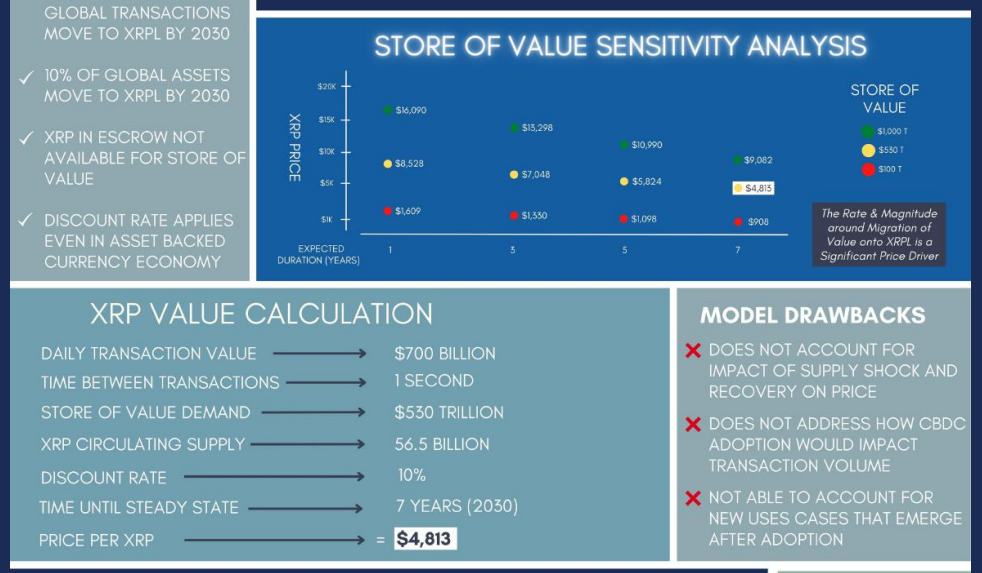
According to the model, store-of-value demand could reach $530 trillion. Even a conservative adoption scenario assuming 10% of global transactions utilize XRP Ledger (XRPL) by 2030 results in the $4,813 price forecast. The mechanics behind the model include:

  • $700 billion in daily transaction value
  • One-second transaction speed
  • 56.5 billion XRP circulating supply
  • 10% discount rate
  • five-year adoption horizon (by 2030)

Meanwhile, the sensitivity analysis shows that if store-of-value demand reaches even higher levels, like $1 quadrillion, XRP’s price could climb well beyond $9,000 under certain assumptions. Notably, based on $100 trillion demand, the unit price of XRP could be $908.

XRP Set to Reach ,813 by 2030, Valhil Capital Predicts in Bold Valuation Study
XRP fair value under the Athey Mitchnick Model

Exponential Growth via the Virtuous Cycle Flywheel

Notably, the model focuses on what the researchers refer to as the Virtuous Cycle Flywheel. This cycle begins with increased adoption, which drives up transaction-based demand. As prices rise, users are incentivized to hold XRP, removing supply from circulation. 

The reduced liquidity further drives price increases, creating a feedback loop. New use cases emerge, generating even more demand for XRP. 

According to Valhil’s findings, this self-reinforcing cycle could lead to exponential price growth, especially if adoption reaches tipping points in major sectors such as global remittances and foreign exchange settlements.

Conservative Yet Ambitious

Interestingly, Valhil Capital describes the model as conservative because it excludes large-scale markets like derivatives and real estate. 

However, the model does acknowledge its limitations, such as the inability to predict future use cases or the impact of CBDC adoption. Still, the outcome highlights the significant value that could be unlocked if XRP achieves mass adoption.

With the bold targets, Valhil Capital’s simulation paints a compelling vision of XRP as more than a fast payment solution but one that could become a critical digital store of value in the global financial system. 

DisClamier: This content is informational and should not be considered financial advice. The views expressed in this article may include the author’s personal opinions and do not reflect The Crypto Basic opinion. Readers are encouraged to do thorough research before making any investment decisions. The Crypto Basic is not responsible for any financial losses.

Source link

29 06, 2025

How Creatine May Help Bone Density When Paired With Exercise

By |2025-06-29T15:12:32+03:00June 29, 2025|Dietary Supplements News, News|0 Comments


For the exercise component, we can look to research for ideas: The women in the 2015 study completed three sessions of whole-body resistance training a week. In each session, they completed three sets of 10 reps of weighted moves (think squats, hamstring curls, bench presses), adding more weight as they progressed. If you’re new to weightlifting, this is a solid protocol to start with, but find a routine that works best for you. This guide can help you get started.


Source link

Go to Top