The main category of Crypto News.
You can use the search box below to find what you need.
[wd_asp id=1]
The main category of Crypto News.
You can use the search box below to find what you need.
[wd_asp id=1]
Ted Hisokawa
Dec 21, 2025 11:37
MATIC price prediction shows potential 18-37% upside to $0.45-$0.52 range by January 2026, though immediate resistance at $0.58 must break for bullish continuation.
• MATIC short-term target (1 week): $0.36-$0.40 range (-5% to +5%)
• Polygon medium-term forecast (1 month): $0.35-$0.45 range with potential breakout
• Key level to break for bullish continuation: $0.58 resistance
• Critical support if bearish: $0.35 with final support at $0.33
The latest MATIC price prediction from analysts reveals a cautiously optimistic consensus despite current market weakness. CoinCodex maintains a conservative short-term target of $0.1141, representing only a 2.33% monthly gain, reflecting the prevailing bearish sentiment with the Fear & Greed Index at 20 (Extreme Fear).
However, MEXC News presents a more bullish Polygon forecast, targeting the $0.45-$0.52 range for medium-term gains of 18-37%. This prediction aligns with multiple analyst views that see MATIC recovering to historical support levels around $0.45 by January 2026, provided the token maintains critical support at $0.35.
The consensus among prediction models suggests that while immediate prospects remain challenging, the medium-term outlook for Polygon shows promise if key technical levels hold.
The current Polygon technical analysis reveals a cryptocurrency positioned at a critical juncture. Trading at $0.38, MATIC sits just above the immediate support level of $0.35, with the RSI at 38.00 indicating neither oversold nor overbought conditions.
The MACD histogram showing -0.0045 confirms bearish momentum persists, while the price position within Bollinger Bands at 0.29 suggests MATIC is trading in the lower portion of its recent range. However, this positioning could indicate oversold conditions that often precede reversals.
Volume analysis from Binance shows $1.07 million in 24-hour trading, which remains relatively low and suggests consolidation rather than aggressive selling pressure. The daily ATR of $0.03 indicates controlled volatility, creating potential for measured moves in either direction.
The moving average structure tells a compelling story: while MATIC trades below all major moving averages (SMA 20 at $0.43, SMA 50 at $0.45), the proximity to these levels suggests potential resistance-turned-support scenarios if buying pressure emerges.
The bullish MATIC price target of $0.45-$0.52 becomes achievable if several technical conditions align. First, MATIC must reclaim the SMA 20 at $0.43, which would signal initial bullish momentum. The critical breakthrough level remains at $0.58, where strong resistance has formed.
Should buyers push MATIC above $0.58, the path opens toward the upper Bollinger Band at $0.56 initially, followed by the more ambitious targets around $0.52. This scenario requires volume expansion and RSI moving above 50 to confirm momentum shift.
The bullish case strengthens if broader cryptocurrency markets recover, as Polygon’s utility in the DeFi and gaming sectors could drive demand. Historical support at $0.45 represents a logical first target, offering approximately 18% upside from current levels.
Bearish scenarios for Polygon center on the breakdown of the $0.35 support level. Should this critical support fail, the next major level sits at $0.33, representing the strong support identified in technical analysis.
A break below $0.33 could trigger further selling toward the 52-week low of $0.37, though this level has already been tested. The bearish case gains strength if the RSI drops below 30 into oversold territory while volume increases, suggesting capitulation selling.
Risk factors include continued broader market weakness, regulatory concerns affecting DeFi protocols, and potential competition from other Layer 2 solutions that could pressure Polygon’s market position.
The current technical setup suggests a cautious approach to buying MATIC. Conservative investors should wait for confirmation above $0.43 (SMA 20) before establishing positions, with initial targets at $0.45.
More aggressive traders might consider accumulating near current levels around $0.38, but must implement strict risk management with stop-losses below $0.35. Position sizing should remain modest given the uncertain technical picture.
A dollar-cost averaging approach makes sense for longer-term investors, as the medium-term Polygon forecast suggests eventual recovery to the $0.45-$0.52 range. However, any purchases should be made with the understanding that a test of $0.35 support remains possible.
Entry strategy should focus on the $0.36-$0.38 range for initial positions, with additional buying planned if MATIC retests $0.35 support successfully.
The MATIC price prediction for the coming months shows cautious optimism despite current technical weakness. While short-term prospects remain challenging with bearish momentum indicators, the medium-term outlook suggests potential recovery to the $0.45-$0.52 range by Q1 2026.
Key indicators to monitor for prediction validation include RSI movement above 50, MACD histogram turning positive, and most critically, whether MATIC can break above the $0.58 resistance level. Failure to hold $0.35 support would invalidate the bullish scenario and suggest deeper correction toward $0.33.
The timeline for this prediction spans 1-3 months, with confidence level assessed as MEDIUM based on the technical setup and analyst consensus. Investors should prepare for volatility while positioning for potential medium-term recovery in Polygon’s price trajectory.
Image source: Shutterstock
The SEC earlier this year dropped its appeal against Ripple, a fintech company that uses XRP to facilitate fast and cheap cross-border transactions.
Ripple CEO Brad Garlinghouse estimates that the XRP blockchain will capture 14% of the transaction volume currently handled by the SWIFT system within five years.
The SEC recently approved several spot XRP ETFs that should encourage adoption by eliminating friction associated with cryptocurrency exchanges.
Geoffrey Kendrick at Standard Chartered Bank estimates XRP (CRYPTO: XRP) will reach $8 in 2026. His forecast, which implies 315% upside from the current price of $1.90, is based on the idea that increased regulatory clarity and the recent approval of spot XRP ETFs will boost adoption.
While I agree in principle — those tailwinds could certainly drive XRP’s price higher — the forecast itself seems overly optimistic, especially when XRP has actually fallen 7% year to date despite the Trump administration’s support for the broader cryptocurrency industry. I think a more reasonable target is $3 in 2026, which implies about 58% upside.
Where to invest $1,000 right now? Our analyst team just revealed what they believe are the 10 best stocks to buy right now. Continue »
Here’s what investors should know about XRP.
Image source: Getty Images.
In 2020, the Securities and Exchange Commission (SEC) filed a lawsuit against Ripple for allegedly selling XRP as an unregistered security. In 2023, a U.S. district court issued a split ruling, determining direct sales to institutional investors were illegal, but programmatic sales (through exchanges) to retail investors were not.
The SEC initially appealed the ruling, but more recently dropped the appeal. The situation reflects the Trump administration’s broader push to support the cryptocurrency industry. For instance, President Trump earlier this year signed an executive order that created a national digital asset stockpile. He also nominated cryptocurrency advocate Paul Atkins as SEC chairman.
Here’s the big picture: The SEC’s decision to drop its appeal against Ripple may encourage XRP adoption among investors and financial institutions because a legal headwind has been eliminated. Additionally, the Trump administration’s policies could reinforce the trend by treating digital assets as a legitimate component of the U.S. financial system.
XRP is the native digital asset on the XRP Ledger, a blockchain designed to support fast and cheap cross-border transactions. The SWIFT messaging system is currently the industry standard in wire transfers, but settlement times are longer and transaction fees are higher. In short, XRP is a bridge currency that resolves those pain points.
Like any asset, XRP’s price will rise as demand rises. One potential catalyst is that fintech company Ripple uses XRP to provide payment services to financial institutions, and Ripple CEO Brad Garlinghouse recently predicted the XRP blockchain would capture 14% of SWIFT’s payment volume (equivalent to $20+ trillion) within five years.
In that scenario, demand for XRP could push its price much higher. But Garlinghouse’s prediction seems too optimistic. It makes no sense to use a volatile cryptocurrency to move money when stablecoins exist. And while Ripple has addressed that problem by introducing the stablecoin Ripple USD (CRYPTO: RLUSD), it competes with better established options like Circle‘s USDC.
Here’s the big picture: Despite legal headwinds clearing and the regulatory environment improving, XRP monthly transaction volume has steadily declined over the last two years. That suggests neither XRP nor RLUSD is gaining significant traction as a bridge currency, and I doubt that will change in the future.
In November, several spot XRP ETFs started trading on U.S. markets, including one product launched by Franklin Templeton, which ranks among the 25 largest money managers in the world by AUM. Those funds may encourage adoption by removing friction associated with traditional cryptocurrency exchanges, such as high fees and the headache of managing multiple accounts.
Indeed, Bitcoin‘s price has increased 90% since spot Bitcoin ETFs were approved in January 2024, so it stands to reason XRP could see material price appreciation as spot XRP ETFs unlock demand. In that context, I think XRP’s price could increase 58% to $3 (more or less) in the next year.
Here’s the big picture: The recent approval of spot XRP ETFs is the most compelling reason to want XRP exposure. XRP is the fifth-largest cryptocurrency by market value, which means it’s probably one of the digital assets in which institutional investors are most interested. Demand from that well-capitalized group could send XRP’s price higher. But I still have far more confidence in Bitcoin, so I would keep any position in XRP (or a spot XRP ETF) rather small.
Before you buy stock in XRP, consider this:
The Motley Fool Stock Advisor analyst team just identified what they believe are the 10 best stocks for investors to buy now… and XRP wasn’t one of them. The 10 stocks that made the cut could produce monster returns in the coming years.
Consider when Netflix made this list on December 17, 2004… if you invested $1,000 at the time of our recommendation, you’d have $509,039!* Or when Nvidia made this list on April 15, 2005… if you invested $1,000 at the time of our recommendation, you’d have $1,109,506!*
Now, it’s worth noting Stock Advisor’s total average return is 972% — a market-crushing outperformance compared to 193% for the S&P 500. Don’t miss the latest top 10 list, available with Stock Advisor, and join an investing community built by individual investors for individual investors.
*Stock Advisor returns as of December 21, 2025.
Trevor Jennewine has no position in any of the stocks mentioned. The Motley Fool has positions in and recommends Bitcoin and XRP. The Motley Fool recommends Standard Chartered Plc. The Motley Fool has a disclosure policy.
The views and opinions expressed herein are the views and opinions of the author and do not necessarily reflect those of Nasdaq, Inc.
The recent approval of spot XRP ETFs could be a significant catalyst for the cryptocurrency.
Geoffrey Kendrick at Standard Chartered Bank estimates XRP (XRP 0.45%) will reach $8 in 2026. His forecast, which implies 315% upside from the current price of $1.90, is based on the idea that increased regulatory clarity and the recent approval of spot XRP ETFs will boost adoption.
While I agree in principle — those tailwinds could certainly drive XRP’s price higher — the forecast itself seems overly optimistic, especially when XRP has actually fallen 7% year to date despite the Trump administration’s support for the broader cryptocurrency industry. I think a more reasonable target is $3 in 2026, which implies about 58% upside.
Here’s what investors should know about XRP.
Image source: Getty Images.
In 2020, the Securities and Exchange Commission (SEC) filed a lawsuit against Ripple for allegedly selling XRP as an unregistered security. In 2023, a U.S. district court issued a split ruling, determining direct sales to institutional investors were illegal, but programmatic sales (through exchanges) to retail investors were not.
The SEC initially appealed the ruling, but more recently dropped the appeal. The situation reflects the Trump administration’s broader push to support the cryptocurrency industry. For instance, President Trump earlier this year signed an executive order that created a national digital asset stockpile. He also nominated cryptocurrency advocate Paul Atkins as SEC chairman.
Here’s the big picture: The SEC’s decision to drop its appeal against Ripple may encourage XRP adoption among investors and financial institutions because a legal headwind has been eliminated. Additionally, the Trump administration’s policies could reinforce the trend by treating digital assets as a legitimate component of the U.S. financial system.
XRP is the native digital asset on the XRP Ledger, a blockchain designed to support fast and cheap cross-border transactions. The SWIFT messaging system is currently the industry standard in wire transfers, but settlement times are longer and transaction fees are higher. In short, XRP is a bridge currency that resolves those pain points.
Like any asset, XRP’s price will rise as demand rises. One potential catalyst is that fintech company Ripple uses XRP to provide payment services to financial institutions, and Ripple CEO Brad Garlinghouse recently predicted the XRP blockchain would capture 14% of SWIFT’s payment volume (equivalent to $20+ trillion) within five years.
In that scenario, demand for XRP could push its price much higher. But Garlinghouse’s prediction seems too optimistic. It makes no sense to use a volatile cryptocurrency to move money when stablecoins exist. And while Ripple has addressed that problem by introducing the stablecoin Ripple USD (RLUSD +0.00%), it competes with better established options like Circle‘s USDC.
Here’s the big picture: Despite legal headwinds clearing and the regulatory environment improving, XRP monthly transaction volume has steadily declined over the last two years. That suggests neither XRP nor RLUSD is gaining significant traction as a bridge currency, and I doubt that will change in the future.
In November, several spot XRP ETFs started trading on U.S. markets, including one product launched by Franklin Templeton, which ranks among the 25 largest money managers in the world by AUM. Those funds may encourage adoption by removing friction associated with traditional cryptocurrency exchanges, such as high fees and the headache of managing multiple accounts.
Indeed, Bitcoin‘s price has increased 90% since spot Bitcoin ETFs were approved in January 2024, so it stands to reason XRP could see material price appreciation as spot XRP ETFs unlock demand. In that context, I think XRP’s price could increase 58% to $3 (more or less) in the next year.
Here’s the big picture: The recent approval of spot XRP ETFs is the most compelling reason to want XRP exposure. XRP is the fifth-largest cryptocurrency by market value, which means it’s probably one of the digital assets in which institutional investors are most interested. Demand from that well-capitalized group could send XRP’s price higher. But I still have far more confidence in Bitcoin, so I would keep any position in XRP (or a spot XRP ETF) rather small.
A major macroeconomic dynamic has undergone a major shift, with the BOJ raising rates just days after the U.S lowered rates. Analysts expect these changes to influence the investment landscape, especially for risk assets such as stocks and crypto, and it may already be happening.
Institutional investors have already begun adjusting their Bitcoin price prediction to account for the recent economic changes.
Recent reports revealed that Cathy Woods dropped her 2030 Bitcoin price prediction from $1.5 million to $1.2 million. Standard Chartered previously predicted that Bitcoin would rally to $300,000 in 2026, but the bank has lowered that prediction by half to $150,000.
Citi reportedly slashed its 12-month Bitcoin price prediction from $181,000 to $143,000. This suggests the banks are less optimistic about Bitcoin’s long-term prospects based on macro liquidity conditions. Especially after the BOJ’s rate hike announcement this week.
The overall market prediction was that the BOJ would announce a rate hike. The Japanese central bank confirmed this on Friday, revealing it was raising rates by 25 basis points.
Interestingly, the Bitcoin USD price chart experienced a rally on the same day that the BOJ announced the rate hike. A contrary outcome to the expected downside.
BTC price traded above $88,000 at press time after recovering from below the $86,000 price tag on Thursday.
The uptick aligned with the idea that the Bitcoin price downside in the last few months priced in the BOJ’s policy change. Some believe that the slight uptick on Friday suggests that some investors bought back after the dip.
On the other hand, this could signal that the market might be faking an uptrend before it extends its downside. One thing was for sure. The actual event did not have much of a negative impact, but the rate hike could still lead to the Yen carry trade unwind.
But if the BOJ’s rate cut was priced in, then Bitcoin might have an easier time recovering. The banks may have just revised their Bitcoin price prediction, but their predictions remained positive, though lower, likely due to the liquidity impact.
Bitcoin exchange reserves may offer a snapshot of the current market sentiment. The amount of BTC on exchanges surged considerably between 11 December and 18 December.
This meant that investors moved their BTC to exchanges in anticipation of a BOJ-induced downside.
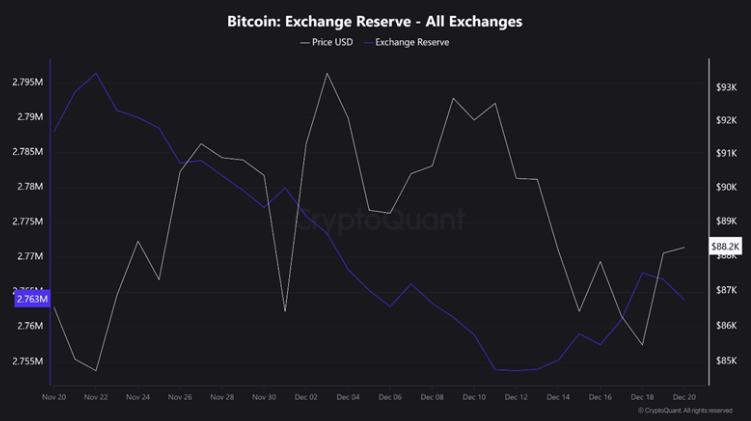
Interestingly, Bitcoin exchange outflows surged in the last 2 days. This suggests growing conviction that the downside risk may have passed for now.
A glance at whale activity revealed a mixed bag of reactions, suggesting a lack of consensus on whether the bearish trend was over. This uncertainty was also backed by expectations that the BOJ’s rate cut would undermine recovery attempts.
In other words, there was still significant uncertainty around BTC’s prospects in early 2021. Especially now that major institutional investors have revised down their Bitcoin price predictions.
The slight weekend rally might be a calm before the storm. Bitcoin could still risk downside given the heightened uncertainty now that the BOJ has raised rates. On the other hand, the already discounted price may continue to attract investors.
Bitcoin institutional activity in the coming days may shed more light on BTC’s next move. If
BTC ETFs embark on aggressive buys, then this could signal more recovery ahead. A contrary outcome may set the backdrop for more bearish price action.
The crypto market has been quite shaky recently, pushing volatility to the roof. This week alone, Bitcoin performed two dead-cat bounces between December 17th and 18th.
The shaky price action, as a result, has pushed investors out of the market amid strong indecisiveness. In tandem, the crypto market cap has fallen to a level last seen in April 2025.
But investors have not given up on crypto yet. They are now eyeing the Solana price prediction moving forward and searching for potential low-cap, high upside cryptocurrencies.
With traders and degens hunting for the next breakout crypto, DeepSnitch AI has emerged as the top crypto with a 100x moonshot prediction for 2026.
DeepSnitch AI utilizes AI agents to provide you with actionable market data, helping you make life-changing crypto investment decisions. This coin is currently in its 3rd out of 15 presale rounds, selling at $0.02903, with close to $1 million raised.
Recent data shows that investors are pulling their capital out of the crypto market amid strong volatility. As a result, the total crypto market cap (TOTAL) dropped to $2.93 trillion on Friday, December 19. This level was last seen in April 2025, marking an 8-month low.

Back then, the crypto market crashed to $2.4 trillion before rebounding strongly to above $4 trillion in October. However, profit-taking and indecisiveness weighed down on the market, which has since dropped 33% from an all-time high of $4.4 trillion.

Nonetheless, the market now seems to have found support and is hedging higher. Crypto market analyst Michaël van de Poppe, however, warns of a potential Bitcoin capitulation alongside a 10% or 20% plunge for altcoins if the market cascades further.
“Wouldn’t be surprised if $BTC continues to cascade and gets itself into a form of capitulation in the next 24 hours, as the trend clearly is down. That would mean -10/20% move on #Altcoins,” he wrote.
However, the analyst suggests that this could be the last washout before a parabolic surge in Bitcoin. Poppe cited potential Bank of Japan news could stir a crypto market recovery. If that happens, Solana price prediction for 2026-2030 could flip bullish.
DeepSnitch AI (DSNT) is an AI-powered protocol that hands you market intel and signals previously enjoyed by crypto whales and insiders. The new project, rumored to launch in January 2026, offers retail traders utility like none other. This has seen traders and degens label it as a 100x token.
Leveraging five AI agents, DeepSnitch AI snoops whale movements, sentiment shifts, and FUD, before it reflects on the prices. This information is delivered directly to you via Telegram or X, giving you an upper hand in the market.
Three out of five AI agents are already live. They include SnitchScan, SnitchFeed, and SnitchGPT. All these agents make sure that you receive timely and accurate crypto data, such as Solana ecosystem updates, before they trigger a price surge.
At the moment, DeepSnitch AI is in the 3rd out of 15 presale rounds. The DSNT token is priced at $0.02903, with close to $1 million raised. This shows strong demand from degens and traders alike.
As you await a clear Solana price prediction, you can jump into DeepSnitch AI to have full early access to its five AI agents and an opportunity to get into a cheaper alternative with 100x potential before its rumored January 2026 launch.
Latest data on TradingView shows that Solana found support around $120 before rebounding. As of December 19, Solana was trading at $124.68, having surged slightly from the support zone.

While SOL still sits at an 8-month low, the price could face a strong rebound from the current level. Upon breaching the resistance at this level in April, the coin surged to $254 in mid-September 2025.
Traders expect a similar move going into 2026, as SOL recovery analysis shows a potential 102% surge to the mid-September high. Crypto trader ‘Lstrader’ expressed bullishness in his recent Solana price prediction.
He suggested that SOL could climb back above $145 in the next few days. If that happens, Solana bullish trends may push the coin above $200 in 2026 and potentially into a new all-time high price towards 2030.
Monad (MON) has emerged as a top trending coin. The crypto project solves the challenges faced between decentralization and scalability by delivering high performance without compromising on decentralization or security.
The project boasts 10,000 transactions per second with a block time of 0.4 seconds and 800ms finality. Monad provides infrastructure for complex applications while maintaining near-zero gas fees. This, alongside the project becoming the first to launch TGE on Coinbase, has pushed the native coin, MON, into the spotlight.
Solana price prediction for 2026-2030 shows a potential bullish price action with SOL recovery analysis suggesting a climb above $145 in the near future. SOL could also achieve a new all-time high with a move above $295 (current ATH) by 2030. However, clear Solana bullish trends must emerge for such a rally to materialize.
On the contrary, DeepSnitch AI (DSNT) tops the 100x rally list with real utility, low cap, and growing investor demand. At just $0.02903 per token, you can own a coin with strong long-term potential. DeepSnitch is rumored to launch in January 2026 on major tier 1 and tier 2 crypto exchanges.
Before January 1st, you can use the code DSNTVIP50 to get a 50% bonus on DSNT purchases above $2,000. Even better, you can attain a 100% bonus on purchases above $5,000 by using the code DSNTVIP100.
Visit the DeepSnitch AI website for more information, and join X and Telegram for community updates.

Solana can reach $1,000 somewhere in the future, possibly by 2030, if not before. However, the recent Solana price prediction shows that the coin could end the year above $145 if bulls take control of the market. For a much cheaper 100x alternative coin in 2026, you can consider DeepSnitch AI, currently priced at only $0.2903.
Solana has the potential to rally in 2026 alongside the general crypto market, according to SOL recovery analysis. As an alternative with much higher ROI potential, you can look at DeepSnitch AI, which is rumored to launch in January 2026 and is speculated to surge by 100x its current presale price of $0.02903.
With the right strategy, Solana can make you a millionaire, but in the very long run, or if you have a significant investment. Strong Solana ecosystem updates may drive the coin into a bullish spree. On the other hand, if you buy DeepSnitch AI at $0.2903 in its ongoing presale, you stand a chance to reap a 100x ROI just in 2026 when the token launches on major tier 1 and tier 2 exchanges.
Ethereum’s price movement has captured attention as ETHUSD climbs by 5.28%, currently trading at $2975.94. This surge reflects a robust momentum in the crypto market, driven by the latest technical indicators and market sentiment. Explore the potential paths Ethereum could take in the near future.
Ethereum USD (ETHUSD) has experienced a notable increase, rising by 5.28% to reach $2975.94. This positive momentum follows a day low of $2964.43 and a day high of $2992.98. Despite the recent upbeat movement, volume remains below average at 60,319,202, compared to the typical 316,144,252, suggesting cautious interest among traders.
The Relative Strength Index (RSI) of ETHUSD is currently at 37.00, indicating a closer approach to an oversold condition, which could signal a potential turnaround. However, the MACD displays a bearish signal with a reading of -117.63 against a MACD signal of -114.70. The ADX stands at 37.87, suggesting a strong trend, while the Awesome Oscillator shows weak momentum at -159.42. The Bollinger Bands are set with a lower bound at $2708.84, indicating potential volatility.
In the coming months, Ethereum’s price is forecasted to average around $2644.67, with a quarterly projection of $3457.34. Looking further ahead, the yearly target is approximately $3367.76, and by five years, ETHUSD could reach up to $4809.89. This growth reflects ongoing market optimism and technological developments within Ethereum’s ecosystem.
Recent news has spotlighted Ethereum amidst broader crypto market discussions. With Bitcoin and XRP showing struggles, Ethereum’s recent surge highlights its potential resilience in the volatile crypto market. News of potential all-time highs next year could further drive investment interest, though forecasts remain subject to change due to macroeconomic shifts and regulatory impacts.
Ethereum’s current trajectory suggests a positive outlook, with a potential break above significant resistance levels. However, forecast changes are possible due to evolving market conditions. Keeping an eye on both technical indicators and macroeconomic signals will be crucial for understanding Ethereum’s future movements.
Ethereum’s price has risen by 5.28%, reaching $2975.94, indicating positive momentum in the market as of the latest data input date of December 20, 2025.
The RSI is at 37.00, indicating that ETHUSD is nearing oversold conditions, which could suggest a potential price rebound if the trend continues downward.
Short-term forecasts suggest that Ethereum may average around $2644.67 in the coming months, with potential growth if market conditions improve further.
Recent news about Ethereum’s potential to reach new highs next year has contributed to positive market sentiment. However, actual outcomes will depend on future market and regulatory developments.
Yes, long-term forecasts are optimistic, with estimates suggesting that Ethereum could reach $4809.89 in five years. However, these projections depend on market stability and technological advancements in Ethereum’s ecosystem.
Disclaimer:
Cryptocurrency markets are highly volatile. This content is for informational purposes only.
The Forecast Prediction Model is provided for informational purposes only and should not be considered financial advice.
Meyka AI PTY LTD provides market data and sentiment analysis, not financial advice.
Always do your own research and consider consulting a licensed financial advisor before making investment decisions.
In recent trading sessions, XRP has shown notable resilience, holding near the $1.90–$1.95 range despite macroeconomic headwinds, including Japan’s recent interest rate adjustment.
During Asian trading hours, the token briefly dipped toward $1.80 but recovered swiftly, reflecting both retail and institutional support. As of December 20, the XRP price today hovered around $1.92–$1.94, with market participants closely monitoring whether renewed liquidity and sustained inflows can support a broader recovery phase.
The Japanese rate hike briefly weighed on risk assets across Asia, yet XRP crypto demonstrated relative strength compared with some peers. TradingView analyst subhikarkar55, who tracks short-term liquidity zones, noted that XRP recovered quickly following the policy move: “XRP today has recovered even though Japan has raised rates,” he said, adding that short-term volatility could still push the price toward $1.8577 before liquidity-driven upside resumes.
XRP recovers to $1.92 despite Japan’s rate hike, with a potential dip to $1.8577 before bouncing toward $2.07. Source: subhikarkar55 on TradingView
From a technical perspective, XRP charts suggest that buyers continue to defend the mid-$1.80 zone. The analyst identified $2.0735 as a near-term recovery level if liquidity conditions improve, aligning with broader observations of improving market depth.
Institutional activity around XRP spot ETFs has been a key driver of market attention. According to SoSoValue data shared by technical analyst ChartNerd, six consecutive weeks of net inflows pushed total net assets to approximately $1.14 billion.

XRP shows a hidden bullish divergence as 6 weeks of Spot ETF inflows push total net assets to $1.14B. Source: @ChartNerdTA via X
“The uncommon divergence between the declining price and the vertical climb in total net assets is what we would call a hidden bullish divergence,” ChartNerd explained.
ETF inflows are often viewed as a proxy for institutional positioning rather than retail speculation. While short-term price movements remain range-bound, this trend may indicate longer-term interest and structural support for XRP.
Renewed optimism has also emerged within the XRP community, with visual comparisons drawn between current price structures and XRP’s historic 2017 breakout. Crypto commentator Steph Is Crypto highlighted similarities between past and present consolidation phases: “$XRP is about to explode, just like it did in 2017. Buckle up!”

XRP may surge again, echoing its 2017 breakout; traders are gearing up for potential explosive momentum. Source: @Steph_iscrypto via X
The comparison references XRP’s surge from fractions of a cent to its all-time high near $3.84 during the 2017 bull cycle. However, market structure, liquidity conditions, and regulatory clarity today differ significantly from those of that period. Ripple’s resolution of SEC tensions has provided more confidence to institutional investors, but risks remain.
XRP’s recent price action reflects a market attempting to balance improving structural signals with ongoing macro uncertainty. Steady XRP spot ETF inflows, relative resilience after Japan’s rate move, and support near the mid-$1.80 range suggest longer-term interest in XRP remains intact. Analysts emphasize that short-term XRP price movements continue to depend heavily on liquidity conditions, Bitcoin trends, and broader macro developments.

XRP was trading at around 1.94, up 3.17% in the last 24 hours at press time. Source: XRP price via Brave New Coin
While comparisons to past bull cycles and institutional accumulation provide a constructive backdrop, XRP price forecasts remain cautious rather than conclusive. The near-term focus is on whether XRP can hold above the $1.85–$1.90 support zone and attract sufficient volume to challenge levels above $2. Until clearer confirmation emerges, market participants continue weighing data-driven signals against the inherent volatility of the crypto market.
Timothy Morano
Dec 20, 2025 13:33
MATIC price prediction suggests 18-37% upside potential to $0.45-$0.52 range if Polygon breaks key $0.58 resistance, with critical support holding at $0.35 level.
Polygon (MATIC) finds itself at a critical juncture as technical indicators paint a complex picture for the layer-2 scaling solution. Trading at $0.38, MATIC sits 70% below its 52-week high of $1.27, presenting both opportunity and risk for investors seeking clear direction.
• MATIC short-term target (1 week): $0.41 (+8%) – Testing EMA resistance
• Polygon medium-term forecast (1 month): $0.45-$0.52 range (+18-37%)
• Key level to break for bullish continuation: $0.58 resistance
• Critical support if bearish: $0.35 immediate, $0.33 strong support
The latest MATIC price prediction from analysts reveals a striking divergence in market sentiment. MEXC News analysts project a medium-term Polygon forecast targeting $0.45-$0.52, representing potential gains of 18-37% within 4-6 weeks. This optimistic outlook hinges on MATIC’s ability to break above the crucial $0.58 resistance level while maintaining support above $0.35.
Contrasting sharply, WEEX Crypto News presents a bearish MATIC price prediction, forecasting a decline to $0.095450 in the short term. This represents a potential 75% drop from current levels, driven by persistent bearish sentiment and a Fear & Greed Index reading of 26, indicating extreme fear in the market.
Long-term projections from KuCoin analysts suggest a more ambitious Polygon forecast, with MATIC price targets ranging from $0.75-$1.25, potentially reaching $1.00 by late 2025. This bullish scenario depends heavily on increased layer-2 adoption and favorable regulatory developments.
Current Polygon technical analysis reveals MATIC trading below all major moving averages except the 7-day SMA ($0.37). The price sits at $0.38, just above the 52-week low of $0.37, suggesting strong support in this region. The RSI reading of 38.00 indicates neutral momentum, neither oversold nor overbought, providing room for movement in either direction.
The MACD histogram at -0.0045 shows bearish momentum, though the relatively small negative value suggests weakening selling pressure. MATIC’s position within the Bollinger Bands at 0.29 indicates the price is closer to the lower band ($0.31) than the upper band ($0.56), suggesting potential for mean reversion toward the middle band at $0.43.
Volume analysis shows $1.07 million in 24-hour trading on Binance, relatively modest for MATIC, indicating consolidation rather than decisive directional moves. The daily ATR of $0.03 reflects contained volatility, typical of accumulation phases.
The optimistic MATIC price prediction scenario targets the $0.45-$0.52 range, aligning with analyst projections. For this Polygon forecast to materialize, MATIC must first reclaim the $0.42-$0.43 zone (EMA 26 and SMA 20), establishing it as support rather than resistance.
A successful break above $0.45 (SMA 50) would open the path toward the critical $0.58 resistance level. This MATIC price target represents the make-or-break point for bulls, as clearing this level could trigger momentum toward the Bollinger Band upper limit at $0.56 and potentially higher.
The bullish case strengthens if Bitcoin and Ethereum maintain stability, as layer-2 solutions like Polygon often benefit from increased network activity during crypto market recoveries.
The bearish MATIC price prediction centers on a break below the $0.35 support level, which could trigger rapid descent toward $0.33 and potentially the extreme target of $0.095450 suggested by pessimistic analysts.
Key risk factors include continued macro headwinds, regulatory uncertainty affecting layer-2 protocols, and potential competition from emerging scaling solutions. A break below the 52-week low at $0.37 would invalidate the current consolidation pattern and suggest deeper correction ahead.
Based on current Polygon technical analysis, a scaled entry approach appears prudent. Consider initial positions near current levels ($0.38) with additional accumulation on any dips toward $0.35 support.
Entry Strategy:
– Conservative entry: $0.35-$0.36 range (support zone)
– Aggressive entry: Current levels around $0.38
– Stop-loss: $0.32 (below strong support at $0.33)
– Target 1: $0.45 (medium-term MATIC price target)
– Target 2: $0.52 (optimistic scenario)
Risk management remains crucial given the mixed signals. Position sizing should reflect the medium confidence level in current predictions, with stops placed below key support levels to limit downside exposure.
Our MATIC price prediction leans cautiously optimistic for the medium term, targeting the $0.45-$0.52 range within 4-6 weeks, representing 18-37% upside potential. This Polygon forecast assumes successful defense of the $0.35 support and eventual break above $0.43 resistance.
The key question for whether to buy or sell MATIC hinges on the $0.58 resistance level. A decisive break above this threshold would validate the bullish MATIC price prediction, while failure to hold $0.35 support would favor the bearish scenario.
Confidence Level: Medium – Mixed technical signals and divergent analyst views suggest cautious optimism while monitoring key levels for confirmation. The timeline for this prediction spans the next 4-6 weeks, with critical inflection points expected around year-end as crypto markets establish 2026 trends.
Image source: Shutterstock
December 20, 2025 — XRP is attempting to claw back the psychologically important $2.00 level after a volatile week for crypto markets, with traders weighing steady U.S. spot XRP ETF inflows against signs that large holders may still be selling into strength.
As of this morning in the U.S., XRP was trading around $1.94 with roughly $1.90 billion in 24-hour trading volume, according to CoinDesk’s price tracker. [1]
XRP’s price action over the last 48 hours has been defined by a sharp dip, a quick rebound, and a renewed fight just under $2.00:
That puts XRP in a familiar posture for December: “close enough” to $2.00 to keep breakout traders interested, but not convincingly above it long enough to force broad repositioning.
Several themes dominated XRP coverage on December 20, 2025, and they point to the same underlying tension: strong institutional-style demand signals, but a spot market that still struggles to trend.
A key story today is that U.S. XRP exchange-traded funds have continued to attract inflows, pushing combined assets to about $1.2 billion, per Crypto Briefing’s aggregation of issuer and tracker data. [5]
That matters for two reasons:
A separate analysis today argued that while ETF flows have been impressive, real adoption signals—payments volume, on-chain settlement, and Ripple’s ecosystem growth—may be more important to sustained upside than ETF headlines alone. [6]
The takeaway: ETFs can amplify demand, but they don’t automatically solve the bigger question—whether XRP’s role as a payments/liquidity asset is expanding fast enough to absorb supply when rallies appear.
Technical coverage published today highlighted local resistance around $1.96 and suggested that a close near that area could increase the odds of a push to $2.00. [7]
In other words, the chart watchers are aligned on a simple framework: reclaim $2.00 decisively or risk another fade back into the mid-$1.8s.
The most important “why” behind XRP’s current price behavior may be this: demand and supply can both be strong at the same time.
Some market commentary today explicitly points to selling pressure from large holders as a key reason the price hasn’t responded more aggressively. [9]
Even if you discount the most sensational takes, the broader point holds: ETF inflows don’t exist in a vacuum.
There’s also a practical market-structure issue: when $2.00 becomes a “magnet” level, it can attract short-term trading, not just long-term accumulation—meaning rallies can be sold quickly if conviction is weak.
XRP’s December moves aren’t happening in isolation. This week’s crypto rebound has been tied to shifting expectations around inflation and rate cuts—but commentary from mainstream market coverage has stressed that the reaction has been erratic.
Barron’s reported that crypto—including XRP—bounced after U.S. inflation data, but analysts cautioned that sellers still appeared to be in control and macro uncertainty remained elevated. [10]
That matters for XRP because:
Even in late 2025, XRP remains unusually sensitive to regulation and “market access” stories, for one simple reason: those headlines directly influence who can buy and how they can buy.
Reuters reported earlier this year that the SEC and Ripple agreed to end the long-running lawsuit, leaving a $125 million fine intact and concluding one of crypto’s most watched legal battles. [11]
That legal clarity has been widely treated as a structural positive for XRP’s U.S. accessibility.
Multiple reports in recent weeks described U.S. spot XRP ETFs as a major milestone, with coverage noting a first approval and launch in November 2025. [12]
By December 20, the market’s key question isn’t whether ETFs exist—it’s whether ETF demand can outpace the supply being sold into rallies.
Another Ripple-related regulatory development came from the banking side. Reuters reported on December 12, 2025 that Ripple was among crypto firms receiving preliminary approval from the OCC to establish national trust banks, a move viewed as further integrating digital assets into the U.S. financial system. [13]
While not an “XRP price catalyst” by itself, the story reinforces the broader theme: institutional rails are expanding, which tends to keep XRP in institutional watchlists.
Today’s analysis across outlets converges on a few straightforward levels and signals:
One risk for bulls is that XRP’s rebound is occurring alongside comments that trading activity/volume can fade even as price rises, which can make breakouts less durable. [16]
Forecasting XRP is inherently uncertain—especially after a year marked by sharp swings. Still, today’s forecast landscape has two clear layers: algorithmic short-term projections and narrative-driven longer-term outlooks.
Several widely used prediction pages show XRP expectations clustered close to current levels over the next few days/weeks—generally small moves rather than explosive targets:
These models may be useful as sentiment indicators, but they are not guarantees—and different methodologies often disagree.
Mainstream investing commentary published today emphasized themes rather than precise numbers, pointing to:
The gap between these “catalyst outlooks” and the relatively flat short-term model forecasts captures the market’s current mood: investors may believe the long-term story is improving, but they still want price confirmation.
For readers tracking XRP into year-end, the most important near-term signals are straightforward:
1. www.coindesk.com, 2. www.coindesk.com, 3. www.investing.com, 4. www.investing.com, 5. cryptobriefing.com, 6. cryptoslate.com, 7. u.today, 8. cryptobriefing.com, 9. coinpedia.org, 10. www.barrons.com, 11. www.reuters.com, 12. finance.yahoo.com, 13. www.reuters.com, 14. u.today, 15. www.investing.com, 16. u.today, 17. www.binance.com, 18. coincodex.com, 19. www.fool.com, 20. www.nasdaq.com, 21. u.today, 22. cryptobriefing.com, 23. coinpedia.org, 24. www.barrons.com
Bitcoin (BTCUSD) surged to $88,092.65 today, marking a significant 3.08% increase and highlighting its potential march towards $92,000. Let’s delve into the factors driving this upward momentum and analyze the technical indicators to predict what might come next.
Bitcoin’s current price of $88,092.65 represents an increase of $2,632.63 or 3.08% in just one day. The volume stood at 709,215,822, surpassing the average of 598,293,187, indicating heightened trading activity. This sharp rise positions BTCUSD steadily towards the psychological barrier of $92,000.
Analyzing the technical indicators, Bitcoin’s RSI is at 36.33, suggesting it’s approaching oversold conditions. Meanwhile, the MACD shows a histogram of 90.94, indicating bullish momentum. With an ADX of 39.19, the current trend strength is solid. Importantly, the Bollinger Bands show resistance levels at the upper limit of $94,762.08, offering a target for bullish traders.
Market forecasts suggest a potential monthly target of $91,771.03, with quarterly predictions reaching as high as $137,052.42. These forecasts, however, emphasize caution due to possible macroeconomic shifts or regulatory changes that could affect market conditions. Meyka AI provides these insights, showcasing how AI analytics contribute to precise market predictions.
Looking back, Bitcoin’s yearly high was $126,296. Current momentum reflects an 18.43% increase year-to-date, highlighting a recovery trajectory since its annual low of $74,420.69. Despite historical volatility, BTCUSD’s current recovery phase appears robust.
Bitcoin’s recent surge brings it within striking distance of $92,000. However, cautious optimism is advised given potential market fluctuations. Keep an eye on volume and trend indicators for potential shifts, and remember, forecasts can change due to macroeconomic conditions or unexpected events in the crypto space.
The current BTCUSD price is $88,092.65, reflecting a 3.08% increase today with a change of $2,632.63 from the previous close of $85,460.02. BTCUSD
Key indicators include an RSI of 36.33, a MACD histogram of 90.94, and an ADX of 39.19, suggesting a strong trend and potential for further growth toward the Bollinger upper band of $94,762.08.
Monthly forecasts suggest a price of $91,771.03, with quarterly predictions reaching $137,052.42. However, these forecasts are subject to change based on macroeconomic conditions and developments in the crypto market.
BTCUSD has increased by 18.43% year-to-date, recovering from a yearly low of $74,420.69 to current levels near $88,000, reflecting ongoing strength despite past volatility.
Factors include macroeconomic shifts, regulatory changes, and unexpected global events that may alter market conditions. It’s essential to track these elements as they can significantly sway Bitcoin’s price trajectory.
Disclaimer:
Cryptocurrency markets are highly volatile. This content is for informational purposes only.
The Forecast Prediction Model is provided for informational purposes only and should not be considered financial advice.
Meyka AI PTY LTD provides market data and sentiment analysis, not financial advice.
Always do your own research and consider consulting a licensed financial advisor before making investment decisions.