The main category of Forex News.
You can use the search box below to find what you need.
[wd_asp id=1]
The main category of Forex News.
You can use the search box below to find what you need.
[wd_asp id=1]
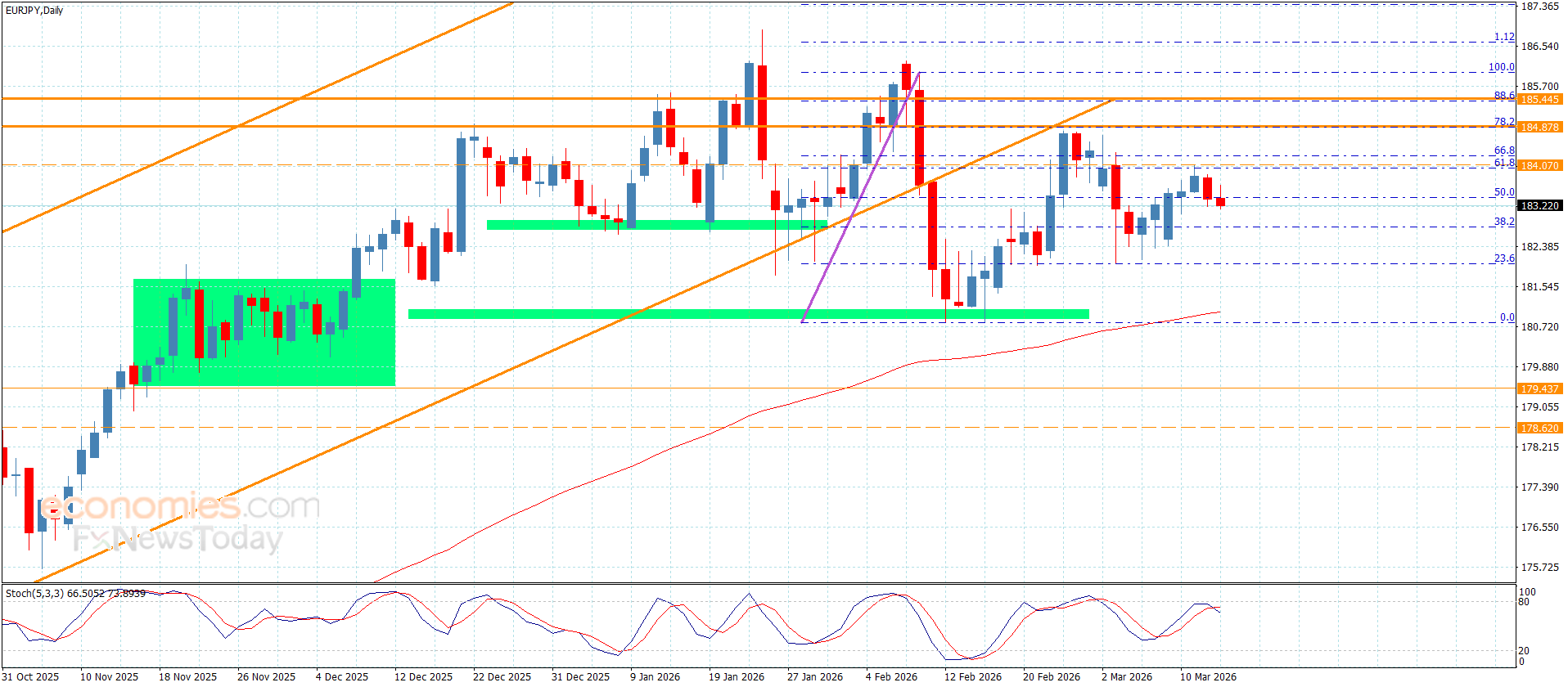
The EURJPY pair is affected by the stability at 184.40 barrier in the last period, which forces it to form new negative trading, approaching the initial negative target at 182.90 as appears in the above image.
Note that stochastic stability below 80 level might push the price to provide more negative trading, to attempt to target 182.45 level reaching %23.6 Fibonacci correction level near 182.00, while its rally again above 184.40 will confirm its move to the bullish track, to attempt to achieve several gains by its rally towards 184.80 and 185.45.
The expected trading range for today is between 182.00 and 183.65
Trend forecast: Fluctuated within the bearish trend
The EURJPY pair is affected by the stability at 184.40 barrier in the last period, which forces it to form new negative trading, approaching the initial negative target at 182.90 as appears in the above image.
Note that stochastic stability below 80 level might push the price to provide more negative trading, to attempt to target 182.45 level reaching %23.6 Fibonacci correction level near 182.00, while its rally again above 184.40 will confirm its move to the bullish track, to attempt to achieve several gains by its rally towards 184.80 and 185.45.
The expected trading range for today is between 182.00 and 183.65
Trend forecast: Fluctuated within the bearish trend
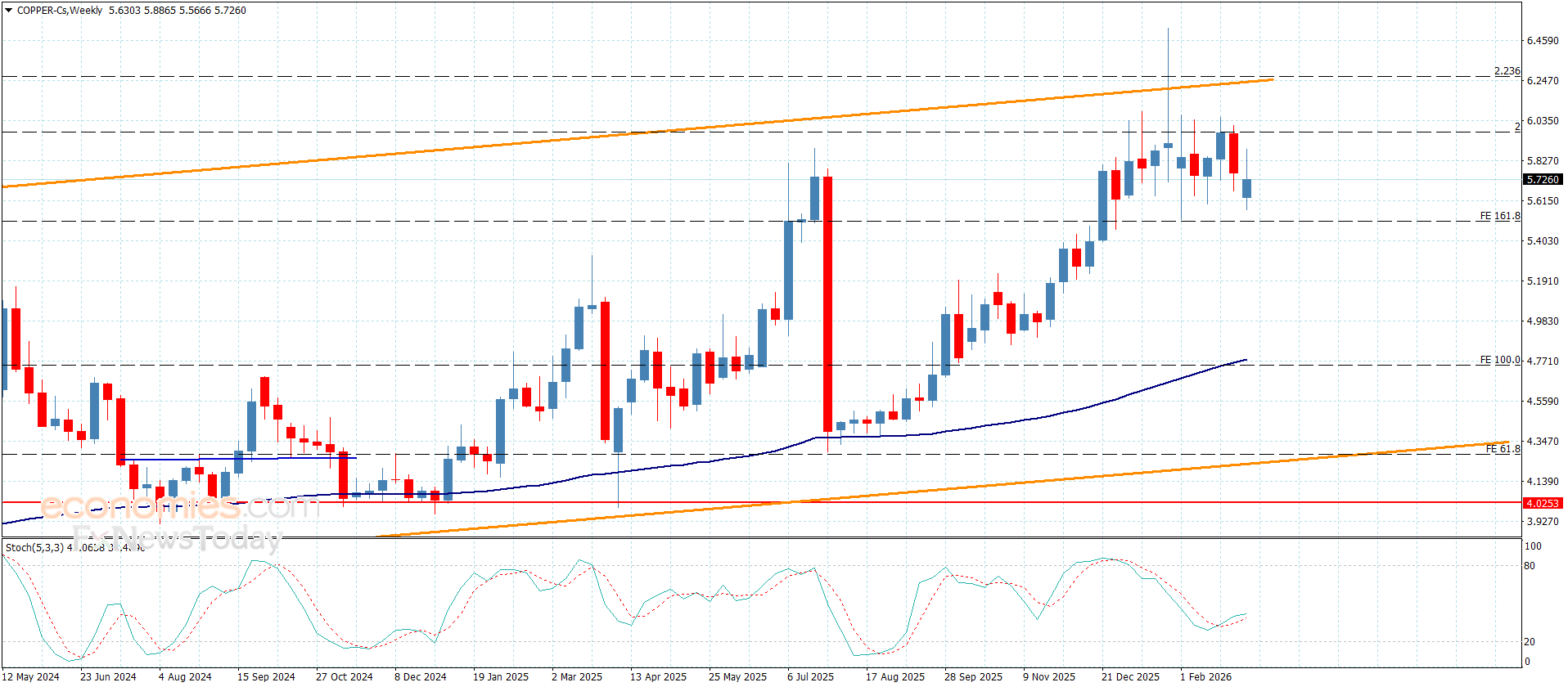
Copper price remains affected by the contradiction of the main indicators, which forces it to provide slow negative trading, to fluctuate near $5.7200, where gathering negative momentum makes us expect forming bearish waves, to attempt to reach the corrective stations at $5.6200, to press on the extra support near $5.5100, forming a key to detect the main trend in the upcoming trading.
While regaining the bullish trend requires forming strong bullish rally to settle above $5.9700 level, to begin targeting new positive stations by its rally towards $6.1200.
The expected trading range for today is between $5.6200 and $5.8200
Trend forecast: Bearish
The Canadian dollar continues to see a lot of momentum against the Japanese yen overall, as oil drives this pair higher.
The Canadian dollar dropped a bit against the Japanese Yen in early trading on Thursday but then turned around to show signs of life.
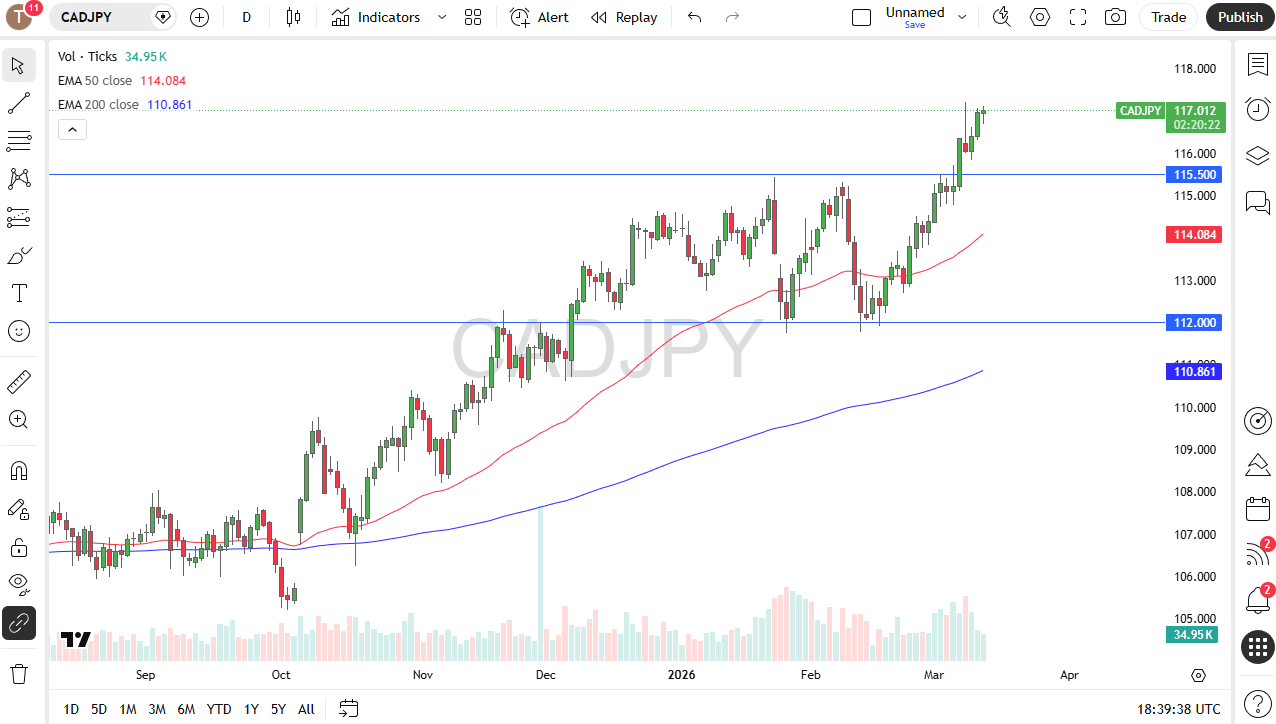
The market is currently hanging around the 117 Yen level, an area that I think is important as it is a large round psychologically significant figure and an area that a lot of traders will be watching due to the fact that markets do tend to be very technical when all else fails.
Keep in mind that the oil market is important to watch and as oil continues to be very strong it does make a certain amount of sense that money goes into the Canadian dollar especially against the Japanese Yen which represents an economy that number 1 has a central bank that can’t tighten monetary policy and therefore interest rates will remain low.
But we also have to keep in mind that the Japanese import 100% of their crude oil and therefore it is one of the best trades that I know of that you can do to take advantage of oil rallying, as this is such a clean set up for those looking to trade oil without the danger of futures.
The 115.50 Yen level underneath is a significant support level based by the previous resistance. We had been consolidating between 112 Yen and 115.5 Yen and that suggests a 250 pip move.
That would have the Canadian dollar reaching the 118 Yen level before it’s all said and done. There’s nothing on this chart that suggests to me that it can’t happen and therefore I think short-term pullbacks are buying opportunities that we can take advantage of in a market that has a lot of momentum.
Ready to trade our CAD Forex forecast? Here’s some of the top trading account in Canada to check out
Christopher Lewis has been trading Forex and has over 20 years experience in financial markets. Chris has been a regular contributor to Daily Forex since the early days of the site. He writes about Forex for several online publications, including FX Empire, Investing.com, and his own site, aptly named The Trader Guy. Chris favours technical analysis methods to identify his trades and likes to trade equity indices and commodities as well as Forex. He favours a longer-term trading style, and his trades often last for days or weeks.
Copper price remains affected by the contradiction of the main indicators, which forces it to provide slow negative trading, to fluctuate near $5.7200, where gathering negative momentum makes us expect forming bearish waves, to attempt to reach the corrective stations at $5.6200, to press on the extra support near $5.5100, forming a key to detect the main trend in the upcoming trading.
While regaining the bullish trend requires forming strong bullish rally to settle above $5.9700 level, to begin targeting new positive stations by its rally towards $6.1200.
The expected trading range for today is between $5.6200 and $5.8200
Trend forecast: Bearish
The GBP/USD pair attracts heavy selling during the first half of the European session on Friday and dives back closer to mid-1.3200s, or the year-to-date low touched last week, in reaction to the disappointing UK macro data. Figures from the UK Office for National Statistics (ONS) showed that the economy stagnated in January, compared to a 0.1% increase recorded in the previous month and market estimates for a 0.2% growth.
Other data showed that Industrial Production declined by 0.2% in January, while Manufacturing Production rose 0.1% during the reported month. The backward-looking data comes on top of heightened uncertainties over conflicts in the Middle East, which could have a ripple effect on economies around the world. This, in turn, weighs heavily on the British Pound (GBP), which, along with sustained US Dollar (USD) buying, exerts additional downward pressure on the GBP/USD pair.
Investors now seem worried that the recent surge in energy prices would rekindle inflation and force the US Federal Reserve (Fed) to delay cutting interest rates. The outlook remains supportive of elevated US Treasury bond yields and assists the USD to attract buyers for the fourth straight day. Furthermore, the global flight to safety benefits the safe-haven buck, pushing the USD Index (DXY), which tracks the Greenback against a basket of currencies, to its highest level since November 2025.
The global risk sentiment remains fragile amid a further escalation of geopolitical tensions in the Middle East and the risk of a prolonged US-Israel campaign against Iran. Meanwhile, Iran’s new supreme leader, Mojtaba Khamenei, warned during his first public statement that all US military bases in the region should be immediately closed or will be attacked. He further added that attacks against US bases in the region would continue, even though Iran believes in goodwill with its neighbors.
US President Donald Trump, on the other hand, said that stopping the evil empire in Iran was of greater importance to him than Oil prices. Adding to this, supply disruption fears due to the closure of the Strait of Hormuz keep Crude Oil prices near the $100 psychological mark. This might continue to benefit the Greenback, suggesting that the path of least resistance for the GBP/USD pair is to the downside. Traders now look forward to the crucial US inflation data for a fresh impetus.
The US Personal Consumption Expenditure (PCE) Price Index – the Fed’s preferred inflation gauge – is due for release later during the North American session. Friday’s US economic docket also features Durable Goods Orders, JOLTS Job Openings, and the Preliminary Michigan Consumer Sentiment and Inflation Index. The immediate market reaction to the data is more likely to be short-lived as the market focus remains glued to geopolitical developments, which favors the USD bulls.
The recent repeated failures near the 200-period Exponential Moving Average (EMA) on the 4-hour chart and the subsequent fall underscore a downside bias within a broader corrective phase. The Moving Average Convergence Divergence (MACD) indicator slips deeper into negative territory with the line below its signal and a mildly expanding negative histogram, signalling strengthening selling pressure.
The Relative Strength Index near 32 stays below the 50 midline and approaches oversold territory, aligning with persistent downward momentum even as the risk of a corrective bounce increases. Any attempted recovery, however, might confront initial resistance at the 1.3350 area, where recent intraday highs converge with the first meaningful recovery pivot. A break above this zone would open the way toward 1.3420 and then the 1.3480 region closer to the 200-period EMA.
On the downside, immediate support is located around 1.3230, guarding the path toward the 1.3180 level as the next bearish target if sellers extend control. A sustained hold below 1.3350 keeps rallies capped and preserves the short-term bearish structure on the 4-hour chart, as reflected by the EMA.
(The technical analysis of this story was written with the help of an AI tool.)
Important DisclaimersFXEmpire is owned and operated by Empire Media Network LTD., Company Registration Number 514641786, registered at 7 Jabotinsky Road, Ramat Gan 5252007, Israel. The content provided on this website includes general news and publications, our personal analysis and opinions, and materials provided by third parties. This content is intended for educational and research purposes only. It does not constitute, and should not be interpreted as, a recommendation or advice to take any action, including making any investment or purchasing any product. Before making any financial decision, you should conduct your own due diligence, exercise your own discretion, and consult with competent advisors. The content on this website is not personally directed to you, and we do not take into account your individual financial situation or needs. The information contained on this website is not necessarily provided in real time, nor is it guaranteed to be accurate. Prices displayed may be provided by market makers and not by exchanges. Any trading or other financial decision you make is entirely your own responsibility, and you must not rely solely on any information provided through the website. FXEmpire does not provide any warranty regarding the accuracy, completeness, or reliability of any information contained on the website and shall bear no responsibility for any trading losses you may incur as a result of using such information. The website may include advertisements and other promotional content. FXEmpire may receive compensation from third parties in connection with such content. FXEmpire does not endorse, recommend, or assume responsibility for the use of any third-party services or websites. Empire Media Network LTD., its employees, officers, subsidiaries, and affiliates shall not be liable for any loss or damage resulting from your use of the website or reliance on the information provided herein.Risk DisclaimersThis website contains information about cryptocurrencies, contracts for difference (CFDs), and other financial instruments, as well as about brokers, exchanges, and other entities trading in such instruments. Both cryptocurrencies and CFDs are complex instruments and involve a high risk of losing money. You should carefully consider whether you understand how these instruments work and whether you can afford to take the high risk of losing your money. FX Empire encourages you to conduct your own research before making any investment decision and to avoid investing in any financial instrument unless you fully understand how it works and the risks involved.
The , along with its European peers, is extending losses on Thursday as oil prices jump again, fuelling concerns about a potential supply shock and rising inflationary pressures amid the war in the Middle East.
climbed back above $100 a barrel after fuel tankers were attacked in the Persian Gulf and as the conflict between Iran and US-Israeli forces appeared far from being resolved.
Europe, which is heavily reliant on oil imports, could see inflation climb if crude prices remain elevated for an extended period, adding pressure to already lacklustre regional growth.
Prior to the Iran war, the ECB was expected to leave interest rates unchanged this year. However, money markets are now pricing in an ECB rate hike by July, with an 85% probability of another increase by December.
Economically sensitive banks are leading the sector lower, while ongoing geopolitical concerns are supporting defence stocks.
BMW is falling 2.3% after the carmaker forecast that pretax earnings will decline moderately this year and that deliveries will stagnate.
There is no major eurozone or German data due to be released today. The US economic calendar is also quiet, so developments surrounding the Middle East conflict will likely be the key market driver.
After running into resistance at 25,400, the DAX rebounded lower, breaking below its 50 and 200 SMA and its multi-month rising trendline, falling to a low of 22,700. The taking out of these key supports, combined with the RSI below 50, keeps sellers hopeful of further declines.
Immediate support is at 23,400. A break below here opens the door to 22,900, the November low, and 22,700, the 2026 low. A break below here creates a lower low.
Buyers would need to rise above 24,000 to create a more stable footing, and 24,200 to the 200 SMA.
is falling for a third straight day as gilt yields rise and the US dollar benefits from safe-haven flows. BoE Governor Andrew Bailey is due to speak.
The is extending gains toward its 2026 highs amid volatile oil prices, stoking inflation worries that could prompt the Federal Reserve to reassess the need for . The dollar is also supported by its safe-haven appeal and by the US’s status as a net energy exporter.
Oil markets have remained volatile even after the International Energy Agency agreed to release a record 400 million barrels of oil from strategic stockpiles. However, markets are not convinced that this will stabilise prices.
Meanwhile, the pound is under pressure as gilt yields rise to a 6.5-month high. Rising oil prices are stoking concerns over inflationary pressures. The Bank of England, which was previously expected to cut rates this month, may instead be forced to hike rates before the end of the year.
The aggressive repricing of BoE rate-cut expectations is providing some support to GBP.
Traders will now look to Bank of England Governor Andrew Bailey’s speech later today for further insight into the outlook for rates, along with the monthly UK figures due tomorrow. For now, the focus will remain on geopolitical developments and concerns over the war-driven surge in energy prices and inflationary pressures.
GBP/USD ran into resistance at 1.3870, rebounded lower, broke below the near-term rising trendline, 50, and 200 SMA, and reached a low of 1.3250. The price recovered from this low but failed to rise above the 200 SMA, keeping the bearish bias in place.
Sellers will look to take out support at 1.3350 and 1.3250, the 2026 low, to create a lower low and extend the bearish move towards 1.32 and 1.30.
Buyers would need to rise above the 200 SMA at 1.3450 to create a higher high and exposes the 50 SMA at 1.3530.
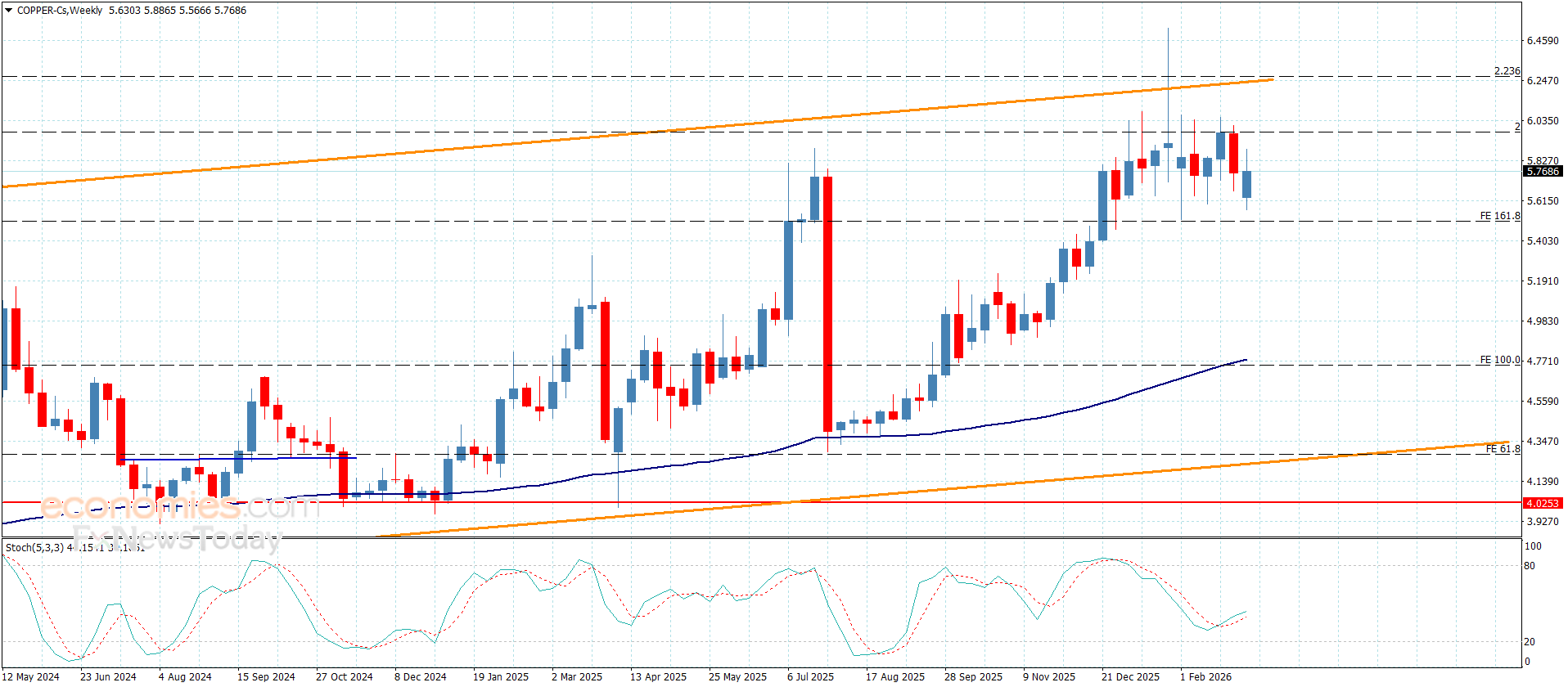
Copper price repeatedly provided negative closes below $5.9700 barrier, confirming the continuation of the suggested bearish correction, to fluctuate near $5.7600.
Gathering negative momentum is important to motivate forming new bearish waves, to ease the mission of reaching towards the initial stations that are located near $5.6200 and $5.5100.
The expected trading range for today is between $5.6200 and $5.8200
Trend forecast: Bearish