The main category of Forex News.
You can use the search box below to find what you need.
[wd_asp id=1]
The main category of Forex News.
You can use the search box below to find what you need.
[wd_asp id=1]
– Written by
David Woodsmith
STORY LINK Pound to Dollar Forecast: GBP Jumps to 10 Day Highs as Oil Prices Slide
The Pound to Dollar exchange rate (GBP/USD) surged to 10-day highs above 1.3480 as a sharp correction in global oil prices improved risk sentiment and curbed safe-haven demand for the US dollar.
Sterling benefited from easing energy fears after comments from US President Donald Trump suggesting the Iran conflict could end soon, while a strong rally in UK government bonds also helped stabilise the Pound after recent volatility.
After finding support below the 1.3300 on Monday, the Pound to Dollar (GBP/USD) exchange rate rallied to 10-day highs above 1.3480 on Tuesday before settling above 1.3450.
There is likely to be selling interest above 1.35 amid elevated uncertainty. According to UoB; “GBP has likely entered a range-trading phase, and it is likely to trade between 1.3325 and 1.3520.”
President Trump’s comments late on Monday that the Iran war would be over soon triggered a slide in oil prices while equity markets rallied strongly. This combination curbed demand for the dollar and also provided relief for the Pound in global markets.
There was also a significant rally in UK bonds with the 10-year gilt yield trading around 4.52% compared with highs above 4.70% on Monday which helped calm immediate fears.
Get better rates and lower fees on your next international money transfer.
Compare TorFX with top UK banks in seconds and see how much you could save.
Middle East developments and energy prices will continue to be watched very closely. There will also be concerns over the domestic outlook given the risk that higher energy prices will undermine confidence and hit activity with a very high element of uncertainty.
According to ING; “What will matter most, though, is a reopening of the Strait of Hormuz and a restart of production across the Middle East. Until investors receive headlines on that score, presumably relating to some kind of ceasefire, we doubt the dollar is going to quickly hand back all the gains made over the last two weeks.”
It added; “For today, let’s see whether we hear of any further US measures to address the oil shock.
MUFG notes that the underlying outlook for energy supplies is a key factor; “The current scenario is that risks to facilities have halted or reduced production as has the inability to use the Strait of Hormuz. Once conditions allow, production can gradually ramp back up.
It added; “A scenario of supply destruction would be far worse in that the time taken for significant repairs would lengthen, potentially notably, the time to get production going again.”
National Australia Bank senior currency strategist Rodrigo Catril commented; “We’re cautious in the sense that it may not be as simple as just declaring the end of the war, our sense is that we haven’t seen the end of the volatility.”
Deutsche Bank noted that a sustained increase in oil prices, a shift in stance from central banks and evidence of economic weakness would trigger much more damage to risk appetite and a deeper slide in equities.
Chief economist Jack Meaning commented; “How close are we to meeting those thresholds? Much closer than a week ago. But on several metrics we aren’t quite there yet, which explains why equities aren’t yet seeing bear-market declines, like we saw in 2022.”

International Money Transfer? Ask our resident FX expert a money transfer question or try John’s new, free, no-obligation personal service! ,where he helps every step of the way,
ensuring you get the best exchange rates on your currency requirements.
TAGS: Pound Dollar Forecasts
Forecasting the USCrude price requires taking into account fundamental, geopolitical, and technical factors. The dynamics of crude oil not only shape the global economic environment but also depend heavily on exporting countries’ decisions, macroeconomic indicators, and unexpected events.
In this review, we will examine the outlook for oil prices over the upcoming trading sessions, assess prospects for the week ahead, and outline key benchmarks for the coming month. The forecast takes into account the current supply-demand balance, speculative positioning, and the latest geopolitical developments.
The article covers the following subjects:
The 4-hour chart shows the following signals:
A Falling Three Methods pattern (1) has formed within the $87.30–$82.67 range, indicating a decline in oil prices. Next, the Dark Cloud Cover pattern (2) has appeared, confirming the decline.
MACD is moving sideways in negative territory, showing no clear momentum.
RSI is holding near 47 in neutral territory, suggesting the price may rise or fall.
MFI is signaling an outflow of liquidity from the asset.
VWAP and SMA20 are positioned above the market price, indicating bearish strength.
Oil forecast for today:
Key support levels: $80.53, $78.42, $76.02, $73.91, $71.84, $69.92, $67.93, $65.15, $63.30, $61.23.
Key resistance levels: $82.67, $85.09, $87.30, $89.72, $92.50, $94.99, $97.41, $99.69, $102.18.
Base scenario: Open short positions (1) below the $80.53 level, with price targets at $78.42, $76.02, $73.91, $71.84, $69.92, $67.93, $65.15, $63.30, and $61.23. Stop Loss (3): $81.59.
Alternative scenario: Open long positions (2) above $82.67. Targets: $85.09, $87.30, $89.72, $92.50, $94.99, $97.41, $99.69, $102.18. Stop Loss (3): $81.59.
The analysis is provided by Alan Tsagaraev.
Alan Tsagaraev is an independent trader and analyst specializing in stock, foreign exchange, and cryptocurrency markets. He holds a degree in Economics and has been a professional investor and financial market trader since 2019. Over the course of his career, he has increased his capital more than tenfold.
USCrude is trading at $88.478 as of 12.03.2026.
On March 12, 2026, the price of USCRUDE may decline.
USCrude price prediction tomorrow:
|
Date |
Daily Low, $ |
Daily High, $ |
Average Price, $ |
|
12.03.2026 |
76.02 |
87.30 |
81.66 |
High volatility is expected in USCrude this week. The escalation of the armed conflict in the Middle East, the closure of the Strait of Hormuz, production cuts by several oil-producing countries, as well as US inflation data and other macroeconomic indicators, may affect crude oil prices.
USCRUDE price prediction this week:
|
Date |
Weekly Low, $ |
Weekly High, $ |
Average Price, $ |
|
09.03.2026– 15.03.2026 |
71.84 |
89.72 |
80.78 |
USCrude is expected to rise over the next month due to seasonal demand growth and continued OPEC+ production constraints. The target range is $99.43–$102.20. Volatility is likely to remain elevated amid geopolitical tensions and mixed US macroeconomic data.
USCRUDE price prediction 30 days:
|
Month |
Monthly Low, $ |
Monthly High, $ |
Average Price, $ |
|
March |
67.29 |
119.48 |
93.38 |
The following factors may affect the price of USCrude:
Many global leaders have stated their readiness to intervene in the Middle East conflict in order to limit the impact of the war in Iran on global energy markets.
G7 countries have instructed the International Energy Agency (IEA) to urgently develop plans to release strategic oil reserves onto the market.
US President Donald Trump announced a temporary suspension of several sanctions restricting oil trade, which is expected to increase supply. In early March, the US Treasury announced a 30-day lifting of the ban on Indian refineries purchasing Russian oil. This measure should ensure a steady flow of oil to the global market.
At the same time, Trump ordered the US Navy to provide military escorts for commercial tankers passing through the strategically important Strait of Hormuz to secure oil transportation routes. He also noted that the administration remains open to dialogue with Tehran.
Despite a sharp correction following the initial surge, oil prices remain elevated. These prices reflect market concerns that the conflict could disrupt oil supplies from the Middle East for an extended period, as the region remains the world’s main oil producer.
Kuwait, Saudi Arabia, Iraq, and the UAE were forced to cut oil production by a combined 6.7 million barrels per day as a precautionary measure. The reasons include both direct threats to infrastructure and disruptions in logistics chains.
Mar. 11 — OPEC monthly report, US February Consumer Price Index (CPI), and US crude oil inventory data.
Mar. 13 — US Q3 2025 GDP data, University of Michigan 5-year consumer inflation expectations index, and total Baker Hughes US rig count.
Mar. 15 — US February industrial production data.
Mar. 18 — February Producer Price Index (PPI) data and the Federal Reserve’s interest rate decision.
Mar. 19 — Philadelphia Fed Manufacturing Index for March.
Mar. 20 — Total Baker Hughes US rig count data.
Mar. 24 — March PMI data for the manufacturing and services sectors.
Our daily Oil price analysis and forecasting methodology includes:
Analysis of fundamental factors and expert opinions influencing USCrude short-term price movements.
Technical analysis of the asset’s charts from H1 to H4 time frames, including identification of key support and resistance levels, examination of technical indicators, and study of candlestick and chart patterns.
Assessment of market sentiment through the analysis of posts and comments on social media, offering insights into the oil price’s next move.
The content of this article reflects the author’s opinion and does not necessarily reflect the official position of LiteFinance broker. The material published on this page is provided for informational purposes only and should not be considered as the provision of investment advice for the purposes of Directive 2014/65/EU.
According to copyright law, this article is considered intellectual property, which includes a prohibition on copying and distributing it without consent.
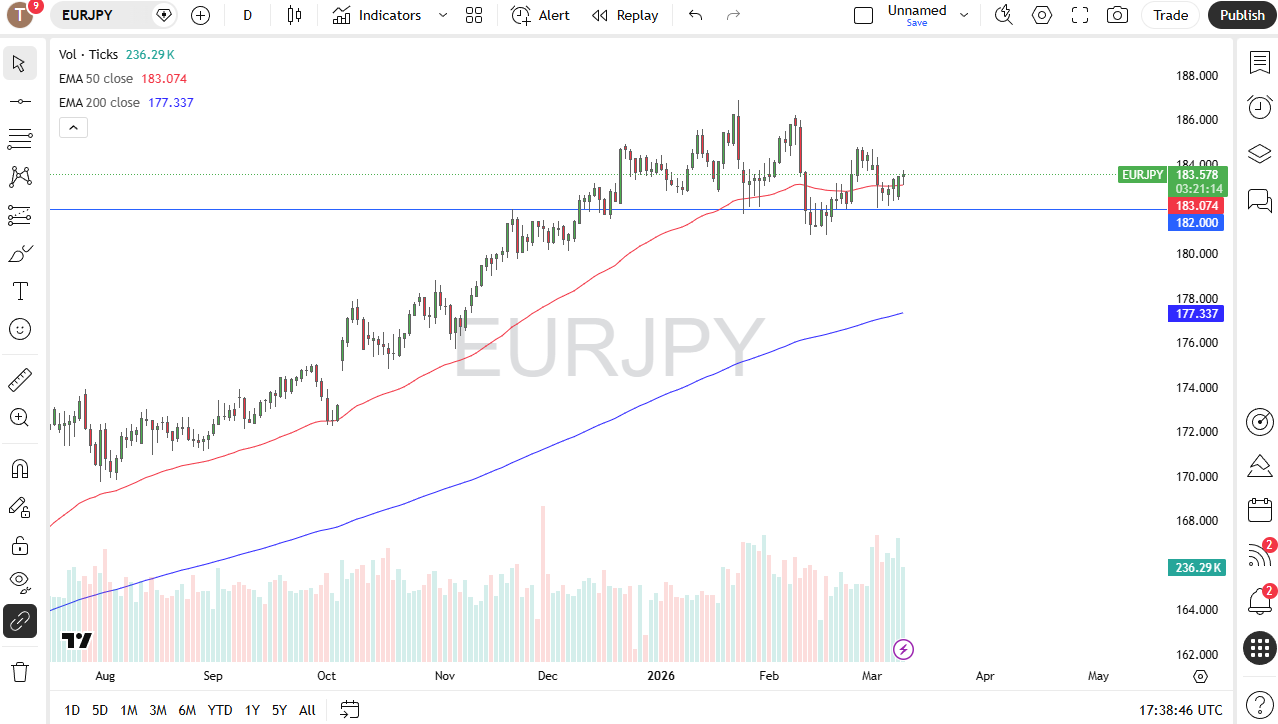
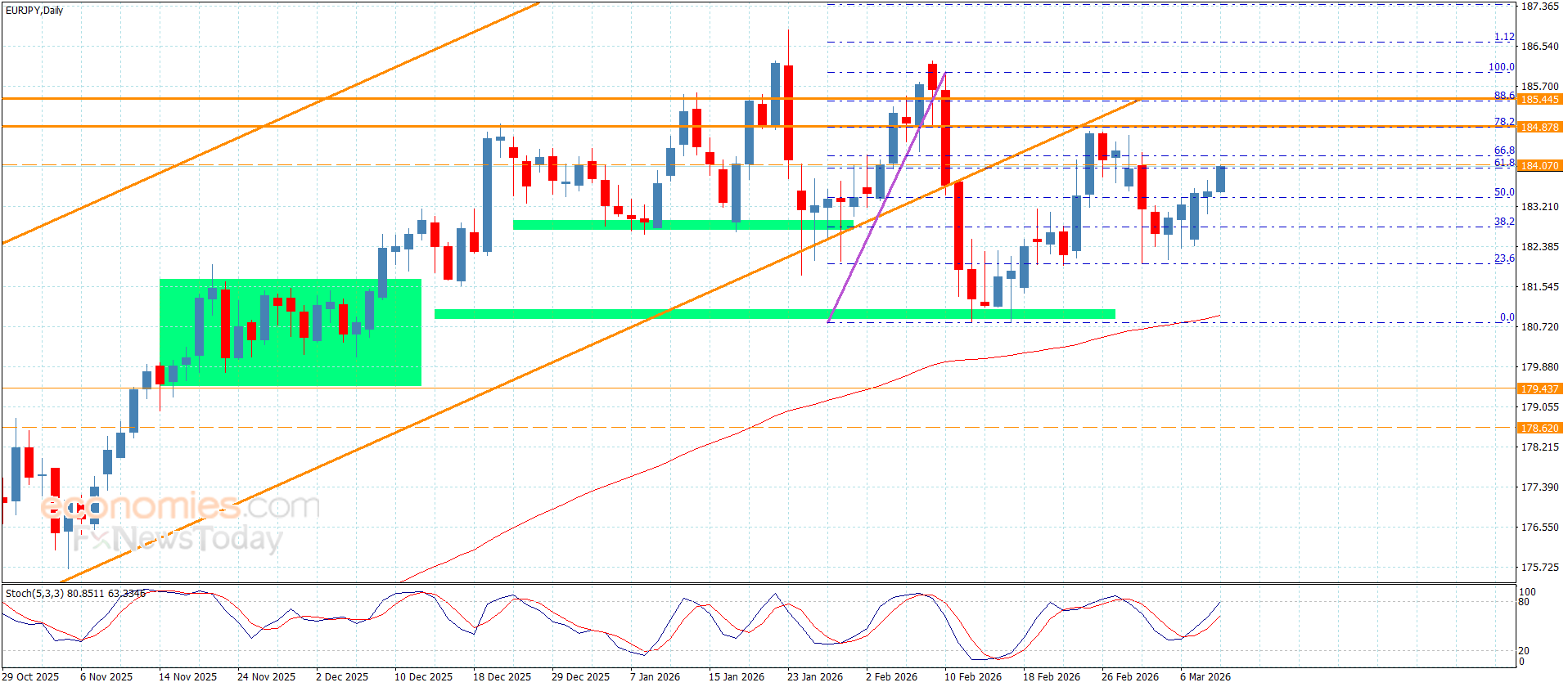
The Euro pulled back on Tuesday, as the consolidation continues, with an upwards tilt. With this, the market continues to pay those holding Euros against the Japanese yen.
The Euro pulled back just a touch during the trading session on Tuesday only to turn around and show signs of life again. The bounce that we have seen occurred at the 50-day EMA and it opens up the possibility of a continuation to the upside, but you also have to keep in mind that the 185 Yen level above is probably going to be thought of as a potential short-term barrier, but that could also make it a target.
Keep in mind that the Japanese Yen is weak against almost everything, but at the same time we see the Euro gaining a little bit against multiple other currencies. The 182 Yen level will continue to be an area of support.
I think as long as we can stay above that level, it remains a buy-on-the-dip scenario, especially as the interest rate differential favors Europe, although if you are trying to play the carry trade you are probably going to use other higher-yielding currencies to do so.
Over the longer term, I think we have a situation where we could go looking at the 186 Yen level, but it is going to remain a very noisy turn of events and the next headline that comes out, especially if it destroys risk appetite. If we were to break down below the 181 Yen level, I think that opens up the floodgate but right now, I believe we have a scenario where traders are going to continue to find reasons to get long, mainly not because they want to own Euro, but because they do not want to own Yen.
Christopher Lewis has been trading Forex and has over 20 years experience in financial markets. Chris has been a regular contributor to Daily Forex since the early days of the site. He writes about Forex for several online publications, including FX Empire, Investing.com, and his own site, aptly named The Trader Guy. Chris favours technical analysis methods to identify his trades and likes to trade equity indices and commodities as well as Forex. He favours a longer-term trading style, and his trades often last for days or weeks.
Natural gas prices ended the last bullish attempts by testing $3.450 barrier, to activate with the moving average 55 negativity, by its decline towards $3.050, to confirm the negative scenario until this moment.
The continuation of facing negative pressures will increase the chances of attacking $2.850 level, and surpassing it will confirm its readiness to resume the negative attempts, t reach the next support at $2.630.
The expected trading range for today is between $2.850 and $3.250
Trend forecast: Bearish
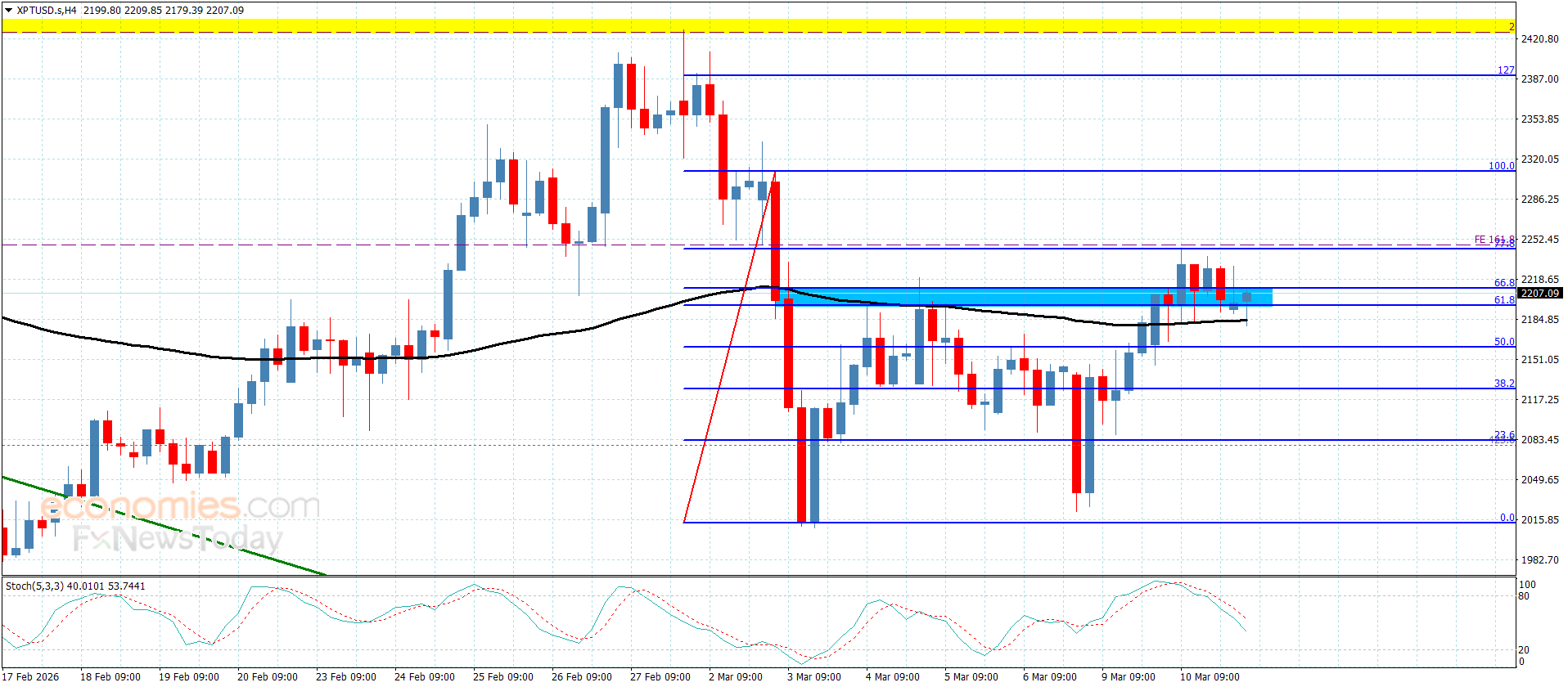
Platinum price is affected by the contradiction of the main indicators, which forces it to delay the previously suggested negative attack, activating with the moving average 55 positivity, by its rally to $2245.00 yesterday, to test the initial resistance, then rebound directly to settle near $2200.00.
Stochastic attempts to provide additional negative momentum by reaching below 50 level will support the chances of renewing the corrective attempts by reaching below $2180.00, then begin targeting negative stations near $2160.00 and $2125.00.
The expected trading range for today is between $2125.00 and $2220.00
Trend forecast: Bearish
Platinum price is affected by the contradiction of the main indicators, which forces it to delay the previously suggested negative attack, activating with the moving average 55 positivity, by its rally to $2245.00 yesterday, to test the initial resistance, then rebound directly to settle near $2200.00.
Stochastic attempts to provide additional negative momentum by reaching below 50 level will support the chances of renewing the corrective attempts by reaching below $2180.00, then begin targeting negative stations near $2160.00 and $2125.00.
The expected trading range for today is between $2125.00 and $2220.00
Trend forecast: Bearish
Platinum price is affected by the contradiction of the main indicators, which forces it to delay the previously suggested negative attack, activating with the moving average 55 positivity, by its rally to $2245.00 yesterday, to test the initial resistance, then rebound directly to settle near $2200.00.
Stochastic attempts to provide additional negative momentum by reaching below 50 level will support the chances of renewing the corrective attempts by reaching below $2180.00, then begin targeting negative stations near $2160.00 and $2125.00.
The expected trading range for today is between $2125.00 and $2220.00
Trend forecast: Bearish
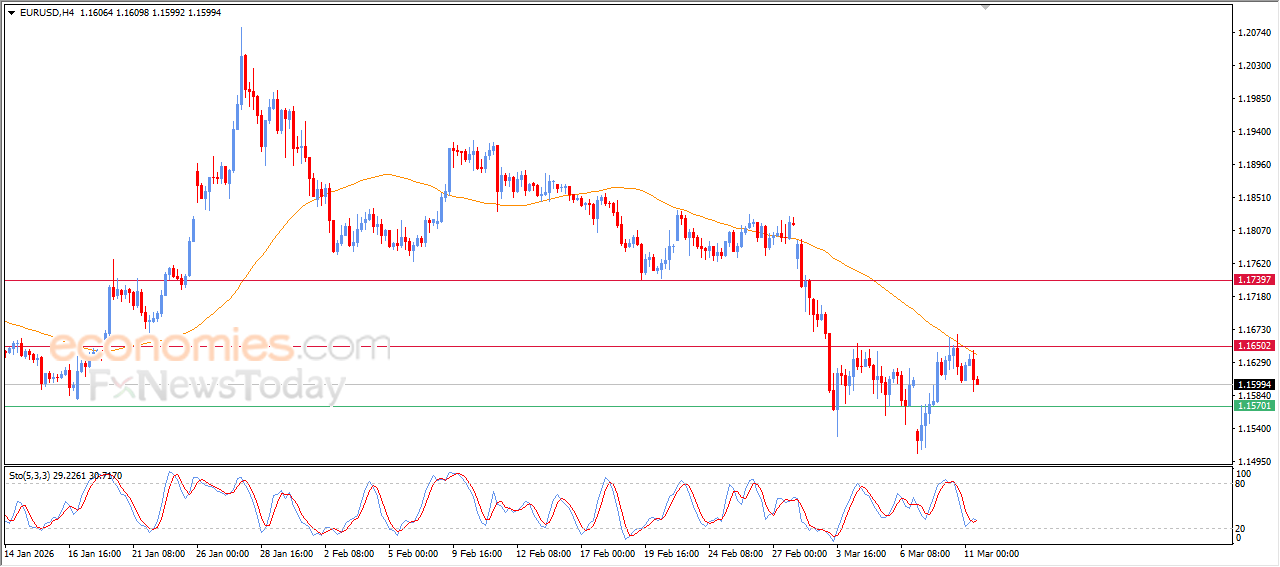
EUR/USD stabilizes slightly above 1.1600 in the European session on Wednesday as investors await February inflation data from the United States (US), while assessing the latest headlines surrounding the Middle East crisis and comments from European Central Bank (ECB) policymakers.
The table below shows the percentage change of Euro (EUR) against listed major currencies this week. Euro was the strongest against the Japanese Yen.
| USD | EUR | GBP | JPY | CAD | AUD | NZD | CHF | |
|---|---|---|---|---|---|---|---|---|
| USD | -0.50% | -0.55% | 0.21% | -0.23% | -2.43% | -1.00% | -0.16% | |
| EUR | 0.50% | -0.08% | 0.72% | 0.25% | -1.97% | -0.52% | 0.33% | |
| GBP | 0.55% | 0.08% | 0.81% | 0.32% | -1.89% | -0.45% | 0.40% | |
| JPY | -0.21% | -0.72% | -0.81% | -0.41% | -2.60% | -1.18% | -0.34% | |
| CAD | 0.23% | -0.25% | -0.32% | 0.41% | -2.21% | -0.77% | 0.07% | |
| AUD | 2.43% | 1.97% | 1.89% | 2.60% | 2.21% | 1.47% | 2.33% | |
| NZD | 1.00% | 0.52% | 0.45% | 1.18% | 0.77% | -1.47% | 0.85% | |
| CHF | 0.16% | -0.33% | -0.40% | 0.34% | -0.07% | -2.33% | -0.85% |
The heat map shows percentage changes of major currencies against each other. The base currency is picked from the left column, while the quote currency is picked from the top row. For example, if you pick the Euro from the left column and move along the horizontal line to the US Dollar, the percentage change displayed in the box will represent EUR (base)/USD (quote).
ECB policymaker Peter Kazimir said on Wednesday that he has no reservations to hike rates without new forecasts and added that an increase in key rates, because of the Iran war, may be closer than thought. On a more cautious tone, ECB Governing Council member François Villeroy de Galhau argued that they need to remain calm and noted that he doesn’t expect a rate hike at next week’s policy meeting. Finally, policymaker Joachim Nagel said that it is still too early to reliably assess the medium- to long-term consequences of the Middle East crisis.
Meanwhile, US stock index futures trade marginally higher on the day, reflecting a cautious market stance. Israel announced that it had begun an “additional wave” of strikes against targets in Tehran early Wednesday. In response, the Islamic Revolutionary Guard Corps (IRGC) of Iran also noted that it escalated its operations against the US and Israel, targeting technological infrastructure in the region.
In the second half of the day, the US Bureu of Labor Statistics (BLS) will publish the Consumer Price Index (CPI) data for February. On a monthly basis, the CPI and the core CPI are forecast to rise 0.3% and 0.2%, respectively. A stronger-than-expected print in the core CPI could be supportive for the USD and cause EUR/USD to edge lower. Conversely, a soft reading could have the opposite impact on the pair’s action. Nevertheless, the market reaction could remain short-lived because February CPI data won’t reflect the impact of rising crude oil prices on inflation.
In the 4-hour chart, EUR/USD trades at 1.1621. The near-term bias is mildly bearish as the pair holds below the downward-sloping 50-period Simple Moving Average (SMA) and the broader 100- and 200-period SMAs, which all cap the upside. Price trades beneath the Bollinger Bands’ upper line and the Relative Strength Index (RSI) hovers near 50, indicating momentum has stabilized after prior selling, yet it does not challenge the prevailing downside tilt implied by the moving averages.
Initial resistance emerges at 1.1670 (Bollinger Band upper line), and a sustained break above this level would be needed to weaken the current bearish tone and open the way toward the the 100-period SMA at 1.1723 ahead of the 200-period SMA at 1.1795. On the downside, the 20-period SMA aligns as the immediate near 1.1600 before 1.1538 (Bollinger Band lower line) and 1.1500 (static level, round level).
(The technical analysis of this story was written with the help of an AI tool.)
The Euro is the currency for the 20 European Union countries that belong to the Eurozone. It is the second most heavily traded currency in the world behind the US Dollar. In 2022, it accounted for 31% of all foreign exchange transactions, with an average daily turnover of over $2.2 trillion a day.
EUR/USD is the most heavily traded currency pair in the world, accounting for an estimated 30% off all transactions, followed by EUR/JPY (4%), EUR/GBP (3%) and EUR/AUD (2%).
The European Central Bank (ECB) in Frankfurt, Germany, is the reserve bank for the Eurozone. The ECB sets interest rates and manages monetary policy.
The ECB’s primary mandate is to maintain price stability, which means either controlling inflation or stimulating growth. Its primary tool is the raising or lowering of interest rates. Relatively high interest rates – or the expectation of higher rates – will usually benefit the Euro and vice versa.
The ECB Governing Council makes monetary policy decisions at meetings held eight times a year. Decisions are made by heads of the Eurozone national banks and six permanent members, including the President of the ECB, Christine Lagarde.
Eurozone inflation data, measured by the Harmonized Index of Consumer Prices (HICP), is an important econometric for the Euro. If inflation rises more than expected, especially if above the ECB’s 2% target, it obliges the ECB to raise interest rates to bring it back under control.
Relatively high interest rates compared to its counterparts will usually benefit the Euro, as it makes the region more attractive as a place for global investors to park their money.
Data releases gauge the health of the economy and can impact on the Euro. Indicators such as GDP, Manufacturing and Services PMIs, employment, and consumer sentiment surveys can all influence the direction of the single currency.
A strong economy is good for the Euro. Not only does it attract more foreign investment but it may encourage the ECB to put up interest rates, which will directly strengthen the Euro. Otherwise, if economic data is weak, the Euro is likely to fall.
Economic data for the four largest economies in the euro area (Germany, France, Italy and Spain) are especially significant, as they account for 75% of the Eurozone’s economy.
Another significant data release for the Euro is the Trade Balance. This indicator measures the difference between what a country earns from its exports and what it spends on imports over a given period.
If a country produces highly sought after exports then its currency will gain in value purely from the extra demand created from foreign buyers seeking to purchase these goods. Therefore, a positive net Trade Balance strengthens a currency and vice versa for a negative balance.
Silver is up for a third consecutive day on Tuesday, helped by a better market mood, weighing on US Dollar (USD) demand. The XAG/USD pair nears the $90 mark despite the escalating crisis in the Middle East.
So far, traffic through the Strait of Hormuz remains restricted by Iranian forces, and oil-producing countries have yet to decide whether to release emergency reserves. However, the G7 asked their energy agencies to be prepared to deploy oil reserves if necessary, while Pete Hegseth, United States (US) Secretary of War, said that Iran made a big mistake targeting its neighbors and threatened to hit Iran “harder than ever,” if the country interrupts oil flows.
The news was enough to push West Texas Intermediate (WTI) crude oil below the $80.00 mark during US trading hours, putting additional pressure on the USD and boosting stocks.
While the Persian Gulf war seems far from over, panic is now under control, and there seem to be better opportunities for Silver longs.
The extent of the conflict determines whether the WTI spike towards $120 a barrel was just a temporary reaction or if it would become a new reality.
In the 4-hour chart, XAG/USD trades at $89.26. The near-term bias is mildly bullish as price has reclaimed the 32.8% Fibonacci retracement of the prior slide from $96.62 to $77.97 at $85.09, hinting at a continuation attempt after the recent rebound from mid-$82s. The 20-period Simple Moving Average (SMA) has turned higher above the flatter 100-period and 200-period SMAs, and price trades above them all. The Momentum indicator holds above its midline and has eased from recent highs, while the Relative Strength Index (RSI) indicator hovers in the low 60s, consistent with a limited bullish potential
Initial resistance emerges at the 61.8% retracement at $89.50, followed by a daily peak in the $91.30 price zone. Support, on the other hand, comes at the rising 20-period SMA around $85.10, followed by the 38.2% retracement at $85.09. Further downside would focus on the 23.6% retracement at $82.37, aligning with the late-January reaction lows and reinforcing it as a pivotal floor for the broader recovery.
In the daily chart, the XAG/USD bias is mildly bullish as spot holds above the 20-day SMA at $83.58, that has flattened but still runs well above the rising 100- and 200-day SMAs, keeping the broader uptrend intact. Momentum remains positive with the 14-day Momentum indicator above 0 and the Relative Strength Index (RSI) holding above the 50 line, reinforcing a preference for upside continuation while current supports hold.
(The technical analysis of this story was written with the help of an AI tool.)