The main category of Forex News.
You can use the search box below to find what you need.
[wd_asp id=1]
The main category of Forex News.
You can use the search box below to find what you need.
[wd_asp id=1]
Silver (XAG/USD) attracts some dip-buying near mid-$64.00s during the Asian session on Friday and stalls the previous day’s modest retracement slide. The white metal climb back closer to the $66.00 round figure in the last hour and remain well within the striking distance of the all-time peak touched on Wednesday.
The XAG/USD once again finds decent support near the upward-sloping 100-hour Simple Moving Average (SMA), keeping buyers in control. It offers dynamic support at $64.75, and holding above this rising average would preserve the bullish tone. The Moving Average Convergence Divergence (MACD) histogram has turned positive and is expanding, suggesting the MACD line has crossed above the Signal line near the zero level. Momentum improves, and a sustained push further into positive territory would bolster the upside bias.
The Relative Strength Index (RSI) stands at 56, neutral-to-bullish and below overbought, supporting scope for further gains if buyers maintain control. However, the daily RSI is flashing overstretched conditions, which makes it prudent to wait for some near-term consolidation or a modest pullback before positioning for any further appreciating move. This, in turn, suggests that the XAG/USD could face some intermediate hurdle near the $66.50-$66.55 region.
This is followed by the record high, around the $67.00 neighborhood, which should cap the upside for the XAG/USD. A sustained strength beyond the said handle, however, will be seen as a fresh trigger for bullish traders and reaffirm the near-term positive outlook.
On the flip side, the $65.40-$65.35 region now seems to protect the immediate downside ahead of the $65.00 psychological mark. This is closely followed by the 100-hour SMA pivotal support, around the $64.75 region, which, if broken decisively, might prompt some technical selling and pave the way for a deeper corrective decline. The XAG/USD might then accelerate the downfall towards testing sub-$64.00 levels before eventually dropping to the $63.35 intermediate support en route to the $63.00 mark.
(A part of the technical analysis of this story was written with the help of an AI tool)
Silver is a precious metal highly traded among investors. It has been historically used as a store of value and a medium of exchange. Although less popular than Gold, traders may turn to Silver to diversify their investment portfolio, for its intrinsic value or as a potential hedge during high-inflation periods. Investors can buy physical Silver, in coins or in bars, or trade it through vehicles such as Exchange Traded Funds, which track its price on international markets.
Silver prices can move due to a wide range of factors. Geopolitical instability or fears of a deep recession can make Silver price escalate due to its safe-haven status, although to a lesser extent than Gold’s. As a yieldless asset, Silver tends to rise with lower interest rates. Its moves also depend on how the US Dollar (USD) behaves as the asset is priced in dollars (XAG/USD). A strong Dollar tends to keep the price of Silver at bay, whereas a weaker Dollar is likely to propel prices up. Other factors such as investment demand, mining supply – Silver is much more abundant than Gold – and recycling rates can also affect prices.
Silver is widely used in industry, particularly in sectors such as electronics or solar energy, as it has one of the highest electric conductivity of all metals – more than Copper and Gold. A surge in demand can increase prices, while a decline tends to lower them. Dynamics in the US, Chinese and Indian economies can also contribute to price swings: for the US and particularly China, their big industrial sectors use Silver in various processes; in India, consumers’ demand for the precious metal for jewellery also plays a key role in setting prices.
Silver prices tend to follow Gold’s moves. When Gold prices rise, Silver typically follows suit, as their status as safe-haven assets is similar. The Gold/Silver ratio, which shows the number of ounces of Silver needed to equal the value of one ounce of Gold, may help to determine the relative valuation between both metals. Some investors may consider a high ratio as an indicator that Silver is undervalued, or Gold is overvalued. On the contrary, a low ratio might suggest that Gold is undervalued relative to Silver.
The Bank of Japan’s recent decision to hike interest rates to unprecedented levels has sent the Japanese yen weaker against the dollar. This move reflects Japan’s ongoing efforts to normalize its monetary policy, marking the highest rates in 30 years. The implications are significant, not only for the USDJPY currency pair but also for Japanese government bond (JGB) yields, impacting traders and investors globally.
The Bank of Japan’s decision to increase interest rates is a noteworthy shift from its long-standing low-rate environment. This push is part of a broader strategy to combat inflation while moving towards policy normalization. By raising rates, the central bank aims to stabilize the economy without stifacing growth, a delicate balance following years of economic stagnation.
This decision has led to the depreciation of the Japanese yen, which has softened against the US dollar. The USDJPY fluctuation reflects global investor reactions, with currency traders adjusting positions in anticipation of further policy changes. For Japan, this is a step towards aligning with other major economies that have been gradually hiking rates post-pandemic.
As the Bank of Japan hikes rates, Japanese government bond (JGB) yields have naturally risen, attracting attention from both domestic and international investors. Higher yields often mean better returns, driving more investment into these bonds.
However, the rise in yields also points to potential risks. If yields rise too sharply, it could disrupt Japan’s financial markets by increasing government borrowing costs. This can impact fiscal policies and potentially slow down economic recovery efforts. Currently, the JGB market remains under close watch, as increased yields signal shifting investor sentiment and potential adjustments in inflation expectations.
The impact of Japan’s rate hike is visible in the USDJPY trading dynamics, with further volatility expected. Market analysts are now revising their forecasts for USDJPY, considering the dual influence of US monetary policies and Japan’s rate changes.
According to a forecast by Forex.com, we could see the USDJPY move in a tight range until further definitive policy statements are made by the Bank of Japan (source). Meanwhile, the Nikkei 225 (^N225) has experienced minor fluctuations, indicating uncertainty amidst investors processing the rate news and its broader market implications.
Investors using Meyka, an AI-powered platform, have access to real-time financial insights and predictive analytics. These tools are particularly valuable in volatile periods like these, where data-driven decisions can significantly impact portfolio performance.
By employing Meyka’s analytics, traders can monitor key indicators, such as changes in currency pairs and bond yields. This empowers them to make informed decisions, navigate market volatility, and optimize trading strategies, ensuring they stay ahead in a fast-evolving financial landscape.
The Bank of Japan’s rate hike has ripple effects across the financial landscape. As the yen weakens and bond yields rise, investors remain on high alert for further policy shifts. Understanding these developments is crucial for those trading in USDJPY or holding JGBs.
Platforms like Meyka offer invaluable tools for investors to track these changes and predict future trends. Staying informed and adaptable has never been more crucial as global economic policies continue to evolve. By leveraging data and insights, investors can better navigate these uncertain tides and align their strategies with emerging financial realities.
The rate hike has led to a weaker Japanese yen against the U.S. dollar as investors adjust to new economic signals and altered yield expectations. This impacts currency traders and cross-border financial dynamics.
Japanese government bonds (JGBs) are debt securities issued by Japan. When rates rise, JGB yields typically increase, attracting more investors but also raising borrowing costs, which can influence fiscal policies.
The USDJPY is expected to experience continued volatility as both U.S. and Japanese monetary policies evolve. Traders should monitor policy announcements from the Bank of Japan and Federal Reserve for further insight.
Disclaimer:
The content shared by Meyka AI PTY LTD is solely for research and informational purposes.
Meyka is not a financial advisory service, and the information provided should not be considered investment or trading advice.
Gold (XAU/USD) is posting marginal losses on Friday, but it keeps hovering without a clear bias above $4,300, with upside attempts capped below $4,355. The long wicks seen on the daily chart highlight a hesitant market, and the moderate US Dollar recovery is acting as a headwind for precious metals.
The US Dollar Index, which measures the value of the Greenback against a basket of currencies, is trading at one-week highs above 98.50, unfazed by the weak US inflation data released on Thursday. That said, market expectations that the US Federal Reserve (Fed) will cut rates further in 2026 are likely to keep US dollar rallies limited, and support Gold near record highs.
The 4-hour chart shows XAU/USD trading at $4,325, little changed on the daily chart, with price action trapped below an ascending triangle, with its top at the $4,355 area.
Technical indicators are mixed. The Moving Average Convergence Divergence (MACD) stays below zero, with the histogram flattening, which hints at a fading bearish pressure. The Relative Strength Index (RSI) prints 54.64, holding above the 50 midline and supporting a mild bullish tilt.
The $4,300 level has been supporting the pair over the last two days. ahead of the triangle bottom, around $4,290. Further down, the target is the December 12 low, at $4,257. To the upside, above the mentioned $4,355, the 127.2% Fibonacci extension of the December 9-12 rally is at $4,400. The Triangle’s measured target is at $4,450.
(The technical analysis of this story was written with the help of an AI tool.)
(This story was corrected on December 19 at 09:55 GMT to say that $4,357 is the December 12 low, and not the December 123 low as previously reported)
The table below shows the percentage change of US Dollar (USD) against listed major currencies today. US Dollar was the strongest against the Japanese Yen.
| USD | EUR | GBP | JPY | CAD | AUD | NZD | CHF | |
|---|---|---|---|---|---|---|---|---|
| USD | 0.08% | 0.01% | 0.94% | 0.10% | 0.08% | 0.43% | 0.13% | |
| EUR | -0.08% | -0.06% | 0.86% | 0.03% | 0.00% | 0.36% | 0.05% | |
| GBP | -0.01% | 0.06% | 0.95% | 0.09% | 0.06% | 0.42% | 0.11% | |
| JPY | -0.94% | -0.86% | -0.95% | -0.82% | -0.86% | -0.52% | -0.82% | |
| CAD | -0.10% | -0.03% | -0.09% | 0.82% | -0.03% | 0.31% | 0.02% | |
| AUD | -0.08% | -0.00% | -0.06% | 0.86% | 0.03% | 0.35% | 0.03% | |
| NZD | -0.43% | -0.36% | -0.42% | 0.52% | -0.31% | -0.35% | -0.30% | |
| CHF | -0.13% | -0.05% | -0.11% | 0.82% | -0.02% | -0.03% | 0.30% |
The heat map shows percentage changes of major currencies against each other. The base currency is picked from the left column, while the quote currency is picked from the top row. For example, if you pick the US Dollar from the left column and move along the horizontal line to the Japanese Yen, the percentage change displayed in the box will represent USD (base)/JPY (quote).
EUR/USD fluctuates in a tight channel above 1.1700 after posting marginal losses on Thursday. The pair’s technical outlook points to a lack of buyer interest in the short term.
The table below shows the percentage change of Euro (EUR) against listed major currencies this week. Euro was the strongest against the New Zealand Dollar.
| USD | EUR | GBP | JPY | CAD | AUD | NZD | CHF | |
|---|---|---|---|---|---|---|---|---|
| USD | 0.22% | 0.06% | 0.33% | 0.17% | 0.66% | 0.73% | -0.11% | |
| EUR | -0.22% | -0.16% | 0.09% | -0.05% | 0.47% | 0.50% | -0.32% | |
| GBP | -0.06% | 0.16% | 0.38% | 0.12% | 0.63% | 0.67% | -0.17% | |
| JPY | -0.33% | -0.09% | -0.38% | -0.15% | 0.35% | 0.39% | -0.22% | |
| CAD | -0.17% | 0.05% | -0.12% | 0.15% | 0.49% | 0.55% | -0.13% | |
| AUD | -0.66% | -0.47% | -0.63% | -0.35% | -0.49% | 0.04% | -0.79% | |
| NZD | -0.73% | -0.50% | -0.67% | -0.39% | -0.55% | -0.04% | -0.83% | |
| CHF | 0.11% | 0.32% | 0.17% | 0.22% | 0.13% | 0.79% | 0.83% |
The heat map shows percentage changes of major currencies against each other. The base currency is picked from the left column, while the quote currency is picked from the top row. For example, if you pick the Euro from the left column and move along the horizontal line to the US Dollar, the percentage change displayed in the box will represent EUR (base)/USD (quote).
EUR/USD gathered bullish momentum and climbed above 1.1760 in the early American session on Thursday as markets reacted to the European Central Bank’s (ECB) policy announcements and soft inflation data from the US.
The ECB left key rates unchanged as widely expected and the new economic projections showed that the economic growth forecasts has been revised up to 1.4% in 2025, 1.2% in 2026 and 1.4% in 2027. In the post-meeting press conference, ECB President Christine Lagarde explained that they can’t offer forward guidance on policy, given the uncertainty surrounding the outlook. Lagarde also noted that they don’t target exchange rates but added that they pay close attention to the Euro’s appreciation.
The US Bureau of Labor Statistics (BLS) reported on Thursday that annual inflation, as measured by the Consumer Price Index (CPI), softened to 2.7% in November. In this period, the core CPI rose by 2.6%. Both of these readings came in below analysts’ estimate and caused the USD to come under bearish pressure with the immediate reaction.
Later in the American session, the negative shift seen in risk mood supported the USD and forced EUR/USD to reverse its direction. Existing Home Sales data for November and the final revision to the University of Michigan’s Consumer Sentiment Index data for December will be featured in the economic calendar, which are unlikely to trigger a significant market reaction.
In case markets remain risk-averse with a bearish opening in Wall Street, EUR/USD could have a difficult time regaining its traction heading into the weekend. At the time of press, US stock index futures were trading mixed. Additionally, end-of-the-week flows ahead of the Christmas holiday could ramp up the pair’s volatility and cause irregular movements.
The 20-period Simple Moving Average (SMA) has flattened just above price at 1.1738, capping near-term upside. The 50-period SMA rises at 1.1715, while the 100- and 200-period SMAs climb at 1.1670 and 1.1615, keeping the broader tone supported. However, the Relative Strength Index (14) sits at 46, below the midline, pointing to subdued momentum.
The lower limit of the ascending regression channel and the 50-period SMA offer immediate support at 1.1715, just before the rising trend line at 1.1695. Below the latter, 1.1670 (100-period SMA) and 1.1615 (200-period SMA) could be seen as next support levels.
On the upside, immediate resistance aligns at 1.1765 (mid-point of the ascending channel), followed by 1.1820 (upper limit of the ascending channel).
(The technical analysis of this story was written with the help of an AI tool)
The Euro is the currency for the 20 European Union countries that belong to the Eurozone. It is the second most heavily traded currency in the world behind the US Dollar. In 2022, it accounted for 31% of all foreign exchange transactions, with an average daily turnover of over $2.2 trillion a day.
EUR/USD is the most heavily traded currency pair in the world, accounting for an estimated 30% off all transactions, followed by EUR/JPY (4%), EUR/GBP (3%) and EUR/AUD (2%).
The European Central Bank (ECB) in Frankfurt, Germany, is the reserve bank for the Eurozone. The ECB sets interest rates and manages monetary policy.
The ECB’s primary mandate is to maintain price stability, which means either controlling inflation or stimulating growth. Its primary tool is the raising or lowering of interest rates. Relatively high interest rates – or the expectation of higher rates – will usually benefit the Euro and vice versa.
The ECB Governing Council makes monetary policy decisions at meetings held eight times a year. Decisions are made by heads of the Eurozone national banks and six permanent members, including the President of the ECB, Christine Lagarde.
Eurozone inflation data, measured by the Harmonized Index of Consumer Prices (HICP), is an important econometric for the Euro. If inflation rises more than expected, especially if above the ECB’s 2% target, it obliges the ECB to raise interest rates to bring it back under control.
Relatively high interest rates compared to its counterparts will usually benefit the Euro, as it makes the region more attractive as a place for global investors to park their money.
Data releases gauge the health of the economy and can impact on the Euro. Indicators such as GDP, Manufacturing and Services PMIs, employment, and consumer sentiment surveys can all influence the direction of the single currency.
A strong economy is good for the Euro. Not only does it attract more foreign investment but it may encourage the ECB to put up interest rates, which will directly strengthen the Euro. Otherwise, if economic data is weak, the Euro is likely to fall.
Economic data for the four largest economies in the euro area (Germany, France, Italy and Spain) are especially significant, as they account for 75% of the Eurozone’s economy.
Another significant data release for the Euro is the Trade Balance. This indicator measures the difference between what a country earns from its exports and what it spends on imports over a given period.
If a country produces highly sought after exports then its currency will gain in value purely from the extra demand created from foreign buyers seeking to purchase these goods. Therefore, a positive net Trade Balance strengthens a currency and vice versa for a negative balance.
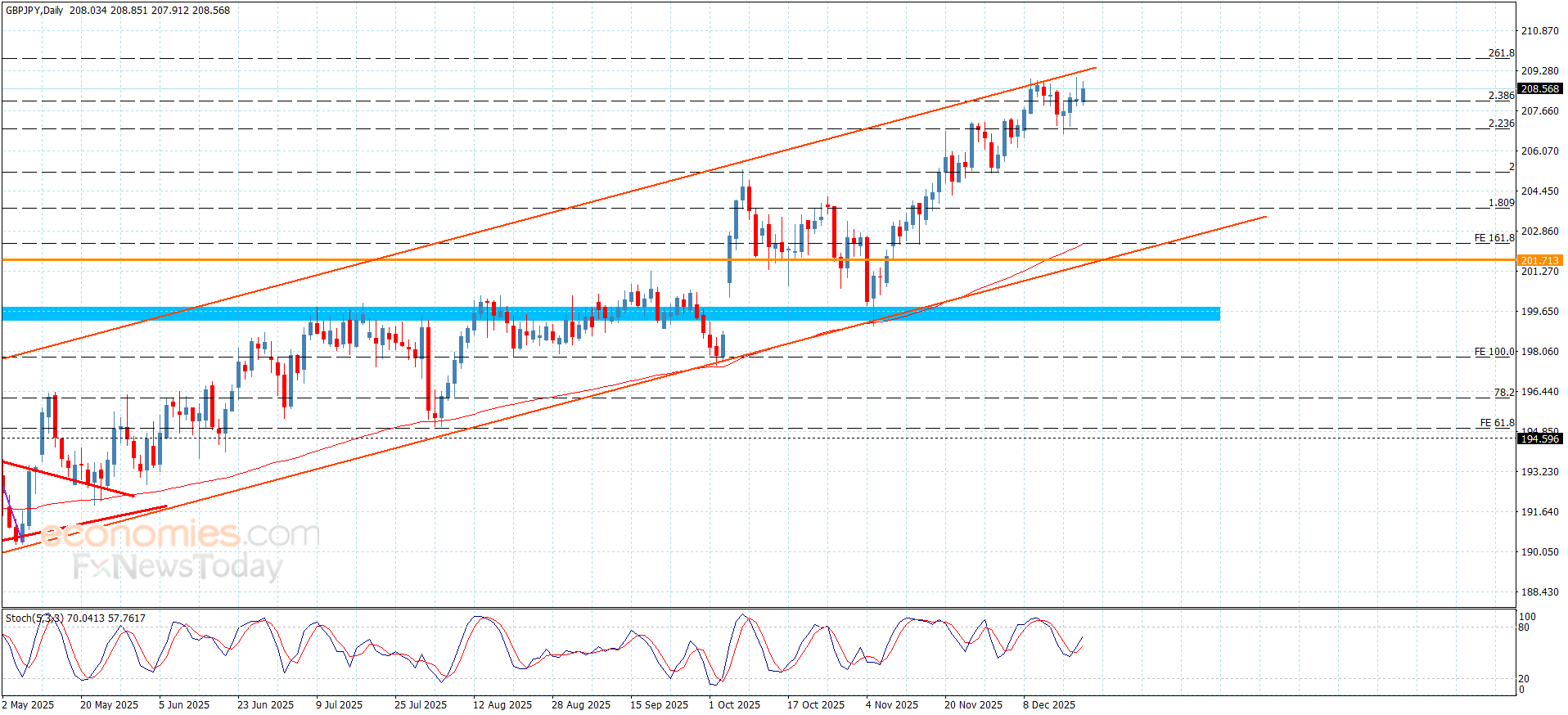
The GBPJPY pair settled above 208.10 level, forming new bullish waves and achieving some previously suggested targets by reaching 209.00, then waiting for providing new sideways trading by its stability near 208.50.
Reminding you that the bullish scenario will remain valid due to the stability within the bullish channel’s levels besides the stability of the initial main support at 206.95, therefore, we will keep preferring our bullish scenario, to expect attacking the bullish channel’s resistance at 209.30 then attempts to hit the next main target near 209.85.
The expected trading range for today is between 208.00 and 209.85
Trend forecast: Bullish
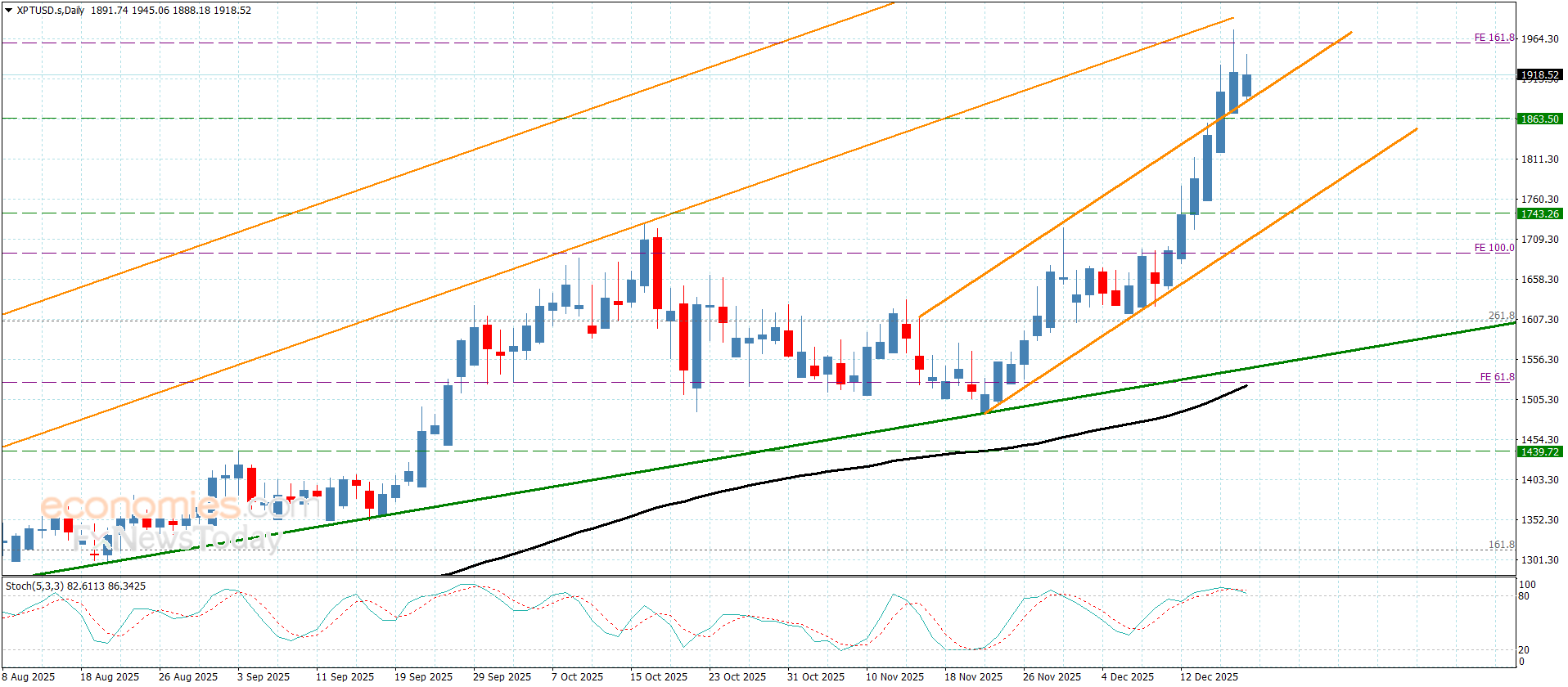
Platinum price provided sideways trading due to its stability below the barrier of $1960.00, which forms %161.8 Fibonacci extension level, forcing it to decline temporarily towards $1890.00.
The continuation of providing mixed trading is expected until breaching the barrier, to confirm its readiness to achieve new historical gains that might begin from $2000.00 psychological barrier, while breaking the extra support at $1860.00 level will force it to provide strong corrective trading, to expect reaching $1835.00 and $1790.00.
The expected trading range for today is between $1870.00 and $ 1960.00
Trend forecast: Fluctuated within the bullish track
Platinum price provided sideways trading due to its stability below the barrier of $1960.00, which forms %161.8 Fibonacci extension level, forcing it to decline temporarily towards $1890.00.
The continuation of providing mixed trading is expected until breaching the barrier, to confirm its readiness to achieve new historical gains that might begin from $2000.00 psychological barrier, while breaking the extra support at $1860.00 level will force it to provide strong corrective trading, to expect reaching $1835.00 and $1790.00.
The expected trading range for today is between $1870.00 and $ 1960.00
Trend forecast: Fluctuated within the bullish track
Platinum price provided sideways trading due to its stability below the barrier of $1960.00, which forms %161.8 Fibonacci extension level, forcing it to decline temporarily towards $1890.00.
The continuation of providing mixed trading is expected until breaching the barrier, to confirm its readiness to achieve new historical gains that might begin from $2000.00 psychological barrier, while breaking the extra support at $1860.00 level will force it to provide strong corrective trading, to expect reaching $1835.00 and $1790.00.
The expected trading range for today is between $1870.00 and $ 1960.00
Trend forecast: Fluctuated within the bullish track
Gold (XAU/USD) extends the previous day’s late pullback from the vicinity of the record high and attracts some follow-through selling during the Asian session on Friday. The US Consumer Price Index (CPI) report released on Thursday pointed to cooling of inflationary pressure. This turns out to be a key factor undermining demand for the previous metal, which is seen as a hedge against rising prices. Furthermore, renewed US Dollar (USD) buying interest and a positive risk tone exert additional downward pressure on the commodity.
A delayed report published by the US Bureau of Labor Statistics on Thursday showed that the headline CPI rose by the 2.7% YoY rate in November against 3.1% expected. Moreover, the core CPI, which excludes volatile food and energy prices, also missed consensus estimates and climbed 2.6% last month. Economists, however, warned that the figures were likely distorted on the back of the longest-ever US government shutdown. This, in turn, assists the USD in attracting for the third straight day and climbs back closer to the weekly top, touched on Wednesday. A firmer Greenback tends to dent demand for USD-denominated commodities, including Gold.
Nevertheless, the crucial inflation data did little to temper expectations of further policy easing by the US Federal Reserve (Fed). Traders are still pricing in a 63 basis points (bps) of rate cuts in 2026. Adding to this, US President Donald Trump said the next Fed chair will be someone who backs sharply lower interest rates. This, in turn, could offer support to the non-yielding Gold. Meanwhile, the prospects for lower US interest rates revive investors’ appetite for riskier assets. This is evident from a generally positive tone around the equity markets and offsets the supporting factor, backing the case for a further near-term depreciating move for the XAU/USD pair.
Traders now look to the US economic docket – featuring Existing Home Sales and the revised University of Michigan Consumer Sentiment Index. This, along with comments from influential FOMC members, might provide some impetus to the USD and produce short-term opportunities around the Gold. Meanwhile, the XAU/USD pair still seems poised to register modest gains for the second straight week. The fundamental backdrop, however, suggests that the path of least resistance for the bullion is to the downside and warrants caution for bullish traders, though a break and acceptance below the $4.300 mark is needed to reaffirm the negative outlook.
The overnight fake breakout through the $4,350-$4,355 supply zone and a subsequent fall below the 100-hour Simple Moving Average (SMA) on Friday favor the XAU/USD bears. However, mixed oscillators on hourly and daily charts make it prudent to wait for some follow-through selling below the $4,300 mark before positioning for deeper losses. The bullion might then fall to the $4,272-4,271 region, or the weekly low. This is followed by the $4,260-4,255 horizontal resistance breakpoint-turned-support, which, if broken, would suggest that the Gold price has topped out and expose the $4,200 round figure.
On the flip side, the $4,338-4,340 zone now seems to act as an immediate hurdle, above which the XAU/USD pair could make a fresh attempt towards challenging the all-time peak, around the $4,380 region, touched in October. Some follow-through buying, leading to a move beyond the $4,400 mark, will be seen as a fresh trigger for bullish traders and allow the Gold price to prolong its recent well-established trend from sub-$3,900 levels, or the October swing low.
The Japanese yen slumped for the second consecutive day, even as the BoJ delivered its interest rate decision. The USDJPY pair rose to a high of 156, up sharply from this week’s low of 154.37.
Japanese yen falls after the BoJ interest rate hike
The USD to JPY exchange rate drifted upwards, even after the BoJ hiked the interest rate for the first time in eleven months. It pushed them to the highest level since 1995, continuing a trend that it started late last year.
Japanese stocks rose after the BoJ rate hike, with the Nikkei 225 Index and the Topix jumping by over 1%. Similarly, Japanese bond yields continued rising, with the 10-year hitting the key resistance level at 2%.
The USDJPY exchange rate rose because the BoJ rate hike was already priced in by market participants. Indeed, the odds of a hike on Polymarket stood at 99% before the meeting. Most analysts were expecting the bank to hike as Kazuo Ueda had hinted.
The pair also jumped as investors waited for Kazuo Ueda’s press conference, where he will share more details on what the bank will do in 2026. In a note, an analyst from Eastspring said:
“Dollar-yen is higher because there’s no indication of more imminent hikes, and because Takata and Tamura issued ‘dissents’ on the price outlook even though the decision to hike was unanimous.”
US inflation and odds of interest rate cuts
The USDJPY exchange rate also reacted to the latest US consumer inflation report on Thursday. A report by the Bureau of Labor Statistics (BLS) showed that the headline Consumer Price Index (CPI) dropped from 3% in October to 2.6% in November, the lowest figure in months.
The core CPI dropped from 3.1% in October to 2.7% in November this year. This trend will likely continue in the foreseeable future because of the performance in the energy sector.
Data shows that the price of crude oil has continued falling in the past few months, with Brent and the West of Texas Intermediate (WTI) dropping to $59 and $55, respectively.
Therefore, there is a possibility that the Federal Reserve and the Bank of Japan will continue to diverge in the coming year. Analysts expect the Fed to keep cutting interest rates, while the BoJ may deliver one or more hikes.
USDJPY technical analysis
FX:USDJPY” class=”wp-image-3007121″ / loading=”lazy” >
The daily timeframe chart shows that the USDJPY exchange rate has been in a strong uptrend in the past few months.
It jumped from a low of 139.90 in April to the current 156.07. It has remained above the 50-day Exponential Moving Average (EMA).
The pair has remained above the Supertrend indicator and is slowly forming a bullish flag pattern. This pattern is made up of a vertical line and a descending channel, which has been in place for the past few weeks.
Therefore, the most likely scenario is where the USDJPY exchange rate continues rising, with the next key target being the year-to-date high of 157.82. A move above that level will point to more upside, potentially to 160 in the next few months.