The main category of Forex News.
You can use the search box below to find what you need.
[wd_asp id=1]
The main category of Forex News.
You can use the search box below to find what you need.
[wd_asp id=1]
The USD/JPY is trading under pressure in anticipation of the Bank of Japan’s policy announcement. However, the pair has slightly gained despite an upbeat national CPI in Japan.
–Are you interested in learning more about copy trading platforms? Check our detailed guide-
The BoJ will announce its rate decision between 03:30 and 05:00 GMT, and the press conference of Governor Kazuo Ueda will take place at 06:30 GMT. Investors are awaiting clarity, which is reducing trading activity.
The BoJ is expected to increase its policy rate to 0.75% from 0.50%. This would be the highest in nearly 30 years, if confirmed. The action would suggest that inflation and wage growth are sufficiently high to warrant stricter policy. Recent inflation statistics support this, as Japan’s national CPI increased by 2.9% in November. Meanwhile, core CPI, which excludes fresh food, stood at 3.0%.
The USD/JPY remains choppy ahead of the meeting. The pair has partially erased the losses, but the selling pressure has appeared in gradual steps, implying a strategic positioning rather than a panic-driven response.
US data has also played a role. The November CPI was reported as 2.7% YoY, which is significantly lower than the expected 3.1% while core CPI slowed to 2.6%. The price gain was only 0.2% per month. The statistics alleviated concerns about inflation, allowing the Fed to maintain its easing policy in 2026. The Treasury yields fell, pushing the greenback lower against most of its peers.
The policy divergence between the US and Japan is evident, influencing the USD/JPY trades. Japan is heading towards a rate hike, while the US is looking to ease further in 2026. The narrowing yield gaps support the yen, devaluing the dollar.
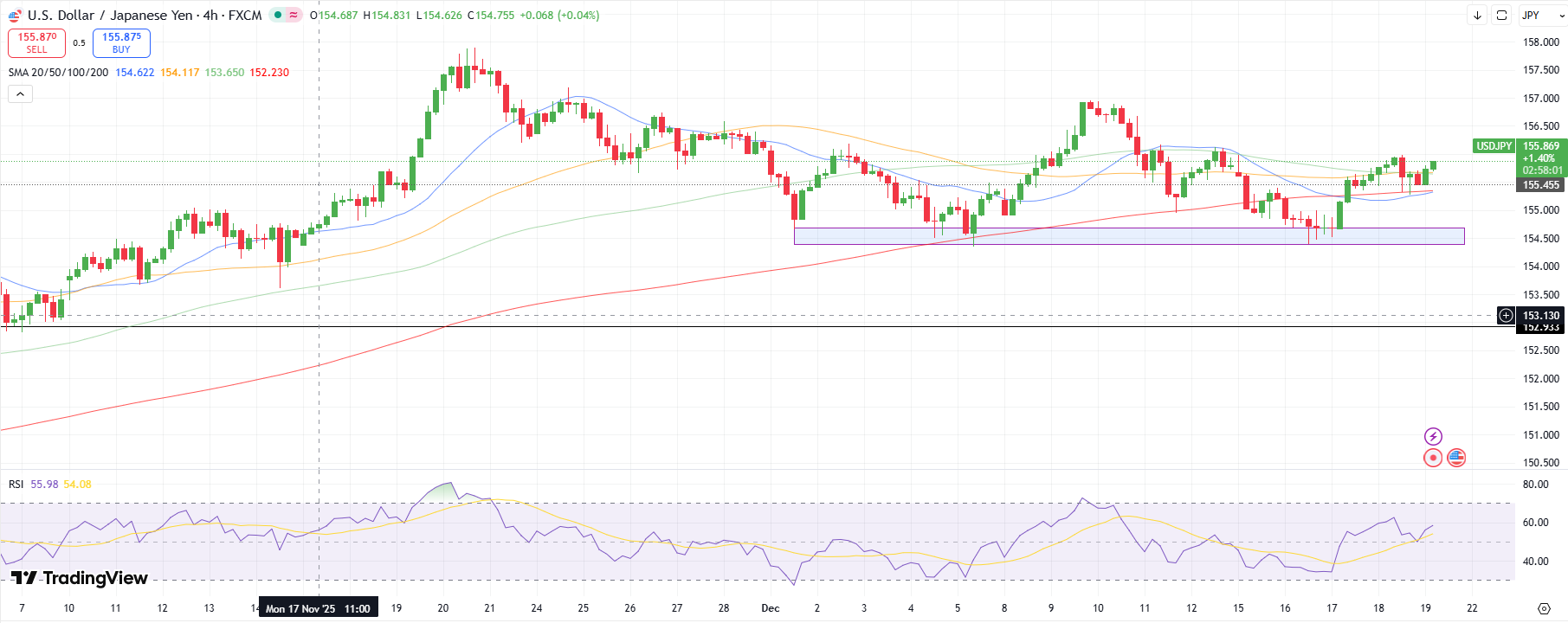
The USD/JPY price remains technically supported by the confluence of 20- and 200-period MAs, while wobbling around the 50- and 100-period MAs. Meanwhile, the RSI stays above the 50.0 level but is flat. This suggests the pair lies in the consolidation phase, awaiting a catalyst to trigger a breakout.
–Are you interested in learning more about scalping forex brokers? Check our detailed guide-
A breakout below the 20-period MA could push the prices to test the demand zone near 154.50 ahead of a horizontal level at 153.00. On the upside, the first resistance level emerges at 156.00, ahead of a potential swing high near the December highs at 156.90.
Looking to trade forex now? Invest at eToro!
68% of retail investor accounts lose money when trading CFDs with this provider. You should consider whether you can afford to take the high risk of losing your money.
The US dollar initially rallied during the trading session on Thursday, but gave back gains rather quickly, mainly due to the CPI numbers coming out with a lower-than-anticipated number in the United States. Therefore, people are starting to focus on the idea of whether or not the Federal Reserve may have to cut rates more quickly.

With that being the case, the market remains very noisy, and it does make a certain amount of sense that we continue to see a lot of volatility, but that’s nothing new for this pair. Furthermore, you also have to keep in mind that on Friday, we get the interest rate decision coming out of the Bank of Japan, so this is a pair that could get turned around right away.
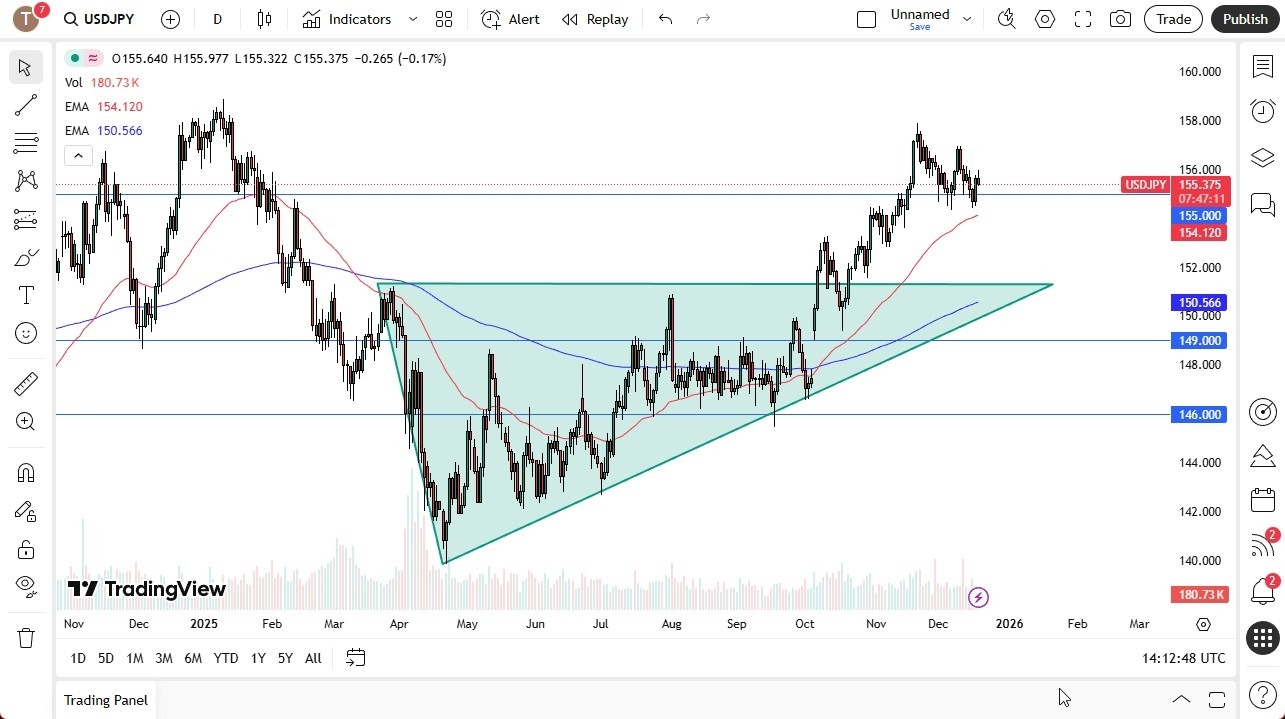
With that being the case, this is watched very closely, and pullbacks are being viewed at this point in time as buying opportunities. The 50-day EMA is near the 4.12 level and rising, and it should offer a little bit of support. The ¥158 level above is where a potential target is being watched.
Whether or not the market gets there between now and the end of the year is a completely different question, but it is expected eventually. The interest rate differential will continue to favor the Americans for the foreseeable future, and inflation and growth in the United States are expected to remain above the optimal level for the central bank. Therefore, the Federal Reserve will likely have to be a little cautious with its rate-cutting cycle.
This does not appear to be a major inflection point, at least not yet. As a result, there is no real reason to believe that the Japanese yen is going to appreciate significantly. There may be the potential for a pullback in this pair after the Bank of Japan statement or press conference, but that should be looked at as a potential opportunity.
Want to trade our USD/JPY forex analysis and predictions? Here’s a list of forex brokers in Japan to check out.
Christopher Lewis has been trading Forex and has over 20 years experience in financial markets. Chris has been a regular contributor to Daily Forex since the early days of the site. He writes about Forex for several online publications, including FX Empire, Investing.com, and his own site, aptly named The Trader Guy. Chris favours technical analysis methods to identify his trades and likes to trade equity indices and commodities as well as Forex. He favours a longer-term trading style, and his trades often last for days or weeks.
Oil is weak, not collapsing. On 18 December 2025, WTI (CL=F) trades around $56–$57 and Brent (BZ=F) is near $60 per barrel. Intraday, Brent is up roughly 0.5–0.7% around $59.9–$60.1, while WTI adds about 0.7–1.0% near $56.3–$56.5, a modest bounce after WTI closed near $55.27 earlier in the week, its lowest settle since February 2021. Even after this uptick, 2025 remains a drawdown year: WTI is down roughly 21% year-to-date, and Brent is lower by just under 20%, consistent with a market that has been pricing oversupply and soft demand rather than a persistent shortage.
Today’s modest rise is driven by a geopolitical risk premium, not by a structural tightening in balances. The United States has ordered a “total and complete blockade” of sanctioned tankers moving Venezuelan crude in and out of the country. Estimates suggest around 600,000 barrels per day of Venezuelan exports are potentially at risk, with flows to the U.S. of roughly 160,000 bpd still partially protected by authorizations linked to Chevron (NYSE:CVX) cargoes. Venezuelan flows represent roughly 1% of global supply, but sanctioned tonnage and insurance risk inject volatility into freight and risk pricing. At the same time, Venezuela’s PDVSA is recovering from a cyberattack that temporarily froze loadings. While operations have resumed, many export shipments remain delayed, adding another layer of uncertainty to short-term export volumes. Parallel to Venezuela, traders are watching the prospect of tighter U.S. sanctions on Russia’s energy sector if peace talks over Ukraine stall, plus new European measures targeting dozens of vessels in Russia’s “shadow fleet” designed to constrain sanctioned crude transport. In theory, these steps should be clearly bullish. In practice, the price impact is capped because the market’s dominant narrative is still “too much oil”, not “too little.”
Recent U.S. inventory data highlight the imbalance. Crude stocks fell by roughly 1.3 million barrels to about 424.4 million barrels in the week ending 12 December, but gasoline and distillate inventories rose more than expected. The crude draw is driven mainly by stronger exports and higher refinery runs, not by a surge in end-demand. Refinery utilization has climbed to the highest levels since early September, yet refined product stocks are building. That tells you the system is well supplied: refineries are processing heavily, but downstream demand is not tight enough to absorb output cleanly. Globally, official outlooks for 2025–2026 show demand growth around 830,000 bpd in 2025 and 860,000 bpd in 2026, while observed inventories rise and crude held “on water” increases sharply as cargoes take longer routes or sit waiting for buyers. Analyst scenarios for 2026 point to potential surpluses ranging roughly from 0.5 million bpd to over 4 million bpd, depending on how OPEC+, U.S. shale and new producers like Brazil, Guyana and Argentina behave. That is why every geopolitical shock is being faded: the default assumption is structural surplus, so disruptions must be large and prolonged to reprice the complex in a lasting way.
Forward price projections for Brent (BZ=F) in 2026 cluster around the low-to-mid $50–$60 range, with WTI (CL=F) a few dollars lower. One major official U.S. forecast sees Brent averaging around $55 in Q1 2026 and staying close to that through the year. A large investment bank projects Brent around $56 and WTI near $52 in 2026, again reflecting depressed but not catastrophic pricing. A survey of analysts published recently shows Brent averaging about $62.2 and WTI around $59.0 in 2026. Different methodologies, similar conclusion: nobody is modeling a structurally tight oil market next year. Where they differ is timing of the turn. Several houses argue that by 2027 prices will need to move higher to incentivize new upstream investment as reserve life shrinks and U.S. shale matures, but the consensus is that 2026 itself is a low-pricing, surplus year, not a major bull market.
Today’s bearish behavior adds to the likelihood that the next lower key support zone may be reached before the current retracement completes. The 61.8% Fibonacci retracement at $3.89 defined this week’s support zone. The reaction of price resistance represented by the 50-day line and a top channel line has shown the sellers remaining in charge. The two indicators show a similar price area for resistance and today’s bearish reaction confirms it. Once prior key support is shown as resistance, the downtrend may be ready to proceed. However, a drop below and daily close below this week’s low of $3.84 is still needed for a bearish continuation signal.
If natural gas fails to take out today’s high before a new trend low, then the next lower target looks likely to be reached. The 200-day average at $3.58 anchors the next lower price zone, along with a long-term uptrend line and a horizontal level around $3.59. That price area was shown as both clear support and resistance in the past. Most recently with the October high at $3.59.
More significantly, the 2023 peak was at $3.64. If that zone fails to reverse price, then the 78.6% Fibonacci retracement at $3.45 becomes a target. There is also confirmation for the 200-day price zone in the weekly chart as the 50-week and 20-week averages are at $3.63 and $3.61, respectively.
On the upside, a decisive breakout above today’s high would be needed for a bullish reversal. That would put natural gas in a position to challenge resistance near the 20-day average, now at $4.55 and falling.
Natural gas’s bounce has stalled exactly at flipped support with a bearish engulfing pattern, reinforcing seller dominance and raising odds of a confirmed break below $3.84. Hold above today’s high to keep countertrend hopes alive; failure opens acceleration toward the powerful 200-day confluence at $3.58–$3.64 and potentially $3.45 if that breaks.
The GBPUSD pair has transformed into a technical battleground as the trading week nears its close. A combination of a divided Bank of England (BoE) and a cooling US inflation report has created a “whipsaw” environment, leaving the price resting precariously on a significant layer of technical support.
The BoE Catalyst: A narrow 5-4 vote for a “hawkish cut” by the Bank of England initially sparked Sterling strength, signaling that the path to future rate cuts remains steep.
The CPI Whipsaw: A soft US CPI print (2.7%) sent the pair to a multi-week high of 1.3446 before a massive retracement saw the pair surrender all daily gains.
The Technical Floor: The price is currently testing a “cluster” of four major moving averages between 1.3348 and 1.3380, a zone that will define the trend for the Friday close.
The initial leg of the GBPUSD rally was fundamentally driven. The Bank of England’s decision to cut rates—but with a clear 5-4 split—indicated to the markets that the BoE is not in a rush to ease aggressively. This “hawkish lean” gave the British Pound a head start against a softening Greenback.
Later, the US Consumer Price Index (CPI) added fuel to the fire. The weaker-than-expected inflation data triggered a sharp sell-off in the US Dollar, propelling the “Cable” above a series of key daily and hourly moving averages. This move saw the pair challenge the highs of the last two weeks, specifically testing the Tuesday peak near 1.3455.
Despite the breakout, momentum failed to hold. The pair has retraced back into a dense zone where four critical moving averages are currently overlapping. This “cluster” acts as a massive technical pivot point:
As long as the price remains within or above this zone, the “Up and Down” volatility theme persists. The price action today reached as low as 1.3370 before stabilizing slightly, keeping the market in a state of high suspense.
As we transition into the final session of the week, the cluster of moving averages will serve as the primary barometer for directional bias.
For the buyers to reclaim the driver’s seat, they must keep the price sustained above the 1.33804 (100-hour MA). A push above the 1.3405 swing area is required to confirm that the bears have been flushed out. If successful, the door opens for another run toward the recent highs at 1.34526.
If the sellers gain enough traction to break below the bottom of the cluster at 1.33488 (200-day MA), the technical picture turns decidedly bearish. A break here would likely trigger a retest of the weekly low at 1.33118, with a secondary target at last week’s low and the key 38.2% Fibonacci retracement level of 1.32833.
In the video above, Greg Michalowski, author ofAttacking Currency Trends, provides a deep dive into these GBPUSD technical levels. He breaks down the real-time price action, helps you define the bias, the risk, and the specific targets that will matter most today and going forward.
Be aware. Be prepared.
Gold prices are consolidating near record territory on Thursday, December 18, 2025, as traders juggle two powerful forces pulling in opposite directions: a still-resilient U.S. dollar and the renewed case for lower U.S. interest rates after a cooler-than-expected inflation reading.
In early trading, spot gold was around the $4,330-per-ounce area, modestly lower on the day after a strong prior-session move, while U.S. gold futures were also fractionally softer. [1]
But the bigger story for bullion today is macro: U.S. CPI cooled to 2.7% year-on-year in November, under the 3.1% consensus forecast in a Reuters poll—fuel for the “rates can fall further” narrative that has helped propel gold’s historic 2025 rally. [2]
Gold’s headline price action on Dec. 18 is best described as steady-to-soft, not a collapse—more like a market taking a breath near all-time highs after an extraordinary year.
A later read from Reuters showed spot gold down 0.4% to $4,323.57/oz (as of 12:10 GMT) with U.S. futures down 0.4% to $4,356.10, underscoring the day’s “small dip” tone rather than any trend break. [5]
Investing.com, meanwhile, cited spot gold at $4,336.54/oz at 09:15 ET (14:15 GMT), with February gold futures at $4,370.30/oz—again consistent with a narrow, high-level range. [6]
One of the simplest relationships in commodities is also one of the most reliable: a stronger dollar can pressure gold, because it makes dollar-priced bullion more expensive for overseas buyers.
Reuters noted the dollar index edged up after touching a near one-week high the prior session, a factor weighing on gold as traders positioned cautiously ahead of inflation data. [7]
But CPI shifted the balance.
After the data, Reuters reported the dollar index weakened (down 0.12% to 98.25 in that update) and Treasury yields fell, an environment that typically improves gold’s appeal. [8]
The headline macro catalyst today is the CPI undershoot:
There’s an important nuance: Reuters reported the CPI release was affected by a 43-day government shutdown, and the Bureau of Labor Statistics did not publish month-to-month CPI changes because October data collection was disrupted. That “data quality caveat” is a big reason why markets may be hesitant to chase gold aggressively higher on a single print. [10]
Even so, softer inflation tends to push investors toward the view that real yields can fall, which is a structural positive for non-yielding assets like gold. [11]
Gold’s 2025 surge has been tightly linked to the belief that the U.S. is in, or nearing, a lower-rate regime. Today’s flow of Fed-related headlines reinforced that debate.
Reuters highlighted that:
For bullion investors, this mix matters because gold can react to two things at once:
Reuters’ broader gold-forecast reporting this week explicitly included worries about Fed independence among the factors analysts see supporting bullion into 2026. [15]
Dec. 18 isn’t only about the Fed. It’s also a heavyweight central-bank week globally, and those decisions feed into FX and bond-market moves that spill over into gold.
Investing.com reported:
That mix matters for gold in two ways:
Gold isn’t moving in isolation. On Dec. 18, Reuters and Investing.com both highlighted unusual strength across precious metals:
Why this matters for gold: when the whole complex runs together, positioning risk rises—profit-taking in one metal can spill into others, even if gold’s fundamentals remain bullish.
One of today’s most striking region-specific stories comes from Thailand, where policymakers are explicitly linking gold trading to currency-market stress.
Reuters reported the Thai central bank is urging the finance ministry to regulate gold trading after a surge in transactions helped push the baht higher, with the governor saying that on days of sharp baht strength, gold transactions can account for about half of the flows driving the move. [20]
For global gold readers, the takeaway is bigger than Thailand: it’s a real-time example of how active gold trading and cross-border flows can become macro-relevant, affecting currencies, policy debates, and potentially even local market access and liquidity.
Australia’s government-linked commodity outlook also underscored how gold’s high price level is reshaping the real economy.
Reuters reported Australia revised expected resource export earnings up 4% to A$383 billion for the current financial year, pointing to record gold prices as a key contributor. It also said gold is set to become Australia’s second most valuable resource export (after iron ore) in the 2025–26 financial year. [21]
Notably, that report included a forward-looking anchor: it said gold prices are likely to remain strong at around $4,000/oz over 2026 before falling in 2027 (in that outlook). [22]
That matters for the “forecast” question investors keep asking: even more cautious government-linked assumptions are now using $4,000 gold as a baseline for next year—a remarkable reset compared with the pre-2024 era.
A day before today’s CPI-driven headlines, Reuters published one of the most comprehensive roundups of the market’s 2026 gold forecasts—and the range is wide.
Key points from that Reuters analysis:
The same Reuters report laid out why strategists believe this cycle has different “supports” than older gold booms:
Even in a bullish framework, the risks are real:
Thursday’s price action fits a common late-cycle pattern in strong bull markets:
Investing.com explicitly described profit-taking after a sharp rally over the past week, while still pointing to “structural support” from central-bank buying and de-dollarisation themes. [33]
And Reuters captured the same cautious tone ahead of CPI, quoting UBS strategist Giovanni Staunovo on investors preferring not to head into the inflation report with open risk. [34]
Gold’s next decisive move is likely to come from a combination of policy confirmation and liquidity:
As of today’s 09:55 update on December 18, 2025, gold remains firmly parked near the $4,330/oz region, reflecting a market that is digesting softer U.S. inflation while still respecting short-term dollar strength and profit-taking near records. [39]
The most important shift in today’s news flow is not the day’s small price dip. It’s the macro narrative reset: with CPI at 2.7% YoY versus 3.1% expected, the case for further easing in 2026 looks stronger—exactly the environment where gold has historically done well. [40]
And with major banks now openly discussing $4,500 to $5,000 gold scenarios in 2026—alongside more conservative forecasts that still sit above $4,200—the metal enters year-end not as a fringe hedge, but as a core macro asset class that’s forcing governments, central banks, and investors to adapt. [41]
XAUUSD Gold Technical Analysis Levels Revealed
1. www.reuters.com, 2. www.reuters.com, 3. www.reuters.com, 4. www.reuters.com, 5. www.reuters.com, 6. ng.investing.com, 7. www.reuters.com, 8. www.reuters.com, 9. www.reuters.com, 10. www.reuters.com, 11. www.reuters.com, 12. www.reuters.com, 13. www.reuters.com, 14. www.reuters.com, 15. www.reuters.com, 16. ng.investing.com, 17. www.reuters.com, 18. www.reuters.com, 19. www.reuters.com, 20. www.reuters.com, 21. www.reuters.com, 22. www.reuters.com, 23. www.reuters.com, 24. www.reuters.com, 25. www.reuters.com, 26. www.reuters.com, 27. www.reuters.com, 28. www.reuters.com, 29. www.reuters.com, 30. www.reuters.com, 31. www.reuters.com, 32. www.reuters.com, 33. ng.investing.com, 34. www.reuters.com, 35. www.reuters.com, 36. www.reuters.com, 37. ng.investing.com, 38. www.reuters.com, 39. www.reuters.com, 40. www.reuters.com, 41. www.reuters.com
Amidst an upward technical correction, the EUR/USD pair jumped to its highest level in two months, briefly testing the psychological resistance level of 1.1800. This followed a widely expected US Federal Reserve interest rate cut, which simultaneously revealed deep internal divisions within the bank. Markets interpreted the split vote and Jerome Powell’s data-dependent remarks as bearish for the US Dollar against other major currencies, providing support for the Euro. Focus is now shifting to the Fed’s path for 2026 and the uncertainty surrounding the selection of Powell’s successor.
For his part, US Federal Reserve Chairman Jerome Powell emphasized the difficulty of formulating monetary policy in the face of high inflation and weak job prospects. He insisted that monetary policy would be data-driven. According to the latest updates, the median forecast points to a further rate cut in 2026, although there is considerable variation in expectations.
Overall, Fed policy will remain a core factor in 2026, especially as Powell’s term ends in May, adding to the climate of uncertainty.
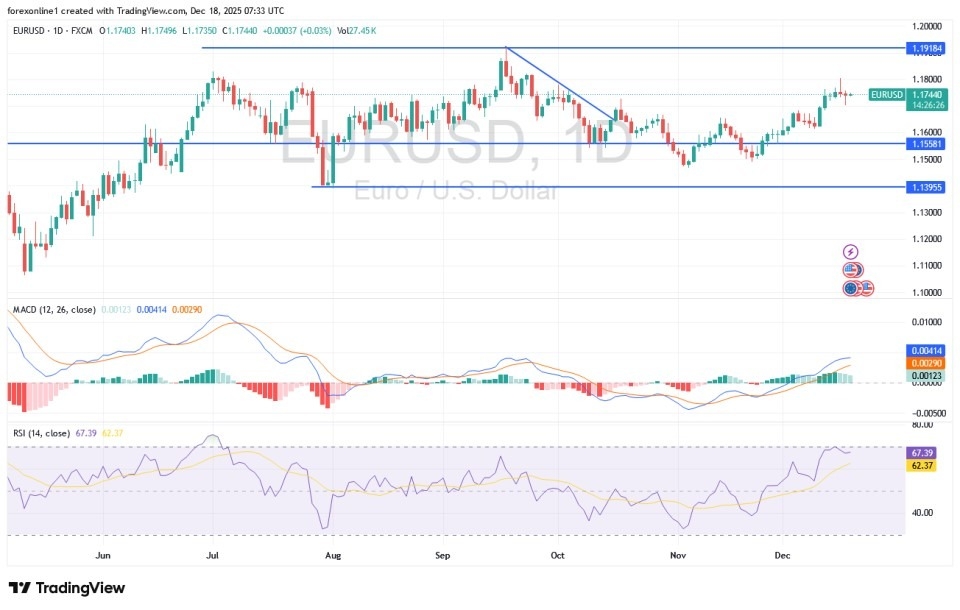
According to reliable trading platforms and based on the daily chart, technical indicators support an upward technical correction for the EUR/USD pair. As previously mentioned, breaking the psychological resistance level of 1.1800 will be crucial for strengthening the bulls’ control and preparing for significant upward breakouts, followed by the psychological peak of 1.2000, the most prominent target for the EUR/USD in the new year. Currently, the 14-day Relative Strength Index (RSI) is near the overbought level of 70, and unless it gains new positive momentum, expect profit-taking. Simultaneously, the MACD indicator has crossed into overbought territory.
The Bearish Scenario: For the pair to return to a downward trajectory on the daily timeframe, it would require a retreat back toward the 1.1500 support level. The EUR/USD pair will be influenced today by the European Central Bank’s policy announcement, with expectations that interest rates will remain unchanged. The bank’s announcement will be at 3:15 PM Egypt time, followed by a statement from ECB President Lagarde at 3:45 PM Egypt time. On the US side, the focus will be on the weekly US jobless claims report and the Philadelphia Fed Manufacturing Index, both due at 3:30 PM Egypt time.
Be cautious. If the EUR/USD fails to break above the 1.1800 level, profit-taking may begin. Never take unnecessary risks.
According to forex trading experts, Scotiabank predicts that the EUR/USD exchange rate will rise to the 1.22 resistance level by the end of 2026, with a further increase to 1.24 the following year. In the same vein, Société Générale sees the possibility of the euro/dollar exchange rate rising to the psychological resistance level of 1.20 by early 2026, but expects a gradual decline to 1.14 by the end of 2026.
Mizuho also predicted that the EUR/USD exchange rate would reach the resistance level of 1.22 by the end of 2026, noting that “Federal Reserve cuts, German fiscal spending, and increased hedging against US dollar exchange rate risks will lead to a repeat of the 2017 scenario in 2025 and 2026, but it is difficult to predict beyond that.”
Ready to trade our Forex daily forecast? We’ve shortlisted the top forex brokers in the industry for you.
XRP’s USD price (XRP-USD) is trading around $1.90–$1.91 on Thursday, December 18, 2025, after another volatile session that briefly pushed the token down toward the mid‑$1.80s and up toward the high‑$1.90s. Across major market trackers, XRP’s 24-hour range has been roughly $1.83 to $1.98—a swing of nearly 8% from low to high, underscoring how jumpy risk assets remain into year‑end. [1]
That volatility is showing up in the broader tape too: bitcoin is still struggling to regain consistent upside traction, while altcoins like XRP are reacting to macro data, ETF flows, and shifting risk appetite almost tick-for-tick. [2]
Below is what’s driving XRP price today, what the latest news and analysis is highlighting on Dec. 18, 2025, and the forecast scenarios traders and investors are watching next.
As of Dec. 18, XRP is quoted near $1.90–$1.91, with notable intraday markers around:
The headline level traders keep circling is psychological as much as technical: $2.00. Multiple market reads published today frame the area just below $2 as an “inflection” zone—where rebounds keep failing and where sellers appear to defend exits. [4]
A major macro catalyst on Dec. 18 has been the latest U.S. inflation read. Reports covering Thursday’s data pointed to cooler-than-expected CPI, which can loosen financial conditions by pulling forward expectations for future rate cuts. In crypto, that often translates into short bursts of relief—especially when positioning is already leaning bearish. [5]
That said, the same coverage also noted uncertainty around the data due to recent disruptions, which helps explain why “good news” hasn’t automatically produced a clean, sustained risk-on rally. [6]
Even with pockets of optimism, several analyses argue crypto is trading like a high-beta extension of broader risk markets right now—meaning when investors de-risk (or even hesitate), altcoins tend to feel it first. One market note published this week described XRP as stuck between nearby support and overhead resistance while the wider market remains choppy. [7]
One forecast published today emphasized that retail demand has faded, pointing to declining futures open interest as evidence that speculative positioning has cooled compared with earlier in the year. The implication: XRP can still bounce, but sustained rallies may struggle without broader participation returning. [8]
One of the most important structural stories for XRP in late 2025 is the emergence of U.S.-listed spot XRP ETFs—and the market is now watching whether those flows can eventually overpower short-term risk-off behavior.
Multiple reports published around Dec. 18 cite steady inflows into U.S.-listed XRP spot ETFs:
A separate analysis this week argued that spot XRP ETFs had built ~$1.01B in net inflows in their early weeks, but still represent a relatively small slice of XRP’s overall market cap—suggesting more “room” for institutional allocation if the category keeps maturing. [10]
One of the clearest, primary-source confirmations comes from Bitwise, which announced its Bitwise XRP ETF would start trading on NYSE on Nov. 20, 2025 under ticker XRP, holding spot XRP and charging a stated management fee (with an initial waiver structure described in the release). [11]
Separately, reports around the broader ETF rollout noted earlier launches and additional listings, including an initial U.S. spot XRP ETF approval and trading start in mid‑November. [12]
Why this matters for price forecasts: ETF flows can be supportive over time, but they don’t guarantee a straight-line move. In the short run, macro risk, profit-taking, and technical breaks can outweigh steady inflows—especially if the market is leaning defensive into year-end.
XRP’s market narrative is tightly linked to Ripple (the company), even though XRP trades freely on exchanges and is not “a Ripple stock.” On Dec. 18, two notable Ripple-related headlines added to the institutional backdrop:
Ripple announced an expanded partnership with TJM Investments / TJM Institutional Services, describing infrastructure support for execution and clearing services and stating Ripple has invested in TJM. The release frames this as part of Ripple Prime’s institutional push (including expectations of expanded digital-asset coverage). [13]
Decrypt reported that VivoPower plans to originate up to $300 million in Ripple Labs shares for an investment vehicle, pitching that equity exposure as implying indirect exposure to roughly 450 million XRP at current prices (valued around $900 million in the article’s framing). [14]
These kinds of stories don’t automatically move XRP day-to-day—but they contribute to the broader theme that more vehicles are being built to express XRP-related exposure through regulated or traditional wrappers.
One of the most consequential regulatory developments in December is that the U.S. Office of the Comptroller of the Currency (OCC) granted conditional approval for Ripple (and other crypto firms) to establish a national trust bank. Importantly, Reuters notes these charters still require final approval before the trust banks can operate, and they do not allow deposit-taking or lending like a full commercial bank. [15]
For XRP market participants, the key signal isn’t “banking magic,” it’s the direction of travel: deeper integration of crypto infrastructure into the regulated financial system—paired with ongoing political and industry debate about standards and risk. [16]
Across today’s forecast notes and analyses, the market is converging around a few key zones.
Different analyses cite different downside waypoints, but the recurring idea is simple: a clean break below $1.82 increases the odds of a deeper flush.
On the upside, the “prove it” level remains $2.00. Analysts broadly frame a reclaim-and-hold above $2 as the first step toward stabilizing.
Above that, one analysis highlights a heavier resistance zone around $2.20–$2.30, describing XRP as having spent weeks trapped beneath it. [20]
Because crypto markets can pivot hard on macro headlines (and XRP can overshoot in either direction), the most responsible forecast is scenario-based. Here’s what today’s reports imply.
If broader risk appetite remains fragile into late December, XRP may continue chopping between roughly $1.82 and $2.00, with rallies selling off near resistance and buyers defending the lower band. This aligns with commentary emphasizing weakened retail participation and the market’s difficulty turning ETF inflows into immediate upside. [21]
If XRP loses ~$1.82 decisively—especially on rising volatility—several analyses suggest the market could probe lower into the $1.60s. In this path, ETF inflows may slow the decline but not necessarily stop it if macro conditions worsen or bitcoin sells off further. [22]
A bullish reversal likely requires a combination of:
This is the “prove the bottom” scenario: if it happens, today’s analysis suggests XRP could transition from “damage control” into a more constructive recovery phase. [23]
Looking beyond the next candle, XRP traders are likely to keep focusing on:
On Dec. 18, 2025, XRP price today (XRP-USD) is hovering near $1.90, still struggling to reclaim $2.00 even as the institutional “plumbing” around XRP appears to be expanding—via spot XRP ETFs with roughly ~$1B+ in cumulative net inflows and a drumbeat of Ripple institutional announcements. [28]
The near-term forecast comes down to a simple battle: hold $1.82–$1.90 support or risk a deeper slide, versus reclaim $2.00 and build a base strong enough to challenge the next resistance band. [29]
XRP Price Predictions: Could It Reach $1000?
1. www.coingecko.com, 2. www.tmgm.com, 3. www.coingecko.com, 4. www.fxstreet.com, 5. www.investors.com, 6. www.investors.com, 7. www.investing.com, 8. www.fxstreet.com, 9. www.fxstreet.com, 10. www.investing.com, 11. bitwiseinvestments.com, 12. finance.yahoo.com, 13. www.businesswire.com, 14. decrypt.co, 15. www.reuters.com, 16. www.reuters.com, 17. www.fxstreet.com, 18. www.investing.com, 19. www.tmgm.com, 20. www.investing.com, 21. www.fxstreet.com, 22. www.investing.com, 23. www.investors.com, 24. www.fxstreet.com, 25. www.investors.com, 26. www.reuters.com, 27. www.businesswire.com, 28. www.coingecko.com, 29. www.fxstreet.com
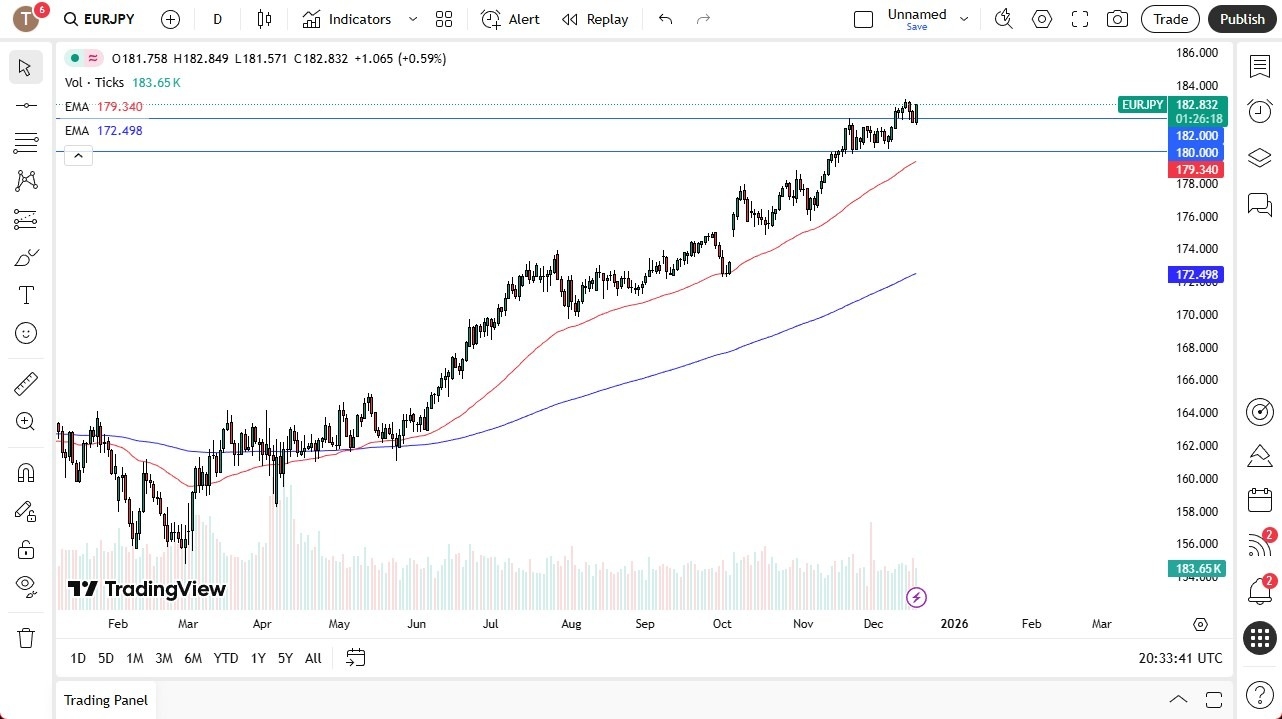
The euro has risen quite nicely against the Japanese yen in what would be a continuation of a very strong trend anyway. But one thing that I am worried about is the fact that we have both of these central banks in the next 36 hours or so coming out with interest rate decisions. While the interest rate decisions themselves probably don’t make the headlines, what will make the headlines will be the comments coming out of central bank governors, especially during the press conference.
So, with that being said, even though this is obviously a very bullish market, and I do want to be a buyer, not a seller, the reality is you have to be very cautious over the next couple of days. With that, I’ve noticed a pattern here of about every 200 pips, there is support and resistance. So, if I get a little bit of a pullback here, perhaps down to the 180 yen level, I’ll become very interested. Once we get through both the European Central Bank and the Bank of Japan, then things will be quite a bit clearer.
Nonetheless, I know what I’m not going to do here. And what I’m not going to do is buy the Japanese yen. I will be buying the euro against the Japanese yen. And I do think that the carry trade continues because no matter what Japan does, they have massive debt problems, where if they raise the rates too much, that causes a real issue. The last 25 years or so of ultra-loose monetary policy have done a real number on the Japanese situation. A collapsing demographic and a high debt level mean they can’t afford higher interest rates for very long.
I think the market knows this, and that’s exactly what it’s sniffing out here. I don’t even necessarily think that the euro is the best currency to trade against the yen. I just think it’s one of many that you can buy in place of it.
Begin trading our daily forecasts and analysis. Here is a list of Forex brokers in Japan to work with.
Christopher Lewis has been trading Forex and has over 20 years experience in financial markets. Chris has been a regular contributor to Daily Forex since the early days of the site. He writes about Forex for several online publications, including FX Empire, Investing.com, and his own site, aptly named The Trader Guy. Chris favours technical analysis methods to identify his trades and likes to trade equity indices and commodities as well as Forex. He favours a longer-term trading style, and his trades often last for days or weeks.
Oil prices are inching higher today, but the rally is tentative — more a geopolitical “risk premium” flicker than a full-blown trend reversal. In early Thursday trading on December 18, 2025, Brent crude hovered around $60 a barrel while U.S. West Texas Intermediate (WTI) traded in the mid-$56s, as markets weighed fresh supply-disruption risks tied to Venezuela and Russia against a stubbornly bearish backdrop of swelling inventories and forecasts for a well-supplied 2026. [1]
By mid-morning in Europe, Brent was up about half a percent near $60 per barrel and WTI was up roughly two-thirds of a percent around $56.32, according to Reuters pricing at 09:10 GMT. [2]
Other early snapshots told the same story: modest gains, volatile intraday action, and plenty of skepticism that the bounce can last without a meaningful change in supply-demand fundamentals. [3]
The biggest headline driver is Washington’s escalating pressure campaign on Venezuela’s oil exports. Reuters reports that President Donald Trump ordered a “total and complete blockade” of sanctioned oil tankers entering and leaving Venezuela, a move that immediately raised questions about enforcement, legality, and the real-world impact on barrels reaching the market. [4]
Why traders care: even if Venezuela is not a massive swing supplier, disruptions can matter when the market is already anxious about sanctions compliance and shipping constraints.
Key details shaping the price reaction:
Even so, the market’s response has been restrained — largely because traders are still asking the same two questions: How enforceable is it, and how long does it last? [8]
Alongside Venezuela, traders are weighing the possibility of tighter restrictions on Russia’s energy sector. Reuters reports that Bloomberg cited sources saying the U.S. is preparing another round of Russia-related energy sanctions if Moscow does not agree to a Ukraine peace deal — although Reuters also notes a White House official said Trump had not made decisions on Russian sanctions. [9]
ING’s take is blunt: with Brent trading around $60 and a broader surplus outlook, Washington potentially has more room to turn the sanctions “dial” upward than it would in a tight market. [10]
Venezuela’s state oil company PDVSA has also been dealing with operational turbulence. Reuters reported that PDVSA resumed loading after disruptions tied to a cyberattack, but that many Venezuelan exports were still on hold even as loading restarted — another factor encouraging short-term supply caution. [11]
Today’s lift comes after crude flirted with multi-year lows earlier this week. Reuters reported that WTI settled at $55.27 on Tuesday, the lowest close since February 2021, before rebounding as Venezuela headlines hit. [12]
The reason the rally is capped is simple: the macro narrative remains dominated by oversupply expectations and uneven demand growth.
Investing.com notes that despite Thursday’s gains, oil has still been tracking toward weekly losses and that 2025 has been a bruising year: WTI down about 21% year-to-date and Brent down just under 20%, reflecting how persistent surplus fears have been. [13]
A key “reality check” for oil bulls this week has been U.S. stockpile data.
Reuters reported that U.S. crude inventories fell by about 1.3 million barrels to 424.4 million barrels in the week ending December 12, but gasoline and distillate inventories rose more than expected — a combination that can mute crude rallies because it hints at softer end-demand or seasonal refinery dynamics. [14]
ING’s daily commodities note adds color: it pegs the crude draw at about 1.27 million barrels, driven largely by stronger exports (with crude exports rising sharply week-over-week), while refined product inventories built meaningfully and refinery runs climbed to the highest levels since early September. [15]
Translation for traders: crude supply is not the only story. If refined products are building, it can be harder for crude prices to sustain a breakout — even when geopolitical headlines are loud.
If today’s price action feels like a tug-of-war, the forecasts explain why.
In its Short-Term Energy Outlook released in December, the U.S. Energy Information Administration (EIA) expects global inventories to keep rising through 2026 and forecasts Brent averaging about $55 per barrel in Q1 2026, staying near that level through the rest of next year. [16]
Notably, the EIA also flags two forces that could prevent an outright collapse: OPEC+ production policy and China’s continued inventory builds. [17]
The International Energy Agency’s December 2025 Oil Market Report sketches a market where supply growth still outpaces demand growth.
Among the most market-moving signals in the IEA update:
The big message: even if sanctions tighten around the edges, the market is still wrestling with abundance.
A Reuters poll of analysts and economists published in late November projected Brent averaging $62.23 per barrel in 2026 and WTI averaging $59.00, while estimating the potential 2026 surplus across a wide range (from roughly 0.5 to 4.2 million bpd). [21]
Crucially, the same poll emphasized the idea that geopolitics may keep a “floor” under prices — not because balances are tight, but because disruptions and enforcement risks can reprice quickly. [22]
Here’s the tension in today’s market:
Reuters quoted a former U.S. State Department energy diplomat suggesting that if Venezuelan exports are materially curtailed and not replaced by spare capacity, the impact could be several dollars per barrel (on the order of $5 to $8). [23]
At the same time, Reuters also cited analysts who argue that U.S. actions may add short-term noise without materially tightening global balances unless the disruption persists or widens. [24]
For readers tracking oil price today and where crude goes next, the near-term roadmap is clear:
Oil is higher today — but it’s rising in a market that still believes the bigger story is too much supply chasing modest demand growth. Venezuela and Russia are injecting fresh uncertainty, and that uncertainty can move prices quickly. Yet the latest official outlooks still point toward a 2026 landscape where inventories build and rallies face resistance unless disruptions become concrete and prolonged. [29]
1. www.reuters.com, 2. www.reuters.com, 3. www.investing.com, 4. www.reuters.com, 5. www.reuters.com, 6. www.reuters.com, 7. www.washingtonpost.com, 8. think.ing.com, 9. www.reuters.com, 10. think.ing.com, 11. www.reuters.com, 12. www.reuters.com, 13. www.investing.com, 14. www.reuters.com, 15. think.ing.com, 16. www.eia.gov, 17. www.eia.gov, 18. www.iea.org, 19. www.iea.org, 20. www.iea.org, 21. www.reuters.com, 22. www.reuters.com, 23. www.reuters.com, 24. www.reuters.com, 25. www.reuters.com, 26. www.reuters.com, 27. www.reuters.com, 28. www.eia.gov, 29. www.reuters.com