The main category of Forex News.
You can use the search box below to find what you need.
[wd_asp id=1]
The main category of Forex News.
You can use the search box below to find what you need.
[wd_asp id=1]
Gold prices started the week firm on Monday, 15 December 2025, extending a multi-day upswing as the U.S. dollar hovered near a two‑month low and Treasury yields eased ahead of a crucial backlog of U.S. economic releases. The precious metal is once again within striking distance of its October record, keeping traders focused on whether this week’s data and central-bank decisions will push XAU/USD into fresh highs—or trigger a year‑end pullback.
In early trading, spot gold climbed 1% to $4,344.40 an ounce by 06:56 GMT, while U.S. gold futures rose 1.1% to $4,377.40. [1]
Pricing snapshots from major market trackers showed gold holding around the same zone:
Gold’s recent strength matters because it’s not just a bounce: Reuters noted bullion hit its highest since 21 October on Friday, and markets have been treating dips as buying opportunities. [4]
Gold is typically most comfortable when the dollar and yields fall together—because a weaker greenback makes dollar‑priced bullion cheaper for non‑U.S. buyers, and lower yields reduce the opportunity cost of holding a non‑interest‑bearing asset.
That setup was visible again on Monday: Reuters reported the dollar near a two‑month low and 10‑year U.S. yields edging lower, both supportive for bullion. [5]
Markets remain laser-focused on the Federal Reserve’s trajectory after last week’s 25-basis-point rate cut, which Reuters described as a rare split decision, alongside signals that the Fed may pause because inflation remains sticky and the labour outlook is uncertain. [6]
That nuance is important for gold:
Reuters also highlighted that investors were pricing in two rate cuts next year, with this week’s jobs report seen as a major test of those expectations. [7]
Gold is heading into one of the most event‑heavy weeks of the year:
In short: gold has a strong macro tailwind and a packed catalyst calendar—often a recipe for sharp moves.
A key reason gold traders are fixated on this week is that price is approaching an area that has acted like a “ceiling” since October.
Reuters quoted OANDA senior market analyst Kelvin Wong saying gold is likely to remain well bid into the nonfarm payrolls release, and that a supportive read could help drive a push toward $4,380–$4,440 after a rebound from a $4,243 support zone. [11]
That aligns with where broader market commentary has placed the “line in the sand”:
Several daily and weekly technical outlooks published on 15 December converged on a similar map:
FXEmpire’s 15 December forecast put it plainly: gold was holding $4,300 support and “eyes” $4,355–$4,395 as the next upside zone in the near term. [16]
FXStreet’s 15 December note similarly framed the move as gold rising to seven‑week highs near $4,350, supported by rate‑cut expectations and safe‑haven flows, with traders waiting for the next push from U.S. labour data. [17]
Today’s gold rally isn’t happening in a vacuum—markets are positioning ahead of data that can swing rate expectations quickly.
Both Reuters and FXStreet highlighted that markets are now awaiting the Nonfarm Payrolls report (with delayed prints for prior months), while attention later in the week shifts to U.S. CPI—the combination most likely to reprice the Fed path. [18]
FXStreet’s “week ahead” analysis laid out the binary risk clearly: if delayed data shows inflation is hotter and jobs stronger than expected, markets could question whether the Fed cuts were the right call—potentially creating a volatility spike that can also drive haven demand for gold. [19]
Beyond daily macro headlines, one policy change is adding a longer-duration bid: India’s move to permit pension funds to invest in gold and silver ETFs.
Reuters reported that the regulatory change could lift institutional participation, and ANZ said such rules can “boost confidence” and support higher allocations across portfolios. [20]
FXEmpire also pointed to the same development as a constructive factor for precious metals demand. [21]
Gold’s rally is also happening alongside extraordinary moves in silver, which has been one of 2025’s standout trades.
On Monday, Reuters put spot silver up 2% to $63.23, after it hit a record $64.65 on Friday. [22]
That silver strength matters for gold because flows often move through the metals complex together. Earlier in the month, Reuters quoted an analyst noting that silver momentum was pulling gold (and other precious metals) higher. [23]
Even with gold already near the top of its recent range, Wall Street and institutional research remains broadly constructive about 2026—though the “how” and “how fast” differ.
Here are some of the most-cited outlooks circulating into year‑end:
The takeaway for readers: the base case across institutions is not “gold collapses”—it’s either consolidation near elevated levels or continued upside if growth slows, inflation stays sticky, or geopolitics deteriorate. The main bearish scenario tends to be a combination of stronger growth, higher rates and a stronger dollar—exactly the mix that upcoming U.S. data and central bank decisions could begin to signal.
If you’re tracking gold price today (15.12.2025) and trying to understand what comes next, these are the near-term signposts:
For now, the trend remains bullish: gold is holding above widely watched support while the market heads into a high‑stakes data week with the dollar still weak and yields capped. Whether this turns into a clean break to new highs—or a volatility-driven shakeout—likely hinges on how Tuesday’s labour prints and Thursday’s inflation numbers reshape the Fed narrative.
1. www.reuters.com, 2. www.investing.com, 3. www.investing.com, 4. www.reuters.com, 5. www.reuters.com, 6. www.reuters.com, 7. www.reuters.com, 8. www.reuters.com, 9. www.fxstreet.com, 10. www.reuters.com, 11. www.reuters.com, 12. www.reuters.com, 13. www.home.saxo, 14. www.fxempire.com, 15. www.fxempire.com, 16. www.fxempire.com, 17. www.fxstreet.com, 18. www.reuters.com, 19. www.fxstreet.com, 20. www.reuters.com, 21. www.fxempire.com, 22. www.reuters.com, 23. www.reuters.com, 24. www.investing.com, 25. www.reuters.com, 26. markets.businessinsider.com, 27. www.citigroup.com, 28. www.gold.org, 29. www.reuters.com, 30. za.investing.com, 31. www.reuters.com, 32. www.reuters.com
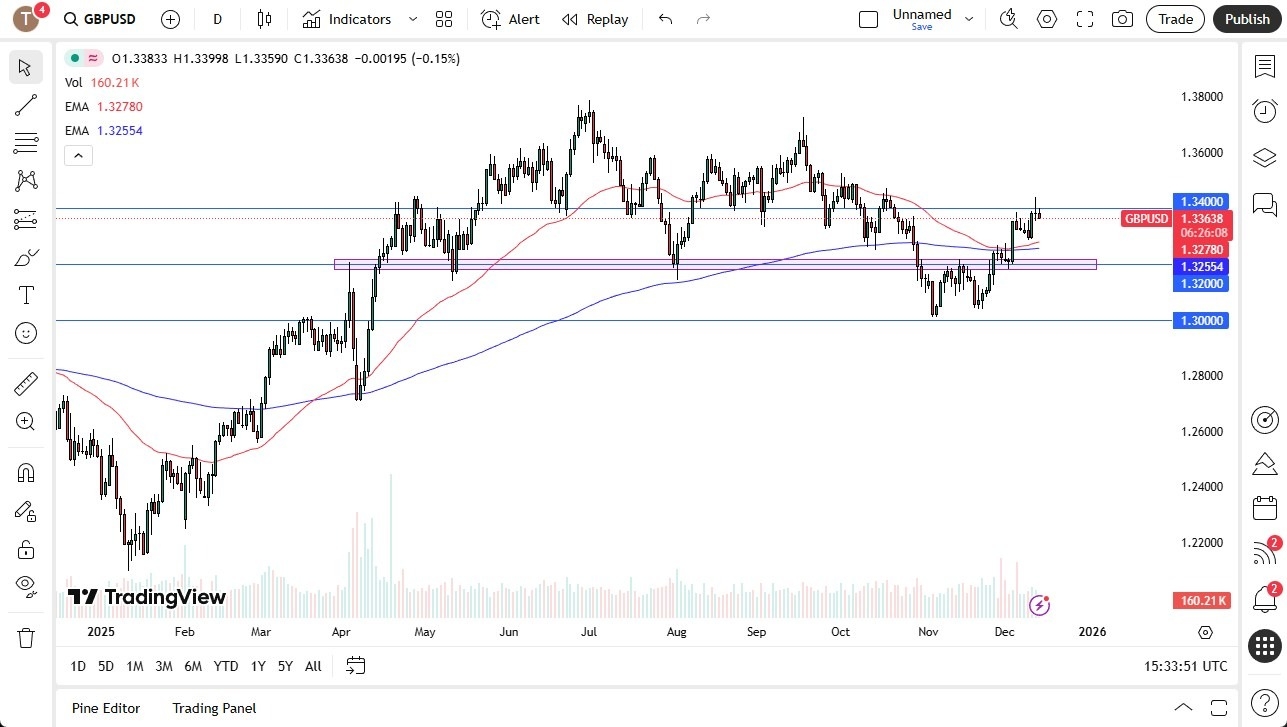
The British pound initially tried to rally, but it failed a bit during the trading session on Friday. Ultimately, this is a market that continues to ask a lot of questions about the 1.34 level as a potential barrier and perhaps even a ceiling.

This is a market that is trying to figure out what to do with the idea of the Federal Reserve potentially being on hold next year, while the British are most certainly going to be cutting rates soon. A lot of what happens from here comes down to the reality that the interest rate differential will not have changed, and that has a lot to do with how this pair behaves.
It was somewhat odd that the pair sold the US dollar the way it did, because this is a market that looks to be in the process of retesting the previous selloff to see whether or not downward pressure continues. That does appear to be the case.
If the market breaks down below the 50-day EMA and the 200-day EMA, there is a real chance of a much more significant breakdown. All things being equal, this looks more like a grind lower rather than an explosive move, although that possibility always exists.
On the other hand, if the market were to break above the 1.3450 level, this area on the chart opens the door to a strong move higher. That would align with a scenario in which the US dollar sells off broadly. It is important to pay close attention to that because when the dollar sells off, it typically does so against everything at the same time.
Ready to trade our daily GBP/USD Forex forecast? Here’s some of the best forex broker UK reviews to check out.
Christopher Lewis has been trading Forex and has over 20 years experience in financial markets. Chris has been a regular contributor to Daily Forex since the early days of the site. He writes about Forex for several online publications, including FX Empire, Investing.com, and his own site, aptly named The Trader Guy. Chris favours technical analysis methods to identify his trades and likes to trade equity indices and commodities as well as Forex. He favours a longer-term trading style, and his trades often last for days or weeks.
Anglo American plc stock (LSE: AAL, ticker often shown as AAL.L) is trading in a market that’s trying to price two big things at once: a copper-heavy future shaped by a transformational merger with Teck Resources, and the very real execution risk that comes with mega-deals, regulatory scrutiny, and operational bottlenecks.
In London trading on 15 December 2025, Anglo American shares hovered around the mid‑2,800p level (roughly £28–£29 per share), after a volatile stretch that included a sharp drop late last week. [1]
After a strong run earlier in 2025, Anglo American shares have recently been choppy. Financial market data for Monday, 15 December 2025 shows the stock closing around 2,837.9p. [6]
On a total-return basis (including dividends), Anglo American’s year-to-date performance has remained positive in 2025, underscoring that investors have largely rewarded the company’s strategic pivot—despite the turbulence around corporate actions. [7]
Why the volatility? In plain terms: when a company proposes a deal that can redefine its commodity exposure and geographic footprint, the market tends to swing between “this is brilliant” and “this is going to be a regulatory and operational headache.”
Anglo American and Teck Resources shareholders have approved a $53 billion, all‑stock, nil‑premium merger that would create a combined company widely described as Anglo‑Teck / Anglo Teck. [8]
Key deal headlines investors are using to value the upside include:
Teck has secured a final order from the Supreme Court of British Columbia approving the plan of arrangement for the merger—an important procedural step that reduces uncertainty around the transaction’s legal pathway. [12]
The market’s focus now shifts to regulators—including Canadian “net benefit” considerations and competition reviews in multiple jurisdictions (with copper’s “critical mineral” status adding a political layer). Reuters has described regulatory approvals as the final major hurdle following the shareholder votes. [13]
Stock implication: until the regulatory timeline becomes clearer, Anglo American shares may trade with a “deal overhang”—where good news helps, but uncertainty caps near-term enthusiasm.
The strategic logic of the merger—and much of the bull case for Anglo American stock—rests on copper.
Reuters reporting this month described copper moving close to $12,000 per metric ton, driven by strong demand (including AI-powered data centers) and tight supply. Reuters also cited expectations for copper market deficits—124,000 tons in 2025 and 150,000 tons in 2026—illustrating why miners with scalable copper exposure are being re-rated. [14]
An outlook report from ING similarly highlights a structurally bullish copper narrative tied to grids, electrification, renewables, and—increasingly—data centers and AI infrastructure. [15]
One of the most repeated industrial logics behind the merger is the possibility of optimizing value from adjacent copper assets in Chile—Teck’s Quebrada Blanca and Anglo’s Collahuasi—via operational coordination. [16]
Stock implication: if investors become more confident that copper stays tight into 2026 and beyond, Anglo American’s copper-heavy trajectory can support higher valuation multiples. But that confidence hinges on output reliability and execution.
The copper thesis is powerful, but miners don’t get paid on PowerPoint—they get paid on tonnes shipped.
Reuters reported that Chilean authorities raised concerns in 2025 about a large crack and water leaks at Teck’s Quebrada Blanca tailings facility, with criticism around reporting speed and ongoing scrutiny. [17]
This matters for Anglo American stock because markets tend to discount “synergies” when there’s a risk that the underlying assets can’t consistently deliver planned volumes.
A market note carried by MarketScreener argued that, even after shareholder approval, translating copper growth ambitions into reality looks challenging, and that uncertainty around restructuring/disposals can limit near-term upside for the shares. [18]
Stock implication: the more the market believes the merger is “hard but doable,” the more Anglo American stock can trade on copper upside and synergy targets. The more the market believes it’s “hard and messy,” the more the stock may be range-bound until milestones are cleared.
Anglo American’s equity story in late 2025 isn’t just “buy copper.” It’s also “sell what doesn’t fit.”
A Reuters report today (15 December 2025) on South Africa’s balance-of-payments data cited Anglo American’s sale of its remaining stake in Valterra Platinum as a driver behind a sharp decline in South Africa’s recorded foreign direct investment outflows in Q3. [19]
While that Reuters item is written as a macro story, equity investors read it as a reminder that Anglo’s simplification program continues to have real financial flows attached to it.
Industry reporting today notes that Anglo American is in the process of selling its 85% stake in De Beers, while Botswana has expressed interest in increasing its ownership (it currently holds 15%). [20]
Separately, reporting in 2025 has pointed to other interested parties, including Angola’s state diamond company pursuing a bid for Anglo’s majority stake. [21]
Stock implication: any credible steps toward a De Beers transaction—price, structure, timeline, or political conditions—can move Anglo American stock quickly, because it affects both cash flow expectations and the clarity of the “new Anglo” portfolio.
Even when shareholders like the strategic direction, they often dislike paying executives extra for doing the job they were hired to do.
Reuters reported that Anglo American withdrew a proposed change to executive bonus awards ahead of the Teck merger vote after investors raised concerns. [22]
UK media coverage also highlighted investor backlash around the size and structure of proposed transaction-linked bonuses. [23]
Stock implication: this isn’t just “corporate drama.” In mega-deals, governance fights can affect investor trust and—at the margin—the shareholder base willing to underwrite risk through a long regulatory process.
Analyst targets and ratings vary widely, which is usually a sign that the market is trying to price a genuinely uncertain path—rather than merely arguing over short-term commodity noise.
That spread basically maps to two competing narratives:
Markets typically reprice deal probability in chunks—when an agency opens a formal review, asks for remedies, or grants clearance.
With copper already up sharply in 2025, incremental upside may depend on whether deficits deepen and whether demand linked to electrification and data centers continues to surprise to the upside. [26]
Any firm timeline, shortlist, or binding agreement around De Beers could be a major valuation event. [27]
Anglo American’s investor calendar shows two key upcoming dates:
Anglo American plc stock is in a classic “strategic transition” phase: it’s being valued less as a diversified legacy miner and more as a future-facing copper platform—especially with the Anglo‑Teck deal moving through major checkpoints.
The opportunity is real: copper fundamentals have strengthened, and the merger’s synergy targets are meaningful on paper. [29]
The risk is equally real: regulators can slow everything down, and operational constraints (especially in Chile) can quickly turn a copper growth story into a confidence problem. [30]
1. markets.ft.com, 2. www.reuters.com, 3. www.reuters.com, 4. www.reuters.com, 5. www.marketbeat.com, 6. markets.ft.com, 7. finance.yahoo.com, 8. www.reuters.com, 9. www.reuters.com, 10. www.angloamerican.com, 11. www.ft.com, 12. www.teck.com, 13. www.reuters.com, 14. www.reuters.com, 15. think.ing.com, 16. www.reuters.com, 17. www.reuters.com, 18. www.marketscreener.com, 19. www.reuters.com, 20. rapaport.com, 21. www.bloomberg.com, 22. www.reuters.com, 23. www.theguardian.com, 24. www.marketbeat.com, 25. valueinvesting.io, 26. www.reuters.com, 27. rapaport.com, 28. www.angloamerican.com, 29. www.reuters.com, 30. www.reuters.com
– Written by
Frank Davies
STORY LINK Euro to Dollar Forecast: EUR/USD Near 1.18 as Fed Uncertainty Dominates
The Euro to US Dollar exchange rate (EUR/USD) jumped to two-month highs above 1.1750 after the Federal Reserve delivered a widely expected rate cut but revealed deeper internal divisions.
Markets read the split vote and Powell’s data-dependent tone as a negative for the dollar, keeping the euro supported. Attention now turns to the Fed’s 2026 path and uncertainty over Powell’s successor.
Scotiabank forecasts Euro to Dollar (EUR/USD) exchange rate gains to 1.22 by the end of 2026 with a further advance to 1.24 the following year.
SocGen does see scope for EUR/USD gains to 1.20 early next year, but forecasts a steady retreat to 1.14 at the end of 2026.
EUR/USD jumped to 2-month highs above 1.1750 after the Federal Reserve policy decision before consolidating.
The Fed cut interest rates by a further 25 basis points to 3.75% at the latest policy meeting, in line with strong consensus forecasts, but divisions intensified.
Get better rates and lower fees on your next international money transfer.
Compare TorFX with top UK banks in seconds and see how much you could save.
There were three dissents against the decision with Schmid and Goolsbee wanting to leave rates on hold while Miran called for a 50 basis-point cut.
Chair Powell emphasised the difficulty in policymaking with higher inflation and weaker employment. He insisted that policy would be data dependent.
According to the latest updates, the median projection is for one further cut in 2026, although there was a wide divergence in forecasts.
Fed policy will remain a key element next year with Chair Powell’s term ending in May and there is a high degree of uncertainty.
Scotiabank commented; “The search for Powell’s successor remains another key risk for the USD, as the current top contender for the role is the dovish-leaning Hassett. Powell’s term (as Chair) officially ends in May, but President Trump has suggested that he could announce his choice as soon as January—setting off a sequence of events that would add significant pressure to the USD into the confirmation and arrival of a new Fed Chair.”
Scotiabank also sees scope for a relatively hawkish ECB stance which would underpin the Euro; “Policymakers had been offering subtle hints over the past few weeks, signaling concerns about upside risks to inflation within the context of an overall balanced outlook.”
Mizuho has an end-2026 EUR/USD forecast of 1.22 and noted; “Fed cuts, German fiscal spending and higher levels of USD FX hedging will lead to a 2017 analogue playing out in 2025/26 but it’s hard to go further than that.”

SocGen also postulated historical comparisons, but does not see a happy ending for the Euro; “There are echoes here of 2020/21 and 2016/17. In both cases, hope that Euro-Zone growth prospects would improve, and monetary policy normalise contrasted with fears that the US economy would suffer a longer-term hangover. In both cases, EUR/USD made it above 1.20, but never got near 1.30 and before long was falling again.”
It added; “over the next few years, unless European economic policy becomes more growth-orientated, a return to the EUR/USD post-2024 average and occasional spikes below 1.10 look depressingly likely.”
International Money Transfer? Ask our resident FX expert a money transfer question or try John’s new, free, no-obligation personal service! ,where he helps every step of the way,
ensuring you get the best exchange rates on your currency requirements.
TAGS: Euro Dollar Forecasts
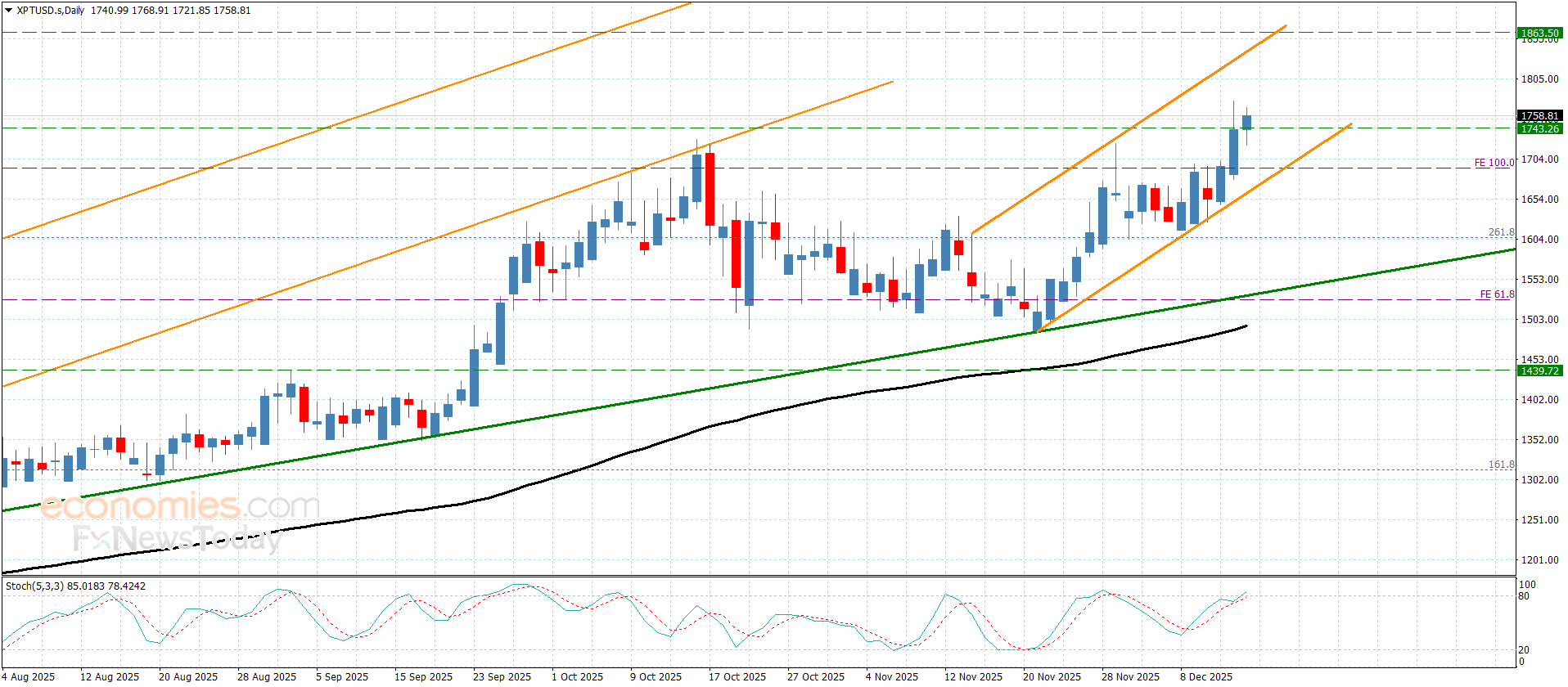
Copper price ended Friday’s trading by providing new bullish close above $5.1300 level, confirming the continuation of the bullish scenario in the near and medium period, attacking the barrier at $5.3200.
The price needs a new bullish momentum to confirm breaching the obstacle, recording new gains that might extend towards $5.5000, if the next main target in the positive trading, while the decline below $5.1300 and providing negative close will push it to form strong corrective waves, suffering several losses by reaching $4.9500.
The expected trading range for today is between $5.2000 and $5.5000
Trend forecast: Bullish
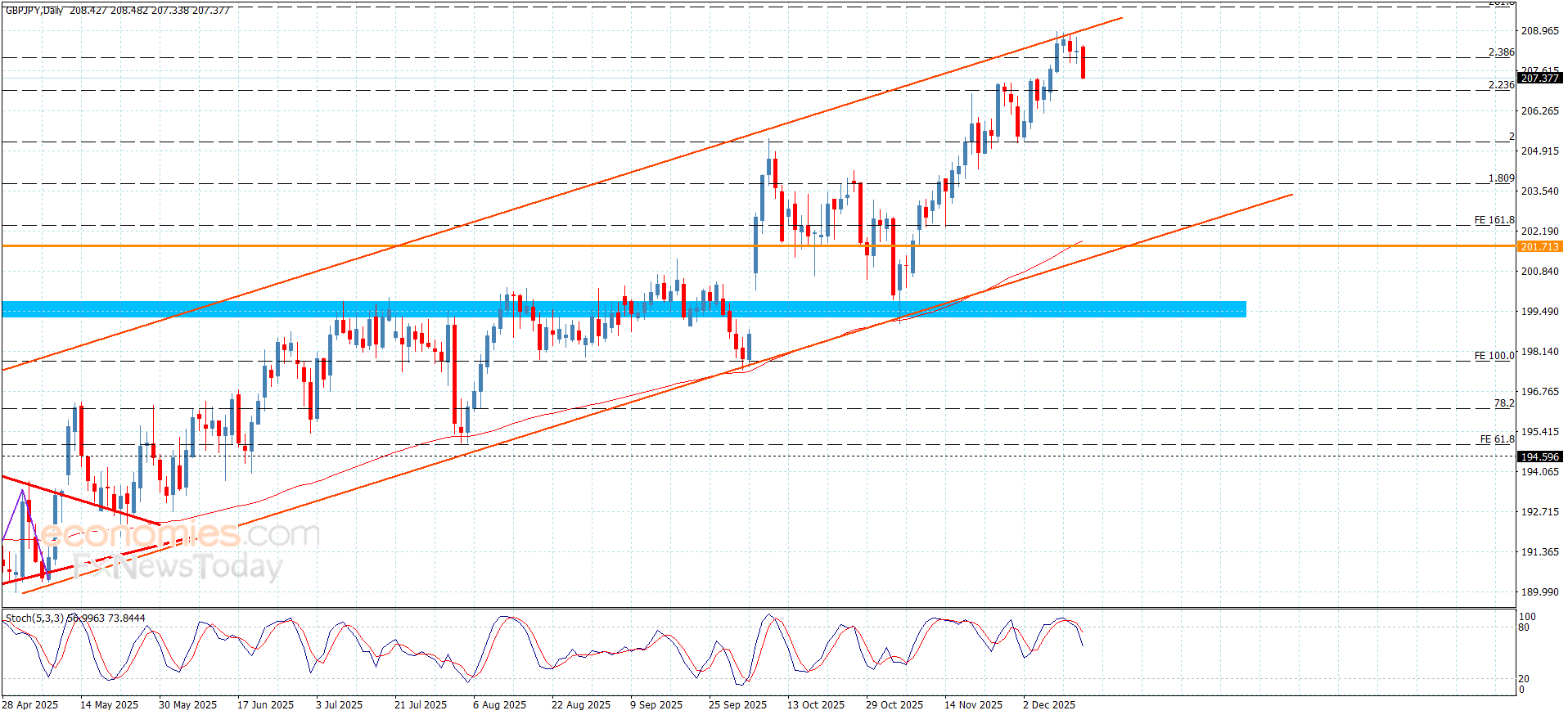
The GBPJPY pair provided a new negative close below the resistance at 208.95, to force it to activate the attempts of gathering gains, to reach 207.35 this morning, facing negative pressures by stochastic exit from the overbought level confirms the importance of reaching extra support at 206.95.
The stability above the targeted support will reinforce the chances of forming positive attempts to target 208.10 level, reaching the mentioned main resistance, while the decline below this support and providing negative close will open the way for resuming the bearish corrective attack, which might target 206.30 and 205.80 level.
The expected trading range for today is between 206.95 and 208.20
Trend forecast: Bearish
Silver (XAG/USD) attracts fresh buyers at the start of a new week and reverses a part of Friday’s retracement slide from the all-time peak, around the $64.65 region. The white metal trades above mid-$62.00s during the Asian session, up 1.25% for the day, and seems poised to prolong its recent well-established uptrend.
From a technical perspective, the XAG/USD finds decent support and bounces off the 100-hour Simple Moving Average (SMA). The subsequent move back above the $62.00 round figure validates the positive outlook. However, neutral oscillators on the 1-hour chart and a slightly overbought Relative Strength Index (RSI) on the daily chart warrant some caution for aggressive bullish traders.
This, in turn, suggests that any further move up is more likely to face some barrier near the $63.00 mark. A sustained strength beyond, however, could lift the XAG/USD towards the next relevant hurdle near the $63.80 area. Some follow-through buying beyond the $64.00 round figure will reaffirm the constructive outlook and allow bulls to challenge the record high, around the $64.65 region.
On the flip side, weakness below the $62.00 mark might still be seen as a buying opportunity near the 100-hour SMA, currently pegged near the $61.45 region. A convincing break below, however, could drag the XAG/USD below the $61.00 round figure, towards the $60.80 zone, or Friday’s swing low. The latter should act as a key pivotal point, which, if broken, should pave the way for deeper losses.
Silver is a precious metal highly traded among investors. It has been historically used as a store of value and a medium of exchange. Although less popular than Gold, traders may turn to Silver to diversify their investment portfolio, for its intrinsic value or as a potential hedge during high-inflation periods. Investors can buy physical Silver, in coins or in bars, or trade it through vehicles such as Exchange Traded Funds, which track its price on international markets.
Silver prices can move due to a wide range of factors. Geopolitical instability or fears of a deep recession can make Silver price escalate due to its safe-haven status, although to a lesser extent than Gold’s. As a yieldless asset, Silver tends to rise with lower interest rates. Its moves also depend on how the US Dollar (USD) behaves as the asset is priced in dollars (XAG/USD). A strong Dollar tends to keep the price of Silver at bay, whereas a weaker Dollar is likely to propel prices up. Other factors such as investment demand, mining supply – Silver is much more abundant than Gold – and recycling rates can also affect prices.
Silver is widely used in industry, particularly in sectors such as electronics or solar energy, as it has one of the highest electric conductivity of all metals – more than Copper and Gold. A surge in demand can increase prices, while a decline tends to lower them. Dynamics in the US, Chinese and Indian economies can also contribute to price swings: for the US and particularly China, their big industrial sectors use Silver in various processes; in India, consumers’ demand for the precious metal for jewellery also plays a key role in setting prices.
Silver prices tend to follow Gold’s moves. When Gold prices rise, Silver typically follows suit, as their status as safe-haven assets is similar. The Gold/Silver ratio, which shows the number of ounces of Silver needed to equal the value of one ounce of Gold, may help to determine the relative valuation between both metals. Some investors may consider a high ratio as an indicator that Silver is undervalued, or Gold is overvalued. On the contrary, a low ratio might suggest that Gold is undervalued relative to Silver.
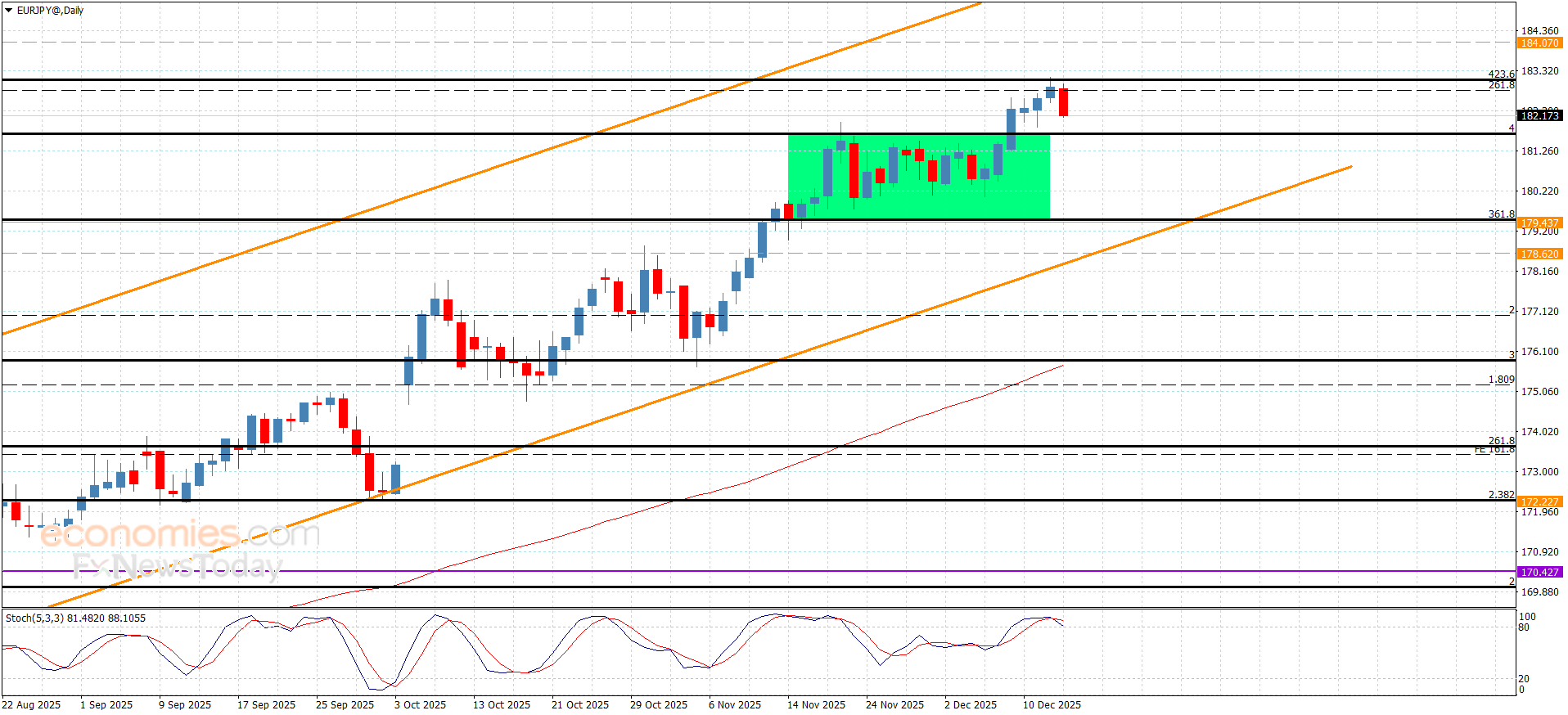
The EURJPY pair surrendered since this morning to the bearish corrective scenario, affected by the stability of the barrier near 183.30 besides stochastic exit from the overbought level, activating the attempts of gathering the gains by reaching 182.15.
Renewing the corrective attempts to test the extra support at 181.70, attempting to gather the positive momentum to form bullish waves and recover the current losses by its rally towards 182.80,
Waiting to breach the barrier to open the way for recording new gains that might extend towards 183.50 reaching the next main target at 184.10 in the near sessions.
The expected trading range for today is between 181.70 and 182.70
Trend forecast: Fluctuated within the bullish trend
Gold (XAU/USD) attracts buyers for the fifth straight day and climbs to the $4,330 region during the Asian session on Monday. The commodity remains well within striking distance of its highest level since October 21, touched on Friday, and seems poised to appreciate further amid a supportive fundamental backdrop. Traders, however, might opt to wait for this week’s important US macro releases, which would shape expectations about the Federal Reserve’s (Fed) rate-cut path and drive demand for the non-yielding yellow metal.
The delayed US Nonfarm Payrolls (NFP) report for October and Retail Sales are scheduled for release on Tuesday, along with the provisional manufacturing and services PMIs. This will be followed by the US consumer inflation figures on Thursday. Apart from this, speeches from influential FOMC members will determine the near-term trajectory for the US Dollar (USD). Investors this week will further take cues from the Bank of England (BoE) rate decision and the European Central Bank (ECB) meeting on Thursday, and the Bank of Japan (BoJ) policy update on Friday. This should provide a fresh directional impetus to the Gold price.
In the meantime, dovish US Federal Reserve (Fed) expectations fail to assist the USD to register any meaningful recovery from a two-month low, touched last Thursday, and continue to underpin the yellow metal. In a widely expected move, the US central bank lowered borrowing costs by 25 basis points (bps) at the end of a two-day policy meeting last Wednesday and projected one more rate cut in 2026. Investors, however, remain hopeful about two more rate cuts next year in the wake of Fed Chair Jerome Powell’s remarks, saying that the central bank does not want its policy to push down on job creation amid downside risks to the labor market.
Meanwhile, US President Donald Trump said last Friday that he was leaning toward choosing either former Fed Governor Kevin Warsh or National Economic Council Director Kevin Hassett to lead the US central bank next year. Market participants seem convinced that the new Trump-aligned Fed chair will be an uber-dovish and slash interest rates regardless of the economic fundamentals. This has been another factor behind the recent USD decline and suggests that the path of least resistance for the Gold price remains to the upside. Moreover, the emergence of dip-buying at the start of a new week and acceptance above the $4,300 mark validate the positive outlook.
Last week’s breakout through the $4,245-4,255 supply zone was seen as a key trigger for the XAU/USD bulls. Moreover, short-term moving averages slope higher, keeping the intraday bias pointing north. The broader setup remains supportive as dips attract demand around dynamic supports. The Moving Average Convergence Divergence (MACD) histogram stays positive but has been contracting from recent peaks, suggesting fading bullish momentum; the MACD line holds above the Signal line and above the zero line. RSI (14) prints 68 (near overbought), easing from earlier extremes and hinting that upside could be capped until momentum resets.
If buyers reassert control and the MACD histogram re-expands, the advance could extend towards retesting the all-time peak, while a further contraction accompanied by an RSI roll-over from the high-60s would favor consolidation. A sustained hold above rising short-term moving averages would preserve the bullish tone, whereas a close beneath these dynamic supports would open the door to a deeper pullback. Overall, momentum remains positive but stretched, which could translate into choppy trade before a decisive break emerges.
(The technical analysis of this story was written with the help of an AI tool)
Gold price (XAU/USD) climbs to seven-week highs above $4,325 during the Asian trading hours on Monday. The precious metal extends its upside amid the prospect of interest rate cuts by the US Federal Reserve (Fed) next year. Lower interest rates could reduce the opportunity cost of holding Gold, supporting the non-yielding precious metal. Additionally, uncertainty and the risk-off sentiment could boost the safe-haven flows, benefiting the yellow metal price.
Nonetheless, hawkish remarks from Fed officials last week could lift the US Dollar (USD) and weigh on the USD-denominated commodity price. Traders will take more cues from the speeches by Fed Governor Stephen Miran and New York Fed President John Williams later on Monday.
The US employment report for October and November will take center stage on Tuesday, including Nonfarm Payrolls (NFP), Average Hourly Earnings and Unemployment Rate. These reports could provide more clarity on the labor market’s health and likely influence expectations for the Fed’s January meeting.
Gold price trades in positive territory on the day. According to the four-hour timeframe, the positive outlook of the precious metal remains in play as the price holds above the key 100-day Exponential Moving Average. The Bollinger Band widens, suggesting a strong bullish trend. Furthermore, the upward momentum is reinforced by the 14-day Relative Strength Index (RSI), which stands above the midline near 68.75. This displays the bullish momentum for the yellow metal.
On the bright side, the first upside barrier to watch is in the $4,345-$4,355 zone, representing the upper boundary of the Bollinger Band and the high of December 12. Sustained upside momentum could take XAU/USD back up to an all-time high of $4,381. Further north, the next resistance level is located at the $4,400 psychological mark.
On the downside, the initial support level for the yellow metal is seen at the low of December 12 at $4,257. More bearish candlesticks reflect a continuation of downside pressure, possibly dragging the price down to the next bearish target at $4,200, the 100-day EMA. The next contention level emerges at $4,166, the lower limit of the Bollinger Band.
In the world of financial jargon the two widely used terms “risk-on” and “risk off” refer to the level of risk that investors are willing to stomach during the period referenced. In a “risk-on” market, investors are optimistic about the future and more willing to buy risky assets. In a “risk-off” market investors start to ‘play it safe’ because they are worried about the future, and therefore buy less risky assets that are more certain of bringing a return, even if it is relatively modest.
Typically, during periods of “risk-on”, stock markets will rise, most commodities – except Gold – will also gain in value, since they benefit from a positive growth outlook. The currencies of nations that are heavy commodity exporters strengthen because of increased demand, and Cryptocurrencies rise. In a “risk-off” market, Bonds go up – especially major government Bonds – Gold shines, and safe-haven currencies such as the Japanese Yen, Swiss Franc and US Dollar all benefit.
The Australian Dollar (AUD), the Canadian Dollar (CAD), the New Zealand Dollar (NZD) and minor FX like the Ruble (RUB) and the South African Rand (ZAR), all tend to rise in markets that are “risk-on”. This is because the economies of these currencies are heavily reliant on commodity exports for growth, and commodities tend to rise in price during risk-on periods. This is because investors foresee greater demand for raw materials in the future due to heightened economic activity.
The major currencies that tend to rise during periods of “risk-off” are the US Dollar (USD), the Japanese Yen (JPY) and the Swiss Franc (CHF). The US Dollar, because it is the world’s reserve currency, and because in times of crisis investors buy US government debt, which is seen as safe because the largest economy in the world is unlikely to default. The Yen, from increased demand for Japanese government bonds, because a high proportion are held by domestic investors who are unlikely to dump them – even in a crisis. The Swiss Franc, because strict Swiss banking laws offer investors enhanced capital protection.