The main category of Forex News.
You can use the search box below to find what you need.
[wd_asp id=1]
The main category of Forex News.
You can use the search box below to find what you need.
[wd_asp id=1]
On Tuesday, December 16, preliminary private sector PMI data will be in focus. The S&P Global Services PMI will be the focal point, given that services account for around 70% of the GDP. Economists forecast the S&P Global Services PMI to drop from 53.2 in November to 51.6 in December.
While slower services sector activity may signal a loss of economic momentum, holding above the 50 neutral level will be key. Furthermore, traders should focus on the employment and prices sub-components. A tighter labor market, higher wage growth (input prices), and hotter inflation (output prices) would signal a more hawkish BoJ rate path.
On Wednesday, December 17, Japanese trade data will provide insights into the effect of US tariffs on demand. Economists predict exports to rise 4.8% year-on-year (YoY) in November, up from 3.6% in October. Imports are expected to rise 2.5% YoY in November, up from 0.7% in October.
A sharp pickup in external demand and robust imports would support Governor Ueda’s view that US tariff risks have diminished. Given Japan’s trade-to-GDP ratio is roughly 45%, improving trade terms would boost the economy and demand for the yen.
For context, external demand fell 0.2% quarter-on-quarter in Q3, contributing to a 0.6% economic contraction. However, the US reduced tariffs on Japanese goods from 25% to 15% in Q3, boosting external demand early in Q4.
On Friday, December 19, national inflation figures will draw interest ahead of the BoJ’s monetary policy decision. Economists forecast the so-called core-core annual inflation rate to remain at 3.1% in November. Steady or rising core-core inflation would boost expectations of a more hawkish BoJ monetary policy outlook.
Copper is closing out 2025 with the kind of price action usually reserved for crisis commodities: sharp rallies, sudden air pockets, and a market that looks tight in some places and oddly comfortable in others. Midway through December, London Metal Exchange (LME) copper is still trading at historically elevated levels after repeatedly printing new highs this month—supported by supply disruptions, policy-driven shifts in global inventory, and a fresh narrative that “AI infrastructure is the new mega-demand driver.” [1]
So what’s the most realistic copper price forecast for December 2025—not next year, not “the decade of electrification,” but the final stretch of this month?
Based on the latest price signals, inventory movements, and the newest forecasts and analyst notes published over the past several days, the most defensible view is this: copper prices are likely to remain high and volatile through the rest of December 2025, with a market bias to hold above $11,000/ton—unless a risk-off shock or a sudden reversal of U.S.-centric stockpiling breaks the spell. [2]
The latest day-delayed LME three-month closing price shows copper at $11,515 per metric ton (down 3.01% on the day shown). [3]
But the bigger signal for December is the ceiling copper has been testing: Reuters reported LME three-month copper touched $11,952/ton in intraday trading this month, keeping the market within reach of the psychologically important $12,000 threshold that traders and procurement desks watch closely. [4]
Shanghai has been reinforcing the bullish tone. Reuters also reported the most-traded Shanghai Futures Exchange (SHFE) copper contract hit fresh records around 94,570 yuan/ton during the same rally, highlighting that the bid isn’t purely a London or U.S. story. [5]
What this means for a December 2025 forecast: the market has already proven it can trade in the high-$11,000s and flirt with $12,000. The real question is whether it can stay there into month-end as liquidity thins and macro headlines hit.
Copper’s late-2025 strength isn’t a single narrative. It’s a triangle: (1) supply disruptions, (2) tariff-driven stock movements, and (3) demand stories that are bigger than construction.
Recent analysis from ING points to a year of disruptions tightening the near-term balance, naming major incidents and outages at key global operations (including Indonesia’s Grasberg, the DRC’s Kamoa-Kakula, and Chile’s El Teniente), while also flagging broader issues like declining ore grades and operational setbacks in top-producing regions. [6]
The market takeaway: even when demand is debated, supply uncertainty is real—and it’s being priced like a risk premium.
One of the most important December 2025 dynamics is that the copper market is tight outside the United States—while U.S. exchange inventories have swelled.
Reuters commentary described a “market fracture” where the U.S. has become a magnet for copper due to lingering tariff uncertainty and pricing distortions between COMEX and the LME—encouraging physical metal to flow into U.S. warehouses. [7]
In parallel, Reuters reporting this month highlighted that COMEX stocks now account for a large share of exchange-traded copper, reinforcing the idea that a significant slice of “visible inventory” has been effectively ring-fenced in the U.S. system. [8]
ING’s latest note adds more color: it argues that tariff risk and arbitrage have distorted global flows, leaving ex-U.S. inventories low, and warns that if tariff expectations change, stock could flow back out—potentially flipping the price dynamic quickly. [9]
Reuters’ latest round-up on the copper rally explicitly linked the move toward $12,000 to surging demand tied to AI-powered data centers and power infrastructure, alongside renewable energy and electrification themes. [10]
At the same time, the “Doctor Copper” signal is complicated: manufacturing data in several regions has not been uniformly strong, yet copper is behaving as if demand is roaring—because the market is also pricing future infrastructure buildouts and near-term supply risk. [11]
No December copper forecast is credible without a China reality check—because China remains the world’s dominant copper consumer and a major force in refined metal flows.
Two recent developments matter:
Those signals can coexist: China can be price-sensitive at the margin (imports dip) while still exporting or repositioning refined metal when arbitrage windows open.
On the policy side, sentiment got a lift after Chinese leaders signaled continued support for fiscal policy heading into 2026—news that Reuters said helped propel both SHFE and LME copper during the latest leg higher. [14]
Bottom line for December: China is unlikely to be a straight-line demand story. For the rest of the month, traders will watch whether policy optimism translates into sustained buying—or whether high prices keep triggering demand resistance.
Here’s a forecast framework that matches what markets are signaling right now—and what the latest analyst notes suggest about support, upside, and the risks that could break the trend.
Forecast range:$11,000–$11,900 per ton for LME three-month copper into late December
Most likely month-end zone:mid-to-high $11,000s, assuming no major macro shock
Why this is the base case:
Forecast range:$11,900–$12,400 per ton (with brief spikes possible)
Catalysts that could trigger the bull case before month-end:
Forecast range:$10,700–$11,200 per ton
Bear-case triggers:
A key feature of December 2025 is that forecasters are not aligned. Some see this as the start of a multi-year supercycle move. Others see a near-term peak that will cool once stockpiling fades and surplus asserts itself.
Over the past week, multiple bullish forecasts have been circulating:
Even if those are primarily 2026 forecasts, they matter for December 2025 because the market trades forward: when banks raise targets and deficits are discussed, it can keep dips shallow into year-end.
Goldman Sachs Research published a more cautious view in the last few days:
Why this matters for December 2025: if traders begin to believe the “surplus” framing into year-end, rallies can fade faster—especially during thin holiday liquidity.
When copper prices surge, miners get pressured to secure long-life, high-quality assets. This month’s deal headlines are reinforcing the market’s long-term conviction—even if they don’t change December spot balances overnight:
For the December 2025 forecast, M&A is mostly a sentiment factor—but sentiment matters when the market is already stretched near records.
If you’re tracking copper prices through the remainder of December 2025, these are the catalysts that can realistically shift the market within days—not quarters.
Copper’s December 2025 setup is unusual: it’s bullish for reasons that are partly fundamental (real supply disruptions, tightness outside the U.S.) and partly structural/policy-driven (tariff uncertainty and inventory relocation). [36]
That mix typically produces two things:
Putting it together, the most realistic forecast for the remainder of December 2025 is a high but choppy market, with $11,000/ton as the key support area and $12,000/ton as the level that defines whether copper ends 2025 in full breakout mode—or in consolidation. [37]
This article is for informational purposes only and does not constitute investment advice.
1. www.lme.com, 2. think.ing.com, 3. www.lme.com, 4. www.tradingview.com, 5. www.tradingview.com, 6. think.ing.com, 7. www.reuters.com, 8. www.reuters.com, 9. think.ing.com, 10. www.reuters.com, 11. www.reuters.com, 12. www.reuters.com, 13. www.reuters.com, 14. www.tradingview.com, 15. think.ing.com, 16. www.lme.com, 17. www.tradingview.com, 18. www.reuters.com, 19. think.ing.com, 20. energynews.oedigital.com, 21. www.reuters.com, 22. think.ing.com, 23. www.tradingview.com, 24. www.tradingview.com, 25. www.northernminer.com, 26. www.fastmarkets.com, 27. www.goldmansachs.com, 28. www.goldmansachs.com, 29. www.reuters.com, 30. www.reuters.com, 31. www.reuters.com, 32. think.ing.com, 33. www.reuters.com, 34. think.ing.com, 35. energynews.oedigital.com, 36. think.ing.com, 37. think.ing.com
Oil prices are limping into the final weeks of 2025 with Brent crude hovering just above $60 a barrel and traders fixated on one word: oversupply. As of Friday, December 12, Brent settled at about $61.12 per barrel and WTI at $57.44, both benchmarks down more than 4% for the week and sitting near their lowest levels in several years. [1]
At the same time, big agencies and Wall Street banks are rolling out fresh forecasts that increasingly point to sub‑$60 oil in 2026, even as OPEC insists the market will be roughly balanced next year. [2]
This article pulls together the latest December 2025 data, forecasts and analysis to sketch out a near‑term oil price forecast for December 2025, and what it might mean for 2026.
In short, December 2025 oil prices are weak, but not collapsing: Brent is holding around the low $60s, yet sentiment is sharply bearish because of what’s happening in supply, demand and inventories.
The IEA’s December 2025 Oil Market Report paints a clear picture:
That imbalance is now showing up in stockpiles:
That’s why recent IEA forecasts of a glut have become one of the main downward forces on prices this month.
A big part of the story is where the barrels are sitting. The IEA highlights a surge in oil on water — crude in transit or temporarily floating — as sanctioned barrels struggle to find buyers and long‑haul shipments from the Americas to Asia jump. [11]
Private‑sector and media analysis has picked this up and sharpened it:
Taken together, the narrative going into December is clear: there is simply too much oil around, and it’s increasingly visible in both inventories and shipping data.
The latest U.S. Energy Information Administration (EIA) Short‑Term Energy Outlook, released on December 9, 2025, explicitly bakes falling prices into its forecast: [14]
Those numbers don’t give a precise December 2025 point forecast, but they send a strong signal: in the EIA’s baseline, the path of least resistance for prices is lower from here, not higher.
It’s important to note that demand itself is not in freefall. The IEA has actually revised its 2025 and 2026 demand growth estimates up slightly, helped by a brighter macro outlook and a weaker U.S. dollar. It now expects:
Cheaper crude and a softer dollar typically support consumption, especially in emerging markets. But when supply growth is running more than double demand growth, as 2025’s numbers suggest, the demand side simply can’t absorb all the new barrels.
Even as the market leans bearish, there is no unified view on just how oversupplied 2026 will be — and that’s crucial context for any December 2025 oil price forecast.
The IEA’s December update trimmed its 2026 surplus estimate for the first time since May, but it still expects global supply to exceed demand by about 3.84 million bpd in 2026, close to 4% of world consumption. [17]
This forecast, heavily publicised in recent days, has weighed on prices throughout December by reinforcing expectations of:
OPEC strongly disputes the idea of a huge oversupply:
OPEC+ has also said it will pause further production increases in the first quarter of 2026, citing widespread predictions of oversupply and signalling that it is prepared to defend prices if needed. [20]
Banks and market surveys sit somewhere between these two poles – but skewing bearish:
In other words, the centre of gravity for 2026 forecasts has shifted into the high‑50s to low‑60s range for Brent, with significant disagreement about how quickly, and from what level, prices will get there.
Major agencies don’t typically publish a day‑by‑day December 2025 oil price forecast, but combining their latest projections with current market behaviour allows us to sketch plausible trading ranges and scenarios for the remainder of the month.
Recent weekly coverage shows a market that reacts more to glut headlines than to geopolitical risk:
Against that backdrop, here’s a scenario‑based December 2025 oil price outlook centred on Brent, with WTI typically trading a few dollars lower.
Important note: The ranges below are analytical scenarios, not guarantees, and are based on current information as of mid‑December 2025. They are not investment advice.
Probability: High | Indicative range (rest of December): Brent ~$60–65, WTI ~$56–61
In this scenario, the narrative that has dominated early December continues:
In this base case, December 2025 looks like a transition month:
Probability: Moderate | Indicative range: Brent ~$55–60, WTI ~$51–57
Here, the glut narrative intensifies just as liquidity thins into year‑end:
Under these conditions, it would not be surprising to see:
The main factor that could limit the downside in this scenario is the growing concern that WTI in the $50–60 range is at or below breakeven for many new U.S. shale wells, which could eventually choke off supply growth. [31]
Probability: Lower | Indicative range: Brent ~$65–72, WTI ~$61–68
For a meaningful rally this month, several things would probably have to line up at once:
Even then, the substantial 2026 surplus projected by the IEA and the sub‑$60 averages envisioned by many banks suggest that any December rally would likely face heavy selling into the high $60s–low $70s, as traders view it as an opportunity to re‑establish shorts or hedge. [35]
Lower crude prices are already filtering through to refined products:
For households and fuel‑intensive businesses, a December spent in the low‑$60s for Brent solidifies expectations of relief at the pump in 2026.
For producers, the December trend is far more uncomfortable:
If December closes near current levels, it will reinforce the idea that 2024–2025’s high‑price era is over, and that oil companies must compete in a lower‑price, transition‑driven environment.
Several near‑term catalysts could still sway oil prices before year‑end:
Pulling all of this together, the most reasonable oil price forecast for December 2025 is:
The balance of evidence from the IEA, EIA, OPEC, Wall Street banks and independent analysts points toward lower average prices in 2026, with many forecasts clustering around mid‑$50s to low‑$60s for Brent and a somewhat cheaper WTI benchmark. [42]
That makes December 2025 less about spectacular price moves and more about setting the baseline for a new phase in the oil market — one defined less by scarcity and more by abundance, rising inventories and the growing weight of the energy transition.
Disclaimer: This article is for informational purposes only and does not constitute investment, trading, or financial advice. Oil markets are volatile, and prices can move sharply on new information.
1. www.reuters.com, 2. www.eia.gov, 3. www.reuters.com, 4. www.reuters.com, 5. tradingeconomics.com, 6. www.iea.org, 7. www.iea.org, 8. www.iea.org, 9. www.iea.org, 10. www.iea.org, 11. www.iea.org, 12. www.ft.com, 13. markets.financialcontent.com, 14. www.eia.gov, 15. www.eia.gov, 16. www.reuters.com, 17. www.reuters.com, 18. www.reuters.com, 19. www.reuters.com, 20. www.reuters.com, 21. www.reuters.com, 22. www.reuters.com, 23. www.reuters.com, 24. oilprice.com, 25. www.reuters.com, 26. www.reuters.com, 27. www.reuters.com, 28. www.eia.gov, 29. www.iea.org, 30. www.ft.com, 31. oilprice.com, 32. www.reuters.com, 33. www.iea.org, 34. www.iea.org, 35. www.eia.gov, 36. www.eia.gov, 37. markets.financialcontent.com, 38. www.reuters.com, 39. markets.financialcontent.com, 40. www.reuters.com, 41. www.reuters.com, 42. www.eia.gov
Yes. Atmospheric G2 projects widespread warmth across the western, central, and southern U.S. between December 17–26. That shift has quickly unwound last week’s rally to a nearly three-year high. Lower-48 gas demand on Friday was estimated at 110.6 bcf/day, down 3.4% year-over-year, showing the direct impact of weaker weather-driven consumption.
Strongly. U.S. dry gas production hit 112.5 bcf/day on Friday, up 7.1% from a year ago, according to BNEF. The EIA also raised its 2025 production forecast to 107.74 bcf/day. While the active rig count slipped by 2 to 127, it remains just below a 2.25-year high. Robust supply in the face of weak demand continues to pressure prices lower.
Limited. The EIA reported a -177 bcf draw for the week ending December 5—larger than both consensus and the five-year average—but inventories remain 2.8% above seasonal norms and flat year-over-year. European storage sits at 71% capacity, well below its five-year average of 81%, but LNG flows to U.S. terminals fell 3% week-over-week to 18.1 bcf/day.
Bearish. With warmer forecasts extending through late December and long liquidation still in play, sellers remain in control. While some technical indicators may be signaling oversold conditions—raising the risk of a short-covering rally—any bounce must be evaluated carefully.
Traders need to distinguish between technical retracements and rallies tied to a meaningful bullish shift in the weather outlook. Continued guessing will be punished, as fundamentals will ultimately prevail. Unless forecasts turn colder or prices find firm support near $3.913, the downside bias remains intact.
More Information in our Economic Calendar.
I wrote on the 7th December that the best trades for the week would be:
Overall, these trades gave a gain of 1.36% per asset.
A summary of last week’s most important data:
Last week’s data had a marginal impact, with the most important market outcome likely to be a continued strengthening of the Swiss Franc, which has been quietly gaining and gaining. This is a currency with a positive real rate of interest which is being allowed by its central bank to steadily strengthen. It is extremely attractive as a safe haven currency, with the Swiss National Bank’s machinations in 2015 mostly forgotten.
The other major impact was the Fed’s hawkish rate cut, with markets now pricing in only a single rate cut of 0.25% in both 2026 and 2027, even though President Trump will be appointing a new Fed Chair in May 2026 and he wants a Chair who will support aggressive rate cuts. However, Trump has now indicated that Kevin Warsh is currently favourite for the position, and he leans towards a hawkish approach.
Most stock markets ended the week slightly lower. It was generally a week of little change in the financial markets, except precious metals, which look increasingly bullish.
The US Dollar had a bearish week, breaking down below key support and invalidating its former long-term bullish trend which had recently begun.

The coming week is the last full week of open markets before the Christmas holiday gets underway. This might mean a more active market than usual, because the week is full of important central bank policy meetings (including two widely expected rate cuts) and inflation data.
We are likely to see an increase in volatility this week.
This week’s most important data points, in order of likely importance, are:
Currency Price Changes and Interest Rates
For the month of December 2025, I made no forecast.
Last week, I made no forecast, as there were no recent excessive moves in currency crosses.
The Euro was the strongest major currency last week, while the Japanese Yen was the weakest. Directional volatility fell again last week, with only 19% of all major pairs and crosses changing in value by more than 1%.
Next week’s volatility could be large as there will be three major central bank policy meetings plus key inflation data.
You can trade these forecasts in a real or demo Forex brokerage account.
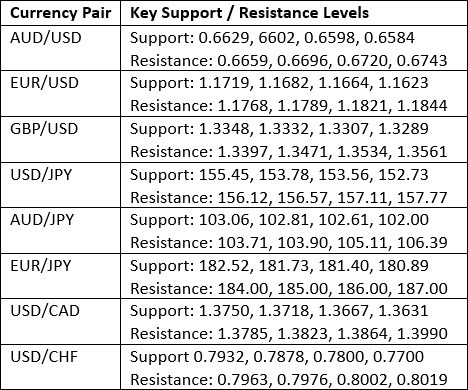
Key Support and Resistance Levels
Last week, the US Dollar Index printed another bearish candlestick with only a minor lower wick. The price is still above its level of 13 weeks ago, but below its level of 26 weeks ago, so by my preferred metric, I declare the long-term bullish trend has failed. The price has also broken below a cluster of key support levels which had held for a long time, which I see as a very bearish sign for the greenback.
The Fed is cut its interest rate last week by 0.25% as was widely expected. However, the outlook for further rate cuts over the coming two years looks very slight. It is interesting that the market is shaking that off, which would normally put a bid into the Dollar, and continuing to sell it – that is a bearish sign.
I think being short of the US Dollar will be a generally good approach now, so over the coming week I will look for trades which fit that bias.
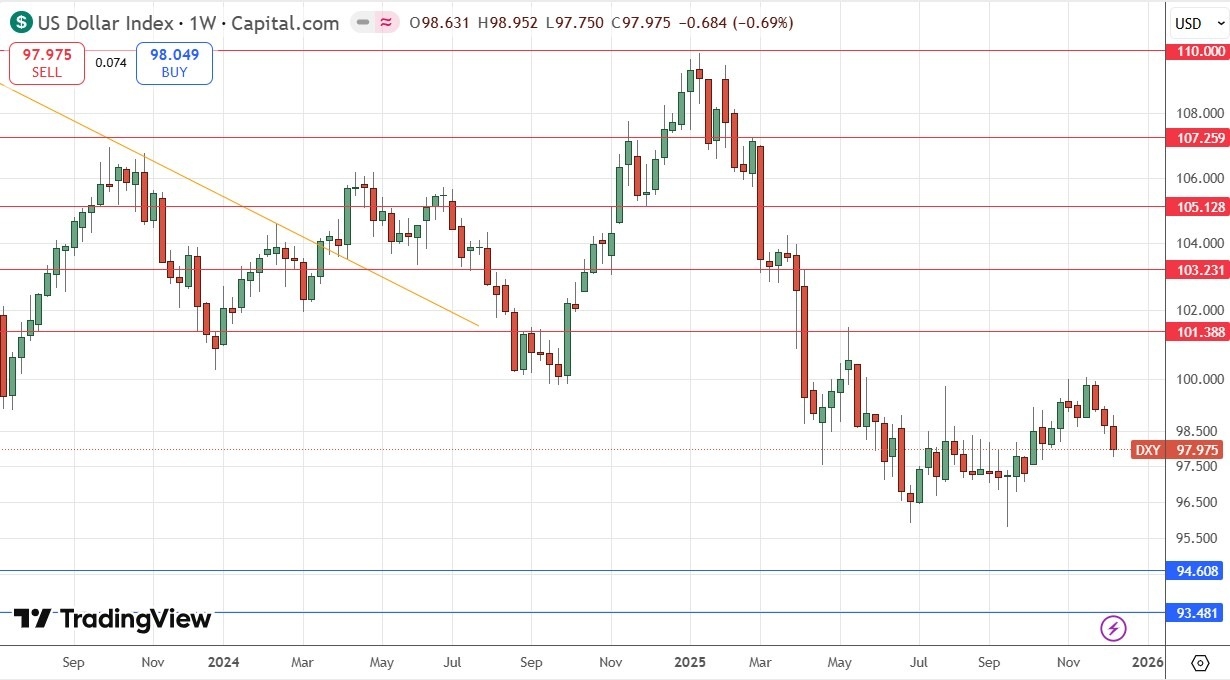
US Dollar Index Weekly Price Chart
The CHF/JPY currency cross weekly chart printed a powerful bullish candlestick that reached an all-time high price. This alone is a notably bullish sign but just look at the orderly ascending trend we have seen here since March this year, shown by the linear regression price channel study in the price chart below.
I usually ignore trends in currency crosses, but this is a powerful one. There are also good fundamental reasons why the Swiss Franc has been the strongest major currency over the long term, and the Japanese Yen has been the weakest.
The Swiss Franc has a zero interest rate but deflation, so the currency is naturally appreciating, while the Japanese Yen has been declining for a long time due to an ultra-loose monetary policy. However, that might change for the Yen soon, as the Bank of Japan is expected to hike rates this week, and might even begin a more aggressive and continuous round of hikes in 2026.
I will not be going long here myself, but it is something other trades might want to investigate and consider.
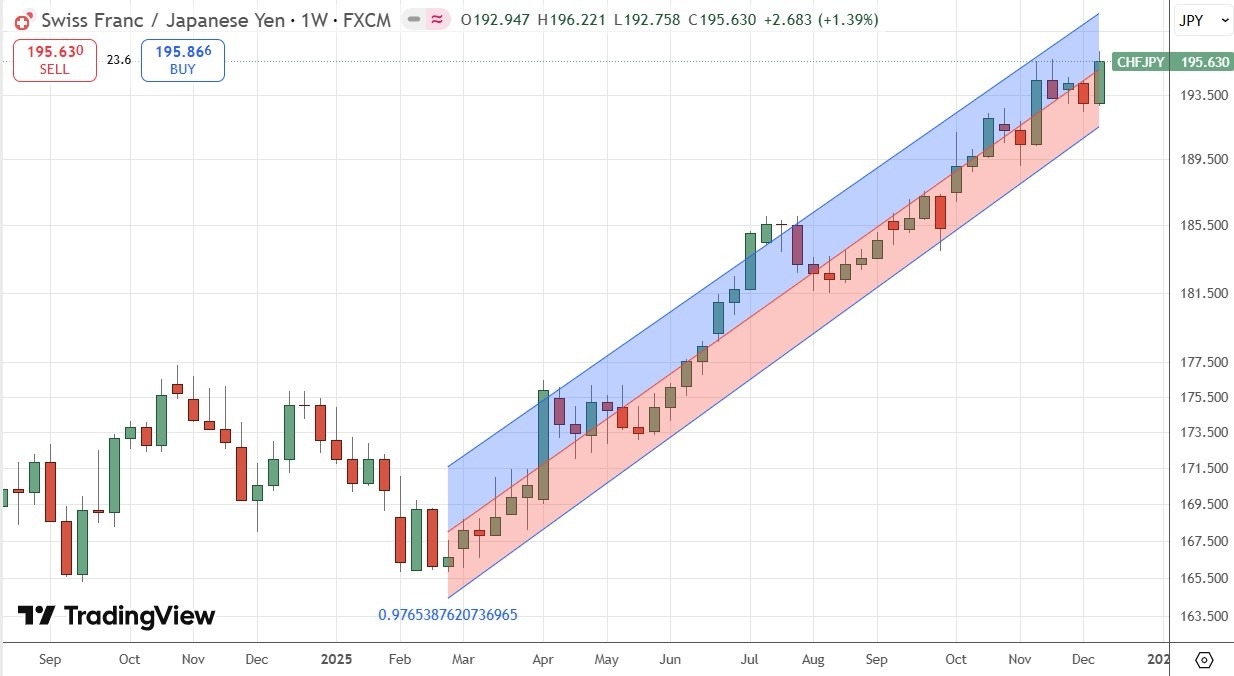
CHF/JPY Weekly Price Chart
The weekly price chart below shows that this major US stock index fell last week, after coming very close to breaking its record high just a few weeks ago. It closed at a record high closing price on Thursday, and then opened high on Friday and then fell sharply to print a bearish near pin-bar candlestick.
This is a bearish sign, which could well be dangerous to act upon. I am not advocating going short, but bulls should be worried, although it is clearly still a bull market.
I wrote a week or two ago that I was becoming more convinced that we have already seen a medium-term high in this stock market index, and this confirms my opinion. I think we are seeing a topping out which is likely to start some kind of retracement.
The Fed seems less and likely to make significant rate cuts in the foreseeable future, and there are strong and realistic concerns about an AI bubble and a general over-valuation of the stock market, so a bearish retracement cannot be a big surprise if it happens.
However, if we get a daily close with no significant upper wick on that day’s candle above the record high at 6,930, I will enter a new long trade.
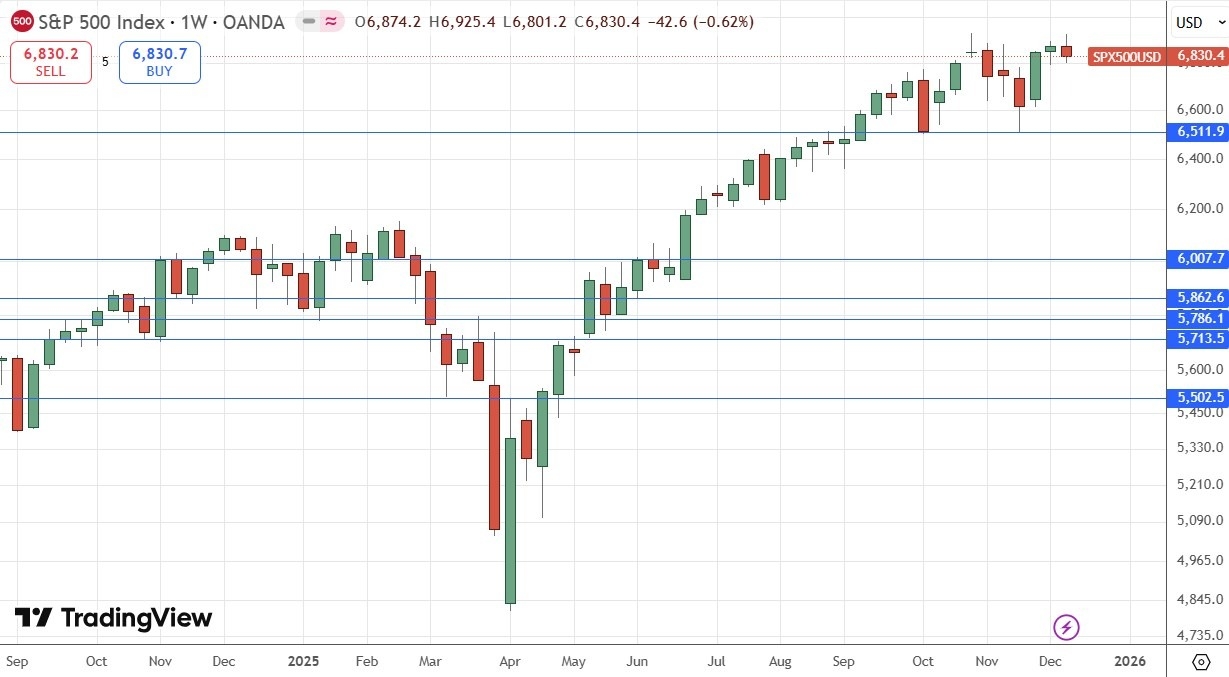
S&P 500 Index Weekly Price Chart
A few weeks / months ago, Silver was in a strong bullish trend which saw the price increase by about 50% in only two months. The rise peaked in October and saw quite a strong retracement, which is usually a sign that the price is not going to make new highs soon. This bearish outlook was reinforced by what seemed to be a bearish double top formed just four weeks ago. However, the price has come up again and then made a very strong bullish breakout with an unusually large move.
We saw a further gain last week as the bullish momentum continued. Volatility is high and the moves can be messy but it’s a bullish breakout that continues to advance.
Another bullish factor is that all the major precious metals rose in value last week, although there is no doubt the Silver is leading the way.
Due to the high volatility and “second bite” breakout, as well as the significant upper wick on the weekly candlestick, I think a half-sized long position is best here, and only after we see a new record high daily close at or above $63.57.
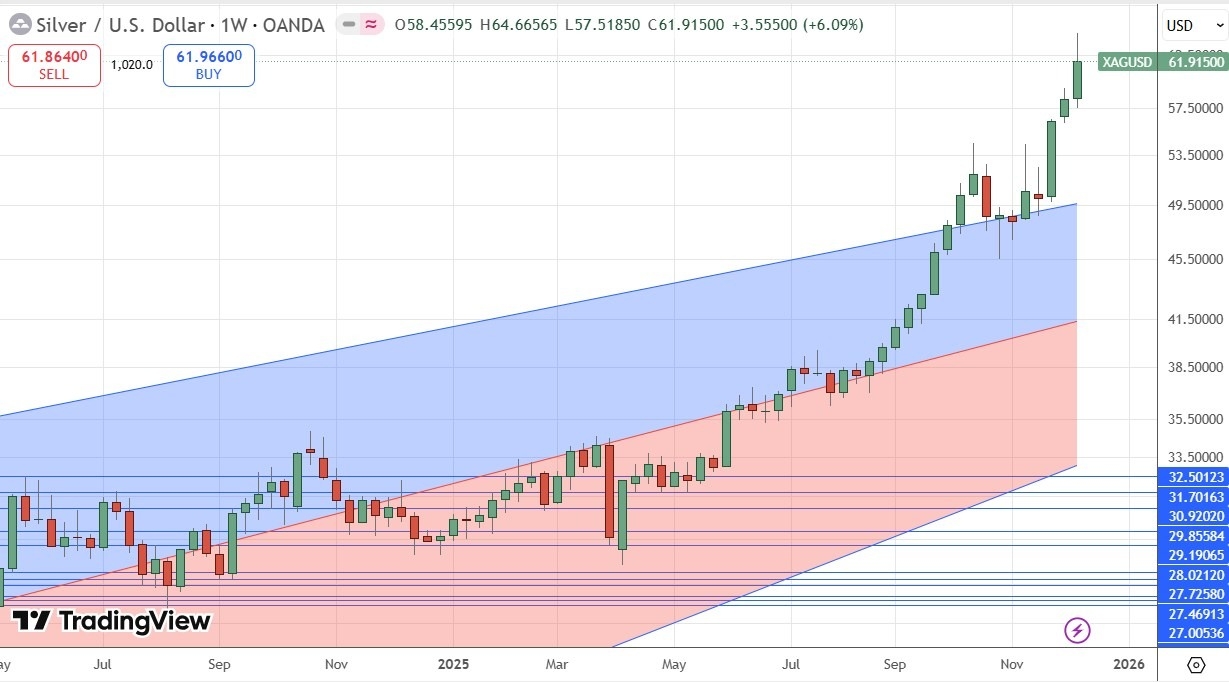
Silver Weekly Price Chart
All precious metals have been rising as an asset class, partly fueled by Fed policies and the declining Dollar, partly due to safe haven inflow.
Silver has clearly been leading the way, but this past week has seen Gold start to catch up with a minor bullish breakout beyond the $4,270 area.
The record high above $4,300 is now in sight, but Gold formed a pin bar on Friday which puts some doubt into whether it will retest or even exceed its record high which it made in October.
I will keep a close eye on Gold and enter a new long trade if we get a daily close above the record high, at or above $4,355.80.
If this long trade sets up, as the progress upwards has been steadier and more orderly than what we have seen in Silver, you might keep a normal position size. I will prefer to use half my normal position size.
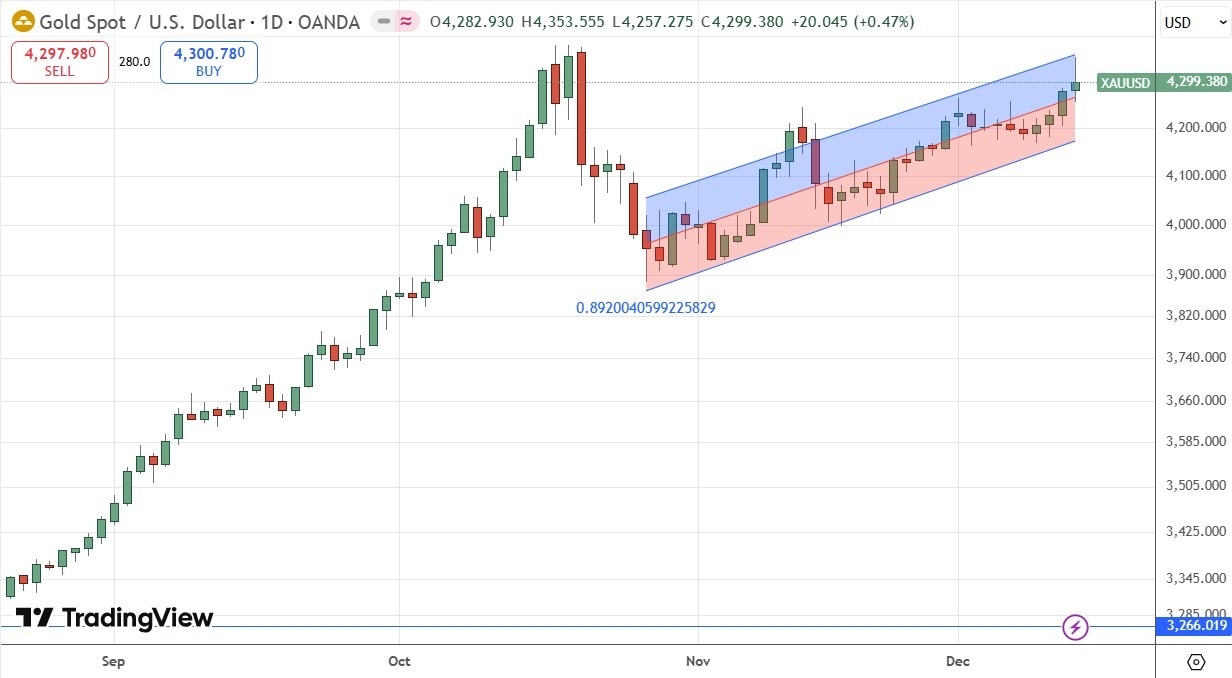
Gold Weekly Price Chart
I see the best trades this week as:
Ready to trade our weekly Forex forecast? Check out our compilation of the top 100 Forex brokers in the world.
The most notable development last week was the move in U.S. Treasurys. The 10-year yield rallied to 4.186%, its highest level since September 2025, closing up 0.047 on the week.
That rise would typically act as a headwind for bullion, and it likely contributed to gold pausing just below last week’s peak. Traders noted that the Fed’s divided vote on its third consecutive rate cut raised questions about the pace of easing in 2026, and the market responded by pushing yields higher rather than lower.
With the 10-year sitting just off multi-month highs, any further firming this week could temporarily slow gold’s upside attempts.
Despite the rise in yields, the U.S. dollar moved in the opposite direction, slipping to multi-month lows and offering consistent support for gold. The disconnect between stronger yields and a weaker dollar gave traders a unique setup: gold faced pressure from the bond market but continued to attract demand from overseas buyers taking advantage of favorable currency conditions.
As long as the dollar stays soft, gold retains a tailwind even in the face of elevated Treasury yields.
This week’s data will shape how traders interpret the Fed’s next steps. Payrolls are expected to show flat hiring in October and a modest 50,000 increase in November, with unemployment edging up to 4.5%.
Silver prices surged above $60 and hit a record $64.64 this week, powered by Fed cuts, a global supply squeeze, and booming industrial demand. Here’s the latest news, key drivers, and a 2026 forecast outlook for silver (XAG/USD).
Published: Dec. 14, 2025
Silver just delivered one of the most dramatic weeks in modern precious-metals trading: a clean break above $60/oz, a sprint to fresh all-time highs near $64–$65, and then a sharp, late-week pullback as traders took profits into the weekend.
From December 8 to December 14, 2025, the story of silver prices has been equal parts macro (a Federal Reserve rate cut and a softer U.S. dollar), micro (tight physical availability and inventory shifts), and structural (multi‑year supply deficits colliding with relentless industrial demand—from solar and EVs to the accelerating build-out of AI infrastructure). [1]
Below is a detailed recap of the week’s key developments, the most-cited forecasts and analyst views published in the Dec. 8–14 window, and the price levels investors are watching next.
Monday, Dec. 8: Silver started the week softer as markets waited for the Fed. Spot silver was reported around $57.98/oz, after having hit $59.32 the prior Friday. [2]
Tuesday, Dec. 9: The psychological barrier broke. Spot silver jumped above $60 and printed a new all-time high around $60.74/oz, with Reuters citing “supply constraints” and strong multi‑year demand expectations. [3]
Wednesday, Dec. 10: After the Fed’s decision, the rally extended. Reuters reported silver hitting a new record near $61.85/oz, with prices up roughly 113% year-to-date at that point and supported by industrial demand, falling inventories, and silver’s U.S. “critical mineral” designation. [4]
Thursday, Dec. 11: Momentum accelerated. Reuters reported spot silver up near $64.22/oz, hovering close to a record high around $64.31/oz, as the U.S. dollar weakened and investors digested the Fed’s cut and outlook. [5]
Friday, Dec. 12: A blow-off top — and a reality check. Reuters reported silver hitting an all-time high of $64.64/oz, then falling nearly 3% to about $61.7/oz as profit-taking set in. Reuters also noted silver was up nearly 5% on the week and up about 112% in 2025. [6]
Weekend, Dec. 13–14: With major markets closed, analysis shifted to sustainability and local-market spillovers. In India, The Economic Times reported MCX silver futures crossed Rs 2,00,000, with the March contract touching Rs 2,01,615 on Dec. 12, before a correction—underscoring how global dollar moves and domestic currency dynamics can amplify volatility. [7]
For a futures-market snapshot, Investing.com’s silver futures historical data shows a sharp climb into the week’s peak and a lower close into Friday (Dec. 12). [8]
The week’s biggest macro catalyst was the Federal Reserve’s quarter‑point rate cut and the market’s attempt to interpret what comes next.
Reuters coverage across the week emphasized that lower rates tend to favor non‑yielding precious metals, and that the U.S. dollar’s decline helped support silver’s rally as the metal became cheaper for non‑U.S. buyers. [9]
But the tone wasn’t purely “dovish.” Reuters also highlighted policy uncertainty and internal division, a reminder that silver can react violently if rate expectations reprice. [10]
Why it matters for silver: Unlike gold, silver is both a monetary and an industrial asset. When easing financial conditions coincide with strong manufacturing and electrification demand, silver often behaves like a “high-beta” precious metal—moving more than gold in both directions. [11]
A critical theme running through Dec. 8–14 commentary: the physical market looks tight, even when headline inventories appear large.
The takeaway: Silver’s rally isn’t only a paper-market story. When participants worry about the ability to source deliverable metal—or fear import frictions—prices can overshoot quickly.
Silver’s “dual-use” identity is front and center in this rally.
Reuters reported that the Silver Institute expects industrial demand to be driven higher through 2030 by sectors including solar energy, EVs and their infrastructure, and data centers and artificial intelligence. [14]
Business Insider amplified the AI angle, arguing silver has become increasingly tied to the AI infrastructure build-out (data centers, advanced chips, and next‑gen electronics), citing commentary from strategists and industry research. [15]
Why the market cares right now: When investors believe demand is “structural” (not just cyclical), they often pay up for scarce materials—and silver’s supply pipeline is notoriously difficult to ramp quickly. [16]
Several widely shared notes this week described a market dynamic where silver is no longer simply “following gold”—it is increasingly leading.
Reuters quoted analysts noting speculative flows into silver as a “more levered play” within the precious-metals complex. [17]
ING also pointed to renewed investor interest and a sharply lower gold/silver ratio (a sign of silver outperformance). [18]
That’s a powerful cocktail: strong fundamentals + macro tailwinds + momentum traders.
It is also why pullbacks can be sharp.
This week’s forecasts largely converge on one message: the long-term setup is constructive, but near-term volatility risk is rising.
By Friday, as silver fell from the highs, Reuters cited a CMZ note saying the move had become “excessive,” calling for caution even while maintaining a positive longer-term view tied to industrial demand. [19]
Technical analysts echoed that. FXStreet’s Dec. 12 coverage described silver as overbought, highlighting RSI readings and warning signals that often show up near short-term peaks. [20]
Monex (publishing an excerpt from CPM Group’s advisory) similarly said the medium-term view remains constructive, but flagged the possibility of a pause and retracement after a very fast move. [21]
Among the clearest longer-horizon calls in the Dec. 8–14 window:
Other outlets framed the same outlook with different emphasis:
Even long-term fundamental stories trade through short-term levels. For the week ending Dec. 14, technical coverage repeatedly highlighted a few zones:
Interpretation: The market just proved it can trade above $60. The next question is whether it can hold above $60 after the first major profit-taking wave.
Even the most bullish outlooks published this week carried explicit warnings. The key risks highlighted across Dec. 8–14 analysis include:
Reuters repeatedly pointed to upcoming U.S. data—including the non‑farm payrolls report due Dec. 16—as a near-term catalyst for rate expectations. If the dollar rebounds and real yields rise, silver can give back gains quickly. [32]
ING’s analysis warned the primary risk is industrial: a sharper global slowdown (electronics/manufacturing) could cool silver’s momentum. It also noted higher prices can eventually trigger demand destruction. [33]
Tariff fear can tighten markets, but any policy clarity that reduces friction can also unwind squeezes. FT and ING both described how policy uncertainty has influenced physical flows and inventory positioning. [34]
ING calls silver “gold on steroids”—it tends to move more than gold in percentage terms. That’s great in a melt-up and painful in a drawdown. [35]
With the Fed decision behind the market and the weekend pause in trading, attention shifts to:
Between Dec. 8 and Dec. 14, 2025, silver’s breakout above $60 and sprint to $64.64 crystallized a new market reality: silver is no longer trading as a sleepy cousin of gold. It’s trading as a strategically important industrial metal and a macro-sensitive monetary asset—meaning it can rally explosively when the dollar weakens and physical tightness meets a surge in demand narratives. [41]
But the same ingredients that powered the move—momentum, positioning, and tightness—also raise the odds of sharp retracements. Most Dec. 8–14 forecasts converge on a balanced view: well-supported longer-term fundamentals, with elevated near-term volatility. [42]
Note: This article is for informational purposes and does not constitute investment advice.
1. www.reuters.com, 2. www.reuters.com, 3. www.reuters.com, 4. www.reuters.com, 5. www.reuters.com, 6. www.reuters.com, 7. m.economictimes.com, 8. www.investing.com, 9. www.reuters.com, 10. www.reuters.com, 11. think.ing.com, 12. www.ft.com, 13. think.ing.com, 14. www.reuters.com, 15. www.businessinsider.com, 16. think.ing.com, 17. www.reuters.com, 18. think.ing.com, 19. www.reuters.com, 20. www.fxstreet.com, 21. www.monex.com, 22. think.ing.com, 23. www.ft.com, 24. www.marketwatch.com, 25. m.economictimes.com, 26. www.fxstreet.com, 27. www.fxstreet.com, 28. www.fxstreet.com, 29. www.fxstreet.com, 30. www.fxstreet.com, 31. www.fxstreet.com, 32. www.reuters.com, 33. think.ing.com, 34. www.ft.com, 35. think.ing.com, 36. www.reuters.com, 37. www.reuters.com, 38. think.ing.com, 39. www.reuters.com, 40. m.economictimes.com, 41. www.reuters.com, 42. www.reuters.com
The 
 EURUSD exchange rate held steady in the past few months, a trend that may continue in the coming months as top analysts predict a return to US dollar slide amid a divergence between the Federal Reserve and the European Central (ECB). It was trading at 1.1740, much higher than last month’s low of 1.1463.
Top analysts predict a return to US dollar slide
The EURUSD pair continued rising as many investors predicted that the US dollar index would start its slide in the coming months.
In several reports, analysts by companies like Goldman Sachs and Deutsche Bank noted that all conditions were highly supportive of a dollar slide.
The main reason is the Federal Reserve will likely maintain a dovish tone as other central banks start hiking interest rates.
For example, analysts believe that the Bank of Japan (BoJ) will hike interest rates this month. Also, the expectation among analysts is that the European Central Bank (ECB) will hike in the third quarter of next year.
Other central banks expected to maintain a hawkish view are the Reserve Bank of Australia (RBA), the People’s Bank of China (PBoC), and the Bank of England (BoE).
On the other hand, the Federal Reserve is expected to maintain a dovish tone in a few months.
It has already started its quantitative easing (QE) policy, and officials predict that it will deliver one more cut this year. Analysts see the bank cutting rates more times as Donald Trump will replace Jerome Powell with a ‘puppet’.
The only limit to the bank’s Fed cuts will be other officials, who have started dissenting. Three officials dissented in the last meeting, with some voting for a cut and others for a raise.
ECB interest rate decision ahead
The next key catalyst for the EURUSD pair will be the upcoming European Central Bank interest rate decision, which will come out on Thursday.
Economists believe that the bank will decide to leave interest rates unchanged in this meeting as the bloc’s economy is doing relatively well and inflation has largely been contained.
As a result, most analysts expect that the bank will hike rates in the third quarter of next year. However, some analysts expect it to cut in March, with a Bloomberg analyst writing:
“While the ECB appears reluctant to cut rates again, our view is that the risks to our call for no change are skewed to the downside. We think the central bank is underestimating the threat US tariffs pose to the region’s economy.”
Therefore, the upcoming monetary policy meeting will shed light on what to expect in the coming meetings.
EURUSD technical analysis
EURUSD chart | Source: TradingView
The EURUSD exchange rate has been in an uptrend in the past few days, rising from a low of 1.1463 in November to 1.1740 today. It has formed an inverse head-and-shoulders pattern, a popular bullish continuation sign.
The pair has already moved above this pattern’s neckline, a move that has confirmed its uptrend. At the same time, the Relative Strength Index (RSI) and the MACD indicators have continued rising in the past few weeks.
Therefore, we are staring at a situation where the pair may keep rising as bulls target the next key resistance at 1.1913, its highest level this year. A move above that level will point to more gains, potentially to the psychological point at 1.2000.
Natural gas price succeeded in resuming the bearish corrective attack, targeting extra support level at $4.200, reminding you that monitoring the price behavior now to confirm the expected targets in the upcoming trading.
The stability above this support will push it to begin forming bullish waves, to target $4.550 level reaching 38.2%Fibonacci correction level near $4.750, while breaking the current support will ease the mission of pressing on the bullish channel’s support at $3.950, increasing the chances of moving to the negative scenario in the upcoming period trading.
The expected trading range for today is between $4.200 and $4.550
Trend forecast: Bullish
Updated: 13 December 2025
Meta description: Glencore plc shares are being pulled between a red‑hot copper market, fresh operational guidance, Congo’s cobalt export quotas, and shifting analyst calls. Here’s the latest news, forecasts, and what could move GLEN in 2026.
Glencore plc stock is back in the spotlight heading into mid‑December, with investors trying to reconcile two very Glencore‑ish realities at once:
Add in Congo’s restarted cobalt export system, a UBS downgrade on valuation, ongoing buybacks, and a freshly published 2026 corporate calendar, and you’ve got a busy setup for anyone tracking Glencore shares (LSE: GLEN; Reuters ticker GLEN.L). [1]
Because 13 December 2025 is a Saturday, the most recent full session is Friday, 12 December. Glencore shares were around the mid‑370p level at the latest close, after trading in a wide intraday band. Data providers show ~375.5p as the latest price, with the day’s range roughly 375.5p to 384.6p. [2]
That matters for context because several broker notes published this week peg price targets in the low‑400p to mid‑400p region—implying upside, but not unlimited room if the stock is already near the top of its recent range.
One of the biggest external drivers for Glencore right now is simply this: copper prices are flirting with $12,000 per metric ton, after a strong 2025 rally. Reuters points to a collision of tight supply and surging demand tied to electricity infrastructure, renewables, EVs—and increasingly AI data centers, which require massive, reliable power delivery (and therefore a lot of copper). [3]
Reuters also referenced expectations for market deficits (shortfalls) in copper in 2025 and 2026, alongside demand growth projections (including China and ex‑China demand). [4]
For Glencore investors, this is the core narrative: if copper is structurally tight for years, copper‑levered miners should benefit—and Glencore has been positioning itself to look more “copper-forward” over time.
At its Capital Markets Day (3 December 2025), Glencore laid out a copper growth strategy that is ambitious even by mining’s long‑cycle standards:
Management also emphasized that many projects are brownfield (expansions/optimizations at existing sites), which the market often prefers because it can be more capital efficient and less “bet-the-company” than a brand‑new mega‑mine. [6]
Glencore also used the event to reiterate the importance of its marketing (trading) business, describing it as continuing to perform well—an important point, because Glencore’s valuation is often a tug‑of‑war between “miner multiple” and “trading house multiple.” [7]
Here’s where the plot thickens.
Despite long‑term optimism, Glencore has lowered its 2026 copper output expectations, with multiple industry sources attributing the change largely to challenges at Collahuasi in Chile (a joint venture). Fastmarkets reports Glencore guiding around ~840,000 tonnes of copper output in 2026 versus earlier plans near ~930,000 tonnes, citing lower grades and water constraints at Collahuasi. [8]
Crucially, that same reporting indicates Glencore expects a rebound: ~930,000 tonnes in 2027 and a return to the 1 million‑tonne level in 2028, assuming recovery and ramp-ups proceed as planned. [9]
Argus also frames it as short‑term pain for long‑term gain, noting the 2026 guidance cut and describing how development work at Collahuasi supports longer‑term output growth, even if it weighs on the immediate run‑rate. [10]
In plain English: Glencore wants to be a bigger copper story—but the bridge to that future still runs through operational bottlenecks.
Glencore also says it plans to restart operations at Alumbrera in Argentina, a mine that previously operated until 2018. Reuters reported that Glencore plans a restart of operations by the end of 2026, with production likely beginning in the first half of 2028. Reuters also noted Glencore pointing to Argentina’s investment/tax framework (including the RIGI incentive regime) and the outlook for copper and gold as part of the rationale. [11]
This is not a “next quarter” catalyst. It’s the kind of project markets typically discount heavily until the permitting, capex, and execution risk starts to compress. But it fits the broader thesis: Glencore is trying to stack future copper optionality while copper fundamentals look structurally supportive.
Glencore isn’t only talking mines. It is also stepping into strategic processing capacity discussions.
Reuters reported that Codelco and Glencore signed an initial agreement to collaborate on a smelter project in Chile’s Antofagasta region. Under the outline:
Why should equity investors care about something that far out?
Because processing is a geopolitical and industrial chokepoint. Reuters highlighted how treatment charges have been pressured in a tight concentrate market and how Chile wants to build more domestic smelting capacity rather than rely heavily on offshore processing. [13]
This is less about next week’s share price and more about where Glencore wants to sit in the copper value chain over the next decade.
Glencore’s battery‑materials exposure also moved back onto center stage this week.
Reuters reported that Glencore became the first miner to export cobalt under the Democratic Republic of Congo’s new cobalt export quota system, sending a small initial shipment as a pilot. The system includes a 10% royalty, quarterly quotas, and (from 2026) an annual export cap. Reuters also reported that traders who originally expected shipments to restart earlier have pushed expectations out, with the first full‑sized cargo now expected later—Reuters mentioned April for the first full‑sized shipment expectation from Congo. [14]
Reuters also cited cobalt prices trading around $24/lb, sharply above earlier‑year lows, reflecting how export constraints can reprice the market fast. [15]
For Glencore stock, this is a double‑edged driver:
On the cost and execution front, Reuters reported on 3 December that Glencore eliminated about 1,000 roles as it streamlines its industrial operating structure. [17]
Glencore’s own Capital Markets Day statement also flagged a streamlined operating structure with an emphasis on accountability and operating performance—so the staffing move lands as part of a broader “tighten the machine” narrative rather than a one‑off headline. [18]
Markets often like cost discipline, but they also ask the uncomfortable question: is this optimization, or is it a response to underlying operational strain? The answer usually shows up in production reports and unit costs over time.
Reuters also reported that South Africa’s Eskom announced an agreement (MoU) with Samancor Chrome and the Glencore‑Merafe Chrome Venture, with the energy regulator reviewing an interim tariff adjustment. Reuters said the companies committed to suspend layoffs and restore part of furnace capacity if interim pricing relief is approved, while longer‑term solutions are explored. [19]
This matters because power pricing is often the difference between “cash machine” and “cash fire” in energy‑intensive processing assets.
On 13 December, Australian media reported that union members backed potential industrial action at Glencore’s Mount Isa copper smelter and Townsville refinery following wage negotiations. The reports reference the context of the A$600 million government support package announced earlier in 2025 and the sensitivity around pay, inflation, and operating viability. [20]
Investors should treat this as a site‑level risk variable: industrial action can pressure output and costs even when commodity prices are favorable.
Glencore’s capital return program remains an important support pillar for the equity.
An RNS filing carried by the Financial Times market feed detailed an off‑market purchase of 6.4 million shares from UBS (dated 5 December 2025), with shares bought for cancellation. The RNS also stated this forms part of Glencore’s existing buyback programme, expected to be completed around the release of full‑year 2025 financial results in February 2026. [21]
In a market that’s increasingly allergic to vague promises, buybacks are a concrete signal: management is willing to convert cash into fewer shares outstanding.
According to Investing.com’s analyst snapshot:
The interesting subtext: the debate isn’t “is copper bullish?” It’s “what’s the cleanest way to own that theme?” UBS’s framing suggests some strategists prefer pure‑play copper miners over diversified miners/traders when the market is paying up for copper exposure. [25]
Glencore published a 2026 corporate calendar that effectively puts “known volatility points” on the map. Key dates include:
For many investors, the January production report is the first big checkpoint: it will help validate whether the “stronger second half” production narratives and guidance ranges are translating into real delivered tonnage.
Glencore is one of those companies where the share price can feel like it’s being steered by a committee of invisible forces. But heading into 2026, a few drivers look especially “load-bearing”:
1) Copper price direction (and deficit credibility)
If copper remains near cycle highs, Glencore benefits—but the market will still discount execution risk at assets like Collahuasi. [27]
2) Proof points on copper volume recovery
The bull case gets cleaner if 2026 looks like a temporary dip that reliably rebounds into 2027–2028 targets. [28]
3) Congo cobalt rulebook clarity
As quotas restart, the key question is whether process friction becomes “normal admin” or “persistent disruption.” [29]
4) Capital returns vs. reinvestment
Buybacks support the stock—but large future copper growth projects are capital hungry. Markets will watch how Glencore balances shareholder returns with risk‑managed growth and partnerships. [30]
5) Operational and labor stability
Australia wage disputes and energy‑intensive asset economics (South Africa) are reminders that mining isn’t only geology—it’s also politics, power prices, and people. [31]
As of 13 December 2025, Glencore plc stock sits at an interesting crossroads:
In other words, Glencore is doing what it always does: offering investors a bundle of upside themes wrapped in execution risk—like a gift box filled with copper wire and geopolitical paperwork.
1. www.reuters.com, 2. stockanalysis.com, 3. www.reuters.com, 4. www.reuters.com, 5. www.glencore.com, 6. www.glencore.com, 7. www.glencore.com, 8. www.fastmarkets.com, 9. www.fastmarkets.com, 10. www.argusmedia.com, 11. www.reuters.com, 12. www.reuters.com, 13. www.reuters.com, 14. www.reuters.com, 15. www.reuters.com, 16. www.reuters.com, 17. www.reuters.com, 18. www.glencore.com, 19. www.reuters.com, 20. www.couriermail.com.au, 21. markets.ft.com, 22. www.investing.com, 23. www.investing.com, 24. www.investing.com, 25. www.investing.com, 26. www.glencore.com, 27. www.reuters.com, 28. www.fastmarkets.com, 29. www.reuters.com, 30. markets.ft.com, 31. www.couriermail.com.au, 32. www.reuters.com, 33. www.glencore.com, 34. www.fastmarkets.com