The main category of Forex News.
You can use the search box below to find what you need.
[wd_asp id=1]
The main category of Forex News.
You can use the search box below to find what you need.
[wd_asp id=1]
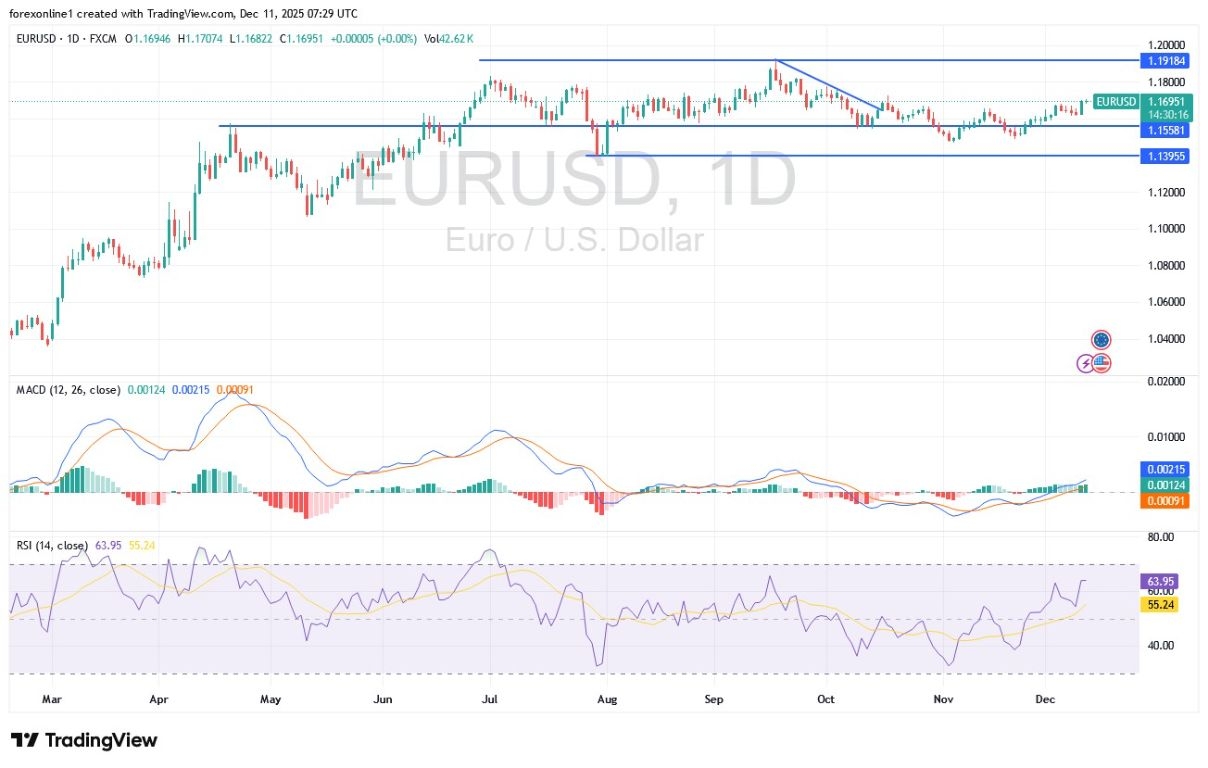
Currency prices moved positively against the US Dollar after the Federal Reserve cut the key US interest rate for the third consecutive time on Wednesday, though it signaled the possibility of keeping it unchanged in the coming months—a move that could anger President Donald Trump, who has demanded sharp reductions in borrowing costs. According to reliable trading platforms, the EUR/USD pair rebounded to the 1.1680 resistance level at the time of writing this analysis. These gains may push the EUR/USD trend out of the neutral zone that dominated trading recently while awaiting the Fed announcement.
The bullish scenario for EUR/USD requires more work to confirm the strength of the bulls’ control. On the daily chart, the psychological resistance of 1.1800 remains the key to a confirmed bullish shift. The pair’s recent gains pushed the Relative Strength Index (RSI) to the 61 level, which supports a technical correction upward, but it still has more room for stronger gains before reaching the overbought zone. The MACD indicator is also moving positively. The echoes of the Fed’s decisions, its policy statement, and updated projections will continue to influence EUR/USD trading in the coming days.
The scenario for a EUR/USD pullback over the same timeframe is linked to the bears bringing the currency prices back toward the vicinity of the psychological support of 1.1500 once again.

Be cautious. The EUR/USD’s upward trend is still in its early stages. We await confirmation of this and recommend buying from the 1.1500 support level again, but never take unnecessary risks.
Following the widely anticipated announcement of a US interest rate cut, the Federal Reserve’s interest rate-setting committee indicated in a statement released after a two-day meeting that it is likely to keep US interest rates unchanged in the coming months. In a series of quarterly economic projections, Federal Reserve officials indicated they expect to cut US interest rates only once next year. Overall, yesterday’s rate cut brought the federal funds rate down by a quarter of a percentage point to around 3.6%, its lowest level in nearly three years. Lower interest rates by the Federal Reserve can reduce borrowing costs for mortgages, auto loans, and credit cards over time, although market forces may also influence these rates.
At the final meeting of 2025, three Fed officials opposed the move, the most dissenting votes in six years, indicating deep divisions within a committee that traditionally operates by consensus. Two officials voted to keep the U.S. interest rate unchanged, while Stephen Miran, appointed by Trump in September, voted for a half-point cut.
The December meeting may well signal a more tense period for the Fed. Officials are divided between those who favor lowering U.S. interest rates to stimulate employment and those who favor keeping them unchanged because inflation remains above the central bank’s 2% target. Unless there are clear signs of full control over inflation, or unemployment worsens, these divisions are likely to persist.
Ready to trade our daily Forex analysis? We’ve made a list of the best forex trading platforms for beginners worth trading with.
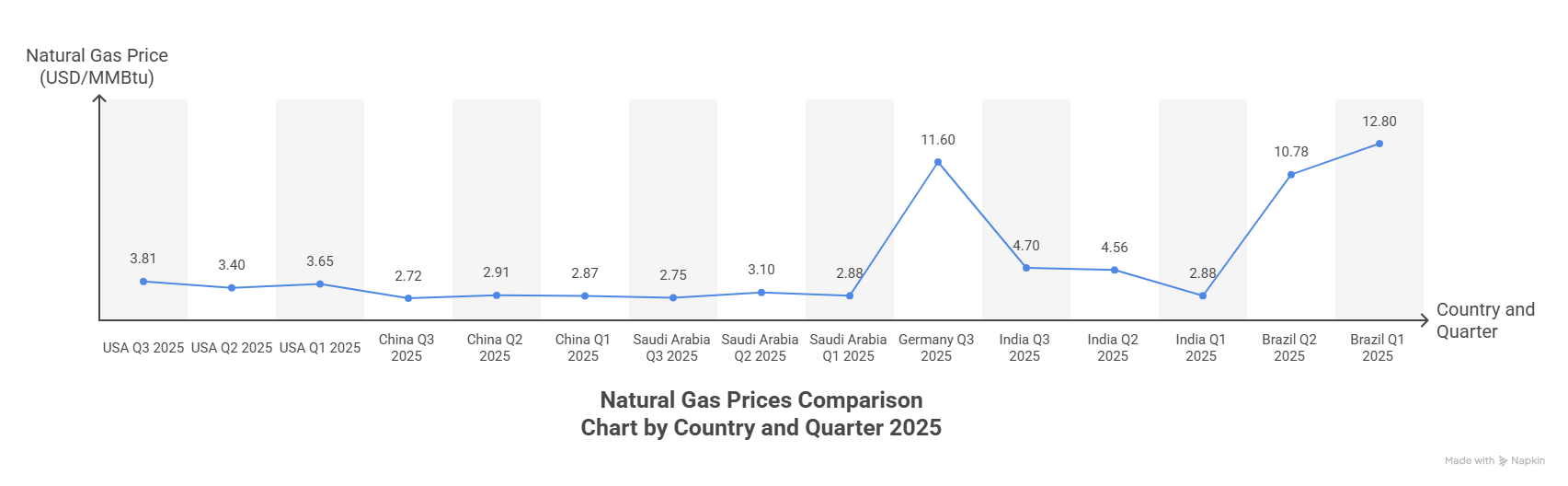
Natural Gas Prices in 2025 showed sharp regional differences driven by LNG flows, supply constraints, and changing demand patterns. Q3 pricing revealed strong increases in the USA and India, while Germany remained the highest-cost region. The latest insights highlight evolving trade dynamics and shifting consumption across global energy markets.
Global Natural Gas Prices in 2025 showed significant regional divergence as supply conditions, LNG flows, geopolitical tensions, and seasonal demand influenced overall movement. According to the latest Natural Gas Price Trend Report, Q3 price levels across the USA, China, Saudi Arabia, Germany, and India reflected shifting consumption patterns and evolving output dynamics. With companies and investors closely monitoring the Natural Gas price index, chart trends, and forecast models, this update provides a data-backed view of current and upcoming pricing developments.
Natural Gas Price Trend Analysis
During the third quarter of 2025, Natural Gas Prices demonstrated varying momentum across major regions. The USA settled at USD 3.81/MMBtu due to balanced domestic production and stronger summer demand. China reached USD 2.72/MMBtu as LNG imports stabilized. Saudi Arabia reported USD 2.75/MMBtu under consistent output conditions. Germany recorded USD 11.6/MMBtu amid supply constraints, while India reached USD 4.70/MMBtu driven by industrial requirements and rising consumption.
Natural Gas Price Forecast 2025
Forecast models suggest Natural Gas Prices may witness moderate fluctuations through late 2025, influenced by global LNG trade patterns, storage capacity, and energy transition momentum. Stable production in the U.S. and Middle East may help maintain balanced pricing, while Europe could continue experiencing elevated values. Long-term outlooks project steady growth as renewable integration reshapes demand profiles. The Natural Gas price index remains essential for forecasting short-term volatility.
Natural Gas Price Chart & Index
The 2025 Natural Gas price chart illustrates volatility in Europe compared to relative steadiness in Asia and North America. The Natural Gas price index highlights price resilience in high-demand regions and sharper swings where supply disruptions persist.
Users can track real-time charts, indexes, and forecast updates at:👉 https://www.imarcgroup.com/natural-gas-pricing-report/requestsample
Natural Gas Price Historical Analysis Data
A review of Natural Gas price history shows strong connections between weather patterns, industrial output, and LNG shipping dynamics. Europe has historically recorded higher price averages due to import dependency. Meanwhile, supply-rich regions often maintain stable long-term pricing. Historical data from 2021–2024 points toward rising global competition for LNG volumes and increased sensitivity to geopolitical events.
What Factors Determine the Price of Natural Gas?
Key contributors shaping Natural Gas Prices include:
These factors collectively determine the price of Natural Gas across different economies.
What Changed in 2025?
In 2025, renewed LNG contracts, storage optimization strategies, and shifts in European supply routes influenced regional pricing. Asia saw improved LNG inflows, while Middle Eastern supply held firm. Germany continued to face elevated costs, reflecting infrastructure constraints and higher import reliance. These dynamics shaped the Natural Gas price today across key markets.
What This Means for Investors / Consumers
For investors, the evolving landscape of Natural Gas Prices presents opportunities in LNG logistics, storage technology, and renewable-linked gas systems. Consumers and industries depend on price forecasting to plan energy budgets and procurement cycles. Monitoring the Natural Gas price index supports long-term contract structuring and risk mitigation.
Top Natural Gas Suppliers Across Regions
Factors Influencing Natural Gas Prices
The most impactful factors include LNG freight rates, production outages, refinery activity, storage reports, government regulations, and the pace of renewable energy integration. Industrial consumption trends in petrochemicals and fertilizers also shape Natural Gas Prices across global hubs.
Regional Price Trends Variations
North America maintained moderate pricing due to abundant shale output. China and Saudi Arabia saw competitive price levels supported by secure supply chains. Germany faced elevated costs tied to LNG import dependency. India experienced price increases reflecting growing industrial energy demand.
Browse Here Fore More Other Realed Reports:
Specific Future Trends and Outlooks
Short Term
Short-term pricing may fluctuate based on winter demand, storage levels, and geopolitical developments affecting LNG routes.
Long Term
Long-term trends indicate stable growth as gas plays a bridging role in global decarbonization. Countries investing in LNG terminals and pipeline diversification may experience greater pricing stability, supporting steady Natural Gas Prices into the late 2020s.
Key Highlights of the 2025 Natural Gas Price Trend
News & Recent Development
Recent industry developments include new LNG terminal expansions, updated gas agreements in Asia, advances in renewable-gas blending technologies, and investments in hydrogen-compatible infrastructure. These updates could reshape global supply flows and influence future Natural Gas Prices.
Quarter-on-Quarter Comparison of Natural Gas Prices in 2025
Natural Gas Prices showed fluctuating patterns from Q1 to Q3, with notable increases in the USA and India. China and Saudi Arabia experienced mild variations, while Europe and Brazil previously faced significant volatility. Overall, 2025 displayed a mixed pricing landscape driven by supply shifts and seasonal demand.
About Us:
IMARC Group is a global management consulting firm that provides a comprehensive suite of services to support market entry and expansion efforts. The company offers detailed market assessments, feasibility studies, regulatory approvals and licensing support, and pricing analysis, including spot pricing and regional price trends. Its expertise spans demand-supply analysis alongside regional insights covering Asia-Pacific, Europe, North America, Latin America, and the Middle East and Africa. IMARC also specializes in competitive landscape evaluations, profiling key market players, and conducting research into market drivers, restraints, and opportunities. IMARC’s data-driven approach helps businesses navigate complex markets with precision and confidence.
Contact Us:
IMARC Group
134 N 4th St. Brooklyn, NY 11249, USA
Email: sales[@]imarcgroup.com
Tel No:(D) +91 120 433 0800
United States: +1-201971-6302
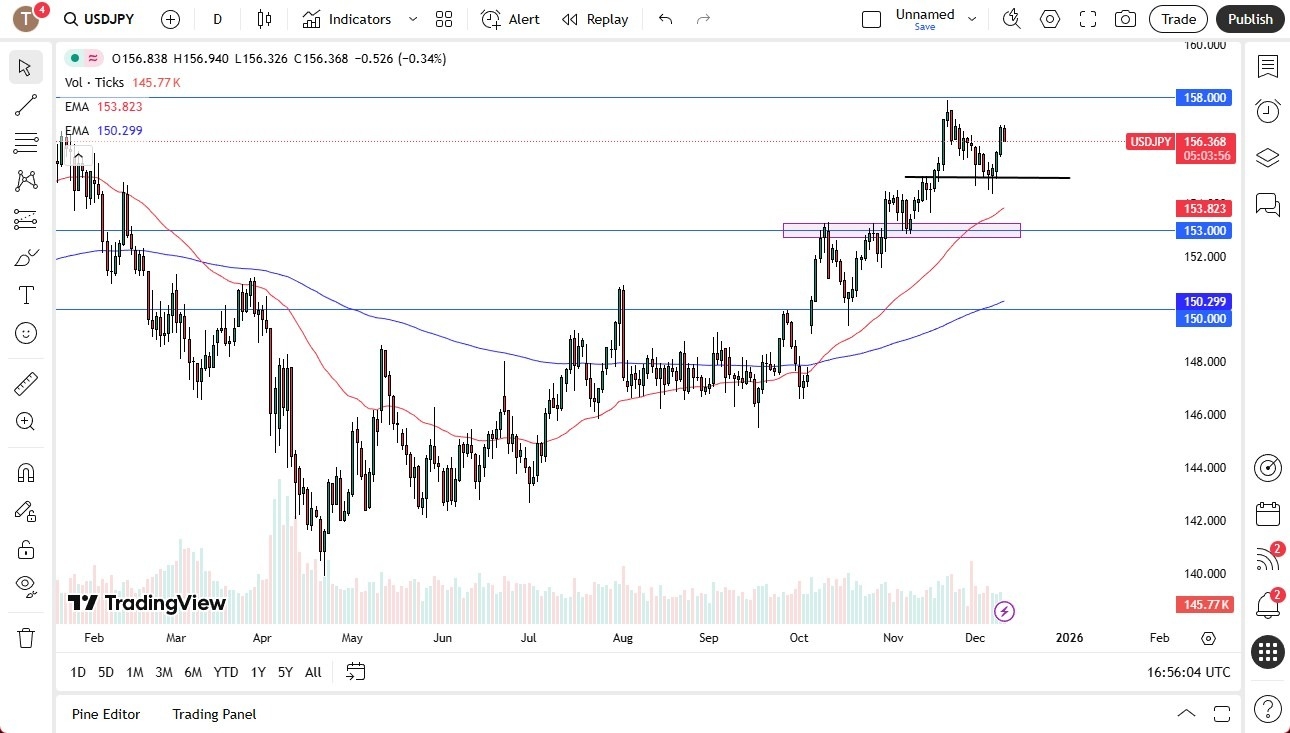
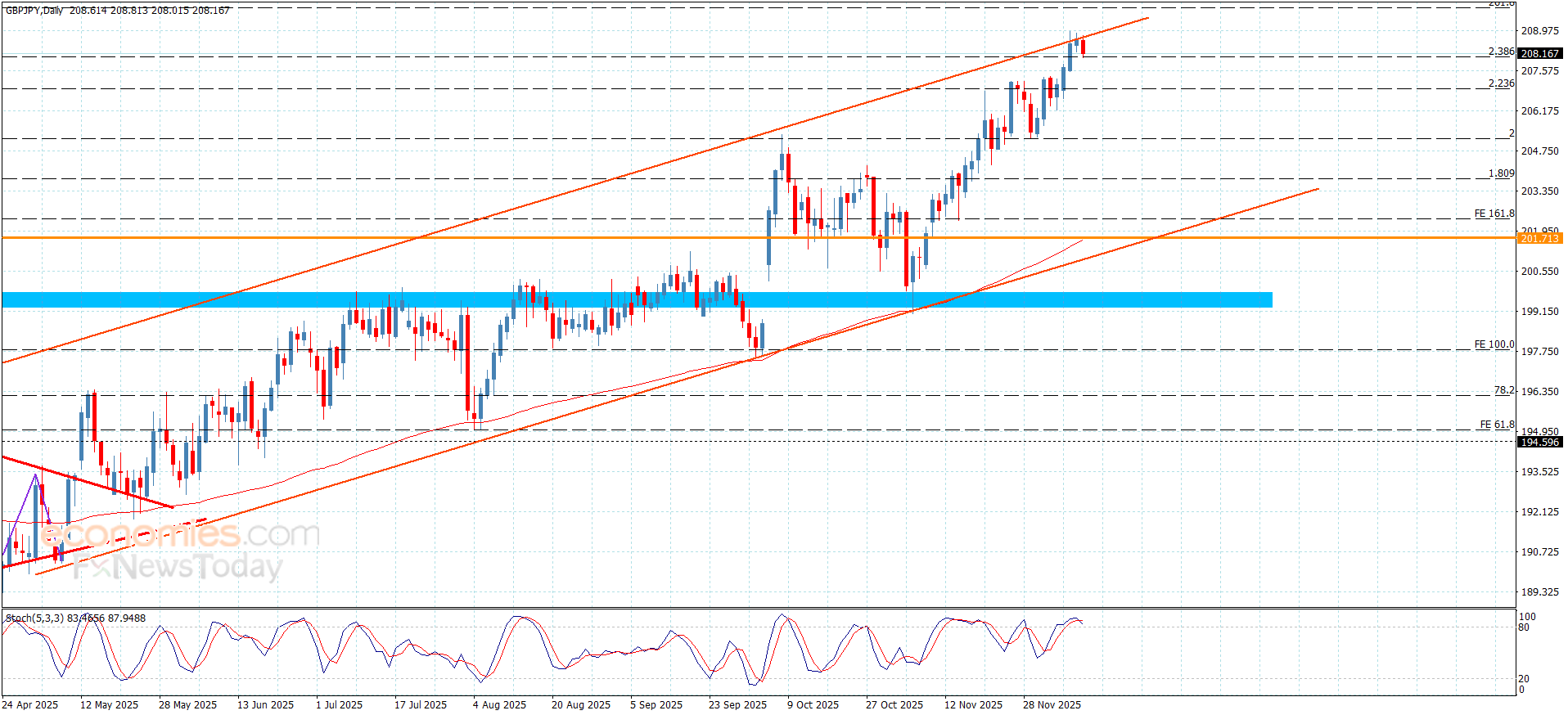
We do have the FOMC interest rate here in a couple of hours, and perhaps more importantly, we have the press conference. So, I suspect that about three hours from now, this chart will look quite a bit different. That being said, it doesn’t really matter because there are a couple of things that we can look at to determine whether or not there is going to be a continuation of the trend, or do we get some type of significant pullback. Notice how I didn’t say change in trend. And that’s because it would take a massive change in tone by the Federal Reserve to turn this thing around.
Pay attention to the press conference; he may say something along the lines of “data-dependent in our future decisions”, and that throws a bit of doubt into the market about the likelihood of continuous interest rate cuts. If that’s the case, then the US dollar should do quite well over the longer term. As a trader, I have closed my long position, and I’m waiting for an entry again. I look at this through the prism of maybe 154 yen being an excellent opportunity. But if we take off straight away and that would be a result of either Powell sounding very hesitant to cut going forward, the statement sounding very hesitant, or maybe they don’t cut at all.
Right now, the Fed watch tool at the CME suggests, I want to say it’s around 90%, I haven’t checked it in a few days, that the Federal Reserve will cut. So, I think that would catch the market so far offside that the US dollar would just slam through the 158 yen level and go to the 160 yen level very quickly. That being said, though, I do think we have an opportunity for a little bit of a pullback to take advantage of, and that’s exactly what I’m going to do. I’m watching this area right around 155, down to 154, and then again at 153.
What I am looking for on a shorter timeframe, not the daily chart necessarily, is some type of move like this. The V pattern on the hourly chart. Once we start to bounce and pick up a little bit of momentum, I’m willing to go long, and that’s because I am okay with owning this pair longer term. That being said, if we break down below 153 in the next several days, then the game’s up at least for a while. I don’t think that happens. Truthfully, I’d be a bit concerned if we broke down below 154, at least in the short term.
Longer term, I do think we’d go higher because the Bank of Japan has a whole litany of problems it has to deal with as well. And really, at this point in time, I think this ends up being a continuation of the carry trade, but I recognize that you may get an opportunity to pick up cheap US dollars.
Want to trade our USD/JPY forex analysis and predictions? Here’s a list of forex brokers in Japan to check out.
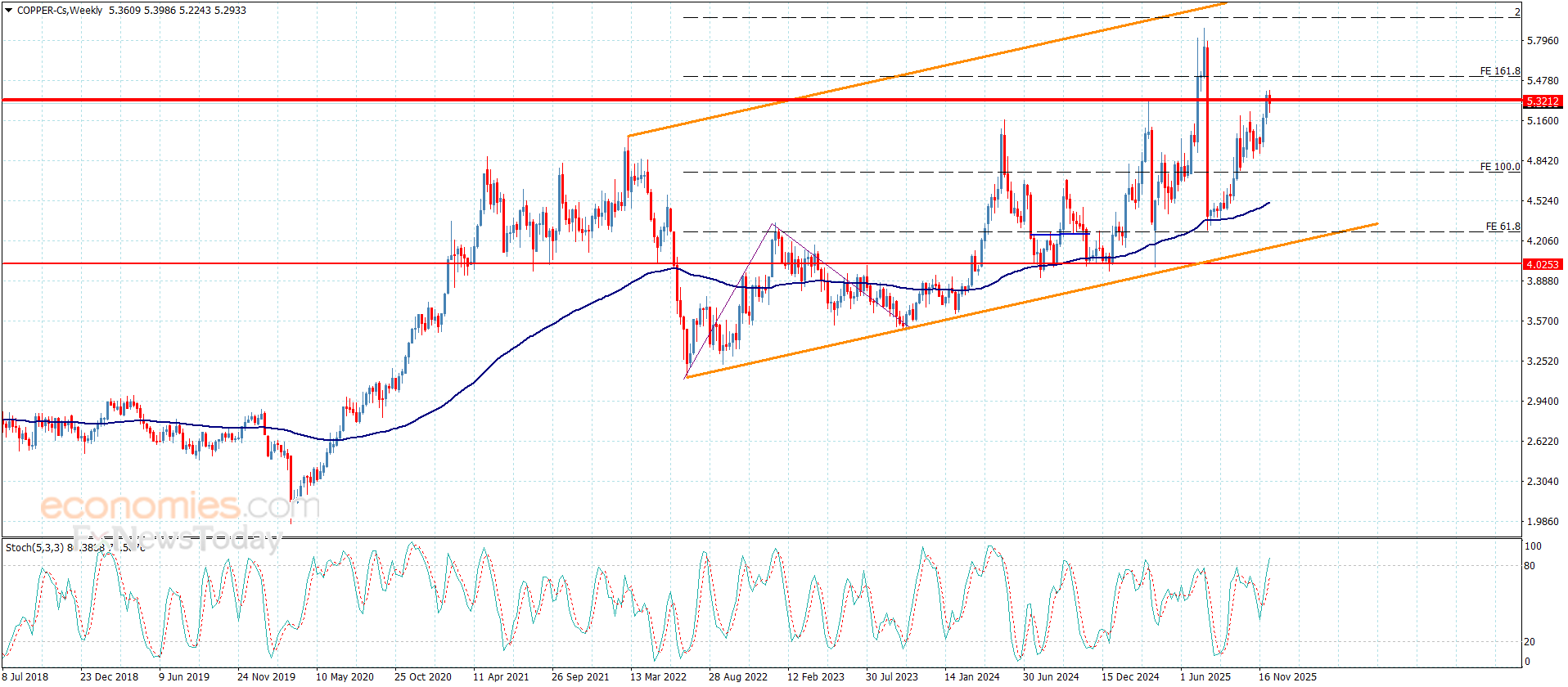
Copper price continued providing sideways trading, despite the positive factors to keep its fluctuating moves near the barrier at $5.3200, we will keep waiting to renew the bullish attempts by surpassing the current barrier to begin recording new gains by its rally towards $5.5000 reaching $5.6500 in the medium period trading.
Noting that the price decline below the extra support at $5.1300 will delay the bullish attack, which forces it to activate the corrective trading by suffering some losses by reaching $4.9500 and $4.7500.
The expected trading range for today is between 3.7500 and 4.0500
Trend forecast: Bullish
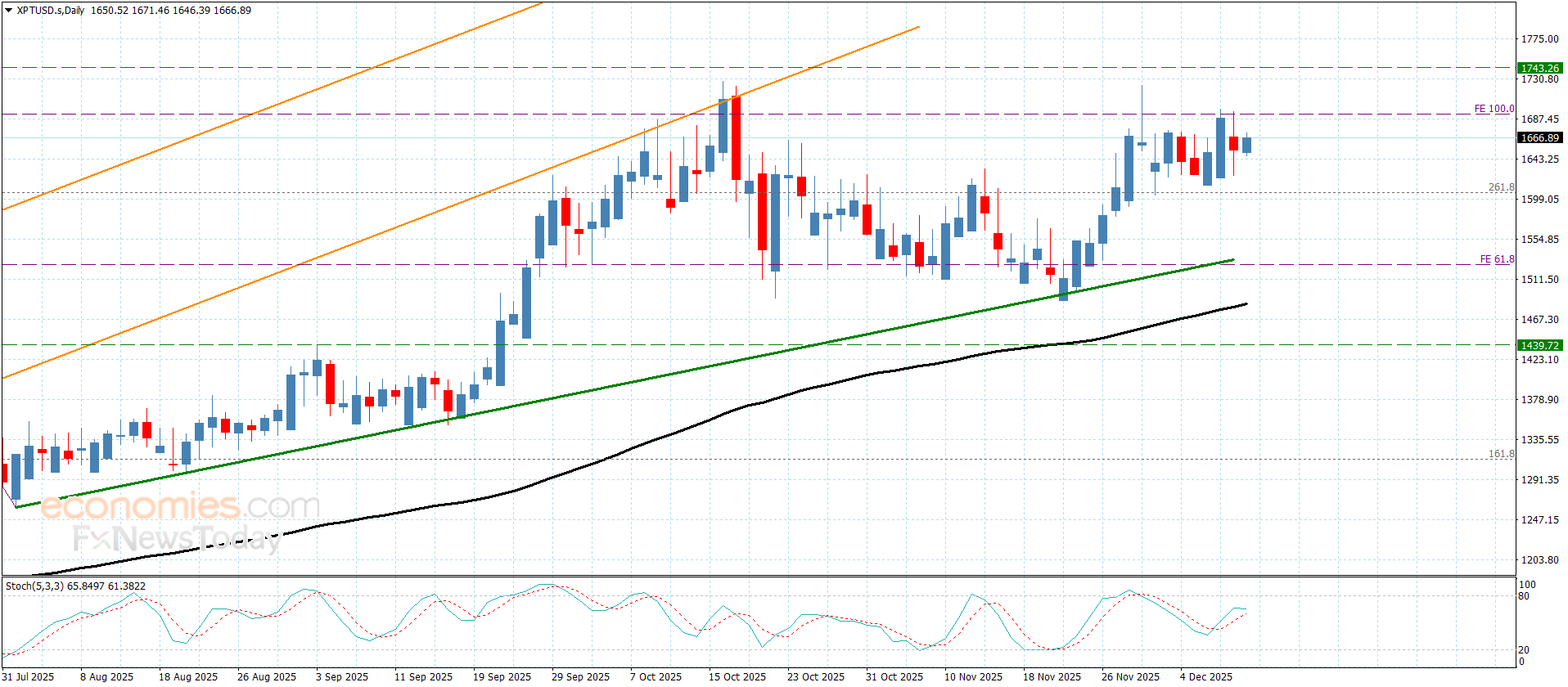
Platinum price surrendered to the sideways bias dominance, to fluctuate slowly near$1660.00 level, affected by the stability at $1695.00 barrier, which obstructs the chances of resuming the main bullish attack.
The price might keep providing sideways trading, however the stability above the extra support of $1605.00 supports the chances of renewing the bullish attempts, therefore, we will keep waiting for breaching the current barrier, to open the way for recording new gains that might begin at $1715.00 and $1745.00.
The expected trading range for today is between $1635.00 and $1695.00
Trend forecast: Sideways until achieving the breach
Platinum price surrendered to the sideways bias dominance, to fluctuate slowly near$1660.00 level, affected by the stability at $1695.00 barrier, which obstructs the chances of resuming the main bullish attack.
The price might keep providing sideways trading, however the stability above the extra support of $1605.00 supports the chances of renewing the bullish attempts, therefore, we will keep waiting for breaching the current barrier, to open the way for recording new gains that might begin at $1715.00 and $1745.00.
The expected trading range for today is between $1635.00 and $1695.00
Trend forecast: Sideways until achieving the breach
Platinum price surrendered to the sideways bias dominance, to fluctuate slowly near$1660.00 level, affected by the stability at $1695.00 barrier, which obstructs the chances of resuming the main bullish attack.
The price might keep providing sideways trading, however the stability above the extra support of $1605.00 supports the chances of renewing the bullish attempts, therefore, we will keep waiting for breaching the current barrier, to open the way for recording new gains that might begin at $1715.00 and $1745.00.
The expected trading range for today is between $1635.00 and $1695.00
Trend forecast: Sideways until achieving the breach
Gold is testing bearish commitments at the $4,250 psychological level on Thursday, pausing a two-day uptrend as markets weigh a less hawkish than feared US Federal Reserve (Fed) policy announcements.
Gold extended its overnight advance into early Asian trading on Thursday before witnessing a profit-taking pullback as sellers jumped in once again at the $4,250 level.
Non-yielding assets such as Gold built on its recent bullish momentum after the Fed delivered on the expected 25 basis points (bps) interest rate cut to 3.5%-3.75% on Wednesday.
Despite the widely anticipated rate cut, the US Dollar was slammed across the board alongside the US Treasury bond yields as Fed Chairman Jerome Powell at his post-meeting press conference stuck to a cautious tone, disappointing those who had been positioned for a more hawkish one.
Markets continued to price in two more rate cuts next year, against the Fed’s median expectation for a single quarter-percentage-point cut next year, powering Gold at the expense of the Greenback.
Traders picked up on the Fed’s concerns over a slowing labor market, lending further support to the bright metal.
Now, with the critical Fed event risk out of the way, the focus turns toward the US employment data, with the Jobless Claims eagerly wait for fresh insights on the state of the labor market ahead of next week’s delayed Nonfarm Payrolls releases.
In the daily chart, XAU/USD trades at $4,225.19. The 21-, 50-, 100- and 200-day Simple Moving Averages (SMAs) climb in bullish alignment, with the shorter ones above the longer ones. Price holds above all these references, reinforcing buyers’ control. The Relative Strength Index (14) prints at 61.83, positive and shy of overbought. Measured from the $4,381.17 high to the $3,885.84 low, the 61.8% retracement at $4,191.95 has been reclaimed, while the 78.6% retracement at $4,275.16 caps the topside.
On dips, the 21-day SMA at $4,157.88 offers initial support, with the 50-day at $4,105.76 cushioning deeper pullbacks. Momentum stays firm while the RSI holds above 50; a loss of the 21-day average could slow the rally and send price toward the 50-day SMA.
(The technical analysis of this story was written with the help of an AI tool)
Gold has played a key role in human’s history as it has been widely used as a store of value and medium of exchange. Currently, apart from its shine and usage for jewelry, the precious metal is widely seen as a safe-haven asset, meaning that it is considered a good investment during turbulent times. Gold is also widely seen as a hedge against inflation and against depreciating currencies as it doesn’t rely on any specific issuer or government.
Central banks are the biggest Gold holders. In their aim to support their currencies in turbulent times, central banks tend to diversify their reserves and buy Gold to improve the perceived strength of the economy and the currency. High Gold reserves can be a source of trust for a country’s solvency. Central banks added 1,136 tonnes of Gold worth around $70 billion to their reserves in 2022, according to data from the World Gold Council. This is the highest yearly purchase since records began. Central banks from emerging economies such as China, India and Turkey are quickly increasing their Gold reserves.
Gold has an inverse correlation with the US Dollar and US Treasuries, which are both major reserve and safe-haven assets. When the Dollar depreciates, Gold tends to rise, enabling investors and central banks to diversify their assets in turbulent times. Gold is also inversely correlated with risk assets. A rally in the stock market tends to weaken Gold price, while sell-offs in riskier markets tend to favor the precious metal.
The price can move due to a wide range of factors. Geopolitical instability or fears of a deep recession can quickly make Gold price escalate due to its safe-haven status. As a yield-less asset, Gold tends to rise with lower interest rates, while higher cost of money usually weighs down on the yellow metal. Still, most moves depend on how the US Dollar (USD) behaves as the asset is priced in dollars (XAU/USD). A strong Dollar tends to keep the price of Gold controlled, whereas a weaker Dollar is likely to push Gold prices up.
The GBP/USD price is trading lower near 1.3365 on Thursday ahead of the London session, pressured by a modest rebound in the US dollar following Wednesday’s Federal Reserve meeting. Despite the pullback, the downside remains limited as the Fed ultimately delivered a dovish tone, encouraging investors to sell the greenback into any strength.
If you are interested in automated forex trading, check our detailed guide-
The Fed cuts the rate by 25 bps for the third straight meeting. However, the voting split, with two members favoring a pause and Trump-appointed Stephen Miran requesting a more substantial move, reflects the growing division within the committee.
In Powell’s press conference, he emphasized that policymakers need time to assess the impact of the easing on the economy. Meanwhile, the Fed projected only one cut in 2026, but traders are speculating on two more cuts, especially after Powell flagged the downside risk to the labor market. The shift in tone triggered a broad dollar sell-off, with the Dollar Index falling to the lowest level since October 21, while the GBP/USD marked a fresh top at 1.3391 before falling.
US yields also slid after the Fed announced fresh Treasury bill purchases, starting from December 12, initiating $40 billion program to stabilize liquidity. The earlier-than-expected balance sheet expansion plan weighed on the yields, adding more pressure on the dollar.
However, the GBP outlook remains complex amid the Bank of England’s easing expectations. Markets now price in an 88% probability of a BoE rate cut next week, following a series of softer UK data that signals easing inflationary pressure. The divergence, with the Fed being flexible and the BoE moving sooner than expected, is limiting the GBP/USD from extending its rally despite dollar weakness.
The broad market sentiment remains cautious as the GBP/USD is left to balance between the dovish Fed and the vulnerability in the pound linked to the BoE. Traders now await the US initial Jobless Claims data due in Thursday’s New York Session for intraday direction.

The GBP/USD 4-hour chart shows the price drifting slowly towards the 20-period MA at around 1.3350. The RSI is off the overbought zone but remains stable, indicating a temporary choppiness before an upside continuation.
–Are you interested to learn more about forex options trading? Check our detailed guide-
However, breaching the 20-period MA could push the price further down towards the 50-period MA at 1.3330, ahead of the demand zone around 1.3275. On the upside, today’s top at 1.3391 remains a key resistance ahead of 1.3420.
Looking to trade forex now? Invest at eToro!
68% of retail investor accounts lose money when trading CFDs with this provider. You should consider whether you can afford to take the high risk of losing your money.
The 20-day average at $4.68—decisively broken on Tuesday—was tested and rejected as resistance Wednesday with the session high of $4.70, delivering textbook bearish behavior where prior dynamic support transforms into overhead supply. Yesterday’s daily close below that average locked in the breakdown, immediately shifting focus to the 50-day average as the next prominent dynamic support line on the downside path.
Compounding the bearish case, the lower boundary line of the ascending wedge pattern was violated as well, providing additional technical confirmation for the corrective thrust. Although a brief bounce could materialize before natural gas presses lower, the overall trajectory suggests it will eventually unfold that way after the hard sell-off that followed last week’s $5.50 high.
That $5.50 peak looks to have completed the short-term trend for now, with the decisive selling immediately after and the failure of a key trend indicator like the 20-day average tipping the scales heavily toward bears. Any potential bounce in the near term may encounter resistance at higher price levels, including not just the 20-day average but also the 10-day line at $4.87. Monday’s low found support right around that average, only for Tuesday’s high to meet it as resistance, again illustrating how prior dynamic support is now showing as resistance and providing even further evidence for the bears.
Further bearish alignment appears on the weekly chart, where a one-week reversal has already triggered this week and there is a good chance the close will confirm the breakdown below last week’s low of $4.76. The weekly trend has held strong since the October higher swing low at $2.89, marking seven straight weeks up. This represents the first decisive breakdown of a prior week’s low since then, a development that underscores the shift in sentiment.
The relationship to a couple of rising trend channels provides further indications that the price of natural gas got severely overextended and was due for this bearish correction. Bullish momentum had accelerated sharply following a reclaim of the 200-day average, culminating in natural gas breaking out of a trend channel where the top channel line connects directly to the early-October swing high at $3.59. Then, on the new high day last week, there was a sharp breakout above the top channel line (200%) of the second channel—but that has proven to be a false breakout, as the swift reversal now validates.
Natural gas continues to exhibit clear bearish control with the 20-day breakdown, wedge violation, and emerging weekly reversal all pointing to further downside toward the 50-day average. While a bounce testing the 10-day or 20-day as resistance fits the pattern, the overextended advance demands correction until excess unwinds—defense at the 50-day would signal possible stabilization, but momentum stays firmly with sellers for now.