The main category of Forex News.
You can use the search box below to find what you need.
[wd_asp id=1]
The main category of Forex News.
You can use the search box below to find what you need.
[wd_asp id=1]
The market remains above the long-term pivot at $65.38, supported further by the 200-day moving average at $63.99 and the 50-day at $62.10. The crossover of the 200-day above the 50-day signals a bullish bias in the broader trend. Price action continues to consolidate within this structure, awaiting a breakout catalyst.
Traders are closely tracking U.S. President Donald Trump’s tightened ultimatum on Russia, demanding progress toward ending the war in Ukraine within 10 to 12 days. The administration is threatening 100% secondary tariffs on countries continuing to trade Russian oil, a move aimed squarely at China and India—Moscow’s largest customers.
Analysts at JP Morgan expect India to comply with U.S. demands, potentially displacing 2.3 million bpd of Russian barrels. China, on the other hand, is unlikely to bend, raising the risk of tariff escalation. Treasury Secretary Scott Bessent warned that China could face significant duties if it maintains its Russian crude intake.
PVM’s John Evans noted that any resulting gap in global supply would take time to fill, even if Saudi Arabia and OPEC step in. This lag adds further support to near-term prices. Vanda Insights estimates a $4–$5 per barrel risk premium is already baked in.
Adding to supply-side pressure, Mexico’s Pemex slashed exports by 39% year-over-year in June, down to 458,103 bpd—the lowest monthly volume since records began in 1990. The drop aligns with Mexico’s ongoing push for energy “sovereignty,” prioritizing domestic refining. Output remains constrained at 1.6 million bpd, well below the company’s stated goal of 1.8 million.
Pemex also reduced refined product imports by 38% last month as its new Olmeca refinery absorbed more feedstock. While the company aims to boost production via private partnerships, execution remains limited.
Price action confirmed a breakout of a small falling wedge pattern. The initial target from the wedge points to the start of the pattern at the recent swing high of $3,409. A move through that level may lead to testing resistance along the top boundary of a symmetrical triangle consolidation. Traders should watch how gold reacts near $3,409, as it may either encounter resistance or signal a further upside breakout.
The current short-term upswing began at the recent swing low (C), suggesting momentum may not yet be strong enough to breach the triangle boundary decisively. A daily close above $3,439 would serve as a more definitive breakout trigger, confirming a sustained bullish move. Until that occurs, any advance should be viewed with caution, as breakouts are prone to failure without follow-through confirmation.
A breakout above this week’s high would trigger a weekly reversal and add to bullish momentum for gold. Conversely, a drop below $3,268 would undermine the short-term bullish case. On the monthly chart, gold is positioned to potentially end the period at its highest-ever monthly close. Even without a triangle breakout, such a close would be a strong bullish signal for the medium-term trend.
Traders should monitor $3,409 as the initial upside target and $3,439 as the confirmed breakout level. Support near $3,268 remains critical to watch for potential downside risk. Until either a clear breakout or a failure occurs, gold is in a decision zone that could define the next major directional move.
For a look at all of today’s economic events, check out our economic calendar.
– Written by
Tim Boyer
STORY LINK Pound Sterling Forecasts Warn Crash vs Euro, Dollar on 1976-Style UK Crisis
The British Pound faces its most alarming warning in decades, with GBP analysts bracing for heavy losses against the euro and US dollar. A former Bank of England policymaker has drawn chilling parallels with the economic crash of 1976 – when the UK was forced into an IMF bailout. With inflation stuck near 4%, gilt yields heading towards 5%, and government borrowing spiralling, fears are growing that the Pound Sterling could be sliding towards a historic collapse.
Former Bank of England (BoE) Monetary Policy Committee (MPC) Andrew Sentance has warned that the UK will see a repeat of the 1976 economic crisis with bonds and the Pound sliding in tandem.
Rachel Reeves is on course to deliver a Healey 1976-style crisis in late 2025 or 26. Like Healey, she has massively boosted public spending, borrowing and taxes – fuelling both demand-pull and cost-push inflation. Unless policies are reversed we are heading for an economic crash!
— Andrew Sentance (@asentance) August 20, 2025
There was a mini scare in January, but Sentance has warned that this is just a taster for more severe turbulence within the next few months.
ING expects the Pound to Euro (GBP/EUR) exchange rate to slide to 1.11 by the end of 2026.
There are parallels with 1976 in weather terms as that year was famous or infamous for a prolonged period of hot weather and drought with the government appointing a minister for drought.
It’s also worth noting that this was followed by heavy rain and floods.
As far as the economy is concerned, 1976 marked economic humiliation for the Callaghan government with Chancellor Healey forced to run to the IMF for an emergency loan as the Pound plummeted in currency markets.
The pound collapsed amid a widening budget deficit, a yawning current account imbalance and stubbornly persistent inflation with the Bank of England unable to support growth via cuts in interest rates.
The government secured a $3.9bn loan, half of which was drawn down by the administration.
Andrew Sentance, who was well known as a very hawkish voice on the MPC has issued a stark new warning.
According to Sentance; “Rachel Reeves is on course to deliver a Healey 1976-style crisis in late 2025 or 26. Like Healey, she has massively boosted public spending, borrowing and taxes – fuelling both demand-pull and cost-push inflation. Unless policies are reversed we are heading for an economic crash!”
The latest official inflation data recorded headline and core inflation at 3.8%, but Sentence considers that the data is underestimating inflation.
Looking at a wider range of indicators, Sentance considers that inflation is already 4.1% and set to increase further.

The 10-year bond yield has increased to above 4.75% and close to 4-month highs. According to Sentence, the yield could increase to 5% before long.
The Pound posted sharp losses in January as fears surrounding UK economic policy increased.
As bond yields continue to move higher, the cost of debt servicing continues to increase. This risks a vicious cycle as bond markets and the Pound crash in tandem.
Sentance has also continued to criticise Bank of England policy.
According to Sentance; “The shocking surge in UK inflation continues. When will the MPC recognise that control of inflation requires policy action to bear down on price rises with interest rates. Cutting rates while inflation is rising is a perverse and irresponsible policy.”
Danske Bank is wary over UK fundamentals and expects GBP/EUR losses to 1.1235 on a 6-12-month view. According to Danske; “The key risk to seeing EUR/GBP trade substantially higher than our forecast is a sharp sell-off in global risk and/or renewed focus on the UK’s fragile fiscal position.”
International Money Transfer? Ask our resident FX expert a money transfer question or try John’s new, free, no-obligation personal service! ,where he helps every step of the way,
ensuring you get the best exchange rates on your currency requirements.
TAGS: Pound Sterling Forecasts
– Written by
David Woodsmith
STORY LINK 2025 Forecast: Pound Sterling to Strengthen Against Dollar, Not the Euro
The latest Pound Sterling forecasts point to a split outlook: analysts see the Pound to Dollar (GBP/USD) forecast turning more positive, while the Pound to Euro (GBP/EUR) forecast remains subdued. Markets expect Sterling to push higher against the US Dollar towards 1.39 over the next 12 months, but struggle to break above 1.16 against the Euro.
Consensus suggests a diverging path for Sterling, shaped by resilient UK economic data, stubborn inflation at 3.8%, and an uncertain Bank of England (BoE) policy outlook.
The Pound to Dollar exchange rate failed to re-test the 1.36 level this week, retreating to near 1.34 amid a tentative dollar recovery. Nevertheless, consensus forecasts are for GBP/USD to strengthen to 1.39 on a 12-month view as markets anticipate lower Federal Reserve interest rates.
Not all banks are aligned: Wells Fargo expects GBP/USD will retreat to 1.30 by the end of 2026 on renewed dollar gains, while UBS sees scope for a move back to 1.39 by late 2025, citing “the outlook for lower Federal Reserve rates, White House policy uncertainty, and international investors raising hedge ratios for dollar assets.”
The Federal Reserve remains the key driver. Earlier in the week, markets were convinced that the Fed would cut rates in September, but stronger US data has cast doubt. Fed members remain split, with Cleveland Fed President Hammack stating current conditions “do not justify a rate cut at this stage.”
Markets are now pricing just over a 70% chance of a September cut. A cautious stance from Chair Powell at Jackson Hole could see the Dollar regain ground in the short term, but longer-term expectations still lean towards weakness, underpinning the more positive GBP/USD forecast.
The Pound to Euro exchange rate has consolidated around 1.1570 after failing again to hold above 1.16. Consensus forecasts point to limited losses, with GBP/EUR seen at 1.15 on a 12-month horizon.
Danske Bank is more bearish, forecasting a retreat to 1.1235 within 6-12 months on the back of weak UK fundamentals. It argues that relative growth dynamics are turning against Sterling:
“We increasingly see domestic factors and the relative growth outlook between the UK and the euro area as becoming GBP negatives. This is further amplified by divergence in fiscal policy, with UK fiscal policy set to be tightened in the Autumn.”
Societe Generale also warns that Sterling’s underlying support is fading:
“GBP has decent short-term support, even if its medium-term support is rotting away in the face of a depressing fiscal outlook. Higher taxes are coming and so is slower growth and further GBP weakness.”
SocGen highlights the Euro’s strengthening base, noting that EUR/GBP support has risen steadily from 0.8250 early in the year to 0.86 by July. By the autumn, it expects support to climb to 0.87 — implying GBP/EUR below 1.15.
UK data continues to paint a mixed picture. Manufacturing PMI remains in contraction, while services activity hit a 12-month high. Inflation data came in stronger than expected at 3.8% for both headline and core, raising stagflation concerns.
The Eurozone, meanwhile, reported a 15-month high in its composite output index, supported by gains in both manufacturing and services despite ongoing global trade headwinds.
The Pound Sterling forecast remains finely balanced. Against the Dollar, expectations of Fed easing underpin projections for GBP/USD to strengthen towards 1.39, but short-term risks remain if Powell pushes back on cuts. Against the Euro, Sterling continues to struggle, with GBP/EUR likely capped around 1.15 and downside risks highlighted by Danske and SocGen.
For now, Sterling’s fate will rest on a tug of war between UK fundamentals, BoE caution, and external drivers from Washington and Frankfurt.
International Money Transfer? Ask our resident FX expert a money transfer question or try John’s new, free, no-obligation personal service! ,where he helps every step of the way,
ensuring you get the best exchange rates on your currency requirements.
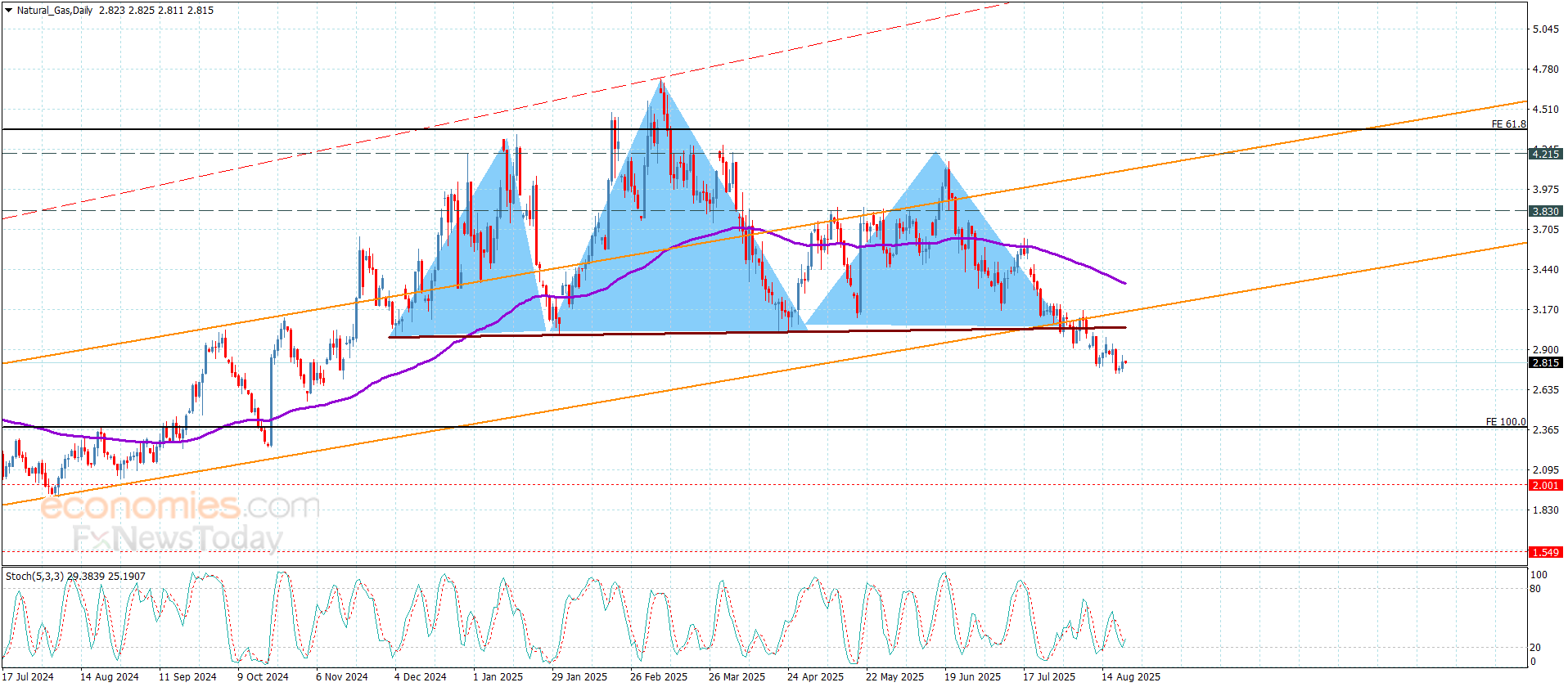
Recent price action shows that natural gas was never able to push through the short downtrend line created during the declining consolidation phase. That failure left the market exposed, and when long-term support finally gave way after multiple tests, it triggered a decisive shift lower. Momentum has since accelerated, reinforcing the dominance of sellers.
The next measured move lower is defined by a falling ABCD pattern, which projects to $2.63. However, given the strength of the decline, that level may offer little more than a temporary pause. A more significant confluence of support lies below, between $2.54 and $2.51. This zone combines both Fibonacci projections and prior swing activity, making it an important area where traders may watch for stabilization or reversal signals.
Natural gas continues to trade beneath the midline of a descending trend channel. This positioning keeps pressure directed toward the channel’s lower boundary, which aligns closely with the $2.54 area. Adding weight to this outlook is a declining trendline drawn from the 2023 peak, which could converge with price zone if weakness extends further. The overlap of channel and trendline support makes the lower zone technically significant.
The weekly chart is turning decisively negative. A close near the lows of the week underscores sustained selling pressure and the lack of meaningful buying interest. Long candles at trend lows often indicate exhaustion, but so far, the bears are clearly in chart. This leaves natural gas vulnerable to additional declines in the near term.
For buyers to regain conviction, natural gas would need to reclaim $2.85, the interim swing high from Thursday. Only a decisive and sustained move above that level would begin to challenge the prevailing bearish structure. Until then, the path of least resistance remains lower, with traders watching for reactions at deeper support.
For a look at all of today’s economic events, check out our economic calendar.
The GBPJPY pair provided temporary positive trading, attempting to recover some of its losses by its rally to 199.35, to begin declining affected by stochastic negativity, approaching from 20 level as appears in the above image.
The attempts of forming an extra barrier at 199.60 level confirms the price confinement within the bearish track, to keep preferring the negative attempts, that might target 198.20 reaching 197.45, to face 61.8%Fibonacci correctional level.
The expected trading range for today is between 198.20 and 199.40
Trend forecast: Bearish
Gold (XAU/USD) extended its rally on Friday, climbing 1% to $3,372.60 per ounce in spot trading while U.S. futures reached $3,416.90, their strongest close in nearly two weeks. December futures (GC=F) opened at $3,383.30, up from Thursday’s $3,336.90, and have gained 35.1% year-on-year from $2,504.10. The latest rebound comes as Powell’s Jackson Hole speech strengthened bets for a 25 basis point Fed cut in September, with CME FedWatch placing odds at 90%, compared to 75% just a day earlier. The softer dollar, down 0.7% on the DXY, and cooling Treasury yields reinforced bullion’s safe-haven appeal.
Gold’s trajectory is defined by pivotal chart levels. Immediate resistance stands at $3,400, a threshold that, if broken, opens the door toward $3,452 and $3,500. Support rests at $3,353, with deeper cushions at $3,319 and $3,300. The 50-day EMA around $3,344–$3,348 is being closely tracked as a pivot zone. Bulls argue that a sustained move above this band would solidify momentum and confirm an extension toward new highs, while a break below $3,350 risks exposing July’s lows.
At Jackson Hole, Powell acknowledged a “challenging situation” for the Fed, with inflation still sticky yet labor market momentum showing cracks. Jobless claims hit 235,000, their highest since 2021, and continuing claims reached 1.972 million. Powell admitted the balance of risks has shifted, giving the market confidence that the Fed is moving closer to an easing cycle. Still, dissent remains: Cleveland’s Beth Hammack and Kansas City’s Jeffrey Schmid cautioned that inflation risks persist, while Atlanta Fed’s Raphael Bostic forecast just one rate cut in 2025, highlighting internal divisions. Despite the hawkish pushback, traders focused on Powell’s softer tone.
Regional markets highlight the sensitivity of physical gold to local currencies. In the Philippines, prices eased to ₱6,112.34 per gram from ₱6,132.23, with a troy ounce fetching ₱190,130.30. Thailand saw gold flows affecting the baht, with stronger exports lifting the currency. These trends underscore gold’s dual role as both an inflation hedge and a currency stabilizer, particularly in Asia, where households frequently turn to bullion as a store of value during volatility.
Geopolitical risk continues to underpin demand. Russia renewed its demands on Ukraine regarding Donbas and NATO restrictions, boosting safe-haven positioning. Meanwhile, U.S. Treasury yields remain capped, with the 10-year at 4.328% and real yields near 1.978%, still favorable for gold. Dollar weakness against the euro and pound added to the bullish backdrop, while USD/JPY’s retreat reflected broader unwinding of long-dollar trades.
Banks and funds remain firmly positive. Goldman Sachs projects $3,700 by end-2025, citing relentless central bank buying and tariff uncertainty. UBS and Citi echoed upside potential as Fed cuts draw closer. Central bank accumulation remains a key driver, with purchases at 50-year highs since January. On a structural level, Crescat Capital estimated that a revaluation of U.S. gold reserves relative to liabilities could justify astronomical prices between $25,000 and $55,000 per ounce — far from tactical reality but a reminder of bullion’s underlying leverage.
Silver (SI=F) surged 2.2% to $39.01, nearing its July peak of $39.91. Platinum added 0.7% to $1,362.90, and palladium advanced 1.4% to $1,125.53. Silver’s outperformance in percentage terms suggests investors are broadening exposure to the precious metals complex, using gold’s breakout as a signal to diversify into correlated assets.
Physical demand in India remains restrained due to high prices, though festival season may revive buying. In the U.S., gold’s mainstream reach expanded as Costco (COST) reported outsized demand for gold bars, silver coins, and platinum. With all three products up more than 22% YTD, retail penetration shows how bullion is becoming embedded in household wealth strategies beyond institutional and central bank demand.
The gold price forecast hinges on whether XAU/USD clears the $3,400 ceiling. A confirmed break higher signals a buy, targeting $3,452 and $3,500. If momentum stalls and $3,350 gives way, a tactical pullback toward $3,319 is likely. With Fed cuts looming, dollar softness, and robust central bank purchases, the structural case remains bullish, and the recommendation is Buy on dips toward $3,350 while maintaining upside exposure to $3,500.
The (ETHUSD) price rose in its last intraday trading, attempting to offload some of its clear oversold on the (RSI), especially with the emergence of the positive signals from there, amid the dominance of the bearish correctional trend on the short-term basis, and its trading alongside a supportive bias line for this track, with the continuation of the negative pressure that comes from its trading below EMA50, intensifying the negative pressure around the price, and prevents the price recovery on the near-term basis.
BestTradingSignal.com – Professional Trading Signals with high accuracy. Subscribe now to tailored packages for the world’s leading markets and receive signals instantly via Telegram from an expert team:
Check full VIP signals performance report for the week of August 11–15, 2025: Full Report
Important DisclaimersThe content provided on the website includes general news and publications, our personal analysis and opinions, and contents provided by third parties, which are intended for educational and research purposes only. It does not constitute, and should not be read as, any recommendation or advice to take any action whatsoever, including to make any investment or buy any product. When making any financial decision, you should perform your own due diligence checks, apply your own discretion and consult your competent advisors. The content of the website is not personally directed to you, and we does not take into account your financial situation or needs.The information contained in this website is not necessarily provided in real-time nor is it necessarily accurate. Prices provided herein may be provided by market makers and not by exchanges.Any trading or other financial decision you make shall be at your full responsibility, and you must not rely on any information provided through the website. FX Empire does not provide any warranty regarding any of the information contained in the website, and shall bear no responsibility for any trading losses you might incur as a result of using any information contained in the website.The website may include advertisements and other promotional contents, and FX Empire may receive compensation from third parties in connection with the content. FX Empire does not endorse any third party or recommends using any third party’s services, and does not assume responsibility for your use of any such third party’s website or services.FX Empire and its employees, officers, subsidiaries and associates, are not liable nor shall they be held liable for any loss or damage resulting from your use of the website or reliance on the information provided on this website.Risk DisclaimersThis website includes information about cryptocurrencies, contracts for difference (CFDs) and other financial instruments, and about brokers, exchanges and other entities trading in such instruments. Both cryptocurrencies and CFDs are complex instruments and come with a high risk of losing money. You should carefully consider whether you understand how these instruments work and whether you can afford to take the high risk of losing your money.FX Empire encourages you to perform your own research before making any investment decision, and to avoid investing in any financial instrument which you do not fully understand how it works and what are the risks involved.
The US dollar continues to take off against the Japanese yen. And if Jerome Powell sounds even remotely hawkish during the session on Friday, then that could send the US dollar screaming towards the 150.50 yen level. On a pullback, I would anticipate that the 50 day EMA offers support, followed by the 146 yen level.
The Australian dollar tried to rally during the session, but it looks like it’s going to give those gains up pretty quickly, as there just isn’t enough momentum to get the Aussie moving. Ultimately, I think you’ve got a situation here where you have to assume that market participants are looking at this through the prism of a market that just hasn’t performed well to begin with.
And therefore, it makes a lot of sense that the Australian dollar eventually gives up strength. Keep in mind that New Zealand just cut interest rates and that probably has people thinking the Australian dollar will suffer the same fate and that makes it a little weaker than other currencies in general.
Over the last year, we’ve seen the US dollar get hit pretty hard and with that, I think you have to believe that if the Australian dollar really couldn’t take advantage of it. If we start to see the US dollar strengthen, then the Aussie is really going to take it on the chin. As things stand right now, I like fading rallies, and I believe the 0.6550 level will continue to be resistant.
For a look at all of today’s economic events, check out our economic calendar.