The main category of Forex News.
You can use the search box below to find what you need.
[wd_asp id=1]
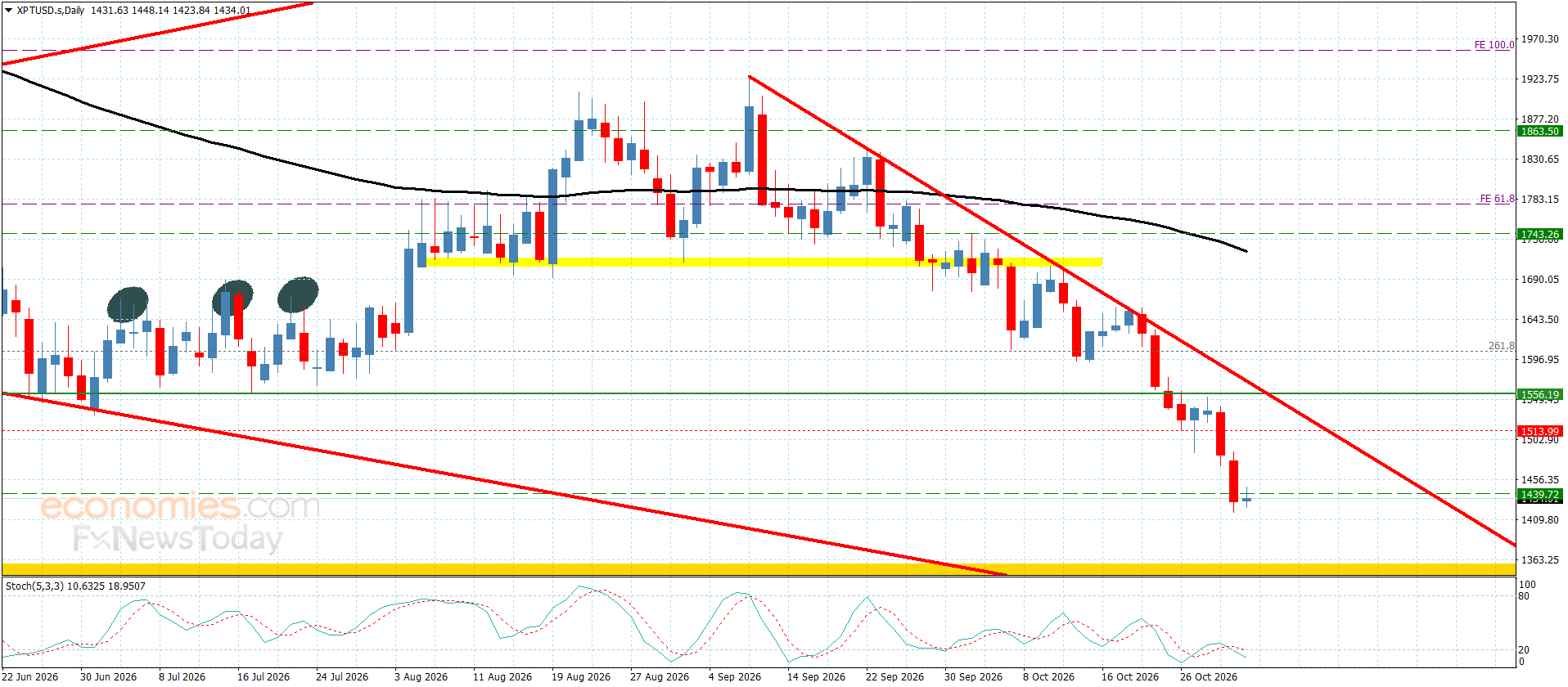
Platinum prices ended their latest bearish wave after touching $1418.00, bringing them close to the first additional target at $1400.00. The price then rebounded to settle near the resistance barrier at $1440.00, supported by stochastic stability above the 20 level.
The price may now move sideways temporarily while gathering additional negative momentum, which could enable it to confirm a break below the current barrier and resume its bearish movement toward $1400.00, followed by the next target at $1365.00.
The expected trading range for today is between $1365.00 and $1455.00
Trend forecast: Bearish
According to the latest IndexBox report on the global Espresso Beans Bundle market, the market enters 2026 with broader demand fundamentals, more disciplined procurement behavior, and a more regionally diversified supply architecture.
The global espresso beans bundle market is undergoing a strategic bifurcation, with high-volume commoditized segments driven by private-label expansion and price-led promotions on one side, and a premium, benefit-led segment fueled by brand storytelling, sustainable claims, and experiential packaging on the other. Channel strategy has emerged as the primary determinant of market share, as traditional grocery and mass retail remain volume engines but face intense shelf competition and margin pressure, while specialty coffee shops, premium grocers, and direct-to-consumer platforms command higher price points and foster brand loyalty.
A clear price architecture segmented by consumer need state rather than pure bean quality has taken hold, with entry-level bundles competing on affordability, mid-tier bundles leveraging origin stories and certifications, and super-premium bundles positioned as luxury gifts or connoisseur experiences. Private-label penetration is accelerating, particularly in Western Europe and North America, compressing the differentiation space for mid-tier branded players. Supply chain resilience and provenance transparency have shifted from niche concerns to mainstream table stakes, creating both compliance costs and branding opportunities.
The e-commerce channel serves distinct functions as a subscription-based replenishment model, a discovery platform for premium roasters, and a key channel for gifting-oriented bundle sales. Innovation is increasingly focused on packaging and format, including smaller batch roasts, nitrogen-flushed pouches, compostable packaging, and bundles paired with accessories or digital brewing guides. As the market evolves through 2035, agility and clear strategic positioning will be critical for success.
The baseline scenario for the global espresso beans bundle market points to steady value growth over the forecast period 2026-2035, supported by the ongoing premiumization of at-home coffee consumption and the expansion of e-commerce subscription models. Volume growth will be moderate, as mature markets in North America and Europe exhibit high per-capita coffee consumption but face saturation in traditional retail channels. However, value growth will outpace volume as consumers trade up to higher-priced bundles featuring single-origin beans, ethical certifications, and innovative packaging.
The market is expected to register a CAGR of 5.8% in value terms, reaching a market index of 168 by 2035 (2025=100). This baseline assumes no major supply disruptions and a gradual easing of input cost inflation. The premium segment will outperform, driven by younger consumers’ interest in experiential products and sustainability claims. Private label will continue to gain share, particularly in Western Europe, but branded players will defend their positions through innovation and channel expansion. Asia-Pacific will be the fastest-growing region, albeit from a smaller base, as coffee culture expands in urban centers.
The e-commerce channel will be a key growth driver, with subscription-based replenishment and gifting bundles gaining traction. Overall, the market will remain highly competitive, with success dependent on brand differentiation, channel management, and supply chain transparency.
Household consumption remains the largest end-use sector for espresso beans bundles, driven by the shift toward home brewing and the desire for café-quality espresso at home. Consumers are increasingly purchasing multi-pack bundles for daily consumption, with a focus on freshness, convenience, and value. The rise of remote and hybrid work arrangements has further accelerated at-home coffee preparation, boosting demand for whole bean bundles that offer a balance of quality and affordability. Through 2035, demand will be supported by the expansion of e-commerce subscriptions and the introduction of smaller pack sizes tailored to single-person households.
Demand-side indicators include household penetration of espresso machines, frequency of at-home coffee preparation, and spending on premium coffee. The segment will see a shift toward sustainable and ethically sourced beans, with consumers willing to pay a premium for verified claims. Private-label offerings will gain traction, particularly in Europe, while branded players will differentiate through origin stories and roast profiles. Current trend: Growing demand for premium and convenient at-home coffee solutions.
Major trends: Rising adoption of home espresso machines and grinders, Growth of coffee subscription services for replenishment, Increasing preference for single-origin and organic beans, Demand for compostable and eco-friendly packaging, and Expansion of bundle formats tailored to gifting and trial.
Representative participants: Starbucks Corporation, J.M. Smucker Company, Keurig Dr Pepper Inc, Nestlé S.A, and Lavazza Professional.
Cafés and coffee shops represent a significant end-use sector for espresso beans bundles, as operators seek consistent quality and cost-effective supply solutions. These establishments often purchase bundles for retail resale or for in-store use, benefiting from the convenience of pre-portioned packs. The segment is driven by the expansion of specialty coffee shops and the growing consumer preference for artisanal espresso. Through 2035, demand will be supported by the rise of small commercial users, such as mobile coffee carts and home-based cafés, which require flexible pack sizes. Demand-side indicators include the number of coffee shops, frequency of bean replenishment, and adoption of wholesale bundles.
The trend toward sustainability will influence purchasing decisions, with cafés favoring suppliers that offer traceable and ethically sourced beans. Bundles that include brewing accessories or digital guides are gaining popularity as value-added offerings. Current trend: Steady growth supported by specialty coffee culture and premium bundle offerings.
Major trends: Growth of specialty coffee shops and independent cafés, Demand for consistent quality and traceability, Adoption of wholesale bundles for cost efficiency, Increasing focus on sustainable sourcing and packaging, and Rise of mobile and pop-up coffee businesses.
Representative participants: Starbucks Corporation, Illycaffè S.p.A, Peet’s Coffee, Blue Bottle Coffee, and Counter Culture Coffee.
Offices and workplaces are a key end-use sector for espresso beans bundles, as employers seek to enhance workplace amenities and support employee productivity. The demand is driven by the provision of premium coffee options in office pantries and break rooms, often through office coffee service providers. Through 2035, the segment will benefit from the return-to-office trend and the increasing expectation of high-quality coffee at work. Demand-side indicators include office occupancy rates, spending on employee perks, and adoption of subscription-based office coffee services. Bundles offer convenience and cost predictability for office managers, with a growing preference for sustainable and fair-trade options.
The segment is also seeing innovation in single-serve bundles compatible with office espresso machines, reducing waste and simplifying inventory management. Current trend: Moderate growth driven by employee wellness and premium office coffee services.
Major trends: Return-to-office driving demand for workplace coffee amenities, Growth of office coffee service subscriptions, Preference for sustainable and fair-trade beans, Adoption of single-serve bundles for convenience, and Integration of smart coffee machines with bundle subscriptions.
Representative participants: Nestlé S.A, Keurig Dr Pepper Inc, Lavazza Professional, J.M. Smucker Company, and Starbucks Corporation.
Hotels and hospitality venues utilize espresso beans bundles to provide premium in-room coffee experiences and enhance guest satisfaction. The segment is driven by the upgrading of in-room amenities and the expansion of boutique and luxury hotels that prioritize high-quality coffee. Through 2035, demand will be supported by the recovery of the travel industry and the growing expectation of specialty coffee in hospitality settings. Demand-side indicators include hotel occupancy rates, guest satisfaction scores related to coffee, and adoption of branded coffee programs. Bundles offer hotels a convenient and consistent solution for in-room coffee, with a trend toward eco-friendly packaging and locally sourced beans.
The segment also sees opportunities in bundling coffee with accessories or local experiences, creating a premium guest offering. Current trend: Stable growth supported by premium guest experiences and bundle offerings.
Major trends: Upgrading of in-room coffee amenities in hotels, Growth of boutique and luxury hotels emphasizing specialty coffee, Demand for sustainable and locally sourced beans, Bundling coffee with accessories or local experiences, and Adoption of branded coffee programs for consistency.
Representative participants: Starbucks Corporation, Illycaffè S.p.A, Lavazza Professional, Peet’s Coffee, and Nestlé S.A.
E-commerce and online retail represent the fastest-growing end-use sector for espresso beans bundles, driven by the convenience of subscription-based replenishment and the discovery of niche and premium brands. Consumers increasingly purchase bundles online for home delivery, attracted by personalized recommendations, competitive pricing, and the ability to access a wide range of roasts. Through 2035, demand will be fueled by the expansion of direct-to-consumer channels and the integration of smart home devices that automate reordering. Demand-side indicators include online penetration of coffee purchases, subscription renewal rates, and average order value.
Bundles are particularly suited to e-commerce, as they can be curated for gifting, trial, or seasonal offerings. The segment also benefits from the growing popularity of coffee subscription boxes that feature rotating selections from different roasters. Current trend: Rapid growth driven by subscription models and direct-to-consumer brands.
Major trends: Growth of coffee subscription services and boxes, Expansion of direct-to-consumer brands, Personalization and curation of bundles for gifting, Integration with smart home reordering systems, and Rising consumer comfort with online grocery shopping.
Representative participants: Blue Bottle Coffee, La Colombe Coffee Roasters, Intelligentsia Coffee, Kicking Horse Coffee, and Counter Culture Coffee.
Interactive table based on the Store Companies dataset for this report.
| # | Company | Headquarters | Focus | Scale | Note |
|---|---|---|---|---|---|
| 1 | Nestlé S.A. | Vevey, Switzerland | Integrated coffee conglomerate | Global | Owns Nespresso, Starbucks retail pact |
| 2 | JDE Peet’s | Amsterdam, Netherlands | Coffee & tea producer | Global | Owns Peet’s Coffee, L’Or, Jacobs, Tassimo |
| 3 | Starbucks Corporation | Seattle, USA | Coffeehouse chain & roaster | Global | Major roaster & retailer of espresso beans |
| 4 | Lavazza Group | Turin, Italy | Coffee roaster & distributor | Global | Leading Italian espresso brand |
| 5 | illycaffè S.p.A. | Trieste, Italy | Premium coffee roaster | Global | Specialist in high-end espresso |
| 6 | Massimo Zanetti Beverage Group | Bologna, Italy | Coffee roaster & distributor | Global | Owns Segafredo Zanetti, Boncafé |
| 7 | Tchibo GmbH | Hamburg, Germany | Coffee roaster & retailer | Global | Major European coffee roaster |
| 8 | Melitta Group | Minden, Germany | Coffee roaster & filter products | Global | Significant espresso bean offering |
| 9 | Strauss Group Ltd. | Petah Tikva, Israel | Food & beverage | Global | Owns Coffee Division, major in espresso |
| 10 | Caffè Vergnano | Santena, Italy | Coffee roaster & distributor | International | Historic Italian espresso brand |
| 11 | Kimbo S.p.A. | Naples, Italy | Coffee roaster | International | Leading Southern Italian espresso brand |
| 12 | Caffè Borbone | Naples, Italy | Coffee roaster & pod specialist | International | Major in portioned espresso market |
| 13 | La Marzocco | Florence, Italy | Espresso machine manufacturer | Global | Influential via machine partnerships |
| 14 | Counter Culture Coffee | Durham, USA | Specialty coffee roaster | National | Premium espresso focus, US wholesale |
| 15 | Intelligentsia Coffee | Chicago, USA | Specialty coffee roaster | National | High-end direct trade espresso beans |
| 16 | Stumptown Coffee Roasters | Portland, USA | Specialty coffee roaster | National | Prominent craft espresso brand |
| 17 | Blue Bottle Coffee | Oakland, USA | Specialty coffee roaster & retailer | International | Nestlé-owned premium espresso |
| 18 | Paulig Group | Helsinki, Finland | Food & coffee roaster | International | Major Nordic/Baltic roaster, espresso lines |
| 19 | Coind S.p.A. | Torino, Italy | Coffee roaster & distributor | International | Owns Caffè Moak, Corsini, etc. |
| 20 | Caffè Nero Group Ltd. | London, UK | Coffeehouse chain & roaster | International | Roasts own espresso blend |
| 21 | Costa Coffee | Dunstable, UK | Coffeehouse chain & roaster | Global | Owned by Coca-Cola, major retail beans |
| 22 | La Colombe Coffee Roasters | Philadelphia, USA | Specialty coffee roaster | National | Premium espresso beans & RTD |
| 23 | Gimoka Coffee S.p.A. | Milan, Italy | Coffee roaster & distributor | International | Significant in HoReCA segment |
| 24 | Caffè Pascucci | Pontevecchio, Italy | Coffee roaster & franchisor | International | Espresso-focused chain & beans |
| 25 | Grupo Nutresa | Medellín, Colombia | Food conglomerate | International | Owns Colcafé, significant roaster |
Rapid urbanization and expanding coffee culture in China, South Korea, and Southeast Asia drive demand. Rising disposable incomes and the popularity of specialty coffee shops support premium bundle sales. E-commerce penetration is high, facilitating subscription models. Local roasters are emerging, but international brands dominate the premium segment. Direction: Fastest-growing region.
High per-capita coffee consumption and a strong culture of at-home brewing sustain demand. Premiumization and private-label expansion are key trends. The U.S. remains the largest market, with growth driven by e-commerce subscriptions and sustainable product offerings. Canada shows similar patterns with a focus on ethical sourcing. Direction: Mature but steady growth.
Western Europe leads in per-capita consumption and premiumization, with Italy, Germany, and France as key markets. Private-label penetration is highest globally, compressing branded margins. Sustainability regulations and consumer demand for traceability shape product offerings. Eastern Europe offers growth potential as coffee culture expands. Direction: Largest market, moderate growth.
Brazil and Colombia are major producers and consumers, with growing domestic demand for premium coffee. Economic volatility and currency fluctuations pose challenges, but urbanization and rising incomes support market expansion. E-commerce is gaining traction, and local roasters are building brand loyalty. Direction: Emerging growth.
The region shows potential, particularly in Gulf countries where coffee consumption is rising. South Africa has a developing specialty coffee scene. Challenges include limited retail infrastructure and price sensitivity, but urbanization and youth demographics present opportunities for affordable premium bundles. Direction: Niche but growing.
In the baseline scenario, IndexBox estimates a 5.8% compound annual growth rate for the global espresso beans bundle market over 2026-2035, bringing the market index to roughly 168 by 2035 (2025=100).
Note: indexed curves are used to compare medium-term scenario trajectories when full absolute volumes are not publicly disclosed.
For full methodological details and benchmark tables, see the latest IndexBox Espresso Beans Bundle market report.
The US Dollar to Yen exchange rate ended Friday around 157.58, down 0.16%, as the Bank of Japan left rates unchanged but strengthened its assessment of underlying inflation.
ING now expects the next increase in December 2026, followed by another in March or April 2027, yet its currency outlook remains cautious about an immediate Yen recovery.
Chris Turner, ING’s global head of markets, writes: “We see it staying bid towards the top of a broad 155-160 range and then turning lower in 2Q next year.”
That places the anticipated turn in USD/JPY in April-June 2027.
The question after the BoJ meeting is how much additional support the Yen can draw from tightening that investors already expect.
The BoJ’s 30 October decision held the overnight rate at 1.25% by an eight-to-one vote, with Hajime Takata favouring an immediate increase to 1.50%.
Its updated economic outlook judged underlying inflation broadly consistent with the 2% target and highlighted upside price risks, while keeping further rate rises dependent on economic and financial developments.
Turner sees international policy as an additional reason to act sooner:
“The BoJ also gave a nod to rate hikes overseas and presumably will be aware of the risks of a weaker yen should it not track the Fed and ECB with a rate hike in December. We now think the BoJ will hike in December, with a likely follow-up in March/April.”
An increase in Japanese rates need not narrow the country’s yield disadvantage if US and European rates rise too.
That leaves room for the BoJ to tighten while the Dollar remains attractive to investors seeking higher returns.
MUFG also favours December.
In its initial response to the decision, the bank wrote:
“Overall, the BoJ’s updated policy communication struck a hawkish tone. The relatively muted market response with USD/JPY largely unchanged on the day is more a reflection that it is already well priced in.”
The pre-meeting case for a stronger Yen now has support from the BoJ’s assessment of inflation, though banks disagree on how quickly policy will follow.
UBS sales-desk commentator Sara Onozato gives more weight to the change in investors’ confidence that the BoJ will keep raising rates.
“For the yen, the shift is supportive: previous BOJ meetings frequently resulted in yen selling as investors questioned the central bank’s willingness to tighten policy, but more frequent rate hikes and a clearer normalization path appear to be changing that perception.”
Onozato adds:
“Exporter demand for yen and the unwinding of yen-short hedges amid weaker equities are providing additional support.”
Exporters converting overseas earnings and investors closing positions against the Yen can generate buying even before another rate increase takes place.
It offers a reason the Yen could improve sooner than ING’s broader timing suggests, particularly if weaker equity markets continue to encourage investors to reduce exposure.
Crédit Agricole favours January, allowing time to assess the government’s investment plans:
“After the Cabinet approves the implementation plan for the government’s Japan Growth Strategy and the FY27 budget proposal in late December, the BoJ is expected to review economic and price developments in its Outlook Report and deliver its next rate hike in January next year.”
“Accelerating rate hikes in response to external factors while domestic demand, including investment activity, remains weak will weigh on economic growth, likely leaving FY27 growth below the government’s target.”
The economists add: “As external factors stabilise, concerns over excessive inflation should also ease, allowing subsequent rate hikes to return to a pace of roughly once every six months.”
That contrasts with the December camp’s emphasis on the danger of allowing inflation to overshoot and the Yen to weaken as other central banks tighten.
ING’s outlook allows renewed Dollar strength within its broad range before a turn lower in Q2 2027. A December hike alone would therefore be consistent with its cautious near-term Yen view.
The stronger case for an earlier Yen recovery combines credible BoJ follow-through with the exporter buying and reduced equity exposure highlighted by UBS. Disappointing Japanese guidance or renewed US yield strength would make that recovery harder to sustain.
Crédit Agricole’s January call leaves a different risk for December: the BoJ could judge that supporting domestic growth warrants waiting. If investors are still positioned for an earlier increase, that delay could weaken the Yen even while further tightening remains likely.
Crude oil prices remain strong near the resistance levels. The high cost of energy remains a risk to the purchasing power of households and company profits. These data suggest that the possibility of further hike by the BOJ remains in play.
I think that if expectations for Japanese rate increases relative to Federal Reserve, ECB and Bank of England rise, this could support the yen and weigh on USDJPY, EURJPY and GBPJPY.
From a technical perspective, USDJPY has been trading within the ascending broadening wedge pattern that stretches from the April 2025 lows. The pair hit a low at the 152.88 level in September and produced strong rebound towards the 159 level.
Now, the pair is consolidating in a tight range between the 159 and 156 levels and is looking for the next direction. A break above 159 may push the pair towards 160, which is the key level for the short-term direction.
Gold futures closed late October near $3,995/oz, dipping back below the key $4,000 threshold after a 4.7% pullback from mid-October highs around $4,194.

Short-Term Trend: Consolidation under pressure. After making a run toward the $4,200 handle earlier in October, high real yields and a buoyant US Dollar (DXY index near 101.8) pulled prices down to test the $3,930 – $4,000 zone.
Money managers and large speculators have trimmed long exposure. Non-commercial long positions dropped ~6.6% from late-September levels while short positions grew by 32.5% off a low base, signaling reduced near-term speculative conviction.
Higher-than-expected inflation metrics coupled with mixed labor market data (29k September payrolls) have kept monetary policy uncertain. The tension between sticky inflation and a slowing labor market continues to drive intraday volatility.
Yield & Dollar Headwinds: Elevated Treasury yields and dollar strength have served as the primary headwinds capping upside momentum above $4,100.
Central Bank Buying: Institutional support remains strong. Central banks have maintained high purchasing volumes (averaging >1,000 tonnes annually in recent years, with over 280 tonnes recorded in Q2), providing a structural floor near $3,900 – $4,000.
Physical Demand: Seasonal demand in key Asian markets (India and China) continues to absorb pullbacks, helping stabilize spot prices during sharp dips.

Olumide Adesina
Financial Market Writer
Olumide Adesina is a French-born Nigerian financial writer. He tracks the financial markets with over 20 years of working experience in investment trading
Foreign exchange analysts at Société Générale expect the Euro to recover to 0.87 against the Pound by the end of the third quarter of 2027, arguing that Pound Sterling‘s strength is becoming harder to justify as UK prices outpace those elsewhere in Europe.
The bank still forecasts EUR/GBP at 0.84 at the end of 2026, allowing for further Euro weakness before the recovery.
At the time of writing, the Euro to Pound exchange rate was near 0.8449, little changed on Tuesday but around 1.1% lower since the end of September.
Euro to Pound (EUR/GBP): 0.844925 (+0.01%)
Pound to Dollar (GBP/USD): 1.324361 (+0.25%)
Euro to Dollar (EUR/USD): 1.118986 (+0.27%)
Kit Juckes, Société Générale’s currency strategist, acknowledges the support Sterling has enjoyed: “The widening in European yield differentials of recent days has given GBP support and dragged EUR/GBP down close to last summer’s lows.”

Juckes puts today’s valuation in the context of the past decade: “More recently, EUR/GBP has spent a decade trading within a relatively narrow range, equivalent to between FRF 7 and FRF 8, or 0.82 to 0.94 in EUR/GBP terms. The challenge facing sterling is that, over this ten-year period of range-bound trading, its real, inflation-adjusted value has appreciated by around 20%.”
Faster domestic price rises make British output more expensive relative to overseas competitors unless the currency weakens to compensate.
Juckes writes: “This has made foreign holidays (Switzerland excluded) feel more affordable, but it has also weighed on exporters.”
Juckes adds: “Tighter fiscal policy is coming; the balance of payments remains a threat and the pound is getting steadily more expensive in real effective terms as inflation exceeds levels elsewhere in Europe.”
The 28 October Budget will put those fiscal choices before investors.
Higher taxes or restrained spending could reassure government lenders while also weakening demand, limiting the economic support behind Sterling.
An expensive Pound does not make a Euro rebound immediate.
In its assessment of the single currency, Société Générale writes: “Higher bond yields, globally, have sent French and Italian yields higher and revived concerns about fiscal sustainability. Elevated energy prices are as bad for the euro now as they were in 2022/2023. In short, the backdrop is unambiguously negative, and for now, the euro remains vulnerable.”
Our recent coverage of France’s fiscal problems limiting the Euro’s appeal examined the same difficulty for investors seeking an alternative to Sterling before the UK Budget.
Société Générale also sees limits to further selling, pointing to large bearish Euro positions in futures markets.
Juckes writes: “The size of the position, combined with the extent of the bad news already priced in, suggests that although downward pressure on the euro will persist as long as oil prices remain elevated and government bond markets remain unsettled, further downside in EUR/USD may be limited.”
That observation concerns the Euro against the Dollar, but provides a qualification to the bank’s broader pessimism about the single currency.
What is Société Générale’s Euro to Pound forecast?
The bank forecasts EUR/GBP at 0.84 at the end of 2026 and 0.87 at the end of the third quarter of 2027.
Why does Société Générale expect the Euro to recover?
It argues that Sterling has become increasingly expensive after adjusting for inflation, while tighter UK fiscal policy and external financing risks could constrain the Pound.
Does the forecast imply an immediate Euro rebound?
No. The bank allows for further weakness this year before a recovery in 2027, with European fiscal concerns and high energy prices still weighing on the Euro.
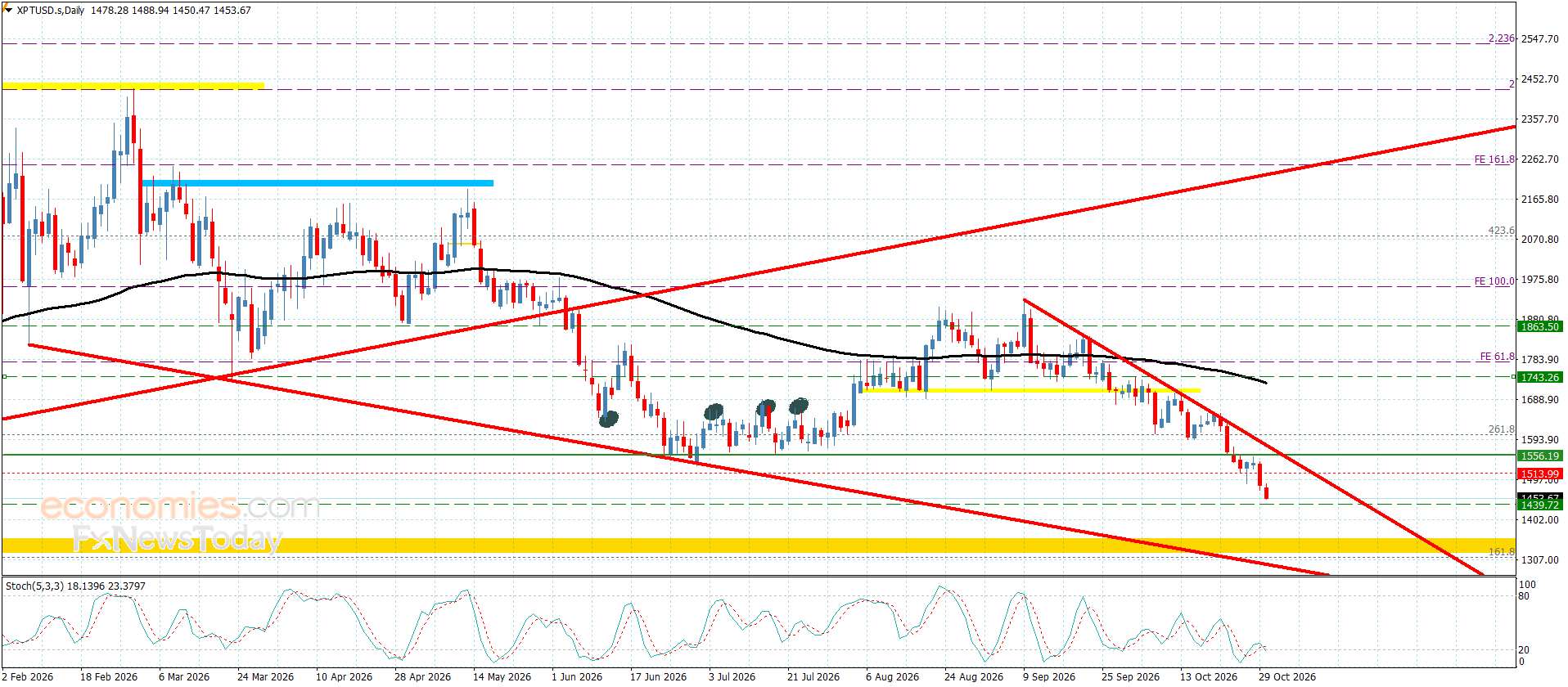
Platinum prices have succumbed to repeated negative pressure, forcing the price to break below the $1505.00 support level and incur further losses, currently settling near $1450.00, as shown in the attached chart.
The continued negative momentum signals from the main indicators, coupled with the $1565.00 level extending the current resistance, will reinforce the bearish trend. We therefore expect the price to break below the obstacle around $1440.00 soon, paving the way for further gradual declines toward the next targets at $1400.00 and $1365.00.
The expected trading range for today is between $1400.00 and $1500.00
Trend forecast: Bearish
Brent crude oil prices have surged to levels not seen in years, with analyst forecasts for 2026 now exceeding $90 per barrel for the first time since May. The U.S. Energy Information Administration recently raised its fourth-quarter 2026 Brent forecast to $105 per barrel, a staggering $14 increase from its previous projection. This dramatic revision reflects a fundamental shift in global oil market dynamics, driven by persistent supply constraints from OPEC+ production cuts, severe disruptions in Middle East energy flows, and an acute shortage of refined products like diesel and marine fuel.
For investors, the implications extend far beyond commodity markets. Major integrated oil companies including ExxonMobil, Chevron, and BP are reporting soaring third-quarter profits fueled by higher refining margins and elevated crude prices. Energy stocks have become one of the best-performing sectors in 2026, outpacing the broader market even as technology names face headwinds. However, the rally is occurring against a backdrop of significant geopolitical risk, with U.S. midterm elections looming and the Strategic Petroleum Reserve depleted to multi-decade lows. Understanding the drivers behind this oil price surge is essential for anyone positioning their portfolio in the current environment.
The trajectory of Brent crude throughout 2026 has defied earlier expectations of a gradual price moderation. At the end of October, Brent settled near $117 per barrel while West Texas Intermediate traded above $104, levels that seemed improbable just six months ago when many analysts expected prices to stabilize in the $70 to $80 range. The disconnect between forecasts and reality stems from a convergence of supply-side shocks that have overwhelmed any demand weakness in the global economy.
Analyst surveys conducted by Reuters and the Wall Street Journal now project Brent to average $92.88 per barrel for the full year 2026, with some institutions forecasting even higher averages closer to $96. The EIA’s October Short-Term Energy Outlook represents perhaps the most bullish official forecast, calling for $105 Brent in the fourth quarter and a full-year average of $96 before moderating to $84 in 2027 as flows recover and inventories rebuild. These upward revisions are not merely speculative; they reflect tangible constraints on global supply that show few signs of easing in the near term.
The price rally has been accompanied by a steepening backwardation in the futures curve, a market structure indicating tight near-term supply relative to longer-dated contracts. This structure rewards holders of physical crude while signaling to refiners and consumers that relief may be months away. For commodity traders and investors in oil-linked instruments, understanding this curve dynamic is critical, as it influences everything from inventory valuations to hedging costs across the energy complex.
For investors seeking to analyze energy sector opportunities with data-driven insights, consider using the AI-powered stock screener to filter and evaluate oil and gas stocks based on real-time financial metrics and market trends.
The Organization of Petroleum Exporting Countries and its allies, collectively known as OPEC+, have emerged as the single most influential factor supporting oil prices in 2026. The group maintains approximately 2 million barrels per day of production cuts across most participating countries, restrictions that are scheduled to remain in place through the end of the year. When OPEC+ convened on November 1, 2026, market participants widely expected the coalition to hold December production quotas unchanged, and early reports confirmed that seven key producing nations reached a preliminary agreement to do exactly that.
Saudi Arabia, the de facto leader of OPEC+, has been particularly disciplined in managing its output. The kingdom holds a production quota of 10.478 million barrels per day but has been producing approximately 2.1 million barrels below that ceiling. This voluntary restraint goes beyond the formal OPEC+ agreement and reflects Saudi Arabia’s strategic priority of supporting prices rather than maximizing market share. Russia, Iraq, Kuwait, Algeria, Kazakhstan, and Oman have similarly signaled their intention to maintain current production levels through the remainder of 2026, with discussions now shifting toward production baselines for 2027.
The significance of OPEC+ discipline cannot be overstated. Global oil demand is projected to decline by approximately 2.5 million barrels per day in the fourth quarter of 2026, yet the market is expected to remain in deficit by roughly 2.7 million barrels per day due to the combined effect of OPEC+ cuts and involuntary supply losses from other regions. This imbalance between shrinking supply and moderating demand is precisely what has driven prices to their current elevated levels. Investors monitoring the energy sector should watch closely for any signals of OPEC+ policy shifts in early 2027, as even modest production increases could substantially alter the price outlook.
Beyond the deliberate production management by OPEC+, the global oil market has been severely disrupted by geopolitical events in the Middle East that have constrained both crude production and refined product exports from the region. The Strait of Hormuz, through which roughly one-fifth of global oil shipments pass, has been declared effectively closed for commercial traffic, creating a logistical bottleneck that no amount of production quota adjustments can resolve. Saudi Arabia’s East-West pipeline, an alternative export route to the Red Sea, has also come under attack, further limiting the kingdom’s ability to deliver crude to Asian buyers.
The supply impact has been substantial. Compared to pre-conflict levels of approximately 4.7 million barrels per day of Middle East refined fuel supply, the world is currently lacking roughly 2.8 million barrels per day of gasoline, jet fuel, and diesel from the region. These losses compound existing constraints from Russian refinery outages, which have reduced another major source of refined product supply to global markets. The result is a tightness in physical oil markets that extends well beyond crude availability into the refined products that consumers and industries actually use.
Marine fuel and diesel markets have been particularly affected, with ICE Low Sulfur Gas Oil front-month contracts for November 2026 settling above $1,500 per ton. The diesel curve remains downward-sloping but at extraordinarily elevated absolute levels, underlining acute tightness in heating and transport fuels as the Northern Hemisphere enters winter. This product market tightness has direct implications for inflation, transportation costs, and industrial activity across the global economy, making the oil price surge a macroeconomic concern rather than merely a commodity market story.
One of the most underappreciated aspects of the current oil market crisis is the severe shortage of middle distillates, a category that includes diesel, heating oil, and jet fuel. Despite reports of falling global oil demand in 2026, diesel buyers in Europe, Latin America, and Africa have spent much of the year scrambling for cargoes. This apparent contradiction makes sense only when one recognizes that diesel markets operate somewhat independently of crude oil balances, driven by refinery capacity, feedstock quality, and regional inventory levels.
The International Energy Agency has warned that middle distillate supply constraints are likely to persist well beyond 2027, even as crude oil flows eventually recover. This extended timeline reflects the structural challenges facing global refining capacity, which has not kept pace with demand growth in emerging markets. New refinery projects take years to complete, and existing facilities face maintenance backlogs, feedstock limitations, and environmental regulations that constrain their ability to ramp up output quickly.
For the trucking, agriculture, shipping, and aviation sectors, the diesel shortage translates into higher operating costs that are difficult to pass through to end consumers immediately. This cost pressure is already visible in freight rates, airline ticket prices, and agricultural commodity markets. The so-called “diesel crisis” is therefore not a temporary phenomenon but a structural feature of the energy landscape that will influence investment decisions across multiple sectors for years to come.
The surge in oil and refined product prices has translated directly into exceptional financial performance for the world’s largest integrated oil companies. ExxonMobil, Chevron, and BP all reported third-quarter 2026 earnings in late October, and the results significantly exceeded analyst expectations across the board. These companies have benefited not only from higher crude prices but also from expanded refining margins, which have widened dramatically due to the product shortages described above.
ExxonMobil expects higher refining margins to boost third-quarter Energy Products earnings by $4.5 billion compared with the second quarter of 2026, illustrating how quickly downstream profitability can improve in a tight product market. Chevron and BP have similarly reported significant increases in their quarterly profits, driven by the combination of elevated oil prices and strong refinery throughput. The energy sector as a whole has outperformed the broader market in 2026, with oil giants taking control of market leadership from technology names that had dominated the previous several years.
From a valuation perspective, the integrated oil majors present an interesting case study. BP trades at a trailing price-to-earnings ratio of approximately 3.21x, while Chevron sits at 8.68x and ExxonMobil at a higher premium relative to the industry average of 6.68x. These varying valuations reflect differences in production growth profiles, capital allocation strategies, and geographic exposure. For investors evaluating energy sector opportunities, these metrics suggest that selective exposure to the oil majors may offer both income through dividends and potential capital appreciation if commodity prices remain elevated.
As oil prices have become a political flashpoint in the United States, the approaching midterm elections on November 3, 2026, have added another layer of uncertainty to energy market dynamics. Energy analysts have noted that crude oil has become the political pressure point of the U.S. midterm elections, carrying more weight for macro markets than central bank meetings or employment reports. The irony is palpable: campaign promises to slash energy costs have collided with a reality in which gasoline, diesel, and jet fuel prices have all soared instead.
The U.S. government enters the midterm cycle with a depleted Strategic Petroleum Reserve, which has been drawn down to historic multi-decade lows through aggressive emergency releases in recent years. This diminished buffer leaves the administration with limited tools to respond to further price spikes, should they occur. Macquarie Energy strategists have warned that energy markets remain on edge ahead of the elections, beholden to concerns of escalation in the Middle East either before or after the November 3 event horizon.
Morgan Stanley Research has estimated that even under optimistic scenarios, full recovery of disrupted Middle East supply would extend well into 2027, with logistical and technical bottlenecks keeping oil and fuel supplies tight in the interim. This timeline suggests that energy policy will remain a contentious issue regardless of the election outcome, and that market volatility around political developments may persist for months to come. For investors, this policy uncertainty reinforces the case for maintaining diversified exposure across the energy value chain rather than concentrating bets on any single outcome.
Looking beyond the immediate crisis, the outlook for oil markets in 2027 depends critically on several variables that remain unresolved. The EIA currently projects Brent to moderate to approximately $84 per barrel in 2027, assuming that Middle East flows recover and global inventories rebuild from their current depleted levels. However, this forecast hinges on geopolitical stabilization that is by no means guaranteed, and on OPEC+ choosing to increase production rather than maintain its current disciplined posture.
The IEA’s assessment that middle distillate supply constraints will persist well beyond 2027 suggests that even if crude oil prices moderate, refined product markets may remain tight. This structural tightness in products could support refining margins even in a lower crude price environment, creating a favorable operating backdrop for integrated oil companies with substantial downstream operations. Conversely, pure-play upstream producers could face margin compression if crude prices decline while their operating costs remain elevated.
For commodity investors, exchange-traded products tracking oil prices may offer exposure to the prevailing trend while limiting single-stock risk. The United States Oil Fund and similar instruments have seen renewed interest as investors seek to capitalize on the current price environment. However, the contango and backwardation dynamics in the futures curve can significantly impact returns on these products, making them more suitable for tactical rather than long-term strategic allocations.
The Brent crude oil price forecast for 2026 has been transformed by a convergence of supply-side shocks that have overwhelmed demand concerns and driven prices to multi-year highs. With analyst consensus now projecting averages above $90 per barrel and the EIA forecasting $105 in the fourth quarter, the energy complex is pricing in a prolonged period of tight supply that extends from crude production through refined product availability. OPEC+ discipline, Middle East disruptions, and structural constraints in global refining capacity have combined to create a market environment that favors energy producers and challenges consumers across the global economy.
For investors, the current environment presents both opportunities and risks. Major integrated oil companies like ExxonMobil, Chevron, and BP are generating exceptional profits and outperforming the broader market, yet their valuations vary significantly depending on production profiles and capital allocation strategies. The approaching U.S. midterm elections add a layer of policy uncertainty that could influence everything from drilling permits to export restrictions, while the depleted Strategic Petroleum Reserve limits the government’s ability to manage prices through intervention.
To navigate this complex landscape, investors need access to real-time data, intelligent analysis, and tools that can identify opportunities across the energy sector. The AI stock picker can help you discover energy stocks with strong fundamentals and favorable technical setups, while the comprehensive pricing plans provide access to advanced screening and portfolio analysis tools. Whether you are looking to capitalize on the oil price rally or hedge against potential downside, now is the time to equip yourself with the analytical capabilities that can make the difference in volatile markets.

Ready to take control of your energy investments? Sign up today and start analyzing oil stocks with AI-powered insights that help you stay ahead of market movements.
The Pound to Dollar exchange rate finished Friday at $1.3389, leaving Pound Sterling 0.94% higher over October after a Budget that avoided the disruption investors had feared.
Pound to Euro (GBP/EUR): 1.199748 (+0.28%)
Pound to Dollar (GBP/USD): 1.3389 (+0.08%)
Euro to Dollar (EUR/USD): 1.115984 (-0.20%)
Rabobank’s post-Budget currency projections allow little further upside over three months, with GBP/USD at $1.34 around late January 2027, before a retreat to $1.30 over 12 months, around late October 2027.
Those projections accompanied a view that markets expected too many Bank of England rate increases.
Since then, Rabobank’s economists have added another hike to their own outlook, changing an important assumption behind the currency analysis without supplying replacement exchange-rate targets in that update.
Before Friday’s policy revision, Rabobank senior FX strategist Jane Foley wrote:
“In RaboResearch’s view, the market continues to price in too much BoE policy tightening. Our central view is that the Bank is unlikely to hike more than once more this cycle. If the market unwinds rate hike speculation, GBP is at risk of being undermined into 2027.”
Lower expected UK rates would reduce the prospective return on Pound Sterling assets, potentially offsetting the reassurance delivered by the Budget.
But on Friday, Rabobank economist Stefan Koopman forecast a quarter-point increase in November to 4.00% and added another in February to 4.25%, citing persistent energy inflation despite limited evidence of wider wage and price spillovers.
That later assessment gives Pound Sterling more interest-rate support than the one-hike assumption in Foley’s analysis.
It does not establish that the currency forecasts have changed, or that all the tightening investors expect will materialise.
The BoE’s next decision and economic forecasts arrive on 5 November, providing an early test of how far policymakers believe rates need to rise.
Foley wrote: “The silver lining of the Truss budget is that no other UK politician wants to repeat the same mistake. In contrast to the situation in some other G7 countries, it is clear to both politicians and the electorate that government spending is constrained by the country’s high level of debt.”
She also identified a vulnerability in the ownership of UK government bonds:
“The fact that around 30% of gilts are held by foreign investors naturally implies that the pound is sensitive to a selloff in government debt.”
If overseas investors reduce exposure to British bonds and convert the proceeds into other currencies, that selling can put pressure on Pound Sterling as well as raise government financing costs.
Avoiding such a shock matters particularly when investors have already positioned for weakness.
Foley’s analysis showed speculators holding net short Pound Sterling positions ahead of the Budget, leaving scope for buying if they closed those bets.
Foley wrote: “Indeed, the lack of any market drama around the budget could give way to a little near-term relief in the pound.”
The published fiscal plans leave £15 billion of headroom against the current-budget rule in 2029/30, down from £23.6 billion in March.
That is the forecast cushion for meeting the rule, rather than money held in reserve.
Foley acknowledged the deterioration: “A reduction in the fiscal headroom is not good news, but crucially this is a self-imposed discipline. Compared with some other G7 countries, at least the UK has a budget consolidation plan in place.”
Foley points to competing demands: “On top of that, the experience of former PM Starmer suggests that welfare reform will be tough particularly given the ageing demographic. At the same time Healey has announced that defence spending will rise to 3% of GDP by 2030.”
Delivering that plan remains difficult, as the spending pressures left for 2027 make clear.
The Institute for Fiscal Studies’ Budget response warns that tight public-service spending assumptions leave the planned reduction in borrowing vulnerable.
The Pound-to-Euro exchange rate finished Friday at €1.1997, having gained 2.45% over October.
Foley wrote:
“EUR/GBP has trended lower over the last month as French budget concerns triggered fears of contagion in other highly indebted European nations. These events have weighed on the EUR and cast a relatively positive light on the pound.”
Rabobank’s three-month EUR/GBP forecast of 0.84 translates to approximately €1.1905 per Pound, calculated by Exchange Rates UK, slightly below Friday’s level.
GBP/USD has already reached the vicinity of Rabobank’s three-month projection. Its projections leave little additional near-term upside, while its added February hike makes next week’s BoE guidance particularly relevant.
GBP/EUR has benefited from a comparison between two strained fiscal positions. Progress towards a credible French budget could weaken that advantage even if confidence in UK policy holds.
For Pound Sterling, the risk is that inflation keeps interest rates and debt-servicing costs high while spending commitments erode the government’s smaller fiscal cushion.
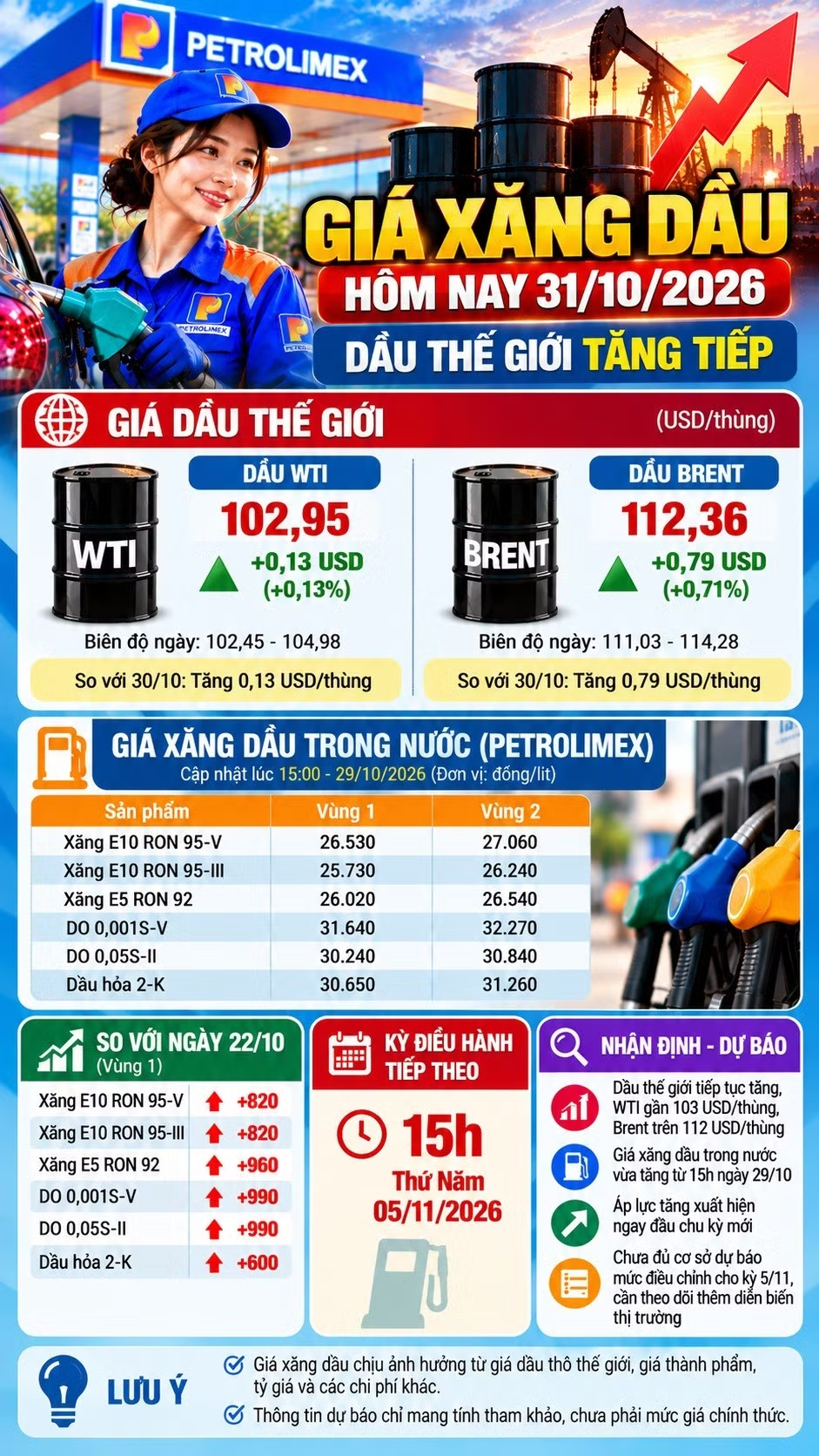
Global oil prices ended the week at a high level, while domestic gasoline and diesel prices have just increased across the board. This development puts pressure on the price adjustment scheduled for November 5th quite early, although there is currently insufficient data to predict the specific increase.
According to the updated data used in this article, the WTI benchmark price on October 31st was $102.95 per barrel, an increase of $0.13 compared to $102.82 per barrel on October 30th, equivalent to approximately 0.13%.
Brent crude rose from $111.57 per barrel to $112.36 per barrel, an increase of $0.79, or approximately 0.71%.
| Type of oil | October 30, 2026 | October 31, 2026 | Change | Proportion |
|---|---|---|---|---|
| WTI | $102.82 per barrel | $102.95 per barrel | +0.13 USD | +0.13% |
| Brent | $111.57 per barrel | $112.36 per barrel | +0.79 USD | +0.71% |
According to the data set, the most recent range for WTI was $102.45 – $104.98 per barrel, while Brent fluctuated between $111.03 – $114.28 per barrel.
Since October 31st is a Saturday, this is not a new oil futures trading session. The data should be interpreted as the weekend benchmark following Friday’s session.
International data shows that the October 30th session actually saw a stronger increase. WTI closed at $104.12 per barrel, up more than 2%; Brent closed at $117.64 per barrel, up about 2.4%, both reaching their highest levels in about 6 months. For the entire month of October, Brent increased by approximately 13.6%, while WTI increased by 15.2%.
The main drivers remain concerns about oil supply and transportation in the Middle East, while the physical market continues to be quite strained. A new Reuters survey shows that experts have also raised their 2026 oil price forecasts amid continued pressures on supply, inventories, and shipping costs.
Thus, despite price differences between sources due to contracts and recording times, the trend at the end of the week was quite clear: international crude oil remained at high levels and showed no signs of sustained cooling.
Domestically, Petrolimex’s retail prices will continue to apply the price list effective from 3 PM on October 29, 2026. Petrolimex confirms that the new prices will be applied from this time until the next price adjustment period.
Unit: VND/liter
| Product | Region 1 | Region 2 |
|---|---|---|
| E10 RON 95-V gasoline | 26,530 | 27,060 |
| E10 RON 95-III gasoline | 25,730 | 26,240 |
| E5 RON 92 gasoline | 26.020 | 26,540 |
| DO 0.001SV | 31,640 | 32,270 |
| DO 0.05S-II | 30,240 | 30,840 |
| 2-K kerosene | 30,650 | 31,260 |
Compared to the price list on October 22nd, all items at Petrolimex have increased in price:
| Product | October 22nd | October 29th | Change |
|---|---|---|---|
| E10 RON 95-V | 25,710 | 26,530 | +820 |
| E10 RON 95-III | 24,910 | 25,730 | +820 |
| E5 RON 92 | 25,060 | 26.020 | +960 |
| DO 0.001SV | 30,650 | 31,640 | +990 |
| DO 0.05S-II | 29,250 | 30,240 | +990 |
| 2-K kerosene | 30,050 | 30,650 | +600 |
According to the general price adjustment on October 29th, E5 RON92 increased by 666 VND/liter to a maximum of 26,027 VND/liter; E10 RON95-III increased by 521 VND/liter to 25,734 VND/liter; and diesel 0.05S increased by 696 VND/liter to 30,246 VND/liter.
The average prices of refined products during the period of October 22-29 also increased significantly: RON92 increased by 4.68%, RON95 by 4.22%, and 0.05S diesel by 2.71%. This is the main reason why retail prices reversed their downward trend after two consecutive periods of decline.
The actual price increase on Petrolimex’s price list is higher than the regulated price increase for some items because, from October 30th, the company no longer applies the policy of further reducing prices by 300 VND/liter/kg as in the previous period.
Unless the operating schedule changes, domestic fuel prices will be updated again at 3 PM on Thursday, November 5, 2026.
Early-cycle signals currently point toward the downside for retail prices.
International crude oil prices closed the week at high levels, with WTI exceeding $104/barrel and Brent surpassing $117/barrel according to international closing data. If this level persists into the beginning of next week and pushes up the prices of RON92, RON95, and diesel, the upward pressure on prices for the November 5th period will become clearer.
However, it is still too early to give a specific increase figure.
The new cycle only begins after October 29th. The sessions from November 2nd to 4th, and especially the average price of finished products, are more important bases for forecasting the adjustment level.
One factor to watch is supply. The market is still being affected by transportation risks and Middle Eastern oil supply, but improved production or supply flows could cause a rapid price reversal. OPEC+ is also expected by the market to maintain relatively stable short-term production targets.
Therefore, based on the data from the weekend of October 31st, it can be concluded that upward pressure has appeared quite clearly at the beginning of the cycle. However, there is not enough basis to confirm whether gasoline and diesel prices will continue to rise on November 5th, or by how much.