The main category of Forex News.
You can use the search box below to find what you need.
[wd_asp id=1]
The main category of Forex News.
You can use the search box below to find what you need.
[wd_asp id=1]
Natural gas price provided more of the mixed trading by reaching $2.750 level, keeping the positive stability above the support level at $2.620, as its stability reinforces the chances of activating the bullish trend in the near period.
Stochastic stability above 50 level will increase the chances of gathering positive momentum, to keep our bullish scenario by its rally towards $2.920, then to repeat the pressure at $3.100 barrier.
The expected trading range for today is between $2.700 and $2.920
Trend forecast: Bullish
The EURJPY pair kept its stability below the initial barrier that is represented by 209.45 level; however, the weakness of the last trading is caused by its neediness to the negative momentum due to stochastic exit from the oversold level as appears in the above image.
The price might keep providing sideways trading until gathering extra negative momentum, to reinforce the chances of attacking 177.80 level, and surpassing it will make it reach the extra negative stations near 177.35 and 176.70, while the risk of changing the trend and begin building bullish trend depends on breaching 180.80 level and holding with a daily close above it.
The expected trading range for today is between 178.10 and 179.40
Trend forecast: Bearish
The GBPJPY pair repeated providing weak sideways trading by its stability near 208.45 level, affected by the continuation of forming an obstacle at 280.10 level against the attempts of resuming the bearish trend, noticing the attempt of stochastic to exit the oversold level, which reinforces the dominance of the sideways range bias in the current trading, with a chance to retest the initial barrier near 210.40.
Achieving the required break and holding below 208.10 level will confirm its readiness to target more negative stations by reaching 206.70 initially, followed by 205.85.
The expected trading range for today is between 208.10 and 209.45
Trend forecast: Fluctuating within the bearish trend
Currently, DXY is trading at 99.07, having recovered from the 98.72 support zone. What I am seeing is price has recovered above the short-term moving averages, but the recovery is running into the 99.16 resistance zone where sellers are stepping in. This keeps the recovery constructive, but not strong enough for me to consider it a reversal.
The first resistance zone I am looking at is 99.16. If price clears this, then 99.28 and 99.39 come into play. If price continues to fall, then 98.99 will until 98.88 and 98.72 become significant.
The RSI is above the midline, which is supportive of the recovery. Even with that said, I remain slightly bullish until DXY trades below 98.99. However, I prefer to remain on the sidelines until the hourly candle closed above 99.16, at which point I would be bullish again. I would become neutral again if DXY trades below 98.88.
Domestic coffee prices
Coffee prices today in the domestic market increased by at least 200 VND/kg. According to giacaphe. com, the average coffee price on September 11 remained at 95,700 VND/kg, anchored in the price range of 95,200-95,800 VND/kg.
In Gia Lai and Dak Lak, coffee prices were recorded at 95,700 VND/kg, an increase of 200 VND/kg.
In Lam Dong, the listed coffee price is at 95,200 VND/kg, an increase of 200 VND/kg.
The old Dak Nong area alone increased by 300 VND/kg, recording a level of 95,800 VND/kg.
The USD/VND exchange rate according to Vietcombank was recorded at 25,710 VND/USD, down 40 VND/USD.
World coffee prices
In the world market, coffee prices increase and decrease interspersed.
According to Barchart, the September 2026 Robusta futures contract today maintained an increase of 14 USD/ton, anchored at the mark of 3,442 USD/ton. In the same direction, the November 2026 term was listed at 3,554 USD/ton, an additional increase of 82 USD/ton. The term from January 2027 to May 2027 witnessed the highest increase of 48 USD/ton, to 3,472 – 3,510 USD/ton.
Meanwhile, the September 2026 Arabica futures contract decreased by 3.9 cents/lb (equivalent to 1.22%), down to the 315.30 cent/lb mark. The December 2026 term has the same decrease, offered to the market at a price of 288.15 cents/lb. Further forwards are anchored in the 274.65 – 279.45 cent/lb range, down from 4.20-4.60 cents/lb.

Assessments and forecasts
Coffee prices fluctuated in opposite directions, with Arabica falling to a 7-week low, while Robusta rose to a 1.5-week high. Arabica coffee prices fell in yesterday’s trading session after the International Coffee Organization (ICO) issued a forecast for record global coffee production and oversupply.
ICO forecasts that global coffee production in the 2025/26 crop year will increase by 4.4% compared to the same period, reaching a record 183.6 million bags, while consumption will decrease by 0.9% to 180.6 million bags. This caused the global coffee market to have a surplus of 3 million bags, marking the first time the market has had oversupply in 5 years.
Brazil’s termination of the coffee harvest is boosting arabica supply and putting pressure on prices.
In addition, higher rainfall than normal in Brazil may promote the flowering process for next year’s coffee crop, thereby becoming a factor putting downward pressure on prices.
Robusta coffee prices are supported by concerns that heavy rain in the Central Highlands of Vietnam, the largest coffee production region in the country, could flood farms and damage the coffee crop.
In Thursday’s session last week, Robusta prices fell to a 3-month low due to signs that coffee supply from Vietnam, the world’s largest Robusta producer, is increasing.
Concerns that the El Nino weather phenomenon may cause damage to the Brazilian coffee crop next year are also factors supporting prices. El Nino may cause rainfall in Brazil to be delayed in September and October, when coffee trees usually bloom, thereby affecting the 2026/27 Brazilian coffee crop.
USD/JPY and EUR/JPY are flashing daily oversold momentum signals not seen since 2024, raising the risk of a near-term reversal ahead of the U.S. CPI report and Federal Reserve policy decision.
Both currency pairs are approaching key technical levels:
These developments come amid expectations and risks surrounding a potential Bank of Japan rate hike, ahead of Friday’s U.S. CPI report, and as Brent crude prices move back above $100 per barrel.
According to the Food and Agriculture Organization of the United Nations, the global food price index rose in August to its highest level since late 2022.
With oil prices elevated, geopolitical tensions unresolved, inflation concerns increasing and daily momentum reaching oversold levels not seen since 2024, a reversal in the direction of USD/JPY and EUR/JPY may be developing.

Source: TradingView
Following the breakdown below the April 2025–July 2026 uptrend, USD/JPY has been respecting the Fibonacci retracement levels of that advance.
Price action recently dropped below the 38.2% retracement at 154.80 and is now only a few points away from the 50% retracement and the next projected support zone near 152.
This level also aligns with the lower boundary of the parallel April 2025–July 2026 channel. At the same time, the daily RSI is showing a bullish divergence from oversold levels last seen in 2024.
This setup hints at a potential final leg lower before a possible reversal during the month.
Bearish scenario: A breakdown below 152 would signal further weakness in the dollar and additional strength in the yen. This could target the lower boundary of the larger channel that has been in place since 2023, near 149.
The 149 area could create another major reversal risk, particularly if momentum sinks deeper into oversold territory across multiple time frames.
Bullish scenario: Reclaiming 154.80 would strengthen the short-term bullish case and open the way toward the 158.40–161 zone.
This area represents a defining barrier between long-term bullish continuation toward the yearly highs and potentially 170, and the risk of another corrective move.
Overall, the bias leans toward a short-term bearish correction while the longer-term bullish structure remains in place.


Source: TradingView
From a weekly perspective, EUR/JPY is holding above the 27.2% retracement level of the February 2025–April 2026 uptrend, near the 178 mark.
At the same time, the daily RSI is falling into oversold territory last seen in 2024, increasing the risk of a bullish reversal in correlation with the USD/JPY chart.
If price drops below 178, the next target would be the 38.2% retracement near 175. This level also aligns with the July 2024 high and could create a high-probability dip-buying setup if momentum indicators move deeper into oversold territory across multiple time frames.
On the upside, a breakout above 181.40 would redirect price action toward the yearly highs and the 8-month resistance zone near 185.60–187.
A sustained move above this zone could open the way toward new multi-year highs.
Overall, the short-term bearish bias and longer-term bullish risks remain in focus.
Written by Razan Hilal, CMT
Follow on X: @Rh_waves
TradingKey – On September 10 Eastern Time, the three major US stock indices fell for the fourth consecutive trading day. US August PPI showed upstream price pressures continued to rise, while international oil prices surged further, with WTI crude breaking back above $100 a barrel, bolstering expectations for a September Fed rate hike. US Treasury yields continued to climb, putting pressure on tech stocks and high-valuation assets, as market focus shifted to Friday’s upcoming US August CPI data.
At the close, the Dow Jones Industrial Average fell 0.61% to 52,069.22; the S&P 500 Index dropped 0.58% to 7,591.70; and the Nasdaq Composite Index slipped 0.65% to 26,081.72.
In sector and individual stock moves, semiconductor shares came under pressure. Nvidia (NVDA) fell 2.37%, while Micron Technology (MU) dropped 4.9%, ranking among the major tech heavyweights dragging down the S&P 500. Apple (AAPL) bucked the trend to rise 3.56% as investors continued to digest the company’s newly released $1,999 foldable iPhone.
In commodities, oil prices became the day’s most significant market driver. Brent crude (UKOIL) surged 7.43% to settle at $109.30 a barrel; WTI crude (USOIL) rose 7.51% to close at $103.94, reclaiming $100 for the first time since May. Military actions between Iran and the US targeting oil tankers continued to escalate, while Houthi forces took control of Yemen’s Mocha port, further elevating the risk of Red Sea shipping disruptions.
In precious metals, gold (XAUUSD) fell 1.94% to close at $4,316.64. Rising US PPI and oil prices fueled expectations for Fed rate hikes, while a strengthening US dollar and higher Treasury yields added pressure on gold.
In cryptocurrencies, Bitcoin (BTCUSD) remained under pressure, dropping 2.22%. Following the release of US PPI data, Bitcoin briefly slipped below $77,000, having previously traded mainly around $78,000. Oil prices breaking above $100 and rising US Treasury yields kept short-term crypto trading focused primarily on Fed policy expectations rather than industry-specific factors.
U.S. August PPI rose 0.4% month-over-month, rising to 5.4% year-over-year. Data from the U.S. Department of Labor showed that the Producer Price Index for August rose 0.4% month-over-month, in line with market expectations and higher than the revised 0.1% in July; the year-over-year gain accelerated from 4.8% to 5.4%. Among components, energy prices rose 4.2% in a single month, with diesel prices surging 24.1%. Following the release of the data, market expectations for a 25-basis-point rate hike by the Federal Reserve in September rose from around 62% to 70%.
Average U.S. diesel price tops $6 per gallon for the first time in history. GasBuddy data showed that the average national diesel price rose above $6 per gallon for the first time on Thursday. Because diesel is widely used in trucking, logistics, and agriculture, high fuel costs could further pass through to goods and service prices, drawing increased attention to the impact of rising oil prices on U.S. inflation.
Middle East conflict expands further as both WTI and Brent top $100. Iran claimed it had attacked 10 vessels near the Strait of Hormuz, while the U.S. struck five Iranian tankers. Meanwhile, Iran-backed Houthi rebels seized control of Yemen’s Mocha port, extending supply risks from the Strait of Hormuz to the Red Sea. OPEC also lowered its 2026 global oil demand growth forecast to 380,000 barrels per day, but supply disruption risks continue to dominate short-term oil prices.
ECB raises interest rates by another 25 bps, pushing deposit rate to 2.5%. The European Central Bank raised interest rates for the second time this year, primarily to address energy inflation triggered by the war in the Middle East. The ECB expects the average inflation rate in the eurozone to reach 3.0% in 2026 and upgraded its economic growth forecast from 0.8% to 0.9%. Lagarde stated that there remain clear upside risks to the inflation outlook.
Oracle beats earnings expectations, shares up about 4% after hours. Oracle (ORCL) reported a 30% year-over-year increase in first-quarter revenue to $19.3 billion, topping market expectations of $19.14 billion; adjusted EPS came in at $1.92, above the expected $1.74. The company added more than $30 billion in new AI cloud contracts during the quarter, bringing its remaining performance obligations to $664 billion, and raised its fiscal 2027 adjusted EPS forecast to $8.10.
Adobe beats revenue and earnings estimates, but shares fall about 2% after hours. Adobe (ADBE) posted third-quarter revenue of $6.76 billion, beating market estimates of $6.7 billion; adjusted EPS was $6.13, also topping expectations of $6.09. However, the midpoint of the company’s fourth-quarter revenue guidance was approximately $6.825 billion, slightly below market expectations of $6.85 billion, sending its stock down about 1.9% in after-hours trading.
Pentagon reportedly considering $5 billion loan to AI cloud company Fluidstack. The U.S. Department of Defense is discussing providing a loan of approximately $5 billion to Fluidstack through its Office of Strategic Capital, according to The Wall Street Journal. The funds will primarily be used to strengthen the supply chain and manufacturing capabilities for U.S. data center components, rather than directly constructing new AI data centers. The plan reflects that the U.S. government is increasingly viewing AI infrastructure as a strategic industry.
U.S. decision on refined copper tariffs reportedly delayed. Sources said the White House is still evaluating the pros and cons of imposing tariffs on refined copper, partly out of concern that higher copper prices could further push up manufacturing costs. Following the reports, copper prices fell more than 4%, while copper mining stocks such as Freeport-McMoRan plunged in tandem.
The table below lists the ten most actively traded stocks in the market. Supported by massive trading volumes and excellent liquidity, these assets have become key benchmarks for tracking global market dynamics.
This content was translated using AI and reviewed for clarity. It is for informational purposes only.
The Euro to Dollar (EUR/USD) exchange rate recovered from a sharp fall below 1.1600 on Thursday as investors assessed US producer-price inflation and the European Central Bank’s latest rate increase.
At the time of writing, EUR/USD was trading around 1.1624, down 0.09% against the previous close, having rebounded from an intraday low near 1.1595.

Economists at Nordea believe the ECB has further tightening ahead, despite policymakers declining to commit to their next move.
“We maintain our baseline of two further 25bp rate hikes at quarterly intervals, with the next one in December and the second in March 2027.”
That path would take the deposit rate from 2.50% to 3.00%, providing potential support for the Euro through higher returns on euro-denominated assets.
The ECB raised its three key interest rates by 25 basis points, matching the increase Scotiabank had described as fully priced before the announcement.
Its monetary policy statement projected inflation at 3.0% this year and 2.5% in 2027, with the latter revised higher.
“We are not pre-committing to a particular rate path,” the ECB said.
Scotiabank had expected a forceful endorsement of further near-term tightening as recovering oil prices threatened broader price pressures.
Nordea reads the inflation projections as evidence that September’s increase will be followed by others.
“A very extended period of inflation above target strongly supports the case for more rate hikes.”
However, Nordea also notes that markets have moved to price a faster tightening path than its own forecast, leaving scope for those expectations to reverse if December remains the likeliest next move.
We believe that limits how much support the Euro exchange rates can draw from further hikes alone: their timing, and whether expectations move beyond what is already priced, will matter.
The US producer-price figures showed core prices, excluding food and energy, rose 0.2% in August, easing from July’s 0.3% increase, with annual inflation at 4.6%.
Headline prices increased 0.4% on the month and 5.4% annually as energy prices jumped 4.2%.
The slower monthly core reading offers encouragement, but persistent price pressure leaves the FED’s response an important constraint on Euro gains.
The recovery keeps Scotiabank’s case for a EUR/USD move towards 1.1700 in focus.
Its pre-release technical assessment nevertheless identified an obstacle just above current levels.
“The 200 day MA (1.1634) continues to offer resistance on a closing basis, and we continue to highlight the absence of any major resistance ahead of the local high around 1.17.”
A close above 1.1634 would strengthen the case for another attempt at 1.1700, while a renewed fall through the session’s 1.1595 low would undermine the recovery.
Our currency coverage draws on live market data, official economic releases and published bank research.
Domestic coffee prices
Today’s coffee prices in the domestic market mostly remained in the old price range, except for the old Dak Nong area. According to giacaphe. com, the average coffee price on September 10 remained at 95,500 VND/kg, down slightly 100 VND/kg.
In Gia Lai and Dak Lak, coffee prices were recorded at 95,500 VND/kg.
In Lam Dong, the listed coffee price is at 95,000 VND/kg.
The old Dak Nong area alone decreased by 300 VND/kg, recording a level of 95,500 VND/kg.
The USD/VND exchange rate according to Vietcombank is recorded at 25,750 VND/USD.
World coffee prices
In the world market, coffee prices are filled with green color on all terms.
According to Barchart, the September 2026 Robusta futures contract today reversed to increase by 14 USD/ton, anchored at the mark of 3,442 USD/ton. In the opposite direction, the November 2026 futures were listed at 3,472 USD/ton, up 14 USD/ton. The term from January 2027 to May 2027 witnessed the highest increase of 19 USD/ton, to 3,439 – 3,462 USD/ton.
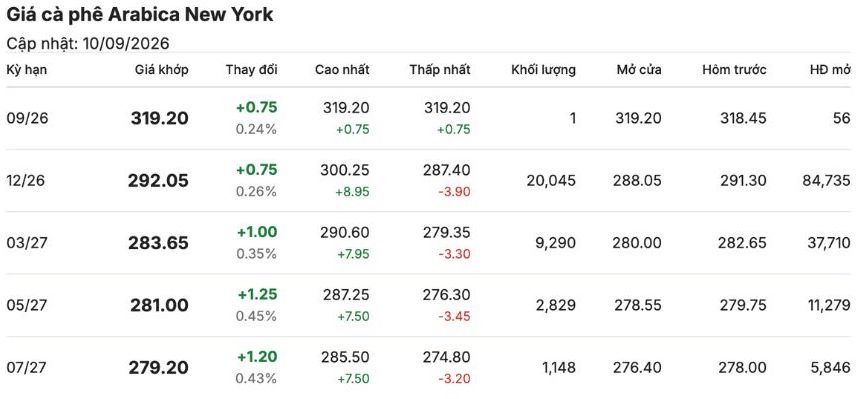
In the same direction, Arabica futures for September 2026 increased slightly by 0.75 cents/lb (equivalent to 0.24%), reaching 319.20 cents/lb. For December 2026, with the same increase, it was offered to the market at a price of 292.05 cents/lb. Further forwards are anchored in the range of 279.2 – 283.65 cents/lb.
Assessments and forecasts
Coffee prices closed the session up, with Robusta reaching a 1-week high. Short-term supply contraction is a factor supporting Arabica coffee prices, as Arabica inventories at ICE fell to a 27-year low, to 218,838 bags on Tuesday.
Robusta coffee prices are also supported by concerns that heavy rain in the Central Highlands of Vietnam, the largest coffee production region in the country, could flood farms and damage the coffee crop.
Coffee exports increased sharply from Vietnam, the world’s largest Robusta producer, which is a factor putting pressure on Robusta prices. Vietnam’s coffee exports in 2025 increased by 17.5% compared to the previous year, to 1.58 million tons. In addition, Vietnam’s coffee production in the 2025/26 crop is forecast to increase by 6% compared to the same period, reaching the highest level in 4 years at 1.76 million tons, equivalent to 29.4 million bags.
The US Department of Agriculture (USDA) forecasts global Arabica production to increase by 12% over the same period, while Robusta production is forecast to decrease by 0.7%. Global end-of-year inventories are forecast to increase by an additional 1.9 million bags, to 26.3 million bags.
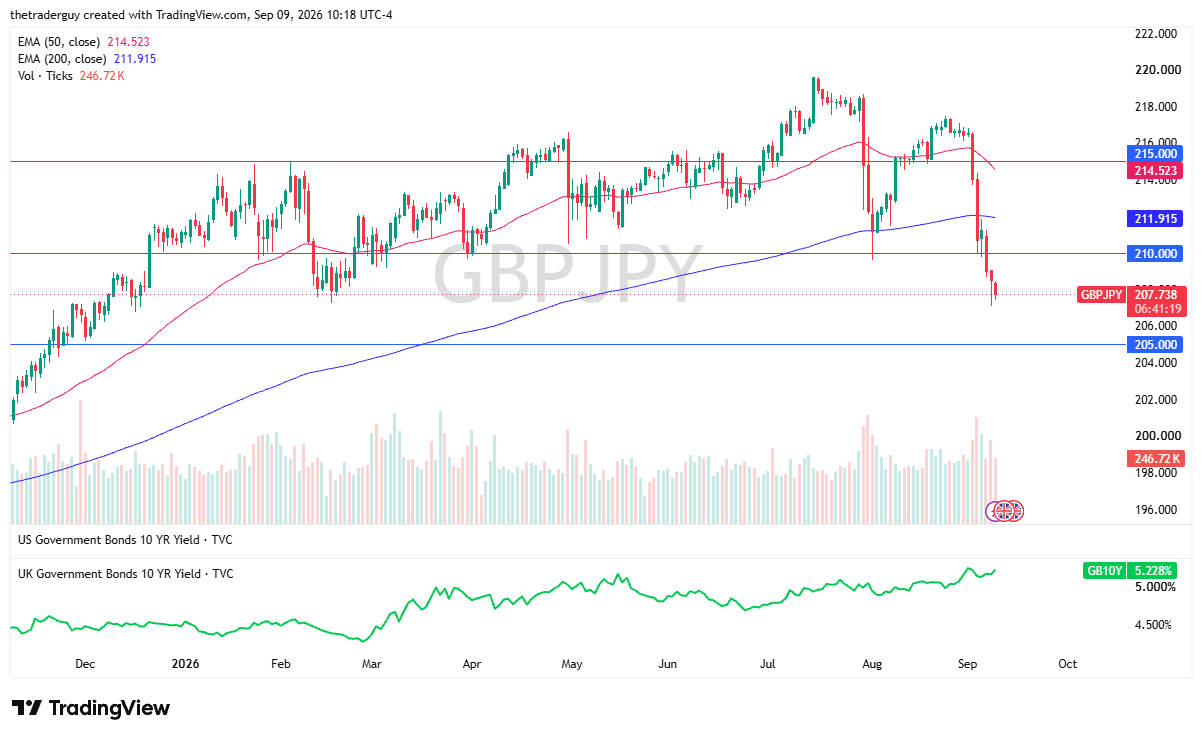
The “Dragon” continues to fall at the moment, as the Japanese yen outperforms almost every other currency that I have been following. At this point, the carry trade looks to be in serious trouble. Is an opportunity presenting itself?
The British pound finds itself falling against the Japanese yen again during the early part of the trading session on Wednesday as the carry trade unwind continues. The ¥207 level seems to be a major support level, having held multiple times, and therefore it is not a huge surprise to see a little bit of stability in this area starting to show itself.

It is not so much a sterling sell-off; this is about the yen rallying, as sterling is slightly stronger against many other currencies. However, traders continue to aggressively unwind yen shorts. The catalyst right now is the Bank of Japan, as markets are increasingly expecting a 25-basis-point Bank of Japan hike next week. The appreciation of 4% over the last 5 sessions is enough to rattle the markets in general.
The market is one that traders tend to use a lot for carry trades, but this is also a situation where the Bank of England is expected to leave rates unchanged next Thursday, so that means the interest-rate differential may shrink just a touch. U.K. yields are extremely high, and the 10-year gilt is right around 5.2%, so the British pound remains a substantial yield-advantage currency. But the directional change in Japanese monetary policy matters more right now than the absolute spread.
Overall, this is a scenario where the Stochastic RSI is deeply oversold, so people may be looking at that. But with the Bank of England coming out on September 17 and the Bank of Japan on September 18, we might see a bit of noise here. I personally am looking for value, as the carry certainly is attractive, but the question is: will we get the bounce here, or do we have to fall closer to ¥205 to see it?
Begin trading our daily forecasts and analysis. Here is a list of Forex brokers in Japan to work with.
Christopher Lewis is a technical analyst and market commentator at DailyForex with more than two decades of trading experience in Forex and other leveraged markets. Based in Columbus, Ohio, he specializes in chart-based analysis of major currency pairs, stock indices, commodities, and energy markets, focusing on clear support and resistance levels, trend structure, and risk management. Christopher produces daily written and video analysis for traders who rely on technical setups to navigate volatile market conditions
As seen on: Pairs Of Aces Podcast,The Trader Guy, FXEmpire