The main category of Forex News.
You can use the search box below to find what you need.
[wd_asp id=1]
The main category of Forex News.
You can use the search box below to find what you need.
[wd_asp id=1]
Gold (XAU/USD) trims losses on Wednesday, with price action returning to the $4,400 area during the European morning session, after bouncing from $4,345 lows on Tuesday. The precious metal is drawing support from broad-based US Dollar (USD) weakness, although the broader trend remains bearish, after losing more than $100 in the previous three trading days.
The Greenback is on its back foot on Wednesday, with investors awaiting Friday’s US Consumer Inflation figures to confirm expectations that the Federal Reserve will hike interest rates next week.
Strategists at Brown Brothers Harriman argue that “a hot CPI print would all but seal a September hike and underpin a firmer USD,” whereas “a cooler reading would strengthen the case for a hold and leave USD vulnerable to a dovish Fed repricing.” BBH experts, however, warn that “even if a September Fed hike becomes a done deal, we doubt USD will make new cyclical highs,” noting that tightening by other major central banks “limits policy divergence, with the ECB widely expected to deliver a 25bps hike tomorrow.”
XAU/USD has trimmed losses, returning to $4,400, yet with price action contained within Tuesday’s range, and with the broader bearish structure intact. The precious metal remains capped below the 200-day Simple Moving Average (SMA), with last week’s knee-jerk reaction looking like the second shoulder of a bearish Head & Shoulders (H&S) formation.
Momentum indicators in the daily chart are neutral-to-bearish, with the Relative Strength Index (RSI) flat around 50 and the Moving Average Convergence Divergence (MACD) in negative territory, suggesting that rebounds are vulnerable.
Tuesday’s low in the mid-$4,300s is holding bears for now and closing the path to the H&S neckline between $4,311 and $4,282, the August 14 and September 2 lows, respectively. A confirmation below those levels brings the August 6 low, at $4,223, into focus. Upside attempts above $4,400, on the contrary, are likely to meet resistance at Tuesday’s high of $4,443, ahead of last week’s highs around $4,500 and the 200-day SMA at $4,537.
(The technical analysis of this story was written with the help of an AI tool. Know more.)
Gold has played a key role in human’s history as it has been widely used as a store of value and medium of exchange. Currently, apart from its shine and usage for jewelry, the precious metal is widely seen as a safe-haven asset, meaning that it is considered a good investment during turbulent times. Gold is also widely seen as a hedge against inflation and against depreciating currencies as it doesn’t rely on any specific issuer or government.
Central banks are the biggest Gold holders. In their aim to support their currencies in turbulent times, central banks tend to diversify their reserves and buy Gold to improve the perceived strength of the economy and the currency. High Gold reserves can be a source of trust for a country’s solvency. Central banks added 1,136 tonnes of Gold worth around $70 billion to their reserves in 2022, according to data from the World Gold Council. This is the highest yearly purchase since records began. Central banks from emerging economies such as China, India and Turkey are quickly increasing their Gold reserves.
Gold has an inverse correlation with the US Dollar and US Treasuries, which are both major reserve and safe-haven assets. When the Dollar depreciates, Gold tends to rise, enabling investors and central banks to diversify their assets in turbulent times. Gold is also inversely correlated with risk assets. A rally in the stock market tends to weaken Gold price, while sell-offs in riskier markets tend to favor the precious metal.
The price can move due to a wide range of factors. Geopolitical instability or fears of a deep recession can quickly make Gold price escalate due to its safe-haven status. As a yield-less asset, Gold tends to rise with lower interest rates, while higher cost of money usually weighs down on the yellow metal. Still, most moves depend on how the US Dollar (USD) behaves as the asset is priced in dollars (XAU/USD). A strong Dollar tends to keep the price of Gold controlled, whereas a weaker Dollar is likely to push Gold prices up.
The U.S. 2-year yield is the first place I’m focusing on today. It continues to climb. Rates rocketing higher suggest people are becoming more and more used to the idea that the Federal Reserve is likely to hike rates, or at least that it is becoming more likely to hike rates next week.
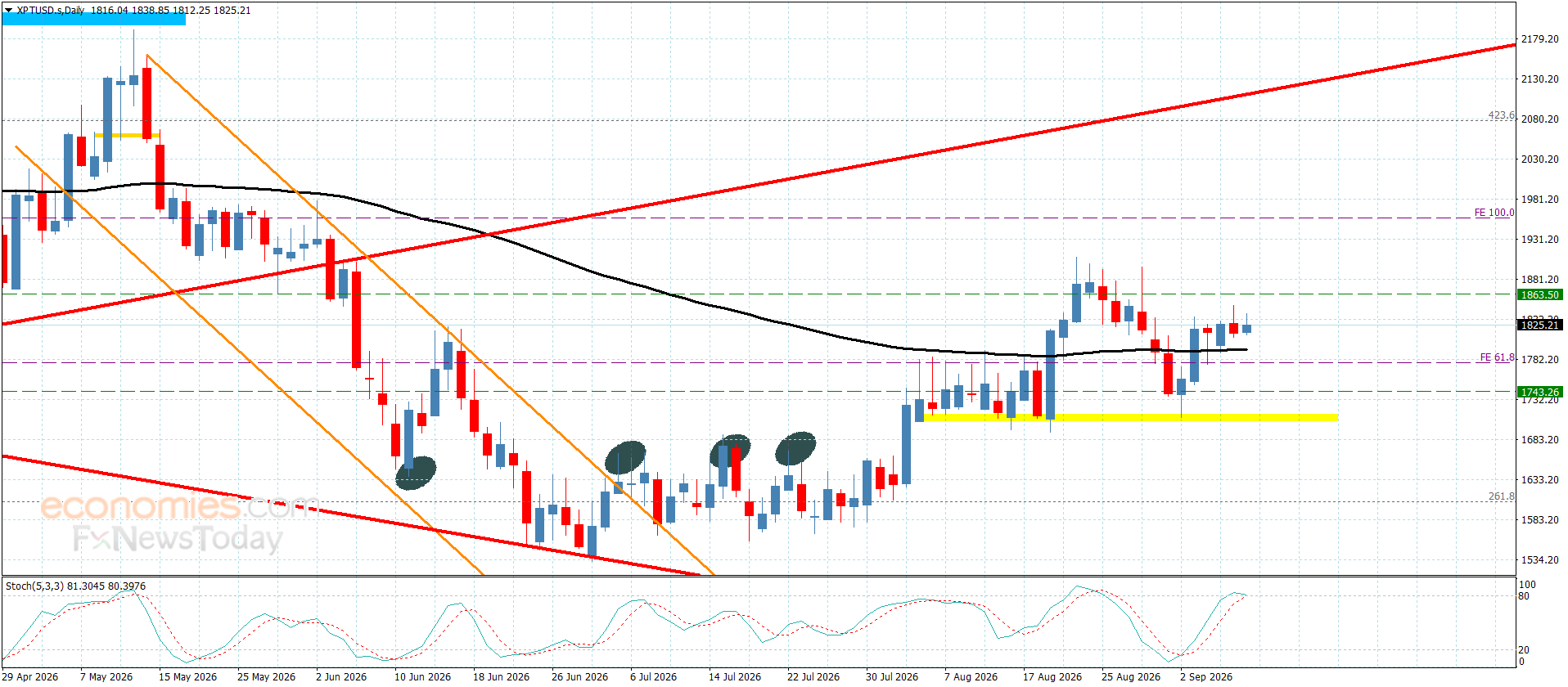
Platinum price didn’t move anything since yesterday, keeping its temporary sideways fluctuation near $1825.00 level, due to the continuation of forming an obstacle against the bullish rally at $1835.00 level.
We recommend waiting to confirm the required breach by providing positive closes above the current barrier, reinforcing the chances of reaching the positive stations, which might begin at $1910.00 and $1958.00, while the risk of changing the trend and begin a bearish trend depends on breaking $1705.00 support.
The expected trading range for today is between $1780.00 and $1910.00
Trend forecast: Bullish
The GBP/JPY pair has dropped significantly, only to turn things around and show signs of life again.
The British pound initially fell against the Japanese yen as we continued to see a lot of carry trade unwind around the world, but it has turned back around later in the day. Perhaps the Japanese yen got a little bit ahead of itself.

So as we head toward a Bank of Japan interest rate decision late next week, we also have to keep in mind that the interest rate differential is going to continue to be a big driver over the longer term.
The question is whether or not we have seen the carry trade unwind finish, or whether the market still has further to go.
The hammer that we are forming for the session is a good look. So we’ll see. I’ll be watching the 210 yen level for a potential breakaway to the upside.
A breakdown below the bottom of the candlestick for the day would be very negative. It could open up the pound to drop down to the 205 yen level.
Overall, this is a market that is being heavily influenced by the Bank of Japan and its intervention. And the question now is whether or not that intervention continues.
This isn’t the primary pair. The primary pair is dollar-yen, but this still has that huge interest rate differential. And even if the Bank of Japan does raise rates, it only makes a slight difference.
It certainly is a market that has been manipulated. That’s nothing new via intervention. But from a longer-term standpoint, not much has changed.
Maybe the British pound softens a little bit, and maybe the next high isn’t at 220 yen like we had seen at one point.
But the interest rate differential continues to be supportive, although that has deteriorated over the last couple of weeks.
Begin trading our daily forecasts and analysis. Here is a list of Forex brokers in Japan to work with.
Christopher Lewis is a technical analyst and market commentator at DailyForex with more than two decades of trading experience in Forex and other leveraged markets. Based in Columbus, Ohio, he specializes in chart-based analysis of major currency pairs, stock indices, commodities, and energy markets, focusing on clear support and resistance levels, trend structure, and risk management. Christopher produces daily written and video analysis for traders who rely on technical setups to navigate volatile market conditions
As seen on: Pairs Of Aces Podcast,The Trader Guy, FXEmpire
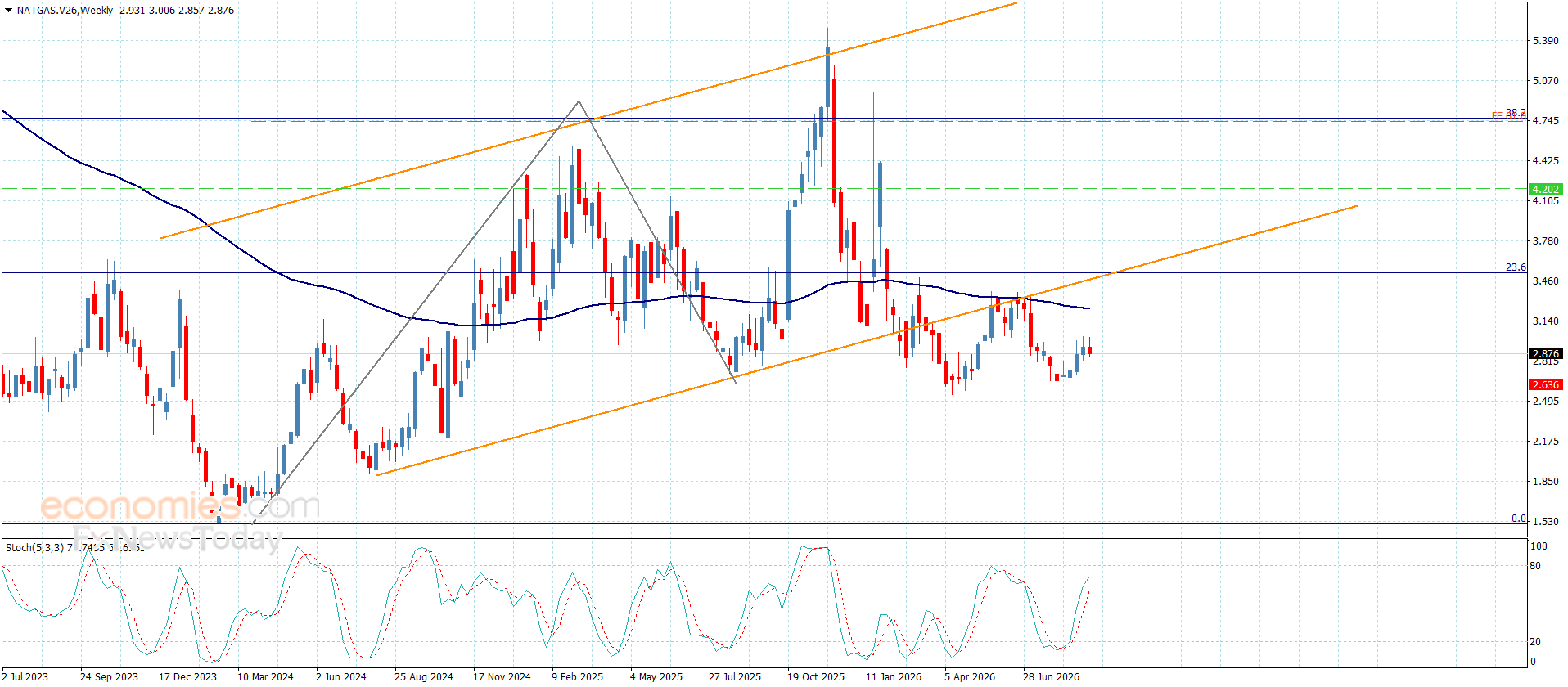
Despite the weakness in the natural gas price last trading, it formed a new sideways fluctuation by its stability near $2.880 level, however it didn’t affect the chances of forming new bullish waves, depending on the stability of the main support at $2.620 besides forming extra support at $2.810 level against the current trading.
The continuation of providing positive momentum by stochastic will help it renew the bullish attempts in the near period, to keep waiting for attacking $3.100 level, and surpassing it will ease the mission of achieving extra losses by its rally towards $3.250 and $3.450.
The expected trading range for today is between $2.800 and $3.100
Trend forecast: Bullish
Silver price (XAG/USD) is up almost 1% to near $66.40 during the Asian trading session on Wednesday. The white metal strengthens as the US Dollar remains under pressure despite expectations that the Federal Reserve (Fed) could raise interest rates at the policy meeting next week.
At press time, the US Dollar Index (DXY), which gauges the Greenback’s value against six major currencies, trades slightly lower to near 98.76. The USD Index is closer to its two-week low of 98.72 posted on Tuesday.
A lower US Dollar makes the Silver price a favorable risk-reward bet for investors.
According to the CME FedWatch tool, traders see a 60% chance that the Fed will raise interest rates in the September policy meeting. Hawkish Fed bets are propelled by a stronger-than-expected United States (US) Nonfarm Payrolls (NFP) report for August released on Friday.
Meanwhile, investors await the US Consumer Price Index (CPI) data for August scheduled for Friday to get fresh cues regarding the Fed’s monetary policy outlook.
According to TD Securities, core inflation likely continued to moderate in August, with the bank projecting that “core CPI rose 2.3% on a y/y basis, down 10 bps vs July,” while “headline inflation likely stayed unchanged at 3.4% y/y.” However, the economists caution that “we see the risks to our forecasts as skewed to the upside given that we’re assuming a number of large price declines in tariff-exposed goods categories.”
In the daily chart, XAG/USD trades at $66.42. The metal trades close to the 20-period Exponential Moving Average (EMA) at $65.79, reflecting a sideways trend.
The 14-period Relative Strength Index (RSI) at 53.68 sits in neutral-positive territory, suggesting modest bullish momentum rather than overbought conditions.
On the downside, initial support is seen near the August 19 low at $62.19, followed by the psychological level of $60.00. Looking up, the June high at $71.56 appears to be a strong barrier for the Silver price bulls.
(The technical analysis of this story was written with the help of an AI tool. Know more.)
Silver is a precious metal highly traded among investors. It has been historically used as a store of value and a medium of exchange. Although less popular than Gold, traders may turn to Silver to diversify their investment portfolio, for its intrinsic value or as a potential hedge during high-inflation periods. Investors can buy physical Silver, in coins or in bars, or trade it through vehicles such as Exchange Traded Funds, which track its price on international markets.
Silver prices can move due to a wide range of factors. Geopolitical instability or fears of a deep recession can make Silver price escalate due to its safe-haven status, although to a lesser extent than Gold’s. As a yieldless asset, Silver tends to rise with lower interest rates. Its moves also depend on how the US Dollar (USD) behaves as the asset is priced in dollars (XAG/USD). A strong Dollar tends to keep the price of Silver at bay, whereas a weaker Dollar is likely to propel prices up. Other factors such as investment demand, mining supply – Silver is much more abundant than Gold – and recycling rates can also affect prices.
Silver is widely used in industry, particularly in sectors such as electronics or solar energy, as it has one of the highest electric conductivity of all metals – more than Copper and Gold. A surge in demand can increase prices, while a decline tends to lower them. Dynamics in the US, Chinese and Indian economies can also contribute to price swings: for the US and particularly China, their big industrial sectors use Silver in various processes; in India, consumers’ demand for the precious metal for jewellery also plays a key role in setting prices.
Silver prices tend to follow Gold’s moves. When Gold prices rise, Silver typically follows suit, as their status as safe-haven assets is similar. The Gold/Silver ratio, which shows the number of ounces of Silver needed to equal the value of one ounce of Gold, may help to determine the relative valuation between both metals. Some investors may consider a high ratio as an indicator that Silver is undervalued, or Gold is overvalued. On the contrary, a low ratio might suggest that Gold is undervalued relative to Silver.
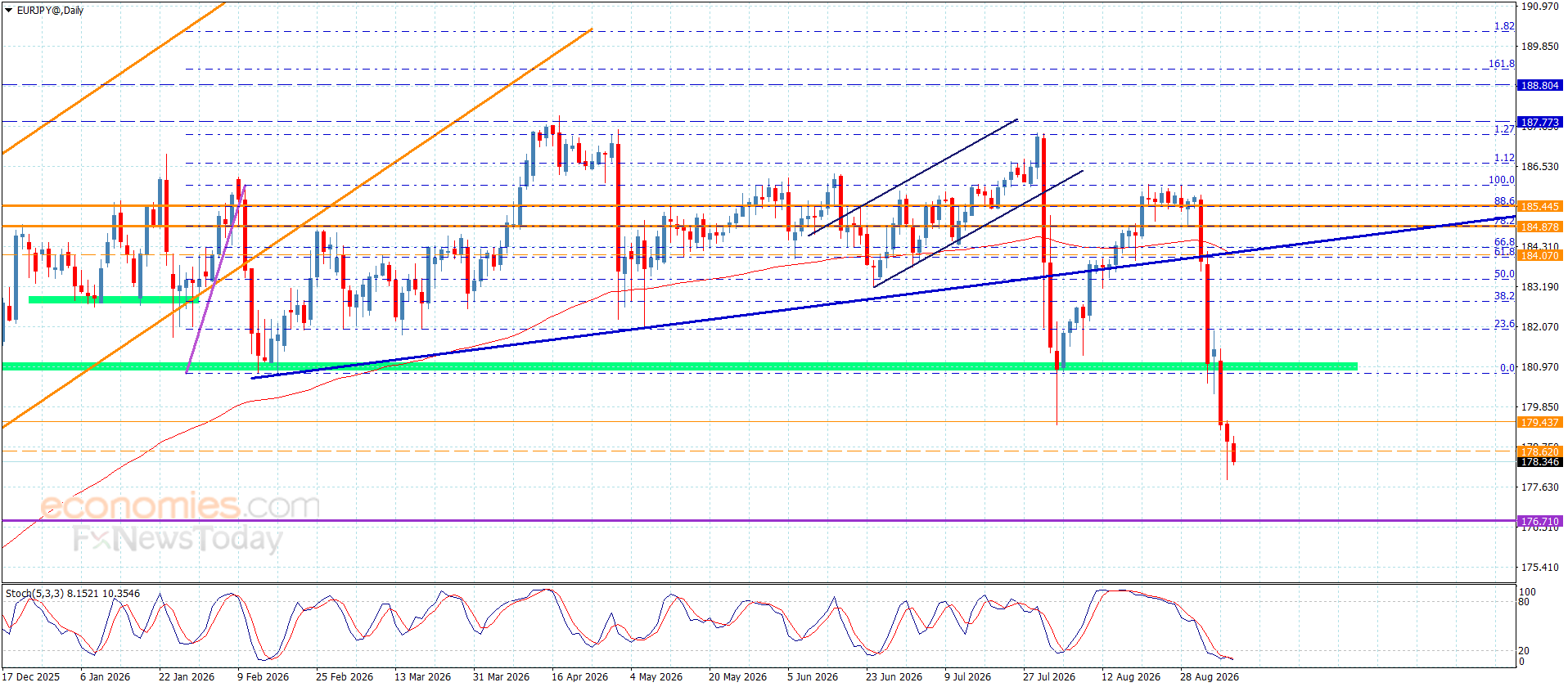
The EURJPY pair attempted to form sideways trading yesterday, however its stability below 180.80 barrier pushed it to renew the bearish attempts, to settle near 178.40 level.
Providing negative momentum by the main indicators reinforces the chances of resuming the bearish trend, to expect surpassing 177.80 level to pave the way for reaching extra negative stations, which are located near 177.35 and 176.70.
The expected trading range for today is between 177.35 and 179.40
Trend forecast: Bearish
Domestic coffee prices
Coffee prices today in the domestic market simultaneously reversed to increase compared to the previous session. According to giacaphe. com, the average coffee price on September 9 remained at 95,600 VND/kg, up 1,300 VND/kg.
In Gia Lai and Dak Lak, coffee prices were recorded at 95,500 VND/kg, an increase of 1,300 VND/kg.
In Lam Dong, the listed coffee price is at 95,000 VND/kg, an increase of 1,300 VND/kg.
The old Dak Nong area still maintained the highest price in the whole region, recording a level of 95,800 VND/kg, an increase of 1,300 VND/kg.
The USD/VND exchange rate according to Vietcombank was recorded at 25,750 VND/USD, down 20 VND/USD.
World coffee prices
In the world market, coffee prices increase and decrease according to each term with different exchanges.
According to Barchart, the September 2026 Robusta futures contract today reversed to decrease by 28 USD/ton, anchored at the 3,347 USD/ton mark. In the opposite direction, the November 2026 futures were listed at 3,458 USD/ton, up 53 USD/ton. The term from January 2027 to May 2027 witnessed the highest increase of 57 USD/ton, to 3,420 – 3,446 USD/ton.
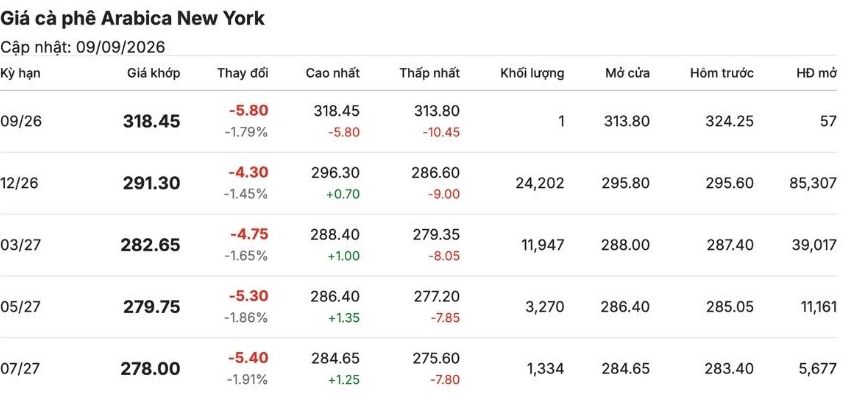
On the other hand, the September 2026 Arabica futures contract decreased by 5.8 cents/lb (equivalent to 1.79%), maintaining at the 318.45 cent/lb mark. The December 2026 term decreased by 4.30 cents/lb, bringing the price to the 291.30 cent/lb mark. Further forwards are anchored in the range of 278 – 282.65 cents/lb.
Assessments and forecasts
Arabica coffee contract for December delivery (KCZ26) closed the session on Tuesday down 4.30 cents, equivalent to 1.45%, while robusta ICE coffee for November delivery (RMX26) increased by 53 USD, equivalent to 1.56%.
Coffee prices closed in opposite directions on Tuesday, with Arabica falling to its lowest level in 2 months. Brazil’s increase in coffee exports put pressure on Arabica prices as the Brazilian Ministry of Commerce said coffee exports in August increased by 44.6% year-on-year, to 206,618 tons, the highest level in 8 months.
Robusta coffee prices rose on Tuesday due to forecasts of heavy rain in the Central Highlands of Vietnam, the largest coffee production region in the country, which could flood farms and damage coffee crops.
In Thursday’s session last week, Robusta prices fell to a 3-month low due to signs that coffee supply from Vietnam, the world’s largest Robusta producer, is increasing. The Vietnam National Bureau of Statistics said last Wednesday that Vietnam’s coffee exports in the first 8 months of 2026 increased by 13.7% year-on-year, to 1.33 million tons.
Rainfall higher than normal in Brazil may promote the flowering process for next year’s coffee crop, thereby becoming a factor putting downward pressure on prices.
Meanwhile, the decrease in inventory is a factor supporting Arabica coffee prices, when Arabica inventory at ICE decreased to the 27-year low, to 218,838 bags. Conversely, increased Robusta inventory is a factor putting pressure on prices when Robusta inventory at ICE increased to the highest level in 9.25 months, reaching 5,004 lots.
GBP/JPY rebounds on Tuesday as the Japanese Yen (JPY) loses momentum following its sharp rise since the start of the month. At the time of writing, the cross trades around 208.90 after briefly falling to 207.10, its lowest level since December 2025.
Some profit-taking in the Yen, combined with oversold Relative Strength Index (RSI) conditions in GBP/JPY, appears to be helping the cross rebound on Tuesday. Higher Oil prices also add pressure on the Japanese currency. Japan relies heavily on imported energy, particularly from the Middle East.
The Yen’s recent rally has been driven by expectations that the Bank of Japan (BoJ) will speed up its monetary policy tightening, prompting traders to unwind Yen-funded carry trades and bring capital back to Japan.
Better-than-initially-estimated Japanese Gross Domestic Product (GDP) data released earlier in the day reinforced expectations of a BoJ rate increase but provided little support to the Yen. The central bank is widely expected to raise interest rates at its September 17-18 meeting.
On the UK side, the Bank of England (BoE) is expected to leave interest rates unchanged for a sixth consecutive meeting on September 17. Attention now turns to the BoE Monetary Policy Report hearing later on Tuesday. Governor Andrew Bailey and other Monetary Policy Committee members will testify before lawmakers and traders will look for fresh clues about the interest rate path.
On the daily chart, GBP/JPY keeps its bearish near-term bias as it trades below the 50-day, 100-day and 200-day simple moving averages (SMAs). However, the Relative Strength Index (RSI) near 25 indicates oversold conditions and helps explain Tuesday’s corrective rebound. The Moving Average Convergence Divergence (MACD) stays below zero, while the Average Directional Index (ADX) rises toward 28, suggesting the broader downtrend remains strong.
On the upside, the psychological 210 mark acts as immediate resistance. A break above this level could open the door toward the 200-day SMA at 213, followed by the 100-day SMA at 214. Further resistance is seen at 217.50 and 219.50.
On the downside, Tuesday’s low near 207.10 provides immediate support. A break below this level could expose the psychological 205.00 mark. Buyers would need to push GBP/JPY firmly above the 210.00-215.00 region to ease the bearish pressure and support a stronger recovery.
(The technical analysis of this story was written with the help of an AI tool. Know more.)
The table below shows the percentage change of Japanese Yen (JPY) against listed major currencies today. Japanese Yen was the strongest against the New Zealand Dollar.
| USD | EUR | GBP | JPY | CAD | AUD | NZD | CHF | |
|---|---|---|---|---|---|---|---|---|
| USD | 0.09% | -0.01% | -0.03% | -0.07% | 0.08% | 0.63% | 0.26% | |
| EUR | -0.09% | -0.10% | -0.07% | -0.11% | -0.02% | 0.54% | 0.17% | |
| GBP | 0.00% | 0.10% | 0.00% | -0.07% | 0.07% | 0.63% | 0.28% | |
| JPY | 0.03% | 0.07% | 0.00% | -0.05% | 0.10% | 0.66% | 0.30% | |
| CAD | 0.07% | 0.11% | 0.07% | 0.05% | 0.14% | 0.70% | 0.35% | |
| AUD | -0.08% | 0.02% | -0.07% | -0.10% | -0.14% | 0.58% | 0.20% | |
| NZD | -0.63% | -0.54% | -0.63% | -0.66% | -0.70% | -0.58% | -0.36% | |
| CHF | -0.26% | -0.17% | -0.28% | -0.30% | -0.35% | -0.20% | 0.36% |
The heat map shows percentage changes of major currencies against each other. The base currency is picked from the left column, while the quote currency is picked from the top row. For example, if you pick the Japanese Yen from the left column and move along the horizontal line to the US Dollar, the percentage change displayed in the box will represent JPY (base)/USD (quote).
– Written by
James Fuller
STORY LINK Pound Sterling Forecast: Rising Gilt Yields Keep GBP/USD under Pressure
The Pound US Dollar (GBP/USD) exchange rate edged lower on Tuesday, with renewed concerns over global inflation weighing on market sentiment and encouraging demand for safer assets.
At the time of writing, GBP/USD was trading at around $1.3524, down slightly from the start of Tuesday’s session.
The US Dollar (USD) gained ground on Tuesday as a fresh jump in energy prices heightened fears that inflation could prove more persistent across the global economy.
Brent crude moved closer to the $100-per-barrel threshold during Tuesday morning trading after targeted strikes hit Saudi energy infrastructure.
Investors are concerned that another sharp increase in energy costs could feed into consumer and producer prices, potentially forcing central banks around the world to maintain or even tighten restrictive monetary policy for longer.
However, the ‘Greenback’s’ gains remained relatively contained as investors adopted a cautious stance ahead of this week’s US inflation figures.
The data could prove crucial in shaping expectations for whether the Federal Reserve will raise interest rates next week.
Get better rates and lower fees on your next international money transfer.
Compare TorFX with top UK banks in seconds and see how much you could save.
Sterling (GBP) also came under pressure on Tuesday, with the latest jump in crude prices contributing to another sell-off in UK government bonds.
Growing concerns over the inflationary impact of higher energy costs pushed borrowing costs higher, with the yield on the benchmark 10-year gilt climbing by around 0.3%.
This left yields just below the multi-year highs reached during last week’s bout of bond market turbulence.
The latest increase in borrowing costs presents another challenge for Chancellor John Healey, as higher debt-servicing expenses could put additional strain on government finances and further reduce the Treasury’s limited fiscal headroom ahead of October’s Budget.
With no major UK or US economic releases scheduled, the Pound to US Dollar (GBP/USD) exchange rate could take its cues from broader market developments through the middle of the week.
Should inflation fears continue to dominate sentiment, investors may become increasingly reluctant to take on risk, potentially strengthening demand for safe-haven currencies such as the US Dollar.

Conversely, any signs of de-escalation in the Middle East could see energy prices retreat from their recent highs.
This could take some pressure off the ‘Greenback’ while also supporting Sterling if falling oil prices help ease concerns over UK inflation and bring gilt yields lower.
International Money Transfer? Ask our resident FX expert a money transfer question or try John’s new, free, no-obligation personal service! ,where he helps every step of the way,
ensuring you get the best exchange rates on your currency requirements.
TAGS: Pound Dollar Forecasts