The main category of Forex News.
You can use the search box below to find what you need.
[wd_asp id=1]
The main category of Forex News.
You can use the search box below to find what you need.
[wd_asp id=1]
Welcome, my fellow traders! I have prepared a price forecast for US Crude, XAUUSD, and EURUSD using a combination of the margin zones method and technical analysis. Based on the market analysis, I suggest entry signals for intraday traders.
The euro remains in an uptrend.
The article covers the following subjects:
Oil continues to trade in a short-term uptrend. The price is climbing toward the Target Zone of 2 at 94.49–93.68. Consider long trades once the price pulls back to the support zone A of 87.61–87.17, with the first target at 89.57 and a second one around 91.97.
Buy near support A of 87.61–87.17. TakeProfit: 89.57, 91.97. StopLoss: 86.11.
Gold is maintaining a short-term downtrend. Bears are holding the price below the resistance zone B of 4,451–4,436. Thus, consider holding short trades until the first target of 4,367 is reached. If the price breaks below this level, the next bearish target will be at 4,282.
The price should break above the 4,464 level to create buying opportunities and reverse the trend.
Hold short trades opened at resistance B of 4,451–4,436. TakeProfit: 4,367, 4,282. StopLoss: 4,472.
The euro is trading in an uptrend and is approaching the first bullish target of 1.1642. If the price pierces this level and settles above it, the next target will be the August high of 1.1711. Should the asset exceed the August high, it may climb further toward the Target Zone 2 of 1.1761–1.1744.
If the euro price breaks below the key support of 1.1585–1.1572 within the short-term uptrend, one may consider short trades the next trading day, aiming for the lower Target Zone of 1.1459–1.1434.
Hold long trades opened near support B of 1.1585–1.1572. TakeProfit: 1.1642, 1.1711. StopLoss: 1.1579.
Would you like to learn more about technical analysis methods and principles? Explore our comprehensive guide.
P.S. Did you like my article? Share it in social networks: it will be the best “thank you” 🙂
Useful links:
The content of this article reflects the author’s opinion and does not necessarily reflect the official position of LiteFinance broker. The material published on this page is provided for informational purposes only and should not be considered as the provision of investment advice for the purposes of Directive 2014/65/EU.
According to copyright law, this article is considered intellectual property, which includes a prohibition on copying and distributing it without consent.
Japan appears to have finally achieved its long-standing goal of strengthening the yen. Currency intervention, speculation about aggressive BoJ rate hikes, and renewed capital inflows have all helped drive the Japanese currency higher. Let’s examine the situation and develop a trading plan for the USD/JPY pair.
The article covers the following subjects:
Perseverance pays off. Japan has finally achieved what the government had long dreamed of—strengthening the yen. The decline of USD/JPY to 7-month lows began with currency intervention and continued as fundamentals shifted and the pair broke below the 155 technical level, triggering massive liquidation of long trades and fueling the decline.
Scott Bessent has every reason to be proud of himself. According to the Treasury Secretary, US participation in the foreign exchange market intervention was necessary. Japan is the largest holder of US Treasuries, and its sale as part of currency interventions will lead to higher yields. At the same time, the yen’s weakness contributed to the devaluation of other Asian currencies, which undermined the competitiveness of US manufacturers.
Source: Bloomberg.
Indeed, according to Japan’s Ministry of Finance, holdings of foreign securities fell by $87.8 billion at the end of the summer, roughly matching the scale of foreign exchange interventions at the turn of July and August.
However, previous interventions more often failed than succeeded in reversing the USDJPY pair. Tokyo needed to change the fundamentals. This was done effectively. First, Policy Board Member Hajime Takata hinted that the decision to raise rates by 25 basis points in September was not set in stone. The BoJ might act more aggressively. Then, Nomura Securities stated that the central bank would raise rates by a quarter of a point at each meeting—in September, October, and December.
The acceleration of the monetary tightening cycle is not the only driver behind the sharp decline in USD/JPY quotes. Rumors are circulating that the growing attractiveness of Japanese assets is prompting large institutional investors to buy them, which will contribute to capital inflows into Japan and a stronger yen.
Source: Bloomberg.
The largest pension funds in Japan and Norway have signaled plans to increase their exposure to the world’s third-largest economy. In August, the GPIF held an unscheduled meeting for the first time in seven years, reportedly to discuss a potential reallocation of its assets. Norway’s GPFN, meanwhile, announced changes to its investment strategy. Previously, the fund allocated its portfolio based on each country’s share of the global economy; it will now allocate based on market capitalization. The shift could bring an additional $17 billion into Japanese securities, providing another potential source of support for the yen.
The issue of capital flows remains unresolved, while any meaningful shift in the fundamentals will ultimately depend on the Bank of Japan’s policy stance—which it has yet to clearly articulate. It is therefore quite possible that yen bulls are getting ahead of themselves. Against this backdrop, stronger-than-expected US inflation data could trigger a rebound in USD/JPY. If the price pierces the 154.4 resistance level, consider opening long positions.
This forecast is based on the analysis of fundamental factors, including official statements from financial institutions and regulators, various geopolitical and economic developments, and statistical data. Historical market data are also considered.
The content of this article reflects the author’s opinion and does not necessarily reflect the official position of LiteFinance broker. The material published on this page is provided for informational purposes only and should not be considered as the provision of investment advice for the purposes of Directive 2014/65/EU.
According to copyright law, this article is considered intellectual property, which includes a prohibition on copying and distributing it without consent.
Gold attempt to regain its bullish momentum faltered around $4,700, with the precious metal now struggling to retain the $4,400 mark. The XAU/USD pair peaked in late August amid reduced speculation that the United States (US) Federal Reserve (Fed) would hike interest rates in September.
Risk-related trading has dominated financial markets for most of this year, with the main focus on Oil price movements and their impact on inflation. The conflict between the US and Iran, which keeps the main Middle East sea passage interrupted, is the main driver for energy prices.
US President Donald Trump launched an attack on Tehran on claims that the Islamic country continued to develop nuclear weapons. But of course, making the US the number one global Oil exporter was also behind the decision to initiate a war. What Trump did not calculate is what Iran’s stubbornness is costing the American people and the rest of the war.
Iran not only refused to capitulate, but also made its own demands and blocked the Strait of Hormuz. As a result, energy prices skyrocketed and exposed the fragile equilibrium between economic progress and inflation. This implies tighter monetary policy, which in turn slows economic growth.
President Trump for sure wants economic growth, but he also demands lower interest rates from the US central bank, something Chair Kevin Warsh & co cannot deliver with increasing price pressures. Instead, the Fed is leaning toward rate hikes.
The situation created a particular market response: In a risk-averse scenario, investors tend to rush into safety. Gold is the preferred refuge, usually followed by the Japanese Yen (JPY) and the Swiss Franc (CHF). The US Dollar (USD) is also considered a safe-haven asset, yet in tumultuous times, Gold demand tends to outpace that of the Greenback.
However, when potential US Fed rate hikes are added to the equation, the USD firms up vs the precious metal. That’s the case these days.
As market participants bet on a Fed interest rate hike in September, XAU/USD comes under pressure.
From a technical point of view, the 4-hour chart shows XAU/USD as bearish, as the pair sits below the 20-period and 100-period moving averages while holding above the 200-period moving average. The 20-period SMA at $4,433.64 and the 100-period SMA at $4,491.14 act as overhead caps, suggesting rallies remain corrective within a broader consolidation. Momentum readings reinforce this subdued bias, with the 14-period Relative Strength Index (RSI) indicator heading marginally lower around 44 and the 14-period Momentum indicator developing below its midline, albeit directionless.
In the daily chart, XAU/USD sits between key moving averages, holding above the 100-day SMA at $4,346.86 while remaining capped by the 20-day SMA at $4,468.52 and the 200-day SMA at $4,536.74. The SMAs are neutral-to-bearish, reflecting increasing selling interest. The RSI indicator, in the meantime, pierces its midline, while the Momentum indicator gains downward traction within neutral levels, in line with lower lows ahead.
On the topside, immediate resistance emerges at the 20-period SMA near $4,433.64, with a break above this level exposing the denser barrier formed by the 100-period SMA around $4,491.14. On the downside, initial support comes from the market’s ability to defend the current area around $4,398, with the 100-day SMA at $4,346.86 as the next key floor; a clear drop below this level would expose deeper corrective risk within the broader range.
(The technical analysis of this story was written with the help of an AI tool. Know more.)
EUR/USD trades near 1.1627 on Tuesday after a US jobs report that came in almost three times above forecast. The data supported the dollar and strengthened expectations of tighter Federal Reserve policy. Attention now shifts to the European Central Bank meeting on 10 September, where the rate increase is already fully priced in, and the guidance that follows will determine the euro’s next move.
The US labour market delivered its strongest month since March. Nonfarm payrolls rose by 162,000 in August against a market forecast of around 56,000. The unemployment rate held at 4.1%, average hourly earnings rose 3.1% year-on-year, and the Bureau of Labor Statistics revised June and July higher by a combined 55,000, turning July’s previously reported job loss into a gain.
Nonfarm payrolls measure how many paid jobs the US economy added during the month, excluding farm work. They provide one of the clearest monthly indications of how much room the Fed has to adjust interest rates.
A labour market this resilient takes the pressure off the Fed to support growth and leaves inflation as its main concern. After the release, money markets raised the probability of a September rate increase to around 58%, up from roughly 52% before the data. Higher expected US rates make dollar deposits more attractive, so the dollar gained ground and EUR/USD settled into a narrow range.
All 65 economists polled by Reuters expect a 25-basis-point increase in the deposit rate to 2.50%. A basis point is one hundredth of a percentage point, so 25 basis points equal 0.25%. Money markets are pricing in the same outcome with near-full certainty and expect the deposit rate to rise further, reaching around 3.00% by June 2027. That implies two more increases after this week.
When an outcome is fully priced in, the decision itself rarely moves the market. The euro will take its cue from the press conference. Eurozone inflation accelerated to 3.3% in August, driven largely by energy costs, and Christine Lagarde has already identified the energy shock as an upside risk to prices.
That leaves one open question for Thursday. If Lagarde confirms that further tightening remains under discussion, the euro could gain support against a dollar that is also pricing in higher rates, with EUR/USD potentially testing 1.1655, the upper edge of its current range. If she delivers the rate increase and keeps every option open without committing to a path, the rate outlook remains in the dollar’s favour, and the pair could move towards 1.1525.
New orders in German manufacturing rose 2.5% in July after an upwardly revised 3.7% increase in June. The market expected 0.3%, and this was the third consecutive monthly increase.
The detail matters for anyone trading the euro. Excluding large-scale contracts, orders fell 1.4% from June. Domestic orders jumped 9.1% while foreign orders fell 2.1%, with demand from outside the euro area down 10.1% and demand from inside the bloc up 12.1%. Most of the headline strength came from shipbuilding, rail and aircraft contracts.
German industry is recovering, but that recovery currently relies on a small number of large contracts and on demand from within Europe. For the ECB, this supports the case that the economy can absorb higher rates.
On the four-hour chart, EUR/USD is building a consolidation range around 1.1620. An upward move towards 1.1655 remains on the table, with a decline towards 1.1525 seen as the following stage.
The MACD indicator supports this reading. MACD compares two moving averages of price and shows whether momentum is building or fading. Its signal line sits above zero and points firmly upwards, reflecting bullish momentum with room for the move higher to continue in the near term.
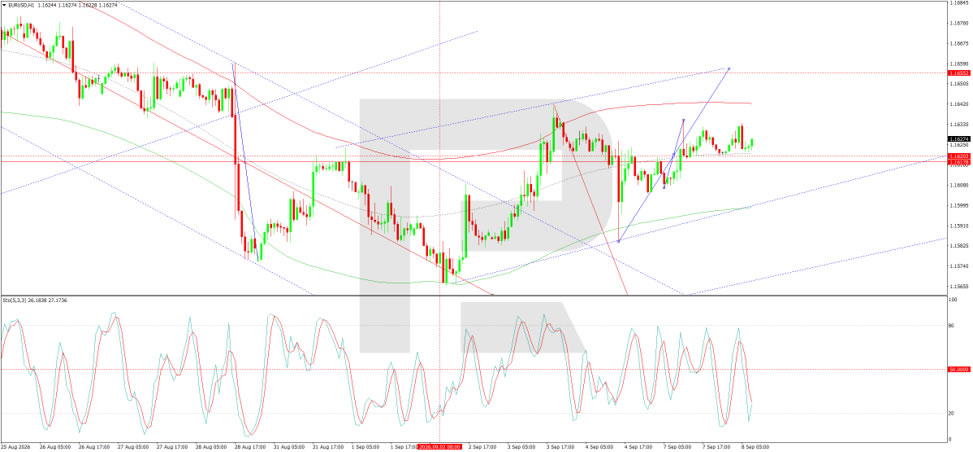
On the hourly chart, the market has completed a downward wave to 1.1620. The pair is now consolidating above that level. The working scenario for today is another upward leg towards 1.1655.
The Stochastic oscillator supports this view. The Stochastic oscillator shows where the current price sits within its recent trading range. Its signal line is above 20 and points upwards towards 80, indicating that the move higher still has room to develop.
EUR/USD enters the ECB week with the technical picture pointing towards 1.1655 in the near term, while the fundamental picture stays split between two central banks moving in the same direction. The rate increase to 2.50% is already priced in, so the euro’s next move depends on the guidance that follows.
While the pair holds above 1.1620, the upside scenario remains the working one, with 1.1525 the level to watch further out should the move higher fail to hold. The US inflation report due next week will be the next catalyst on the dollar side of the pair, so the levels set this week are likely to be tested again quickly. Traders who want to follow the reaction in real time can place both levels on the chart in advance and watch how EUR/USD behaves around them during the decision.
Disclaimer
Any forecasts contained herein are based on the author’s particular opinion. This analysis may not be treated as trading advice. RoboForex bears no responsibility for trading results based on trading recommendations and reviews contained herein.
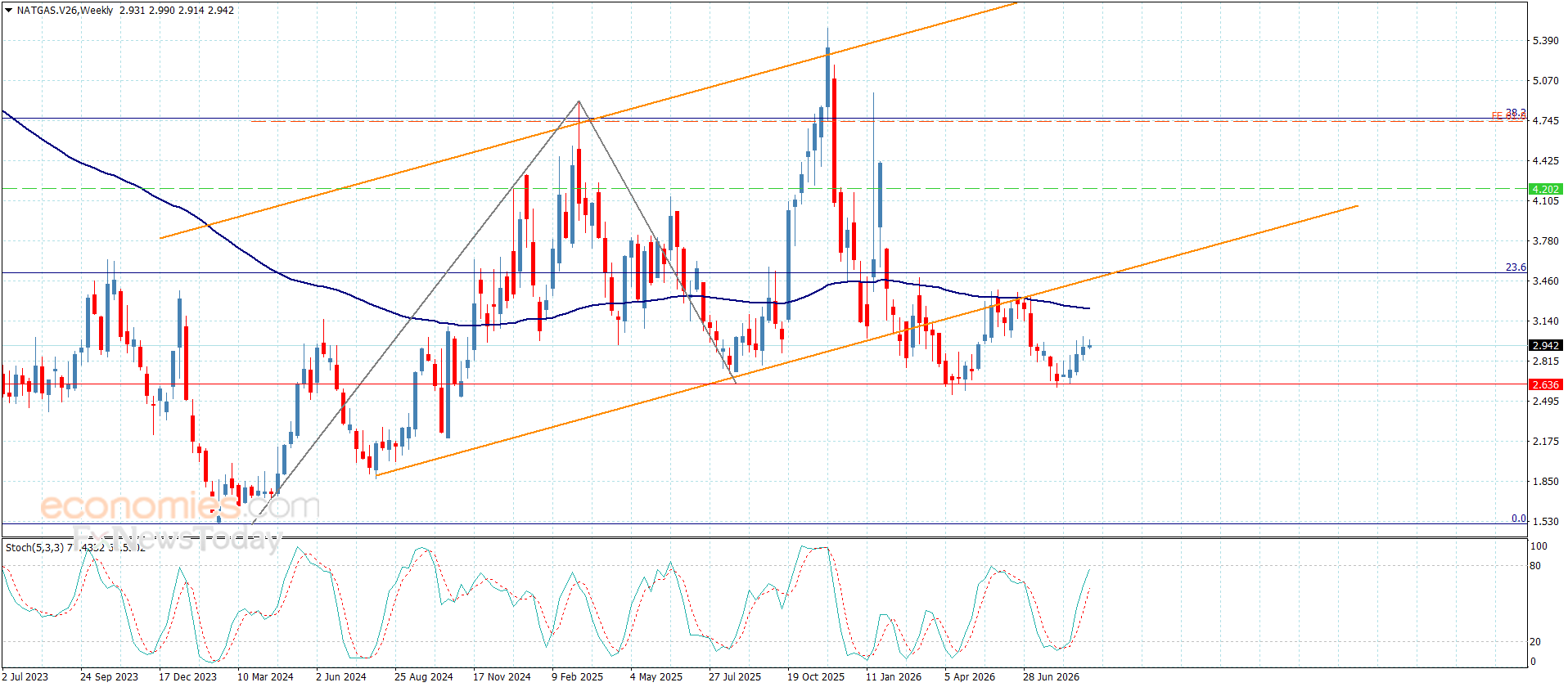
No escape for natural gas price from forming new bullish waves, due to the positive factors that are represented by the stability above the main support level at $2.620, besides providing positive momentum by stochastic in the current period.
And that confirms targeting more positive stations, reaching the initial target at $3.100, attempting to press on the barrier near $3.250 to find an exit for recording extra gains in the upcoming period.
The expected trading range for today is between $2.860 and $3.100
Trend forecast: Bullish
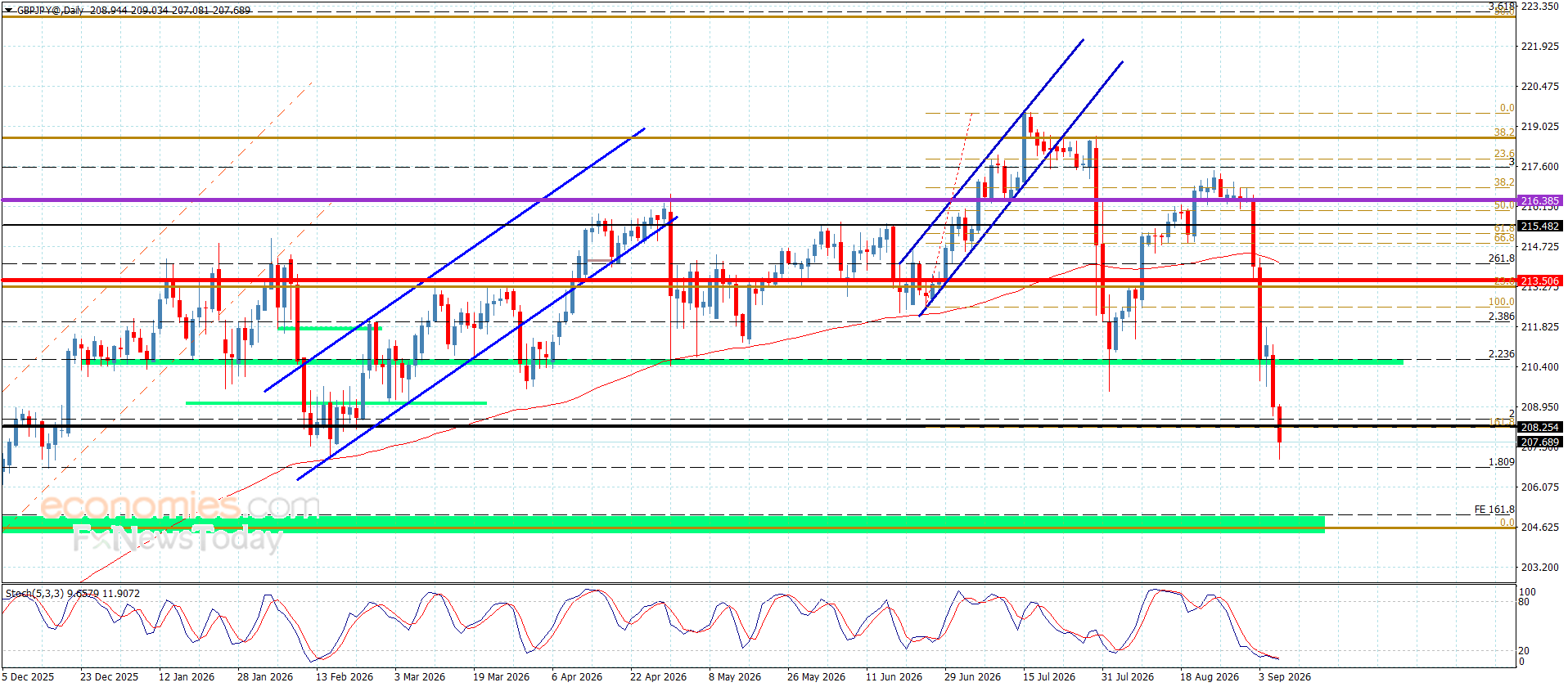
The GBPJPY pair is surrounded by negative pressures, forcing it to break at 210.40, to move to a new negative station, to suffer big losses by reaching 207.10.
Stochastic stability within the oversold level might force the price to provide mixed trading, its stability below 210.40 confirms its surrender to the bearish trend, increasing the chances of targeting in the near period at 206.70 followed by 205.00 level.
The expected trading range for today is between 206.70 and 209.10
Trend forecast: Bearish
Domestic coffee prices
Coffee prices today in the domestic market simultaneously decreased compared to the previous session. According to giacaphe. com, coffee prices on September 8th averaged at 94. 300 VND/kg, down 500 VND/kg.
In Gia Lai and Dak Lak, coffee prices were recorded at 94. 200 VND/kg, down 500 VND/kg.
In Lam Dong, the listed coffee price is at 93.700 VND/kg, down 500 VND/kg.
The old Dak Nong area still maintained the highest price in the whole region, recording a level of 94,500 VND/kg, down 500 VND/kg.
The USD/VND exchange rate according to Vietcombank was recorded at 25,770 VND/USD, down 70 VND/USD.
World coffee prices
In the world market, coffee prices increase and decrease according to each term with different exchanges.
According to Barchart, the September 2026 Robusta contract increased by another 56 USD/ton, anchored at the 3,400 USD/ton mark. In the opposite direction, the November 2026 term was listed at 3,405 USD/ton, down 25 USD/ton. The term from January 2027 to May 2027 saw the largest decrease of 21 USD/ton, down to 3,363 – 3,394 USD/ton.
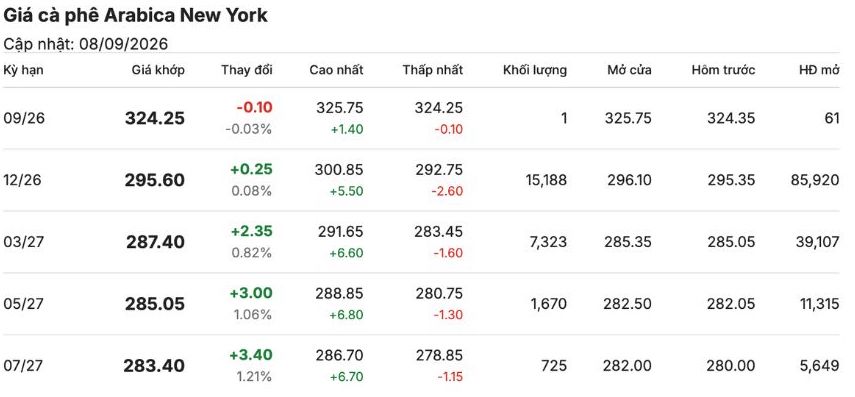
On the other hand, the September 2026 Arabica futures contract slightly decreased by 0.1 cent/lb (equivalent to 0.03%), maintaining at the 324.25 cent/lb mark. The December 2026 term increased slightly by 0.25 cent/lb, keeping the price at 295.60 cent/lb. Further forwards are anchored in the 287.4 – 285.05 cent/lb range.
Assessments and forecasts
According to the Vietnam Coffee – Cocoa Association (Vicofa), in the first 8 months of 2026, Vietnam’s coffee exports reached nearly 1.7 million tons, worth more than 6 billion USD, an increase of more than 10% in volume, but a decrease of 11.2% in value compared to the same period in 2025 due to reduced export prices.
The EU and the United States continue to be the key export markets for Vietnamese coffee. In addition, some markets in Asia, especially China, are opening up new growth poles for the industry.
According to forecasts, coffee prices tend to increase in the coming time, thanks to the support of many factors such as climate change with heavy rainfall slowing down harvest time in Brazil; El Nino, hot sun, drought will occur in Asia at the end of 2026 and 2027, which may affect coffee production and supply; low inventory.
The biggest downward pressure currently comes from the world’s largest coffee producer, Brazil.
The 2026/27 Arabica crop harvest in this country was almost completed by the end of August thanks to dry weather conditions helping to accelerate progress.
According to the latest forecast from brokerage company StoneX, Brazil’s output this crop year may reach a record level of 77.2 million bags, up 2.6% compared to the forecast in March. Brazil’s export growth also recorded a breakthrough, as the country’s government announced exports in August reached 3.44 million bags, up 45% compared to the same period last year.
EUR/JPY loses ground for the second consecutive day, trading around 178.40 during the Asian hours on Tuesday. Technical analysis of the daily chart indicates the currency cross remains within the descending channel pattern, signalling a bearish bias.
The EUR/JPY cross maintains a bearish near-term tone as it remains below both the nine- and 50-period Exponential Moving Averages (EMAs). The pair is extending its pullback from recent highs, and the Relative Strength Index (RSI) at 23.09 sits in oversold territory, hinting that while downside momentum is stretched, sellers still dominate below the clustered EMAs.
The EUR/JPY cross is positioned slightly above the newly formed support level at the lower boundary of the descending channel around 177.70. A break below the channel would strengthen the bearish bias and put downward pressure on the cross as it navigates the region around the 10-month low of 175.70, recorded in November 2025.
On the upside, the EUR/JPY cross could rebound toward the nine-day EMA of 182.00, followed by the 50-day EMA of 184.13. Further resistance lies at the upper boundary of the descending channel around 185.70, followed by the all-time high of 187.95 set on April 17.
(The technical analysis of this story was written with the help of an AI tool. Know more.)
The table below shows the percentage change of Euro (EUR) against listed major currencies today. Euro was the weakest against the Japanese Yen.
| USD | EUR | GBP | JPY | CAD | AUD | NZD | CHF | |
|---|---|---|---|---|---|---|---|---|
| USD | -0.04% | 0.00% | -0.54% | -0.15% | 0.02% | 0.27% | -0.07% | |
| EUR | 0.04% | 0.05% | -0.52% | -0.09% | 0.06% | 0.32% | -0.03% | |
| GBP | -0.01% | -0.05% | -0.56% | -0.15% | 0.01% | 0.28% | -0.07% | |
| JPY | 0.54% | 0.52% | 0.56% | 0.42% | 0.59% | 0.86% | 0.51% | |
| CAD | 0.15% | 0.09% | 0.15% | -0.42% | 0.16% | 0.43% | 0.09% | |
| AUD | -0.02% | -0.06% | -0.01% | -0.59% | -0.16% | 0.27% | -0.08% | |
| NZD | -0.27% | -0.32% | -0.28% | -0.86% | -0.43% | -0.27% | -0.34% | |
| CHF | 0.07% | 0.03% | 0.07% | -0.51% | -0.09% | 0.08% | 0.34% |
The heat map shows percentage changes of major currencies against each other. The base currency is picked from the left column, while the quote currency is picked from the top row. For example, if you pick the Euro from the left column and move along the horizontal line to the US Dollar, the percentage change displayed in the box will represent EUR (base)/USD (quote).
The bank said Brent crude could rise above $120 a barrel in 2027 if average oil production in the Gulf remains 4 million barrels per day below pre-war levels. That compares with Goldman Sachs’ base-case assumption of a 500,000-barrel-per-day shortfall.
However, the bank also outlined a significantly lower-price scenario. Brent could fall into the $60s a barrel in 2027 if average Gulf oil production rises by 1 million barrels per day above pre-war levels, according to the Reuters report.
Oil prices have recently climbed to a six-week high as renewed conflict in the Middle East heightened concerns over potential supply disruptions. Iran has also threatened the United States with economic retaliation, adding to fears that the conflict could escalate further.
The six-month-old war has been characterised by periods of calm followed by renewed flare-ups, keeping energy markets on edge. Shipping through the Strait of Hormuz has also slowed sharply, with an average of only 10 commodity ships passing through the key waterway each day over the past 10 days, the lowest level since May, shipping data showed on Monday.
Read more: Global Market Today: Asia stocks waver as yen surges, Iran warns of retaliation
Goldman Sachs said the increase in its price forecasts remained relatively modest despite its assumption that shipping disruptions would continue. Reuters reported that the bank pointed to limited drawdowns in OECD commercial oil inventories since the conflict began and its expectation that Middle Eastern producers would continue adapting supply flows.The Strait of Hormuz is a critical route for global energy shipments, and prolonged disruption could tighten crude supplies and put upward pressure on prices. The extent of the impact, however, will depend heavily on the duration of the conflict, the pace at which Gulf production recovers and the ability of producers and traders to redirect supplies.
Goldman Sachs’ scenarios highlight the wide range of possible outcomes for crude prices in 2027, with prolonged supply losses potentially pushing Brent above $120 a barrel, while a stronger-than-expected recovery in Gulf production could send prices down toward the $60s.
TradingKey – As of the Asian session on September 8, WTI crude oil prices (USOIL) continued to fluctuate at high levels, with the latest price trading higher near $92.30, up 1.2% on the day after touching a nearly two-month high of $93.29. Over the past week, WTI has accumulated a gain of nearly 10%. The re-escalation of the US-Iran conflict, shipping restrictions in the Strait of Hormuz, and OPEC+’s pause on further production increases have jointly provided sustained upward momentum for oil prices.
From a fundamental perspective, WTI has continued to climb recently, with the core driver remaining Middle East crude supply risks stemming from the escalating U.S.-Iran conflict. As both sides launch a new round of actions targeting oil tankers and related military targets, market focus has shifted from pure geopolitical tension to whether the conflict will further affect shipping through the Strait of Hormuz and crude oil exports from the Persian Gulf.
Recently, the number of commodity vessels passing through the Strait of Hormuz has dropped noticeably, while safety and insurance risks facing commercial oil tankers have risen in tandem. Given that the Strait of Hormuz handles a substantial portion of global oil transport, if traffic remains persistently below normal levels, even if crude exports are not completely disrupted, the market will need to price in a higher risk premium for potential supply losses.
Meanwhile, OPEC+ decided to maintain its existing production policy unchanged in October, pausing its previous streak of consecutive output increases. This means that amid rising supply uncertainty in the Middle East, the short-term buffer of additional supply from OPEC+ is reduced, providing further support to oil prices.
However, WTI has already risen rapidly from near $80 in late August to above $92, with some geopolitical risk already priced in. Whether oil prices can further challenge $97 or even $100 going forward will depend critically on the actual shipping conditions in the Strait of Hormuz and whether Middle East crude experiences more pronounced supply losses.
If attacks on commercial tankers expand further, or if energy facilities such as major oil fields and export terminals are affected, WTI could still continue to move higher; conversely, if signals of negotiations or a ceasefire emerge between the U.S. and Iran and shipping recovers, the current elevated risk premium could rapidly recede.
WTI crude oil price daily chart, source: TradingView
Looking at the daily chart of WTI crude oil prices, driven by the escalation of the US-Iran conflict, oil prices recently rose from $80 to a high of $93.29. The short-term candlestick structure shows a distinct pattern of continuously higher highs and higher lows, indicating that the short-term uptrend remains intact. Meanwhile, the 5-day and 10-day moving averages sequentially crossed above the 144-day moving average, forming a golden cross structure and further strengthening short-term bullish momentum.
Currently, oil prices today advanced to just below the July 23 rebound high of $93.50, increasing short-term upside pressure. If oil prices can effectively break through and hold above $93.50, it will open up upside space toward $97.00. Further up, prices could test the $100 mark and even challenge $105.
On the downside, the primary support level to watch below is the $91-$90 range. If oil prices fall below $90, they may further test support near $87.70 down below; if the decline continues, they could test support at the 20-day moving average.
This content was translated using AI and reviewed for clarity. It is for informational purposes only.