The main category of Forex News.
You can use the search box below to find what you need.
[wd_asp id=1]
The main category of Forex News.
You can use the search box below to find what you need.
[wd_asp id=1]
The Euro tried to rally to begin the trading session on Thursday but gave back gains. At this point in time, it looks like we continue to go sideways, and it looks like we have nowhere to be at this point in time.
The 1.18 level continues to be a bit of a magnet for price, and we are sitting just above the crucial 50-day EMA. Quite frankly, I think we’ve got a situation where the pair just doesn’t know where to go and therefore, we will remain hugging the 50-day EMA in the short term.

Ultimately, if we can break above the 1.1850 level it opens up the possibility of a move to the 1.20 level. But we can also say that if we were to break down below the lows of last week maybe we could open up a move down to the 1.16 level, which is right about where the 200-day EMA is hanging around.
Ultimately, this is a market that I think continues to be very noisy and of course will move on to the latest noise coming out of the US economic background. After all we have to wonder about the Federal Reserve and what they are going to do as far as interest rates are concerned.
People are trying to do what they can to get a grasp on the idea that the Fed may or may not cut rates as rapidly as previously expected as the jobs situation in the United States has been better than anticipated. That does slow things down but now we’re starting to see people talk about 2027 not so much 2026 and if that ends up being something that catches hold the US dollar will pick up strength yet again because we already know that the European Central Bank is likely to be flat this year as far as monetary policy is concerned.
I think there’s so much confusion here that short-term range bound traders are probably the only people bothering with this market in what would probably be thought of as about a 50-pip zone with the 1.18 level.
Ready to trade our daily Forex analysis? We’ve made this forex brokers list for you to check out.
Christopher Lewis has been trading Forex and has over 20 years experience in financial markets. Chris has been a regular contributor to Daily Forex since the early days of the site. He writes about Forex for several online publications, including FX Empire, Investing.com, and his own site, aptly named The Trader Guy. Chris favours technical analysis methods to identify his trades and likes to trade equity indices and commodities as well as Forex. He favours a longer-term trading style, and his trades often last for days or weeks.
The article covers the following subjects:
Consider short positions from corrections below the level of 67.30 with a target of 55.00–50.50.
Breakout and consolidation above the level of 67.30 will allow the asset to continue rising to the levels of 77.50–87.00.
A descending correction appears to continue forming as the second wave of larger degree (2) on the weekly chart, with wave C of (2) developing as its part. On the daily time frame, a bullish correction appears to have formed as the fourth wave iv of C, and the fifth wave v of C has started developing. The third wave of smaller degree (iii) of v of C has presumably been completed on the H4 time frame. The fourth wave (iv) of v has finished forming as a local correction. If the presumption is correct, WTI will continue to drop to 55.00–50.50 within wave (v) of v. The level of 67.30 is critical in this scenario as a breakout above it will enable the price to continue rising to the levels of 77.50–87.00.
This forecast is based on the Elliott Wave Theory. When developing trading strategies, it is essential to consider fundamental factors, as the market situation can change at any time.
The content of this article reflects the author’s opinion and does not necessarily reflect the official position of LiteFinance broker. The material published on this page is provided for informational purposes only and should not be considered as the provision of investment advice for the purposes of Directive 2014/65/EU.
According to copyright law, this article is considered intellectual property, which includes a prohibition on copying and distributing it without consent.
Euro–Japanese yen (EUR/JPY) is quoted around 182.569 as of 11:12am (UTC) on 20 February 2026, trading within an intraday range of 182.082–183.039. The cross is holding close to the European Central Bank’s latest euro reference rate for the yen, which stood near 182.05 JPY per EUR on 19 February 2026. Past performance is not a reliable indicator of future results.
The latest flash Eurozone composite PMI for February printed above both forecasts and the prior reading (Reuters, 20 February 2026), while Japan’s national CPI has eased to its slowest pace since early 2022 (MarketScreener, 20 February 2026). This combination has prompted some market participants to reassess the timing and extent of potential BoJ tightening, contributing to a softer yen tone.
As of 20 February 2026, third-party euro Japanese yen predictions outline a mix of bullish and corrective technical scenarios, with levels clustered around recent trading near 182–185 and mapped against Fibonacci retracements, moving averages, and prior highs. Across these notes, analysts frame targets as conditional paths rather than firm projections, linking them to incoming Eurozone data, Japanese inflation, and the timing of potential Bank of Japan rate moves.
ING Think sets forecasts for EUR/JPY at 184 in Q1 and Q2 2026, edging to 185 in Q3 and Q4 2026, before moderating to 177 in 2027. This profile implies a relatively stable trajectory through 2026, followed by a projected pullback the following year, based on ING’s macro assumptions for Japan and the broader G10 currency complex. As with other institutional forecasts, these figures reflect scenario-based modelling and remain sensitive to changes in interest-rate differentials, inflation trends, and global risk conditions (ING Think, 20 February 2026).
DailyForex notes that EUR/JPY is ‘hanging around the 185 yen level’, describing the market as trading within a broader uptrend and holding above its 50-day EMA, with pullbacks characterised as temporary retracements within that structure. The analysis references interest-rate differentials that favour the euro over the yen and identifies potential support zones around 182 and 180. It also highlights the upcoming European Central Bank rate decision as a potential catalyst for volatility, noting that policy surprises could either disrupt the prevailing trend or reinforce it, depending on the outcome (DailyForex, 5 February 2026).
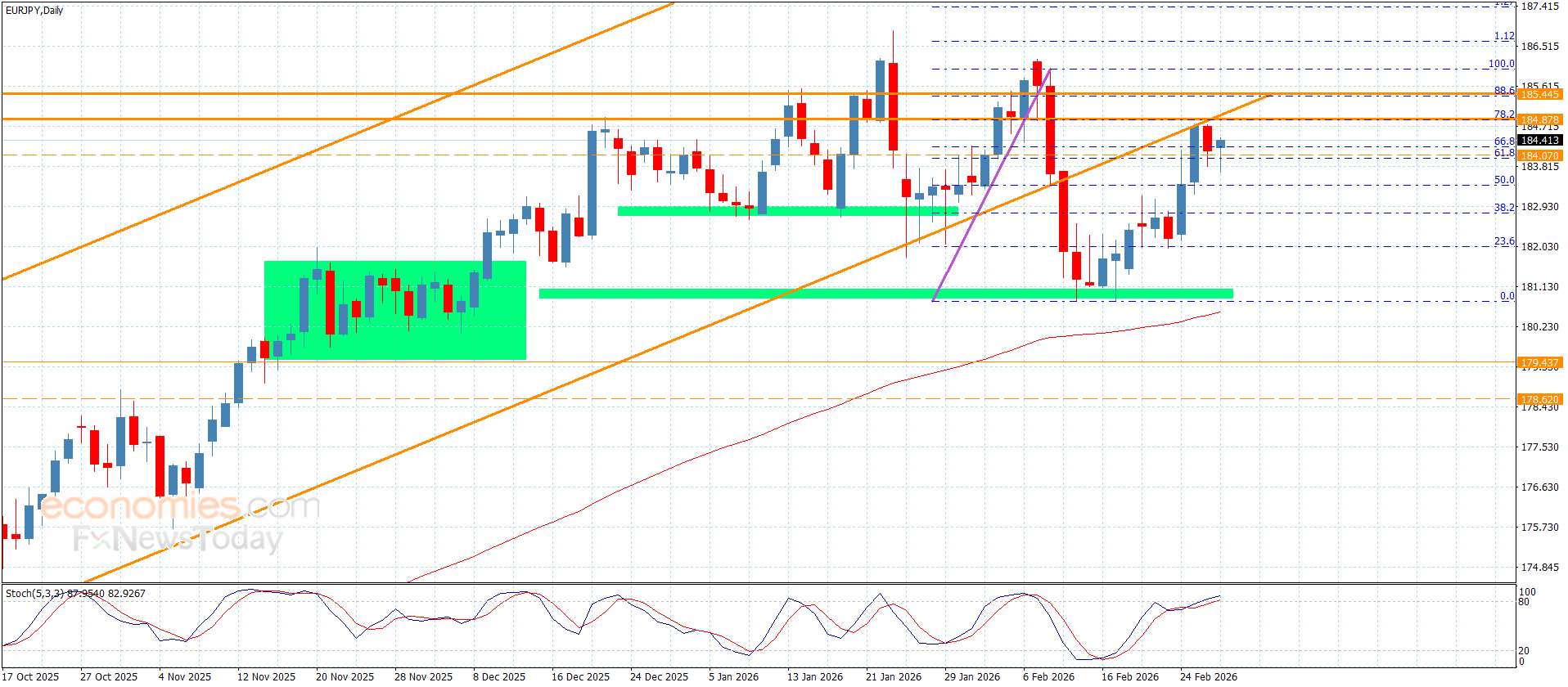
Economies.com states that EUR/JPY ‘keeps the positivity’, after reaching 183.15 and consolidating near 182.35. The bullish scenario is described as valid while support at 180.80 holds. The analysis references continued positive signals from technical indicators and suggests that maintaining trade above 180.80 could open the way towards 183.40 and the 61.8% Fibonacci correction level at 184.05, while noting that broader sentiment conditions remain relevant (Economies.com, 20 February 2026).
Takeaway: These third-party outlooks indicate a range of potential scenarios. Analysts stress that outcomes remain contingent on BoJ policy signals, Eurozone data, and shifts in global risk appetite.
Predictions and third-party forecasts are inherently uncertain, as they cannot fully account for unexpected market developments. Past performance is not a reliable indicator of future results.
One the daily chart, EUR/JPY trades around 182.569 as of 11:12am (UTC) on 20 February 2026, with price oscillating just below a broad moving-average band defined by the 20-, 50-, 100- and 200-day SMAs at roughly 183, 184, 181 and 176. The same-period EMAs cluster nearby, with the 100-day EMA near 180.7 and the 200-day EMA around 176.5. This configuration leaves the longer-term trend structure intact, even as shorter-dated averages lean softer.
The 14-day RSI sits near 46, in neutral territory, while an ADX reading around 20 indicates a modest, non-directional trend backdrop rather than a strong impulse in either direction.
On the topside, the nearest classic pivot resistance stands at R1 around 186.3; a daily close above this level would place R2 near 189.1 into focus as the next reference area. On the downside, the classic pivot at 184.0 remains an overhead marker, while the 100-day SMA near 181.0 forms an initial moving-average shelf. A sustained move below this zone could expose S1 near 181.2 if selling pressure builds (TradingView, 20 February 2026).
This technical analysis is provided for informational purposes only and does not constitute financial advice or a recommendation to buy or sell any instrument.
Over the two years to 20 February 2026, EUR/JPY has trended higher from the mid-150s to the low-180s, advancing in stages rather than in a straight line. The pair spent much of early 2024 consolidating around 160–165, then moved into the high-160s and low-170s through mid-2024 before pushing above 170 during the summer and closing 2024 near 163–165.
By mid-2025, EUR/JPY was trading around 165–170. A subsequent leg higher produced prices in the high-160s to low-170s during the second half of the year, before the pair finished near 184.
So far in 2026, daily prices have mostly remained within a relatively tight 181–186 band. EUR/JPY traded around 182.58 on 20 February 2026 after briefly moving above 186 earlier in the month. Overall, the cross stands noticeably higher than it did two years ago, while still exhibiting short-term volatility within broader ranges.
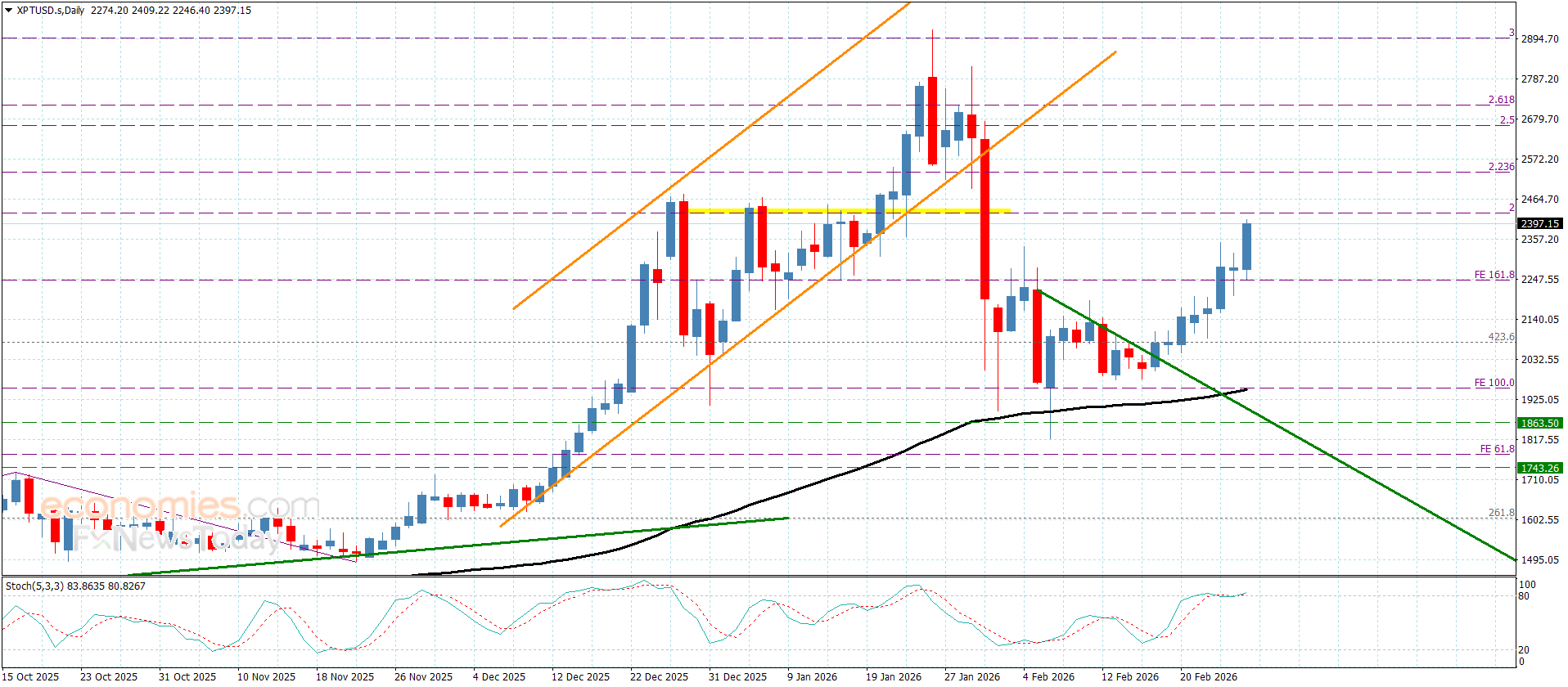
Platinum price succeeded in testing $2245.00 support, to receive a new bullish momentum, forming strong bullish waves, recording several gains by its stability at $2405.00.
Providing positive momentum by the main indicators will ease the way for the rally towards $2465.00, forming second main target in the current trading, note that resuming the rise again requires breaching near $2525.00 and holding above it to reinforce the chances for reaching new positive stations in the medium period.
The expected trading range for today is between $2275.00 and $2470.00
Trend forecast: Bullish
Important DisclaimersFXEmpire is owned and operated by Empire Media Network LTD., Company Registration Number 514641786, registered at 7 Jabotinsky Road, Ramat Gan 5252007, Israel. The content provided on this website includes general news and publications, our personal analysis and opinions, and materials provided by third parties. This content is intended for educational and research purposes only. It does not constitute, and should not be interpreted as, a recommendation or advice to take any action, including making any investment or purchasing any product. Before making any financial decision, you should conduct your own due diligence, exercise your own discretion, and consult with competent advisors. The content on this website is not personally directed to you, and we do not take into account your individual financial situation or needs. The information contained on this website is not necessarily provided in real time, nor is it guaranteed to be accurate. Prices displayed may be provided by market makers and not by exchanges. Any trading or other financial decision you make is entirely your own responsibility, and you must not rely solely on any information provided through the website. FXEmpire does not provide any warranty regarding the accuracy, completeness, or reliability of any information contained on the website and shall bear no responsibility for any trading losses you may incur as a result of using such information. The website may include advertisements and other promotional content. FXEmpire may receive compensation from third parties in connection with such content. FXEmpire does not endorse, recommend, or assume responsibility for the use of any third-party services or websites. Empire Media Network LTD., its employees, officers, subsidiaries, and affiliates shall not be liable for any loss or damage resulting from your use of the website or reliance on the information provided herein.Risk DisclaimersThis website contains information about cryptocurrencies, contracts for difference (CFDs), and other financial instruments, as well as about brokers, exchanges, and other entities trading in such instruments. Both cryptocurrencies and CFDs are complex instruments and involve a high risk of losing money. You should carefully consider whether you understand how these instruments work and whether you can afford to take the high risk of losing your money. FX Empire encourages you to conduct your own research before making any investment decision and to avoid investing in any financial instrument unless you fully understand how it works and the risks involved.
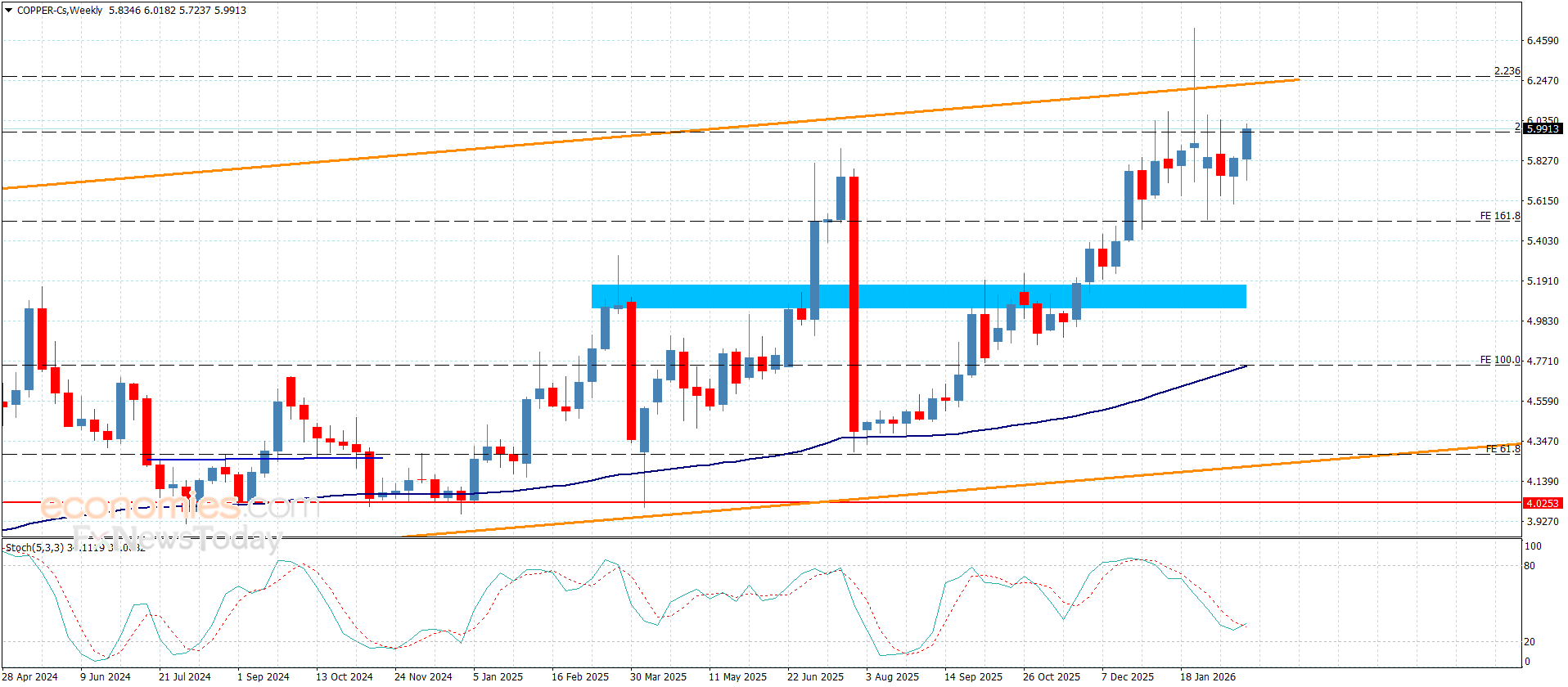
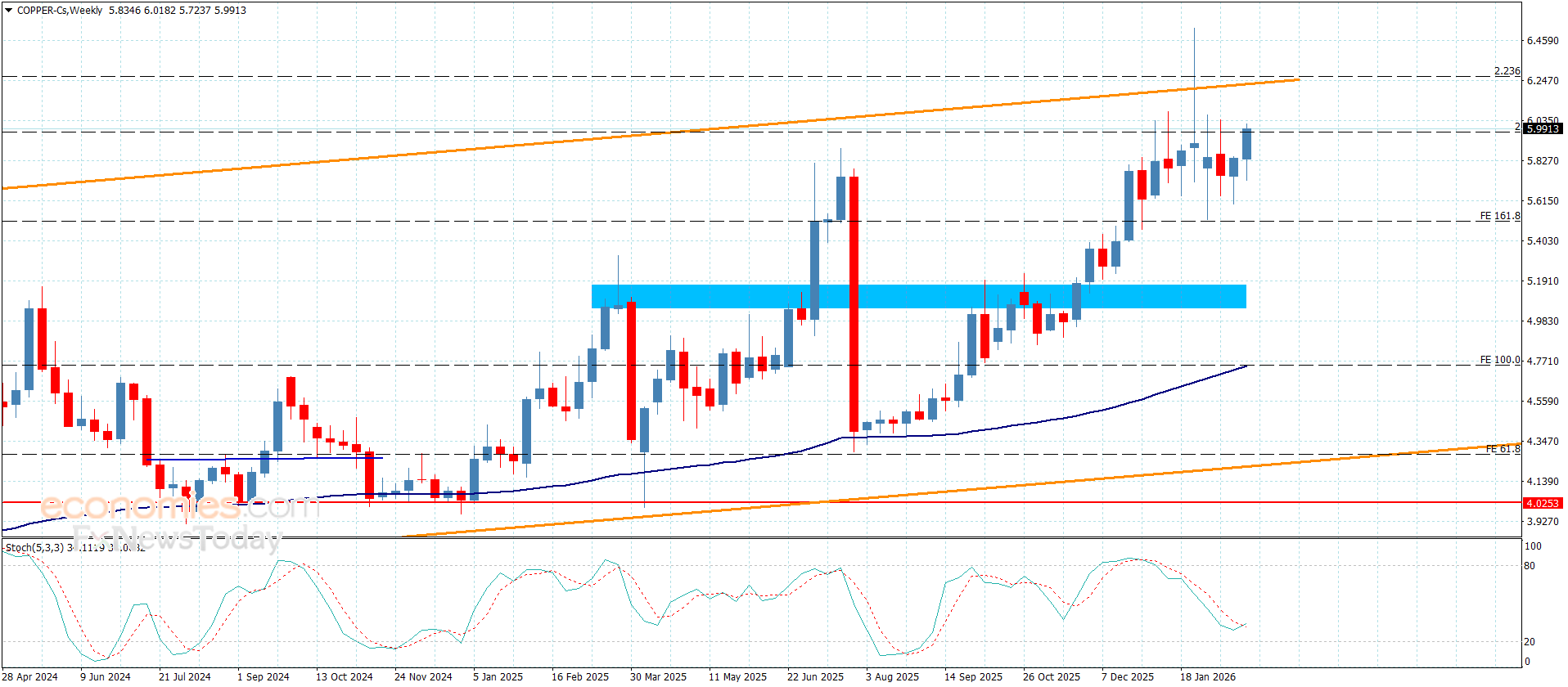
Copper price resumed bullish attempts to fluctuate above $5.9700 barrier, announcing its readiness to form new bullish waves in the near period, note that positive close above this barrier, to support the chances of its rally towards positive stations that begin at $6.1200 and $6.2400.
While the return fluctuates below $5.9700 will force it to delay the bullish rally, and there is chance to form bearish corrective waves to target $5.8200 and $5.7400 before any new attempt to reach the previously suggested targets.
The expected trading range for today is between $5.900 and $6.1200
Trend forecast: Bullish
Platinum price succeeded in testing $2245.00 support, to receive a new bullish momentum, forming strong bullish waves, recording several gains by its stability at $2405.00.
Providing positive momentum by the main indicators will ease the way for the rally towards $2465.00, forming second main target in the current trading, note that resuming the rise again requires breaching near $2525.00 and holding above it to reinforce the chances for reaching new positive stations in the medium period.
The expected trading range for today is between $2275.00 and $2470.00
Trend forecast: Bullish
Platinum price succeeded in testing $2245.00 support, to receive a new bullish momentum, forming strong bullish waves, recording several gains by its stability at $2405.00.
Providing positive momentum by the main indicators will ease the way for the rally towards $2465.00, forming second main target in the current trading, note that resuming the rise again requires breaching near $2525.00 and holding above it to reinforce the chances for reaching new positive stations in the medium period.
The expected trading range for today is between $2275.00 and $2470.00
Trend forecast: Bullish
WTI CL=F is trading near $67.07, having faded from an earlier move that took it down to roughly $65.75. Brent BZ=F sits around $72.34 after slipping from about $71.03. The pullback is modest – roughly 1% – and follows a strong run driven by US–Iran tension. The key point is simple: spot is holding in the high-$60s for CL=F and low-$70s for BZ=F, while the main bank decks still anchor fair value closer to $60 over the coming year. That mismatch between current pricing and modelled equilibrium is the heart of the current risk range for oil.
Goldman Sachs now projects Brent around $60 and WTI roughly $56 for Q4 2026. For the full year, the bank expects Brent to average $64 a barrel, up from a previous $56 call, and WTI to average $60 versus a prior $52. The shift acknowledges tighter-than-expected inventories and a stronger starting point, but the structure remains bearish versus today’s prices. The forecast still embeds a 2.3 million barrels-per-day surplus in 2026 and assumes no Iran-related supply disruption and no Russia–Ukraine peace deal that radically reshapes flows. In its framework, today’s Brent level in the low-$70s carries about a $6 geopolitical premium plus another roughly $5 overshoot versus a fair-value path driven by rising OECD stocks. If tensions ease and stocks build, that premium is designed to fade out of the curve.
Morgan Stanley’s numbers are aligned with that structural story but recognise the near-term risk bid. The bank now sees Brent averaging $62.50 in Q2 2026, up from $57.50, and $60 in Q3, also lifted from $57.50. The message is clear: a higher path in the short run due to geopolitical risk, then a glide path back toward $60 as long as flows remain intact. At current levels, Brent near $72 and WTI near $67 trade roughly 15–20% above the range that both houses consider sustainable once the risk premium leaks out and the 2.3 million bpd surplus reasserts itself. For CL=F and BZ=F, that means every spike driven by headlines has to be measured against models that still see mid-$60s as a ceiling, not a floor.
The market is not trading bank spreadsheets in a vacuum. The US has executed its largest regional military build-up since the 2003 Iraq invasion, positioning assets for a sustained campaign if ordered. At the same time, Oman’s foreign minister confirms a third round of US–Iran nuclear talks in Geneva, scheduled for Thursday. That combination explains the price action: oil rallied hard into the weekend on headlines that war looked “increasingly likely,” then gave back roughly 1% when the Geneva track was confirmed and some traders booked profits. Trump has raised the global tariff rate from 10% to 15% and publicly set a 10–15 day window for Tehran to accept strict conditions on its nuclear programme. On the other side, Iranian leadership has little domestic room to accept those demands without collapsing its internal legitimacy. That is why seasoned energy strategists argue that it is difficult to see both fleets quietly turning back without either a deal that looks like capitulation for one side, or a direct confrontation. As long as that structural conflict is unresolved, Oil, WTI CL=F and Brent BZ=F will carry a persistent risk premium.
The upside risk is straightforward. If diplomacy fails and military action begins, Iran has two clear levers: attack on production facilities in Saudi Arabia, the UAE or Kuwait, and disruption of shipping through the Strait of Hormuz, where roughly a fifth of global seaborne crude moves. FGE’s Fereidun Fesharaki explicitly points to $90–$100 Brent as “within reach” if Middle East supply is hit. That is not a theoretical model; it reflects past episodes where partial loss of Gulf barrels or credible threats to Hormuz pushed benchmarks sharply higher. In that environment, the 2.3 million bpd surplus disappears overnight and the debate shifts from inventory builds to basic availability. For BZ=F, a jump from $72 into a $90–$100 band becomes a live scenario. For CL=F, a proportionate move would target the mid-$80s and above.
While the supply side is dominated by US–Iran risk, demand faces its own shock. Trump’s decision to lift temporary tariffs from 10% to 15% on all imports adds a new drag on global trade and industrial activity. Higher uniform tariffs raise input costs, slow cross-border flows and, if persistent, erode global GDP. China has already called on Washington to reverse the measures to avoid broader trade disruption. If the 15% rate holds or moves toward the 15–20% band that some policy voices favour, refined product consumption, freight demand and industrial fuel use will feel the pressure. That is the mechanism behind forecasts that still put Brent around $60–$65 and WTI around $56–$61 through 2027. Even when the Middle East risk premium is high, tariff-driven demand risk pushes in the opposite direction, limiting how long Oil, CL=F and BZ=F can sustain triple-digit levels without real physical shortages.
Underneath the noise, the supply-demand balance still leans toward surplus on paper. Goldman’s 2.3 million bpd 2026 surplus forecast already trims both supply and demand by 0.2 million bpd against earlier assumptions because Asian growth has softened at the margin. The supply side is downgraded in Kazakhstan, Venezuela, Iran and Iraq after repeated misses on realised output, but this is offset by upgrades across the Americas and within core OPEC producers that still have spare capacity in reserve. Critically, OPEC+ is expected to begin raising production gradually from Q2 2026 because OECD inventories have not swollen enough to justify deeper restraint. That means any risk-driven rally in Oil faces a cartel that is willing to add barrels once prices stretch too far above the $60–$70 band. At the other end of the spectrum, if sanctions relief accelerates for Iran or Russia and more barrels hit the water, bank models point to downside risks of roughly $5 for Brent and $8 for WTI versus their Q4 2026 targets.
The chart on CL=F reflects that macro tug-of-war. On the daily time frame, WTI has rallied back to a resistance cluster around $66.43–$66.50. Each test of that band has met supply as traders fade geopolitically driven spikes and lean into the surplus narrative. Support levels are staggered below spot. Around $64.14 sits a mid-range demand zone where short-term buyers start to appear. Deeper down, $62.36 marks a more important support shelf. As long as CL=F holds above $62.36 on daily closes, the bullish case for tactical longs remains intact: there is a clear risk marker, and the market can continue to use geopolitical dips to reload. A decisive breakout above the $66.50 band opens a path toward $70.50, which is the next major technical reference from recent swing highs. Failure at resistance and a break below $64.14 would put $62.36 back into focus and strengthen the argument that the price action is rolling back toward the bank decks rather than breaking away from them.
Volatility has ticked higher again across Oil, WTI CL=F and Brent BZ=F. On the 4-hour and daily charts, Average True Range has climbed, which translates directly into larger candles and wider daily ranges. When ATR rises, each bar carries more risk, stops need more space, and gap risk increases on geopolitical headlines. This environment favours momentum strategies but punishes late entries. From a structural perspective, rising ATR fits a market that has shifted from quiet range trading into active expansion as US–Iran headlines, Geneva talks, tariff changes and revised bank forecasts all hit the tape within days of each other. As long as ATR stays elevated, traders should expect sharp responses around levels like $66.43, $64.14, $62.36 for CL=F and $70–$75 for BZ=F.
At today’s levels and the bank forecast path, oil is no longer behaving like the main inflation engine it was at $100 plus. If Brent averages around $64 in 2026 and drifts toward $60 in Q4 as Goldman expects, fuel costs and freight rates ease further, giving households and companies some breathing room. That supports consumption and makes it easier for central banks to argue for stable or lower policy rates, especially if other inflation components cool. For exporting economies and high-cost producers, the story is less comfortable. A $60–$65 Brent world compresses margins for capital-intensive upstream projects, particularly outside the Gulf. It forces capex rationing, encourages portfolio high-grading and puts pressure on fiscal balances in countries whose budgets were built around higher reference prices. That is one reason sovereigns in the Gulf are pushing hard on projects like the $100 billion Jafurah development and new condensate streams: they need diversified hydrocarbon and non-oil revenue to handle a structurally lower oil-price base.
The current tape places WTI CL=F near $67 and Brent BZ=F around $72. Those marks sit midway between two credible poles. On one side, bank models and surplus math point to Brent at $60–$65 and WTI at $56–$61 through 2027, underpinned by a 2.3 million bpd surplus, gradual OPEC+ supply increases and tariff-related demand risks. On the other, US military deployments, explicit talk of likely conflict, and the structural vulnerability of Gulf infrastructure and the Strait of Hormuz make $90–$100 Brent a realistic outcome if the worst-case scenario materialises. Spot is not cheap relative to the surplus view and not expensive relative to the war case. It is pricing a blend of both: some risk premium, some surplus, and a sizeable amount of uncertainty.
Bringing the numbers and structure together points to a split stance on Oil, WTI CL=F and Brent BZ=F. In the near term, while WTI holds above $62.36 and continues to respect the $66.43 band, the bias is bullish on geopolitical dips. US–Iran risk, the largest US build-up in the region since 2003 and credible scenarios involving Hormuz or regional facilities justify maintaining tactical long exposure when prices retreat toward support. On a 6–12 month horizon, with Goldman and Morgan Stanley both anchoring Brent around $60–$64, WTI around $56–$60, and a 2.3 million bpd surplus plus OPEC+ flexibility in the background, chasing spikes into the $70s–$80s turns unattractive unless actual supply is hit. In that medium-term window, rallies driven purely by headlines and sentiment look better suited for scaling out or building staggered short exposure than for fresh aggressive longs. Under current information, the stance is clear: short-term, oil leans bullish on controlled pullbacks; structurally, it trends toward a HOLD / SELL-ON-STRENGTH profile unless the Middle East moves from brinkmanship to real disruption.