The main category of Forex News.
You can use the search box below to find what you need.
[wd_asp id=1]
The main category of Forex News.
You can use the search box below to find what you need.
[wd_asp id=1]
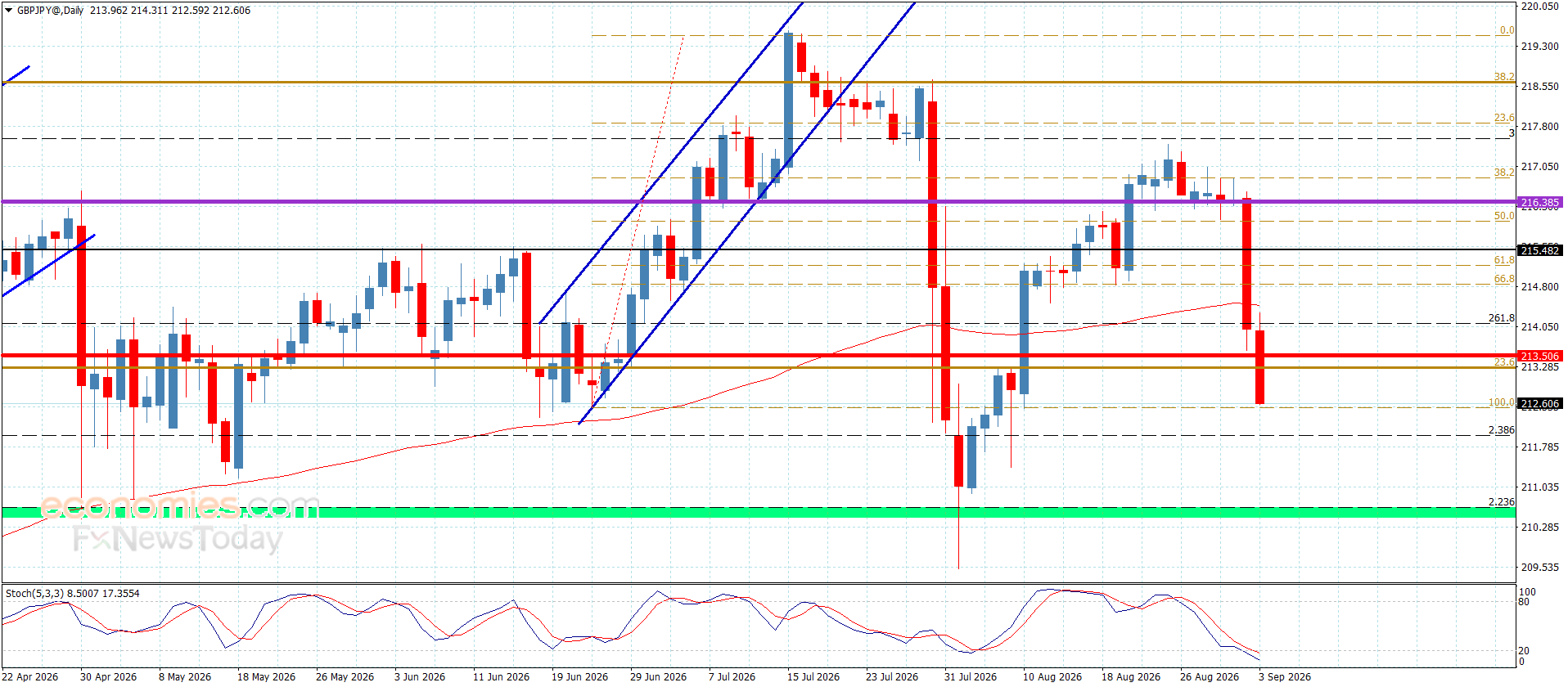
The GBPJPY pair formed a sharp decline yesterday, affected by the repeated negative pressures, surpassing the previously waited targets by reaching 214.95 level, to settle near 212.35 level as appears in the above image.
Providing extra negative momentum by stochastic makes us expect attempting to break 211.45 support, which represents a confirmation key for the main trend in the upcoming trading, breaking this support will confirm the continuation of the negativity, to expect forming the next target at 210.25 level, while holding above it will provide a chance for recovering the losses and forming new bullish waves.
The expected trading range for today is between 211.50 and 214.25
Trend forecast: Bearish
Gold (XAU/USD) is trading higher on Thursday, returning to levels above $4.400 after bouncing from three-week lows near $4,280 on Wednesday. The precious metal is drawing support from a weaker USD, as ADP employment data disappointed and New York Federal Reserve (Fed) President John Williams tamed rate hike expectations, but Fed tightening bets remain solid, and bulls are likely to face significant resistance at $4,470.
US Data released on Wednesday revealed that private employment rose 38K in August, the weakest reading since January and well below the 47K increase expected.
Apart from that, New York Federal Reserve President John Williams said that rising bond yields are due to a solid economy, rather than to inflation fears, and suggested that the central bank should “wait and see” before taking decisions on interest rates. This cooled hopes of an immediate rate hike, although futures markets are still pricing a 60% chance of a 25 basis point hike at September’s meeting, according to the CME’s FedWatch Tool.
XAU/USD has bounced up from lows and is trading returning to the $4,430 area, but keeps a mildly bearish near‑term tone following an impulsive reversal from last week’s highs near $4,700. Momentum indicators are in neutral territory, with the daily Relative Strength Index (14) at 52 and the Moving Average Convergence Divergence (MACD) below zero, which shows that the bullish impulse is fragile.
Gold bulls are likely to be tested at the August 31 high, near $4,470, and, above here at the key 200‑day Simple Moving Average (SMA) at $4,533, which closes the path to last week’s high, at $4,690. On the downside, a break of the August 14 low in the $4,310 area confirms a “Head and Shoulders” pattern, and adds pressure towards the August 6 low of $4,220 and the late July lows near $4,000.
(The technical analysis of this story was written with the help of an AI tool. Know more.)
Gold has played a key role in human’s history as it has been widely used as a store of value and medium of exchange. Currently, apart from its shine and usage for jewelry, the precious metal is widely seen as a safe-haven asset, meaning that it is considered a good investment during turbulent times. Gold is also widely seen as a hedge against inflation and against depreciating currencies as it doesn’t rely on any specific issuer or government.
Central banks are the biggest Gold holders. In their aim to support their currencies in turbulent times, central banks tend to diversify their reserves and buy Gold to improve the perceived strength of the economy and the currency. High Gold reserves can be a source of trust for a country’s solvency. Central banks added 1,136 tonnes of Gold worth around $70 billion to their reserves in 2022, according to data from the World Gold Council. This is the highest yearly purchase since records began. Central banks from emerging economies such as China, India and Turkey are quickly increasing their Gold reserves.
Gold has an inverse correlation with the US Dollar and US Treasuries, which are both major reserve and safe-haven assets. When the Dollar depreciates, Gold tends to rise, enabling investors and central banks to diversify their assets in turbulent times. Gold is also inversely correlated with risk assets. A rally in the stock market tends to weaken Gold price, while sell-offs in riskier markets tend to favor the precious metal.
The price can move due to a wide range of factors. Geopolitical instability or fears of a deep recession can quickly make Gold price escalate due to its safe-haven status. As a yield-less asset, Gold tends to rise with lower interest rates, while higher cost of money usually weighs down on the yellow metal. Still, most moves depend on how the US Dollar (USD) behaves as the asset is priced in dollars (XAU/USD). A strong Dollar tends to keep the price of Gold controlled, whereas a weaker Dollar is likely to push Gold prices up.
This currency pair has spent recent months rewarding traders who were prepared to buy dips, but the market is beginning to look much less comfortable with that familiar pattern as the US Dollar stays strong.
The recent move lower is starting to look more convincing, with Sterling now not one of the stronger major currencies. This shift in the market’s perception of the British Pound may be the catalyst, combined with technical changes, that make this currency pair worth paying more attention to over the coming days.

The good news for traders is that the GBP/USD looks like it may behave very respectful of technical factors, which might make it interesting to trade now.
Both currencies can be seen as relatively strong and weak, with the US Dollar reasserting its earlier strength and starting to move more decisively higher. However, this will not be truly decisive until the US Dollar Index get established above the big round number at 100, which looks likely to be a pivotal point.
There is major US data due this week – average earnings and NFP – which could also give the relative value of the US Dollar a big push. In these cases, “accidents often happen along the line of least resistance”, so a trend can get a nice tailwind from a surprise.
Finally, technical factors are looking very strong and decisive, with some obvious lines in the sand which traders can use to gauge the picture.
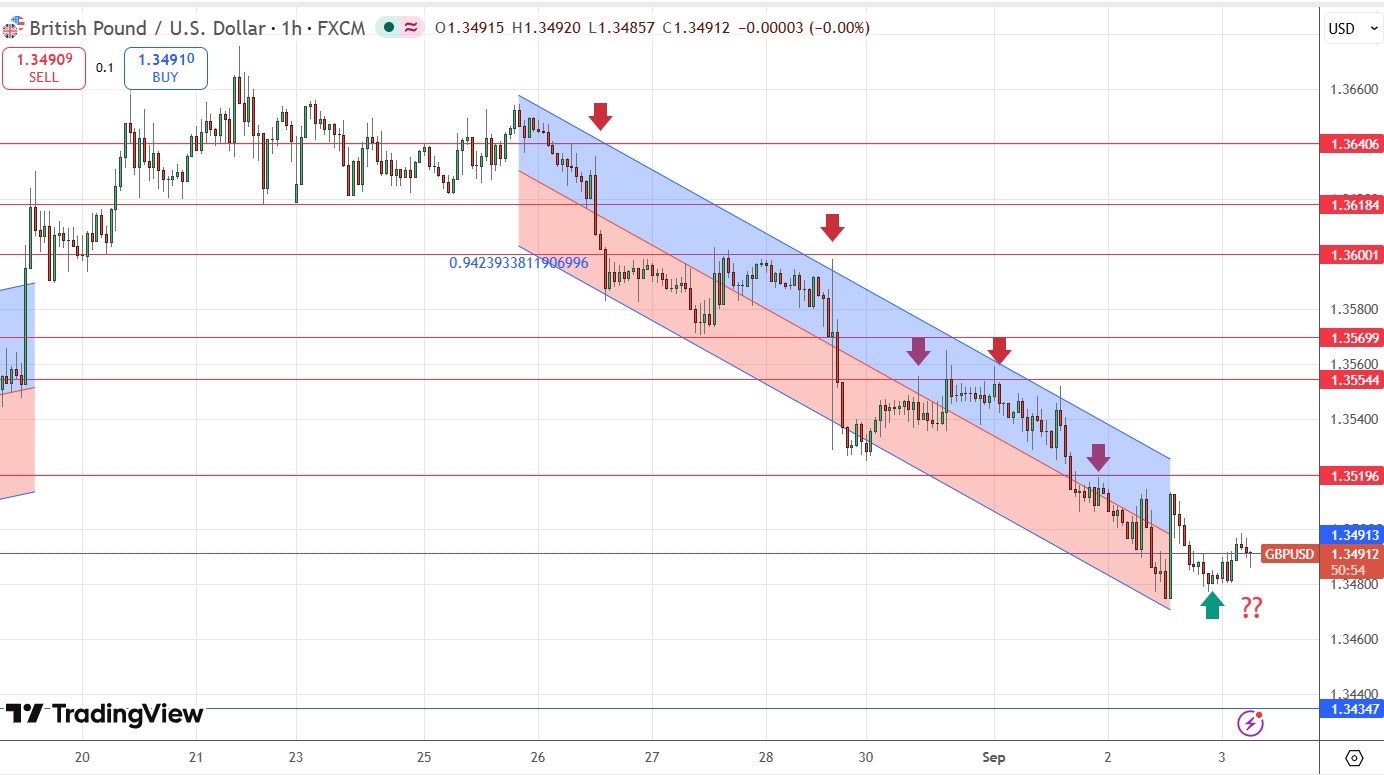
The price action has been decisively bearish for over one week now, ever since the price failed to break out to a new six-month high price above 1.3650 and began moving lower with a series of orderly breakdowns which flipped support to become new resistance levels. There has not even been one single true higher low in this entire movement until a few hours ago, and the early and light status of that makes it highly questionable.
Another factor which adds to the convincing nature of this bearish leg is the way this price action can almost completely be captured by a linear regression analysis study, which can be seen within the price chart below. When this feature can be drawn to make a price channel symmetric, it tends to be more reliable.
The standout support or resistance level which looks as if it could be pivotal today is the resistance overhead at 1.3520, which might extend as high as 1.3530 and will be confluent with the upper trend line of the descending price channel for most of the rest of today.
GBP/USD H1 Price Chart Showing Recent Impulsive Moves
The blind spot here may be an over-reliance on technical analysis. As a technical analyst, today’s chart of this currency pair jumps out as having meaningful indications. This probably makes me overconfident that a bearish scenario will play out over the near term.
Unless there is a major and unscheduled surprise from the Bank of England or even the European Central Bank, it is difficult to see what I might be missing, except maybe the tension between the USA and Iran escalating after the countries traded military blows yesterday. However, the situation seems to have de-escalated in recent hours, with no new US attacks last night. It is conceivable a Fed member might say something that is interpreted as dovish which could trigger a minor US Dollar selloff.
I see the dream scenario here for traders, especially day traders, is to hope for a retracement to the 1.3520 level which tests that area which rejects it forcefully – this could be a very good short trade entry signal.
Taking 1.3520 as the likely pivotal point, an alternative scenario will likely play out if the price can get established above that level today, which will open the door to a rise to 1.3554 – this 1.3550 has also recently acted as a very pivotal area, so this resistance level might play a significant role in what happens after that.
GBP/USD is worth watching because it is making a technical steady bearish move which is supported by fundamental, sentimental, and most of all technical indicators. If it continues moving lower, it has a long way to fall while remaining within its dominant range, suggesting there could be a good opportunity to get involved on the short side, although that moment might well not be arriving today. Alternatively, the pair may surprise, if the first potential lower high we saw form within recent hours produces an impulsive bullish move which breaks the resistance level at 1.3520.
Ready to trade our GBP/USD analysis? Here is our list of the best Forex brokers worth checking out.
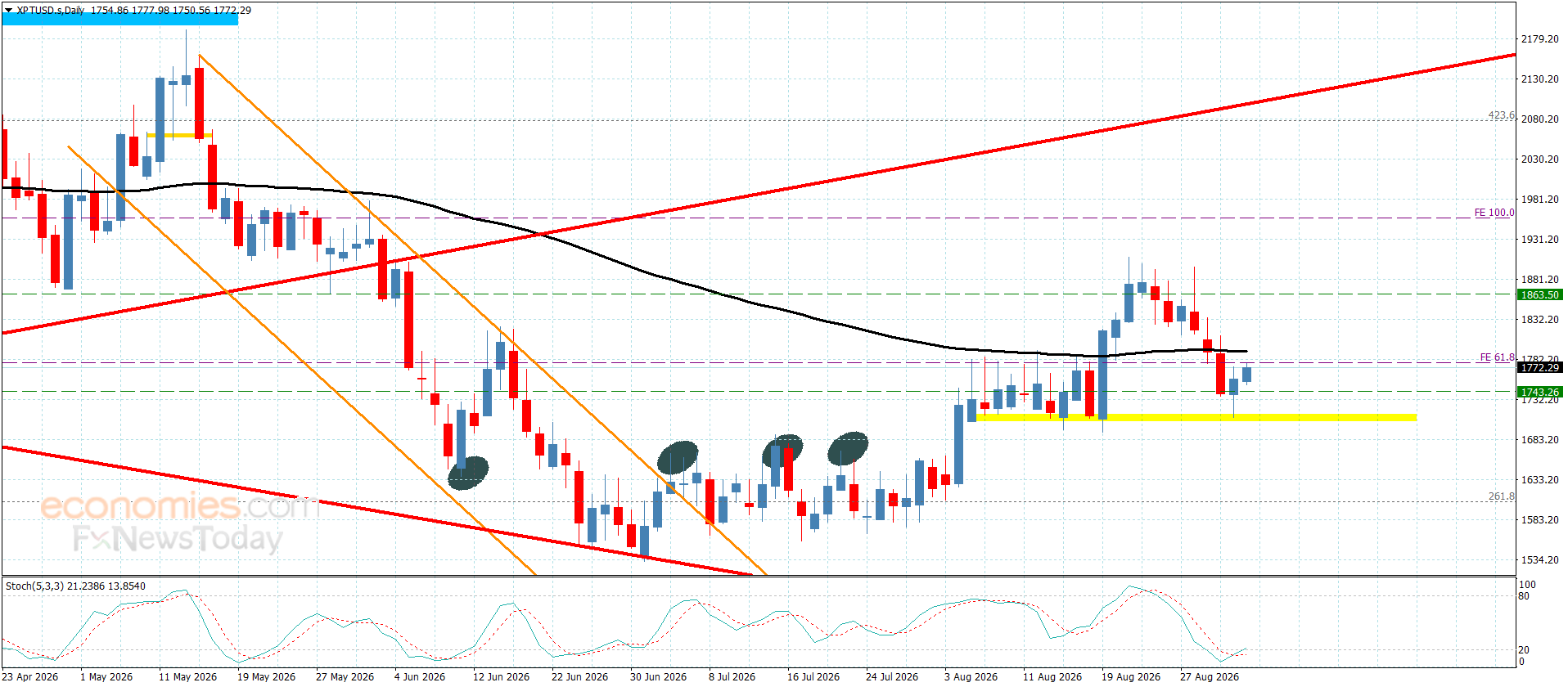
Platinum price ended the last corrective decline by its approach from the support level of $1695.00, to begin forming bullish waves, announcing the continuation of the previously suggested bullish scenario, fluctuating near $1780.00 level.
The price might be forced to provide some sideways trading until gathering bullish momentum to surpass the 55-moving average at $1800.00, to begin targeting several positive stations by its rally towards $1860.00 and $1910.00.
The expected trading range for today is between $1730.00 and $1860.00
Trend forecast: Bullish
The US dollar continues to see a lot of back-and-forth motion against the yen, as we are sitting at a major inflection point, and waiting for the jobs report.
The US dollar continues to see a lot of back-and-forth trading against the Japanese yen as the interest rate differential continues to play out. This carry trade position has been one that I have been involved in for some time now, and we find ourselves hanging around the crucial 50-day EMA, an area that a lot of technical traders will pay a certain amount of attention to.
The 160 yen level seems to be a bit of a magnet for price as well, but it is worth noting that interest rates in America continue to climb, and that only widens the overall carry trade prospects. With this, the market will continue to be noisy, but it is probably also worth noting that we have the jobs number coming out on Friday, and that tends to be a big mover of this USD/JPY currency pair overall.
I do not like the idea of shorting this pair, mainly because I just don’t want to own the Japanese yen. The Japanese yen has been beaten up pretty significantly, and with good reason, as the Japanese are essentially stuck with their monetary policy being ultra-loose.
In this environment and the fact that energy inflation continues to be a major problem, it is just difficult for me to see how the Japanese yen continues to find any footing outside of intervention. There are intervention risks here, obviously, as we have seen quite a bit of intervention over the last several months, but at the end of the day, intervention only slows down what is going on in a market. It very rarely turns things around.
The jobs number on Friday will be parsed, and it will be very important to pay attention to, but I also recognize that the overall trend is still the same. It is still bullish for the US dollar and bearish for the Japanese yen. I like buying dips.
Want to trade our USD/JPY forex analysis and predictions? Here’s a list of forex brokers in Japan to check out
Christopher Lewis is a technical analyst and market commentator at DailyForex with more than two decades of trading experience in Forex and other leveraged markets. Based in Columbus, Ohio, he specializes in chart-based analysis of major currency pairs, stock indices, commodities, and energy markets, focusing on clear support and resistance levels, trend structure, and risk management. Christopher produces daily written and video analysis for traders who rely on technical setups to navigate volatile market conditions
As seen on: Pairs Of Aces Podcast,The Trader Guy, FXEmpire
Spot gold is edging higher Wednesday after rebounding from an early session setback. The main trend changed to down earlier today when sellers took out the swing bottom at $4,311.04, but new buyers may have emerged on the test of a key retracement zone.
The long-term range is $3,942.10 to $4,697.11. Its 50% to 61.8% retracement zone is $4,319.60 to $4,230.51. Today’s rebound came from a trade to $4,282.62, which fell inside the zone. To some traders, this is a value zone.
Adding to concerns about heightened volatility is the fact that Spot gold is trading under 200-day moving average resistance at $4,530.71 and nearing 50-day moving average support at $4,222.93.
The early price action suggests trader reaction to the 50% level at $4,319.60 will determine the direction of the market into the close. A sustained move over this level could lead to a strong rally into the close, while failure to hold it would put the $4,230.51 to $4,222.93 support cluster back on the radar.
The rate trade stays pointed against gold until the data changes it. Warsh and Barr both said this week the Fed has more work to do. The 10-year pulled back from 4.814% but is still near a multiyear high. The dollar index is at 99.67. Crude is above $90 WTI and near $95 Brent. The geopolitical bid from the Middle East conflict is going to the dollar, not the metal. Friday’s payrolls report at 56,000 expected is the number that can either keep the 68% September odds in place or force a repricing. The rate pressure holds until a soft jobs number gives buyers a reason to step back in.
Gold bounced from $4,282.62 inside the long-term retracement zone at $4,319.60 to $4,230.51. The main trend turned down Wednesday when sellers took out $4,311.04. The 200-day moving average at $4,530.71 is resistance above. The trade stays bearish while gold sits under $4,319.60. A close above that level is the first sign value buyers are taking over. A break through the 50-day at $4,222.93 opens the support cluster down to $3,942.10. The 200-day break from Friday is still the damage running this market. Wednesday’s bounce has not undone it.
If you’d like to know more about how to trade gold, please visit our educational area.
The week has not been particularly favorable for the euro. Over the last three trading sessions, EUR/USD has declined by nearly 0.5%, once again highlighting a meaningful bearish bias in the short term. For now, this selling pressure has been supported by factors such as the recovery in the U.S. bond market and the resurgence of geopolitical tensions, developments that have allowed the dollar to regain part of the ground lost in previous weeks. As long as these catalysts remain relevant, selling pressure around EUR/USD could continue to play an important role during the coming trading sessions.
Today’s session has been particularly relevant due to new developments coming out of the Middle East. The United States resumed attacks against certain targets in Iran after nearly a month without significant exchanges between the two sides. In addition, attacks against two tankers in the Strait of Hormuz were reported at the start of the week, a development that has once again raised concerns about potential disruptions to one of the most important routes for global energy trade and reduced expectations of a quick diplomatic resolution to the conflict.
The market’s reaction to these events has been an increase in the geopolitical risk premium and a rise in uncertainty surrounding the outlook for global markets. This effect is already beginning to appear in the behavior of WTI crude oil, which has once again moved closer to the $90 per barrel area. In broader terms, this dynamic is reviving concerns over rising energy costs and could continue to fuel expectations of higher inflationary pressures in the months ahead.
This environment also comes at a time when markets continue to reassess the outlook for the Federal Reserve. Since Jackson Hole, investors have increasingly priced in a more hawkish stance after Kevin Warsh emphasized that inflation remains a meaningful risk to the U.S. economy. These comments have helped reinforce expectations that interest rates could remain elevated for longer or even leave room for additional hikes should inflation continue to prove persistent.
This situation is already being reflected in the U.S. bond market. 10-year Treasury yields continue to move toward the 4.8% area, reaching new highs for 2026. While European bond yields have also shown a gradual recovery, benchmark yields remain near 3.7%, still well below equivalent levels in the United States. This yield differential continues to support the relative attractiveness of dollar-denominated assets over their European counterparts.
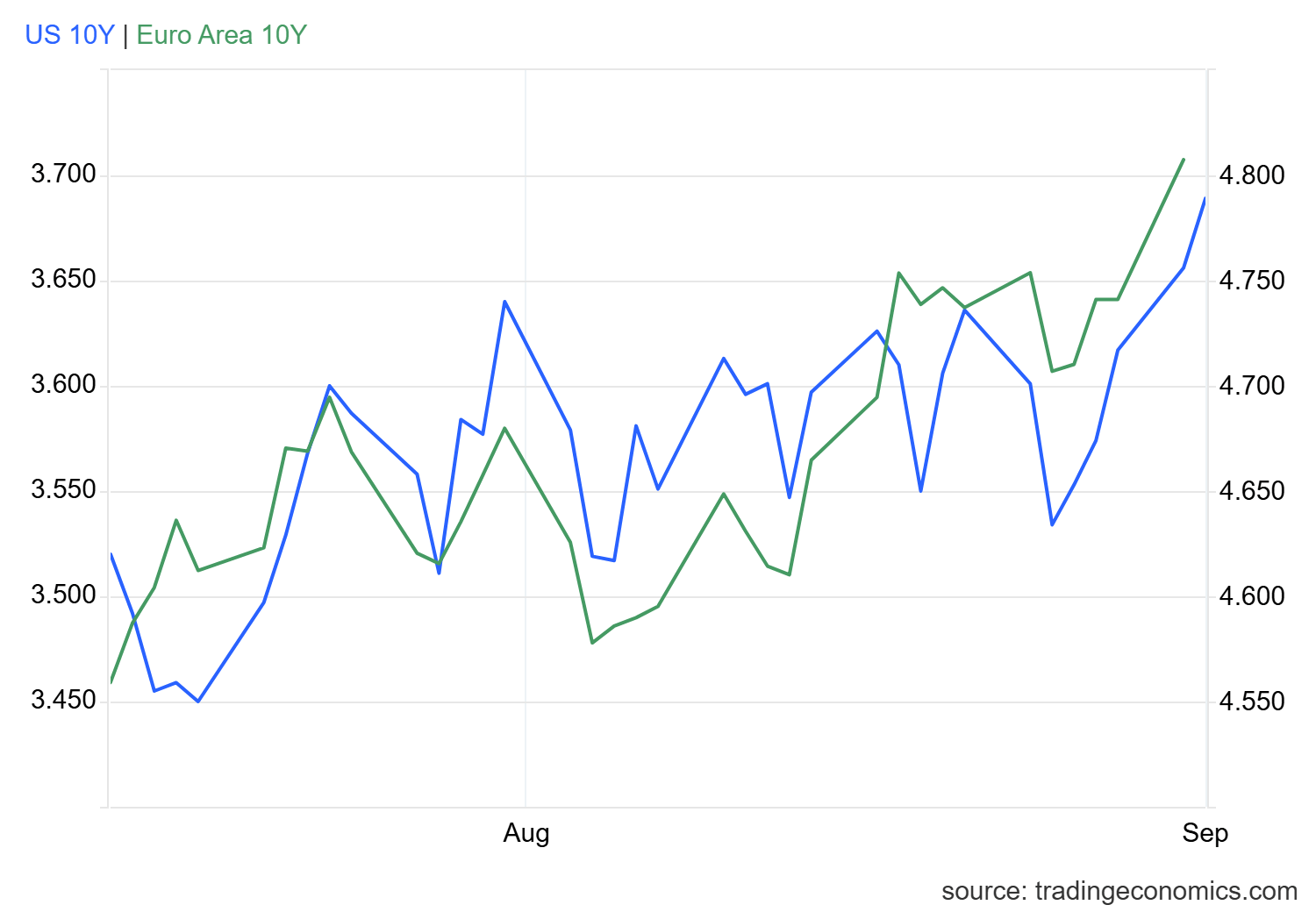
Source: TradingEconomics
Taking all of this into account, the current environment remains supportive of the U.S. dollar. On one hand, rising geopolitical tensions could once again encourage demand for safe-haven assets. On the other, the strength of the U.S. bond market continues to support interest in dollar-denominated investments. Together, these factors help explain why the euro is struggling to regain ground in a consistent manner.
This reaction can already be seen in the behavior of the DXY Index, which measures the dollar’s performance against its major rivals. The index continues to maintain a relatively steady upward slope and is once again approaching the 100-point area, reflecting a gradual improvement in confidence toward the greenback during recent sessions.
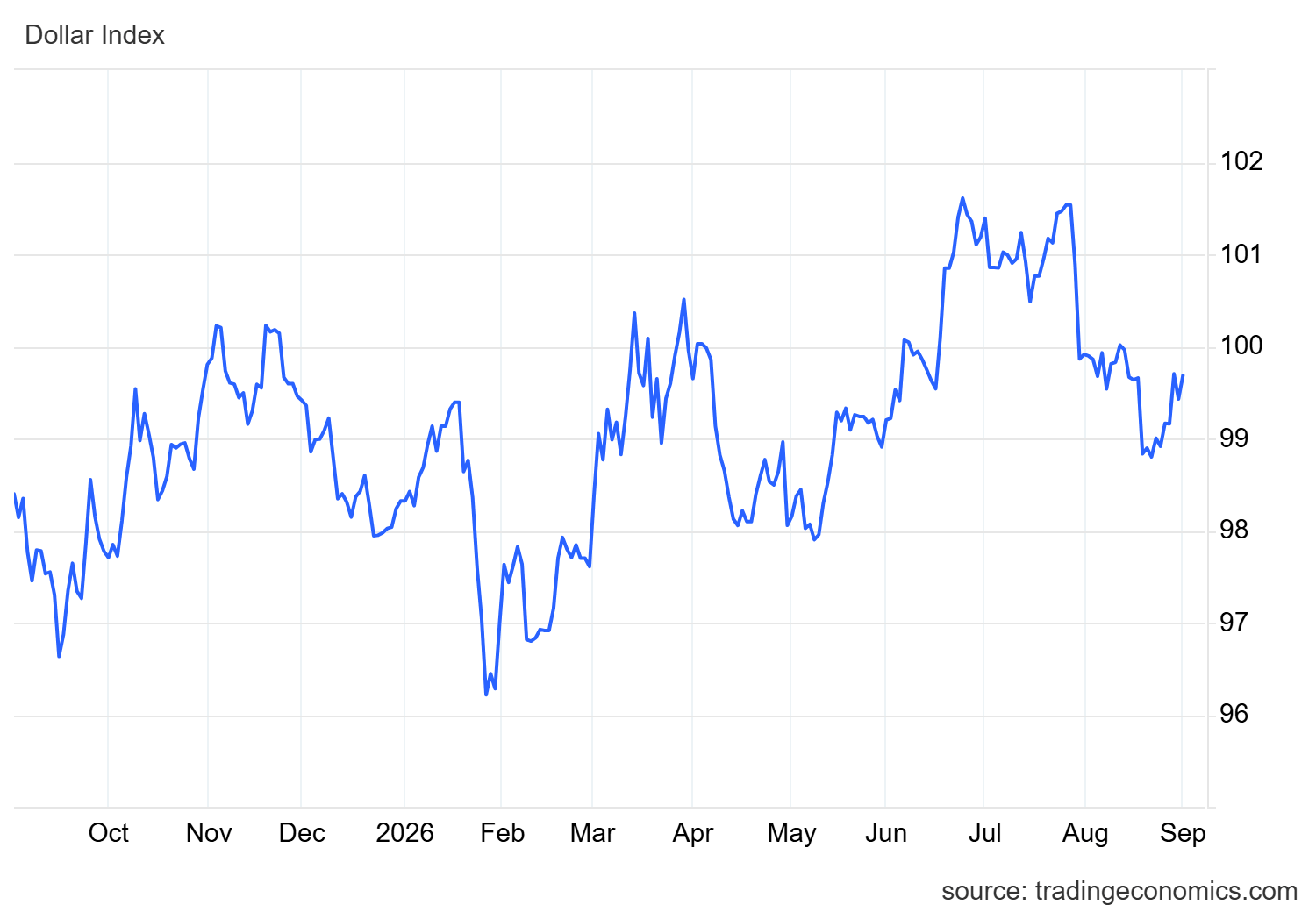
Source: TradingEconomics
As a result, recent developments appear to be providing fresh support for the U.S. dollar. As long as the market continues to perceive that the dollar is benefiting from both geopolitical concerns and expectations of higher interest rates, the euro may continue facing difficulties in establishing a sustained recovery. Under this scenario, bearish pressure around EUR/USD could remain relevant during the upcoming trading sessions.
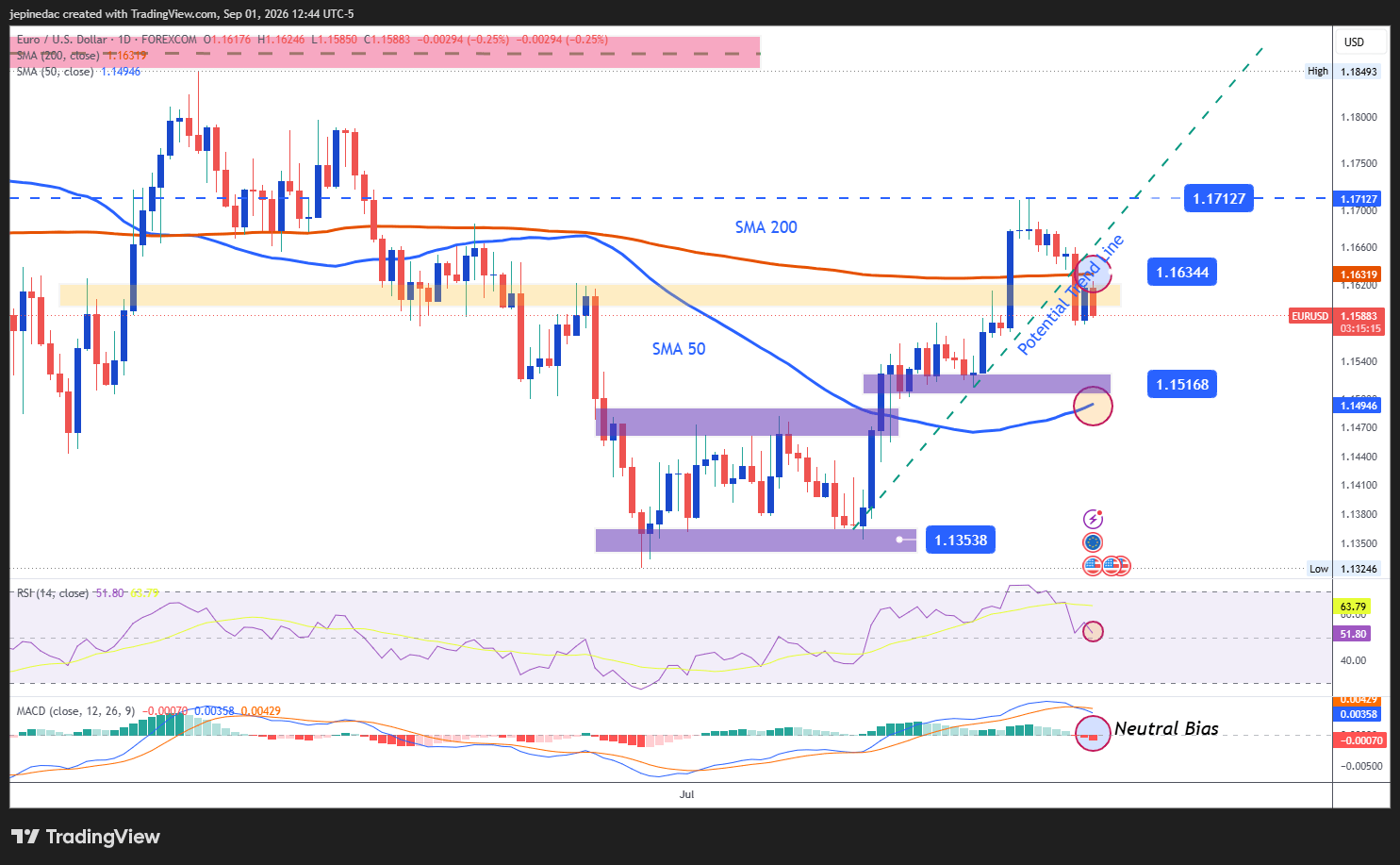
Source: StoneX, Tradingview
Key Levels to Watch:
Written by Julian Pineda, CFA, CMT – Market Analyst
Follow him on: @julianpineda25
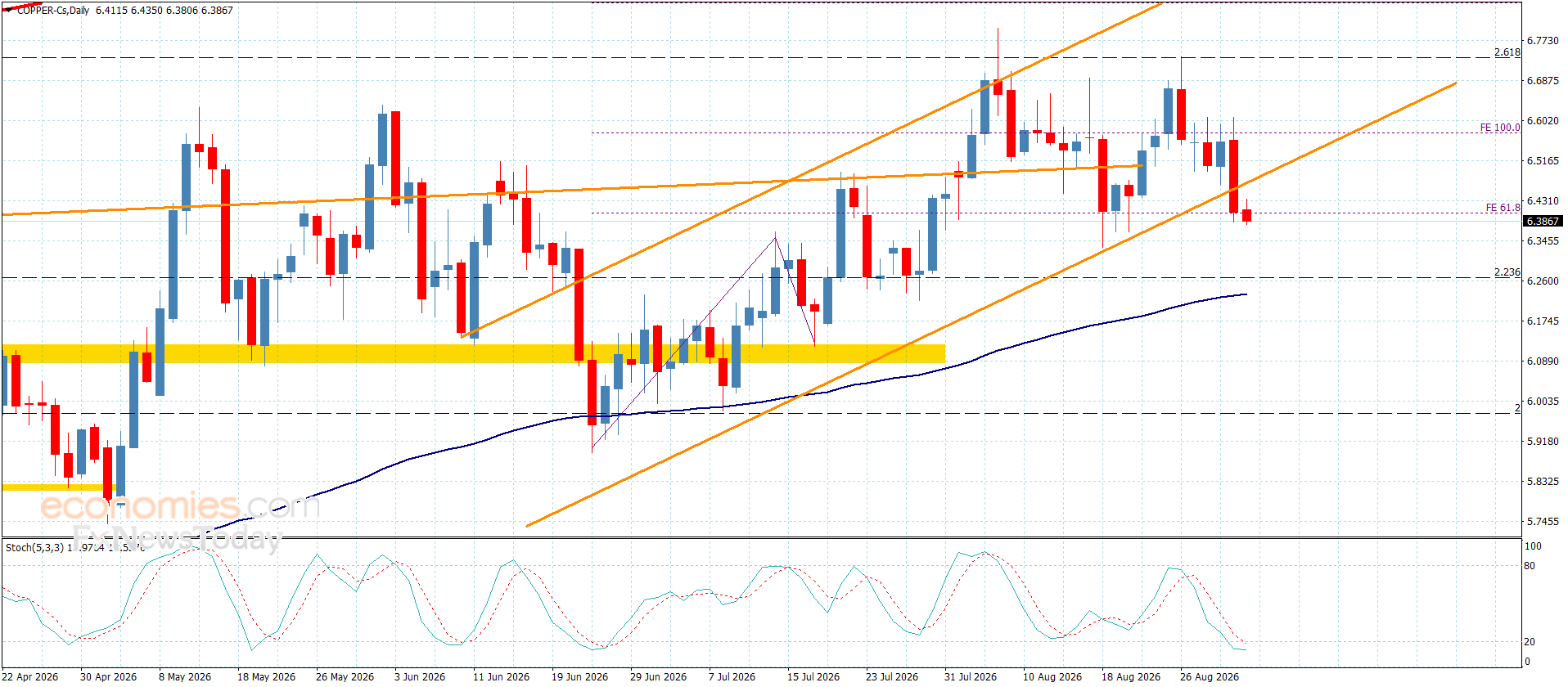
Copper price ended its recent trading by posting consecutive closes below the barrier at $6.7400, forcing it to succumb to the negative momentum of the Stochastic indicator and form several bearish corrective waves, with the price currently stabilizing around $6.3800.
The price needs to hold above the support level at $6.3300 during the current period to reinforce the previously suggested main bullish scenario, initially targeting $6.5000 and then the aforementioned barrier. However, breaking below this support and holding beneath it would force the price to form further corrective waves, potentially leading to additional losses toward $6.2000, which in turn represents the key level separating the current move from a potential change in the overall trend of upcoming trading.
The expected trading range for today is between $6.3300 and $6.5000
Trend forecast: Fluctuating
– Written by
David Woodsmith
STORY LINK GBP/USD Forecast: Pound Sterling Recovers as Weak US Data Hits the Dollar
The Pound US Dollar (GBP/USD) exchange rate recovered some ground through the latter part of Tuesday’s session as weaker-than-expected US data undermined demand for the ‘Greenback’.
At the time of writing, GBP/USD was trading at around $1.3546, little changed from Tuesday’s opening levels.
The US Dollar (USD) initially found support on Tuesday, with renewed tensions between the US and Iran prompting a bout of safe-haven demand.
The latest exchange of strikes marked the first direct hostilities between the two sides in several weeks, helping to drive another sharp increase in oil prices and adding to market uncertainty.
The ‘Greenback’ subsequently surrendered these gains, however, after a pair of disappointing US economic releases raised fresh concerns over the health of the world’s largest economy.
The latest ISM manufacturing PMI and July’s JOLTs job openings both fell short of expectations. The weakness in the jobs data was particularly significant for USD investors, as evidence of a cooling labour market could make the Federal Reserve more reluctant to raise interest rates in the months ahead.
The Pound (GBP) was largely rangebound against its major counterparts on Tuesday as UK markets reopened following the bank holiday against a backdrop of sharply higher borrowing costs.
Get better rates and lower fees on your next international money transfer.
Compare TorFX with top UK banks in seconds and see how much you could save.
The benchmark 10-year gilt yield climbed to around 5.24%, its highest level since 2008, as rising oil prices and renewed inflation concerns prompted investors to reassess the outlook for UK monetary policy.
Higher energy costs could force the Bank of England (BoE) to keep interest rates elevated for longer, although the prospect of tighter policy offered little immediate support to Sterling.
An upward revision to the UK’s August manufacturing PMI also failed to generate much interest, with the latest improvement largely overlooked by currency markets.
Looking ahead to Wednesday, the Pound to US Dollar (GBP/USD) exchange rate may be influenced by the release of the latest US ADP employment report.
Economists expect August’s figures to show that private-sector hiring remained subdued. A weak reading could weigh on the US Dollar by reinforcing expectations that Friday’s non-farm payrolls report may also disappoint.
With the UK economic calendar offering little of significance, Sterling is likely to take its direction from broader market sentiment and developments elsewhere in the currency market.

International Money Transfer? Ask our resident FX expert a money transfer question or try John’s new, free, no-obligation personal service! ,where he helps every step of the way,
ensuring you get the best exchange rates on your currency requirements.
TAGS: Pound Dollar Forecasts
Welcome, my fellow traders! I have prepared a price forecast for the USCrude, XAUUSD, and EURUSD using a combination of the margin zones method and technical analysis. Based on the market analysis, I suggest entry signals for intraday traders.
Gold prices continued to fall today.
The article covers the following subjects:
Oil prices continued to rise yesterday, piercing the Target Zone of 86.82–85.61 and reaching the Gold Zone of 90.05–89.64. Bears are currently holding the Gold Zone, so a downward correction may unfold.
If a correction develops, the price may test the support zone A of 86.71–86.31. Consider long trades near it, with the first target at 88.53 and the second one around 90.75.
Buy near support A of 86.71–86.31. TakeProfit: 88.53, 90.75. StopLoss: 85.28.
Gold prices continued to fall today, reaching the Gold Zone of 4,286–4,276. Bulls defended this zone, and the price began to rise. If this corrective rally continues, the metal will climb to resistance A of 4,395–4,385. Once this zone is tested, consider short trades, with the first target at 4,338 and the second one near today’s low of 4,282.
Sell near resistance A of 4,395–4,385. TakeProfit: 4,338, 4,282. StopLoss: 4,420.
The euro continues to correct lower and is testing support B of 1.1585–1.1572. This support zone is the boundary of the short-term uptrend. If bulls keep the asset above this zone and the price begins to rise, long trades can be considered, with the first target at 1.1642 and the second one around 1.1711.
If the euro price settles below support B, the short-term trend will turn bearish. In this case, consider short trades on the next trading day, targeting the lower Target Zone of 1.1459–1.1434.
Buy near support B of 1.1585–1.1572. TakeProfit: 1.1642, 1.1711. StopLoss: 1.1540.
Would you like to learn more about technical analysis methods and principles? Explore our comprehensive guide.
P.S. Did you like my article? Share it in social networks: it will be the best “thank you” 🙂
Useful links:
The content of this article reflects the author’s opinion and does not necessarily reflect the official position of LiteFinance broker. The material published on this page is provided for informational purposes only and should not be considered as the provision of investment advice for the purposes of Directive 2014/65/EU.
According to copyright law, this article is considered intellectual property, which includes a prohibition on copying and distributing it without consent.