The main category of Forex News.
You can use the search box below to find what you need.
[wd_asp id=1]
The main category of Forex News.
You can use the search box below to find what you need.
[wd_asp id=1]
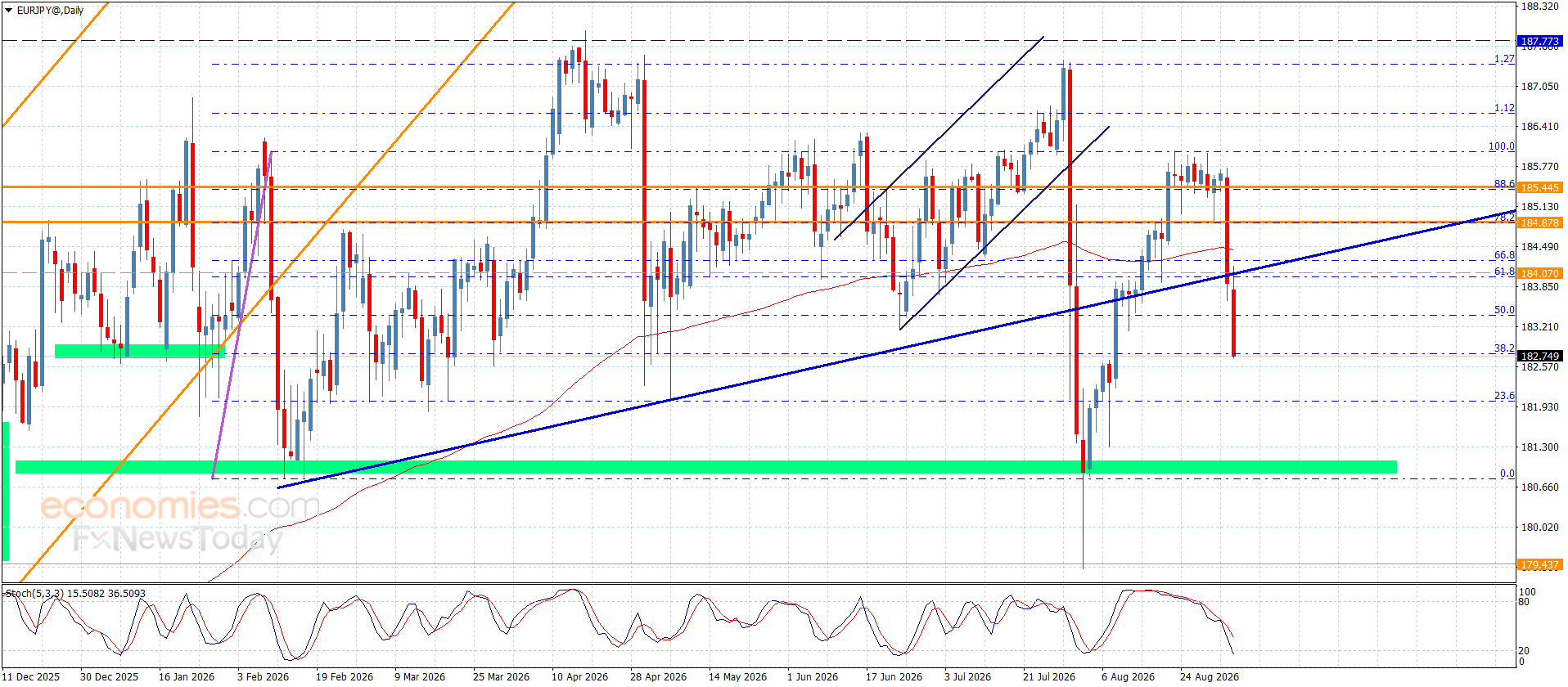
The EURJPY pair activated with negative pressure yesterday, forming a sharp decline to surpass the previously suggested negative stations, resuming the bearish trend by reaching 182.50.
We expect forming negative attempts in the current trading, to target 182.10 level then attempts to press on the support near 181.35, while regaining the bullish trend requires forming a strong bullish rebound, to settle above 184.30 level.
The expected trading range for today is between 181.35 and 183.90
Trend forecast: Bearish
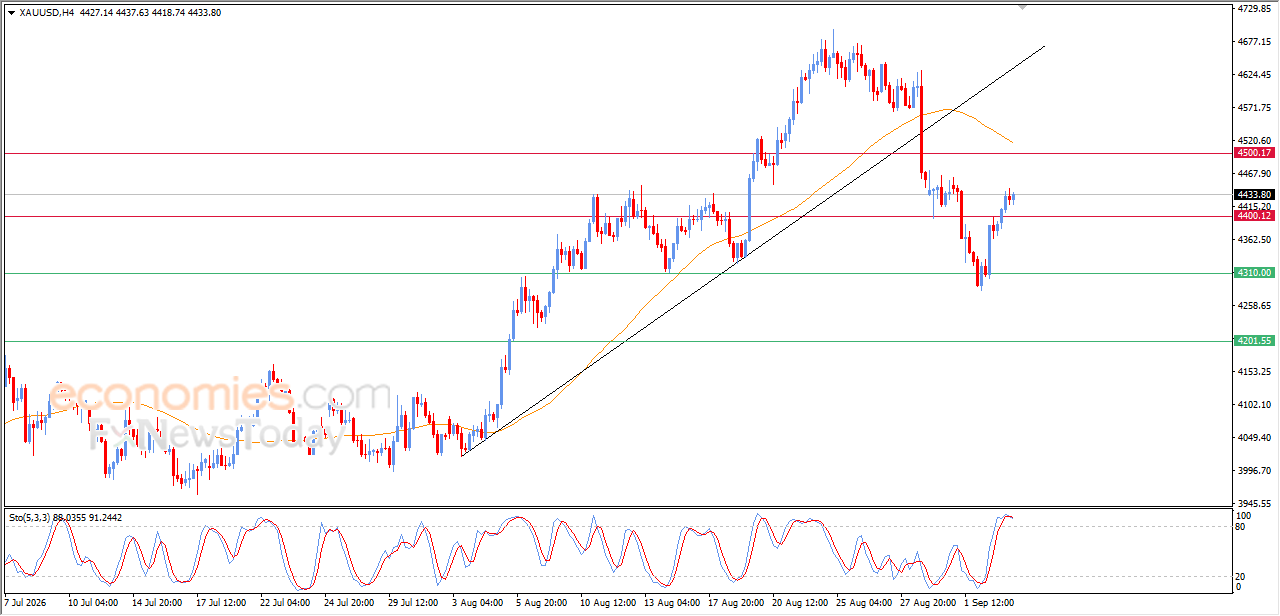
Trading at $4,472 as of the 4-hour chart, Gold price showed a sharp recovery from $4,304. I find it interesting that price bounced back to the $4,422–$4,465 resistance zone. With the broader trend line still limiting the rally, this zone actually creates a legitimate price ceiling and a decision zone as opposed to confirming a price reversal.
I have my eyes on the $4,465–$4,487 resistance zone, as the next goal will be the $4,564 level should price break cleanly above $4,487. On the other hand, $4,304 will be the first support of interest, followed by the $4,365 and $4,422 support zones. If these penetrate, attention will return to the broader $4,221–$4,263 price demand zone.
Arthur Hayes predicts EURJPY will fall to 140 or below by mid-2027, with year-end 2026 targets for Ether, Ethena and Ether.fi.
Marcus Renfield
… min read


Arthur Hayes has predicted that the EURJPY currency pair will fall to 140 or below by mid-2027, while setting year-end 2026 price targets of $10,000 for Ether, $0.50 for Ethena and $2 for Ether.fi.
The forecasts were highlighted in a post attributed to Cointelegraph on X. Hayes, a prominent crypto market commentator, provided targets across both the foreign-exchange and digital-asset markets, with his EURJPY call extending into 2027 while the cryptocurrency targets focus on the end of 2026.
For the cryptocurrency market, Hayes has set a year-end 2026 target of $10,000 for Ether. The forecast places the second-largest cryptocurrency by market capitalization alongside two other tokens for which he also provided specific price levels.
Ethena has a year-end 2026 target of $0.50, while Ether.fi has a target of $2. The three targets cover assets with different roles within the broader digital-asset market, but the post does not provide additional details explaining the assumptions behind each forecast.
The figures are price targets rather than confirmed market outcomes. No timeline beyond year-end 2026 was provided for the Ether, Ethena or Ether.fi projections.
Hayes also forecast a substantial decline in EURJPY, predicting that the pair will reach 140 or below by mid-2027.
EURJPY represents the exchange rate between the euro and Japanese yen. Unlike the cryptocurrency targets, Hayes’ currency forecast extends beyond the end of 2026 and specifies a mid-2027 timeframe.
The post does not provide additional figures or a stated rationale for the projected decline. As a result, the 140 level should be treated as Hayes’ forecast rather than an established expectation for the currency pair.
Hayes’ projections use two distinct time horizons. The cryptocurrency targets for Ether, Ethena and Ether.fi are set for year-end 2026, while the EURJPY forecast points to mid-2027.
The forecasts therefore identify specific price levels and deadlines, but the original post does not detail the conditions that Hayes expects would lead markets toward those levels.
The next defined milestones are the end of 2026 for the three crypto targets and mid-2027 for the EURJPY forecast, when the respective predictions can be measured against actual market prices.
Data source: Cointelegraph
Writer: Marcus Renfield
Crypto Market Analyst & Onchain Writer
Marcus Renfield covers cryptocurrency markets with a focus on onchain data, Bitcoin price action, and emerging market narratives. His writing examines how capital flows, network activity, and broader market structure influence short- and medium-term trends.
He aims to provide clear, data-informed analysis for readers seeking a deeper understanding of crypto market dynamics.
Check out other news and articles on Google News
Silver price (XAG/USD) struggles to extend Wednesday’s strong recovery move above $66.25 during the European trading session on Thursday. The white metal could remain sideways as investors await the United States (US) Nonfarm Payrolls (NFP) data for August, which will be released on Friday.
According to TD Securities, August Nonfarm Payrolls are expected to “rebound to 95k after July posted a decline of 23k,” with the firm cautioning that “risks to our payrolls forecasts appear hawkish, and we would not rule out an outsized positive surprise.” The unemployment rate is projected to have “gone sideways at 4.1% with balanced risks,” suggesting only limited change in headline labour market conditions.
Investors will pay close attention to the US NFP report as it is expected to influence market expectations for the Federal Reserve’s (Fed) monetary policy outlook.
Analysts at TD say that “a modestly hawkish employment report will reaffirm the Fed’s attention on inflation, but it will be by itself unlikely to push the Committee towards hikes,” as they “continue to expect that inflation data can print modestly, allowing the Fed to keep rates on hold for now.”
According to the CME FedWatch tool, traders see a two-in-three chance that the Fed will increase interest rates in the September policy meeting.
Elsewhere, higher oil prices due to restricted energy shipments through the Strait of Hormuz, a vital passage to almost one-fifth of global energy supply, could fizzle out the recovery move in the Silver price.
Higher oil prices prompt global inflation expectations, a scenario that increases fears of interest rate hikes from central banks. Such a case bodes poorly for non-yielding assets, like Silver.
In the daily chart, XAG/USD trades at $66.00. The pair holds above the 20-day Exponential Moving Average (EMA) at $65.51, keeping the near-term bias constructive as price extends its recovery from the mid-$50s area.
The Relative Strength Index (14) at 53.04 sits in neutral territory but leans higher, which suggests buyers still have the upper hand without the market being overstretched.
On the downside, immediate support is seen at the 20-day EMA at $65.51, where a deeper pullback would be expected to attract fresh demand. Looking up, the August high near $71 is expected to remain a key barrier.
(The technical analysis of this story was written with the help of an AI tool. Know more.)
Silver is a precious metal highly traded among investors. It has been historically used as a store of value and a medium of exchange. Although less popular than Gold, traders may turn to Silver to diversify their investment portfolio, for its intrinsic value or as a potential hedge during high-inflation periods. Investors can buy physical Silver, in coins or in bars, or trade it through vehicles such as Exchange Traded Funds, which track its price on international markets.
Silver prices can move due to a wide range of factors. Geopolitical instability or fears of a deep recession can make Silver price escalate due to its safe-haven status, although to a lesser extent than Gold’s. As a yieldless asset, Silver tends to rise with lower interest rates. Its moves also depend on how the US Dollar (USD) behaves as the asset is priced in dollars (XAG/USD). A strong Dollar tends to keep the price of Silver at bay, whereas a weaker Dollar is likely to propel prices up. Other factors such as investment demand, mining supply – Silver is much more abundant than Gold – and recycling rates can also affect prices.
Silver is widely used in industry, particularly in sectors such as electronics or solar energy, as it has one of the highest electric conductivity of all metals – more than Copper and Gold. A surge in demand can increase prices, while a decline tends to lower them. Dynamics in the US, Chinese and Indian economies can also contribute to price swings: for the US and particularly China, their big industrial sectors use Silver in various processes; in India, consumers’ demand for the precious metal for jewellery also plays a key role in setting prices.
Silver prices tend to follow Gold’s moves. When Gold prices rise, Silver typically follows suit, as their status as safe-haven assets is similar. The Gold/Silver ratio, which shows the number of ounces of Silver needed to equal the value of one ounce of Gold, may help to determine the relative valuation between both metals. Some investors may consider a high ratio as an indicator that Silver is undervalued, or Gold is overvalued. On the contrary, a low ratio might suggest that Gold is undervalued relative to Silver.
The Euro (EUR) is looking for direction against the British Pound (GBP) on Monday, following a sharp reversal last Friday, with bears eyeing the bottom of the last two weeks’ trading range, just below 0.8550. Negative pressure seems to have eased, but the risk-off market mood, amid rising tensions in Iran and rising Crude prices, is capping Euro rallies for now.
TMGM Analysis: Financial Market News, Economic Calendar & Market Insights
The pair retreated sharply on Friday as Federal Reserve (Fed) Chairman Kevin Warsh boosted hopes of upcoming interest rate hikes, affirming that policymakers “have work to do” on inflation. Investors saw these comments as a sign that the Fed will honour its commitment to bring inflation to the 2% target, although Warsh did not mention rate hikes in his speech.

EUR/GBP trades at 0.8556, halfway through the last few weeks’ trading range, although the impulsive reaction from levels near the 0.8580 resistance area and the lower high printed on Friday have provided fresh hopes for bears. Momentum indicators in 4-hour charts have slid into negative levels, with the Relative Strength Index (14) around 40 hinting at modest bearish momentum, while the Moving Average Convergence Divergence (MACD) fell below zero, showing waning upside pressure rather than a clear directional break.
On the downside, bears are likely to be tested at the August 25 low near 0.8545, although the key support level is the August 12 low, at 0.8531. A break below here will confirm a multiple top between 0.8575 and 0.8585 and shift the focus towards the July 20 and 21 lows at 0.8485 and 0.8490 respectively.
On the upside, Friday’s top, at 0.8576, and the July and August peak near 0.8585 are likely to pose significant resistance for bulls. Above there, the next target is a previous support area just above 0.8600 (June 24, 30 lows).
(The technical analysis of this story was written with the help of an AI tool. Know more.)
The table below shows the percentage change of Euro (EUR) against listed major currencies today. Euro was the strongest against the US Dollar.
| USD | EUR | GBP | JPY | CAD | AUD | NZD | CHF | |
|---|---|---|---|---|---|---|---|---|
| USD | -0.09% | -0.06% | -0.30% | -0.07% | 0.03% | -0.08% | -0.16% | |
| EUR | 0.09% | 0.00% | -0.19% | 0.02% | 0.08% | 0.02% | -0.07% | |
| GBP | 0.06% | -0.00% | -0.19% | 0.00% | 0.06% | -0.00% | -0.06% | |
| JPY | 0.30% | 0.19% | 0.19% | 0.21% | 0.31% | 0.22% | 0.15% | |
| CAD | 0.07% | -0.02% | -0.01% | -0.21% | 0.11% | 0.02% | -0.07% | |
| AUD | -0.03% | -0.08% | -0.06% | -0.31% | -0.11% | -0.08% | -0.14% | |
| NZD | 0.08% | -0.02% | 0.00% | -0.22% | -0.02% | 0.08% | -0.06% | |
| CHF | 0.16% | 0.07% | 0.06% | -0.15% | 0.07% | 0.14% | 0.06% |
The heat map shows percentage changes of major currencies against each other. The base currency is picked from the left column, while the quote currency is picked from the top row. For example, if you pick the Euro from the left column and move along the horizontal line to the US Dollar, the percentage change displayed in the box will represent EUR (base)/USD (quote).
Gold posted a series of consecutive gains during its latest intraday trading, despite the continued dominance of the short-term bearish corrective trend. Negative pressure continues as the price trades below EMA50, which threatens to reverse these gains in the near term, particularly with the emerging negative divergence in the relative strength indicators after they reached extremely overbought levels, excessively so compared with the price movement, along with the beginning of a bearish crossover.
The U.S. Dollar Indexis currently trading at 99.23 on the 2-hour chart after dropping below the recovering channel from the August lows. What is interesting is how quickly the index was rejected at the 99.80 – 99.86 range. DXY lost 99.62, 99.48, and 99.35 very quickly, which shows how much the structure of the bullish recovery has weakened.
The first area I will be watching is 99.12, as the downwards support zone begins there. Breaking below this would expose 98.90, 98.72, and 98.56. In the opposite direction, looking at the previous support zone of 99.35 – 99.48 and adding 99.62, the resistance zone starts to form there.
RSI has dropped and begun to enter oversold territory, so a bounce in the index is possible, but I also believe that the DXY will drop furtherwhen trading below the 99.48 range. I will reverse that opinion if the index breaks above the 99.62 range, but I believe the rallies will be corrective in nature rather than a strong downtrend.
The US Dollar (USD) remains under selling pressure on Thursday, as investors juggle with risk-related headlines and little guidance from macroeconomic data. Spot Gold benefited from broad USD weakness and surpassed the $4,500 level during American trading hours.
The USD traded with a firmer tone at the beginning of the week after the United States (US) and Iran resumed hostilities, sending Oil prices sharply up and hence raising concerns about mounting inflationary pressures. The Greenback, however, came under pressure mid-week amid speculation that the Bank of Japan (BoJ) intervened in the currency market to prevent the Japanese Yen (JPY) from falling further.
A better market mood kept the USD pressured despite the Middle East conflict. On the one hand, speculative interest welcomed headlines indicating that Russian President Vladimir Putin said there is a chance for constructive peace talks with Ukraine.
Finally, Federal Reserve (Fed) Governor Christopher Waller cooled the odds for a September rate hike, saying that officials can “wait one meeting,” as long as there are no surprises from upcoming inflation data, adding that a 25 bps hike won’t bring inflation back to 2%.
Data that can shape the upcoming Fed’s decision is around the corner: On Friday, the US will publish the August Nonfarm Payrolls (NFP) report, a picture of the situation in the labor market, while next week, the country will unveil the Consumer Price Index (CPI) for the same month.
In the four-hour chart, XAU/USD turned bullish as it moved above the 20-period Simple Moving Average (SMA) at $4,397.48, the 100-period SMA at $4,481.65, and the 200-period SMA at $4,315.95. The moving averages are pretty much horizontal, failing to provide clear directional clues. Still, the price holding above them skews the risk to the upside. Technical indicators, in the meantime, gain upward traction above their midlines, maintaining nice vertical slopes, a sign of strong buying interest.
The XAU/USD pair daily chart keeps a constructive near-term tone as it holds above both the 20-day SMA at $4,462.49 and the 100-day SMA at $4,358.36. The Relative Strength Index (RSI) indicator ticks north at around 56, while the Momentum indicator also holds in positive territory, suggesting steady, rather than exuberant, upside pressure.
On the downside, immediate support is seen at the 100-period SMA at $4,481.65, followed by the 20-period SMA at $4,397.48 and then the 200-period SMA near $4,315.95. On the topside, the 200-day SMA at $4,533.34 forms the next significant resistance, and a sustained break above this barrier would likely open the door to further gains.
(The technical analysis of this story was written with the help of an AI tool. Know more.)
The US Dollar to Japanese Yen (USD/JPY) exchange rate slipped to 159.6004 on Wednesday, leaving Westpac’s September forecast target of 162 around 1.5% above spot.
USD/JPY had climbed as high as 160.3872 during the previous 48 hours before reversing sharply, while the daily decline reached 0.37%.

The chart above shows the pair giving back its advance through 160.30 and finishing near the bottom of its 159.4938-160.3872 range.
Westpac’s September call is effectively for one more test higher rather than an unprecedented breakout.
The pair traded as high as 163.9798 in July, so 162 has already proved reachable this summer.
What follows in Westpac’s forecast curve is far more interesting.
The bank sees USD/JPY easing to 160 in December and remaining there in March 2027, before falling to 158 in June, 156 in September and 154 at the end of next year.
The decline then continues at a remarkably steady pace: 152 in March 2028, 150 in June, 148 in September and 146 in December.
From the forecast peak of 162 to the final 146 target, that would be a 9.9% fall in USD/JPY and an appreciation of almost 11% for the Yen against the Dollar.
Westpac’s accompanying interest-rate forecasts make the currency path more striking.
The bank keeps the Federal Funds rate at 3.625% throughout the forecast period, rather than relying on a sizeable US easing cycle to pull USD/JPY lower.
It also expects the US 10-year Treasury yield to ease only modestly, from 4.65% in September to 4.55% in the first half of 2027.
The yield then rises gradually to 4.85% by December 2028, precisely when USD/JPY reaches 146.
In other words, Westpac is forecasting a major Yen recovery without a lasting collapse in US yields.
The published figures do not include a separate Japanese interest-rate path or written explanation for the move, so it would be wrong to assign the decline to one specific catalyst.
Still, the curve fits a market increasingly focused on whether Japanese policy can take over from direct currency support.
As we noted in our recent Yen analysis, intervention can deliver an abrupt move but has struggled to overcome the interest-rate gap for long.
Westpac’s numbers instead describe a slow adjustment lasting more than two years.
These are dated forecast points rather than promised trading stops, but the message is unusually clear: 162 may come first, while the bigger move is eventually lower.
Friday’s Japanese household-spending figures and US employment report provide the next test, with Westpac forecasting a 70,000 rise in payrolls against a market estimate of 55,000.
Our currency coverage draws on live market data, official economic releases and published bank research.
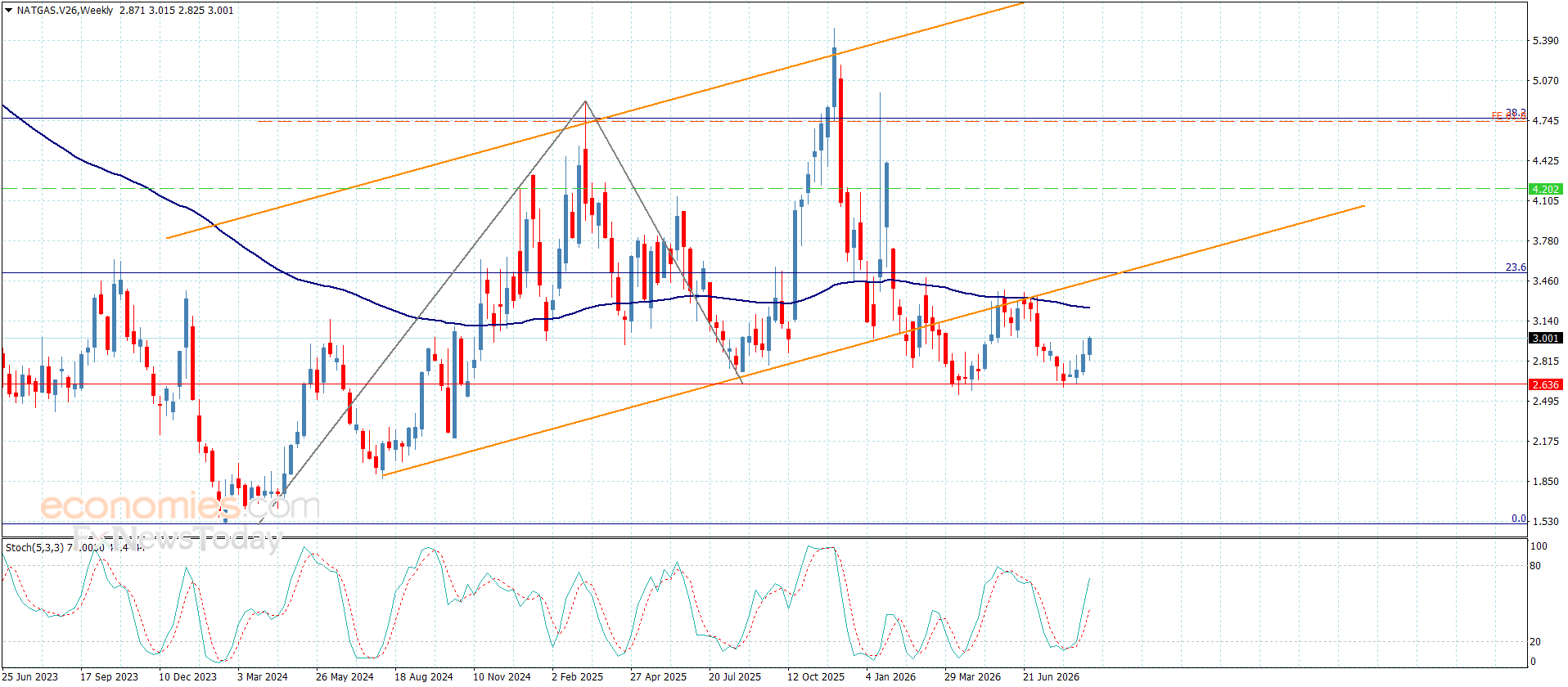
Natural gas price benefited from the repeated positive pressures by breaching the barrier at $2.920, confirming the continuation of the bullish corrective scenario, approaching the initial target at $3.050.
In general, the stability above $2.620 support and providing bullish momentum by the main indicators will increase the efficiency of the bullish trend in the current trading, to expect the attempt of recording extra gains by its rally towards $5.200 and $3.380.
The expected trading range for today is between $2.950 and $3.200
Trend forecast: Bearish