The main category of Forex News.
You can use the search box below to find what you need.
[wd_asp id=1]
The main category of Forex News.
You can use the search box below to find what you need.
[wd_asp id=1]
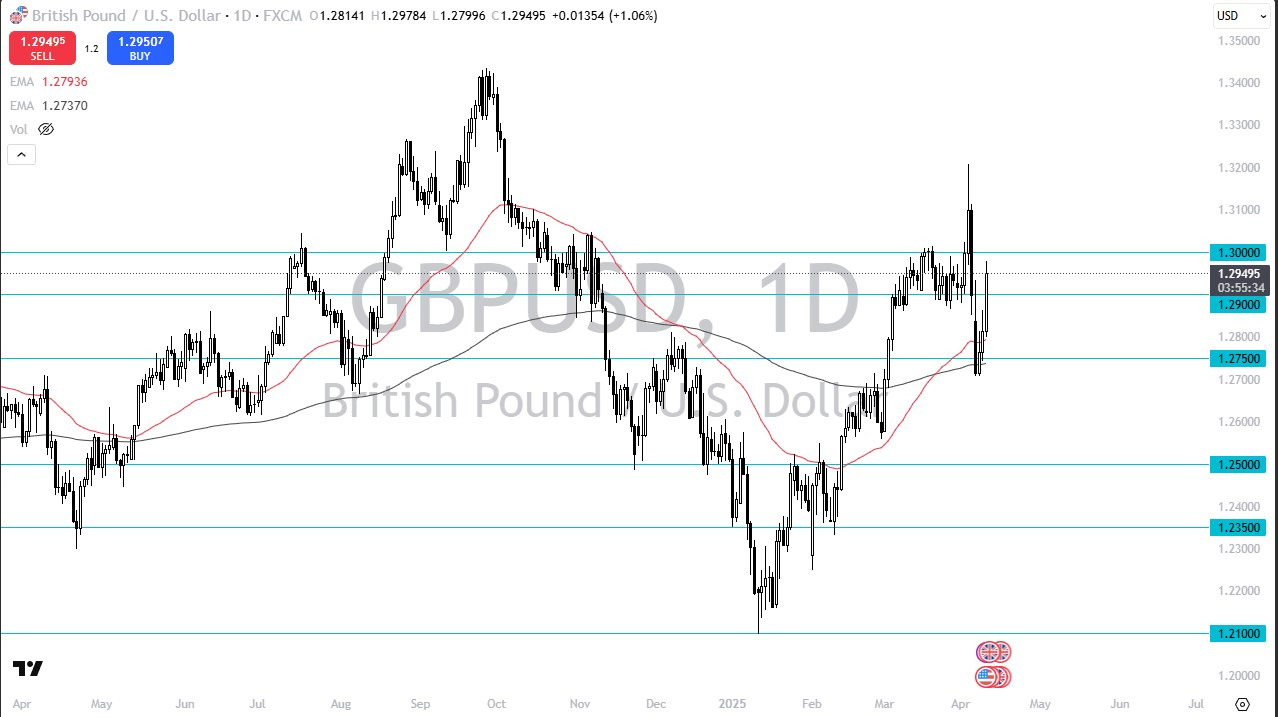
The technical analysis for the GBP/USD pair is all over the place, and it really comes down to what your time frame is. After all, short-term traders have been whipped in both directions over the last couple of days, but longer-term traders have been buyers over the last several months. That being said, the market is likely to continue to see a lot of volatility, see you do have to be cautious with your position sizing. That being said, it is worth noting that the pair is approaching the crucial 1.30 level, which of course is a large, round, psychologically significant figure, and an area where we have seen a lot of business conducted.

I think the next couple of days will be crucial, because it will give us an idea as to what people are going to do for safety. After all, treasuries are selling off, giving higher interest rates in America, which is a bit counterintuitive. As long as that’s the case, then you will see the British pound in other currencies do quite well against the US dollar, but if traders run to treasuries for safety again, that will drive up the US dollar. As things stand right now, it feels a little bit like we are seeing a lot of capital flight from the United States, perhaps due to the tariff wars.
That being said, there’s a lot to take in here, and I do think that we have a situation where we probably try to carve out some type of range using the 1.2750 level is the bottom, and it may be the 1.30 level as the top. We could even extend that to the 1.32 level, due to the massive amounts of volatility that we continue to see an all markets, not just this one.
Ready to trade the GBP/USD Forex analysis? Check out the best forex trading company in UK worth using.
Silver (XAG/USD) struggles to capitalize on its modest intraday uptick and retreats slightly after touching a fresh weekly high, around the $31.30 region during the early European session on Thursday. The intraday selling picks up pace in the last hour and drags the white metal back below the $31.00 mark as traders now look forward to the US consumer inflation figures before placing fresh directional bets.
From a technical perspective, the XAG/USD now seems to have found acceptance above the 38.2% Fibonacci retracement level of the recent slump from the March swing high to a fresh year-to-date low touched earlier this week. The subsequent move up, however, stalls ahead of the 50% Fibo. level. Moreover, oscillators on the daily chart – though they have been recovering from lower levels – are holding in negative territory. This, in turn, warrants some caution before positioning for an extension of the weekly uptrend from the $28.25 region, or the lowest level since September 2024.
In the meantime, any further slide below the 38.2% Fibo. level is likely to find some support near the $30.55 region. Some follow-through selling, however, could make the XAG/USD vulnerable to accelerate the fall towards the $30.00 psychological mark en route to the 23.6% Fibo. level, around the $29.80-$29.75 zone. Failure to defend the said support levels would shift the near-term bias back in favor of bearish traders. The white metal might then decline to the $29.35-$29.30 zone en route to the $29.00 mark and eventually aim towards retesting the multi-month low, around the $28.25 region.
On the flip side, bulls might now wait for a sustained strength beyond the daily swing high, around the $31.30 region, which nears the 50% Fibo. level, before placing fresh bets. The subsequent move-up should allow the XAG/USD to reclaim the $32.00 mark and climb further towards the 61.8% Fibo. level, around the $32.15-$32.20 zone. The latter should act as a key pivotal point, which if cleared decisively will be seen as a fresh trigger for bullish traders and lift the white metal beyond the $32.65 intermediate barrier, towards the $33.00 round figure.
Silver is a precious metal highly traded among investors. It has been historically used as a store of value and a medium of exchange. Although less popular than Gold, traders may turn to Silver to diversify their investment portfolio, for its intrinsic value or as a potential hedge during high-inflation periods. Investors can buy physical Silver, in coins or in bars, or trade it through vehicles such as Exchange Traded Funds, which track its price on international markets.
Silver prices can move due to a wide range of factors. Geopolitical instability or fears of a deep recession can make Silver price escalate due to its safe-haven status, although to a lesser extent than Gold’s. As a yieldless asset, Silver tends to rise with lower interest rates. Its moves also depend on how the US Dollar (USD) behaves as the asset is priced in dollars (XAG/USD). A strong Dollar tends to keep the price of Silver at bay, whereas a weaker Dollar is likely to propel prices up. Other factors such as investment demand, mining supply – Silver is much more abundant than Gold – and recycling rates can also affect prices.
Silver is widely used in industry, particularly in sectors such as electronics or solar energy, as it has one of the highest electric conductivity of all metals – more than Copper and Gold. A surge in demand can increase prices, while a decline tends to lower them. Dynamics in the US, Chinese and Indian economies can also contribute to price swings: for the US and particularly China, their big industrial sectors use Silver in various processes; in India, consumers’ demand for the precious metal for jewellery also plays a key role in setting prices.
Silver prices tend to follow Gold’s moves. When Gold prices rise, Silver typically follows suit, as their status as safe-haven assets is similar. The Gold/Silver ratio, which shows the number of ounces of Silver needed to equal the value of one ounce of Gold, may help to determine the relative valuation between both metals. Some investors may consider a high ratio as an indicator that Silver is undervalued, or Gold is overvalued. On the contrary, a low ratio might suggest that Gold is undervalued relative to Silver.
EUR/USD trades at its highest level since February 2022 above 1.1400.
The USD selloff intensifies after China raises tariffs on US goods in retaliation.
The near-term technical outlook points to overbought conditions.
EUR/USD gained more than 2% on Thursday and extended its upsurge on Friday to a new multi-year high above 1.1400. Although the pair’s near-term technical outlook points to overbought conditions, investors are like to stay away from the US Dollar (USD) amid a deepening US-China trade conflict.
The table below shows the percentage change of Euro (EUR) against listed major currencies this week. Euro was the weakest against the Swiss Franc.
| USD | EUR | GBP | JPY | CAD | AUD | NZD | CHF | |
|---|---|---|---|---|---|---|---|---|
| USD | -4.18% | -1.76% | -2.23% | -2.62% | -2.82% | -3.87% | -4.95% | |
| EUR | 4.18% | 2.81% | 2.70% | 2.26% | 1.34% | 0.94% | -0.19% | |
| GBP | 1.76% | -2.81% | -1.42% | -0.54% | -1.43% | -1.82% | -2.92% | |
| JPY | 2.23% | -2.70% | 1.42% | -0.36% | 0.35% | -0.46% | -2.44% | |
| CAD | 2.62% | -2.26% | 0.54% | 0.36% | -0.55% | -1.29% | -2.66% | |
| AUD | 2.82% | -1.34% | 1.43% | -0.35% | 0.55% | -0.40% | -1.52% | |
| NZD | 3.87% | -0.94% | 1.82% | 0.46% | 1.29% | 0.40% | -1.13% | |
| CHF | 4.95% | 0.19% | 2.92% | 2.44% | 2.66% | 1.52% | 1.13% |
The heat map shows percentage changes of major currencies against each other. The base currency is picked from the left column, while the quote currency is picked from the top row. For example, if you pick the Euro from the left column and move along the horizontal line to the US Dollar, the percentage change displayed in the box will represent EUR (base)/USD (quote).
Growing fears over the US economy tipping into recession caused the US Treasury bonds and the USD to remain under heavy selling pressure on Thursday.
On Friday, China’s Finance Ministry announced that they will raise additional tariffs on US imports from 84% to 125% from April 12, in retaliation to the US’ tariffs on Chinese goods.
This development caused the USD selloff to intensify and triggered another leg higher in EUR/USD in the European session.
The US economic calendar will feature Producer Price Index data for March and the University of Michigan will publish the Consumer Sentiment Index data for April. Investors could ignore these data releases and remain focused on fresh developments surrounding the US -China trade war.
In case US President Donald Trump responds by increasing tariffs on Chinese goods even further, the USD selloff could continue heading into the weekend. On the other hand, the USD could stage a rebound if one of the sides takes a step back to ease tensions.
The Relative Strength Index (RSI) indicator on the 4-hour chart climbed above 80, highlighting overbought conditions for the pair.
On the upside, 1.1500 (round level) could be seen as the next resistance level before 1.1535 (static level from November 2021) and 1.1600 (static level, round level). Looking south, supports could be spotted at 1.1300 (static level, round level) and 1.1200 (static level, round level).
Generally speaking, a trade war is an economic conflict between two or more countries due to extreme protectionism on one end. It implies the creation of trade barriers, such as tariffs, which result in counter-barriers, escalating import costs, and hence the cost of living.
An economic conflict between the United States (US) and China began early in 2018, when President Donald Trump set trade barriers on China, claiming unfair commercial practices and intellectual property theft from the Asian giant. China took retaliatory action, imposing tariffs on multiple US goods, such as automobiles and soybeans. Tensions escalated until the two countries signed the US-China Phase One trade deal in January 2020. The agreement required structural reforms and other changes to China’s economic and trade regime and pretended to restore stability and trust between the two nations. However, the Coronavirus pandemic took the focus out of the conflict. Yet, it is worth mentioning that President Joe Biden, who took office after Trump, kept tariffs in place and even added some additional levies.
The return of Donald Trump to the White House as the 47th US President has sparked a fresh wave of tensions between the two countries. During the 2024 election campaign, Trump pledged to impose 60% tariffs on China once he returned to office, which he did on January 20, 2025. With Trump back, the US-China trade war is meant to resume where it was left, with tit-for-tat policies affecting the global economic landscape amid disruptions in global supply chains, resulting in a reduction in spending, particularly investment, and directly feeding into the Consumer Price Index inflation.
The EURUSD price continues the rise during its recent intraday trading, amid the strong dominance of the main upward trend. The pair’s recent rise came despite the emergence of negative signals on the Relative Strength Index (RSI) indicators, after reaching highly overbought levels, which highlights the strength of this positive trend.
To get our more detailed analysis and 100% accurate signals provided by Best Trading Signal, subscribe to Economies.com VIP Club through the link below!
Copper price didn’t move anything since yesterday’s trading, delaying the bullish rally by its repeated fluctuation below 38.2%Fibonacci correction level, which represents an intraday obstacle by its stability near $4.4000.
The continuation of stochastic attempts to provide positive momentum and the repeated stability above the critical support at $4.000, these factors make us keep the bullish suggestion, to expect the mentioned obstacle and holding above it, targeting extra positive stations that begin at $4.5600 and $4.6800.
The expected trading range for today is between $4.2300 and $4.5600
Trend forecast: Bullish
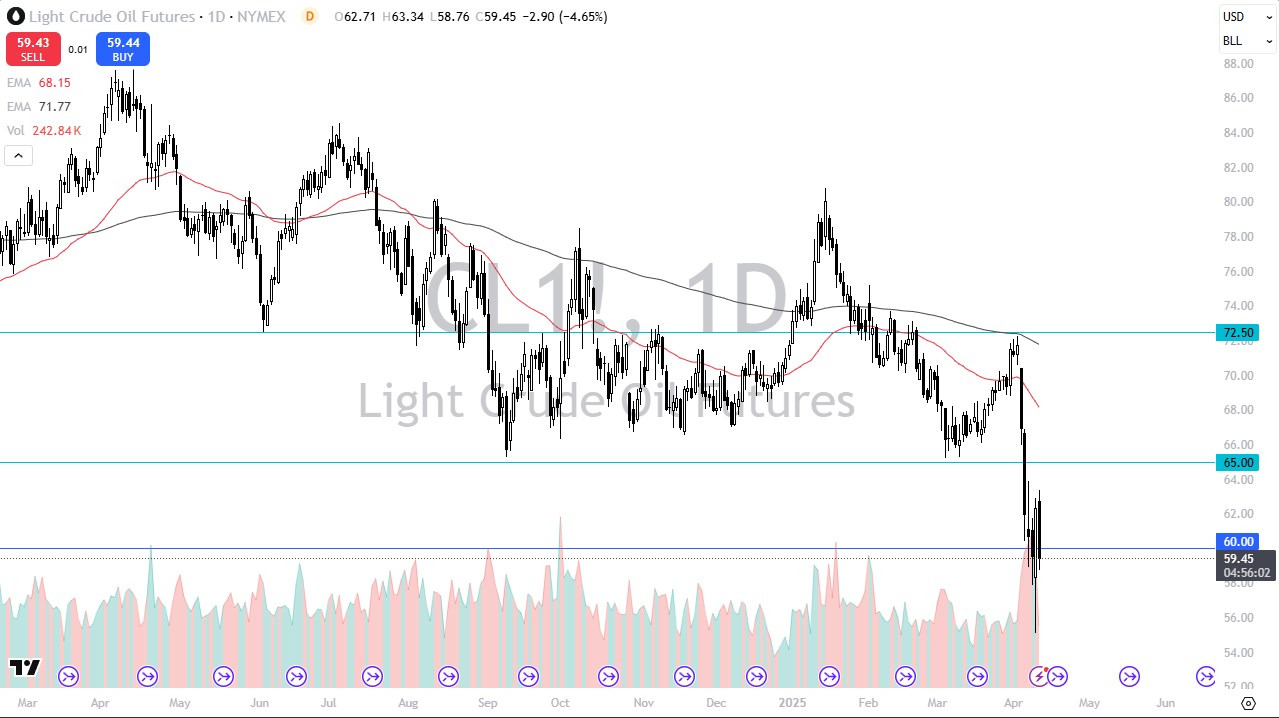
The reprieve that we got during the trading session on Thursday, quite frankly, I think was a bit of a short covering rally and I think a lot of traders are starting to look at this and go, well, has anything actually changed? Maybe things aren’t as bad as they could be, but the real trade tariff issue right now between the United States and China is going to cause a lot of major problems.
The market bouncing from here should be thought of as a gift for sellers to get involved in, but I really don’t like the idea of trying to catch a falling knife here. The best case scenario for crude oil at the moment is going to be spending a lot of time around the $60 level. For what it is worth, I was watching the futures market earlier and there was definitely some type of bid right around the $60 level. So, we’ll have to watch that closely. As I record this video, we are down about 50 cents below that level, but we have also bounced from the lows of the day. So, all things being equal, this is a market that I think is in transition and we will have to pay close attention to whether or not it can pick itself up off the floor. Job one for the bulls will be to go sideways for a while. If we break down below the $55 level, look out below. Crude oil, probably just craters.
Ready to trade daily crude oil price analysis? We’ve shortlisted the best Forex Oil trading brokers in the industry for you.
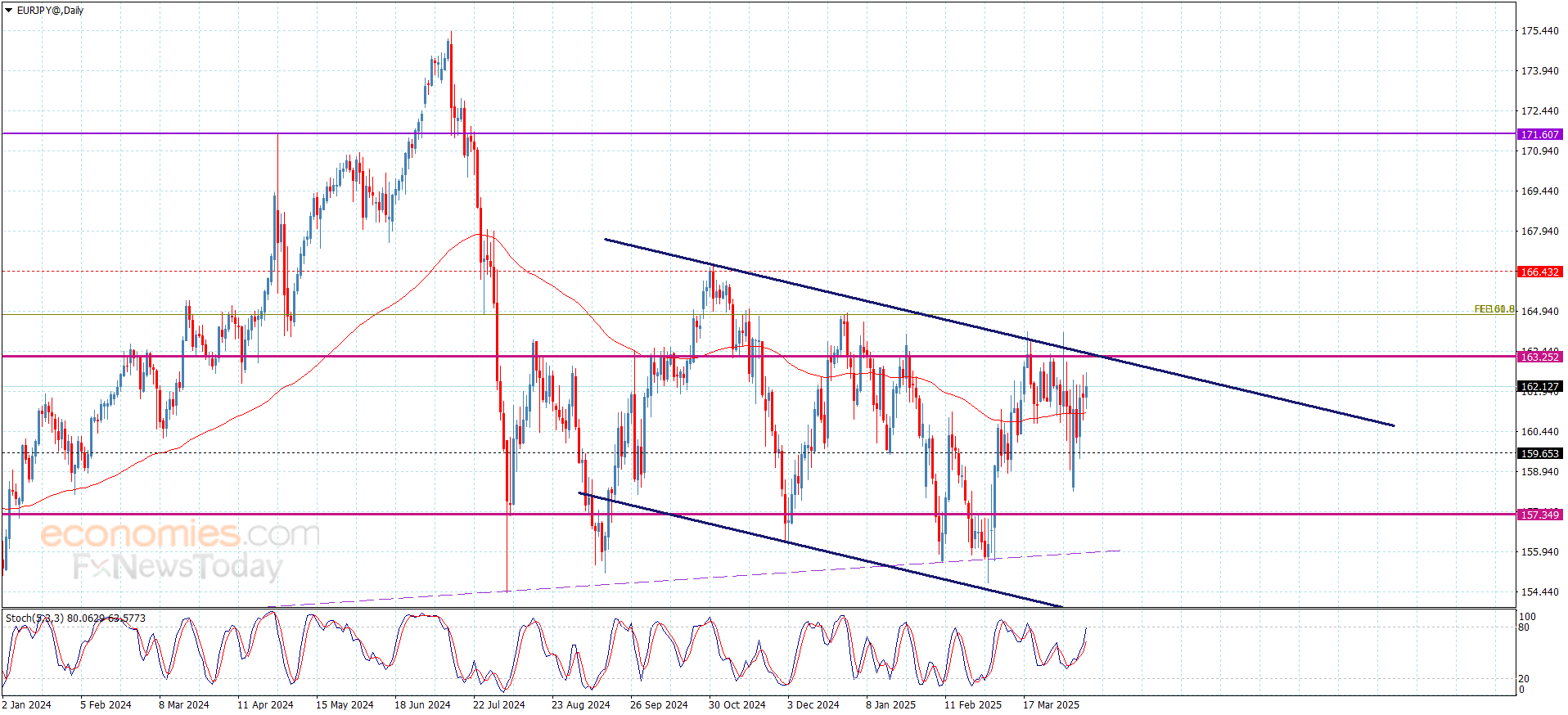
The EURJPY pair provided several mixed waves since yesterday, due to the contradiction between the main indicators’ positivity and the overall stability below the bearish channel’s resistance at 163.20, to notice its stability near 161.85 without achieving any of the waited negative targets.
The price needs a new negative momentum, to reinforce the efficiency of the bearish track, which might target 160.60 level and 159.60, while the price surrender to the positivity of the main indicators and its rally above the main resistance will confirm its readiness to build a new bullish track, to begin targeting several positive stations by attacking 164.10 level initially, reaching 164.85.
The expected trading range for today is between 160.60 and 162.50
Trend forecast: Bearish
Gold price (XAU/USD) keeps its range close to fresh all-time highs near $3,220 in early Europe on Friday. The US Dollar (USD) downward spiral and escalating trade war between the United States (US) and China continue to underpin the safe-haven appeal of Gold price.
Data released by the US Bureau of Labor Statistics (BLS) on Thursday revealed that US consumer prices unexpectedly fell in March, but inflation risks are tilted to the upside after US President Donald Trump doubled down on China tariffs. The US CPI inflation eased to 2.4% YoY in March from 2.8% in February. This reading came in below the market expectation of 2.6%.
The core CPI, which excludes volatile food and energy prices, increased 2.8% YoY in March, compared to a rise of 3.1% seen in February and came in below the consensus of 3.0%. On a monthly basis, the headline CPI declined 0.1%, while the core CPI rose 0.1%.
Trump said on Wednesday he would temporarily lower duties on dozens of countries. However, Trump also raised tariffs on China to 125%, effective immediately, after Beijing announced plans to retaliate with 84% duties. The worries over the global economy and the renewed trade tensions between the world’s two biggest economies keep investors in safe-haven assets, supporting the Gold price.
“Gold regains its safe-haven appeal and gets back on track for new all-time highs,” said Nikos Tzabouras, Senior Market Analyst at Tradu.com.
Additionally, increased dovish bets surrounding Federal Reserve (Fed) rate cuts this year exacerbate the Greenback’s pain, strengthening the USD-denominated commodity price. Traders continue pricing three or four rate cuts this year.
The daily chart shows that the 14-day Relative Strength Index (RSI) is prodding the overbought region at 70, suggesting more room for upside before the buyers’ exhaustion sets in.
The immediate resistance is seen at the $3,250 psychological level, above which a fresh uptrend toward the $3,300 threshold would be in the offing.
On the downside, the initial demand area is seen at $3,200, below which the 21-day Simple Moving Average (SMA) resistance-turned-support at $3,061 could come into play.
If the correction extends, the $3,000 mark will be the last line of defense for buyers.
The table below shows the percentage change of US Dollar (USD) against listed major currencies this week. US Dollar was the weakest against the Swiss Franc.
| USD | EUR | GBP | JPY | CAD | AUD | NZD | CHF | |
|---|---|---|---|---|---|---|---|---|
| USD | -2.99% | -0.98% | -1.45% | -2.07% | -2.61% | -3.42% | -4.02% | |
| EUR | 2.99% | 2.36% | 2.20% | 1.58% | 0.32% | 0.18% | -0.45% | |
| GBP | 0.98% | -2.36% | -1.42% | -0.77% | -1.99% | -2.13% | -2.74% | |
| JPY | 1.45% | -2.20% | 1.42% | -0.59% | -0.21% | -0.76% | -2.25% | |
| CAD | 2.07% | -1.58% | 0.77% | 0.59% | -0.90% | -1.38% | -2.25% | |
| AUD | 2.61% | -0.32% | 1.99% | 0.21% | 0.90% | -0.15% | -0.77% | |
| NZD | 3.42% | -0.18% | 2.13% | 0.76% | 1.38% | 0.15% | -0.62% | |
| CHF | 4.02% | 0.45% | 2.74% | 2.25% | 2.25% | 0.77% | 0.62% |
The heat map shows percentage changes of major currencies against each other. The base currency is picked from the left column, while the quote currency is picked from the top row. For example, if you pick the US Dollar from the left column and move along the horizontal line to the Japanese Yen, the percentage change displayed in the box will represent USD (base)/JPY (quote).
Gold has played a key role in human’s history as it has been widely used as a store of value and medium of exchange. Currently, apart from its shine and usage for jewelry, the precious metal is widely seen as a safe-haven asset, meaning that it is considered a good investment during turbulent times. Gold is also widely seen as a hedge against inflation and against depreciating currencies as it doesn’t rely on any specific issuer or government.
Central banks are the biggest Gold holders. In their aim to support their currencies in turbulent times, central banks tend to diversify their reserves and buy Gold to improve the perceived strength of the economy and the currency. High Gold reserves can be a source of trust for a country’s solvency. Central banks added 1,136 tonnes of Gold worth around $70 billion to their reserves in 2022, according to data from the World Gold Council. This is the highest yearly purchase since records began. Central banks from emerging economies such as China, India and Turkey are quickly increasing their Gold reserves.
Gold has an inverse correlation with the US Dollar and US Treasuries, which are both major reserve and safe-haven assets. When the Dollar depreciates, Gold tends to rise, enabling investors and central banks to diversify their assets in turbulent times. Gold is also inversely correlated with risk assets. A rally in the stock market tends to weaken Gold price, while sell-offs in riskier markets tend to favor the precious metal.
The price can move due to a wide range of factors. Geopolitical instability or fears of a deep recession can quickly make Gold price escalate due to its safe-haven status. As a yield-less asset, Gold tends to rise with lower interest rates, while higher cost of money usually weighs down on the yellow metal. Still, most moves depend on how the US Dollar (USD) behaves as the asset is priced in dollars (XAU/USD). A strong Dollar tends to keep the price of Gold controlled, whereas a weaker Dollar is likely to push Gold prices up.
The likely daily close below the uptrend line is bearish, and more so since it follows a decline after finding resistance around a key short-term price zone. Wednesday’s high of $3.83 found resistance a little below the 50-Day MA, which had previously denoted as trend support. That is potentially bearish by itself as the progression of a bear trend typically rises to test prior support as resistance before it continues lower.
Also, notice that resistance was seen both yesterday and today around the middle line within the falling channel (red). There are also two prior interim price swing lows at $3.73 and $3.74, that now mark potential resistance. Finally, potential resistance around the 20-Week MA is at $3.71.
In other words, since a close below the trendline is bearish, and resistance was seen over several days in an area of confluence, there remains the potential for a bearish continuation of the corrective decline that followed the recent peak of $4.90. Moreover, a declining channel remains in place and natural gas continues to trade below both the 20-Day and 50-Day MAs.
Therefore, although a rise above today’s would be a sign of strength given that the uptrend line and middle channel line would have been reclaimed, natural gas would be heading into prior consolidation and potential resistance around the 50-Day MA, now at $3.88, and the 20-Day MA, at $3.92 currently. Moreover, the relative strength index (RSI) remains in a downtrend and may establish a lower swing high.
One or a few days more of price action should begin to clarify the developing patterns. A 78.6% retracement was completed yesterday on the way to support at $3.34. Since a sharp rally followed, it showed buyers back in charge. Therefore, new bullish signs, starting with a rally above today’s high, should be seen as follow-through to renewed strength. If not, indicated by a drop below $3.46 and $3.34, then further downside becomes likely.
For a look at all of today’s economic events, check out our economic calendar.
April 10, 2025 – Written by David Woodsmith
STORY LINK Pound to Euro Rate Dragged Lower by EUR/USD Rally to 1.11
A EUR/USD rally past 1.11 on foreign exchange markets has dragged the Pound Sterling lower against the Euro on Thursday.
The Pound Euro (GBP/EUR) exchange rate weakened on Thursday following US President Donald Trump’s U-turn on his global tariffs.
On Thursday, the Euro (EUR) gained strength against most of its trading partners as Donald Trump announced a 90-day pause on global tariffs for all countries, except China, with a temporary 10% tariff.
In response to this shift, the US Dollar (USD) continued its downward trend during Thursday’s European trading session.
Due to the inverse relationship between the Euro and the US Dollar, the Euro capitalised on the USD’s decline, rising against the majority of its counterparts.
On Thursday, the Pound (GBP) managed to hold its ground against most of its rival currencies, even in the absence of significant economic data.
Despite the lack of major British economic indicators, Sterling maintained its strength, partly because of a decrease in expectations for an interest rate cut by the Bank of England (BoE).
With the UK bond markets stabilising, the probability of a BoE interest rate cut next week dropped from almost 100% to 78%, offering support to the Pound.
Looking ahead to Friday, the primary drivers of movement for the Pound Euro exchange rate will likely be the economic releases from both the UK and the Eurozone.
In the UK, the latest GDP figures are set to be released, and if the index reports an expected minor rebound, it could provide a positive boost to GBP exchange rates, helping to end the week on a strong note.
Meanwhile, in the Eurozone, Germany will unveil its latest inflation data.
Should the Consumer Price Index (CPI) report a downturn as expected, it could put downward pressure on the Euro, potentially weakening the single currency as the week draws to a close.

International Money Transfer? Ask our resident FX expert a money transfer question or try John’s new, free, no-obligation personal service! ,where he helps every step of the way,
ensuring you get the best exchange rates on your currency requirements.