The main category of Forex News.
You can use the search box below to find what you need.
[wd_asp id=1]
The main category of Forex News.
You can use the search box below to find what you need.
[wd_asp id=1]
Natural gas price lost the positive momentum recently, which forces it to settle below the obstacle at 4,180$, to form a temporary negative rebound, to keep its stability above the extra support at 3,750$.
We expect the price affection by the sideways bias domination, to attempt to gain the required positive momentum, to expect targeting 4,050 level, then repeat the attempt of breaching the mentioned obstacle, while facing new negative pressures might push the price to resume the correctional decline, to suffer extra losses by reaching 3,560$ before any attempt to achieve the waited positive targets.
The expected trading range for today is between 3,750$ and 4,050$
Trend forecast: Bullish
Spot Gold trades in the $2,970 region, approaching the intraday low posted during the Asian session at $2,971.28. Financial markets have been on their toes ever since the day started amid the escalation of the trade war unleashed by United States (US) President Donald Trump last week.
Despite comments about being willing to negotiate retaliatory tariffs announced last Wednesday, Trump decided to lift the bet and pledged additional 50% tariffs on China if Beijing does not back off on the 34% retaliatory levies announced over the weekend.
Chinese announcement sent Asian indexes into a selling spiral, which continued during European trading hours. All indexes closed in the red and with sharp losses, while Wall Street futures also fell. By the time being, indexes managed to bounce from their intraday lows, but are consolidating losses.
In the meantime, rumors of a potential 90-day delay on the implementation of reciprocal tariffs lifted the mood early in the American session, yet hopes were short-lived, as the White House quickly denied such a possibility. Trump, however, repeated on Truth Social that negotiations with “other countries” will take place “immediately.”
Tariff-related developments will dominate the scene during the upcoming days, alongside the trend of all assets. At the time being, the US Dollar (USD) finds risk-related demand, but that may change, considering the ultimate fear is that tariffs will result in higher inflation alongside an economic recession. Markets foresee a gloomy future for the USA, which will impact all other major economies.
From a technical point of view, XAU/USD is poised to extend its slide. The daily chart shows that the pair is developing below its 20 Simple Moving Average (SMA), which now acts as dynamic resistance at around $3,033.60. The 100 and 200 SMAs keep heading north far below the current level, yet technical indicators head south vertically and within negative levels, anticipating another leg south.
In the near term, and according to the 4-hour chart, the bearish case is even clearer. The 20 SMA turned sharply lower, still holding above the 100 and 200 SMAs, which, anyway, lost their bullish strength. The XAU/USD pair is currently piercing its 200 SMA a handful of $ above the current level, while technical indicators resumed their slides after barely correcting early oversold conditions. Immediate support comes at around 2,959.00, where the pair topped late in February. A clear break lower opens the door for a steeper Gold slide.
Support levels: 2,959.00 2,942.50 2,929.45
Resistance levels: 2,982.20 2,998.30 3,015.55
Generally speaking, a trade war is an economic conflict between two or more countries due to extreme protectionism on one end. It implies the creation of trade barriers, such as tariffs, which result in counter-barriers, escalating import costs, and hence the cost of living.
An economic conflict between the United States (US) and China began early in 2018, when President Donald Trump set trade barriers on China, claiming unfair commercial practices and intellectual property theft from the Asian giant. China took retaliatory action, imposing tariffs on multiple US goods, such as automobiles and soybeans. Tensions escalated until the two countries signed the US-China Phase One trade deal in January 2020. The agreement required structural reforms and other changes to China’s economic and trade regime and pretended to restore stability and trust between the two nations. However, the Coronavirus pandemic took the focus out of the conflict. Yet, it is worth mentioning that President Joe Biden, who took office after Trump, kept tariffs in place and even added some additional levies.
The return of Donald Trump to the White House as the 47th US President has sparked a fresh wave of tensions between the two countries. During the 2024 election campaign, Trump pledged to impose 60% tariffs on China once he returned to office, which he did on January 20, 2025. With Trump back, the US-China trade war is meant to resume where it was left, with tit-for-tat policies affecting the global economic landscape amid disruptions in global supply chains, resulting in a reduction in spending, particularly investment, and directly feeding into the Consumer Price Index inflation.
If a breakdown below the trendline triggers and it is sustained, the bearish decline may continue to lower potential support areas. A key potential trend support level is around the 200-Day MA, now at $3.03. It turns out that a prior interim swing high of $3.02 from October previously signaled a bull breakout of a large symmetrical triangle and the continuation of a developing uptrend. It would not be unusual to see another test of support around that initial breakout level, or an attempt.
Following a reclaim of the 200-Day MA in September last year there was one initial pullback that successfully tested support around the 200-Day line. That low was followed by a steady rise that eventually reached the current trend high and 2025 high of $4.90. Also, following an initial upside breakout through $3.02, natural gas eventually pulled back and successfully found support around the $3.02 price area at the end of January. Since the 200-Day MA has converged around the $3.02 price level, it may act like a magnet if the trendline is broken.
Furthermore, there is also an initial target for a falling ABCD at $3.08. That target expands the potential support zone from around $3.08 to $2.99. The lower value is the interim swing low from late January. It adds to the potential significance of the support zone since it points to a similar price area.
Since the 50-Day MA was broken to the downside again last Friday, the 200-Day line becomes a potential target. Also, if the trendline also fails as support, the next lower trendline becomes an eventual target. This doesn’t mean that either of the lines will be reached, but it does reflect intensifying selling pressure.
For a look at all of today’s economic events, check out our economic calendar.
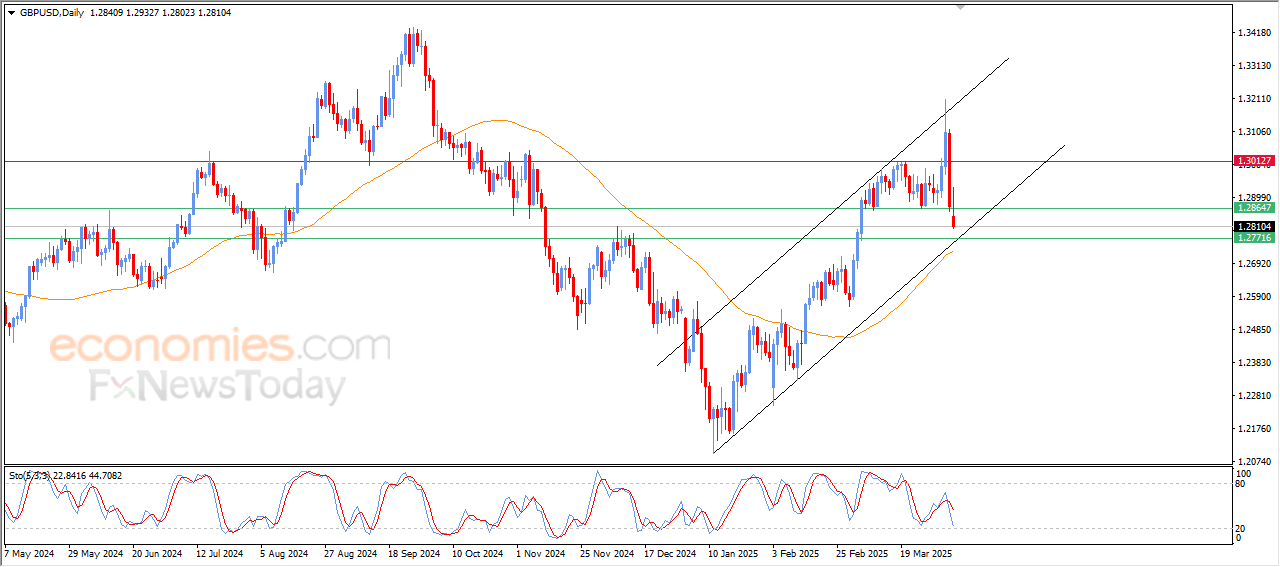
The GBPUSD price declined in its last trading on the intraday trading, to turn its early gains into losses to break the key support level at 1.2865, by the above image, we notice the trading within a bullish correctional price channel’s range, supported by it continues trading above the EMA50, the price last decline is caused by the negative pressure that come from the (RSI).
To get our more detailed analysis and 100% accurate signals provided by Best Trading Signal, subscribe to Economies.com VIP Club through the link below!
The price of silver (XAG/USD) is up almost 2.4%, nearing $30.30, during North American trading hours on Monday. The white metal bounces back strongly after a bloodbath on Thursday and Friday as traders have become increasingly confident that the Federal Reserve (Fed) could cut interest rates in the June meeting.
According to the CME FedWatch tool, traders have completely pared their bets, favoring an interest rate reduction in June.
Traders have raised Fed dovish bets as Fed Chair Jerome Powell has signaled concerns over the United States (US) economic outlook after President Donald Trump swept reciprocal tariffs on all its trading partners.
“We face a highly uncertain outlook with elevated risks of both higher unemployment and higher inflation,” Powell said on Friday.
However, the industrial demand for Silver has turned sluggish as Trump’s tariffs have stemmed concerns over the global economic outlook, especially in China, which has been slapped with 54% tariffs.
Silver has applications in various industries, such as Electric Vehicles (EV), electronics, and solar energy. Given that China is the manufacturing hub of the world, a higher degree of tariffs on them impacts its manufacturing sector, which eventually hits Silver’s demand.
Theoretically, heightening global economic tensions increase the appeal of precious metals, such as Silver, but fears of a slowdown in its industrial demand weighs on its price.
Silver price recovers to test the breakdown region of the Ascending Triangle chart formation near its upward-sloping border around the August 8 low of $26.45. The horizontal resistance of the above-mentioned chart pattern is plotted from the October 22 high of $34.87
Technically, the breakdown of the Ascending Triangle pattern indicates results in a volatility expansion, which leads to higher volume and formation of wide ticks.
The 14-day Relative Strength Index (RSI) rebounds slightly after turning oversold around 27.00. This indicates that the recovery move appears to be a short-lived one, and investors should brace for more weakness.
Looking down, the August 8 low of $26.45 will act as key support for the Silver price. While, the April 4 high of $32.00 will be the major barrier.
Silver is a precious metal highly traded among investors. It has been historically used as a store of value and a medium of exchange. Although less popular than Gold, traders may turn to Silver to diversify their investment portfolio, for its intrinsic value or as a potential hedge during high-inflation periods. Investors can buy physical Silver, in coins or in bars, or trade it through vehicles such as Exchange Traded Funds, which track its price on international markets.
Silver prices can move due to a wide range of factors. Geopolitical instability or fears of a deep recession can make Silver price escalate due to its safe-haven status, although to a lesser extent than Gold’s. As a yieldless asset, Silver tends to rise with lower interest rates. Its moves also depend on how the US Dollar (USD) behaves as the asset is priced in dollars (XAG/USD). A strong Dollar tends to keep the price of Silver at bay, whereas a weaker Dollar is likely to propel prices up. Other factors such as investment demand, mining supply – Silver is much more abundant than Gold – and recycling rates can also affect prices.
Silver is widely used in industry, particularly in sectors such as electronics or solar energy, as it has one of the highest electric conductivity of all metals – more than Copper and Gold. A surge in demand can increase prices, while a decline tends to lower them. Dynamics in the US, Chinese and Indian economies can also contribute to price swings: for the US and particularly China, their big industrial sectors use Silver in various processes; in India, consumers’ demand for the precious metal for jewellery also plays a key role in setting prices.
Silver prices tend to follow Gold’s moves. When Gold prices rise, Silver typically follows suit, as their status as safe-haven assets is similar. The Gold/Silver ratio, which shows the number of ounces of Silver needed to equal the value of one ounce of Gold, may help to determine the relative valuation between both metals. Some investors may consider a high ratio as an indicator that Silver is undervalued, or Gold is overvalued. On the contrary, a low ratio might suggest that Gold is undervalued relative to Silver.
According to financial market experts’ forecasts, US inflation is expected to provide indications of the repercussions of Trump’s tariffs. American households are likely to see a slight decrease in overall inflation last month, which economists consider a temporary respite following the wave of tariffs imposed by US President Donald Trump. According to economic calendar data, the Bureau of Labor Statistics figures next Thursday are expected to show a slight increase in the US Consumer Price Index (CPI) of 0.1%, the smallest increase since July, based on the average estimates of economists surveyed by Bloomberg.
Meanwhile, the core CPI, a more accurate measure of underlying inflation because it excludes often volatile food and energy costs, is expected to rise 0.3% from February and 3% from a year earlier. This would be the slowest annual pace since 2021.
In general, economists are likely to pay close attention to commodity price inflation in March, as it will help clarify how quickly the higher US tariffs on Chinese goods are reaching American consumers. Trump imposed 10% tariffs on China in February and again last month, in addition to higher tariffs on global steel and aluminium imports, which took effect on March 12. Canada and Mexico have also imposed higher US tariffs on goods not covered by the FTA.
Additionally, there is a risk that goods price inflation will begin to worsen before Trump’s April 2 announcement of comprehensive tariffs, if traders begin to raise prices pre-emptively. During the first two months of the year, the core CPI for goods, excluding food and energy, showed signs of a halt in the years-long deflationary trend.

We still recommend selling the euro against the US dollar from every level of appreciation.
According to economic experts’ views, the repercussions of Trump’s global tariff war will continue throughout the region, with EU trade ministers scheduled to meet today, Monday. Finance ministers will meet on Friday. For his part, French Finance Minister Eric Lombard, in an interview published on Saturday evening, stated that the EU’s response to US tariffs could include regulating the use of data by major US technology companies.
Eurozone data will focus on the backdrop of the manufacturing sector before the White House launches its fierce attack. German industrial production and trade figures for February will be released on Monday, followed by Italian factory output on Thursday. At the same time, the European Central Bank will enter a media blackout period on Thursday before its decision on April 17, the outcome of which – despite market bets – remains uncertain.
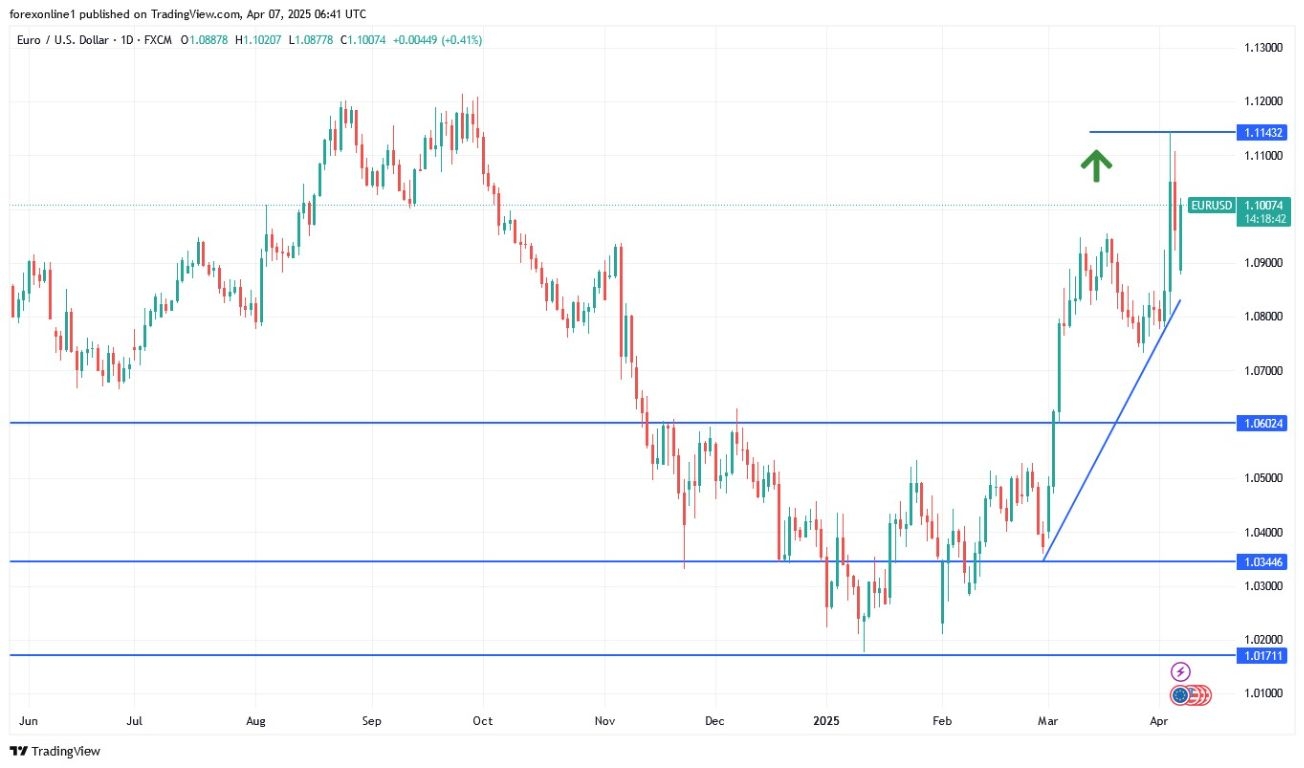
According to the daily chart performance above, the EUR/USD pair has an opportunity for an upward rebound if it moves towards and above the psychological resistance of 1.1000, which may trigger technical buying and thus prepare for bullish breakouts that support the upward turn of the Relative Strength Index and the MACD indicator. Technically, this may occur if bulls move the pair towards the resistance levels of 1.1035 and 1.1120, respectively. Conversely, on the same timeframe, the 1.0880 support level will remain a turning point and a threat to the current upward correction. Also, the matter will end with bears moving towards the psychological support level of 1.0800.
The EUR/USD pair may remain in its current range until the reaction to the announcement of US tariffs and this reaction, along with the announcement of US inflation figures and the content of the latest Federal Reserve meeting minutes.
Ready to trade our daily Forex analysis? We’ve made a list of the best forex demo accounts worth trading with.
As bearish sentiment builds in oil markets, major banks are slashing their price forecasts for both Brent and WTI, citing mounting recession risks, the U.S. tariff shockwave, and a surprise uptick in OPEC+ supply.
Goldman Sachs led the downgrades, issuing its second cut in days. The bank now sees Brent averaging $58 and WTI at $55 in 2026, down $4 per barrel from its prior estimate, and well below earlier projections of $62 and $59, respectively. It follows a 5.5% cut to its 2025 Brent forecast on Friday and a sharply reduced view on demand, now pegged at just 300,000 bpd growth for 2024—half its earlier outlook.
Goldman also hiked its U.S. recession odds to 45%, warning of a “sharp tightening in financial conditions” and policy uncertainty that is likely to curb capital spending. The firm hinted that a reversal of tariffs could lift prices above current forecasts, but for now, it’s preparing for prolonged weakness.
Citi dropped its near-term Brent forecast to $60 per barrel for the next three months, pointing to a $10 drop in prices since the tariff announcement. The bank is cautious on any short-term rally, advising investors to sell into strength unless a major shift in U.S. policy—or a dramatic supply response—materializes.
Morgan Stanley followed suit, cutting its Brent outlook for Q2 to $65 per barrel, down from $70. It now expects Brent to hover around $62.50 through the second half of the year.
This wave of forecast downgrades builds on market instability that had already taken hold before today. ING commodity analysts previously flagged the OPEC+ decision to increase output as a key factor driving recent oil price moves. According to ING, the shift was motivated by three pressures: U.S. sanctions on Venezuela and Iran, Washington’s push for lower prices, and a desire within OPEC+ to discipline overproducers like Iraq and Kazakhstan.
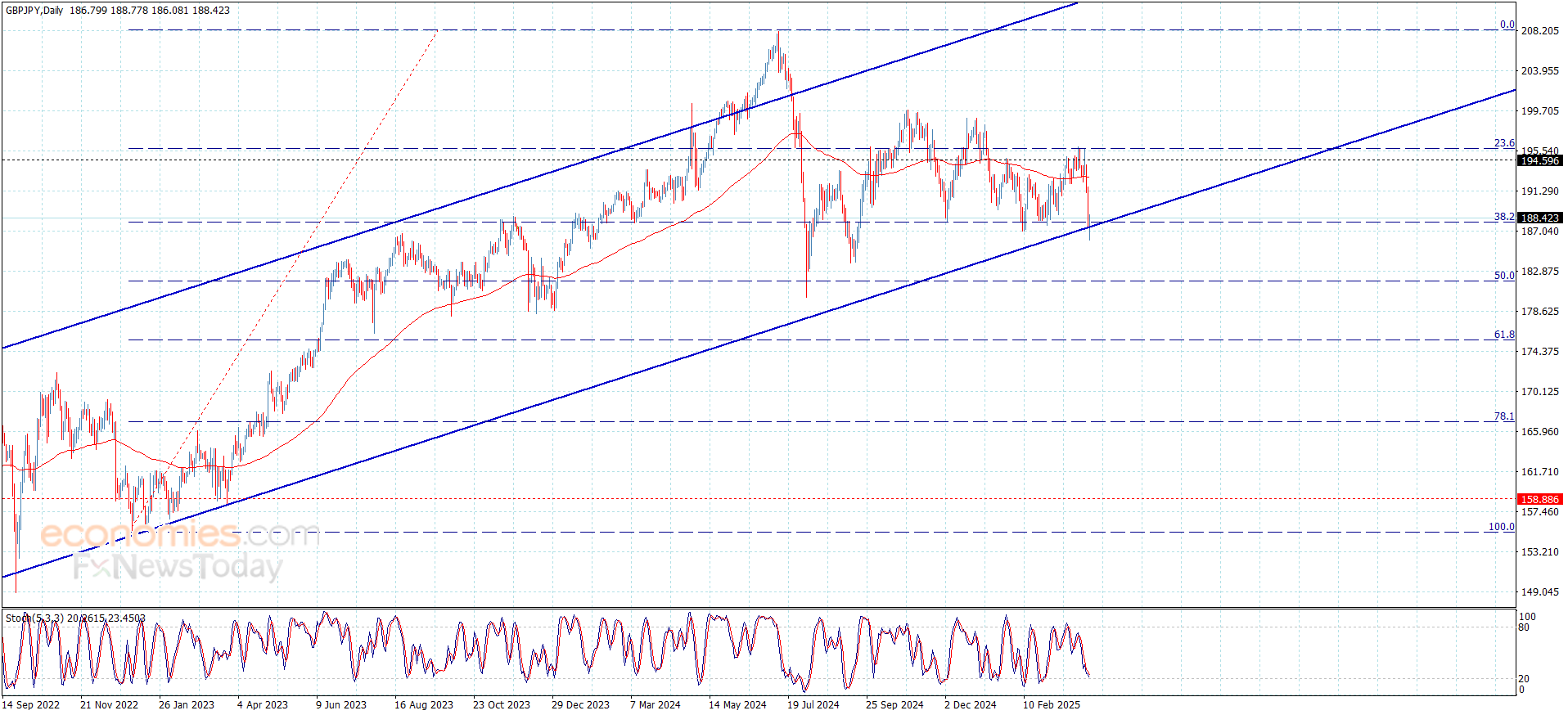
The GBPJPY pair opened today’s trading negatively, attempting to reach below the main support at 187.50, to hit 186.10, then bounces again to settle above the support again.
Note that the continuation of providing negative momentum by the main indicators will increase the chances for confirming breaking the current support, to reinforce its move to a new negative station, which allows it to target 184.90 level, reaching 50% Fibonacci correction level at 181.80, therefore, we recommend waiting for confirming the break to avoid any losses that might be caused by the price bullish correctional rebound before reaching the extra negative targets.
The expected trading range for today is between 184.90 and 189.80
Trend forecast: bearish by confirming the break
Risk-off sentiment intensified after U.S. President Donald Trump announced sweeping new tariffs affecting over 180 countries, including a 54% total tariff rate on Chinese goods. Global equity markets sold off sharply, with Dow futures falling over 1,300 points and the 2-year Treasury yield plunging 16 basis points to 3.52%, the lowest since September 2022. The equity market collapse forced investors to cover margin calls, prompting gold liquidations despite the metal’s safe-haven appeal.
Federal Reserve Chair Jerome Powell signaled a more cautious approach on rate cuts, noting that the inflationary impact of the tariffs could be more persistent than initially anticipated. While markets had priced in as many as five rate cuts this year, Powell’s emphasis on inflation control suggests the Fed may delay any easing. The hawkish tone put further downside pressure on gold, as the likelihood of near-term rate cuts diminished.
Despite Monday’s sharp drop, gold remains supported by ongoing central bank purchases and growing recession fears. China added to its gold reserves for a fifth consecutive month, while Deutsche Bank upgraded its year-end gold price forecast to $3,350, citing macroeconomic headwinds and safe-haven demand. Additionally, real yields are expected to stay low, providing a longer-term bullish backdrop for gold.
The GBPJPY pair opened today’s trading negatively, attempting to reach below the main support at 187.50, to hit 186.10, then bounces again to settle above the support again.
Note that the continuation of providing negative momentum by the main indicators will increase the chances for confirming breaking the current support, to reinforce its move to a new negative station, which allows it to target 184.90 level, reaching 50% Fibonacci correction level at 181.80, therefore, we recommend waiting for confirming the break to avoid any losses that might be caused by the price bullish correctional rebound before reaching the extra negative targets.
The expected trading range for today is between 184.90 and 189.80
Trend forecast: bearish by confirming the break