The main category of Forex News.
You can use the search box below to find what you need.
[wd_asp id=1]
The main category of Forex News.
You can use the search box below to find what you need.
[wd_asp id=1]
So for now, the gold price is effectively in limbo, with traders looking to see what the next set of US economic data really says before deciding which way to bet.
It’s worth remembering that the Federal Reserve minutes from their January meeting made it pretty clear that the central bank is under no pressure to slash interest rates anytime soon. In fact, some officials were even talking up the possibility of raising rates again if inflation doesn’t start to slow down like they think it should.
On top of that we’ve just seen yet more economic data showing the US job market is still going strong. Put all that together with more hawkish comments from Fed officials and investors are now starting to rethink their expectations for a serious rate cut.
As a result, the US dollar has gone from strength to strength and has now reached its highest level in months – and that’s all bad news for gold.
On the geopolitical front, President Donald Trump sent out a pretty stern warning to Iran on Thursday – telling them they have to get a nuclear deal sorted within 10 to 15 days or else. Iran’s response to UN Secretary General Antonio Guterres was that they don’t want war but that if anyone attacks them, then Iran will hit back – and they might even hit some key military targets in the region.
Which of course, just increases the chances of a wider conflict breaking out in the Middle East, and that’s good news for Gold, because we all know how well it tends to do when tensions start to rise.
BitcoinWorld
Silver Price Forecast: XAG/USD Consolidates Below $78.50 with Bullish Momentum Intact
Global precious metals markets witnessed significant movement this week as silver prices consolidated below the critical $78.50 resistance level. The XAG/USD pair maintained its bullish structure despite recent consolidation, according to technical analysis from multiple trading platforms. Market analysts observe this consolidation as a healthy pause within a broader upward trend that began in early 2025. Industrial demand fundamentals continue supporting silver’s long-term valuation while short-term technical factors drive daily price action.
Technical charts reveal XAG/USD trading within a defined range between $77.80 and $78.50 throughout the past five sessions. This consolidation follows a substantial rally from the $72.30 support level established in February 2025. The 50-day moving average currently provides dynamic support at $76.45 while the 200-day moving average trends upward at $74.20. Furthermore, the Relative Strength Index (RSI) maintains a neutral reading of 58, indicating neither overbought nor oversold conditions.
Market technicians identify several key technical patterns developing simultaneously. First, a symmetrical triangle formation appears on the four-hour chart with converging trendlines. Second, the weekly chart shows higher lows established since December 2024. Third, Fibonacci retracement levels from the recent swing high to low indicate strong support clusters. These technical factors collectively suggest the consolidation represents accumulation rather than distribution.
| Level Type | Price | Significance |
|---|---|---|
| Immediate Resistance | $78.50 | Previous swing high & psychological level |
| Primary Support | $77.80 | Current consolidation low |
| Secondary Support | $76.45 | 50-day moving average |
| Major Support | $74.20 | 200-day moving average |
| Year-to-Date High | $79.85 | 2025 peak established March 15 |
Multiple fundamental factors contribute to silver’s current price action and future trajectory. Industrial demand remains robust as global manufacturing indices show expansion in key sectors. The photovoltaic industry continues consuming record silver volumes for solar panel production. Additionally, electronics manufacturing maintains strong silver consumption for conductive components. These industrial applications create consistent baseline demand regardless of investment flows.
Monetary policy developments significantly impact precious metals pricing. The Federal Reserve’s recent communication suggests a measured approach to interest rate adjustments. Historically, silver performs well during periods of moderate inflation with stable interest rates. Central bank diversification into precious metals provides additional structural support. Several emerging market central banks increased their silver reserves during the first quarter of 2025 according to IMF data.
Commodity analysts from leading financial institutions provide context for silver’s current consolidation phase. “Silver often experiences consolidation periods after significant rallies,” notes Dr. Elena Rodriguez, Senior Commodity Strategist at Global Markets Research. “The current pause below $78.50 represents healthy profit-taking rather than trend reversal. Industrial demand fundamentals remain exceptionally strong.”
Technical analyst Michael Chen observes specific chart patterns. “The symmetrical triangle formation typically resolves in the direction of the preceding trend,” Chen explains. “With silver’s underlying trend clearly bullish, this consolidation likely precedes another upward movement. Key resistance at $78.50 represents the immediate hurdle.” Historical data supports this analysis, showing similar consolidation patterns in 2021 and 2023 preceding substantial rallies.
Market sentiment indicators provide additional insight. The Commitments of Traders report shows commercial hedgers maintaining substantial long positions. Meanwhile, speculative positioning remains balanced without extreme readings. Volatility measures indicate normal market conditions rather than distressed trading. These factors collectively suggest sustainable price action rather than speculative excess.
Silver’s performance relative to gold provides important context for understanding its market dynamics. The gold-silver ratio currently trades at 82:1, slightly above its five-year average of 80:1. This ratio measures how many ounces of silver purchase one ounce of gold. Historically, ratios above 80 indicate potential silver outperformance relative to gold. The ratio peaked at 92:1 in late 2024 before beginning its current descent.
Platinum and palladium markets show different dynamics than silver. Platinum maintains stronger industrial connections to automotive catalysts while palladium faces substitution pressures. Silver’s unique dual role as both industrial metal and monetary asset creates distinct price drivers. Unlike platinum group metals, silver benefits from both manufacturing demand and investment flows. This diversification supports price stability during sector-specific downturns.
Several key differences distinguish silver from other precious metals:
Current silver price action mirrors historical consolidation patterns observed during previous bull markets. The 2009-2011 bull market featured multiple consolidation periods between major advances. Similarly, the 2019-2020 rally included several pauses around psychological resistance levels. These historical precedents suggest consolidation represents normal market behavior rather than weakness.
Seasonal patterns also influence silver price movements. Historically, April through June represents a seasonally strong period for precious metals. This seasonal strength coincides with increased industrial activity and jewelry manufacturing. The current consolidation occurs during this traditionally favorable period, potentially amplifying any breakout that follows. Historical data shows silver posting positive returns in 70% of April-June periods since 2000.
Long-term chart analysis reveals important support and resistance zones. The $78.50 level represents not only recent resistance but also a historical congestion area from 2023. Successful breach of this level would open technical targets near $82.00 and eventually $85.00. Conversely, breakdown below $76.45 would signal deeper correction potential toward $74.20. The symmetrical triangle pattern typically resolves within two to three weeks of formation.
Several risk factors warrant consideration despite the generally bullish outlook. First, unexpected Federal Reserve policy shifts could strengthen the US dollar, pressuring precious metals. Second, global economic slowdown could reduce industrial silver demand. Third, technological substitution in certain applications might decrease long-term consumption. Fourth, increased mining production could alter supply-demand balances.
Market participants monitor specific indicators for trend confirmation. Sustained trading above $78.50 would confirm breakout from consolidation. Increasing trading volume during upward moves would validate buyer conviction. Continued expansion in manufacturing PMI readings would support industrial demand fundamentals. Conversely, breakdown below the 50-day moving average would suggest weakening technical structure.
The silver price forecast remains cautiously optimistic as XAG/USD consolidates below the $78.50 resistance level. Technical analysis suggests this consolidation represents a pause within a broader bullish trend rather than reversal. Fundamental factors including industrial demand and monetary policy continue supporting silver’s valuation. Historical patterns indicate similar consolidation phases often precede further advances. Market participants should monitor the $78.50 resistance and $76.45 support levels for directional clues. The silver price forecast ultimately depends on both technical breakout confirmation and sustained fundamental support.
Q1: What does consolidation below $78.50 mean for silver prices?
Consolidation represents a pause in price movement as markets digest recent gains. Technical analysis suggests this is normal behavior within an uptrend rather than bearish reversal.
Q2: What technical levels should traders watch for silver?
Key levels include immediate resistance at $78.50, primary support at $77.80, and the 50-day moving average at $76.45. Break above $78.50 would signal continuation higher.
Q3: How does industrial demand affect silver prices?
Industrial applications account for approximately 50% of silver demand. Strong manufacturing activity, particularly in solar panel and electronics production, provides fundamental price support.
Q4: What is the current gold-silver ratio and its significance?
The ratio currently trades near 82:1, slightly above its five-year average. Ratios above 80 historically indicate potential for silver outperformance relative to gold.
Q5: What risk factors could negatively impact silver prices?
Potential risks include stronger US dollar from Fed policy, reduced industrial demand from economic slowdown, technological substitution, and increased mining production.
This post Silver Price Forecast: XAG/USD Consolidates Below $78.50 with Bullish Momentum Intact first appeared on BitcoinWorld.
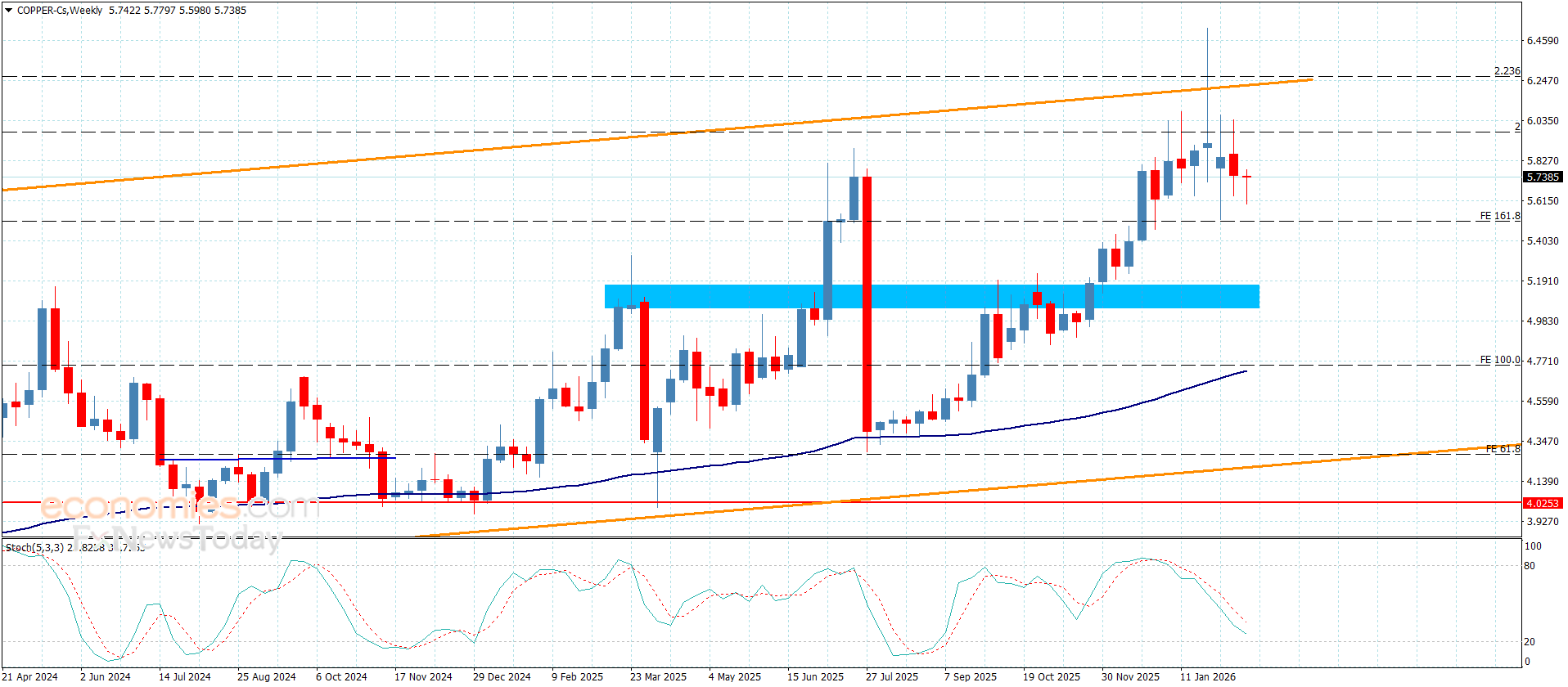
Copper price ended the last corrective trading by reaching $5.5900 level, to keep its stability above $5.5100 support, attempting to surpass the negative pressure to notice its rally towards $5.7300.
Note that the main indicators contradiction might tpush the price to provide unstable mixed trading, noting that holding below $5.9700 barrier supports the chances of resuming the corrective attempts in near and medium period.
The expected trading range for today is between $5.5500 and $5.8500
Trend forecast: Fluctuating
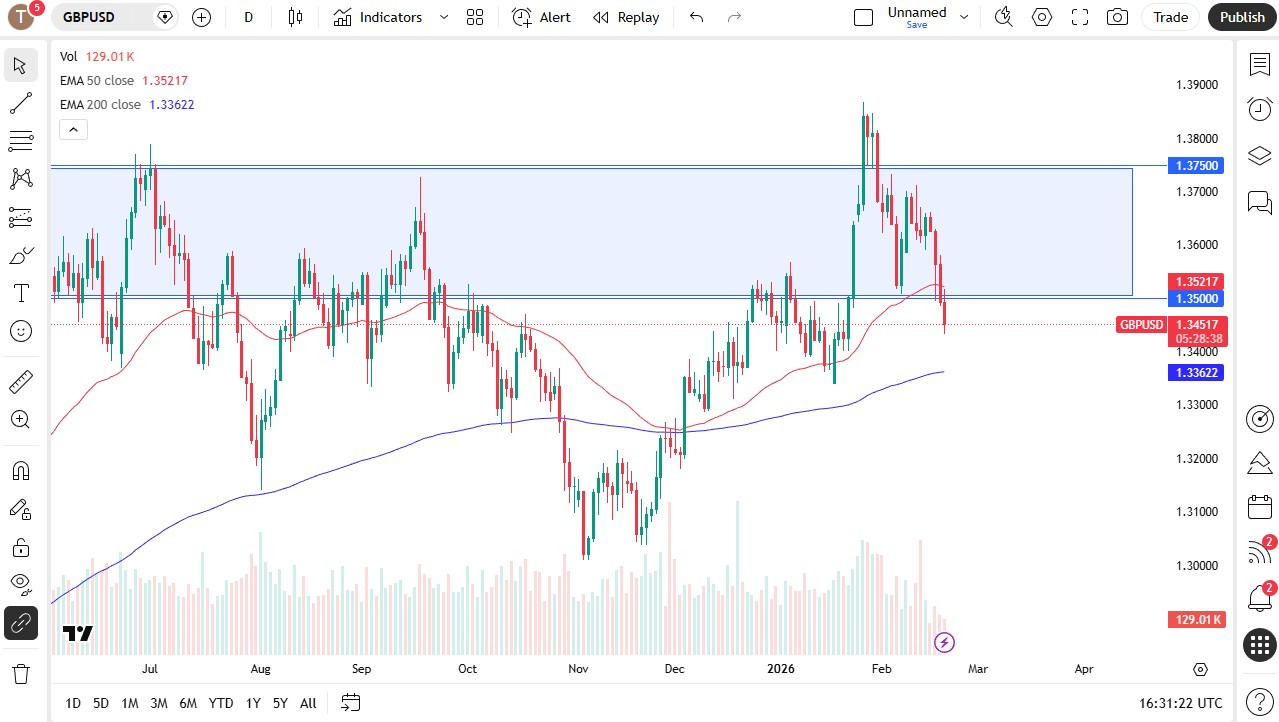
Keep in mind that the British pound is falling for a whole host of reasons, not the least of which is that the Bank of England held rates last meeting, but they also had a 5 to 4 vote split revealing a growing faction favoring immediate cuts. This is compounded by recent data suggesting that UK employment is at roughly 5.2%, which is a 5-year high and now markets have priced in a 75% chance of a rate cut in March. This is the biggest issue that the pair is facing at the moment.

By contrast, you have the Federal Reserve in a wait-and-see mode, and I think that makes the US dollar a little bit more hawkish. Plus, the US dollar shorts had gotten so overdone that it makes a certain amount of sense that the overextension of short positions needs to be wound down against any signs of weakness as we have here.
I do think we will probably go looking to the 200-day EMA next, which is the 1.3350 level. Short-term rallies should end up being selling opportunities at the first signs of exhaustion. This will continue to be the way going forward as far as I can see at the moment.
Ready to trade the Forex GBP/USD analysis and predictions? Here are the best forex trading platforms UK to choose from.
Christopher Lewis has been trading Forex and has over 20 years experience in financial markets. Chris has been a regular contributor to Daily Forex since the early days of the site. He writes about Forex for several online publications, including FX Empire, Investing.com, and his own site, aptly named The Trader Guy. Chris favours technical analysis methods to identify his trades and likes to trade equity indices and commodities as well as Forex. He favours a longer-term trading style, and his trades often last for days or weeks.
Gold sticks to recent gains around the $5,000-mark early Friday, biding time before the high-impact US macro events. The focus is now on the US fourth-quarter (Q4) Gross Domestic Product (GDP), core Personal Consumption Expenditures (PCE) Price Index and the Supreme Court’s ruling on President Donald Trump’s tariffs.
Gold continues its struggle to extend the recovery from near the $4,850 region for the third straight day as persistent US Dollar (USD) strength outweighs safe-haven demand for the yellow metal amid looming geopolitical tensions between the US and Iran.
The Greenback is in a bullish consolidative phase, courtesy of the hawkish Minutes of the US Federal Reserve’s (Fed) January monetary policy meeting and a recent slew of upbeat economic data.
Data published by the Labor Department on Thursday showed that the US Initial Jobless Claims declined by 23,000 to 206,000 in the week ended February 14. The data fell by the most since November, adding to evidence of stabilization in the US labor market.
Meanwhile, the Minutes on Wednesday suggested that the Fed remains in no rush to cut interest rates.
Additionally, concerns surrounding the disruptions led by Artificial Intelligence (AI) and the disappointing earnings report from Walmart tempered the recent market optimism, boosting the USD’s appeal as a safety net.
However, Gold continues to find a floor amid renewed geopolitical tensions between the US and Iran, while untouched bets for three 25 basis points (bps) Fed rate cuts this year also remain supportive of the non-yielding bullion.
After CBS News reported that a potential US military strike on Iran could come as early as Saturday, Trump warned late Thursday that Iran must make a deal, or “bad things will happen,” with the threat of military strikes still hanging heavy over delicate nuclear negotiations, per BBC News. In response, Iran threatened a decisive response if attacked,
With geopolitical risks in play, the next big catalysts for Gold are the US GDP, PCE inflation and Supreme Court’s verdict on Trump’s tariffs.
Also, of note will be the global business PMI data, which significantly impact the broader market sentiment.
The US economy is expected to expand by 3% on an annualized basis in Q4 2025, against a 4.4% growth reported in the previous quarter. Meanwhile, the core PCE Price Index, the Fed’s preferred inflation gauge, is expected to rise by 2.9% in December after increasing by 2.8% in November.
The US data points will be crucial to reset the market’s pricing of the Fed rate cut bets, heavily influencing the USD’s performance and eventually the Gold price direction.
The 21-day Simple Moving Average (SMA) rises to $5,006.49 and caps the immediate recovery, while price holds above the ascending 50-day SMA at $4,703.94. The 100- and 200-day SMAs also climb and sit well below spot, reinforcing a broader bullish bias despite near-term hesitation. The 14-day Relative Strength Index stands at 54 (neutral), indicating momentum has cooled but remains slightly positive. Measured from the $5,597.89 high to the $4,401.99 low, the 50% Fibonacci (Fibo) Retracement at $4,999.94 acts as nearby resistance, with the 61.8% Fibo retracement at $5,141.05 overhead; a daily close above these hurdles could extend the advance.
Failure to reclaim the short-term average would keep price contained beneath the 21-day SMA, leaving pullbacks to lean on dynamic trend support from the rising 50-day average around $4,700, where the 23.6% Fibo Retracement also lingers. A deeper setback would bring the 100-day SMA at $4,405.36 into view, while the 200-day SMA at $3,915.63 anchors the longer-term uptrend. Conversely, a decisive push back above the 21-day SMA would refocus upside momentum toward higher Fibonacci barriers and preserve the broader bullish structure.
(The technical analysis of this story was written with the help of an AI tool.)
The real Gross Domestic Product (GDP) Annualized, released quarterly by the US Bureau of Economic Analysis, measures the value of the final goods and services produced in the United States in a given period of time. Changes in GDP are the most popular indicator of the nation’s overall economic health. The data is expressed at an annualized rate, which means that the rate has been adjusted to reflect the amount GDP would have changed over a year’s time, had it continued to grow at that specific rate. Generally speaking, a high reading is seen as bullish for the US Dollar (USD), while a low reading is seen as bearish.
Monetary policy in the US is shaped by the Federal Reserve (Fed). The Fed has two mandates: to achieve price stability and foster full employment. Its primary tool to achieve these goals is by adjusting interest rates.
When prices are rising too quickly and inflation is above the Fed’s 2% target, it raises interest rates, increasing borrowing costs throughout the economy. This results in a stronger US Dollar (USD) as it makes the US a more attractive place for international investors to park their money.
When inflation falls below 2% or the Unemployment Rate is too high, the Fed may lower interest rates to encourage borrowing, which weighs on the Greenback.
The Federal Reserve (Fed) holds eight policy meetings a year, where the Federal Open Market Committee (FOMC) assesses economic conditions and makes monetary policy decisions.
The FOMC is attended by twelve Fed officials – the seven members of the Board of Governors, the president of the Federal Reserve Bank of New York, and four of the remaining eleven regional Reserve Bank presidents, who serve one-year terms on a rotating basis.
In extreme situations, the Federal Reserve may resort to a policy named Quantitative Easing (QE). QE is the process by which the Fed substantially increases the flow of credit in a stuck financial system.
It is a non-standard policy measure used during crises or when inflation is extremely low. It was the Fed’s weapon of choice during the Great Financial Crisis in 2008. It involves the Fed printing more Dollars and using them to buy high grade bonds from financial institutions. QE usually weakens the US Dollar.
Quantitative tightening (QT) is the reverse process of QE, whereby the Federal Reserve stops buying bonds from financial institutions and does not reinvest the principal from the bonds it holds maturing, to purchase new bonds. It is usually positive for the value of the US Dollar.
Important DisclaimersFXEmpire is owned and operated by Empire Media Network LTD., Company Registration Number 514641786, registered at 7 Jabotinsky Road, Ramat Gan 5252007, Israel. The content provided on this website includes general news and publications, our personal analysis and opinions, and materials provided by third parties. This content is intended for educational and research purposes only. It does not constitute, and should not be interpreted as, a recommendation or advice to take any action, including making any investment or purchasing any product. Before making any financial decision, you should conduct your own due diligence, exercise your own discretion, and consult with competent advisors. The content on this website is not personally directed to you, and we do not take into account your individual financial situation or needs. The information contained on this website is not necessarily provided in real time, nor is it guaranteed to be accurate. Prices displayed may be provided by market makers and not by exchanges. Any trading or other financial decision you make is entirely your own responsibility, and you must not rely solely on any information provided through the website. FXEmpire does not provide any warranty regarding the accuracy, completeness, or reliability of any information contained on the website and shall bear no responsibility for any trading losses you may incur as a result of using such information. The website may include advertisements and other promotional content. FXEmpire may receive compensation from third parties in connection with such content. FXEmpire does not endorse, recommend, or assume responsibility for the use of any third-party services or websites. Empire Media Network LTD., its employees, officers, subsidiaries, and affiliates shall not be liable for any loss or damage resulting from your use of the website or reliance on the information provided herein.Risk DisclaimersThis website contains information about cryptocurrencies, contracts for difference (CFDs), and other financial instruments, as well as about brokers, exchanges, and other entities trading in such instruments. Both cryptocurrencies and CFDs are complex instruments and involve a high risk of losing money. You should carefully consider whether you understand how these instruments work and whether you can afford to take the high risk of losing your money. FX Empire encourages you to conduct your own research before making any investment decision and to avoid investing in any financial instrument unless you fully understand how it works and the risks involved.
Natural gas price surrendered to the main indicators negativity by providing new bearish pressures on the bullish channel’s support at $3.000 level as appears in the above image, the attempt of 3.520 level to form extra barrier might increase the chances of surrendering to the negative pressures, by breaking the current support, to confirm its move to bearish track by targeting several negative stations that might begin at $2.850 and $2.660.
We notice the continuation of stochastic fluctuation near 20 level, to increase the chances of gathering the required negative momentum to achieve the break then begin targeting the previously suggested negative stations.
The expected trading range for today is between $2.850 and $3.180
Trend forecast: Bearish
Following Wednesday’s sharp decline, EUR/USD continued to edge lower and closed in negative territory on Thursday. The pair stays on the back foot early Friday and trades slightly above 1.1750.
The table below shows the percentage change of Euro (EUR) against listed major currencies this week. Euro was the weakest against the US Dollar.
| USD | EUR | GBP | JPY | CAD | AUD | NZD | CHF | |
|---|---|---|---|---|---|---|---|---|
| USD | 0.98% | 1.41% | 1.63% | 0.60% | 0.36% | 1.36% | 0.93% | |
| EUR | -0.98% | 0.43% | 0.64% | -0.38% | -0.63% | 0.37% | -0.05% | |
| GBP | -1.41% | -0.43% | -0.04% | -0.80% | -1.05% | -0.05% | -0.47% | |
| JPY | -1.63% | -0.64% | 0.04% | -1.01% | -1.23% | -0.26% | -0.65% | |
| CAD | -0.60% | 0.38% | 0.80% | 1.01% | -0.28% | 0.76% | 0.33% | |
| AUD | -0.36% | 0.63% | 1.05% | 1.23% | 0.28% | 1.01% | 0.61% | |
| NZD | -1.36% | -0.37% | 0.05% | 0.26% | -0.76% | -1.01% | -0.42% | |
| CHF | -0.93% | 0.05% | 0.47% | 0.65% | -0.33% | -0.61% | 0.42% |
The heat map shows percentage changes of major currencies against each other. The base currency is picked from the left column, while the quote currency is picked from the top row. For example, if you pick the Euro from the left column and move along the horizontal line to the US Dollar, the percentage change displayed in the box will represent EUR (base)/USD (quote).
The US Dollar (USD) preserved its strength after Wednesday’s impressive rallly that was fuelled by the hawkish tone seen in the Federal Reserve’s (Fed) minutes of the January policy meeting. Additionally, the risk-averse market atmosphere helped the USD outperform its rivals as investors reacted to escalating geopolitical tensions in the Middle East, with reports suggesting that the US could take military action against Iran as early as this weekend.
BBC reported late Thursday that US President Donald Trump said that Iran must make a deal, or “bad things will happen.” Iran told UN Secretary-General Antonio Guterres that it does not seek war but said that they will not tolerate military aggression. Moreover, Iranian officials reportedly also warned of a decisive response if the US takes military action over the nuclear dispute.
Later in the European session, HCOB Manufacturing and Services Purchasing Managers’ Index (PMI) reports from Germany and the Eurozone will be watched closely by market participants. In case PMI figures come in above 50 and reflect ongoing expansion in the private sector’s business activity, the Euro could keep its footing and allow EUR/USD to find support.
In the American trading hours, the US Bureau of Economic Analysis will publish its first estimate of the Gross Domestic Product (GDP) growth for the fourth quarter. Investors expect the US’ GDP to grow at an annural rate 3% in Q4, following the impressive 4.4% growth recorded in Q3. A positive surprise could support the USD and force EUR/USD to extend its weekly slide. Conversely, a disappointing print, at or below 2%, could open the door for a rebound in the pair heading into the weekend.
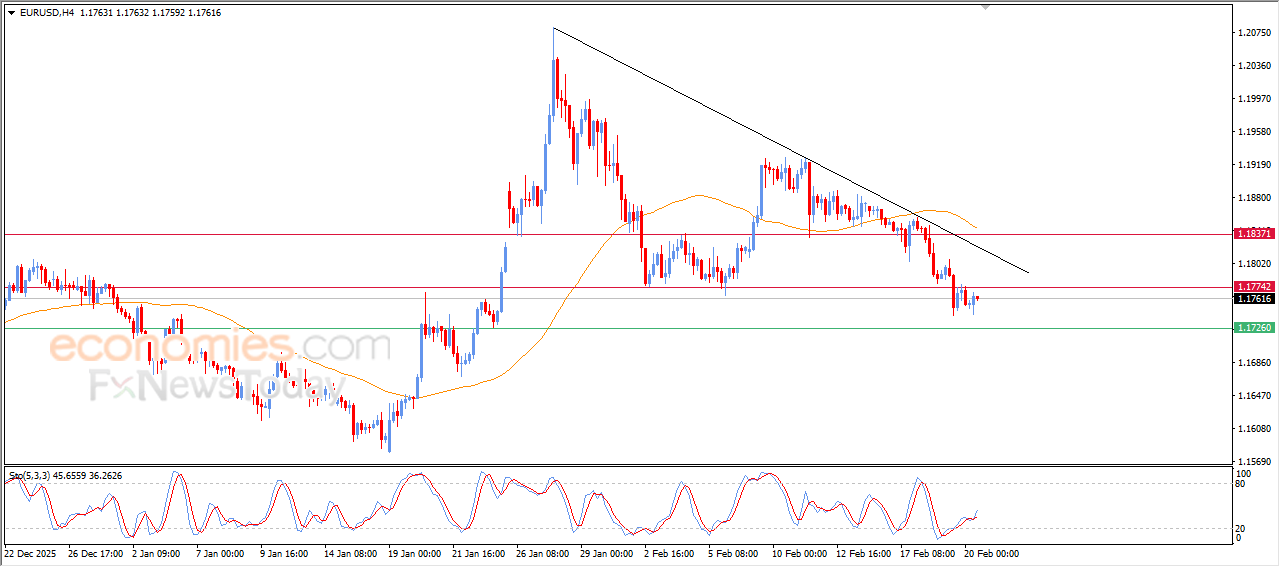
In the 4-hour chart, EUR/USD trades at 1.1761. The 20-, 50-, and 100-period Simple Moving Averages (SMAs) slope lower and sit above price, underscoring persistent selling pressure. The 200-period SMA edges higher but remains overhead, acting as initial resistance at 1.1782. The Relative Strength Index (RSI) stays near 30 (oversold), suggesting that there could be a correction before the resumption of the downtrend.
Measured from the 1.1590 low to the 1.2026 high, the 61.8% retracement aligns as a key technical level at 1.1757. A close beneath would expose the 78.6% retracement at 1.1683 ahead of 1.1600 (static level, round level). On the upside, . The descending trend line from 1.2023 caps rebounds, with resistance seen near 1.1840, and failure to reclaim that barrier would keep rallies short-lived.
(The technical analysis of this story was written with the help of an AI tool.)
The Euro is the currency for the 20 European Union countries that belong to the Eurozone. It is the second most heavily traded currency in the world behind the US Dollar. In 2022, it accounted for 31% of all foreign exchange transactions, with an average daily turnover of over $2.2 trillion a day.
EUR/USD is the most heavily traded currency pair in the world, accounting for an estimated 30% off all transactions, followed by EUR/JPY (4%), EUR/GBP (3%) and EUR/AUD (2%).
The European Central Bank (ECB) in Frankfurt, Germany, is the reserve bank for the Eurozone. The ECB sets interest rates and manages monetary policy.
The ECB’s primary mandate is to maintain price stability, which means either controlling inflation or stimulating growth. Its primary tool is the raising or lowering of interest rates. Relatively high interest rates – or the expectation of higher rates – will usually benefit the Euro and vice versa.
The ECB Governing Council makes monetary policy decisions at meetings held eight times a year. Decisions are made by heads of the Eurozone national banks and six permanent members, including the President of the ECB, Christine Lagarde.
Eurozone inflation data, measured by the Harmonized Index of Consumer Prices (HICP), is an important econometric for the Euro. If inflation rises more than expected, especially if above the ECB’s 2% target, it obliges the ECB to raise interest rates to bring it back under control.
Relatively high interest rates compared to its counterparts will usually benefit the Euro, as it makes the region more attractive as a place for global investors to park their money.
Data releases gauge the health of the economy and can impact on the Euro. Indicators such as GDP, Manufacturing and Services PMIs, employment, and consumer sentiment surveys can all influence the direction of the single currency.
A strong economy is good for the Euro. Not only does it attract more foreign investment but it may encourage the ECB to put up interest rates, which will directly strengthen the Euro. Otherwise, if economic data is weak, the Euro is likely to fall.
Economic data for the four largest economies in the euro area (Germany, France, Italy and Spain) are especially significant, as they account for 75% of the Eurozone’s economy.
Another significant data release for the Euro is the Trade Balance. This indicator measures the difference between what a country earns from its exports and what it spends on imports over a given period.
If a country produces highly sought after exports then its currency will gain in value purely from the extra demand created from foreign buyers seeking to purchase these goods. Therefore, a positive net Trade Balance strengthens a currency and vice versa for a negative balance.
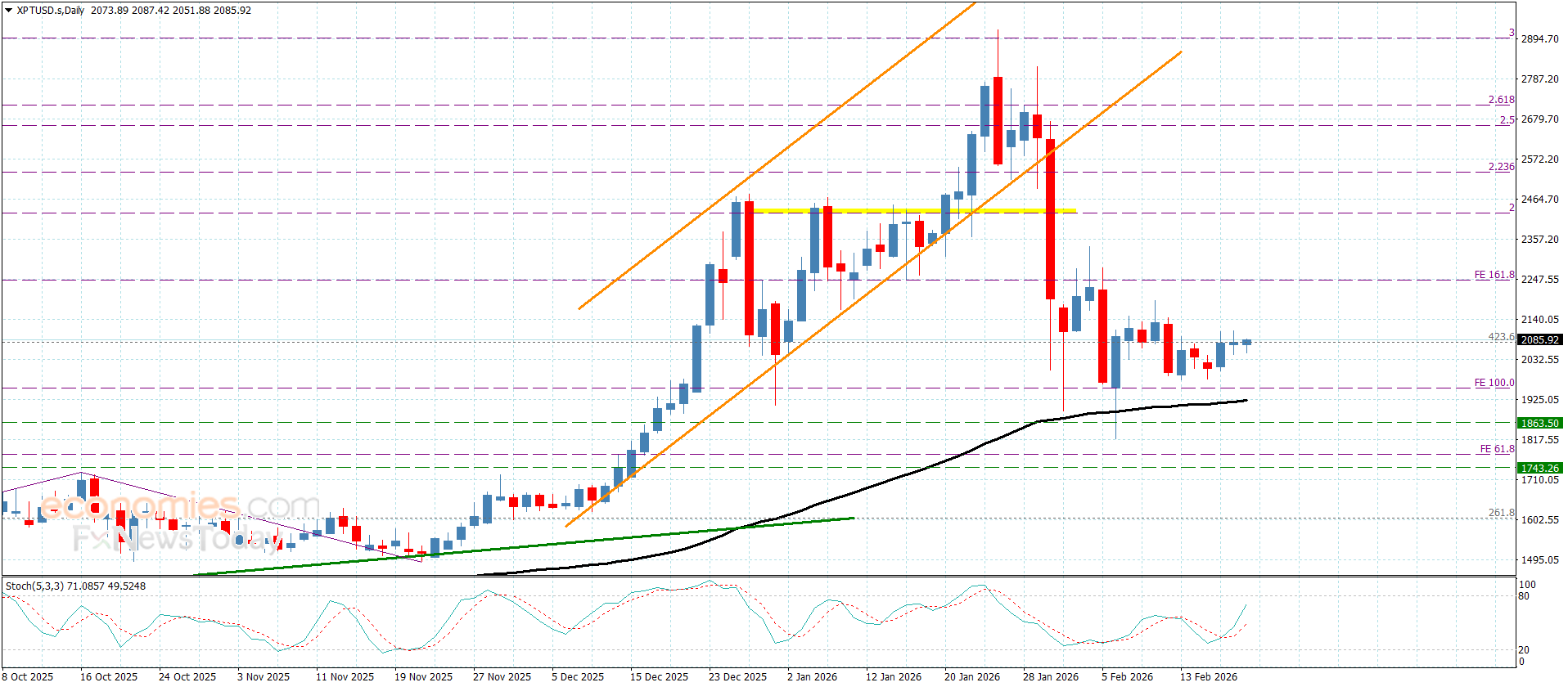
Platinum price began receiving bullish momentum due to stochastic rally above 50 level, accompanied by the moving average 55 attempt to form extra support by its stability below the current trading, to begin forming bullish waves and settle near $2090.00.
The attempt of forming extra support at $2020.00 level reinforces the chances of renewing the bullish attempts, to keep our bullish scenario that might target $2165.00 level soon, reaching near $2245.00 barrier.
The expected trading range for today is between $2020.00 and $2165.00
Trend forecast: Bullish
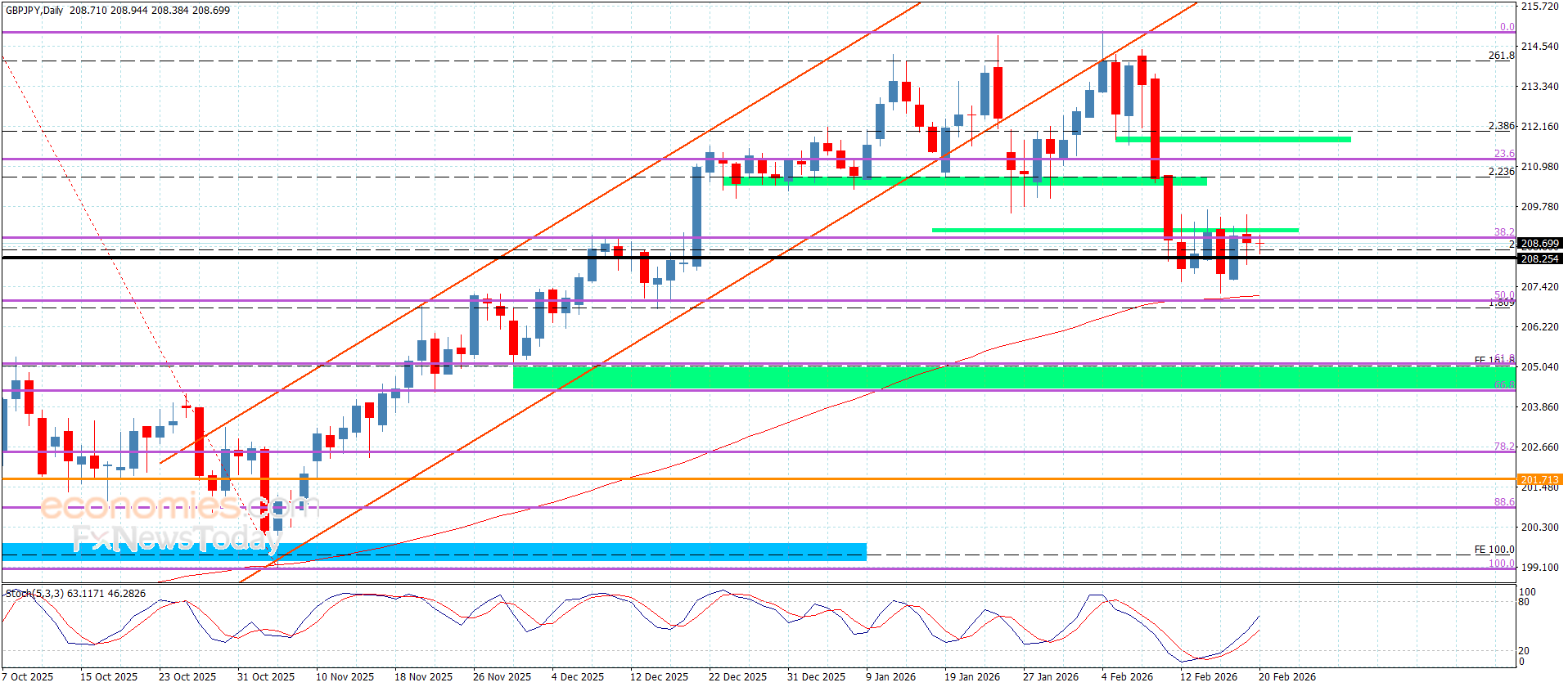
The GBPJPY pair failed to settle above 209.15 barrier, providing mixed trading due to the contradiction between the negative stability and providing bullish momentum by the main indicators, to settle near 208.65.
We expect the trading within tight path that is represented by 209.15 barrier, while 208.20 forms extra support against the current trading, we recommend monitoring the price behavior and waiting for surpassing one of these levels, to detect the main trend in the upcoming trading. Where confirming the breaching will open the way for recording clear gains that might begin at 210.65 and 211.70, while breaking the support and holding below it will force it suffer extra losses that might extend towards 207.05.
The expected trading range for today is between 208.20 and 209.15
Trend forecast: Neutral