The main category of Forex News.
You can use the search box below to find what you need.
[wd_asp id=1]
The main category of Forex News.
You can use the search box below to find what you need.
[wd_asp id=1]
June 16, 2025 – Written by David Woodsmith
STORY LINK Pound-to-Euro Week Ahead Forecast: BoE Cuts to Weaken GBP Sterling
Foreign exchange strategists at RBC Capital Markets (RBC) see scope for the GBP/EUR exchange rate to strengthen to at least 1.20 over the next 2-3 months, provided risk conditions remain benign.
It does, however, forecast that the GBP to EUR rate will slide to 1.11 at the end of 2026.
In contrast, Scotiabank forecasts that the Pound Sterling can hold just above 1.20 against the Euro by the end of 2025
GBP/EUR dipped to 7-week lows during the week as evidence of a weaker labour market and GDP disappointment undermined the Pound. There was little net impact from the government spending review, although underlying reservations continued.
RBC sees a notable divergence between the short and medium-term views.
On a short-term view it commented; “As we head into the summer, GBP could stand to gain a bit more if markets settle into carry-hunting mode.”
The bank remains very cautious over the medium-term outlook; “As a long-term c/a deficit country, the UK runs a 280bn negative net international investment position with the rest of the world. It does not have the large stock of foreign assets invested in the US that the Euro area or Japan have.
RBC added; “It is also exposed to global trade wars as a small open economy and fiscally constrained in its ability to support growth through deficit spending.”
The Pound will inevitably be more vulnerable if the economy deteriorates.
The latest labour-market release suggested that there had been significant deterioration with a slide in payrolls, while unemployment hit a 4-year high and wages growth slowed more than expected.
GDP also contracted 0.3% for April after a 0.2% expansion the previous month.
HSBC commented; “our forecast is for a small fall back in Q2. That said, we should not over interpret. A negative GDP print in Q2 would not necessarily suggest recession risks, but payback from an artificially strong Q1.”
There are strong expectations that the Bank of England will hold interest rates at 4.25% in the week ahead. There is, however, speculation over more dovish guidance.
According to Danske Bank; “While markets have increasingly converged to our view of two further rate cuts from the BoE this year, we see risks further skewed to the downside. With slower activity and the scope for more aggressive BoE easing, we see this supporting our view a move higher in EUR/GBP, which we target at 0.87 in 6-12 months.” (GBP/EUR losses to just below 1.1500.)
According to Goldman Sachs; “We expect the labour market to loosen further in the coming months. A looser labour market is in turn likely to further reduce pay pressures.”
Commerzbank commented; “the market is now pricing in significantly more interest rate cuts by the Bank of England this year than at the beginning of the year. As we have emphasised several times, the path towards a stronger pound remains narrow, even if we do not want to overinterpret a single data release.”
Credit Agricole notes fundamentals reservations, but sees scope for Pound resilience; “Yet, as long as the UK economy continues to at least fare as well as the Eurozone, the GBP may still be able to eke out marginal gains over the EUR, especially as it retains a more compelling rate appeal.”
HSBC expects fundamentals will support the Euro; “Not only has the Eurozone growth narrative turned more positive following Germany’s large infrastructure and defence fiscal package, but the ECB has also returned the policy interest rate to the estimated neutral rate.
It added; “In contrast, the BoE has kept policy restrictive, some way above the estimated neutral rate. If UK data remain weak and CPI slows, markets may price more BoE rate cuts, which would likely weaken GBP against the EUR.”
International Money Transfer? Ask our resident FX expert a money transfer question or try John’s new, free, no-obligation personal service! ,where he helps every step of the way,
ensuring you get the best exchange rates on your currency requirements.
TAGS: Pound Euro Forecasts
Platinum price activated the bearish correctional track in Friday’s trading after hitting the barrier at $1305.00, to gather some of the gains by reaching $1215.00 achieving the suggested initial target.
The continuation of the main indicators contradiction makes us keep preferring the correctional track, which might target $1185.00 and $1162.00 level, while renewing the bullish attempts requires providing positive closes above $1275.00 level, to increase the chances for reaching new bullish stations.
The expected trading range for today is between $1185.00 and $1260.00
Trend forecast: Bearish
GBP/USD holds its ground at the beginning of the week and trades in a tight band above 1.3550. Although the technical outlook suggests that the bullish stance remains unchanged in the near term, investors could refrain from taking large positions ahead of this week’s highly-anticipated Federal Reserve (Fed) and Bank of England (BoE) policy meetings.
The table below shows the percentage change of British Pound (GBP) against listed major currencies last 7 days. British Pound was the strongest against the US Dollar.
| USD | EUR | GBP | JPY | CAD | AUD | NZD | CHF | |
|---|---|---|---|---|---|---|---|---|
| USD | -1.57% | -0.41% | -0.49% | -0.89% | -0.25% | -0.38% | -1.25% | |
| EUR | 1.57% | 1.16% | 1.08% | 0.67% | 1.36% | 1.20% | 0.32% | |
| GBP | 0.41% | -1.16% | 0.00% | -0.48% | 0.20% | 0.03% | -0.84% | |
| JPY | 0.49% | -1.08% | 0.00% | -0.40% | 0.19% | 0.06% | -0.87% | |
| CAD | 0.89% | -0.67% | 0.48% | 0.40% | 0.63% | 0.52% | -0.36% | |
| AUD | 0.25% | -1.36% | -0.20% | -0.19% | -0.63% | -0.16% | -1.03% | |
| NZD | 0.38% | -1.20% | -0.03% | -0.06% | -0.52% | 0.16% | -0.87% | |
| CHF | 1.25% | -0.32% | 0.84% | 0.87% | 0.36% | 1.03% | 0.87% |
The heat map shows percentage changes of major currencies against each other. The base currency is picked from the left column, while the quote currency is picked from the top row. For example, if you pick the British Pound from the left column and move along the horizontal line to the US Dollar, the percentage change displayed in the box will represent GBP (base)/USD (quote).
The US Dollar (USD) benefited from safe-haven flows on Friday and caused GBP/USD to end the day in negative territory, as geopolitical tensions escalated after Israel launched a military operation against Iran.
Over the weekend, Iran and Israel continued to exchange missile strikes. A spokesperson for the Israeli military said on Monday that Israel has destroyed one third of Iran’s surface-to-surface missile launchers and added that they have achieved aerial superiority over Iran.
Meanwhile, Iranian foreign ministry spokesperson Esmaeil Baghaei said on Monday that the Iranian parliament is preparing a bill to leave the nuclear Non-Proliferation Treaty (NPT) and added that they remain opposed to developing of weapons of mass destruction, per Reuters. Following these developments, markets remain relatively cautious, helping the USD stay resilient against its peers.
The economic calendar will not feature any high-impact data releases on Monday. Ahead of the Fed and the BoE meetings, Retail Sales data from the US on Tuesday and Consumer Price Index data from the UK on Wednesday could trigger short-lasting market reactions.
The Relative Strength Index (RSI) indicator on the 4-hour chart stays slightly above 50 and GBP/USD trades above the 20-period, 50-period and the 100-period Simple Moving Averages (SMA), suggesting that the bullish bias remains intact in the short term but lacks momentum.
On the downside, the 100-period SMA forms the immediate support level at 1.3530 before 1.3460 (static level) and 1.3425 (200-period SMA). Looking north, resistance levels could be seen at 1.3600 (mid-point of the ascending channel), 1.3630 (static level) and 1.3700 (static level, round level).
The Pound Sterling (GBP) is the oldest currency in the world (886 AD) and the official currency of the United Kingdom. It is the fourth most traded unit for foreign exchange (FX) in the world, accounting for 12% of all transactions, averaging $630 billion a day, according to 2022 data.
Its key trading pairs are GBP/USD, also known as ‘Cable’, which accounts for 11% of FX, GBP/JPY, or the ‘Dragon’ as it is known by traders (3%), and EUR/GBP (2%). The Pound Sterling is issued by the Bank of England (BoE).
The single most important factor influencing the value of the Pound Sterling is monetary policy decided by the Bank of England. The BoE bases its decisions on whether it has achieved its primary goal of “price stability” – a steady inflation rate of around 2%. Its primary tool for achieving this is the adjustment of interest rates.
When inflation is too high, the BoE will try to rein it in by raising interest rates, making it more expensive for people and businesses to access credit. This is generally positive for GBP, as higher interest rates make the UK a more attractive place for global investors to park their money.
When inflation falls too low it is a sign economic growth is slowing. In this scenario, the BoE will consider lowering interest rates to cheapen credit so businesses will borrow more to invest in growth-generating projects.
Data releases gauge the health of the economy and can impact the value of the Pound Sterling. Indicators such as GDP, Manufacturing and Services PMIs, and employment can all influence the direction of the GBP.
A strong economy is good for Sterling. Not only does it attract more foreign investment but it may encourage the BoE to put up interest rates, which will directly strengthen GBP. Otherwise, if economic data is weak, the Pound Sterling is likely to fall.
Another significant data release for the Pound Sterling is the Trade Balance. This indicator measures the difference between what a country earns from its exports and what it spends on imports over a given period.
If a country produces highly sought-after exports, its currency will benefit purely from the extra demand created from foreign buyers seeking to purchase these goods. Therefore, a positive net Trade Balance strengthens a currency and vice versa for a negative balance.
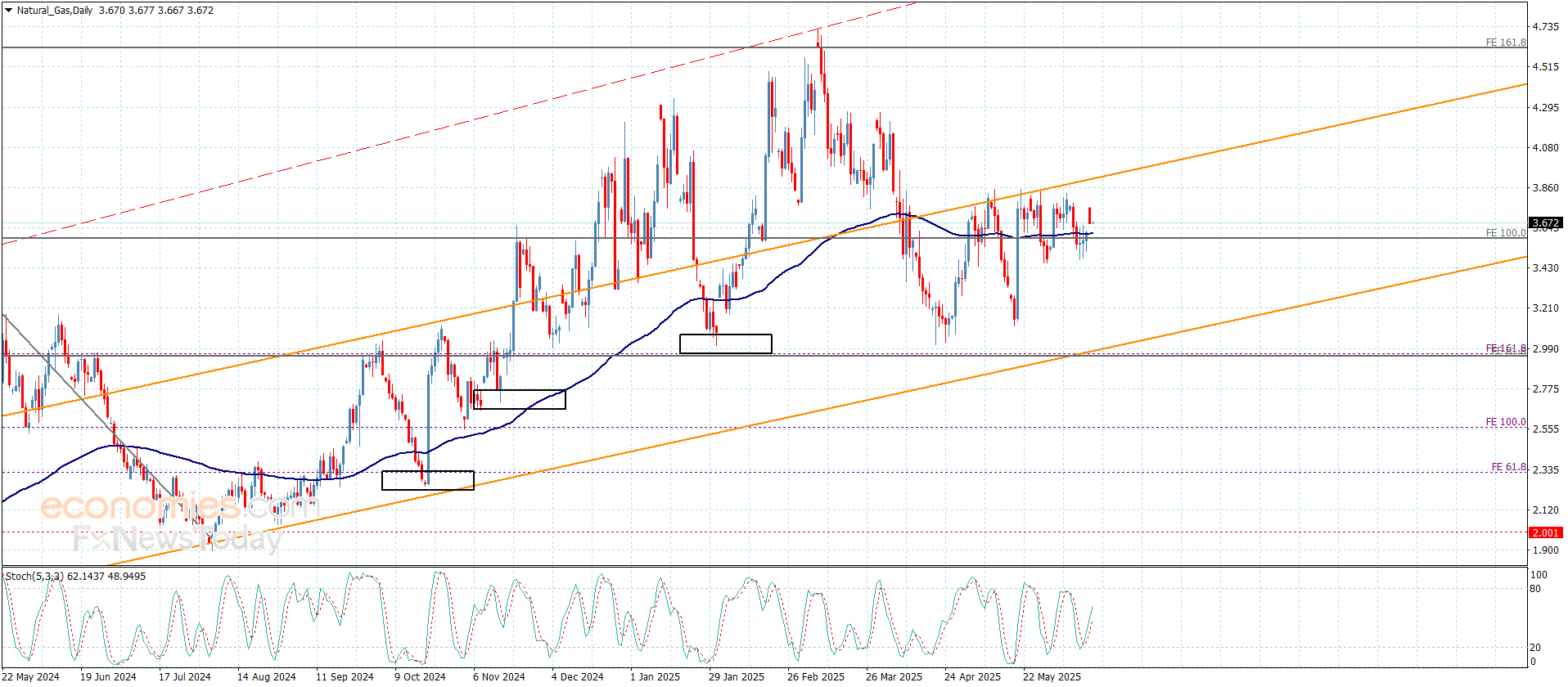
Natural gas prices were affected by the technical circumstances, forming a bullish rally and surpassing the moving average 55 at $3.600, achieving some gains by reaching 43.750 level.
Reminding you that regaining the bullish scenario requires forming a strong bullish rally, to breach the resistance at $3.900, to confirm its readiness to record new gains that might begin at $4.050 and $4.200, while the price return to fluctuate below $3.600 will cancel the positive chances, which forces it to renew the bearish attempts by reaching $3.450 initially.
The expected trading range for today is between $3.600 and $3.900
Trend forecast: Bullish
Platinum price activated the bearish correctional track in Friday’s trading after hitting the barrier at $1305.00, to gather some of the gains by reaching $1215.00 achieving the suggested initial target.
The continuation of the main indicators contradiction makes us keep preferring the correctional track, which might target $1185.00 and $1162.00 level, while renewing the bullish attempts requires providing positive closes above $1275.00 level, to increase the chances for reaching new bullish stations.
The expected trading range for today is between $1185.00 and $1260.00
Trend forecast: Bearish
The Silver price (XAG/USD) edges lower to around $36.20 during the Asian trading hours on Monday. The recovery in the Greenback weighs on the USD-denominated commodity price. However, the potential downside seems limited amid the escalating geopolitical tensions in the Middle East.
The upbeat US economic data released on Friday could provide some support to the US Dollar (USD). The University of Michigan Consumer Sentiment Index improved for the first time in six months, with the index rising to 60.5 in June from 52.2 in the previous reading. This reading came in above the market estimations of 53.5.
On the other hand, markets fear the Israel-Iran conflict could spill over into regional conflict, which boosts safe-haven assets like Silver. Israel started attacks on Iran on Friday, targeting nuclear facilities and missile factories and killing military leaders. Semi-official Iranian media outlet Mehr News reported on Sunday that the fourth phase of Iran’s operation against Israel has begun. Iranian officials underscored that they would “respond firmly to any adventurism” from Israel.
The US Federal Reserve (Fed) policy meeting on Wednesday will be closely watched. The Fed is anticipated to keep interest rates steady at its June meeting. However, futures markets expect two rate cuts by year-end, possibly starting in September, bolstered by tame inflation data last week.
Silver is a precious metal highly traded among investors. It has been historically used as a store of value and a medium of exchange. Although less popular than Gold, traders may turn to Silver to diversify their investment portfolio, for its intrinsic value or as a potential hedge during high-inflation periods. Investors can buy physical Silver, in coins or in bars, or trade it through vehicles such as Exchange Traded Funds, which track its price on international markets.
Silver prices can move due to a wide range of factors. Geopolitical instability or fears of a deep recession can make Silver price escalate due to its safe-haven status, although to a lesser extent than Gold’s. As a yieldless asset, Silver tends to rise with lower interest rates. Its moves also depend on how the US Dollar (USD) behaves as the asset is priced in dollars (XAG/USD). A strong Dollar tends to keep the price of Silver at bay, whereas a weaker Dollar is likely to propel prices up. Other factors such as investment demand, mining supply – Silver is much more abundant than Gold – and recycling rates can also affect prices.
Silver is widely used in industry, particularly in sectors such as electronics or solar energy, as it has one of the highest electric conductivity of all metals – more than Copper and Gold. A surge in demand can increase prices, while a decline tends to lower them. Dynamics in the US, Chinese and Indian economies can also contribute to price swings: for the US and particularly China, their big industrial sectors use Silver in various processes; in India, consumers’ demand for the precious metal for jewellery also plays a key role in setting prices.
Silver prices tend to follow Gold’s moves. When Gold prices rise, Silver typically follows suit, as their status as safe-haven assets is similar. The Gold/Silver ratio, which shows the number of ounces of Silver needed to equal the value of one ounce of Gold, may help to determine the relative valuation between both metals. Some investors may consider a high ratio as an indicator that Silver is undervalued, or Gold is overvalued. On the contrary, a low ratio might suggest that Gold is undervalued relative to Silver.
Platinum price activated the bearish correctional track in Friday’s trading after hitting the barrier at $1305.00, to gather some of the gains by reaching $1215.00 achieving the suggested initial target.
The continuation of the main indicators contradiction makes us keep preferring the correctional track, which might target $1185.00 and $1162.00 level, while renewing the bullish attempts requires providing positive closes above $1275.00 level, to increase the chances for reaching new bullish stations.
The expected trading range for today is between $1185.00 and $1260.00
Trend forecast: Bearish
Gold price has briefly pulled back from fresh two-month highs reached just above $3,450 early Monday. All eyes remain on the deepening Israel and Iran conflict and trade headlines for fresh trading impetus.
The US Dollar (USD) seems to have regained its lost footing in Asian trading on Monday, starting a new week on the front across its major currency rivals amid sagging investors’ confidence, leading to the minor pullback in Gold price.
Intensifying Iranian missiles attacks on Israel over the weekend, which continues well into early Monday, remains a drag on risk sentiment even as markets try to take into their stride and divert their attention to the upcoming central banks’ policy announcements this week.
On Sunday, Israel and Iran launched fresh attacks on Sunday, raising concerns of a broader regional conflict, which could out trade under risks through the Strait of Hormuz.
Israel’s air force attacked surface-to-surface missile sites in central Iran.
Iran told mediators Qatar and Oman that it is not open to negotiating a ceasefire with the US while it is under Israeli attack.
Meanwhile, Reuters reported that Reuters US President Donald Trump had vetoed an Israeli plan in recent days to kill Iran’s Supreme Leader Ayatollah Ali Khamenei, citing two US officials.
Gold buyers also face exhaustion after rising as much as 4% in the previous week as a sense of caution seeps in ahead of the US Federal Reserve (Fed) policy verdict due later on Wednesday.
Markets continue to price in the first interest rate of this year to come in September, still expecting two 25 basis points (bps) rate cuts by year-end.
Dovish Fed expectations continue to lend support to bright metal alongside the Middle East geopolitical crisis, with markets awaiting fresh impetus for the next leg higher.
Monday’s Retail Sales and Industrial Production data from China failed to lift Gold price as the focus now remain on US Retail Sales and the Bank of Japan (BoJ) policy decision on Tuesday.
The BoJ policy announcements could fuel the USD/JPY pair-driven volatility in the Greenback, eventually impacting the USD-denominated Gold price.
Gold price has stalled its recent uptrend, having failed to close the week above the critical resistance near $3,440.
However, the bullish potential remains in place as the 14-day Relative Strength Index (RSI) stays comfortably above the midline, currently near 62.50.
The retreat from two-month highs of could meet initial demand at $3,400, below which the sellers could challenge the previous strong resistance now support at $3,377, the 23.6% Fibonacci Retracement (Fibo) level of the April record rally.
The next downside cushion will be aligned at the 21-day Simple Moving Average (SMA) at $3,336 if the $3,350 psychological barrier gives way.
On the upside, acceptance above the aforesaid static resistance at $3,440 is critical to resuming the advance toward the record highs of $3,500.
The two-month highs of $3,453 could test bearish commitments buyers regain poise.
Gold has played a key role in human’s history as it has been widely used as a store of value and medium of exchange. Currently, apart from its shine and usage for jewelry, the precious metal is widely seen as a safe-haven asset, meaning that it is considered a good investment during turbulent times. Gold is also widely seen as a hedge against inflation and against depreciating currencies as it doesn’t rely on any specific issuer or government.
Central banks are the biggest Gold holders. In their aim to support their currencies in turbulent times, central banks tend to diversify their reserves and buy Gold to improve the perceived strength of the economy and the currency. High Gold reserves can be a source of trust for a country’s solvency. Central banks added 1,136 tonnes of Gold worth around $70 billion to their reserves in 2022, according to data from the World Gold Council. This is the highest yearly purchase since records began. Central banks from emerging economies such as China, India and Turkey are quickly increasing their Gold reserves.
Gold has an inverse correlation with the US Dollar and US Treasuries, which are both major reserve and safe-haven assets. When the Dollar depreciates, Gold tends to rise, enabling investors and central banks to diversify their assets in turbulent times. Gold is also inversely correlated with risk assets. A rally in the stock market tends to weaken Gold price, while sell-offs in riskier markets tend to favor the precious metal.
The price can move due to a wide range of factors. Geopolitical instability or fears of a deep recession can quickly make Gold price escalate due to its safe-haven status. As a yield-less asset, Gold tends to rise with lower interest rates, while higher cost of money usually weighs down on the yellow metal. Still, most moves depend on how the US Dollar (USD) behaves as the asset is priced in dollars (XAU/USD). A strong Dollar tends to keep the price of Gold controlled, whereas a weaker Dollar is likely to push Gold prices up.
The Gold price (XAU/USD) attracts some buyers to near $3,445 during the early Asian session on Monday. The precious metal rises to over a one-month high due to escalating Middle East tensions and rising bets of a Federal Reserve (Fed) rate cut.
Investors ignored the upbeat US economic data released on Friday. Data released by the University of Michigan on Friday showed that the Consumer Sentiment Index rose to 60.5 in June versus 52.2 prior. This reading came in above the market consensus of 53.5.
Renewed geopolitical concerns in the Middle East following an Israeli attack on Iran continue to underpin the Gold price, a traditional safe-haven asset. Iranian officials underscored that they would “respond firmly to any adventurism” from Israel.
“Israel knocking out Iranian targets is causing a little bit of geopolitical scare in the market. Prices will stay elevated in anticipation of what is to come, the retaliation by Iran,” said Daniel Pavilonis, senior market strategist at RJO Futures.
The Fed is expected to leave its policy rate in the 4.25%-4.50% range at its June meeting on Wednesday. However, traders now expect a quarter-percentage-point rate cut by September. Before last week’s US inflation data, traders had expected the Fed to wait until December to deliver a second rate cut. Rising expectations of a Fed rate cut lift interest-bearing assets like Gold.
Gold has played a key role in human’s history as it has been widely used as a store of value and medium of exchange. Currently, apart from its shine and usage for jewelry, the precious metal is widely seen as a safe-haven asset, meaning that it is considered a good investment during turbulent times. Gold is also widely seen as a hedge against inflation and against depreciating currencies as it doesn’t rely on any specific issuer or government.
Central banks are the biggest Gold holders. In their aim to support their currencies in turbulent times, central banks tend to diversify their reserves and buy Gold to improve the perceived strength of the economy and the currency. High Gold reserves can be a source of trust for a country’s solvency. Central banks added 1,136 tonnes of Gold worth around $70 billion to their reserves in 2022, according to data from the World Gold Council. This is the highest yearly purchase since records began. Central banks from emerging economies such as China, India and Turkey are quickly increasing their Gold reserves.
Gold has an inverse correlation with the US Dollar and US Treasuries, which are both major reserve and safe-haven assets. When the Dollar depreciates, Gold tends to rise, enabling investors and central banks to diversify their assets in turbulent times. Gold is also inversely correlated with risk assets. A rally in the stock market tends to weaken Gold price, while sell-offs in riskier markets tend to favor the precious metal.
The price can move due to a wide range of factors. Geopolitical instability or fears of a deep recession can quickly make Gold price escalate due to its safe-haven status. As a yield-less asset, Gold tends to rise with lower interest rates, while higher cost of money usually weighs down on the yellow metal. Still, most moves depend on how the US Dollar (USD) behaves as the asset is priced in dollars (XAU/USD). A strong Dollar tends to keep the price of Gold controlled, whereas a weaker Dollar is likely to push Gold prices up.
June 15, 2025 – Written by Tim Boyer
STORY LINK Pound to Dollar Forecast: 40-Month Best, but “Room for Downside Correction”
The Pound to Dollar exchange rate (GBP/USD) jumped to a 40-month high just above 1.3630 late on Thursday as the dollar came under further pressure.
There was, however, a sharp retreat to lows near 1.3520 on Friday following Israel’s military strike on Iranian nuclear facilities before trading just below 1.3550.
There was renewed demand for safe-haven assets while the slide in risk appetite undermined the Pound in global markets.
According to ING, GBP/USD may be able to avoid sustained losses; “Cable has potentially a wide room for downside correction given how expensive it looks relative to rate differentials. But we have seen how structurally bearish USD bets are preventing dollar gains from being sustainable. So, we’d be more cautious on that side.”
UoB commented; “The likelihood of GBP closing above 1.3640 will remain intact as long as 1.3515 is not breached. Looking ahead, should GBP close above 1.3640, the focus will shift to 1.3700.”
A break below 1.3500 – 1.3515 would suggest a sharper correction.
MUFG noted the shift in trading dynamics; “In the FX market the initial response has been a flight to safety which has benefitted the Swiss franc, yen and US dollar.”
Commerzbank currency strategist Michael Pfister expects caution will prevail in the short term; “Until the danger of further escalation has passed, safe assets are likely to remain in demand.”
Danske Bank added; “The attack adds significant uncertainty to diplomacy, with US officials denying direct involvement while cautioning that it could either hinder or, unexpectedly, pressure Iran towards discussions.”
MUFG commented; “Market participants will now be watching closely to see how the conflict develops and whether it will have an actual disruptive impact on global supply chains including importantly the supply of oil.”
Rabobank discussed the potential implications; “the war between Israel and Iran, the likely involvement of the US and the possible involvement of other countries in the region, will take center stage today and in the coming days. Which scenario is going to develop?”
According to the bank; “The best-case scenario, which markets seem to be pricing in, is a short and fast operation that will deliver Israel and the US a major geopolitical victory. However, in terms of probability of this scenario unfolding, how easy is it is to take out an entire country with a relatively strong military in 24-48 hours?”
It added; “There are several escalation scenarios. The worst case is a long, drawn-out war that spreads to Hormuz and/or Saudi/UAE, and to global sites via proxies.”
The Pound is also liable to be hampered by reservations over the domestic economy and speculation over more dovish Bank of England guidance at next week’s policy meeting.
Danske Bank noted the weaker than expected GDP data released on Thursday; “The data yesterday follows weaker than expected labour market data out earlier this week and highlights that the UK economy is experiencing more underlying weakness following a strong start to the year.”
There are still doubts whether the dollar can gain sustained support.
Scotiabank commented; “The relative loss of investor appetite for U.S. assets is increasingly becoming a forecasting issue. Concerns about U.S. fiscal plan(s) have led to a rise in U.S. borrowing costs that have spread to other markets.”
Traders are also still very wary over tariff developments. President Trump stated that higher tariffs would be extended to domestic appliances.
According to ABN Amro; “The overall impact on the economy would not be favorable, and the repercussions for financial markets could be significantly worse. This reputational damage has arguably been a major factor driving the dollar’s devaluation in recent months.
International Money Transfer? Ask our resident FX expert a money transfer question or try John’s new, free, no-obligation personal service! ,where he helps every step of the way,
ensuring you get the best exchange rates on your currency requirements.