The main category of Forex News.
You can use the search box below to find what you need.
[wd_asp id=1]
The main category of Forex News.
You can use the search box below to find what you need.
[wd_asp id=1]
GBP/USD lost its traction and dropped to a multi-day low below 1.2400 on Thursday following the Bank of England’s (BoE) monetary policy announcements. After staging a rebound in the American session, the pair seems to have stabilized above 1.2400 early Friday.
The table below shows the percentage change of British Pound (GBP) against listed major currencies this week. British Pound was the strongest against the US Dollar.
| USD | EUR | GBP | JPY | CAD | AUD | NZD | CHF | |
|---|---|---|---|---|---|---|---|---|
| USD | -0.21% | -0.38% | -2.12% | -2.67% | -1.24% | -1.55% | -1.06% | |
| EUR | 0.21% | 0.23% | -0.63% | -1.19% | -0.58% | -0.05% | 0.44% | |
| GBP | 0.38% | -0.23% | -1.93% | -1.41% | -0.80% | -0.27% | 0.22% | |
| JPY | 2.12% | 0.63% | 1.93% | -0.56% | 1.05% | 1.50% | 1.72% | |
| CAD | 2.67% | 1.19% | 1.41% | 0.56% | 0.37% | 1.16% | 1.66% | |
| AUD | 1.24% | 0.58% | 0.80% | -1.05% | -0.37% | 0.53% | 1.02% | |
| NZD | 1.55% | 0.05% | 0.27% | -1.50% | -1.16% | -0.53% | 0.49% | |
| CHF | 1.06% | -0.44% | -0.22% | -1.72% | -1.66% | -1.02% | -0.49% |
The heat map shows percentage changes of major currencies against each other. The base currency is picked from the left column, while the quote currency is picked from the top row. For example, if you pick the British Pound from the left column and move along the horizontal line to the US Dollar, the percentage change displayed in the box will represent GBP (base)/USD (quote).
The BoE lowered the policy rate by 25 basis points (bps) at the February policy meeting, as widely anticipated. Two members of the Monetary Policy Committee (MPC), however, unexpectedly voted in favor of a 50 bps cut, triggering a Pound Sterling selloff with the immediate reaction.
In the post-meeting press conference, “we must judge in future meetings whether underlying inflation pressures are easing enough to allow further cuts” BoE Governor Andrew Bailey said and helped GBP/USD find a foothold.
The US Bureau of Labor Statistics will publish the employment report for January later in the day. Nonfarm Payrolls (NFP) are forecast to rise by 170,000, following the 256,000 increase recorded in December. In the same period, the Unemployment Rate is seen holding steady at 4.1%.
A positive surprise, with an NFP reading above 200,000, could boost the USD in the American session and force GBP/USD to stretch lower. On the other hand, a print below 150,000 could revive expectations for a Federal Reserve (Fed) rate cut in March and open the door for a leg higher in the pair.
Despite Thursday’s pullback, the Relative Strength Index (RSI) indicator on the 4-hour chart stays near 50 and GBP/USD holds above the ascending trend line, reflecting sellers’ hesitancy.
GBP/USD could face immediate resistance at 1.2450 (Fibonacci 50% retracement of the latest downtrend) ahead of 1.2500 (static level, round level) and 1.2530 (Fibonacci 61.8% retracement). On the downside, the 200-period Simple Moving Average (SMA) could act as first support at 1.2400 before 1.2370 (Fibonacci 38.2% retracement, ascending trend line, 100-period SMA) and 1.2300 (static level, round level).
Nonfarm Payrolls (NFP) are part of the US Bureau of Labor Statistics monthly jobs report. The Nonfarm Payrolls component specifically measures the change in the number of people employed in the US during the previous month, excluding the farming industry.
The Nonfarm Payrolls figure can influence the decisions of the Federal Reserve by providing a measure of how successfully the Fed is meeting its mandate of fostering full employment and 2% inflation. A relatively high NFP figure means more people are in employment, earning more money and therefore probably spending more. A relatively low Nonfarm Payrolls’ result, on the either hand, could mean people are struggling to find work. The Fed will typically raise interest rates to combat high inflation triggered by low unemployment, and lower them to stimulate a stagnant labor market.
Nonfarm Payrolls generally have a positive correlation with the US Dollar. This means when payrolls’ figures come out higher-than-expected the USD tends to rally and vice versa when they are lower. NFPs influence the US Dollar by virtue of their impact on inflation, monetary policy expectations and interest rates. A higher NFP usually means the Federal Reserve will be more tight in its monetary policy, supporting the USD.
Nonfarm Payrolls are generally negatively-correlated with the price of Gold. This means a higher-than-expected payrolls’ figure will have a depressing effect on the Gold price and vice versa. Higher NFP generally has a positive effect on the value of the USD, and like most major commodities Gold is priced in US Dollars. If the USD gains in value, therefore, it requires less Dollars to buy an ounce of Gold. Also, higher interest rates (typically helped higher NFPs) also lessen the attractiveness of Gold as an investment compared to staying in cash, where the money will at least earn interest.
Nonfarm Payrolls is only one component within a bigger jobs report and it can be overshadowed by the other components. At times, when NFP come out higher-than-forecast, but the Average Weekly Earnings is lower than expected, the market has ignored the potentially inflationary effect of the headline result and interpreted the fall in earnings as deflationary. The Participation Rate and the Average Weekly Hours components can also influence the market reaction, but only in seldom events like the “Great Resignation” or the Global Financial Crisis.
Are you looking for more exclusive insights and analysis? Join Economies.com VIP Club Channel on Telegram and get access to:
Subscribe now to our channel on Telegram and join the Economies VIP Club to get ahead in the market. Limited Spots Available.
For inquiries about how to register, contact us through this link.
Image: © Mohamed Yahya, Reproduced under CC licensing
The Japanese yen stands out as the top-performing G10 currency, benefitting from the Bank of Japan’s tightening cycle, while emerging market (EM) currencies appear positioned for a comeback after a turbulent 2024.
1. USD Outlook: Still Strong but More Fragile
Key Change: While the US dollar remains strong, it has become more volatile due to policy uncertainty and high valuation.
Drivers include growth and interest rate differentials that still support the USD, but not as strongly as in 2022-2024. U.S. trade and geopolitical risks (tariffs, negotiations) are now mostly priced in, limiting further upside.
That being said, Soc Gen sees no clear catalysts for a sharp USD reversal yet.
GBP/EUR investment bank consensus forecast for 2025. See the median, mean, highest and lowest point targets, giving a highly accurate forecasting resource. Request it Now.
2. JPY Forecast: Stronger Due to BoJ Tightening
The Japanese yen (JPY) is the only G10 currency with a clear positive shift. The Bank of Japan (BoJ) is tightening monetary policy while other central banks consider rate cuts, potentially allowing USD/JPY to fall into the 140-150 range in H1 2025, from recent highs near 159.
Longer-term, a return to USD/JPY 100 is possible but could take over a decade.
3. EUR/USD Volatility Rising
Key Change:
EUR/USD volatility is expected to stay high due to US protectionism and potential “currency war” escalation. Tariff risks impacting European exports and the ECB’s monetary response must also be considered says Soc Gen.
4. European Currencies: SEK and CHF Could Outperform
Key Changes:
SEK (Swedish krone) could outperform as a European equity recovery takes hold.
CHF (Swiss franc) weakening as risk appetite returns and the SNB intervenes to manage currency strength.
EUR/GBP expected to range between 0.83-0.87 in 2025 as GBP shorts increase.
5. EM Currencies: Turning Point for Recovery
A stronger EM FX performance is expected in 2025 after a difficult Q4 2024.
Peak uncertainty and market pain may be behind us, says Soc Gen, and as more tariff hurdles are resolved, market fears will ease. A more favorable US interest rate environment and improved growth outlook will also offer some support.
The Mexican peso is tipped to be the first to recover, followed by Brazilian real.
6. Tariff Impact on AUD, NZD, and CAD
The Australian, New Zealand, and Canadian dollars are under pressure due to US tariff threats. Soc Gen says US trade tensions are set to disproportionately affect these economies. CAD has broken above 1.45 against USD due to US-Canada tariff risks. AUD/USD will remain under pressure until geopolitical risks ease.
7. Emerging Market Currencies:
Latin America:
The Mexican peso is positioned for a recovery, as tariff fears ease.
The Brazilian real is rebounding due to reduced concerns over fiscal policy credibility.
Asia:
The Chinese yuan remains weak due to US tariff escalation and moderate Chinese retaliation.
The Indian rupee is one of the weakest EM performers, facing structural slowdowns and portfolio outflows.
CEEMEA:
The Turkish lira will see controlled depreciation, but total returns remain attractive.
The South African rand faces risks from Trump’s social media threats and potential removal from AGOA trade deal.
8. FX Forecast Adjustments
EUR/USD: Expected to remain between 1.01 and 1.07 in H1 2025.
USD/JPY: Forecasted to drop into the 140-150 range in H1.
USD/CAD: Trading above 1.45, reflecting trade risks.
EUR/GBP: Expected to stabilize between 0.83-0.87.
MXN, BRL, TRY: Emerging markets currencies expected to rebound.
9. Summary of Major Forecast Changes
USD remains strong but faces more volatility and fragility.
JPY is the most positively revised G10 currency due to BoJ tightening.
Emerging Market FX (especially MXN, BRL) expected to recover.
EUR/USD volatility to increase due to tariff risks and US monetary policy.
Tariffs are weighing on AUD, NZD, CAD.
SEK could outperform in Europe, while CHF weakens.
TRY depreciation will be gradual, while ZAR faces downside risks.
Bitcoin price (BTCUSD) still stuck between the trend keys represented by 95195.00$ support and 100000.00$ resistance, which makes us continue with our neutrality until the price surpassed one of these levels followed by detecting its next destination clearly.
Are you looking for more exclusive insights and analysis? Join Economies.com VIP Club Channel on Telegram and get access to:
Subscribe now to our channel on Telegram and join the Economies VIP Club to get ahead in the market. Limited Spots Available.
For inquiries about how to register, contact us through this link.
The EURJPY pair formed new negative wave this morning to surpass the first additional target at 157.25 by targeting 156.75 followed by forming temporary correctional rebound.
Are you looking for more exclusive insights and analysis? Join Economies.com VIP Club Channel on Telegram and get access to:
Subscribe now to our channel on Telegram and join the Economies VIP Club to get ahead in the market. Limited Spots Available.
For inquiries about how to register, contact us through this link.
Silver price bounced upwards after the decline that it witnessed in the previous sessions, as it approached the key support base 31.63$, noticing that Stochastic provides positive signals that support the chances of achieving more rise in the upcoming period.
Are you looking for more exclusive insights and analysis? Join Economies.com VIP Club Channel on Telegram and get access to:
Subscribe now to our channel on Telegram and join the Economies VIP Club to get ahead in the market. Limited Spots Available.
For inquiries about how to register, contact us through this link.
Ethereum price (ETHUSD) faced new negative pressure yesterday to break 2764.75$ and settle below it, to witness signs of double top pattern that might push the price to turn to decline and suffer more losses on the intraday basis in case breaking the neckline at 2630.00$.
Are you looking for more exclusive insights and analysis? Join Economies.com VIP Club Channel on Telegram and get access to:
Subscribe now to our channel on Telegram and join the Economies VIP Club to get ahead in the market. Limited Spots Available.
For inquiries about how to register, contact us through this link.
Gold price is resuming its record-setting rally early Friday after taking a brief pause a day ago. However, Gold buyers stay cautious in the run-up to the critical US Nonfarm Payrolls (NFP) data release.
All eyes now remain on the US labor market data, which will likely provide fresh insights on the scope and timing of the US Federal Reserve (Fed) interest rate cuts this year. The data is also likely to have a significant impact on the US Dollar (USD) and the US Treasury bond yields, eventually influencing the near-term direction in Gold price.
The US economy is seen creating 170,000 jobs in January after recording a stellar job gain of 256,000 in December. The Unemployment Rate is likely to remain at 4.1% in the same period. Meanwhile, Average Hourly Earnings are set to rise by 3.8% in January, compared to a 3.9% increase previously.
A smaller-than-expected increase in the headline NFP figure and slowing wage growth could indicate loosening labor market conditions in the US, reviving dovish Fed expectations and driving Gold price to fresh all-time highs close to the $2,900 threshold. In case of an upside surprise, markets will double down on the recent hawkish hold decision by the Fed, dialling down expectations of two Fed rate cuts this year.
The US Dollar will likely receive the much-needed respite from a potentially strong US payrolls data, initiating a corrective decline in Gold price.
The Greenback consolidates weekly losses heading into the main event risk for Friday – the US employment data, bearing the brunt of receding fears of a potential global trade war after US President Donald Trump’s pushback on Canada and Mexico for a month while markets look past the US-Sino tariff war, expecting no further escalation.
This has helped the USD-denominated Gold price hold near lifetime highs.
Gold price portrays an impending Bull Cross on the four-hour time frame. Gold buyers need a four-hour candlestick closing above the falling trendline resistance at $2,862 to validate the bullish continuation pattern.
If the further upside is confirmed, Gold price will retest the record highs at $2,882. The next relevant target is aligned at the $2,900 round level, above which the $2,95 psychological level will be tested.
The Relative Strength Index (RSI) points north while above the midline, currently near 63. The leading indicator remains supportive of the upside bias.
On the flip side, any retracement will meet the initial demand at $2,849, the 21-four-hour Simple Moving Average (SMA).
The falling trendline support at $2,826 will be the next cushion for Gold price, below which the $2,800 level will be challenged.
The Nonfarm Payrolls release presents the number of new jobs created in the US during the previous month in all non-agricultural businesses; it is released by the US Bureau of Labor Statistics (BLS). The monthly changes in payrolls can be extremely volatile. The number is also subject to strong reviews, which can also trigger volatility in the Forex board. Generally speaking, a high reading is seen as bullish for the US Dollar (USD), while a low reading is seen as bearish, although previous months’ reviews and the Unemployment Rate are as relevant as the headline figure. The market’s reaction, therefore, depends on how the market assesses all the data contained in the BLS report as a whole.
Copper price provided new positive close above 4.3300$ level, confirming keeping the previously suggested bullish track to notice recording some additional gains by reaching 4.4800$.
Are you looking for more exclusive insights and analysis? Join Economies.com VIP Club Channel on Telegram and get access to:
Subscribe now to our channel on Telegram and join the Economies VIP Club to get ahead in the market. Limited Spots Available.
For inquiries about how to register, contact us through this link.
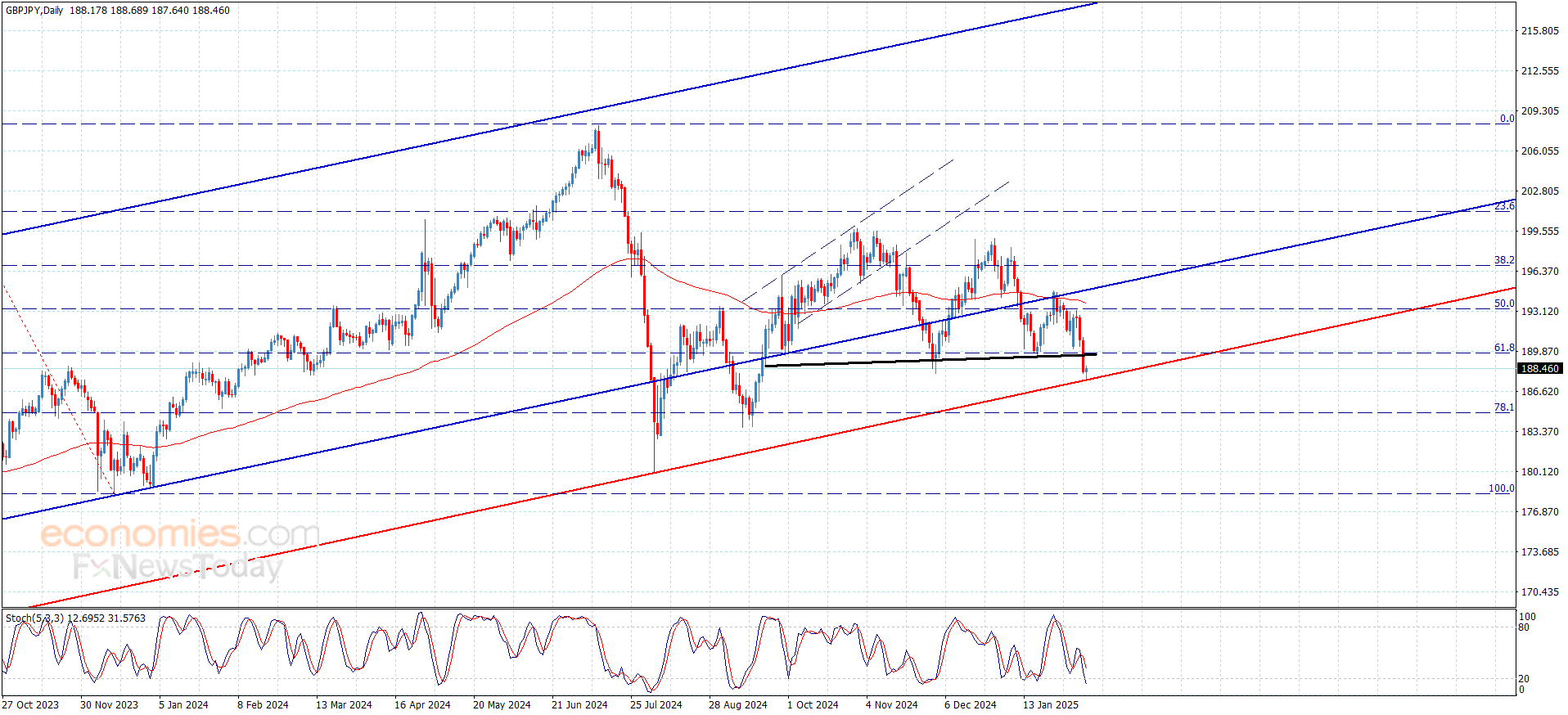
The GBPJPY pair ended the last negative attack by touching the target at 187.70, facing solid support as appears on the chart to start forming correctional bullish waves by consolidating near 188.50 now.
Note that the continuous consolidation above the mentioned support will confirm forming new bullish waves to expect rallying towards 189.50, while surpassing it will extend trades towards 190.90, while facing negative pressures and crawling below the current support will confirm moving to new negative track to suffer big losses by moving towards 185.90 first.
The expected trading range for today is between 187.70 and 189.50
Trend forecast: Bullish