The main category of Forex News.
You can use the search box below to find what you need.
[wd_asp id=1]
The main category of Forex News.
You can use the search box below to find what you need.
[wd_asp id=1]
I wrote on the 14th December that the best trades for the week would be:
Overall, these trades gave a gain of 0.46% per asset.
A summary of last week’s most important data:
Last week’s data had a marginal impact, with one exception: the Bank of Japan. Although this rate hike was expected, the Bank said that it could be expected that real interest rates will remain negative. This was a dovish shock, which sent the Yen tumbling, with every major currency gaining firmly against it. The Yen now looks like a great bet as a short component of any long-term trade, with some analysts now seeing it as the new Turkish Lira, but with a much cheaper spread.
The other thing which really stood out last week was the way market shrugged off a surprising drop in US inflation data. This did give the stock market a bit of a boost, but it was nothing special, and the S&P 500 Index is still off its recent high, even as we head towards the end of the year. This suggests two things might be true:
It is notable that the lower inflation rate has not shifted rate cut expectations for 2026 in a decisive way.
Finally, precious metals continued to rise strongly over the past week, which along with the Japanese Yen is probably the main thing for traders to be watching now. Arguably, the continuing rate cuts we are seeing by major central banks is giving precious metals a strong tailwind.
The coming week includes the Christmas holiday, which includes public holidays in several major markets on Thursday and Wednesday or Friday in some cases. This will almost definitely mean a much less liquid and active market than usual.
We are likely to see a decrease in volatility this week. There is almost no high-impact data due.
This week’s most important data points, in order of likely importance, are:
Currency Price Changes and Interest Rates
For the month of December 2025, I made no forecast.
Last week, I made no forecast, as there were no recent excessive moves in currency crosses.
The US Dollar was the strongest major currency last week, while the Japanese Yen was the weakest. Directional volatility fell again last week, with only 11% of all major pairs and crosses changing in value by more than 1%.
Next week’s volatility will almost certainly be even lower.
You can trade these forecasts in a real or demo Forex brokerage account.
Key Support and Resistance Levels
Last week, the US Dollar Index printed a bullish pin bar. The price is now above its levels of 13 weeks ago and of 26 weeks ago, so by my preferred metric, I declare a long-term bullish trend. The problem with that though, is that the price is just consolidating, and there is very low separation within that metric, so I have no faith in it.
US inflation came in unexpectedly low last week, but the Dollar rose. You could say that is a bullish sign for the greenback, with the market ignoring bearish news. However, the inflation print did not significantly shift rate cut expectations, so I don’t see this as a bullish sign.
I take no bias on the US Dollar right now.

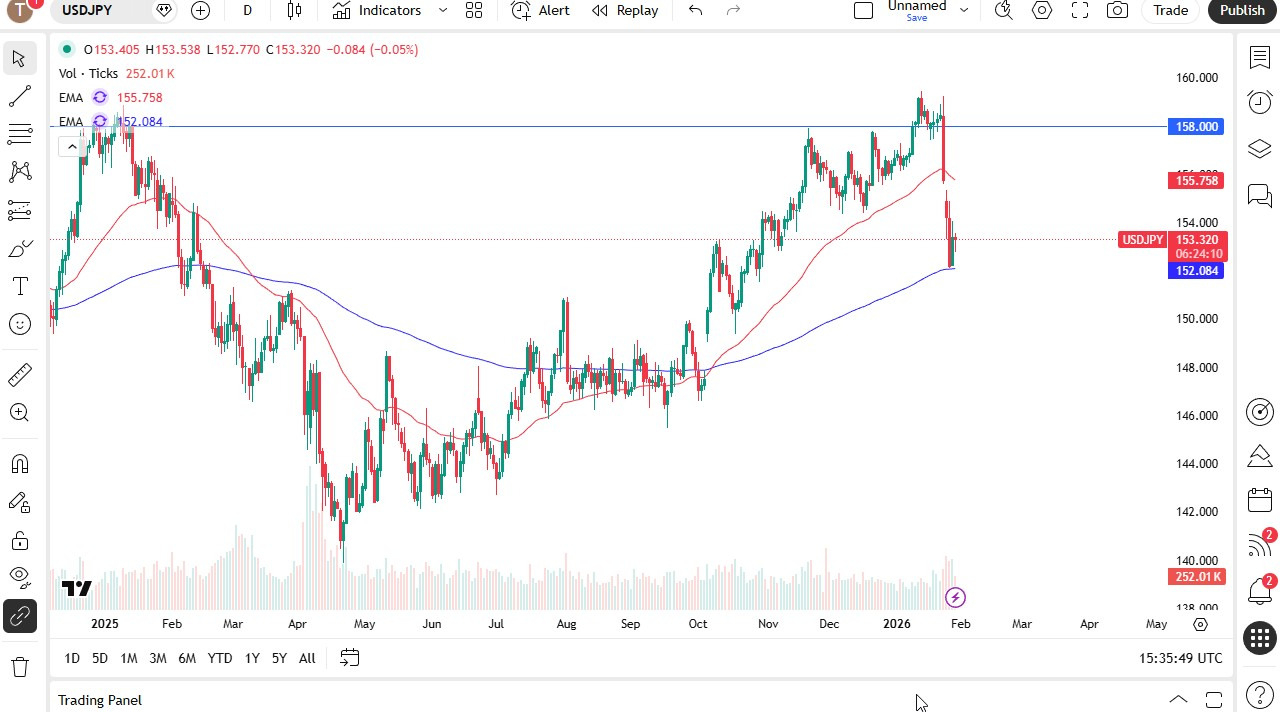
The USD/JPY currency pair weekly chart printed a powerful bullish engulfing (outside) candlestick that is very close to testing the 2025 high. The price closed right on its high. There are lots of bullish signs here.
Drilling down, this is really about the Japanese Yen and not the US Dollar – the greenback, as I have already said, is consolidating, although it may be a bit bullish. The Yen is the big story, and it all happened on Friday when the Bank of Japan made a rate cut but effectively committed to keeping negative real interest rates for the foreseeable future, because it cannot service the huge level of debt in Japan without this. This signifies that the BoJ is happy to let the Yen depreciate, provided the moves are orderly and within an acceptable range of volatility.
It is rare for traders to get a signal from a central bank that is tradable, but we have one now. There may be pullbacks and the moves may be slow, but short Japanese Yen looks like an excellent medium to long-term bet.
I am long this currency pair. Over the short-term bulls might do well to be mindful of the swing high at ¥158.88.
USD/JPY Price Chart
The CHF/JPY currency cross weekly chart printed a powerful bullish candlestick that reached an all-time high price. This alone is a notably bullish sign but just look at the orderly ascending trend we have seen here since March this year, shown by the linear regression price channel study in the price chart below.
I usually ignore trends in currency crosses, but this is a powerful one. There are also good fundamental reasons why the Swiss Franc has been the strongest major currency over the long term, and the Japanese Yen has been the weakest.
The Swiss Franc has a zero interest rate but deflation, so the currency is naturally appreciating, while the Japanese Yen has been declining for a long time due to an ultra-loose monetary policy. The Bank of Japan said on Friday it would maintain negative real interest rates even as it begins to hike, and that has been enough to send the Yen tumbling and giving a very strong signal that the Yen is likely to decline further.
I will not be going long here myself, but it is something other traders might want to investigate and consider. As the USD is not doing very much and the bet here is short Yen, it might make sense to be long of a basket of currencies or assets against the Yen, and the Swiss Franc should probably be included in that.
CHF/JPY Weekly Price Chart
The daily price chart below shows that this major US stock index gained slightly last week, after coming very close to breaking its record high just a few weeks ago. It ended Friday right on its high, which is a bullish sign, and within reach of its record high.
Although the chart looks technically bullish, I think the boost here is all about the lower-than-expected US inflation data which was released on Thursday. The Index had been falling steadily over the past week until that release.
The all-time high here is not far from the big round number at 7,000. As we are about to enter a low-liquidity market period, I think it will be wise to only enter a new long trade here if we get a daily close above that level, without a significant upper wick on the daily candlestick used to trigger the entry.
S&P 500 Index Daily Price Chart
A few weeks / months ago, Silver was in a strong bullish trend which saw the price increase by about 50% in only two months. The rise peaked in October and saw quite a strong retracement, which is usually a sign that the price is not going to make new highs soon. This bearish outlook was reinforced by what seemed to be a bearish double top formed just five weeks ago. However, the price has come up again and then made a very strong bullish breakout with an unusually large move.
We saw a further gain last week as the outsize bullish momentum continued. Volatility is high and the moves can be messy but it’s a bullish breakout that continues to advance.
Another bullish factor is that all the major precious metals rose in value last week, although there is no doubt the Silver is leading the way.
Be mindful of the high volatility, but as last week saw another very bullish move and ended very close to the high, I think being long here is a good idea, but a half normal position size is probably wise.
Silver Weekly Price Chart
Platinum had its best week last week in years. It ended the week right at its high, and above the round number at $2,000. Platinum has not reached these prices since 2008.
With the strong advances we are seeing in several other precious metals, it makes sense to be long here, but of course the high recent volatility makes it very easy for a stop loss to be hit if you are using a long-term ATR to size your stop loss and position size, so be mindful of that.
It might be wise for any new entry to be made with half normal position size.
Platinum Weekly Price Chart
All precious metals have been rising as an asset class, partly fueled by Fed policies and the declining Dollar, partly due to safe haven inflow.
Silver has clearly been leading the way, but these past two weeks have seen the price Gold start to catch up with a minor bullish breakout beyond the $4,270 area. The price got close to the record high last week, but the weekly candlestick was a small doji, which signifies indecision.
I will keep a close eye on Gold and enter a new long trade if we get a daily close above the record high, at or above $4,355.80.
If this long trade sets up, as the progress upwards has been steadier and more orderly than what we have seen in Silver, you might keep a normal position size. I prefer to use half my normal position size.
Gold Weekly Price Chart
I see the best trades this week as:
Ready to trade our weekly Forex forecast? Check out our list of the top 100 Forex brokers.
December 20, 2025 — Silver is ending 2025 with a bang. After surging to fresh all-time highs in the latest U.S. session, spot silver (XAG/USD) is holding around the mid-$67 range on Saturday, with live spot quotes near $67.40–$67.48 per ounce depending on the feed and timestamp. [1]
That price zone caps an extraordinary year in which silver has outpaced nearly every major liquid asset class—and it keeps the spotlight fixed on one question heading into the new year: Is $70 silver the next stop, or is the market setting up for a volatility-driven reset?
While weekend trading conditions differ from the most liquid weekday sessions, Saturday’s spot indications underscore how strong the momentum remains after Friday’s record-setting move.
Here’s the latest context:
Silver’s late-year acceleration is also showing up in the broader investment narrative, with market coverage increasingly treating the metal as both a macro hedge and a strategic industrial input as AI and electrification demand grows. [5]
In recent days, the dominant explanation across major market reporting has converged around a similar mix of catalysts:
Silver—like gold—tends to benefit when investors anticipate lower policy rates and easier financial conditions.
Reuters pointed to U.S. macro data feeding that narrative, including cooler-than-expected inflation and a higher unemployment rate, reinforcing expectations that the Federal Reserve stays on an easing path. [6]
In the same report, Reuters noted traders were pricing at least two 25-basis-point rate cuts in 2026, based on LSEG data. [7]
Silver’s physical market is small enough that marginal changes in inventories and financing costs can matter a lot, fast.
Even when COMEX inventories look large on paper, analysts have warned that regional availability and deliverable liquidity can be a separate story—especially when flows and policy risks drive metal into specific hubs. [10]
Silver is unique among precious metals because its investment identity coexists with heavy industrial usage.
Reuters has tied demand strength to AI data centers, solar cells, and electric vehicles. [11]
Business Insider went further, arguing the AI build-out is turning silver into “another AI play,” citing commentary from Ed Yardeni and pointing to a report from The Silver Institute and Oxford Economics on rising silver demand tied to digitalization and AI adoption. [12]
Beyond macro and industrial demand, several reports highlight that investment flows are doing real work in this rally.
On Friday, Reuters quoted Blue Line Futures chief market strategist Phillip Streible saying silver ETF flows remain a dominant theme, alongside retail speculation. [13]
Meanwhile, Investopedia reported Deutsche Bank expects ETF holdings to climb further—projecting silver held in ETFs could reach about 1.1 billion troy ounces by end-2026, surpassing a prior record. [14]
And in a separate 2026 outlook write-up carried by Nasdaq, Ole Hansen of Saxo Bank said (via an X post cited in the article) that inflows into silver-backed ETFs reached ~130 million ounces in 2025, lifting total holdings to roughly 844 million ounces (an ~18% increase). [15]
Taken together, the flow picture reinforces a key point for 2026: even a small incremental shift in investor demand can overwhelm a tight physical balance—especially when the market is already trending.
By the numbers, the market has moved fast enough that even bulls are talking about consolidation.
A December 20 technical note from FXLeaders said silver has “a good chance” of reaching $70 before the New Year, pointing to strong demand conditions and momentum after the gold/silver ratio dropped below 65. [16]
Other technical coverage has been framing the next steps in terms of whether silver can push through resistance cleanly—or whether overbought conditions trigger a shakeout:
Not all of the latest analysis is celebratory.
Barron’s cited Sundial Capital Research warning that silver (as tracked by the iShares Silver Trust) had stretched to “historic deviations” above key moving averages—conditions that in prior cycles (including 2011 and 2020) preceded sharp drops of 20%+. [19]
That doesn’t invalidate the bullish fundamentals—but it does underline silver’s reputation for violent swings in both directions.
As of December 20, 2025, forecasts and outlooks for 2026 are clustering into three broad camps:
This is the most common bullish-but-not-extreme view right now:
The key dissenting institutional angle isn’t that silver collapses—it’s that silver underperforms after an exceptional year.
Reuters reported Morgan Stanley expects silver to lag gold, calling 2025 a likely peak deficit year and noting expectations for falling solar installations in 2026. [23]
This is a reminder that a big part of the silver bull thesis is industrial momentum; if any major industrial driver softens, silver can re-price quickly.
Some bank projections published earlier in the rally are now being re-evaluated against spot prices in the high-$60s:
Investopedia reported Deutsche Bank forecast silver would average about $55/oz in 2026, while also expecting stronger investor demand to crowd out industrial availability and lift ETF holdings. [24]
With spot already well above that level, readers should interpret such “average price” forecasts as scenarios that implicitly include volatility and pullbacks—not as a ceiling.
A useful way to reconcile the forecast spread is to separate structural factors from cyclical factors:
This dual nature is why silver can look like a precious metal in one moment and a high-beta industrial commodity in the next.
With silver already priced for a lot of good news, the next phase likely depends on whether the macro tailwinds and physical tightness persist into early 2026. Traders and longer-term investors are likely focused on:
Silver’s price action into December 20, 2025 reflects an unusual alignment: easier-rate expectations, tight physical conditions, and a powerful industrial narrative tied to AI and electrification. [31]
But the same combination that can propel silver into the $70s can also produce fast air pockets if positioning gets crowded or macro expectations reverse—an issue raised in both mainstream commentary and technical warnings. [32]
For 2026, the center of gravity in forecasts is moving toward $70+ scenarios, with bullish calls extending toward $75 in some strategist outlooks—while large institutions still debate how sustainable the deficit and industrial impulse will be after an extraordinary 2025. [33]
1. www.jmbullion.com, 2. www.reuters.com, 3. www.jmbullion.com, 4. www.reuters.com, 5. www.businessinsider.com, 6. www.reuters.com, 7. www.reuters.com, 8. www.reuters.com, 9. www.investopedia.com, 10. www.reuters.com, 11. www.reuters.com, 12. www.businessinsider.com, 13. www.reuters.com, 14. www.investopedia.com, 15. www.nasdaq.com, 16. www.fxleaders.com, 17. www.actionforex.com, 18. www.actionforex.com, 19. www.barrons.com, 20. www.reuters.com, 21. www.nasdaq.com, 22. timesofindia.indiatimes.com, 23. www.reuters.com, 24. www.investopedia.com, 25. www.nasdaq.com, 26. www.reuters.com, 27. www.reuters.com, 28. www.reuters.com, 29. www.businessinsider.com, 30. www.reuters.com, 31. www.reuters.com, 32. www.barrons.com, 33. www.nasdaq.com
Gold prices are ending 2025 in rare territory: near record highs, up roughly two-thirds year-to-date, and with Wall Street forecasts increasingly clustering around the $4,500–$5,000 zone for 2026. As of Saturday, December 20, spot gold (XAU/USD) is hovering around $4,338 per ounce after Friday’s close, with the latest daily range showing buyers defending dips toward the $4,300 handle and sellers leaning against the mid-$4,350s. [1]
That near-term “pause” masks a bigger story: gold is being pulled between a firmer U.S. dollar and higher yields on one side, and rate-cut expectations, central-bank demand, and persistent geopolitical uncertainty on the other—an unusually supportive mix that has kept pullbacks shallow in late December trading. [2]
Friday’s session capped a steady week: Reuters reported spot gold around $4,347/oz late Friday in New York trading, with U.S. gold futures settling higher and gold posting a weekly gain. [7]
Gold’s 2025 surge has been closely tied to expectations that U.S. policy rates will continue to ease and that real rates will be less restrictive in 2026. Reuters noted that traders have been leaning toward at least two 25-basis-point cuts next year, and recent U.S. data has kept that debate alive. [8]
Even within thin year-end conditions, gold has stayed resilient as investors digest softer inflation and a cooling jobs backdrop referenced in market coverage this week. [9]
A stronger U.S. dollar typically makes gold more expensive for non-dollar buyers. Late-week reporting highlighted that the dollar recovered toward short-term highs, adding friction to gold’s attempts to push cleanly beyond the mid-$4,350s. [10]
FXStreet also flagged that holiday conditions can reduce liquidity and magnify swings—often producing sharp, headline-driven moves that do not always reflect a true change in trend. [11]
The most important structural element underpinning gold into 2026 is official-sector buying. Reuters’ mid-December outlook framed it plainly: central banks have been diversifying reserves away from dollar assets, providing a foundation for prices even when investor positioning becomes stretched. [12]
In the same Reuters report, J.P. Morgan’s metals strategy team estimated that to keep prices flat, the market needs roughly 350 tonnes per quarter of central bank and investment demand—and they forecast that buying could average 585 tonnes per quarter in 2026. [13]
That “official bid” theme is also colliding with politics. For example, Reuters reported that an Italian parliamentary committee backed language asserting that the Bank of Italy’s gold reserves “belong to the people,” a politically charged move that drew criticism from the European Central Bank over central bank independence. [14]
Gold’s 2025 rally has not been purely a central-bank story. The World Gold Council’s 2026 outlook highlighted that investment demand—especially through gold ETFs—has been a major driver during the current bull run. It cited about $77 billion of inflows this year, adding more than 700 tonnes to ETF holdings, and noted that total holdings are up by roughly 850 tonnes since May 2024. [15]
Meanwhile, a World Gold Council weekly monitor noted that increased ETF buying and rising bullish positioning in derivatives were among the forces pushing gold higher into December. [16]
High prices are changing the composition of consumer demand—especially in price-sensitive regions.
A Dec. 20 report in The Economic Times, citing the World Gold Council’s India commentary, said India’s gold consumption is projected to fall to 650–700 tonnes in 2025 from 802.8 tonnes in 2024, reflecting how the price surge has crimped volume demand even as investment buying remains comparatively firm. [17]
This matters for the 2026 outlook because softer jewellery volumes can reduce one source of baseline demand. But it can also reinforce gold’s shift from “consumer good” toward “financial asset,” especially when investment flows are strong.
A striking feature of late-December research notes is how many major institutions now see gold staying elevated in 2026—though they disagree on how quickly it gets there and how volatile the path may be.
Here are the most widely cited targets and ranges circulating as of Dec. 20:
The common thread across these forecasts is that the “old” gold playbook—rates down, dollar down, gold up—has been joined by a newer structural narrative: reserve diversification, geopolitical fragmentation, and persistent tail risks that keep gold strategically relevant even when inflation is not spiking.
Rather than offering a single point forecast, the World Gold Council mapped out scenario-based ranges for 2026 performance (and explicitly described them as hypothetical illustrations rather than firm forecasts).
Key scenarios it outlined include: [23]
What makes these scenarios useful for investors and readers right now is that they translate the 2026 gold debate into a simple framework:
Late-December technical commentary has converged around a familiar structure: consolidation below resistance with buyers stepping in on dips.
What that means in practical terms:
Also worth noting: multiple market commentaries emphasized that late-December trading can be distorted by holiday liquidity, which can produce exaggerated moves around key levels like $4,300 and $4,350. [30]
While macro drivers dominate, several policy and supply-side developments are also feeding into the broader gold narrative:
These aren’t day-to-day price drivers the way U.S. rates are, but they help explain why gold is increasingly treated as a strategic asset class—intertwined with reserves, fiscal debates, and policy decisions.
With markets reopening after the weekend, gold traders are likely to focus on three near-term themes:
As of Dec. 20, 2025, gold is consolidating near $4,338/oz after an extraordinary year. [37] The market is no longer just trading inflation headlines; it is pricing a broader set of forces—rate paths, reserve diversification, ETF demand, and geopolitics—that many forecasters believe can keep gold elevated into 2026. [38]
The key question for the months ahead is not whether gold remains important, but which driver dominates: a softer growth/risk-off backdrop that fuels the next leg higher—or a stronger dollar/higher-yield regime that finally forces a deeper reset after a historic run. [39]
1. www.investing.com, 2. www.fxstreet.com, 3. www.investing.com, 4. www.fxstreet.com, 5. www.fxstreet.com, 6. www.reuters.com, 7. www.reuters.com, 8. www.reuters.com, 9. www.reuters.com, 10. www.fxstreet.com, 11. www.fxstreet.com, 12. www.reuters.com, 13. www.reuters.com, 14. www.reuters.com, 15. www.gold.org, 16. www.gold.org, 17. m.economictimes.com, 18. www.reuters.com, 19. www.reuters.com, 20. www.reuters.com, 21. www.reuters.com, 22. www.reuters.com, 23. www.gold.org, 24. www.gold.org, 25. www.gold.org, 26. www.fxstreet.com, 27. www.gold.org, 28. www.fxstreet.com, 29. www.fxstreet.com, 30. www.fxstreet.com, 31. www.reuters.com, 32. www.reuters.com, 33. m.economictimes.com, 34. www.fxstreet.com, 35. www.reuters.com, 36. www.fxstreet.com, 37. www.investing.com, 38. www.reuters.com, 39. www.gold.org
December 20, 2025 — Natural gas markets are closing out the week with a familiar winter tug-of-war: weather forecasts softening near-term heating demand, while LNG export pull and policy shifts keep longer-term supply anxiety alive. Friday’s last traded levels (with weekend markets largely closed) show a market that’s no longer panicking about immediate shortages—but also not comfortable enough to price in a smooth ride through 2026.
Below is a comprehensive roundup of the key natural gas news, forecasts, and analyses in circulation on 20.12.2025, spanning the U.S. Henry Hub benchmark, Europe’s TTF, and global LNG pricing—plus what major outlooks imply for 2026. [1]
The U.S. benchmark (NYMEX) January Henry Hub contract ended Friday’s session higher at $3.984/MMBtu, with Reuters noting the move was supported by near-record LNG export flows even as the broader weather narrative stayed bearish. [6]
But the session’s headline was volatility. Another Reuters update circulating on Dec. 20 described futures easing toward a seven-week low near $3.879/MMBtu as forecasts turned warmer—before prices later firmed into the close. [7]
That intraday push-pull matters because it reveals what traders are currently pricing:
One of the most telling signals right now isn’t the front-month contract—it’s the shape of the curve.
Reuters reporting highlighted that the March–April 2026 premium (a spread traders watch to express late-winter risk) was trading at an ultra-thin ~1 cent—a record low in that update. In industry slang, this March/April position is called the “widow-maker” because violent weather-driven moves have historically wiped out leveraged bets. [11]
When that spread compresses, it usually implies the market is less worried about end-of-winter scarcity—at least given current information. That doesn’t mean winter can’t surprise; it does mean the curve is currently pricing more “manageable winter” than “crisis.” [12]
On fundamentals, the U.S. Energy Information Administration’s weekly update (released Dec. 18, covering the week ending Dec. 17) also documented a 167 Bcf net storage withdrawal for the week ending Dec. 12, leaving total working gas stocks at 3,579 Bcf—about 1% above the five-year average but 2% below year-ago levels. [13]
Even on days when weather models dominate U.S. price action, the LNG complex keeps “pulling” on the balance sheet.
Reuters noted that feedgas gains came despite small flow declines at Venture Global’s Calcasieu Pass and Plaquemines facilities in Louisiana in recent days (as described by analysts in that report). [14]
Meanwhile, the EIA weekly update recorded 33 LNG vessels departing U.S. ports between Dec. 11 and Dec. 17 with a combined capacity of 126 Bcf, underscoring how strong the shipping cadence has been heading into year-end. [15]
In one of the week’s most closely watched corporate signals, Energy Transfer said it was suspending development of its Lake Charles LNG export project in Louisiana, citing capital allocation priorities toward pipelines and concerns around the economics of an increasingly crowded LNG buildout cycle. Reuters reported the proposed facility was expected to have 16.45 mtpa of liquefaction capacity. [16]
Why this matters for prices: a pause or cancellation doesn’t change tomorrow’s molecule flows, but it alters the market’s long-run “oversupply” assumptions—especially if it becomes a pattern rather than a one-off. [17]
Another “plumbing” indicator moved this week: Atlantic LNG shipping rates fell below $100,000/day. LNG Prime reported Spark’s Atlantic freight assessment at $92,000/day (down $23,750 week-on-week), with Pacific rates also lower. [18]
Freight doesn’t just affect shipping companies—it can widen or narrow netbacks and influence whether marginal cargoes flow toward Europe or Asia when price spreads are thin. [19]
Europe’s gas market has been trading a different narrative than the U.S.: less about one country’s weather model and more about the system-wide resilience of storage, LNG inflows, and power-sector swings.
A Reuters update republished on Dec. 20 reported the Dutch TTF front-month up around €0.70 to ~€28.05/MWh, with prices supported by weaker wind power output, which can increase gas-fired generation needs. [20]
A widely circulated ING analysis (also dated Dec. 20) emphasized that the EU entered the 2025/26 heating season below the original 90% storage target by Nov. 1—but crucially, it also noted the Commission’s earlier move to relax storage rules, reducing the pressure to buy “at any cost.” Storage peaked around 83% in mid-October, and by early December had fallen to about 75%, below both the five-year average and last year’s ~85% at that point. [21]
This is the key European tension:
Complementing that view, LNG Prime cited Gas Infrastructure Europe (GIE) data showing EU storage at about 68.24% full on Dec. 17, down from 71.29% a week earlier and 77.10% on the comparable date in 2024. [24]
ING’s analysis flagged positioning as a risk factor: it said investment funds moved from net long 292 TWh in February to net short 50 TWh by end-November, with gross shorts at a reported record high in that dataset. The implication is straightforward: if Europe gets a true cold shock—or a major outage—short covering could amplify price spikes. [25]
While day-to-day prices may hinge on wind and temperature, Europe’s longer-term story is policy-driven.
On Dec. 17, Reuters reported the European Parliament approved the EU plan to phase out Russian gas imports by late 2027, with the agreement specifying a halt to Russian LNG imports by end‑2026 and pipeline gas by end‑September 2027 (pending final approval steps). [26]
This matters because it structurally increases Europe’s reliance on LNG—especially from the U.S.—even if the region continues adding renewables and trying to curb demand. [27]
In global LNG, Asia is often the swing buyer. Right now, the swing looks… restrained.
A Reuters market wrap republished by Business Recorder reported spot LNG for February delivery into Northeast Asia around $9.50/MMBtu, described as roughly a 20‑month low, citing ample supply and subdued demand. [28]
The same update also pointed to a narrowing spread between Asia’s JKM and European pricing, with Europe’s LNG marker cited near $8.881/MMBtu in that report—tight spreads that reduce the incentive to chase the “best basin” and instead emphasize logistics, freight, and regas capacity. [29]
ING’s Dec. 20 analysis argued that China is “driving the weakness” in Asian LNG demand in 2025, citing factors including industrial softness, higher domestic production growth, and rising pipeline gas imports. [30]
Even if you disagree with every datapoint, the strategic point is hard to ignore: pipeline gas growth can displace LNG demand, and that changes global clearing prices when new LNG export trains arrive. [31]
If 2025 was the year the market re-learned winter risk, 2026 is shaping up as the year of a new argument: how tight does the U.S. balance get once incremental LNG demand arrives—and how quickly does production respond?
In the U.S. Energy Information Administration’s Short-Term Energy Outlook, the EIA forecasts Henry Hub at $4.01/MMBtu on average in 2026, with dry natural gas production around 109.11 Bcf/d and LNG exports averaging 16.3 Bcf/d. [32]
EIA also projects end-of-winter (end of March 2026) storage around 2,000 Bcf, reflecting an overall balance that is tighter than the ultra-loose periods of the last decade—but not necessarily “crisis tight.” [33]
A Bernstein outlook distributed via Investing.com on Dec. 20 argued it still “has faith in five,” framing $5/mcf Henry Hub as the new equilibrium after years nearer ~$3.50. The note emphasized demand growth led by LNG exports and power generation, claiming current U.S. LNG volumes are at record levels and “around 5 Bcf/d above a year ago.” [34]
On supply, Bernstein highlighted producer restraint—especially in Haynesville—arguing that depressed rig activity and lags between drilling and output mean much of 2026 supply is already “set” at lower levels, while Permian horizontal rig counts were noted as down about 20% from early-2025. [35]
In a separate 2026 commodities outlook, Reuters reported Goldman forecasts U.S. natural gas at $4.60/MMBtu for 2026 (and $3.80 for 2027), while projecting TTF at €29/MWh for 2026 (and €20 for 2027). [36]
Even though this was published Dec. 18, it’s still part of the active “current outlook stack” being referenced in market commentary on Dec. 20. [37]
Two additional developments—while not Saturday headlines—remain directly relevant to price formation as of Dec. 20:
Even with the curve signaling near-term comfort, natural gas remains one of the most headline-sensitive commodities. Here are the catalysts most likely to move prices coming out of Dec. 20:
As of 20.12.2025, the natural gas market is sending a mixed but coherent message:
1. www.tradingview.com, 2. www.hellenicshippingnews.com, 3. www.hellenicshippingnews.com, 4. www.brecorder.com, 5. www.eia.gov, 6. www.tradingview.com, 7. www.hellenicshippingnews.com, 8. www.hellenicshippingnews.com, 9. www.hellenicshippingnews.com, 10. www.hellenicshippingnews.com, 11. www.hellenicshippingnews.com, 12. www.hellenicshippingnews.com, 13. www.eia.gov, 14. www.hellenicshippingnews.com, 15. www.eia.gov, 16. www.reuters.com, 17. www.reuters.com, 18. lngprime.com, 19. lngprime.com, 20. www.hellenicshippingnews.com, 21. www.hellenicshippingnews.com, 22. www.hellenicshippingnews.com, 23. www.hellenicshippingnews.com, 24. lngprime.com, 25. www.hellenicshippingnews.com, 26. www.reuters.com, 27. www.reuters.com, 28. www.brecorder.com, 29. www.brecorder.com, 30. www.hellenicshippingnews.com, 31. www.hellenicshippingnews.com, 32. www.eia.gov, 33. www.eia.gov, 34. www.investing.com, 35. www.investing.com, 36. www.reuters.com, 37. www.reuters.com, 38. www.reuters.com, 39. www.reuters.com, 40. www.hellenicshippingnews.com, 41. www.hellenicshippingnews.com, 42. www.eia.gov, 43. www.reuters.com, 44. www.hellenicshippingnews.com, 45. www.hellenicshippingnews.com, 46. www.eia.gov, 47. www.brecorder.com
Given recent low volatility, a pullback to test support near the 10-day average at $4,282 and rising, before a decisive advance, wouldn’t be surprising. Resistance has been seen near the completion of a 100% measured move at $4,356, which matches the price advance in the first measured move as marked on the chart. A failure of the 20-day average could see a test of support near the 20-day average, now at $4,234.
If the short-term trend high from this week can be exceeded, then a breakout to a new record high above $4,381 becomes a possibility. A 127.2% measured move projection first targets $4,454. Then, a 127.2% extension of the more recent bearish correction in October points to a potential initial upside target of $4,516. The extension target carries more weight as it is derived from a larger pattern.
On the weekly timeframe, a weekly breakout triggered this week above last week’s high of $4,353, but it will not confirm today as the weekly close will likely be below that weekly high. This is consistent with the lack of bullish momentum and sideways movement recently, showing a lack of strong conviction from buyers.
Gold’s multi-week uptrend stays intact above rising averages and trendlines, but persistent low volatility and an unconfirmed weekly breakout highlight absent buyer conviction. Expect a likely dip to the 10-day $4,282 or 20-day $4,234 before resolution; clearance of $4,375–$4,381 unlocks $4,454–$4,516, while loss of the 10-day raises short-term seller risk.
For a look at all of today’s economic events, check out our economic calendar.
Fortescue Ltd (ASX: FMG) heads into the weekend with investors juggling three big forces that rarely play nicely together: an iron ore market that’s proving tougher than many expected, a fresh push into copper via the proposed buyout of Alta Copper, and a decarbonisation strategy that’s shifting from “hydrogen hype” toward nearer-term industrial projects like green iron and electrification. [1]
On the last trading day before Saturday, December 20, Fortescue shares closed at A$21.88 on Friday (Dec. 19), down 3.23% on the session—after trading between A$21.75 and A$22.50—with volume around 16.84 million shares, notably above recent norms. [2]
That selloff matters because it arrived after the stock had recently tagged a 52‑week high of A$23.38 on Dec. 11, leaving FMG about 6.4% below that peak at Friday’s close. [3]
Because the ASX is closed on Saturday, the “today” reference point for Fortescue stock is the most recent close: Friday, Dec. 19, 2025. On that day, FMG opened at A$22.41, hit a high of A$22.50, dipped to A$21.75, and finished at A$21.88 (‑3.23%). [4]
The down day also came with a clear “attention signal” in activity: FT market data shows an average volume around 8.14m, while Friday’s volume on Investing.com’s historical tape was roughly 16.84m—roughly double the typical clip. [5]
Fortescue is still, first and foremost, an iron ore business—so the real heartbeat is the China steel/iron ore complex.
A Reuters commodities column this week highlighted the odd divergence: China’s steel production is sliding, yet iron ore imports look set to hit a record in 2025. Reuters cited November steel output at 69.87 million tonnes (‑10.9% y/y) and argued 2025 output is tracking toward the lowest annual total since 2018, even as iron ore imports for the year are on pace to top 2024’s record. [6]
Iron ore pricing has been resilient in that environment. Reuters noted Singapore iron ore contracts were on a rising trend from US$93.35/t (July 1) and closed at US$106.25/t earlier this week, near a Dec. 4 high close of US$107.90/t. [7]
The catch (and it’s a big one): Reuters also pointed to port stockpiles rising (SteelHome data), suggesting there’s only so far restocking can run before import strength cools. [8]
For Fortescue investors, that’s the central near-term question: is iron ore strength a durable “floor” (helping margins and dividends), or a restocking mirage before a softer 2026?
The forward view is where “FMG stock forecast” conversations get spicy.
Westpac’s December 2025 commodities update expects a pullback: it forecasts a 20% decline in iron ore to US$83/t by end‑2026, tying the call to falling Chinese steel production, rising port inventories, and the growing gap between Chinese steel prices and input costs. [9]
ING’s commodities team is also leaning bearish, but a touch less dramatic on averages: ING says 2026 faces a “more challenging” backdrop and explicitly states, “We see prices averaging $95/t in 2026.” [10]
ING also frames Guinea’s Simandou as a genuine supply wildcard, saying Simandou is expected to ship around 20 million tonnes in 2026 and ramp toward 120 million tonnes per year by 2030. [11]
Meanwhile, Australia’s Resources and Energy Quarterly (December 2025) strikes a policy-grade version of the same story: iron ore prices have been “more resilient than expected,” but are forecast to decline in coming years due to rising supply from Africa, Brazil and Australia, and it forecasts Australian iron ore export earnings easing from $116b (2024–25) to $114b (2025–26) and $107b (2026–27). [12]
The short version: the macro tape is still supportive today, but a lot of serious forecasters see 2026 as the year the supply/demand math starts acting like the adult in the room.
The biggest Fortescue-specific catalyst in December has been its plan to buy the remaining stake in Alta Copper.
Fortescue announced (via ASX release) it will acquire the ~64% of Alta Copper it doesn’t already own, via its subsidiary Nascent Exploration, offering C$1.40 per share in cash—an implied equity value of C$139 million—with Alta’s board supporting the transaction. [13]
Key deal mechanics investors are watching:
Strategically, it puts Fortescue more visibly into the copper lane—where long-run demand narratives (electrification, grids, data centres) have kept prices buoyant.
Reuters, reporting on copper markets on Dec. 19, noted copper prices hovering near record highs amid tight supply concerns and highlighted bullish long-term calls like Goldman Sachs pointing to US$15,000/ton by 2035 (even as near-term forecasts vary). [16]
That doesn’t automatically make Alta Copper a near-term earnings driver—it’s a development-stage story with permitting, community engagement and build-out risk—but it does signal Fortescue’s capital allocation is no longer a single-commodity bet. [17]
Fortescue’s “energy and green tech” narrative hasn’t vanished. It’s evolving—more practical boots, fewer moon boots.
Fortescue and Taiyuan Iron and Steel Group (TISCO), a subsidiary of China Baowu, are collaborating on a hydrogen‑based, plasma‑enhanced metallurgical process aimed at cutting emissions in steelmaking.
Reuters reported the partnership includes building and operating a trial line that could produce 5,000 metric tons of hot metal, and that Fortescue will fund the project using its Pilbara iron ore. [18]
Fortescue’s own release frames it as a potential pathway to reduce or eliminate some traditionally high‑emissions steps (like sintering/pelletizing/coking) and as a response to growing demand for lower‑emissions steelmaking inputs. [19]
On the “do the work, not the vibes” side, Fortescue says it delivered its first large-scale BYD Battery Energy Storage System (BESS) to North Star Junction in the Pilbara: 48 containers, providing 250 MWh and 50 MW (five hours). It’s positioned as the first step in a planned 4–5 GWh BESS rollout across its Pilbara energy network. [20]
In Europe, the timeline is stretching.
Statkraft announced it and Fortescue agreed to amend and extend the conditional power agreement for Fortescue’s Holmaneset green hydrogen/green ammonia project. The amendments extend the agreement timeframe to 2029 and expand it to cover a 10-year power supply, with the PPA conditional on financial close and commercial operations starting. [21]
Fortescue’s project page describes Holmaneset as a proposed project with stated capacity of 40k tonnes per year (green hydrogen) and status listed as scoping. [22]
Taken together, the message to markets is subtle but important: Fortescue’s decarbonisation push is increasingly about de-risking its own operations (power, electrification) and building optionality in green iron—while some hydrogen export ambitions are being given more runway. [23]
Even in a week dominated by macro and deal headlines, Fortescue’s core attraction remains the same: a large, cash-generative iron ore operation with a history of shareholder returns.
Fortescue’s investor material highlights FY25 Underlying EBITDA of US$7.9bn, NPAT of US$3.4bn, and A$3.4bn in dividends paid (FY25). [24]
Market data on FT shows FMG at Friday’s close carrying a market cap around A$69.62bn, with an indicated annual dividend yield around 5.03% (based on its displayed annual dividend figure and price data). [25]
Dividends are never guaranteed (commodity cycles have sharp teeth), but for many portfolios, Fortescue is still treated as an iron ore + yield exposure—just with more strategic “call options” attached than it had a few years ago. [26]
Here’s where the plot thickens.
Several widely followed consensus aggregators currently show average price targets below FMG’s latest close, implying the market price is running ahead of the typical analyst midpoint.
Why might targets lag the share price?
Because analysts aren’t just forecasting Fortescue-the-company; they’re forecasting the iron ore price regime (and therefore margins) that Fortescue will live in. And right now, major outlooks (Westpac, ING, Australia’s REQ) are collectively leaning toward a softer iron ore environment into 2026–27, even if 2025 finishes strong. [31]
Fortescue’s investor key dates show the December Quarterly Production Report is scheduled for 22 January 2026—the next big “hard numbers” catalyst for shipments and costs. [32]
Investors will look for updates on the expected January 2026 shareholder meeting and any signals around permitting strategy and development timetable for Cañariaco. [33]
The near-term iron ore bid has been supported by imports/restocking, but Reuters’ analysis suggests inventories are already elevated, which could cap further upside if steel demand doesn’t improve. [34]
ING explicitly flags Simandou as a supply game-changer over the next few years, and both ING and Australia’s REQ point to rising supply from multiple regions as a core reason prices could trend lower. [35]
Announcements like the Pilbara BESS rollout, the TISCO green iron trial, and the Holmaneset power agreement extension are worth tracking—not because they change next quarter’s earnings, but because they shape Fortescue’s cost base, strategic positioning, and future optionality. [36]
As of Dec. 20, 2025, Fortescue stock is being pulled by two magnets at once: resilient iron ore pricing in late 2025 (good for cash flow) and increasingly cautious 2026 forecast frameworks (bad for mid-cycle valuation assumptions). [37]
Layer on top Fortescue’s copper pivot (Alta Copper), and the company starts to look less like a pure iron ore dividend machine—and more like an iron ore cash engine trying to buy itself a second (and third) act. Whether that earns a higher multiple or just adds execution risk is exactly what the next few quarters of delivery will decide. [38]
1. www.reuters.com, 2. www.investing.com, 3. markets.ft.com, 4. www.investing.com, 5. markets.ft.com, 6. www.reuters.com, 7. www.reuters.com, 8. www.reuters.com, 9. www.westpaciq.com.au, 10. think.ing.com, 11. think.ing.com, 12. www.industry.gov.au, 13. content.fortescue.com, 14. content.fortescue.com, 15. www.reuters.com, 16. www.reuters.com, 17. content.fortescue.com, 18. www.reuters.com, 19. www.fortescue.com, 20. www.fortescue.com, 21. www.statkraft.com, 22. www.fortescue.com, 23. www.statkraft.com, 24. investors.fortescue.com, 25. markets.ft.com, 26. investors.fortescue.com, 27. in.tradingview.com, 28. in.investing.com, 29. fintel.io, 30. simplywall.st, 31. www.westpaciq.com.au, 32. investors.fortescue.com, 33. content.fortescue.com, 34. www.reuters.com, 35. think.ing.com, 36. www.fortescue.com, 37. www.reuters.com, 38. content.fortescue.com
Natural gas markets closed the week with a split personality: U.S. futures bounced off fresh lows even as milder weather forecasts capped upside, European prices ticked higher on weaker wind output, and Asian spot LNG fell to its lowest level since April 2024 as demand stayed soft.
The result is a global gas story defined by abundant supply, weather-driven volatility, and a growing debate over how profitable incremental LNG exports will be as price spreads narrow—all while major policy and project decisions reshape the outlook for 2026 and beyond.
Here’s where the most-followed gas markers stood during Friday’s session:
Those headline numbers mask a crucial nuance: the market is being pulled in opposite directions. On one side, weather forecasts reduce near-term heating demand. On the other, LNG export feedgas remains near record highs, keeping a firm bid under U.S. supply-demand balances even when the forecast turns warm. [4]
U.S. gas traders spent Dec. 19 wrestling with one dominant question: Is this winter demand going to show up in time to tighten balances—or will mild forecasts and record output keep the market comfortably supplied?
Reuters data cited in market coverage showed forecasts for mostly warmer-than-normal U.S. weather through Jan. 3, which tends to reduce heating demand versus seasonal norms. [5]
That warmth showed up in projected demand: LSEG estimates referenced in the same reporting pointed to Lower 48 demand (including exports) falling from about 144.6 bcfd this week to roughly 127.5 bcfd over the next two weeks—a meaningful step down for mid-winter. [6]
Even with mild forecasts, U.S. export pull remained the market’s stabilizer. Reported flows to the eight major LNG export plants averaged about 18.5 bcfd so far in December, above November’s 18.2 bcfd record. [7]
This matters because LNG demand is sticky—term contracts, cargo scheduling, and liquefaction operations can keep feedgas elevated even when domestic weather turns warm.
On the supply side, LSEG data cited in the same coverage pegged Lower 48 production at about 109.6 bcfd so far in December, matching November’s record pace. [8]
In other words, the U.S. market is balancing:
Two separate intraday storylines captured the volatility:
That kind of reversal is classic “weather + positioning” natural gas behavior.
If you want a single indicator of whether traders fear winter scarcity, watch the calendar spreads.
On Dec. 19, Reuters market coverage noted that the March-over-April 2026 spread was trading around a record-low ~1 cent, signaling traders were not paying up for late-winter risk versus shoulder-season supply. [11]
Storage data also helped frame the picture:
Bottom line: withdrawals have been meaningful, but not yet “scarcity signaling.” The curve is still telling you the market expects supply to be adequate—unless weather surprises.
European wholesale gas moved up modestly Friday morning, and the reason wasn’t a sudden supply shock—it was power-market physics.
The front-month TTF contract was up around €28.05/MWh as forecasts for lower wind generation implied higher gas burn for power. [14]
But the upside was limited by a familiar set of anchors:
The key European takeaway for Dec. 19: power-sector swings (wind output) can move the prompt contract, but storage and pipeline supply have kept rallies contained.
Asian spot LNG extended its downtrend, with Reuters-reported market estimates putting February Northeast Asia spot LNG at $9.50/MMBtu, down from $10 the prior week and the weakest since April 2024. [17]
Why the softness?
A separate, highly relevant datapoint: S&P Global reported Chinese domestic LNG prices fell to five-year winter lows, highlighting oversupply and muted demand conditions inside the region that can blunt spot LNG buying. [20]
Shipping economics quietly reinforced the global split:
That matches the bigger theme of late 2025: Europe continues to act as the balancing market—absorbing flexible LNG when Asia demand is price-sensitive.
One of the most consequential pieces of Dec. 19’s natural gas news wasn’t a price tick—it was a project decision.
Energy Transfer said it would suspend development of the Lake Charles LNG export project, citing a mix of rising costs, global LNG oversupply concerns, and a strategic preference for pipeline investments. [23]
Why this matters for natural gas markets:
A Dec. 19 analysis piece highlighted that the profit window for spot U.S. LNG cargoes has tightened, as U.S. gas prices rose while Europe and Asia LNG prices softened—compressing the spread exporters rely on. [25]
Reuters commentary earlier in December similarly pointed to the Henry Hub–TTF spread shrinking and warned that if spreads narrow enough, some LNG volumes could become uneconomic versus variable costs, particularly in a more oversupplied global market later this decade. [26]
This is the crucial “second layer” of today’s market:
Forecasts published and referenced around this period converge on a clear near-term message: winter strength, then moderation—but with plenty of volatility risk.
EIA’s December Short‑Term Energy Outlook projected:
EIA also projected the annual Henry Hub price at $3.56 in 2025 and $4.01 in 2026, alongside rising U.S. LNG exports (about 14.9 bcfd in 2025 and 16.3 bcfd in 2026 in the STEO overview). [28]
A Reuters-cited Goldman outlook projected TTF around €29/MWh in 2026 and €20/MWh in 2027, while forecasting U.S. gas around $4.60/MMBtu in 2026 and $3.80/MMBtu in 2027—a framework aimed at balancing supply growth with rising LNG-linked demand. [29]
Two structural stories continued to shape sentiment in the background:
These don’t necessarily move Henry Hub day-to-day, but they influence where LNG goes, how hard Europe competes for supply in cold spells, and how new supply projects are justified.
1. www.tradingview.com, 2. www.tradingview.com, 3. www.tradingview.com, 4. www.tradingview.com, 5. www.tradingview.com, 6. www.tradingview.com, 7. www.tradingview.com, 8. www.tradingview.com, 9. www.tradingview.com, 10. www.tradingview.com, 11. www.tradingview.com, 12. www.eia.gov, 13. www.tradingview.com, 14. www.tradingview.com, 15. www.tradingview.com, 16. www.tradingview.com, 17. www.tradingview.com, 18. www.tradingview.com, 19. www.tradingview.com, 20. www.spglobal.com, 21. www.tradingview.com, 22. www.tradingview.com, 23. www.reuters.com, 24. www.reuters.com, 25. gasoutlook.com, 26. www.reuters.com, 27. www.eia.gov, 28. www.eia.gov, 29. www.reuters.com, 30. www.reuters.com, 31. www.reuters.com, 32. www.tradingview.com, 33. www.tradingview.com, 34. www.tradingview.com, 35. www.tradingview.com, 36. www.spglobal.com
Silver prices are holding close to record territory on Friday, December 19, 2025, as traders balance a cooler U.S. inflation print (supportive for rate-cut expectations) against a firmer dollar and year-end positioning.
At around 09:34 GMT (FXStreet’s latest update just ahead of that at 09:32 GMT), spot silver (XAG/USD) traded at $65.76 per troy ounce, up about 0.5% from Thursday’s close. [1]
Silver’s price action on Dec. 19 has been tight but elevated, with multiple market feeds showing it hovering in the mid-$65s to around $66:
Despite minor fluctuations across venues and timestamps, the bigger message is consistent: silver remains close to historic highs, with dips quickly attracting buyers.
A cooler-than-expected U.S. inflation reading has helped keep precious metals supported. Reuters reported U.S. consumer prices rose 2.7% year-on-year in November, below economists’ 3.1% forecast, which nudged market expectations toward easier policy. [6]
This matters for silver because it is a non-yielding asset: when markets expect lower interest rates, the opportunity cost of holding metals tends to fall.
FXStreet’s silver commentary also framed the pullbacks as potentially limited because rate-cut expectations can support the metal after profit-taking. [7]
Even with rate-cut chatter, the U.S. dollar’s firmness has been a headwind. Reuters noted the dollar was near over one-week highs, making dollar-priced metals more expensive for buyers using other currencies—often a near-term drag on gold and silver. [8]
This tug-of-war—dovish macro vs. firm USD—is a big reason silver is consolidating rather than surging straight through its record.
Silver is coming off a powerful run, including a push to $66.88 earlier this week. [9]
That kind of move naturally triggers “lock in gains” flows, especially into year-end.
FXEmpire described Friday’s weakness in early European trade as position-adjustment/profit-taking rather than a decisive break in the bullish macro backdrop. [10]
Alongside macro, geopolitical risk is supporting haven demand. Moneyweb (citing Bloomberg) flagged Venezuela-related tensions as a factor lifting haven appeal in precious metals. [11]
FXStreet also pointed to escalating U.S.–Venezuela tensions as a potential tailwind for safe-haven assets like silver. [12]
Silver isn’t just “up today”—it has been one of the standout trades of 2025.
FXStreet also noted the gold/silver ratio around 65.78 in Friday’s data snapshot—a level many traders monitor as a quick gauge of relative valuation between the two metals. [15]
Forecast coverage on Dec. 19 is converging on one theme: silver is still bullish, but stretched—so levels matter.
In a Dec. 19 technical outlook, FXStreet’s analysis highlighted:
FXEmpire’s Dec. 19 outlook framed silver as consolidating near $65.85 with:
FXEmpire also cited futures pricing implying roughly a 26.6% probability of a rate cut at the next Fed meeting (via CME FedWatch), underscoring that traders are still debating timing—even if the broader disinflation trend is supportive. [22]
Another FXStreet update earlier in the session described silver slipping to around $64.95 on profit-taking, while arguing the downside could be limited if cooling inflation keeps expectations tilted toward lower rates. [23]
With silver near record highs, the next catalyst often decides whether the market breaks out or consolidates:
Silver remains firmly in focus on Dec. 19, 2025. Around 09:34 GMT, the market was trading near $65.76/oz, staying close to record territory after this week’s $66.88 peak. [28]
The near-term roadmap is clear: rate-cut expectations and geopolitics are supportive, but a stronger dollar and profit-taking are keeping silver in a tight, headline-sensitive range—right below the levels that could trigger the next breakout. [29]
1. www.fxstreet.com, 2. www.fxstreet.com, 3. www.moneyweb.co.za, 4. www.reuters.com, 5. www.kitco.com, 6. www.reuters.com, 7. www.fxstreet.com, 8. www.reuters.com, 9. www.reuters.com, 10. www.fxempire.com, 11. www.moneyweb.co.za, 12. www.fxstreet.com, 13. www.fxstreet.com, 14. www.reuters.com, 15. www.fxstreet.com, 16. www.fxstreet.com, 17. www.fxstreet.com, 18. www.fxstreet.com, 19. www.fxstreet.com, 20. www.fxempire.com, 21. www.fxempire.com, 22. www.fxempire.com, 23. www.fxstreet.com, 24. www.reuters.com, 25. www.reuters.com, 26. www.moneyweb.co.za, 27. www.reuters.com, 28. www.fxstreet.com, 29. www.reuters.com
Starbucks Corporation stock (NASDAQ: SBUX) is trading slightly lower on Friday, December 19, 2025, as investors balance a “turnaround-in-progress” narrative against real-world crosscurrents: elevated coffee costs, labor disruption risk, and a still-evolving international strategy—especially in China.
As of early afternoon, Starbucks shares were $88.77, down $0.65 (-0.72%). [1]
Below is a full, up-to-the-minute look at the news flow, forecasts, and analyst views shaping SBUX today—plus the specific issues Wall Street is watching into 2026.
After a strong stretch of “green shoots” optimism around CEO Brian Niccol’s operational reset, SBUX is seeing modest profit-taking into the end of the week. The intraday dip also comes as the broader conversation around coffee prices—one of Starbucks’ most important input costs—has re-entered headlines today.
Market data trackers showed SBUX near $88.77 by early afternoon. [2]
A major macro theme for beverage and restaurant names today is the reality that retail coffee prices can remain elevated even if tariff-related pressure eases, because price transmission through the supply chain can lag by months.
In a Reuters report published today, analysts and industry sources pointed to prior supply tightness and timing lags as reasons consumer coffee prices may not quickly fall—even after recent tariff changes. [3]
This matters for Starbucks because recent company results already highlighted how commodities and related cost items can squeeze profitability. In Starbucks’ late-October earnings coverage, Reuters reported that coffee prices and tariffs were among the factors pressuring margins, alongside investment costs tied to the turnaround. [4]
Why investors care: if Starbucks stays cautious on menu price increases (to protect traffic), sustained coffee inflation can make margin recovery slower—and the stock tends to trade on the pace and credibility of that recovery.
Starbucks is in a multi-quarter effort to make stores feel less transactional and more like the brand’s original “third place,” while also improving throughput and labor deployment.
Reuters has described Niccol’s strategy as a cost-and-experience reset that he calls “Back to Starbucks.” [5]
That plan has included operational changes such as menu simplification, faster service goals, and store upgrades. [6]
Recent reporting also described Starbucks piloting new store designs and committing meaningful staffing/labor-hour investments to support execution at scale. [7]
Market takeaway: Starbucks bulls generally argue the stock can re-rate higher if “throughput + experience” improvements translate into sustainably higher transactions. Bears tend to argue it’s difficult to fix speed, service, and staffing economics simultaneously—especially with commodity and wage pressures.
Starbucks’ strategy in China has been one of the most consequential moving pieces for the equity story in 2025.
Reuters reported that Starbucks agreed to sell control of its China operations to Boyu Capital in a deal valuing the business at $4 billion, with Boyu holding up to 60% and Starbucks 40%, while Starbucks continues to license brand/IP to the venture. [8]
The same Reuters report also highlighted the competitive reality in the market, including Starbucks’ declining China market share and the rise of lower-priced competitors. [9]
Earlier in the process, Reuters also reported that bidders had valued Starbucks China as high as $5 billion, with offers often framed around an EBITDA multiple approach. [10]
What investors are debating now:
A clear near-term uncertainty for SBUX is labor disruption risk and reputational overhang.
Reuters reported on December 11 that hundreds of baristas walked off the job in 34 U.S. cities, escalating a month-long strike. The union said over 3,800 baristas had participated and that the strike had spread to more than 180 stores across 130 cities. [11]
Starbucks, in the same Reuters report, argued the impact was limited—stating that fewer than 1% of its roughly 17,000 U.S. coffeehouses had been affected at any point. [12]
On the regulatory front, New York City announced a $38.9 million settlement with Starbucks related to alleged violations of the city’s Fair Workweek Law, describing it as the largest worker-protection settlement in city history. [13]
The city said the settlement requires over $35.5 million in restitution to workers plus $3.4 million in civil penalties and costs, and applies to hourly workers in NYC across a multi-year period. [14]
Investor relevance: these items don’t necessarily change Starbucks’ long-term brand power, but they can influence risk perception, operating leverage assumptions, and how much “execution discount” the market applies to the stock.
A Reuters report on December 18 said Cuisine Solutions—known for producing Starbucks’ egg bites—hired Morgan Stanley and Rothschild to explore a potential sale process, with a valuation that could exceed $2 billion, according to sources. [15]
This isn’t a direct Starbucks corporate action, but it’s relevant in two ways:
Starbucks is also leaning into cultural collaborations as part of brand re-energizing.
Modern Retail reported this week that Starbucks hired Neiv Toledano (previously at e.l.f. Cosmetics) as a senior marketing manager of fashion and beauty, described as a first-of-its-kind dedicated role focused on partnerships/collabs. [16]
Why it matters for the stock: These initiatives are unlikely to move near-term EPS by themselves, but they speak to management’s push to rebuild relevance and traffic—especially among younger, trend-driven consumers.
Analyst communities still skew constructive on SBUX—but targets are dispersed, reflecting uncertainty about how quickly the turnaround can convert into earnings power.
StockAnalysis reports:
It also lists notable recent rating actions (examples include reiterated/maintained ratings and price-target changes from firms such as TD Cowen, Citi, RBC, and Piper Sandler across Oct–Dec). [19]
TipRanks shows:
How to interpret the spread:
When one aggregator shows a ~$95 target and another shows ~$101+, it’s usually methodology and coverage differences—not a sudden change in core sentiment. The more important signal is that targets cluster around “modest upside,” while the wide high/low range signals a market still debating Starbucks’ medium-term earnings trajectory.
The next major scheduled inflection point is earnings.
MarketBeat lists Starbucks’ upcoming Q1 earnings date as “Jan. 27 after market closes (estimated).” [21]
Separately, Reuters reporting around Starbucks’ recent results indicated the company expected to provide a financial outlook at an investor event in January (context: Starbucks suspended guidance shortly after Niccol took the helm). [22]
1. www.marketbeat.com, 2. www.marketbeat.com, 3. www.reuters.com, 4. www.reuters.com, 5. www.reuters.com, 6. www.reuters.com, 7. www.reuters.com, 8. www.reuters.com, 9. www.reuters.com, 10. www.reuters.com, 11. www.reuters.com, 12. www.reuters.com, 13. www.nyc.gov, 14. www.nyc.gov, 15. www.reuters.com, 16. www.modernretail.co, 17. www.marketbeat.com, 18. stockanalysis.com, 19. stockanalysis.com, 20. www.tipranks.com, 21. www.marketbeat.com, 22. www.reuters.com, 23. www.reuters.com, 24. www.reuters.com, 25. www.marketbeat.com, 26. www.reuters.com, 27. www.reuters.com, 28. www.nyc.gov
Friday’s closing price is on track to be the third day out of four where natural gas closed below prior support at the 200-day average, now at $3.75, and a long-term rising trendline. Daily closes below the 200-day line and trendline is bearish behavior as prior dynamic support switches to resistance. Now the 20-day average has touched the 50-day average, and it will soon cross below it, further confirming bearish sentiment.
Despite being possibly extended to the downside, bearish price action shows the potential for further downside. Given the current chart pattern, unless natural gas can rise above and then close above Thursday’s lower swing high of $3.93, downside pressure remains. However, given Thursday’s relatively large range, natural gas could continue to consolidate at support seen near the 61.8% retracement.
A decisive drop below today’s low, also a weekly low, at $3.60, triggers a continuation of the bearish retracement. If price then continues to weaken, the next lower potential support zone around $3.48 to $3.44 becomes the next downside target. The beginning of the range is a 78.6% Fibonacci retracement of an internal upswing, while the lower boundary was resistance at the swing high in early-September. If that price zone fails to attract buyers and natural gas continues to weaken, the 78.6% Fibonacci retracement of the last full upswing becomes a potential target at $3.48.
On the upside, if a rally above $3.93 can be sustained, then potential resistance from prior support at $4.09 to the 38.2% Fibonacci retracement at $4.15 is identified as the first potential resistance zone. But the also significant 20-day average presents dynamic resistance, and it is at $4.24 currently and falling.
Natural gas remains under bearish pressure with multiple closes below the 200-day average and trendline, but the hammer off the 61.8% Fib and hold above $3.60 offers early hope for consolidation or bounce. Clearance of $3.93 targets $4.09–$4.15; failure to defend $3.60 opens $3.44–$3.48 and keeps the retracement alive.
For a look at all of today’s economic events, check out our economic calendar.