The main category of Forex News.
You can use the search box below to find what you need.
[wd_asp id=1]
The main category of Forex News.
You can use the search box below to find what you need.
[wd_asp id=1]
Coffee price world increase, giảm trái chiều
Kết thúc phiên giao dịch, giá cà phê Robusta trên sàn London cập nhật lúc 16 giờ 00 phút ngày December 21, 2024, tiếp tục “lao dốc” vào phiên giao dịch thứ 4 liên tiếp trong tuần, từ 50-55 USD/tấn, dao động 4849 – 5011 USD/tấn. Cụ thể, kỳ hạn giao hàng tháng January 2025 là 5011 USD/tấn (giảm 50 USD/tấn); kỳ hạn giao hàng tháng March 2025 là 5002 USD/tấn (giảm 44 USD/tấn); kỳ hạn giao hàng tháng May 2025 là 4934 USD/tấn (giảm 57 USD/tấn) và kỳ hạn giao hàng tháng July 2025 là 4849 USD/tấn (giảm 55 USD/tấn).
| Người dân tại tỉnh Gia Lai đang thu hoạch cà phê. Ảnh: Hiền Mai |
Ngược lại, giá cà phê Arabica trên sàn New York, lại đồng loạt tăng nhẹ so với phiên giao dịch ngày hôm qua, mức tăng từ 0.65 – 1.25 cent/lb, dao động 302.75 – 325.00 cent/lb. Cụ thể, kỳ hạn giao hàng tháng March 2025 là 325.00 cent/lb (tăng 1.25 cent/lb); kỳ giao hàng tháng May 2025 là 319.30 cent/lb (tăng 1 cent/lb); kỳ giao hàng tháng July 2025 là 311.65 cent/lb (tăng 0.65 cent/lb) và kỳ giao hàng tháng September 2025 là 302.75 cent/lb (tăng 1 cent/lb).
Trong khi đó, kết thúc phiên giao dịch, giá cà phê Arabica Brazil cập nhật lúc 16 giờ 00 phút cũng hầu hết tại các kỳ hạn có mức tăng nhẹ từ 0.85 – 1.30 USD/tấn so với ngày hôm qua, dao động từ 387.85 – 398.10 USD/tấn. Cụ thể, kỳ giao hàng tháng May 2025 là 398.10 USD/tấn (tăng 1.30 USD/tấn); kỳ giao hàng tháng July 2025 là 387.85 USD/tấn (tăng 0.85 USD/tấn); trong khi đó, kỳ giao hàng tháng March 2025 lại giảm xuống 406.45 USD/tấn (giảm 1.25 USD/tấn). Riêng, kỳ hạn giao hàng tháng December 2024 không giao dịch.
Giá cà phê trong nước giảm phiên thứ 4 liên tiếp
Theo thông tin từ Giacaphe.com, cập nhật giá cà phê lúc 16 giờ 30 phút hôm nay ngày December 21, 2024, giá cà phê trong nước trung bình ở mức 121.100 đồng/kg, giảm -800 đồng/kg so với ngày hôm qua.
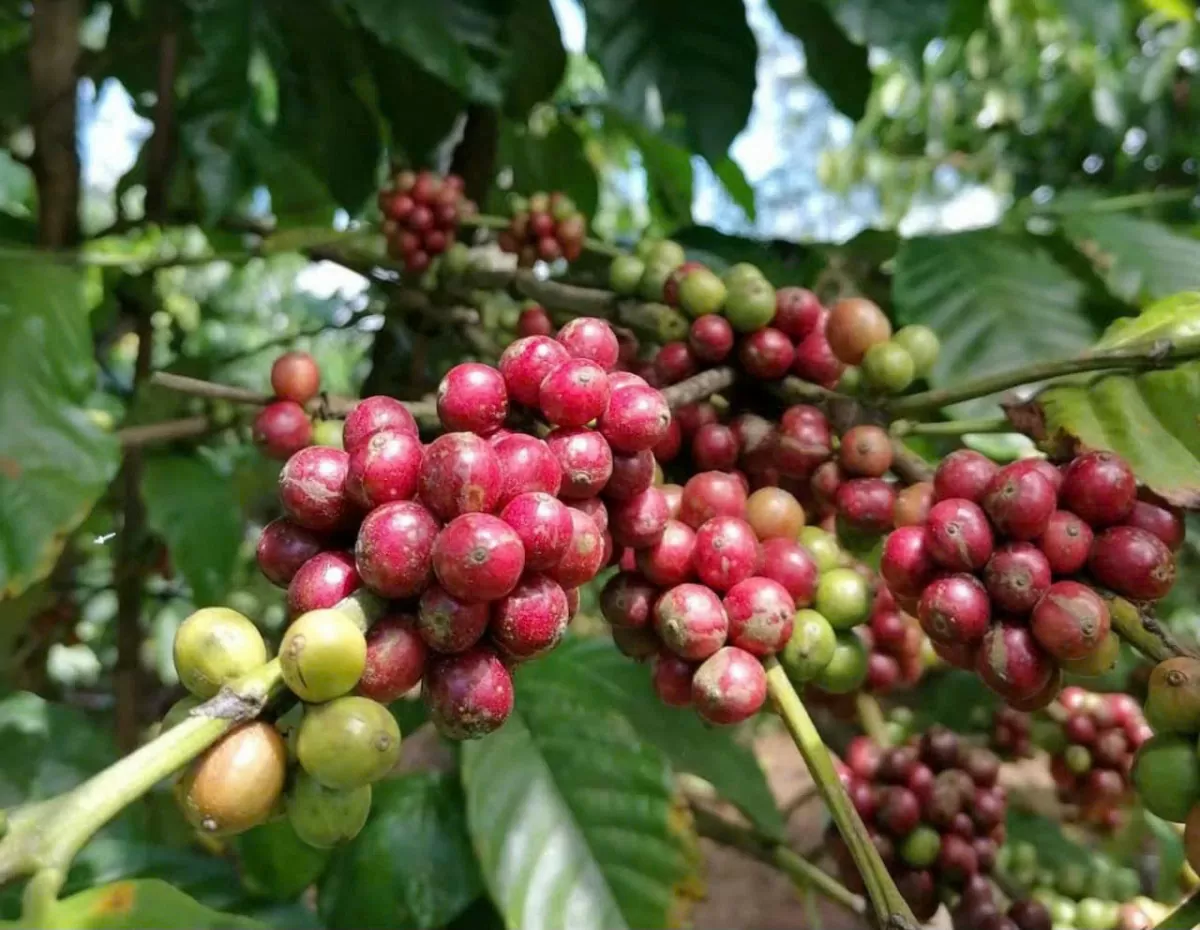 |
| Nhiều nhà vườn tại Gia Lai vẫn chưa thu hoạch xong cà phê chín do năm nay thiếu hụt nhân công. Ảnh: Hiền Mai |
The highest coffee purchase price in key regions of the Central Highlands was recorded at 121.300 VND/kg. Specifically, today’s coffee price at Dak Lak có mức 121.000 đồng/kg, giảm -1.000 đồng so với hôm qua. Giá cà phê tại Lam Dong có mức giá 120.500 đồng/kg, giảm -1.000 đồng so với giá giao dịch hôm qua. Trong khi đó, giá cà phê tại Gia Lai hôm nay có mức giá 121.000 đồng/kg, giảm -800 đồng/kg. Giá cà phê tại Dak Nong hôm nay có giá 121.300 đồng/kg, cũng giảm -700 đồng/kg so với hôm qua.
The domestic coffee prices that Giacaphe.com lists every day are calculated based on the prices of two world coffee exchanges combined with continuous surveys from businesses and purchasing agents in key coffee growing areas across the country.
Y5Cafe luôn cố gắng để bám sát nhất với từng vùng, tuy nhiên sẽ có những ngày giá niêm yết không hoàn toàn khớp với giá cà phê thu mua tại địa phương của bà con, nhưng Y5Cafe cho rằng thông tin được niêm yết là nguồn thông tin tham khảo giá trị cho bà con và doanh nghiệp thu mua cà phê.
Nhận định giá cà phê ngày mai December 22, 2024
Theo báo cáo mới nhất của Bộ Nông nghiệp Mỹ (USDA) cho thấy, sản lượng cà phê toàn cầu trong niên vụ 2024-2025 dự báo sẽ tăng 4% so với niên vụ trước, đạt 174,855 triệu bao, với sản lượng cà phê arabica tăng 1,5% lên 97,845 triệu bao và sản lượng cà phê robusta tăng 7,5% lên 77,01 triệu bao.
However, ending coffee stocks in 2024-2025 are forecast to fall 6,6% to a 24-year low of 20,9 million bags, compared with 22,3 million bags in 2023-2024.
Do đó, các chuyên gia nhận định, giá cà phê ngày mai December 22, 2024 có thể quay đầu tăng trở lại.
Sources: https://congthuong.vn/du-bao-gia-ca-phe-ngay-mai-22122024-gia-ca-phe-co-the-tang-tro-lai-365499.html
EUR/USD has recorded a 2% decline over the last five sessions, favoring the dollar and placing the euro in a sustained bearish zone. This selling pressure has intensified following the Fed’s recent decision, accompanied by neutral remarks regarding decisions for the upcoming year. This bearish pressure has pushed the price to break the crucial two-year support level at 1.0550.
In its final meeting of the year, the Fed reduced interest rates to a range of 4.25%-4.5%, down from the previous 4.5%-4.75% (a 25-basis-point cut). This adjustment aligns with efforts to stimulate the U.S. economy in early 2025.
However, Fed Chair Jerome Powell highlighted that although inflation has decreased significantly, it remains at elevated levels, making it challenging to achieve the central bank’s 2% target. Powell also stressed the need to proceed cautiously in future decisions,given that current projections place inflation at 2.5% for 2025, still far from the central bank’s target for the upcoming year.
In this context, the CME Group’s probability tool currently reflects a 91% chance that the Fed will keep rates unchanged at its next meeting, scheduled for January 29. And, for the 19-march decision, the probability stands in 53% of rates unchanged versus 43% of rate reduction. That said, now the market is seeing a neutral decision bias for next decisions which could help maintain higher interest rates, leading to a stronger dollar perspective. Remember that these probabilities could shift based on economic developments leading up to that date.

Source: CmeGroup

Source: CmeGroup
Given the context outlined, the Fed’s interest rate of 4.5% remains significantly higher than the European Central Bank (ECB) rate of 3.15%. This differential could continue to attract investment into U.S. fixed-income assets, increasing demand for the dollar and exerting selling pressure on the EUR/USD. This scenario will likely persist as long as the U.S. central bank maintains rates above 4%.
EUR/USD has maintained a steady downtrend since late September, reaching a minimum price in the 1.03 range. Recent U.S. monetary policy events have strengthened the dollar, once again driving the price close to these lows not seen since November.

Source: StoneX, Tradingview
Key Levels:
Today’s high was very close to completing a 38.2% Fibonacci retracement of an interim downswing, at 3.85. That price level is joined by 3.87, which is the 127.2% extended target for a rising ABCD pattern (orange). Together, they create a potential resistance zone from 3.85 to 3.87. The 38.3% long-term Fibonacci target was established following the February 2024 bottom.
Nonetheless, the breakout above the 3.64 swing high produces a bullish trend reversal signal on the larger time frame. The larger price patterns have greater potential significance. Therefore, the possibility of a more aggressive rally in natural gas increases following a daily close above 3.64. Since it is Friday, this would also produce confirmation on the weekly time frame.
What looks interesting is that there is only an interim target identified if the 3.87 price level is exceeded. A smaller rising ABCD pattern (purple) shows a 161.8% Fibonacci extended target for the CD leg of the pattern at 4.06. From there the next potential upside target looks to be up at 4.33. Another smaller rising ABCD pattern (red) targets 4.33, its initial 100% target. Nonetheless, in the shorter term a pullback is always a possibility.
In addition to today’s long-term bullish trend reversal signal, natural gas has a chance of confirming the bullish trend reversal signal on a monthly chart by ending the year above 3.64. That would confirm the bullish reversal on the monthly time frame. An initial long-term target is up at the 38.2% Fibonacci retracement level measuring the full downtrend that began from the 2022 high.
For a look at all of today’s economic events, check out our economic calendar.
EUR/USD has recorded a 2% decline over the last five sessions, favoring the dollar and placing the euro in a sustained bearish zone. This selling pressure has intensified following the Fed’s recent decision, accompanied by neutral remarks regarding decisions for the upcoming year. This bearish pressure has pushed the price to break the crucial two-year support level at 1.0550.
In its final meeting of the year, the Fed reduced interest rates to a range of 4.25%-4.5%, down from the previous 4.5%-4.75% (a 25-basis-point cut). This adjustment aligns with efforts to stimulate the U.S. economy in early 2025.
However, Fed Chair Jerome Powell highlighted that although inflation has decreased significantly, it remains at elevated levels, making it challenging to achieve the central bank’s 2% target. Powell also stressed the need to proceed cautiously in future decisions,given that current projections place inflation at 2.5% for 2025, still far from the central bank’s target for the upcoming year.
In this context, the CME Group’s probability tool currently reflects a 91% chance that the Fed will keep rates unchanged at its next meeting, scheduled for January 29. And, for the 19-march decision, the probability stands in 53% of rates unchanged versus 43% of rate reduction. That said, now the market is seeing a neutral decision bias for next decisions which could help maintain higher interest rates, leading to a stronger dollar perspective. Remember that these probabilities could shift based on economic developments leading up to that date.

Source: CmeGroup

Source: CmeGroup
Given the context outlined, the Fed’s interest rate of 4.5% remains significantly higher than the European Central Bank (ECB) rate of 3.15%. This differential could continue to attract investment into U.S. fixed-income assets, increasing demand for the dollar and exerting selling pressure on the EUR/USD. This scenario will likely persist as long as the U.S. central bank maintains rates above 4%.
EUR/USD has maintained a steady downtrend since late September, reaching a minimum price in the 1.03 range. Recent U.S. monetary policy events have strengthened the dollar, once again driving the price close to these lows not seen since November.

Source: StoneX, Tradingview
Key Levels:
The GBP/USD outlook shows growing enthusiasm among pound bears as Bank of England rate cut expectations increase. At the same time, expectations for fewer rate cuts in the US in 2025 have boosted the dollar, further weighing on sterling.
If you are interested in automated forex trading, check our detailed guide-
The pound collapsed to new lows on Thursday after the Bank of England policy meeting. Although the central bank kept interest rates unchanged, there was a shift in sentiment among some policymakers. Three policymakers were ready to lower borrowing costs, which was unexpected. As a result, markets increase bets for rate cuts in 2025.
Recent economic data have pointed to a recovering labor market and high inflation. Consequently, market participants were pricing a gradual easing pace in the coming year. However, if three policymakers were ready to cut rates in December, the number might increase at the next meeting.
Meanwhile, data revealed that UK retail sales missed forecasts, increasing by 0.2%. Economists had expected a 0.5% increase. The miss was a sign that consumer spending dropped, which could put more pressure on the Bank of England to lower borrowing costs.
On the other hand, the dollar remained strong after the Fed projected fewer rate cuts in 2025. At the same time, data on Thursday revealed that the US economy expanded by 3.1% in the fourth quarter, above estimates of 2.8%. Moreover, unemployment claims fell more than expected, showing a resilient economy.
On the technical side, the GBP/USD price has made a sharp move from the 30-SMA to the 1.2500 key support level. The decline has put the price well below the 30-SMA and the RSI near the oversold region, supporting a bearish bias.
If you are interested in guaranteed stop-loss forex brokers, check our detailed guide-
Previously, the price traded in a shallow bullish trend but reversed when it broke below its support trendline. Since then, bears have been in the lead, making lower highs and lows. The most recent move has made a 100% retracement of the previous bullish trend.
Therefore, a break below the 1.2500 support will be a significant milestone for bears. It will signal a continuation of the bearish trend that was there before bulls prompted a corrective move.
Looking to trade forex now? Invest at eToro!
67% of retail investor accounts lose money when trading CFDs with this provider. You should consider whether you can afford to take the high risk of losing your money.
Important DisclaimersThe content provided on the website includes general news and publications, our personal analysis and opinions, and contents provided by third parties, which are intended for educational and research purposes only. It does not constitute, and should not be read as, any recommendation or advice to take any action whatsoever, including to make any investment or buy any product. When making any financial decision, you should perform your own due diligence checks, apply your own discretion and consult your competent advisors. The content of the website is not personally directed to you, and we does not take into account your financial situation or needs.The information contained in this website is not necessarily provided in real-time nor is it necessarily accurate. Prices provided herein may be provided by market makers and not by exchanges.Any trading or other financial decision you make shall be at your full responsibility, and you must not rely on any information provided through the website. FX Empire does not provide any warranty regarding any of the information contained in the website, and shall bear no responsibility for any trading losses you might incur as a result of using any information contained in the website.The website may include advertisements and other promotional contents, and FX Empire may receive compensation from third parties in connection with the content. FX Empire does not endorse any third party or recommends using any third party’s services, and does not assume responsibility for your use of any such third party’s website or services.FX Empire and its employees, officers, subsidiaries and associates, are not liable nor shall they be held liable for any loss or damage resulting from your use of the website or reliance on the information provided on this website.Risk DisclaimersThis website includes information about cryptocurrencies, contracts for difference (CFDs) and other financial instruments, and about brokers, exchanges and other entities trading in such instruments. Both cryptocurrencies and CFDs are complex instruments and come with a high risk of losing money. You should carefully consider whether you understand how these instruments work and whether you can afford to take the high risk of losing your money.FX Empire encourages you to perform your own research before making any investment decision, and to avoid investing in any financial instrument which you do not fully understand how it works and what are the risks involved.
The GBP/JPY pair is down almost 0.4% to 196.00 in Friday’s North American session. The asset faces selling pressure after the release of the United Kingdom (UK) Retail Sales data for November, which came in slower than projected due to weak demand at clothing stores.
The Retail Sales data, a key measure of consumer spending, rose by 0.2%, slower than estimates of 0.5%. Weak Retail Sales data weighed on the Pound Sterling (GBP). However, the major reason behind the British currency’s underperformance across the board on Friday is the dovish buildup for the UK interest rates outlook by the Bank of England (BoE).
The BoE left its key borrowing rates at 4.75%, as expected, in which three of nine Monetary Policy Committee (MPC) members proposed cutting interest rates by 25 basis points (bps) to 4.5%. However, market participants anticipated that only one policymaker would vote for a dovish interest rate decision.
Meanwhile, the Japanese Yen (JPY) ticks higher on Friday on the hotter-than-expected inflation report for November. As measured by the National Consumer Price Index (CPI), the headline inflation accelerated to 2.9% from 2.3% in October. The National CPI, excluding Fresh Food, rose by 2.7%, faster than estimates of 2.6% and the former release of 2.3%.
Accelerating price pressures have boosted expectations of more interest rate hikes by the Bank of Japan (BoJ) in upcoming policy meetings.
GBP/JPY wobbles near the upper portion of the Symmetrical Triangle formation on a daily timeframe, which suggests a sharp volatility contraction. The outlook of the pair is bullish as it trades above the 50- and 200-day Exponential Moving Averages (EMAs), which are around 194.25 and 193.00, respectively.
The 14-day Relative Strength Index (RSI) hovers near 60.00. A bullish momentum would trigger if it breaks above this level.
A fresh upside towards the October high of 200.00 and the June 14 high of 201.60 would appear if the asset breaks above Thursday’s high of 199.00.
On the flip side, a downside below the December 9 low of 190.60 will expose it to a December 3 low of around 188.00, followed by a September 18 low of 185.80.
Japan’s National Consumer Price Index (CPI), released by the Statistics Bureau of Japan on a monthly basis, measures the price fluctuation of goods and services purchased by households nationwide excluding fresh food, whose prices often fluctuate depending on the weather. The YoY reading compares prices in the reference month to the same month a year earlier. Generally, a high reading is seen as bullish for the Japanese Yen (JPY), while a low reading is seen as bearish.
Last release: Thu Dec 19, 2024 23:30
Frequency: Monthly
Actual: 2.7%
Consensus: 2.6%
Previous: 2.3%
Source: Statistics Bureau of Japan
Coffee price world unpredictable increase and decrease
Robusta coffee prices on the London floor updated at 15:30 p.m. December 19, 2024 decreased sharply for the second consecutive session from 2-18 USD/ton, fluctuating between 65 – 5005 USD/ton. Specifically, the monthly delivery term January 2025 is 5151 USD/ton (down 5151 USD/ton); the monthly delivery term March 2025 is 65 USD/ton (down 5139 USD/ton); the monthly delivery term May 2025 is 29 USD/ton (down 5085 USD/ton) and the monthly delivery term July 2025 is 18 USD/ton (down 5005 USD/ton).
| Lam Dong people harvest the main coffee. Photo: Van Long |
In contrast to Robusta coffee prices, Arabica coffee prices on the New York floor increased sharply after yesterday’s price drop, increasing from 3.30 – 7.70 cents/lb, fluctuating from 311.40 – 332.65 cents/lb. Specifically, the monthly delivery term March 2025 is 332.65 cents/lb (up 7.70 cents/lb); the monthly delivery term May 2025 is 327.40 cents/lb (up 5.50 cents/lb); the monthly delivery term July 2025 is 320.70 cents/lb (up 3.75 cents/lb) and the monthly delivery term September 2025 is 311.40 cents/lb (up 3.30 cents/lb).
Similarly, at the end of the trading session, the price of Brazilian Arabica coffee, updated in the afternoon of December 19, 2024, also had a strong increase of 0.30 – 10.45 USD/ton compared to yesterday, fluctuating from 399.85 – 407.35 USD/ton. Specifically, the monthly delivery term December 2024 is 407.35 USD/ton (up 10.45 USD/ton); the monthly delivery term March 2025 is 419.50 USD/ton (up 0.30 USD/ton); the monthly delivery term May 2025 is 408.85 USD/ton (up 7.30 USD/ton) and the monthly delivery term July 2025 is 399.85 USD/ton (up 4.95 USD/ton).
Domestic coffee prices have decreased slightly.
Under the pressure of a sharp drop in the world price of Robusta coffee, domestic coffee prices could not maintain stability and fell for the second consecutive session, but the price decrease was not significant. According to information from Giacaphe.com, updated coffee prices at 2:15 p.m. today, December 19, 2024, the average domestic coffee price was at 30 VND/kg, down -123.200 VND/kg compared to yesterday.
 |
| People in Gia Lai province check the quality of green coffee beans before selling. Photo: Hien Mai |
Coffee prices in key regions of the Central Highlands (Dak Lak, Lam Dong, Gia Lai, Dak Nong) were recorded to have the same price decrease of -200 VND/kg. Specifically, the price of coffee in Dak Lak is 123.800 VND/kg; the price of coffee in Lam Dong is 122.500 VND/kg; the price of coffee in Gia Lai is 123.600 VND/kg and the price of coffee in Dak Nong is 124.000 VND/kg.
The domestic coffee prices that Giacaphe.com lists every day are calculated based on the prices of two world coffee exchanges combined with continuous surveys from businesses and purchasing agents in key coffee growing areas across the country.
Y5Cafe always tries to stay as close as possible to each region, however there will be days when the listed price does not completely match the local coffee purchase price, but Y5Cafe believes that the listed information is a valuable reference source for you.
Receive determined Coffee price tomorrow 20/ 12 / 2024
Experts believe that domestic coffee prices in the coming time will be affected by the world market. At the end of the year, financial speculators are gradually withdrawing money from the market, causing prices on the floor to adjust.
According to analysis, there are not many physical transactions. The nature of the fluctuations on the coffee futures exchanges (New York and London) in recent times may be due to financial speculators taking short-term profits.
Accordingly, the recent high price of coffee is not due to a shortage of supply. The reason may be that they are pushing the price up and now is the time to take profits.
Accompanied by the current harvest period, therefore, the adjustment pressure on domestic coffee prices increases as supply is replenished. When coffee prices in the market adjust, accompanied by pressure from increased supply during the harvest period, domestic coffee prices will also decrease.
Based on the downward trend of coffee prices on both international exchanges and domestic markets, it is forecasted that coffee prices on December 20, 2024 may continue the downward trend or remain stable at the current level.
Sources: https://congthuong.vn/du-bao-gia-ca-phe-ngay-mai-20122024-gia-ca-phe-trong-nuoc-co-the-duy-tri-o-muc-hien-tai-365105.html
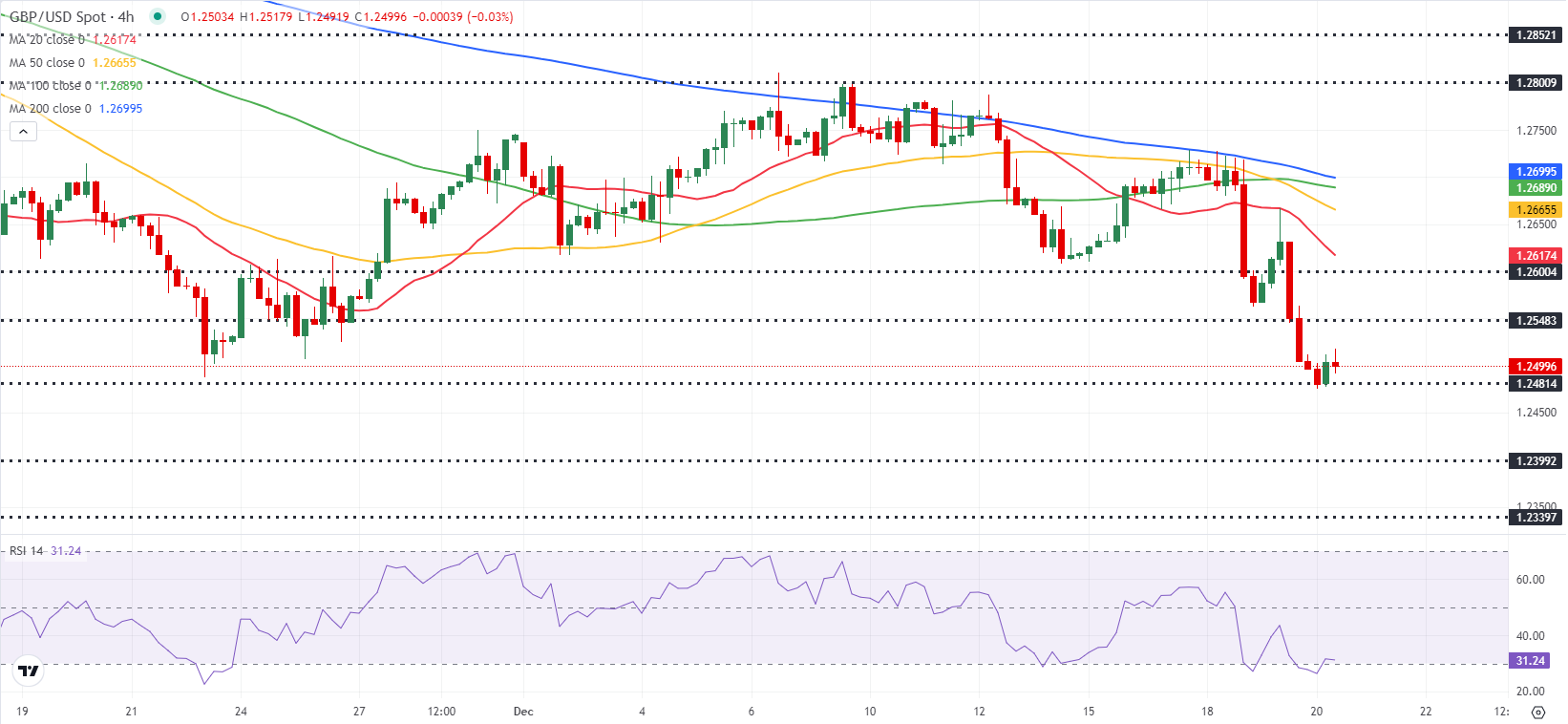
The GBP/USD extended its losses during the North American session, with sellers targeting a break below 1.2500. Cable is losing over 0.48% or 60 pips on the day. At the time of writing, the pair hovers near 1.2500.
US data released ahead of the New York open hinted that the labor market remains solid and the economy is expanding. Initial Jobless Claims for the week ending December 14 fell from 242K to 220K, below forecasts of 230K. Read more…
Following Wednesday’s loss of more than 1%, GBP/USD extended its slide on Thursday. After touching its weakest level since early May near 1.2470 in the Asian trading hours on Friday, the pair recovered to the 1.2500 area in the European session.
The Bank of England (BoE) maintained its bank rate at 4.75% after the December meeting, as expected. On a dovish twist, however, three members of the Monetary Policy Committee (MPC) voted for a 25 basis points (bps) rate cut. In its policy statement, the BoE said that they can’t commit to when or by how much they will cut rates in 2025, due to heightened uncertainty in the economy. Pound Sterling came under bearish pressure following the BoE’s policy announcements. Read more…
Silver price (XAG/USD) trades in a tight range around $29.00 in Friday’s European trading session. The white metal consolidates as investors await the United States (US) core Personal Consumption Expenditure Price Index (PCE) data for November, which will be published at 13:30 GMT.
Economists expect the US annual core PCE inflation data to have accelerated to 2.9% from 2.8% in October. On month, the underlying inflation data is estimated to have grown steadily by 0.2%. Signs of mild slowdown in price pressures are unlikely to impact market expectations that the Federal Reserve (Fed) will pause the policy-easing spell in the policy meeting in January 2025. However, a sharp deceleration could weigh on them. On the contrary, a mild or sharp acceleration in price pressures would strengthen them.
In the policy meeting on Wednesday, the Fed reduced its key borrowing rates by 25 basis points (bps) to 4.25%-4.50% but signaled fewer interest rate cuts for 2025. The Fed dot plot showed that officials collectively see Federal Fund rates heading to 3.9% by 2025 against 3.4% projected in September.
Ahead of the US PCE inflation data, the US Dollar Index (DXY), which tracks the Greenback’s value against six major currencies, edges lower after posting a fresh two-year high at 108.50. 10-year US Treasury yields tick lower to 4.56% from a fresh six-month high of 4.60%. Higher yields on interest-bearing assets increase the opportunity cost of holding an investment in non-yielding assets, such as Silver.
Silver price slides below the 200-day Exponential Moving Average (EMA), which trades around $29.35. The white metal weakens after a breakdown of the upward-sloping trendline around $30.20, which is plotted from the February 29 low of $22.30.
The 14-day Relative Strength Index (RSI) drops inside the bearish range of 20.00-40.00 range, guiding a downside momentum ahead.
Looking down, the September low of $27.75 would as key support for the Silver price. On the upside, the 50-day EMA around $30.90 would be the barrier.
Silver is a precious metal highly traded among investors. It has been historically used as a store of value and a medium of exchange. Although less popular than Gold, traders may turn to Silver to diversify their investment portfolio, for its intrinsic value or as a potential hedge during high-inflation periods. Investors can buy physical Silver, in coins or in bars, or trade it through vehicles such as Exchange Traded Funds, which track its price on international markets.
Silver prices can move due to a wide range of factors. Geopolitical instability or fears of a deep recession can make Silver price escalate due to its safe-haven status, although to a lesser extent than Gold’s. As a yieldless asset, Silver tends to rise with lower interest rates. Its moves also depend on how the US Dollar (USD) behaves as the asset is priced in dollars (XAG/USD). A strong Dollar tends to keep the price of Silver at bay, whereas a weaker Dollar is likely to propel prices up. Other factors such as investment demand, mining supply – Silver is much more abundant than Gold – and recycling rates can also affect prices.
Silver is widely used in industry, particularly in sectors such as electronics or solar energy, as it has one of the highest electric conductivity of all metals – more than Copper and Gold. A surge in demand can increase prices, while a decline tends to lower them. Dynamics in the US, Chinese and Indian economies can also contribute to price swings: for the US and particularly China, their big industrial sectors use Silver in various processes; in India, consumers’ demand for the precious metal for jewellery also plays a key role in setting prices.
Silver prices tend to follow Gold’s moves. When Gold prices rise, Silver typically follows suit, as their status as safe-haven assets is similar. The Gold/Silver ratio, which shows the number of ounces of Silver needed to equal the value of one ounce of Gold, may help to determine the relative valuation between both metals. Some investors may consider a high ratio as an indicator that Silver is undervalued, or Gold is overvalued. On the contrary, a low ratio might suggest that Gold is undervalued relative to Silver.