The main category of Forex News.
You can use the search box below to find what you need.
[wd_asp id=1]
The main category of Forex News.
You can use the search box below to find what you need.
[wd_asp id=1]
Important DisclaimersThe content provided on the website includes general news and publications, our personal analysis and opinions, and contents provided by third parties, which are intended for educational and research purposes only. It does not constitute, and should not be read as, any recommendation or advice to take any action whatsoever, including to make any investment or buy any product. When making any financial decision, you should perform your own due diligence checks, apply your own discretion and consult your competent advisors. The content of the website is not personally directed to you, and we does not take into account your financial situation or needs.The information contained in this website is not necessarily provided in real-time nor is it necessarily accurate. Prices provided herein may be provided by market makers and not by exchanges.Any trading or other financial decision you make shall be at your full responsibility, and you must not rely on any information provided through the website. FX Empire does not provide any warranty regarding any of the information contained in the website, and shall bear no responsibility for any trading losses you might incur as a result of using any information contained in the website.The website may include advertisements and other promotional contents, and FX Empire may receive compensation from third parties in connection with the content. FX Empire does not endorse any third party or recommends using any third party’s services, and does not assume responsibility for your use of any such third party’s website or services.FX Empire and its employees, officers, subsidiaries and associates, are not liable nor shall they be held liable for any loss or damage resulting from your use of the website or reliance on the information provided on this website.Risk DisclaimersThis website includes information about cryptocurrencies, contracts for difference (CFDs) and other financial instruments, and about brokers, exchanges and other entities trading in such instruments. Both cryptocurrencies and CFDs are complex instruments and come with a high risk of losing money. You should carefully consider whether you understand how these instruments work and whether you can afford to take the high risk of losing your money.FX Empire encourages you to perform your own research before making any investment decision, and to avoid investing in any financial instrument which you do not fully understand how it works and what are the risks involved.
Keep in mind that employment numbers out of Canada on Friday will have a major influence on what happens next. So, it could be even noisier than you would expect. Short-term pullbacks I think are buying opportunities with the 109 yen level underneath being massive support based upon previous resistance and of course, previous support. “Market memory” should continue to play a part here, and at this point, I think you have a situation where we are simply going to bounce around, but in a somewhat positive way in the near term.

The 200 day EMA is sitting above there, but the 50 day EMA sits right around the 109 yen level. In general, keep in mind that if the Canadian dollar continues to rally against the Japanese yen, it will be more of a risk on type of move as the Japanese yen is considered to be a major safety currency.
The Canadian dollar is highly influenced by crude oil, but in general, the interest rate differential in Canada being so much stronger than Japan is a major reason why this CAD/JPY pair has been going higher for a while. Buying dips will more likely than not be the way that I trade this market at least until we break down below the 50-day EMA when I might consider shorting. Longer term I think we probably go looking toward the 118 yen level but that would take serious time.
Ready to trade our Forex daily analysis and predictions? Here’s a list of the best Forex Trading platform in Canada to choose from.
Nonetheless, there is only one more trading day to the week and therefore natural gas will likely end the week with an inside week pattern. The high and low of the week will provide the pivot levels to watch heading into next week. Currently, the high for the week was 2.82 and the low was 2.51. Since natural gas has been increasing the number of bullish indications, the expectation is for an eventual upside breakout.
For example, the recent downswing the reversed from 2.21 support was a successful test of support at the 200-Day MA. In addition, once the swing low was established a new internal trendline shows the angle of ascent for the short-term advance, which has noticeably increased from the prior lower uptrend line.
The inside week pattern has the potential to see a strong breakout to the upside and begin a rally that triggers a breakout of a large symmetrical triangle pattern. The recent swing high of 3.02 is part of the swings that define the pattern. A breakout above there will trigger a breakout of the triangle, and a continuation of the rising trend that has delivered a higher swing low (C) but not yet a higher swing high. If natural gas can continue to strength following a breakout, then it has a chance at the first target zone from 3.35 to 3.45.
For a look at all of today’s economic events, check out our economic calendar.
Silver price (XAG/USD) bounces back above $31.00 in Thursday’s North American session after a sharp nosedive move on Wednesday. The white metal stays vigilant with investors focusing on the Federal Reserve’s (Fed) monetary policy decision, which will be announced at 19:00 GMT.
The Fed is widely anticipated to cut interest rates by 25 basis points (bps) to 4.50%-4.75%, according to the CME FedWatch tool. This would be the second interest rate cut by the Fed this year. The Fed started the policy-easing cycle in September, however, the rate-cut size was 50 bps.
Ahead of the Fed’s policy, the US Dollar Index (DXY), which gauges Greenback’s value against six major currencies, tumbles to near 104.60. The USD index retraces almost half of Wednesday’s rally, which was inspired by Republican Donald Trump’s victory in United States (US) presidential elections. 10-year US Treasury yields drop to near 4.41%.
Investors will pay close attention to the press conference of Fed Chair Jerome Powell’s speech to get cues about the impact of Trump’s victory on inflation and the interest rate outlook. Trump vowed to raise import tariffs and lower corporate taxes, which could boost inflationary pressures and labor demand.
Silver price slides to near $31.00 after breaking below the horizontal support plotted from the May 21 high of $32.50. The near-term trend of the Silver price has turned bearish as it has dropped below the 50-day Exponential Moving Average (EMA), which trades around $31.60.
The asset could find support near the upward-sloping trendline around $29.00, plotted from the February 28 low of $22.30.
The 14-day Relative Strength Index (RSI) dives to near 40.00. Should RSI (14) fall below 40.00, a bearish momentum will be triggered.
Silver is a precious metal highly traded among investors. It has been historically used as a store of value and a medium of exchange. Although less popular than Gold, traders may turn to Silver to diversify their investment portfolio, for its intrinsic value or as a potential hedge during high-inflation periods. Investors can buy physical Silver, in coins or in bars, or trade it through vehicles such as Exchange Traded Funds, which track its price on international markets.
Silver prices can move due to a wide range of factors. Geopolitical instability or fears of a deep recession can make Silver price escalate due to its safe-haven status, although to a lesser extent than Gold’s. As a yieldless asset, Silver tends to rise with lower interest rates. Its moves also depend on how the US Dollar (USD) behaves as the asset is priced in dollars (XAG/USD). A strong Dollar tends to keep the price of Silver at bay, whereas a weaker Dollar is likely to propel prices up. Other factors such as investment demand, mining supply – Silver is much more abundant than Gold – and recycling rates can also affect prices.
Silver is widely used in industry, particularly in sectors such as electronics or solar energy, as it has one of the highest electric conductivity of all metals – more than Copper and Gold. A surge in demand can increase prices, while a decline tends to lower them. Dynamics in the US, Chinese and Indian economies can also contribute to price swings: for the US and particularly China, their big industrial sectors use Silver in various processes; in India, consumers’ demand for the precious metal for jewellery also plays a key role in setting prices.
Silver prices tend to follow Gold’s moves. When Gold prices rise, Silver typically follows suit, as their status as safe-haven assets is similar. The Gold/Silver ratio, which shows the number of ounces of Silver needed to equal the value of one ounce of Gold, may help to determine the relative valuation between both metals. Some investors may consider a high ratio as an indicator that Silver is undervalued, or Gold is overvalued. On the contrary, a low ratio might suggest that Gold is undervalued relative to Silver.
However, they also noted that global economic uncertainty and volatility in financial markets are likely to influence future policy decisions. Meanwhile, a private survey showed sentiment among Japanese manufacturers weakened in November, driven by concerns over weak Chinese demand and persistent inflationary pressures.
According to stock trading platforms., US stocks hit all-time highs. According to trading, the three major US indices rose to record highs on Wednesday as Donald Trump secured the 2024 presidential race, defeating Kamala Harris. At the same time, the Standard & Poor’s 500 rose 2.4%, the Nasdaq advanced 2.8%. similarly, the Dow Jones rose more than 1,400 points, or 3.4%, recording its best day since 2022. Optimism about a second Trump administration is driving investor sentiment, with expectations of pro-business policies such as tax cuts, deregulation and tariffs expected to boost economic growth and corporate profits.
According to trading, the leading gains were sectors that are ready to benefit from Trump’s policies, including the financial, energy and industrial sectors. Bank stocks such as JPMorgan and Wells Fargo jumped more than 10% to record highs. Likewise, Nvidia shares rose more than 4% and Tesla shares jumped 14%. In contrast, real estate, consumer staples and utilities shares declined, with ProLogis down 1%, American Tower Corp down more than 7% and Walmart down 1%.
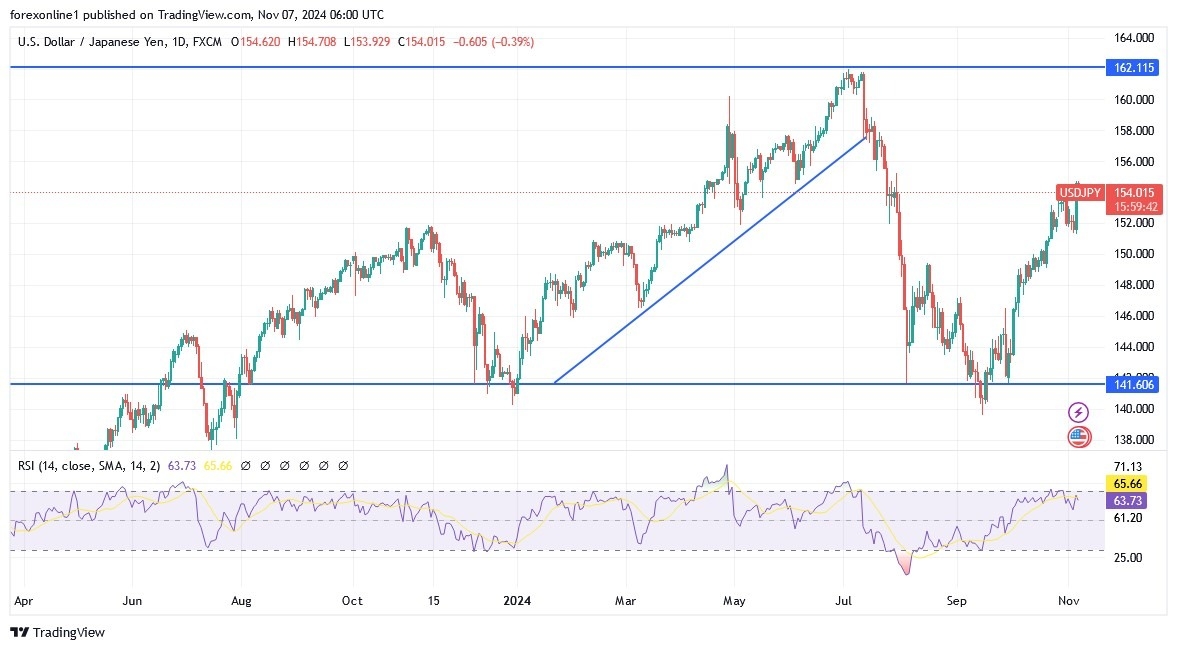
The overall upward trend of the USD/JPY currency pair is gaining strength, and Trump’s victory will bolster the bulls to achieve more. Technically, the upward movement may continue until there are Japanese signals to intervene in the foreign exchange market to prevent further currency depreciation. Especially, under Trump’s leadership, which opposes currency devaluation. Currently, the nearest resistance levels for the trend are 154.85 and 156.00, respectively.
Ready to trade our USD/JPY forex forecast? Here are the best forex brokers in Japan to choose from.
Experts predict that coffee prices on November 7, 2024 will likely continue to fluctuate within a narrow range due to pressure from supply and fluctuations in the international market.
The recovery of Robusta coffee prices on the London floor has partly supported domestic coffee prices, helping to prevent a sharp decline. However, the abundant coffee supply in Vietnam during the main harvest season still puts considerable pressure on coffee prices.
Vietnam’s robusta harvest could help ease price pressure, but the smaller output may not be enough to restore global coffee supplies in the long term. Vietnam’s coffee production this year (including Arabica and Robusta) is expected to be around 26-27 million bags, down from the USDA’s May estimate of 5 million bags, as the impact of drought has yet to be fully assessed.
| Coffee price forecast for November 7, 2024: Continue the uptrend |
Recorded in the trading session on November 6, 2024, today’s coffee price increased by 400 – 500 VND/kg, ranging from 105.900 – 106.400 VND/kg. Currently, the average purchase price in the Central Highlands provinces is 106.300 VND/kg, the highest purchase price in Dak Nong, Dak Lak, Gia Lai, Kon Tum provinces is 106.400 VND/kg.
Specifically, the coffee purchase price in Gia Lai province (Chu Prong) is 106.400 VND, an increase of 500 VND/kg compared to yesterday, in Pleiku and La Grai the same price is 106.300 VND/kg; In Kon Tum province, the price is 106.400 VND/kg, an increase of 500 VND/kg compared to yesterday; In Dak Nong province, coffee is purchased at the highest price of 106.400 VND/kg, an increase of 400 VND/kg compared to yesterday.
The price of green coffee beans (coffee beans, fresh coffee beans) in Lam Dong province in districts such as Bao Loc, Di Linh, Lam Ha, coffee is purchased at 105.900 VND/kg, an increase of 400 VND/kg compared to yesterday.
Domestic coffee price (date 6/11) in Dak Lak province; in Cu M’gar district, coffee is purchased at about 106.400 VND/kg, an increase of 400 VND/kg compared to yesterday, and in Ea H’leo district, Buon Ho town, coffee is purchased at the same price of 106.300 VND/kg.
Updated world coffee prices at 20:00 on November 6, 2024 Vietnam time on the London exchange, the price of Robusta coffee futures contract for monthly delivery January 2025 on the London exchange was at 4.267 USD/ton, down 105 USD compared to the beginning of the trading session.
 |
| Coffee price today November 6, 2024: Robusta coffee price on London floor. (Photo: Screenshot giacaphe.com |
The monthly delivery term March 2025 is 4.205 USD/ton, down 98 USD; the monthly delivery term May 2025 is 4.146 USD/ton, down 98 USD and the monthly delivery term May 2025 is 4.074 USD/ton, down 97 USD.
 |
| Arabica coffee price on New York floor on November 6, 2024. (Photo: Screenshot of giacaphe.com) |
Of which, the price of Arabica coffee on the New York floor at 20:00 on November 6, 2024 decreased in all terms, fluctuating at 241.20 – 245.20 cents/lb.
Specifically, the monthly delivery term December 2024 is 245.20 cents/lb; down 4.95 cents/lb compared to the beginning of the session. The monthly delivery term March 2025 is 244.60 cents/lb, down 4.80 cents/lb; the monthly delivery term May 2025 is 243.30 cents/lb, down 1.95 cents/lb and the monthly delivery term July 2025 is 241.20 cents/lb, down 4.80 cents/lb.
 |
| Brazilian Arabica coffee price on November 6, 2024.(Photo: Screenshot of giacaphe.com) |
Brazilian Arabica coffee prices today at 21:00 p.m. November 6, 2024 increased and decreased in opposite directions. Specifically, the monthly delivery term December 2024 was 300.00 USD/ton, down 1.40%; the monthly delivery term March 2025 was 299.50 USD/ton, down 1.40%; the monthly delivery term May 2025 was 304.05 USD/ton, up 1.93% and the monthly delivery term July 2025 was 301.10 USD/ton, up 1.93%.
Robusta coffee traded on ICE Futures Europe (London floor) opens at 16:00 and closes at 00:30 (the next day), Vietnam time.
Arabica coffee on the ICE Futures US floor (New York floor) opens at 16:15 p.m. and closes at 01:30 a.m. (the next day), Vietnam time.
Rains in key coffee-producing regions in October facilitated flowering, raising producers’ expectations for the 10-2025 crop, the Brazilian Agricultural Research Agency (CEPEA) said. However, concerns about crop development remain uncertain, given that coffee plants have been affected by high temperatures and a lack of rain for nearly six months in some areas.
The 2023-2024 crop failure, high prices and low yields have led to a high rate of sales this year, leaving inventories tight, raising concerns about coffee supplies until Brazil’s next crop.
Information for reference only. Prices may vary depending on locality.
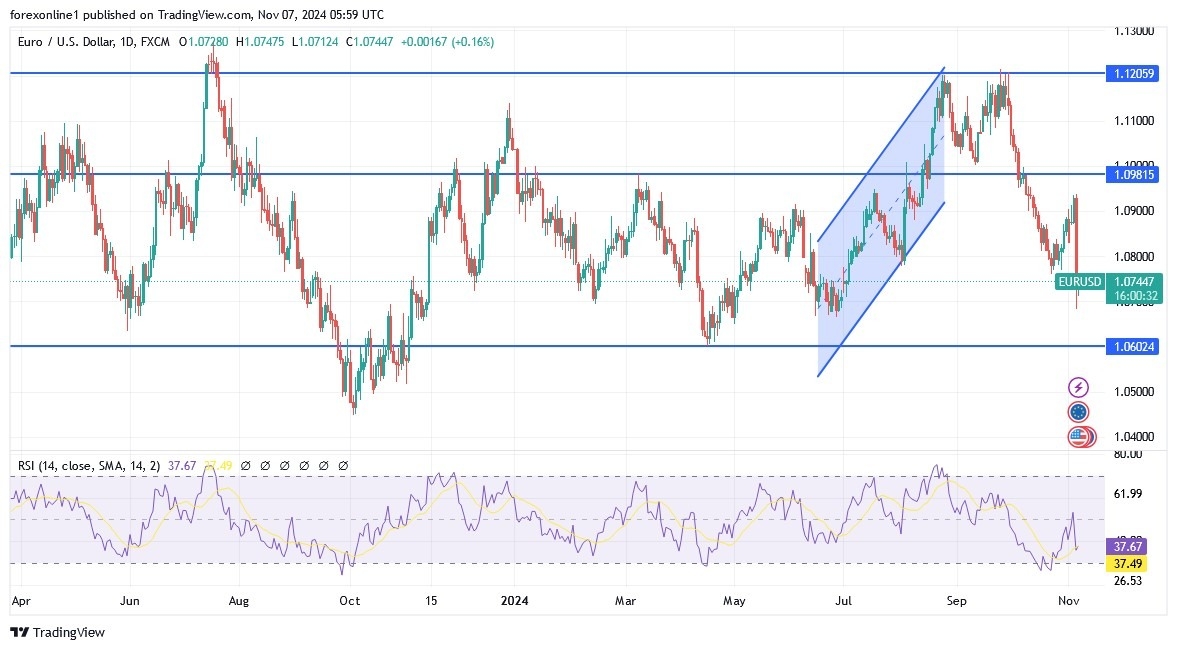
On the other hand, the euro was the hardest hit among G10 currencies. It had fallen 1.75% against the US dollar to $1.0740 as of 8 a.m. CET, putting it on track for its worst day since March 2020. At 11:18 a.m. CET on Wednesday, the EUR/USD exchange rate showed a slight recovery to 1.0749 on Wednesday after falling to a four-month low of around 1.0682.
Forex analyst Kyle Chapman of Ballinger Group attributed the dollar’s rise to the market’s positioning for potential Trump-led policies. “The US dollar rocketed across the board in its best day in four years,” Chapman noted. He stressed that Trump’s expected economic approach, which includes inflationary pressures and tariffs, is a key factor. With the New York Times estimating a Trump win chance at more than 95%, financial markets appear to be pricing in the former president’s impact on US trade and economic direction. Chapman’s comments underscore market expectations of a more protective US trade stance, which could impact global trade dynamics.
Many believe that a Trump win could mean an extension of his trade policies in his first term, potentially affecting a wider range of US trading partners, not just China. This expectation is driving the dollar’s strength as investors seek refuge in the US currency, which is now seen as more resilient under Trump.
The euro has been hit hard by these developments, remaining the weakest among G10 currencies. Ulrich Leuchtmann, head of FX and commodity research at Commerzbank, explained that Trump’s restrictive trade policies are expected to disproportionately impact the eurozone. He noted that “the eurozone is likely to suffer disproportionately from a restrictive US trade policy,” stressing that export-dependent European economies, especially Germany, will face challenges in maintaining growth. Germany’s reliance on exports has been a key component of the eurozone’s economic strength, but a US shift away from open trade flows could upend this dynamic, threatening to exacerbate the eurozone’s growth shortfall. Such a scenario could deepen the euro’s struggles in the coming months, especially if US tariffs are imposed or trade routes are disrupted.
As analysts see further downside for the euro in the near term, ING FX analyst Chris Turner suggested a tough future for EUR/USD under Trump’s trade policies. He said, “This would be the worst-case scenario for EUR/USD – facing renewed trade wars but without the boost to global growth that extended US tax cuts could provide,”. They expect that if this trend continues, the EUR/USD pair could fall below parity by late 2025.
Currently, the euro price is facing pressure in the near term, with analysts expecting further declines if Trump’s path to the White House remains clear. While some market pricing has already priced in a potential Trump victory, there is a consensus that the EUR/USD pair could approach the 1.0550/1.0600 range in the coming days if the dollar price continues to strengthen. Especially, in light of the limited support from the eurozone for growth under these conditions.
Technically, the euro price is heading for its worst day since March 2020 as Trump’s victory in the US presidential election strengthened the dollar. Obviously, a Trump victory poses significant risks to the European economy. Especially, with potential tariffs on key sectors such as cars and chemicals, along with concerns over security and support for Ukraine.
Ready to trade our EUR/USD Forex analysis? We’ve made a list of the best forex demo accounts worth trading with.
Spot Gold rallied after Wall Street’s opening, nearing the $2,700 mark after trading as low as $2,643.28 early in the Asian session. The US Dollar lost steam on persistent stocks’ strength following the United States (US) presidential election result. Most Asian and European indexes closed in the green, in line with renewed risk appetite, which finally took its toll on the USD.
US indexes trade mixed, with the S&P500 extending its recent rally to unexplored territory, but the Dow Jones Industrial Average (DJIA) was barely capable of holding ground. Market participants await the Federal Reserve (Fed) monetary policy announcement. The Fed is expected to trim the interest rate by 25 basis points (bps), a movement that was priced long ago.
Market players, however, will focus on how the Fed will respond to the latest political developments in the US. Trump’s victory is seen as a steep turnaround that could interrupt the recently adopted monetary loosening path. Chairman Jerome Powell has multiple times remarked on the central bank’s independence from the government and will likely repeat so in his post-decision speech.
Nevertheless, neither Powell nor investors could ignore the fact that Trump’s ideas alongside the Republican platform may bring back to the table mounting inflationary pressures. In such a scenario, Gold is likely to strengthen.
From a technical point of view, the upside seems limited for XAU/USD. In the daily chart, the bright metal remains below its 20 Simple Moving Average (SMA), which anyway maintains its bullish slope. The 100 and 200 SMAs also head north but far below the current level, suggesting the long-term bias is bullish. Finally, technical indicators turned marginally higher, with the Momentum hovering within neutral levels and the Relative Strength Index (RSI) indicator developing around 50. The modest uptick is not enough, however, to confirm additional gains ahead.
The 4-hour chart shows technical indicators have corrected extreme oversold conditions but also that the advance loses steam within negative levels. At the same time, the pair surpassed a flat 200 SMA, which currently provides support at around $2,687.40. Nevertheless, the 20 SMA maintains its downward slope above the current level and moves further below the 100 SMA, limiting the bullish potential in the near term.
Support levels: 2,687.50 2,673.90 2,652.25
Resistance levels: 2,700.00 2,714.90 2,731.45
Above: Bank of England Governor Andrew Bailey delivers a post-MPC press conference in November. Image courtesy of the Bank of England, reproduced under CC licensing conditions.
Pound Sterling is stabilising against the Dollar, with the worst post-election predictions failing to materialise. Traders now have the Bank of England and Federal Reserve to contend with.
Another busy day awaits Dollar traders, with the Bank of England and Federal Reserve both likely to cut interest rates and address recent political developments.
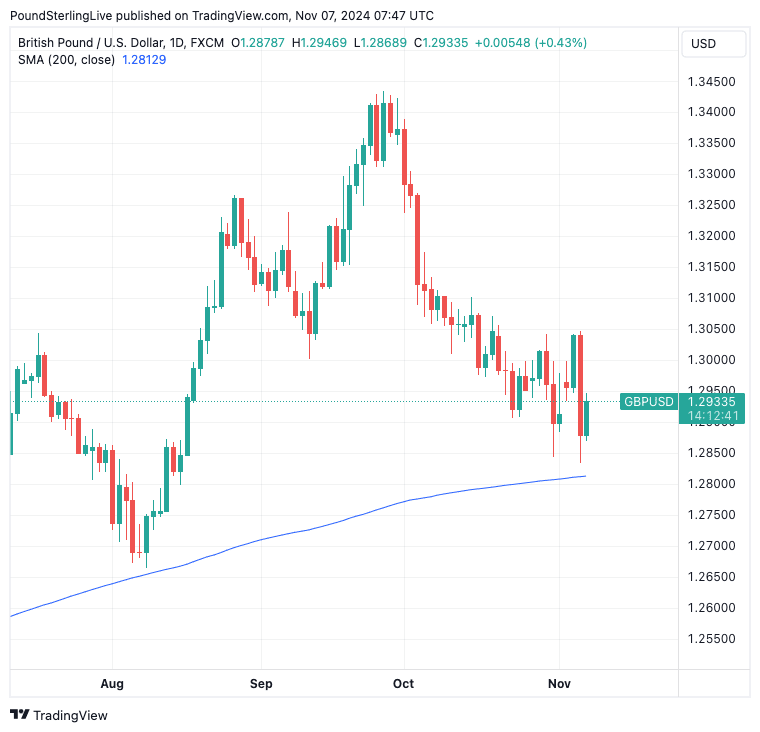
The Pound to Dollar exchange rate (GBP/USD) slumped by 1.25% on the day it was announced Donald Trump had won the Presidential election and his Republican Party was 90% likely to take full control of Congress.
As the impact of the outcome – which markets weren’t quite prepared for (a red sweep had an approximate 30% probability) – is digested, the losses have faded.

At the time of writing Thursday, GBP/USD is back above 1.29 at 1.2935. The stabilisation means key support lines around 1.2813 have been defended, and a bigger post-election rout might have been avoided.
The market was swift to react to Trump’s strong showing, but the lack of follow through confirms markets are entering a new phase.
“In reflection of the huge range of uncertainties, the USD’s rally is already showing signs of fatigue,” says Jane Foley, Senior FX Strategist at Rabobank. “Overall, it is to too early to draw strong conclusions on the impact of Trump’s policies and this is resulting in a reluctance by investors to extend the USD’s rally for the time being.”
GBP/USD investment bank consensus forecasts: The end-2024 and 2025 guide from Corpay has been released. It shows a sizeable uplift was made to the consensus forecasts for GBP/USD. Please request a copy here.
We know what Trump wants to do, but we don’t know what he will do. He is notoriously unpredictable, a trait that he uses to his advantage on the global stage.
Economists observe Trump will want to negotiate on matters of trade, which means the worst-case scenarios that he threatened during the campaign might yet be avoided. These include a 60% tariff on all Chinese goods.
Markets will be alert to developments regarding the new administration and its prospective policies in the coming days, so we wouldn’t say the dollar’s ascent has ended just yet as it will be sensitive to headlines.
The next question for the Pound is how does the Bank of England react to recent events?
Interest rates will be cut by 25 basis points, as has been expected for some time. However, the Bank will need to decide whether to cut them again in December.
The new economic forecasts, which the Bank uses to guide market expectations, will provide some answers.

There will be some degree of uncertainty as to whether last week’s budget decisions have been fully incorporated into the forecasts. In particular, we know growth will likely rise near term as the government’s borrowing and spending spree juices the economy.
This will give reason for the Bank to strike a tone of caution, which can underpin the Pound.
The Office for Budget Responsibility released its forecasts alongside the budget last week, and these should offer some guidelines for what to expect from the Bank.
The OBR raised its inflation expectations, which, if repeated by the Bank, would amount to a ‘hawkish’ development for the Pound. It also raised growth projections for next year, although forecasts for the medium-term (through to 2029) were downgraded.
The tone of the Bank’s guidance and Governor Bailey’s post-decision interview will also be important for the Pound.
Expect Bailey to field questions about rising borrowing costs following the budget and Donald Trump’s victory yesterday.
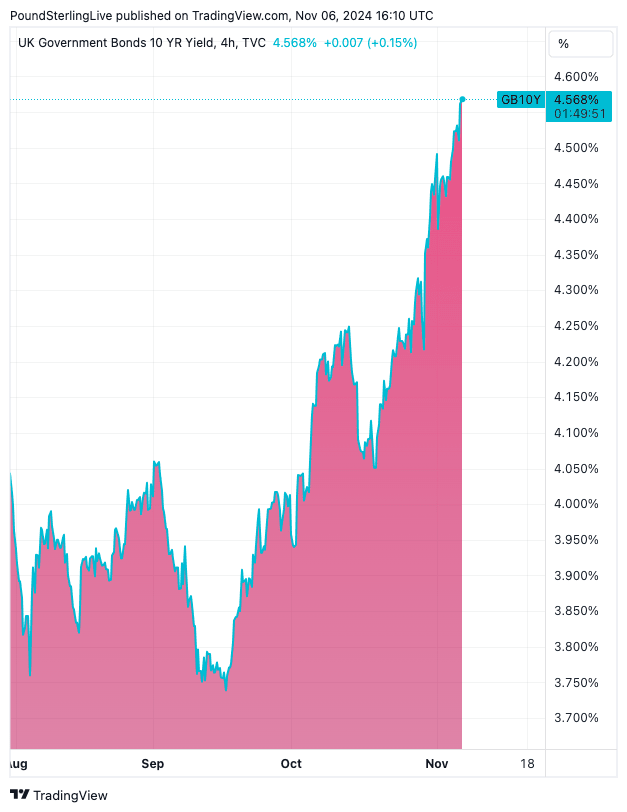
Above: UK ten-year bond yields have surged.
The Bank will have to be particularly cautious in this febrile environment, and loose lips could see the Pound punished.
The Federal Reserve will cut interest rates by 25 basis points, but again, the more pertinent question for markets is what happens in December and in 2025.
Already, we have seen expectations for a December rate cut recede, while a number of investment banks have cut their forecasts for the amount of easing to follow in 2025.
This is because they think a Trump administration offers inflationary policies, including tariffs and tax cuts.
With inflation still above the 2.0% target, the Fed must proceed cautiously.
According to the CME FedWatch Tool, the probability of a 25-basis-point rate cut in January, assuming a half-point cut this year, has declined from 69% a month ago to 32% today.
Economists at Nomura now expect just one Fed cut in 2025, with policy on hold until the realised inflation shock from tariffs has passed.
“We expect Trump to follow through on his campaign proposals to raise tariffs, leading to a significant near-term boost to inflation and modestly lower growth,” says David Seif, an economist at Nomura. “We expect some additional easing in 2026 but have raised our terminal rate forecast to 3.625% from 3.125%.”
Wells Fargo economists say they are reassessing their forecasts for the Federal Reserve’s base rate in the wake of the election.
“The FOMC’s reaction function likely would be more hawkish in response to higher inflation from tax cuts than from tariffs. Tighter monetary policy is an effective method for slowing demand growth, but it cannot do much to combat inflationary pressure from a supply shock such as tariffs,” says Wells Fargo economist Jay Bryson.
The recent re-election of former President Donald Trump has bolstered some bullish sentiment, with expectations that his administration’s energy policies could favor oil and gas production. Trump has pledged to reduce regulatory restrictions on fossil fuel producers, which could provide some long-term support for natural gas. Market reaction to Trump’s win initially pushed prices up 7.7 cents on Wednesday, but futures have since pulled back slightly as traders digest these developments in the broader context of supply and demand.
Forecasts for the Nov 7-13 period indicate milder-than-average conditions across much of the U.S., with cooler weather concentrated in the western and central states. The southern and eastern regions will see warmer temperatures, reducing natural gas heating demand. According to NatGasWeather, overall demand is projected to be light to very light, limiting the likelihood of a weather-driven price spike in the immediate term.
Today’s EIA report is expected to show a storage build of 64-66 Bcf, well above the five-year average of 32 Bcf. This increase reflects mild weather across much of the U.S. last week and robust wind energy output, which has dampened natural gas demand for power generation. A build close to this range would increase the inventory surplus to over 200 Bcf above the seasonal average, further weighing on prices.
Given ample storage and mild demand, the near-term outlook for natural gas remains bearish. Without a strong catalyst to drive up demand, prices may face continued downward pressure, potentially testing support levels. Traders should monitor today’s EIA report closely, as a larger-than-expected build would likely reinforce a bearish trend.