The main category of Forex News.
You can use the search box below to find what you need.
[wd_asp id=1]
The main category of Forex News.
You can use the search box below to find what you need.
[wd_asp id=1]
Most Read: EUR/USD Update – Euro Vulnerable on Rate Cut Bets and Safe Haven Flows
The Japanese Yen is going through a bumpy week with a new PM incoming, snap elections and modest safe haven gains. The list of issues facing the currency continues to expand as markets assess the monetary policy path of the incoming PM.
Comments thus far do not suggest any significant changes with incoming PM Ishiba today stating he expects monetary easing trend to stay in place. The PM also mentioned that he expects to work closely with the BoJ to overcome deflation and improve the economy.
Governor of the BoJ Kazuo Ueda who was brought in largely to facilitate a normalization in policy looks likely to continue his work without too much outside influence. At present markets are still unsure as to when the BoJ may raise rates again and this is in part responsible for recent Yen weakness.
The Yen did catch a bid on Tuesday as heightened geopolitical risks saw a flood into haven assets as the risk-off mood began to take hold. However, today we are seeing a strong US Dollar and GBP in particular which has pushed yen pairs higher on the day.
On the economic data front there is nothing major expected this week from Japan, EU or the UK. The biggest data release is the NFP and jobs report on Friday out of the US which could affect USD/JPY but could also have a knock on effect on overall market sentiment.
Beyond that it is key to keep an eye on developments in the Middle East. Any changes could see a flood into safe havens once more which could work in the Yens favor, even if it only proves to be temporary.
Source: For all market-moving economic releases and events, see the MarketPulse Economic Calendar. (click to enlarge)
USD/JPY
The USD/JPY pair has been hovering in a range of about 500 pips for the last 8 trading days. The return of USD strength has helped the pair stave off a retest of the psychological 140.00 handle.
At the time of writing USDJPY is eyeing a candle close above a key resistance area which could open up a run toward the 150.00 psychological mark. A rejection at the 146.37 handle could however lead to a push toward the most recent lows.
On the daily timeframe price action is messy as well with a higher high followed by a lower low and change in structure. A daily candle close above the 145.00 is enough to see another change in structure which would suggest that favor currently rests with the bulls.
Support
Resistance
USD/JPY Daily Chart, October 2, 2024

Source: TradingView.com (click to enlarge)
GBP/JPY
GBP/JPY is at a key confluence area which could help define the upcoming price action for the pair. Having been stuck in a range since Monday it was nice to see a bit of GBP strength return and push the GBP/JPY to closer to the 200.00 psychological mark.
Immediate resistance rests at 195.859 which is provided by the 100-day MA. A break beyond this level opens up a potential run toward 200.00.
GBP/JPY Daily Chart, October 2, 2024

Source: TradingView.com (click to enlarge)
Support
Resistance
EUR/JPY
The EUR/JPY is almost identical in terms of price action to the GBP/JPY. The increasing rate cut bets where the ECB are concerned has failed to dampen the spirits of EUR/JPY bulls.
Technically speaking, following the significant selloff in EUR/JPY which began on July 11, EUR/JPY has yet to retrace even 50% of that move.
This means room for a deeper recovery remains in EUR/JPY and given the lack of data expected out this week we could very well get a continuation of the recent bullish price action.
Immediate resistance rests at 161.85 with a break higher facing a key confluence zone around the 163.50-164.00 handles.
EUR/JPY Daily Chart, October 2, 2024

Source: TradingView.com (click to enlarge)
Support
Resistance
Follow Zain on Twitter/X for Additional Market News and Insights @zvawda
Content is for general information purposes only. It is not investment advice or a solution to buy or sell securities. Opinions are the authors; not necessarily that of OANDA Business Information & Services, Inc. or any of its affiliates, subsidiaries, officers or directors. If you would like to reproduce or redistribute any of the content found on MarketPulse, an award winning forex, commodities and global indices analysis and news site service produced by OANDA Business Information & Services, Inc., please access the RSS feed or contact us at info@marketpulse.com. Visit https://www.marketpulse.com/ to find out more about the beat of the global markets. © 2023 OANDA Business Information & Services Inc.

He has spent the last 3 years in an analyst role honing his skills across various financial domains, including technical analysis, economic data interpretation, price action strategies, and analyzing the geopolitical impacts on global markets. Currently, Zain is advancing in obtaining his Capital Markets & Security Analyst (CMSA) designation through the Corporate Finance Institute (CFI), where he has completed modules in fixed income fundamentals, portfolio management fundamentals, equity market fundamentals, introduction to capital markets, and derivative fundamentals.
He is also a regular guest on radio and television programs in South Africa, providing insight into global markets and the economy. Additionally, he has contributed to the development of a financial markets course approved by BankSeta (Banking Sector Education and Training Authority) at NQF level 6 in South Africa.

The GBP/USD weekly forecast shows a sudden shift in sentiment to the downside as the dollar regains its shine.
The GBP/USD price made a solid bearish candle for the week as the dollar firmed against the pound. It was a strong week for the greenback as data, policymaker remarks, and Middle East tensions supported the currency.
–Are you interested to learn more about day trading brokers? Check our detailed guide-
The first catalyst for the dollar was Powell’s hawkish speech, which dashed hopes for a 50-bps rate cut in November.
Meanwhile, data from the US showed a tight labor market, with vacancies and private employment rising more than expected. Furthermore, the nonfarm payrolls report revealed a bigger-than-expected employment jump.
Elsewhere, Middle East tensions increased demand for the safe-haven dollar.
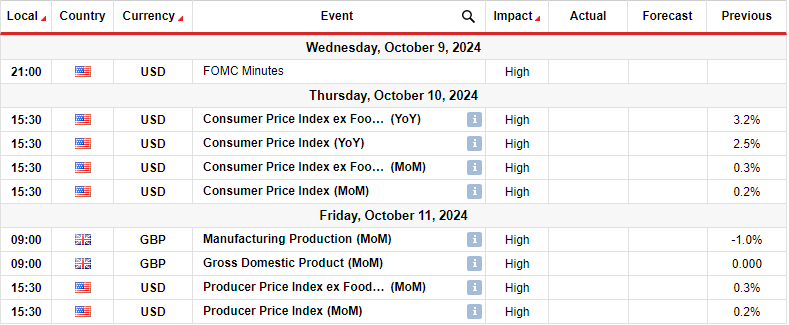
Next week, market participants will focus on the FOMC minutes. The minutes might contain clues on what policymakers might do in the future. At the same time, the US CPI and PPI reports will show whether inflation is nearing the Fed’s 2% target.
Analysts believe consumer inflation will ease further in September from 2.5% to 2.3%. A bigger-than-expected drop will pile pressure on the Fed to lower borrowing costs. As a result, bets for a 50-bps November rate cut would increase. On the other hand, an unexpected jump would favor a smaller rate cut.
In the UK, market participants will focus on manufacturing production and the GDP report. A resilient economy will lower bets for BoE rate cuts, while the opposite is true.
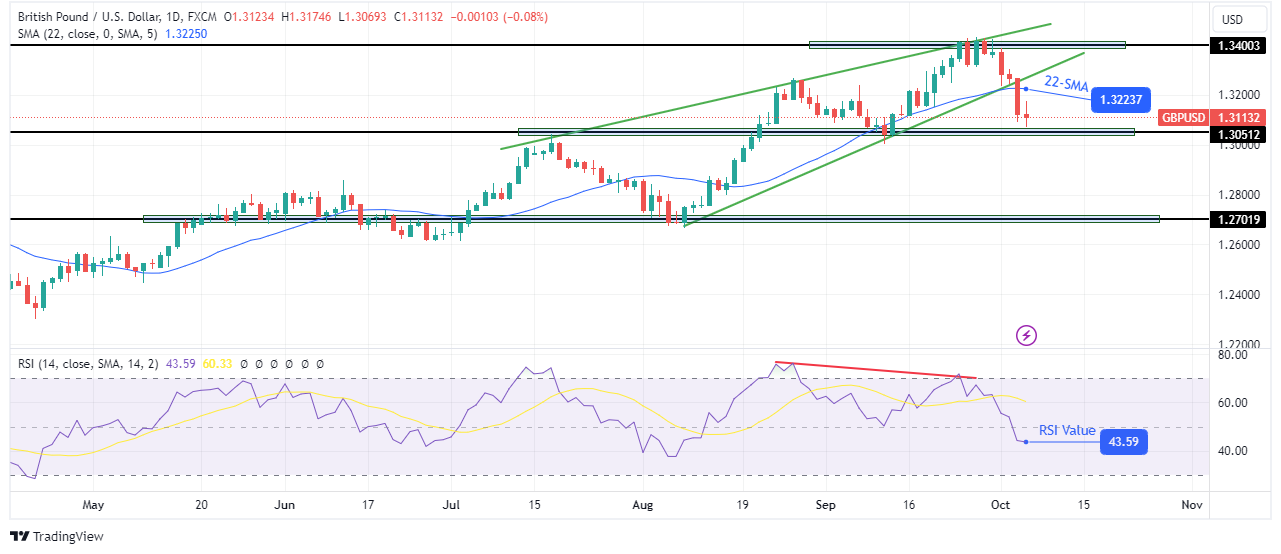
On the technical side, the GBP/USD price has broken out of its bullish wedge to the downside. At the same time, it has broken below the 22-SMA, indicating a shift in sentiment. Previously, the price made a series of higher highs and lows in a wedge pattern.
-Are you looking for the best AI Trading Brokers? Check our detailed guide-
However, the uptrend paused when it reached the 1.3400 resistance. Here, the RSI made a bearish divergence, indicating fading bullish momentum. Soon after, bears got strong enough to break out of the bullish wedge. In the coming week, the price will face the 1.3051 support level. A break below would clear the path to the 1.2701 support, strengthening the bearish bias.
Looking to trade forex now? Invest at eToro!
67% of retail investor accounts lose money when trading CFDs with this provider. You should consider whether you can afford to take the high risk of losing your money.
The USD/JPY rallied sharply inside the Ichimoku cloud (Kumo) after the US Bureau of Labor Statistics (BLS) revealed that the latest jobs report added over 254K employees to the workforce. This underpinned US Treasury yields, which lifted the exchange rate to current price levels due to their close correlation with the pair. The major trades at 148.73, up by over 1%.
The USD/JPY aimed higher, yet it remains far from turning bullish. Despite this, bulls are in charge in the short term, eyeing a decisive break above the August 15 high of 149.39 and the 150.00 figure.
The Relative Strength Index (RSI) is bullish, aiming upwards, suggesting further upside is seen in the USD/JPY pair.
If buyers clear 150.00, the next resistance would be the 200-day moving average (DMA) at 151.06. On further strength, that will expose the 100-DMA at 151.94.
Conversely, the USD/JPY first support would be the 148.00 figure. Once surrendered, the first support would be the Senkou Span B at 147.78, followed by the bottom of the Kumo at 146.90-147.00.
The table below shows the percentage change of Japanese Yen (JPY) against listed major currencies today. Japanese Yen was the strongest against the New Zealand Dollar.
| USD | EUR | GBP | JPY | CAD | AUD | NZD | CHF | |
|---|---|---|---|---|---|---|---|---|
| USD | 0.52% | -0.02% | 1.22% | 0.15% | 0.64% | 0.85% | 0.72% | |
| EUR | -0.52% | -0.52% | 0.72% | -0.35% | 0.11% | 0.35% | 0.18% | |
| GBP | 0.02% | 0.52% | 1.25% | 0.18% | 0.64% | 0.86% | 0.69% | |
| JPY | -1.22% | -0.72% | -1.25% | -1.07% | -0.59% | -0.40% | -0.54% | |
| CAD | -0.15% | 0.35% | -0.18% | 1.07% | 0.47% | 0.72% | 0.52% | |
| AUD | -0.64% | -0.11% | -0.64% | 0.59% | -0.47% | 0.22% | 0.03% | |
| NZD | -0.85% | -0.35% | -0.86% | 0.40% | -0.72% | -0.22% | -0.18% | |
| CHF | -0.72% | -0.18% | -0.69% | 0.54% | -0.52% | -0.03% | 0.18% |
The heat map shows percentage changes of major currencies against each other. The base currency is picked from the left column, while the quote currency is picked from the top row. For example, if you pick the Japanese Yen from the left column and move along the horizontal line to the US Dollar, the percentage change displayed in the box will represent JPY (base)/USD (quote).
The technical analysis of course is somewhat mixed at this point, but I believe that the ¥109 level is going to end up being a major point of inflection, as traders breaking through that level could open up a move toward the 200 Day EMA. Anything above the 200 Day EMA opens up a much bigger move, perhaps to the ¥115 level before it’s all said and done. Furthermore, we also have to pay attention to the idea of what’s going on with the carry trade, as that is obviously a major influence on what happens next in all of the Japanese yen will dated pairs.

The Bank of Japan has just decided to sit still on the idea of raising rates again recently, and therefore it did put a little bit of softness back into the Japanese yen. Furthermore, we also had seen the head of the Bank of Japan recently admit that they probably could not raise rates anytime soon. In other words, this will more likely than not send the carry trade back into full motion, and if that’s going to be the case, I think you get a situation where value hunters will look at dips as a potential opportunity to get long of this market and collect all that swap at the end of the day.
At this point, I suspect that the ¥105 level will become the floor, assuming that we even pull back that far. I don’t expect it to, so with this I am looking at dips that show signs of support and a bounce as a buying opportunity, but I also would not hesitate to start buying this market above the ¥109 level on a daily close that clears that region.
Ready to trade our daily Forex analysis? We’ve made a list of the best forex demo accounts worth trading with.
Silver price declined marginally on Friday, going down by 0.5 to trade at $31.87 at the time of writing on the heels of upbeat US labour market data. The greyish metal got rejected at $32.30 in its most recent ascent, but it will likely attempt another go at it as the geopolitical situation in the Middle East provides tailwinds.
US Non-Farm Payrolls numbers beat forecasts in September, coming in at 254k against the median forecast figure of 147k. Meanwhile, the August reading was revised upward from 142k to 159k, signaling a robust jobs situation. In addition, unemployment rate fell to 4.1 percent from August’s 4.2 percent which analysts had forecast to remain unchanged.
Solid jobs growth in the United States eases pressure on the Federal Reserve to cut interest rates by a deeper margin and puts pressure on dollar-denominated silver. With inflation subsiding significantly in recent months, the Fed will likely pay greater attention to the jobs market in its interest rate decision making.
That said, continued escalation of war in the Middle East and the fear sentiment surrounding it will provide safe haven demand for silver as investors seek to diversify their portfolio. Israel had sworn to retalliate Iran’s missile attack, and markets willl be on the edge as investors wait to see the direction the conflict takes. That could provide support for silver price in the near-term.
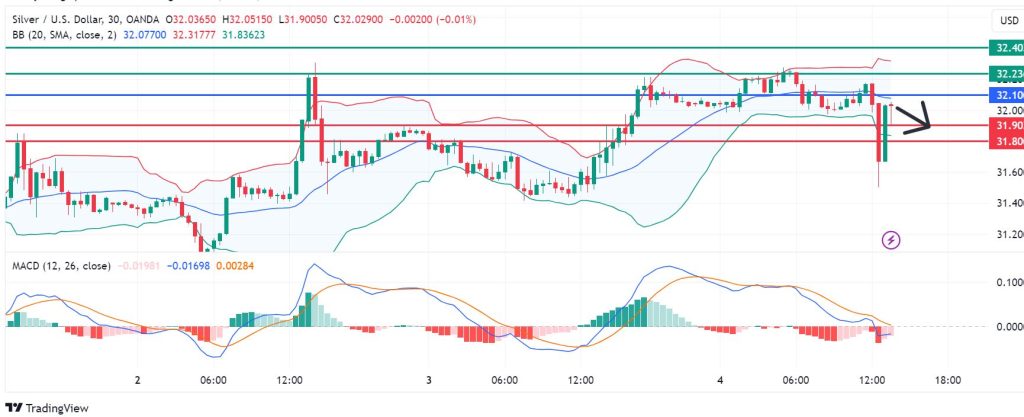
The momentum on silver price calls for further downside, with the MACD indicator line below the signal line. The pivot will likely be at 32.10, with the first support coming at 31.90. However, a stronger bearish momentum could breach that mark and send the price to test 31.80.
Alternatively, moving above 32.10 will favour the buyers, who could advance further to the first resistance at 31.90. However, if they manage to break above that mark, the downside narrative will be invalid, and the momentum could see the price move to the next barrier established at 31.80.
The Pound Sterling (GBP) closed the week deep in the red against the US Dollar (USD), as the GBP/USD extended the correction from 30-month highs to below 1.3100.
GBP/USD failed to sustain at higher levels and returned to negative territory, giving up almost 300 pips in the past week. The pair faced a double whammy, with the resurgence of the demand for the US Dollar on one hand while on the other side, the Pound Sterling was thrown under the bus on the Bank of England’s (BoE) dovish policy expectations and the risk-averse market environment.
The recent slew of strong US economic data, including JOLTS Job Openings, ADP Employment Change and ISM Services PMI poured cold water on bets that the Federal Reserve (Fed) will opt for a 50 basis points (bps) interest rate cut in November, fuelling a sustained recovery in the US Dollar against its major rivals.
Data on Tuesday showed that US Job Openings rebounded to a three-month high in August, arriving at 8.04 million after declining to 7.71 million in July. The Automatic Data Processing (ADP) reported on Wednesday that the US private sector employment increased by 143,000 jobs for September, accelerating from the upwardly revised 103,000 in August and better than the 120,000 estimate.
Meanwhile, US ISM Services PMI jumped from 51.5 to 54.9 in September, above the forecast of 51.7 while marking the highest reading since February 2023. Markets now price in about a 34% chance that the Fed will deliver a big rate cut at its next meeting, compared with almost 60% last week, the CME Group’s FedWatch Tool shows.
The Greenback also drew haven demand from mounting risks of the Israel-Iran conflict turning into a wider regional war in the Middle East. Iran conducted missile attacks on Israel to avenge last week’s killings of leaders of the Tehran-back militant group Hezbollah. Israel responded by striking an apartment in central Beirut, which killed nine people. The Lebanese Army returned Israeli fire for the first time in nearly a year of fighting between Israel and Hezbollah.
On the Pound Sterling side of the equation, the prevalent risk aversion continued to remain a weight on the high-beta currency. However, it was BoE Governor Andrew Bailey’s dovish commentary in an interview with The Guardian on Thursday that exacerbated its pain, knocking off the GBP/USD pair to the lowest level in three weeks at 1.3092.
Bailey said that the BoE could become a bit ‘more activist’ on rate cuts if there’s further good news on inflation. Following his remarks, UK money markets suggested about 42 bps of rate cuts to bank rate in the remainder of 2024 versus about 36 bps on Wednesday.
The pair licked its wounds on Friday amid persistent Middle East concerns and the market’s nervousness heading into the US NFP showdown. Nevertheless, GBP/USD turned south in the second half of the day and dropped below 1.3100 as the USD capitalized on the upbeat US data. Nonfarm Payrolls (NFP) in the US rose by 254,000 in September, beating the market forecast of 140,000 by a wide margin. Moreover, August’s NFP increase of 142,000 got revised higher to 159,000.
The early part of the upcoming week is a quiet one until midweek when the Minutes of the Fed’s September meeting will be released on Wednesday. The absence of high-impact economic releases from the UK and the US will put the focus on a flurry of speeches from the Fed policymakers on Monday and Tuesday.
On Thursday, the highly influential US Consumer Price Index (CPI) data will be reported alongside the weekly Jobless Claims. Following the data releases, New York Fed President John Williams is due to participate in a moderated discussion about the economic outlook and monetary policy at Binghamton University.
Friday will feature the monthly Gross Domestic Product (GDP) and Industrial Production data from the UK. The US calendar will see the publication of the Producer Price Index (PPI) and preliminary Michigan Consumer Sentiment and Inflation Expectations data the same day.
Besides, Middle East geopolitical developments will continue to remain on traders’ radars throughout the week, as tensions between Israel and Iran intensify.
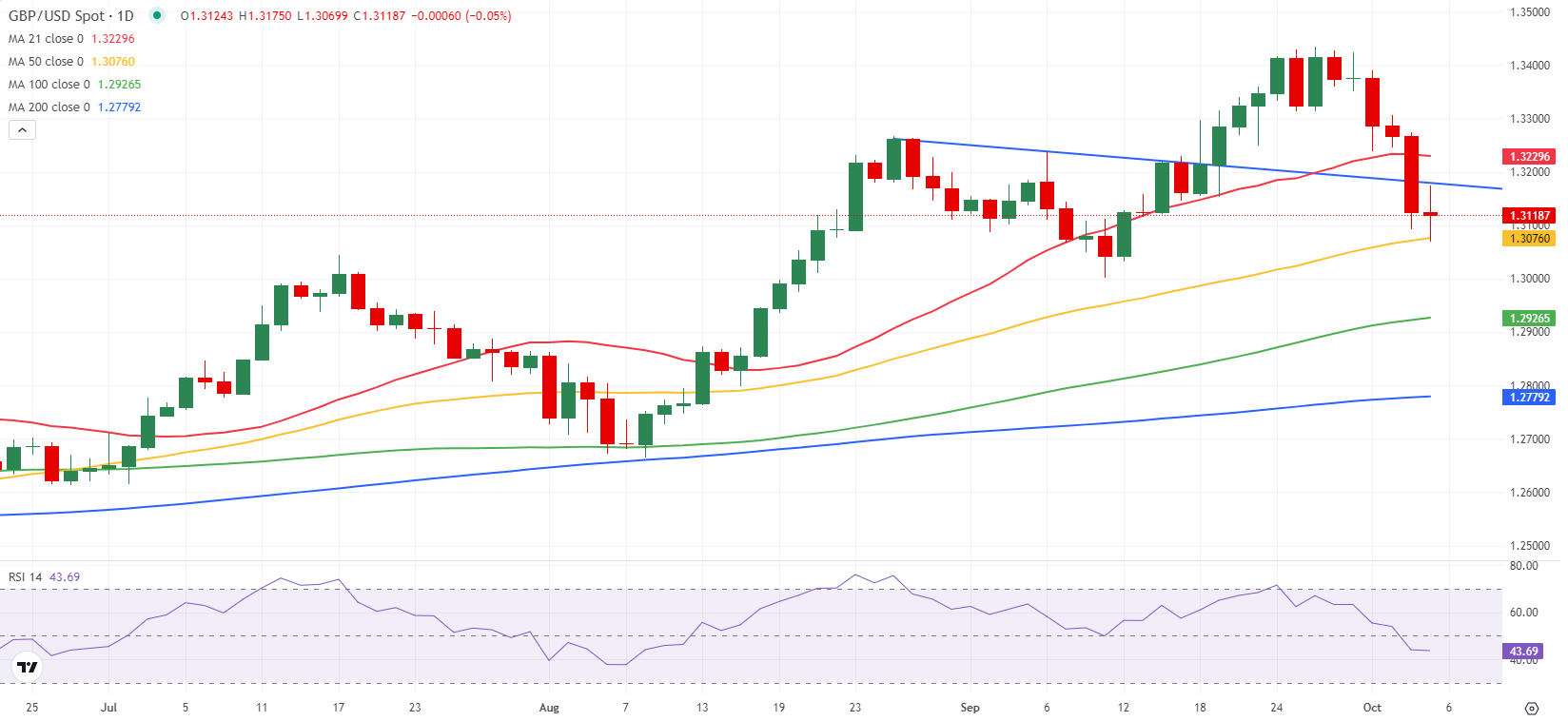
As observed on the daily chart, the GBP/USD pair has breached the critical support levels on its corrective decline from over two-and-a-half-year highs of 1.3434 reached last week.
Thursday’s closing below the 21-day Simple Moving Average (SMA) at 1.3230, followed by a sustained break of the falling trendline resistance turned support at 1.3165, empowered sellers further.
Looking ahead, the risks appear skewed to the downside for GBP/USD, as the 14-day Relative Strength Index (RSI) holds its position well below the 50 level, currently near 44.
The immediate support for buyers is aligned at the 50-day SMA at 1.3076. A weekly closing below it would initiate a fresh downtrend toward the 1.3000 psychological mark.
The next bearish target is seen at the 100-day SMA at 1.2926. The last line of defense for buyers is located at 1.2779, the key 200-day SMA.
Conversely, any recovery attempt will likely meet the initial contention area at around 1.3160, the previous falling trendline support now turned resistance.
Acceptance above the 21-day SMA at 1.3230 is needed to negate the near-term bearish bias.
Pound Sterling will then target the 1.3300 round level on the road to recovery, above which the 30-month top of 1.3434 will be back on buyers’ radars.
December arabica coffee (KCZ24) today is down -1.85 (-0.70%), and November ICE robusta coffee (RMX24) is down -72 (-1.35%).
Coffee prices are moving lower today as forecasts for rain in Brazil sparked long liquidation coffee futures. Today’s two-week Global Forecast System model showed rain is expected for Brazil’s coffee-growing regions next week during the all-important flowering period for Brazil’s coffee trees.
The downside in coffee prices is limited today after Conab, Brazil’s crop forecasting agency, cut its 2024 Brazil coffee production forecast to 54.8 million bags from 58.8 million bags forecast in May.
Strength in the Brazilian real (^USDBRL) is bullish for arabica coffee prices as the real rallied to a 1-month high against the dollar today, discouraging export selling from Brazil’s coffee producers.
On Monday, Dec arabica and Nov robusta posted contract highs, while nearest-futures (U24) robusta posted a new all-time high. Coffee prices have rallied sharply over the past week as adverse global weather events threaten coffee production. Brazil has been facing the driest weather since 1981, according to the natural disaster monitoring center Cemaden. Rainfall in Brazil has consistently been below normal since April, damaging coffee trees during the all-important flowering stage and reducing the prospects for Brazil’s 2025/26 arabica coffee crop. Somar Meteorologia reported Monday that Brazil’s Minas Gerais region received no rain over the past week. Minas Gerais accounts for about 30% of Brazil’s arabica crop. Also, robusta coffee has support after heavy rain from typhoon Yagi may have damaged Vietnam’s robusta coffee fields.
Robusta coffee prices are underpinned by fears that excessive dryness in Vietnam will damage coffee crops and curb future global robusta production. Vietnam’s agriculture department said on March 26 that Vietnam’s coffee production in the 2023/24 crop year dropped by -20% to 1.472 MMT, the smallest crop in four years, due to drought. The USDA FAS on May 31 projected that Vietnam’s robusta coffee production in the new marketing year of 2024/25 will dip slightly to 27.9 million bags from 28 million bags in the 2023/24 season. Last Wednesday, the General Department of Vietnam Customs reported that Vietnam’s August coffee exports fell -9.9% y/y to 76,214 MT and that Vietnam’s Jan-Aug coffee exports fell -12.1% y/y to 1.06 MMT.
Last Tuesday, Cecafe reported that Brazil’s Aug green coffee exports rose +1.4% y/y to 3.41 million bags. The rise in Brazil’s green coffee exports was consistent with other recent news showing higher exports. The Brazilian Trade Ministry reported on August 7 that Brazil’s July coffee exports rose +44% y/y to 202,000 MT. Also, Cecafe reported on July 11 that Brazil’s 2023/24 coffee exports rose +33% y/y to a record 47.3 million bags. On a global basis, the International Coffee Organization (ICO) reported on September 6 that global coffee exports rose +12.2% y/y in July to 11.29 million bags and that global exports during Oct-July rose +10.5% y/y to 115.01 million bags.
A rebound in ICE coffee inventories from historically low levels is negative for prices. Last Thursday, ICE-monitored arabica coffee inventories rose to a 1-1/2 year high of 858,474 bags, up from the 24-year low of 224,066 bags posted in November 2023. Also, ICE-monitored robusta coffee inventories on July 25 rose to a 1-year high of 6,521 lots, up from the record low of 1,958 lots posted in February 2024.
In a bearish factor, the International Coffee Organization (ICO) said on May 3 that 2023/24 global coffee production climbed +5.8% y/y to 178 million bags due to an exceptional off-biennial crop year. ICO also said global 2023/24 coffee consumption rose +2.2% y/y to 177 million bags, resulting in a 1 million bag coffee surplus.
The USDA’s bi-annual report on June 20 was bearish for coffee prices. The USDA’s Foreign Agriculture Service (FAS) projected that world coffee production in 2024/25 will increase +4.2% y/y to 176.235 million bags, with a +4.4% increase in arabica production to 99.855 million bags and a +3.9% increase in robusta production to 76.38 million bags. The USDA’s FAS forecasts that 2024/25 ending stocks will climb by +7.7% to 25.78 million bags from 23.93 million bags in 2023/24. The USDA’s FAS projects that Brazil’s 2024/25 arabica production would climb +7.3% y/y to 48.2 mln bags due to higher yields and increased planted acreage. The USDA’s FAS also forecasts that 2024/54 coffee production in Colombia, the world’s second-largest arabica producer, will climb +1.6% y/y to 12.4 mln bags.
More Coffee News from Barchart
On the date of publication,
did not have (either directly or indirectly) positions in any of the securities mentioned in this article. All information and data in this article is solely for informational purposes. For more information please view the Barchart Disclosure Policy
here.
The views and opinions expressed herein are the views and opinions of the author and do not necessarily reflect those of Nasdaq, Inc.
I don’t necessarily think that it’s going to be a massive one, but I do recognize that we are in an area that, more likely than not, will continue to attract attention. On a rally from here, the 1.12 level could be the target, which is probably worth noting as a major resistance barrier going back all the way to the beginning of 2022.
The market pulling back the way it has during the week does suggest that perhaps we are not ready to go to the upside and that would make a certain amount of sense I suppose because both central banks are likely to be cutting rates, and I don’t see how that changes much.
The ECB already has cut a couple of times and now the question is with CPI in the European Union, perhaps coming under its target even more than it’s no longer an inflationary situation. It’s a question as to whether or not the ECB will have to stimulate and if that ends up being the case that obviously will work against the euro. The Federal Reserve has cut 50 basis points and that was a bit shocking. We saw the Euro rise higher because of it. But now the question is, how much further do they have to cut? Probably have to wait and see on that one, but I think at this point, we’re just going back and forth between major round numbers. 1.10 underneath is massive support. 1.12 above is massive resistance.
Ready to trade our daily EUR/USD Forex forecast? Here’s a list of some of the top forex brokers in Europe to check out.
STORY LINK Pound Sterling Today: GBP/EUR, GBP/USD Slide on Dovish BoE Bailey Rhetoric
The pound dipped sharply in Asian trading on Thursday following a media interview by Bank of England Governor Bailey.
Bailey hinted at a faster rate of interest rate cuts and, in response, the Pound to Euro (GBP/EUR) exchange rate sliding to 1.1905 from just above 1.20.
The Euro-Zone PMI services-sector business confidence index was revised higher to 51.4 from the flash reading of 50.5 which also had some positive Euro impact.
Stronger expectations of an ECB rate cut this month should, however, offer significant Pound protection.
In a wide-ranging interview, Bank of England Governor Bailey expressed concerns over developments in the Middle East and the risk of a spike in oil prices.
Bailey said he was encouraged by the fact that cost of living pressures had not been as persistent as the Bank thought they might be. He said if the news on inflation continued to be good there was a chance of the Bank becoming more “a bit more activist” in its approach to cutting interest rates, now at 5.0%.
Markets have fully priced in a November rate cut and expect rates to decline to 3.75% by the middle of next year.
MUFG commented; We altered our view on the BoE to assume back-to-back rate cuts before year-end given our view that the economy was now showing clearer evidence of decelerating economic growth.”
The bank quoted recent evidence on the economy; “Sentiment indicators are now turning lower – the GfK consumer confidence index, the PMIs, the CBI Orders index, the Lloyds Business Barometer have turned lower pointing to weaker growth and the potential for a further softening in underlying inflation.”
MUFG also considered the global outlook; “With the Fed and ECB also likely cutting at back-to-back meetings before year-end the damage for the pound should not be considerable. Still, long GBP has been a popular and fruitful trade this year and there is a risk of a downside correction especially if financial market volatility was to pick-up on increased risk aversion.”
On Wednesday, ECB council member Schnabel commented that a “Return to 2% target in a timely manner is becoming more and more likely despite elevated services inflation and strong wage growth.”
She added that; “Signs of softening labor demand and progress in disinflation suggest inflation could sustainably fall back to the 2% target.”
She did note that elevated services inflation and strong wage growth persist, but added; “We cannot ignore the headwinds to growth.”
According to ING; “This could be a sign that the hawks are throwing the towel on the October debate, and will accept another cut after the lower-than-expected CPI figures earlier this week.
International Money Transfer? Ask our resident FX expert a money transfer question or try John’s new, free, no-obligation personal service! ,where he helps every step of the way,
ensuring you get the best exchange rates on your currency requirements.
TAGS: Pound Sterling Forecasts
“Traders are looking for a clearer direction, and all eyes are on the upcoming US employment report, which could serve as the next major catalyst for gold prices,” stated Mark Ashford, senior market analyst at Global Commodities. “The dollar’s strength has been a major headwind for gold.”
The US dollar has been gaining ground, nearing a one-month high, as recent economic indicators paint a picture of a stable labor market. According to the US Department of Labor, unemployment claims rose slightly to 225,000 for the week ending September 28, up from 218,000 in the prior week.
Meanwhile, private-sector employment saw an unexpected increase in job openings for August, reinforcing the strength of the US labor market.
Additionally, the Institute for Supply Management (ISM) reported that its Non-Manufacturing PMI rose to 54.9 in September, its highest reading since February 2023.
The robust labor market data has tempered expectations for significant Fed rate cuts, further supporting the US dollar and creating headwinds for non-yielding assets like gold.
While gold’s safe-haven appeal is being reinforced by the uncertain geopolitical landscape, this has not yet been enough to push prices higher. Hezbollah’s recent launch of 230 projectiles from Lebanon into Israel and retaliatory Israeli airstrikes have heightened the risk of a broader regional conflict.