The main category of Forex News.
You can use the search box below to find what you need.
[wd_asp id=1]
The main category of Forex News.
You can use the search box below to find what you need.
[wd_asp id=1]
Meanwhile, traders are preparing for the Bank of England’s monetary policy decision on Thursday. The British central bank is expected to maintain interest rates, although traders expect cuts in November and December, followed by five more cuts in 2025. The easing cycle began in August when the central bank cut borrowing costs by 25 basis points. The annual inflation rate in Britain remained at 2.2% in August, in line with expectations, while services inflation rose to 5.6% as expected. Core inflation also rose to 3.6%, beating expectations of 3.5%. However, both services inflation and the headline rate were below the levels the central bank had forecast for August.
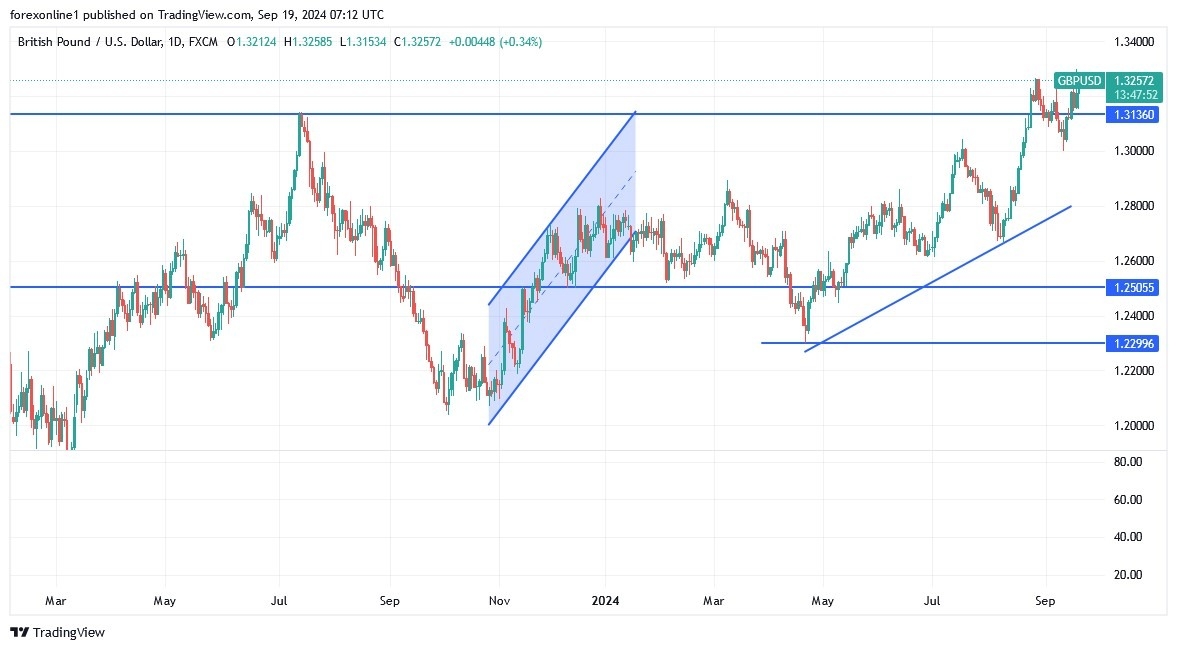
According to Forex Market, the GBP/USD exchange rate is set for volatility as the UK releases its August inflation report ahead of interest rate decisions by the Federal Reserve and the Bank of England. The exchange rate was trading at 1.3165 on Wednesday, just a few points below its year-to-date high of 1.3267.
According to the Economic Calendar, The Office for National Statistics (ONS) will release the latest inflation report a day before the Bank of England announces its monetary policy decision. Economists expect the data to show that UK headline inflation rose slightly in August. The Consumer Price Index (CPI) is expected to move from -0.2% in July to 0.3% in August. On an annual basis, the CPI is expected to remain at 2.2%. Core inflation, which excludes volatile food and energy prices, is expected to rise from 3.3% in July to 3.6% in August. These figures will come a week after the UK released an encouraging jobs report, showing that wage growth remained strong in July.
If analysts’ estimates are accurate, the figures will reduce the chances of a rate cut by the Bank of England when it concludes its two-day meeting on Thursday. Also, the data will mean that inflation in Britain remains stubbornly high and above the bank’s 2.0% target. Meanwhile, Economists believe a series of rate cuts will follow this week’s pause as the bank works to stimulate a slowing economy. However, some analysts believe the bank will cut rates by 0.25% at this meeting. Refinitiv data shows the odds of a cut have risen to around 35%.
Some economists favour a cut due to a wet summer, services inflation and recent wage growth figures. Similarly, some analysts believe that a rate cut would help to limit the rise in sterling, which could make the UK an attractive source market.
Before the recent gains in the currency pair, the pound fell in mid-week trading amid growing bets that the Bank of England will be encouraged by the Federal Reserve and cut US interest rates again on Thursday. Money market pricing shows the odds of a second 25bp rate cut by the bank have risen to around 33%, from close to zero just two weeks ago. The odds of a 50bp rate cut by the Fed are clearly having an impact, as markets believe the bank will be inclined to follow the Fed’s lead. Consequently, the shift in expectations is acting as a headwind for UK bond yields and the pound.

The GBP/USD exchange rate has been on a strong upward trajectory in the past few months. Technically, it bottomed at 1.2290 in May and then pulled back strongly to a high of 1.3268 in August. Along the way, the pair formed an ascending channel pattern. It also moved slightly above the crucial resistance level at 1.3141, the highest level it reached in July last year. Concurrently, the GBP/USD pair remained stable above the 50-day and 25-day exponential moving averages (EMA) while the Relative Strength Index (RSI) moved slightly above the neutral zone. Also, the pair formed a small double top pattern on the chart, which is a common reversal sign. Therefore, the likely scenario is for the pair to pull back since the rate cut has been priced in by market participants. If this happens, the pair could drop to the next psychological level at 1.3000.
Ready to trade our GBP/USD Forex forecast? Here’s a list of some of the top forex brokers UK to check out.
TPCCrude oil: Middle East in focus
Performance
WTI crude oil had surged on Tuesday on the incident of pager blasts in Lebanon which killed eight people and injured hundreds; however, yesterday, it settled 0.83 per cent lower at $69.38 despite a 50-bps cut by the Fed.
FOMC monetary policy decision
The US Federal Reserve, as the markets largely expected, slashed the Fed Fund rate by 50 bps to 4.75 per cent-5 per cent range. Commodities rallied soon after the rate cut decision only to reverse their gains to fall sharply lower as the Fed Chair Powell’s presser was balanced. Powell said that the 50-bps point rate cut was to ensure that the central bank is not behind the curve as the Fed is committed to its dual goals of inflation control and maximum employment. He added that the US economy was in a good shape and inflation was headed lower to the Fed’s target of 2 per cent.
The US yields surged on his comments, which weighed on commodities complex severely. The US bonds have continued to decline today also.
Traders’ focus will be on the Bank of England’s monetary policy decision due today. Although the Bank is not expected to lower rates today, its monetary policy stance will be closely scrutinised.
Data roundup
UK inflation data were in line with the forecast. Consumer prices rose 2.2 per cent from a year earlier, the same pace as the previous month.
US housing starts (August) came in at 1356K verssus the forecast of 1318K. Building permits (August) came in at 1475K Vs the forecast of 1410K as the prior data was revised higher from 1396K to 1406K.
Upcoming data and event
Today’s US data on tap include Total Net TIC flows (July), current account balance (2Q), Philadelphia Fed Business Outlook (September), weekly job data and existing home sales (August).
The Bank of England will deliver its monetary policy decision today. It is expected that the Central Bank, having slashed benchmark rates to 5 per cent in its previous meeting, will go for a pause in this meeting; however, with two monetary policy meetings still left this year, it is expected that the Bank will cut rates twice more.
US weekly DoE crude oil data
DoE weekly data were somewhat positive for the counter. US inventories dipped by 1630K barrels (forecast 213K b), Cushing stocks were down by 1979K barrels, gasoline inventories rose by 69K (forecast 1140K barrels), while distillate inventories were up by 125K barrels (forecast 994K barrels).
Refinery utilisation in the week ending September 13 edged lower by 0.70 per cent (Forecast -1.26 per cent). US crude oil stocks fell to the lowest levels in almost a year to 417.50 mb. Crude oil implied demand was 19755 Kbpd as compared to 20048 Kbpd in the previous week. gasoline demand sunk further below 9 mbpd, the second straight week of falling below this mark.
US gasoline inventories rose to the highest level since early August as inventories reached 221.60 mb. US Crude oil production fell to 13.20 mbpd, the lowest since June.
Outlook
WTI crude oil is expected to find good support into the dips as apart from the Fed cutting rates by 50-bps, geopolitical tensions are back in focus after a second of devices’ explosions rippled through Lebanon and the region killing 8 people and injuring over 300. With Israel looking to carry out its offensive against Hezbollah to the next level, traders will monitor the evolving situation in the Middle East closely for possibility of disruptions to the oil supplies.
Near-next month spread remains in a deep backwardation of over $1.
WTI Crude oil may rise to $72 in the near term. Support is at $67. Buying the dips is advisable.
(Disclaimer: Praveen Singh is a senior fundamental research analyst of currencies and commodities at Sharekhan. Views expressed are his own.)
First Published: Sep 19 2024 | 10:28 AM IST
The USD/JPY outlook favors the upside, though the pair has fluctuated a lot since the FOMC policy meeting. Initially, the yen strengthened against the dollar before falling sharply as market participants took profits. Meanwhile, markets are preparing for the Bank of Japan policy meeting on Friday.
–Are you interested in learning more about making money with forex? Check our detailed guide-
The US central bank finally cut borrowing costs on Wednesday after months of market speculation. The Fed lowered interest rates by a significant 50-bps, above forecasts of 25-bps. Before the meeting, market participants were pricing a 65% chance of such an outcome. Meanwhile, economists had predicted a smaller cut. Therefore, after the meeting, the dollar fell as traders had not fully priced such a move. However, the decline was short-lived as it recovered as traders locked in their yen profits.
The Fed has taken its first step to lower interest rates, showing increased confidence among policymakers that they have tamed inflation. Furthermore, Powell said the massive cut was meant to keep unemployment in check. Lower borrowing costs will likely hurt the dollar. However, they will also spur economic growth, which will eventually reverse the downtrend.
On the other hand, the yen’s prospects remain bright in the long run. Bank of Japan policymakers have recently voiced hawkish remarks in support of more rate hikes. At the policy meeting on Friday, the BoJ will likely keep rates unchanged. However, the market focus will be on messaging for future policy moves. More hawkish remarks will support the yen.
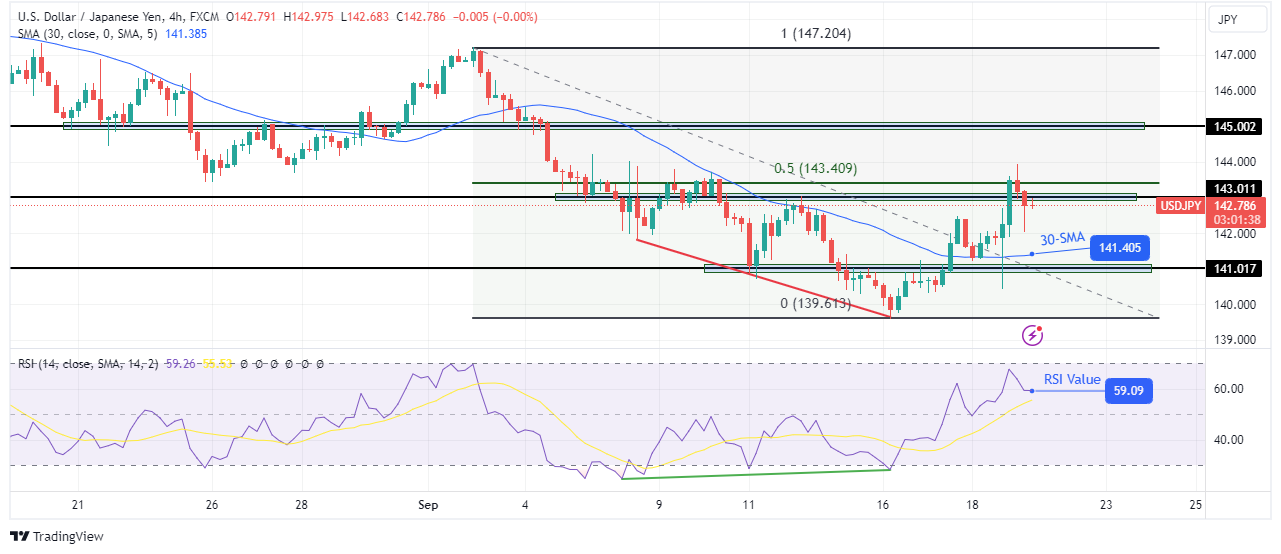
On the technical side, the USD/JPY price has made a new high near a solid resistance zone. The trend recently reversed after the RSI made a bullish divergence. Bulls took charge when the price broke above the 30-SMA, and the RSI started trading in bullish territory above 50.
–Are you interested in learning more about MT5 brokers? Check our detailed guide-
However, the new rally has met a solid hurdle comprising the 0.5 Fib and the 143.01 key resistance level. The price probably needs a strong catalyst to breach this zone. A break above would allow bulls to revisit the 145.00 key resistance level and continue the uptrend.
Looking to trade forex now? Invest at eToro!
68% of retail investor accounts lose money when trading CFDs with this provider. You should consider whether you can afford to take the high risk of losing your money.
Silver price (XAG/USD) oscillates below the crucial resistance of $31.00 in Wednesday’s European session. The white metal stays on the sidelines as investors await the Federal Reserve’s (Fed) monetary policy, which will be announced at 18:00 GMT.
The Fed is poised to deliver its first interest rate cut decision in more than four years as officials are worried about deteriorating labor market conditions. However, policymakers remain confident that price pressures are on track to return to the bank’s target of 2%.
With firm speculation that the Fed will pivot to policy normalization, investors will focus on the likely interest rate cut size. According to the CME FedWatch tool, 30-day Federal Funds Futures pricing data shows that the probability of the central bank cutting rates by 50 basis points (bps) to 4.75%-5.00% is 65% and the rest favors a 25-bps rate cut. Apart from the Fed’s policy decision, investors will also focus on the Fed’s dot plot and economic projections.
Ahead of the Fed policy, the US Dollar Index (DXY), which tracks the Greenback’s value against six major currencies, drops to near 100.80. On the contrary, 10-year US Treasury yields jump to near 3.67%. The announcement of the Fed’s large rate cut would weigh heavily on the US Dollar and bond yields.
Silver price trades cautiously ahead of the Fed’s interest rate decision. The white metal could a fresh upside if it manages to break above September 16 high of $31.10. The near-term outlook of the Silver price remains firm as the asset holds above the 20-day Exponential Moving Average (EMA), which trades around $29.40.
The 14-day Relative Strength Index (RSI) rises above 60.00. A fresh round of bullish momentum could occur if the oscillator sustains about this level.
Silver is a precious metal highly traded among investors. It has been historically used as a store of value and a medium of exchange. Although less popular than Gold, traders may turn to Silver to diversify their investment portfolio, for its intrinsic value or as a potential hedge during high-inflation periods. Investors can buy physical Silver, in coins or in bars, or trade it through vehicles such as Exchange Traded Funds, which track its price on international markets.
Silver prices can move due to a wide range of factors. Geopolitical instability or fears of a deep recession can make Silver price escalate due to its safe-haven status, although to a lesser extent than Gold’s. As a yieldless asset, Silver tends to rise with lower interest rates. Its moves also depend on how the US Dollar (USD) behaves as the asset is priced in dollars (XAG/USD). A strong Dollar tends to keep the price of Silver at bay, whereas a weaker Dollar is likely to propel prices up. Other factors such as investment demand, mining supply – Silver is much more abundant than Gold – and recycling rates can also affect prices.
Silver is widely used in industry, particularly in sectors such as electronics or solar energy, as it has one of the highest electric conductivity of all metals – more than Copper and Gold. A surge in demand can increase prices, while a decline tends to lower them. Dynamics in the US, Chinese and Indian economies can also contribute to price swings: for the US and particularly China, their big industrial sectors use Silver in various processes; in India, consumers’ demand for the precious metal for jewellery also plays a key role in setting prices.
Silver prices tend to follow Gold’s moves. When Gold prices rise, Silver typically follows suit, as their status as safe-haven assets is similar. The Gold/Silver ratio, which shows the number of ounces of Silver needed to equal the value of one ounce of Gold, may help to determine the relative valuation between both metals. Some investors may consider a high ratio as an indicator that Silver is undervalued, or Gold is overvalued. On the contrary, a low ratio might suggest that Gold is undervalued relative to Silver.
Potential of the Euro (EUR) breaking above 1.1200 remains unclear, UOB Group Quek Ser Leang and Victor Yong note.
24-HOUR VIEW: “Yesterday, we expected EUR to trade in a 1.1085/1.1145 range. In NY trade, EUR soared briefly to 1.1189, plummeted to 1.1094 and then closed largely unchanged (1.1118, +0.04%). Despite the choppy price action, the underlying tone seems to have softened somewhat. Today, we expect EUR to trade in a range, albeit a lower one of 1.1080/1.1140.”
1-3 WEEKS VIEW: “Two days ago (17 Sep, spot at 1.1125), we highlighted that EUR “is likely to continue to rise, but it is unclear at this time if it has sufficient momentum to break above the year-to-date high, near 1.1200.” Yesterday, EUR rose briefly to 1.1188, pulling back to close largely unchanged. The price action did not result in any increase in momentum, and it is still unclear for now if EUR can break above 1.1200. However, only a breach of 1.1060 (‘strong support’ level previously at 1.1040) would indicate that the potential for EUR to rise above 1.1200 has dissipated.”
Updates prices at 1610 GMT
By Eric Onstad
LONDON, Sept 18 (Reuters) –Copper prices ticked higher on Wednesday ahead of a widely expected rate cut by the U.S. Federal Reserve, which investors bet will support metals demand.
Three-month copper on the London Metal Exchange CMCU3 was up 0.5% at $9,417 per metric ton by 1610 GMT after slipping on Tuesday.
U.S. Comex copper futures HGc2 added 0.3% to $4.24 a lb.
LME copper has rebounded by 6% since touching a three-week low on Sept. 4, but is still down 15% since hitting a record high in May.
“The market is looking for additional support to come from that rate cut announcement and is also focusing on China, for that government to do more to arrest the slide we’re seeing,” said Ole Hansen, head of commodity strategy at Saxo Bank in Copenhagen.
Chinese President Xi Jinping last week urged authorities to strive to achieve annual economic goals, leading to expectations of stimulus measures to bolster a flagging economic recovery.
LME copper was hovering just under $9,500, a level that, if broken, would open up the path to challenge $10,000, Hansen added.
“A lack of profit-taking does indicate that there is some underlying belief that what happens next will add some support to the market,” he said.
Most of the buying activity was by computer-driven funds, a trader said.
The chances of the Fed kicking off its easing cycle with a super-sized cut of 50 basis points were revived earlier this week after media reports raised the prospect of more aggressive action.
A rate cut often helps boost economic growth and demand for metals, along with pressuring the U.S. dollar.
A softer dollar index =USD supported the market, making dollar-priced metals cheaper for buyers using other currencies.
LME zinc CMZN3 was the worst performer, falling 1.2% to $2,891 a ton after more inflows of inventories to LME-registered warehouses, which have jumped 10% over two days to 251,850 tons. MZNSTX-TOTAL
LME aluminium CMAL3 edged up 0.4% to $2,533 a ton, nickel CMNI3 rose 0.3% to $16,240, lead CMPB3 gained 0.9% to $2,036 while tin
For the top stories in metals, click TOP/MTL
($1 = 7.0955 yuan)
Reporting by Eric Onstad; Additional reporting by Mai Nguyen in Hanoi; Editing by Mark Potter, Barbara Lewis and David Evans
 For related news and prices, click on the codes in brackets: LME price overview RING= COMEX copper futures 0#HG: All metals news MTL All commodities news C
Foreign exchange rates FX=SPEED GUIDES LME/INDEX
Gold price is defending $2,550 early Thursday, catching a breath after intense volatility witnessed in the aftermath of the all-important US Federal Reserve (Fed) monetary policy announcements and Fed Chairman Jerome Powell’s press conference.
Traders turn their focus to the upcoming US Jobless Claims and Existing Home Sales data to gauge the health of the overall economy, which could shed fresh light on the future path of rates by the Fed, having a significant impact on the value of the US Dollar and Gold price.
The Fed announced a 50 basis points (bps) rate cut on Wednesday, bringing the fed funds rate to the range of 4.75%-5.0%. The Summary of Economic Projections, the so-called Dot Plot chart, suggested a total of 100 bps of rate cuts for this year and the next.
Fed Chair Jerome Powell, during his press conference, also maintained a dovish tone, explaining that “this recalibration of our policy stance will help maintain the strength of the economy and the labor market, and will continue to enable further progress on inflation as we begin the process of moving toward a more neutral stance. We are not on any preset course. We will continue to make our decisions meeting by meeting.”
In an immediate reaction to the Fed policy announcements, the US Dollar (USD) tumbled to the lowest level in over a year against its major rivals amid a sharp sell-off in the US Treasury bond yields, lifting the non-interest-bearing Gold price to a fresh record high of $2,600. However, Gold price faced rejection at that level and corrected sharply to settle in the red near $2,560.
The pullback in the Gold price was fuelled by an impressive turnaround staged by the US Dollar, as an outsized rate reduction was well priced in by the markets. Further, hopes that a large Fed rate cut could lead to a potential ‘soft-landing’ for the US economy also aided the Greenback’s recovery across the board.
The USD recovery stretched into the Asian session on Thursday, keeping Gold price struggling, as traders look to a fresh batch of US economic data for fresh trading impetus. Gold price, however, continues to find support at lower levels, courtesy of the renewed Middle East geopolitical tensions.
According to the latest reports, at least 20 people were killed and over 450 injured in Lebanon after hand-held radios or walkie-talkies used by the militant group Hezbollah exploded in multiple parts of the country. These explosions occurred a day after a suspected Israeli attack targeting pagers used by the group for communication between its members.
A re-escalation of the tensions between Israel and Hezbollah is likely to bode well for the traditional safe-haven Gold price, also as hopes of further rate cuts. Markets are now pricing in a 25 bps rate cut at the Fed’s November and December meeting.
As observed on the daily chart, Gold price remains bullish, as the 14-day Relative Strength Index (RSI) turns north while well above the 50 level, currently near 63.00.
The renewed upside in Gold price could challenge the previous record high at $2,590 again before taking on the $2,600 threshold.
Acceptance above that level will call for a test of the $2,650 psychological barrier.
On the flip side, if the corrective decline resumes, Gold price could threaten the previous day’s low of $2,547, below which the August 20 high of $2,532 will be tested.
Further down, the 21-day Simple Moving Average (SMA) at $2,524 could be a tough nut to crack for Gold sellers.
Gold has played a key role in human’s history as it has been widely used as a store of value and medium of exchange. Currently, apart from its shine and usage for jewelry, the precious metal is widely seen as a safe-haven asset, meaning that it is considered a good investment during turbulent times. Gold is also widely seen as a hedge against inflation and against depreciating currencies as it doesn’t rely on any specific issuer or government.
Central banks are the biggest Gold holders. In their aim to support their currencies in turbulent times, central banks tend to diversify their reserves and buy Gold to improve the perceived strength of the economy and the currency. High Gold reserves can be a source of trust for a country’s solvency. Central banks added 1,136 tonnes of Gold worth around $70 billion to their reserves in 2022, according to data from the World Gold Council. This is the highest yearly purchase since records began. Central banks from emerging economies such as China, India and Turkey are quickly increasing their Gold reserves.
Gold has an inverse correlation with the US Dollar and US Treasuries, which are both major reserve and safe-haven assets. When the Dollar depreciates, Gold tends to rise, enabling investors and central banks to diversify their assets in turbulent times. Gold is also inversely correlated with risk assets. A rally in the stock market tends to weaken Gold price, while sell-offs in riskier markets tend to favor the precious metal.
The price can move due to a wide range of factors. Geopolitical instability or fears of a deep recession can quickly make Gold price escalate due to its safe-haven status. As a yield-less asset, Gold tends to rise with lower interest rates, while higher cost of money usually weighs down on the yellow metal. Still, most moves depend on how the US Dollar (USD) behaves as the asset is priced in dollars (XAU/USD). A strong Dollar tends to keep the price of Gold controlled, whereas a weaker Dollar is likely to push Gold prices up.
EUR/USD soared into a fresh high for September after the Federal Reserve (Fed) surprised markets with a full 50 bps rate cut on Wednesday, pushing risk appetite into the high side and sending traders scrambling for the buy button. This marks the first Fed rate cut in over four years. Following the Fed’s first rate cut since 2020, markets eased back to where they began, with Fiber settling back into the 1.1100 handle.
The Fed’s dot plot of the Federal Open Market Committee’s (FOMC) Summary of Economic Projections was also revised downward from the central bank’s previous rate outlook. The median policy expectations from the Fed now see the Fed Funds rate at 4.4% by year-end 2024 and 3.4% by year-end 2025, down from 5.1% and 4.1%, respectively.
Going deeper into the Fed’s notes, Fed policymakers now see US Gross Domestic Product (GDP) growth of 2.0% flat through 2024, down from the previous print of 2.1% in June. Fed officials also expected the US Unemployment Rate to settle around 4.4% by the end of 2024.
Fed Chair Jerome Powell did his best to soothe markets during his ensuing press conference following the Fed’s bumper 50 bps rate trim, highlighting that the Fed will resume its wait-and-see approach to incoming economic data in the weeks to come before deciding on further rate cuts. The Fed head’s measured approach to explaining the Fed’s policy adjustment helped to keep market flows on-balance, and rate markets are pricing in 65% chance of no further action at the FOMC’s next rate call on November 7.
Despite Wednesday’s Fed-fueled intraday rally, EUR/USD continues to churn near the 1.1100 handle. The post-Fed rally toward 1.1200 reversed course in short order, and Fiber has chalked in a flat day for the midweek session. The pair is still cycling chart paper on the high end of recent momentum, and short pressure will have a difficult time staging a full pullback to the 50-day Exponential Moving Average (EMA) near 1.1000.
The Euro is the currency for the 20 European Union countries that belong to the Eurozone. It is the second most heavily traded currency in the world behind the US Dollar. In 2022, it accounted for 31% of all foreign exchange transactions, with an average daily turnover of over $2.2 trillion a day. EUR/USD is the most heavily traded currency pair in the world, accounting for an estimated 30% off all transactions, followed by EUR/JPY (4%), EUR/GBP (3%) and EUR/AUD (2%).
The European Central Bank (ECB) in Frankfurt, Germany, is the reserve bank for the Eurozone. The ECB sets interest rates and manages monetary policy. The ECB’s primary mandate is to maintain price stability, which means either controlling inflation or stimulating growth. Its primary tool is the raising or lowering of interest rates. Relatively high interest rates – or the expectation of higher rates – will usually benefit the Euro and vice versa. The ECB Governing Council makes monetary policy decisions at meetings held eight times a year. Decisions are made by heads of the Eurozone national banks and six permanent members, including the President of the ECB, Christine Lagarde.
Eurozone inflation data, measured by the Harmonized Index of Consumer Prices (HICP), is an important econometric for the Euro. If inflation rises more than expected, especially if above the ECB’s 2% target, it obliges the ECB to raise interest rates to bring it back under control. Relatively high interest rates compared to its counterparts will usually benefit the Euro, as it makes the region more attractive as a place for global investors to park their money.
Data releases gauge the health of the economy and can impact on the Euro. Indicators such as GDP, Manufacturing and Services PMIs, employment, and consumer sentiment surveys can all influence the direction of the single currency. A strong economy is good for the Euro. Not only does it attract more foreign investment but it may encourage the ECB to put up interest rates, which will directly strengthen the Euro. Otherwise, if economic data is weak, the Euro is likely to fall. Economic data for the four largest economies in the euro area (Germany, France, Italy and Spain) are especially significant, as they account for 75% of the Eurozone’s economy.
Another significant data release for the Euro is the Trade Balance. This indicator measures the difference between what a country earns from its exports and what it spends on imports over a given period. If a country produces highly sought after exports then its currency will gain in value purely from the extra demand created from foreign buyers seeking to purchase these goods. Therefore, a positive net Trade Balance strengthens a currency and vice versa for a negative balance.
A spike in jobless claims could rekindle fears of a US hard landing. Weaker labor market conditions could affect wage growth and consumer spending, which contributes over 60% to the US GDP. Deteriorating labor market conditions could fuel speculation about an aggressive November Fed rate cut to bolster the economy. A more dovish Fed rate path may push the USD/JPY below 139.5.
Other stats include housing sector-related data and the Philly Fed Manufacturing Index. However, labor market data will likely have more impact on the USD/JPY pair.
USD/JPY trends will depend on the US labor market data and Friday’s BoJ interest rate decision. A spike in jobless claims and a hawkish Bank of Japan stance on interest rates may push the USD/JPY pair below 139.5. Currently, the BoJ and Fed monetary policy stances suggest a narrowing interest rate differential, signaling downward pressure for the USD/JPY.
Investors should remain alert, with the BoJ’s interest rate decision crucial for the USD/JPY pair. Monitor real-time data, central bank views, and expert commentary to adjust your trading strategies accordingly. Stay ahead of the market with our expert insights.
The USD/JPY remains well below the 50-day and 200-day EMAs, affirming bearish price signals.
A USD/JPY return to the 142.500 level could give the bulls a run at the 143.495 resistance level. Furthermore, a breakout from the 143.495 resistance level could signal a move toward the 145.891 resistance level.
Economic indicators from Japan, US labor market data, and central bank commentary require consideration.
Conversely, a drop below the 141.032 support level could give the bears a run at the September 16 low of 139.576. A return to 139.576 may signal a drop toward the 137.712 support level.
The 14-day RSI at 38.60 indicates a USD/JPY break below the 141.032 support level before entering oversold territory.
The 50-day EMA at $1.31424 supports the current bullish momentum, while the 200-day EMA at $1.30481 reinforces the longer-term uptrend.
As long as the pair stays above the $1.3156 pivot, the upward channel remains intact, suggesting more buying interest. A break below this level, however, could shift the bias towards selling.
The Euro (EUR) remains stable following the release of Final CPI, which held at 2.2% year-over-year, matching expectations. Core CPI also aligned at 2.8%.
Markets now shift focus to the upcoming speech from German Buba President Nagel, which could offer insights into future European Central Bank policy direction and impact the Euro’s outlook.
The EUR/USD pair is currently trading at $1.11188, up 0.08%, and hovering just above its pivot point at $1.11107, signaling potential bullish momentum. Immediate resistance is seen at $1.11453, with higher targets at $1.11753 and $1.12007.
On the downside, key support levels are at $1.10827, followed by $1.10525 and $1.10213.