The main category of Forex News.
You can use the search box below to find what you need.
[wd_asp id=1]
The main category of Forex News.
You can use the search box below to find what you need.
[wd_asp id=1]
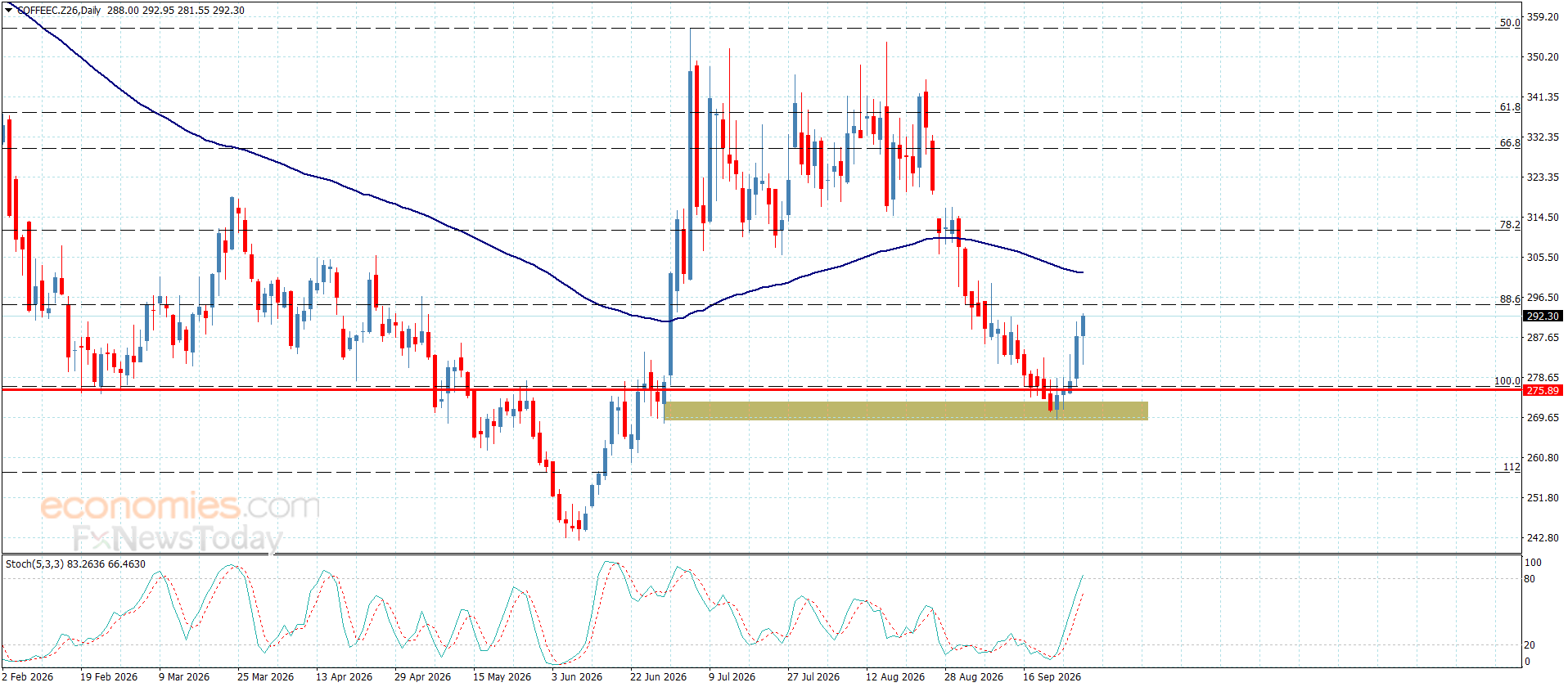
Coffee price successfully held above the support level near 269.00, forming strong bullish waves and achieving some of the previously suggested gains by currently reaching 288.00.
As shown on the attached chart, stochastic is approaching the 80 level, increasing the chances of the price gathering the positive momentum needed to resume its bullish attack, which could target 299.25, followed by 311.00.
The expected trading range for today is between 283.00 and 299.25.
Trend forecast: Bullish
According to FedWatch Tool, the probability of a rate hike at the next meeting in October has increased to 70.3%. Traders expect that the federal funds rate would be raised by 100 bps by the end of 2027. Expectations of a series of rate hikes put significant pressure on gold that pays no interest.
U.S. dollar gained some ground against a broad basket of currencies as forex traders focused on developments in debt market. Stronger dollar put additional pressure on gold in today’s trading session.
I’d note that one of the reasons for the sell-off in gold markets could be technical. The strong pullback in debt markets could have forced investors to raise cash elsewhere, forcing them to sell gold.
Currently, gold is trying to settle below the support level at $4160 – $4180. In case gold manages to settle below the $4160 level, it will head towards the next support, which is located in the $4000 – $4020 range. RSI is in the moderate territory, so there is plenty of room to gain momentum in case the right catalysts emerge.
– Written by
James Fuller
STORY LINK GBP/USD Forecast: Pound-Dollar Slips as Fed Rate Hike Bets Support Dollar
The Pound US Dollar (GBP/USD) exchange rate slipped lower on Tuesday as a subdued market mood continued to favour safe-haven currencies.
At the time of writing, GBP/USD was trading at around $1.3227, down approximately 0.2% from Tuesday’s opening levels.
The US Dollar (USD) edged higher on Tuesday as persistent strength in energy prices encouraged investors to favour defensive assets.
Brent crude continued to trade comfortably above $100 a barrel amid uncertainty surrounding attempts to bring the US-Iran conflict to an end and negotiations over the possible reopening of the Strait of Hormuz.
The ‘Greenback’ was also benefiting from firm Federal Reserve interest rate expectations, with markets pricing in around a 72% probability of another 25-basis-point rate increase in October.
However, USD gains remained relatively restrained in early Tuesday trade as investors looked ahead to the latest JOLTS job openings figures.
A weaker-than-expected reading could point to a cooling US labour market and prompt markets to scale back their expectations for further Fed tightening.
Get better rates and lower fees on your next international money transfer.
Compare TorFX with top UK banks in seconds and see how much you could save.
The Pound (GBP) lacked a clear sense of direction on Tuesday, with Sterling moving within a narrow range as the UK economic calendar offered little in the way of fresh market-moving data.
Investors were also reluctant to make significant bets ahead of Prime Minister Andy Burnham’s keynote speech at the Labour Party conference.
Burnham is expected to discuss several long-running policy issues, including potential changes to the pension triple lock and his position on the UK’s relationship with the European Union.
Any comments on closer ties with the EU could attract attention from currency markets.
Looking ahead, the main catalyst for the Pound US Dollar (GBP/USD) exchange rate on Wednesday is likely to be the release of the latest core PCE price index.
The Federal Reserve’s preferred measure of underlying inflation is expected to show that price pressures increased again in August.

A stronger-than-expected reading could reinforce expectations of an October rate hike and provide further support for the US Dollar.
UK investors will also have the final estimate of second-quarter GDP to consider.
However, barring a significant revision to the previous reading, Sterling may remain more sensitive to broader shifts in global risk appetite than domestic economic developments.
International Money Transfer? Ask our resident FX expert a money transfer question or try John’s new, free, no-obligation personal service! ,where he helps every step of the way,
ensuring you get the best exchange rates on your currency requirements.
TAGS: Pound Dollar Forecasts
JOLTs Job Openings decreased from 7.335 million (revised from 7.271 million) to 7.079 million, compared to analyst forecast of 7.23 million.
Traders also had a chance to take a look at the CB Consumer Confidence report. The report showed that CB Consumer Confidence declined from 88.6 (revised from 89.4) in August to 81.9 in September, compared to analyst consensus of 89.2.
Currently, U.S. Dollar Index is trying to settle above the resistance level at 101.50 – 101.65. In case U.S. Dollar Index manages to settle above the 101.65 level, it will head towards the next resistance, which is located in the 102.35 – 102.50 range. RSI is in the overbought territory, but there is some room to gain additional upside momentum in the near term.
Silver (XAG/USD) registers a modest recovery from the $60.30 area, or the lowest level since August 5, touched earlier this Tuesday, though it lacks follow-through. Nevertheless, the white metal sticks to intraday gains through the early European session and currently trades just below the $61.00 mark, up over 0.50% for the day.
TMGM Analysis: Financial Market News, Economic Calendar & Market Insights
From a technical perspective, the Relative Strength Index (RSI) hovers near oversold levels around 28, hinting at stretched downside conditions and prompting some intraday short-covering. Meanwhile, the Moving Average Convergence Divergence (MACD) indicator stays in negative territory with a weak profile, not yet signaling a confirmed reversal. Moreover, the XAG/USD holds well beneath the 200-period Exponential Moving Average (EMA) at $64.64, maintaining a bearish near-term tone.
Hence, any subsequent move up is likely to confront initial resistance near the $61.00 round figure. Some follow-through buying should pave the way for a further recovery to the $61.80-$61.85 intermediate hurdle, before the XAG/USD climbs further beyond the $62.00 and aims to test the $62.40-$62.45 horizontal support breakpoint. The latter should act as a key pivotal point, and sustained strength beyond it is needed to back the case for any further appreciating move for the white metal.
On the downside, weakness there is no meaningful support, and traders may look to the $60.00 psychological round number to gauge the next leg of a directional move. A convincing break should pave the way for a fall to the $59.40-$59.35 support before the XAG/USD slides further towards the $59.00 mark. If the metal extends its decline, bears might then aim to challenge the August monthly low, around the $56.60-$56.55 zone, with some intermediate support near the $57.00 round figure.
(The technical analysis of this story was written with the help of an AI tool. Know more.)

Silver is a precious metal highly traded among investors. It has been historically used as a store of value and a medium of exchange. Although less popular than Gold, traders may turn to Silver to diversify their investment portfolio, for its intrinsic value or as a potential hedge during high-inflation periods. Investors can buy physical Silver, in coins or in bars, or trade it through vehicles such as Exchange Traded Funds, which track its price on international markets.
Silver prices can move due to a wide range of factors. Geopolitical instability or fears of a deep recession can make Silver price escalate due to its safe-haven status, although to a lesser extent than Gold’s. As a yieldless asset, Silver tends to rise with lower interest rates. Its moves also depend on how the US Dollar (USD) behaves as the asset is priced in dollars (XAG/USD). A strong Dollar tends to keep the price of Silver at bay, whereas a weaker Dollar is likely to propel prices up. Other factors such as investment demand, mining supply – Silver is much more abundant than Gold – and recycling rates can also affect prices.
Silver is widely used in industry, particularly in sectors such as electronics or solar energy, as it has one of the highest electric conductivity of all metals – more than Copper and Gold. A surge in demand can increase prices, while a decline tends to lower them. Dynamics in the US, Chinese and Indian economies can also contribute to price swings: for the US and particularly China, their big industrial sectors use Silver in various processes; in India, consumers’ demand for the precious metal for jewellery also plays a key role in setting prices.
Silver prices tend to follow Gold’s moves. When Gold prices rise, Silver typically follows suit, as their status as safe-haven assets is similar. The Gold/Silver ratio, which shows the number of ounces of Silver needed to equal the value of one ounce of Gold, may help to determine the relative valuation between both metals. Some investors may consider a high ratio as an indicator that Silver is undervalued, or Gold is overvalued. On the contrary, a low ratio might suggest that Gold is undervalued relative to Silver.
The EUR/USD pair is currently trading at 1.1362, and is showcasing further signs of weakness after recently sliding beneath the 1.1325 support zone. Below both of the moving averues, and in a lower high formation, the pair has further potential to the downside, and could still be in a short term formation.
I will be looking for the first significant level of resistance to be near the 1.1412 level. If the pair is able to rise above 1.1412, further resistance may come in near 1.1455, 1.1504 and 1.1558 respectively. If current support at 1.1325 is broken, further support may come in near 1.1266 and 1.1211.
While RSI has been showing some bullish signs near oversold territory, I believe further downside may be limited at the current time. If current support is broken, I may gain a bearish bias near 1.1266. I would gain a bearish bias near 1.1412 if it is tested and broken, and would need to see a bullish move above 1.1455 to negate my current bearish bias.
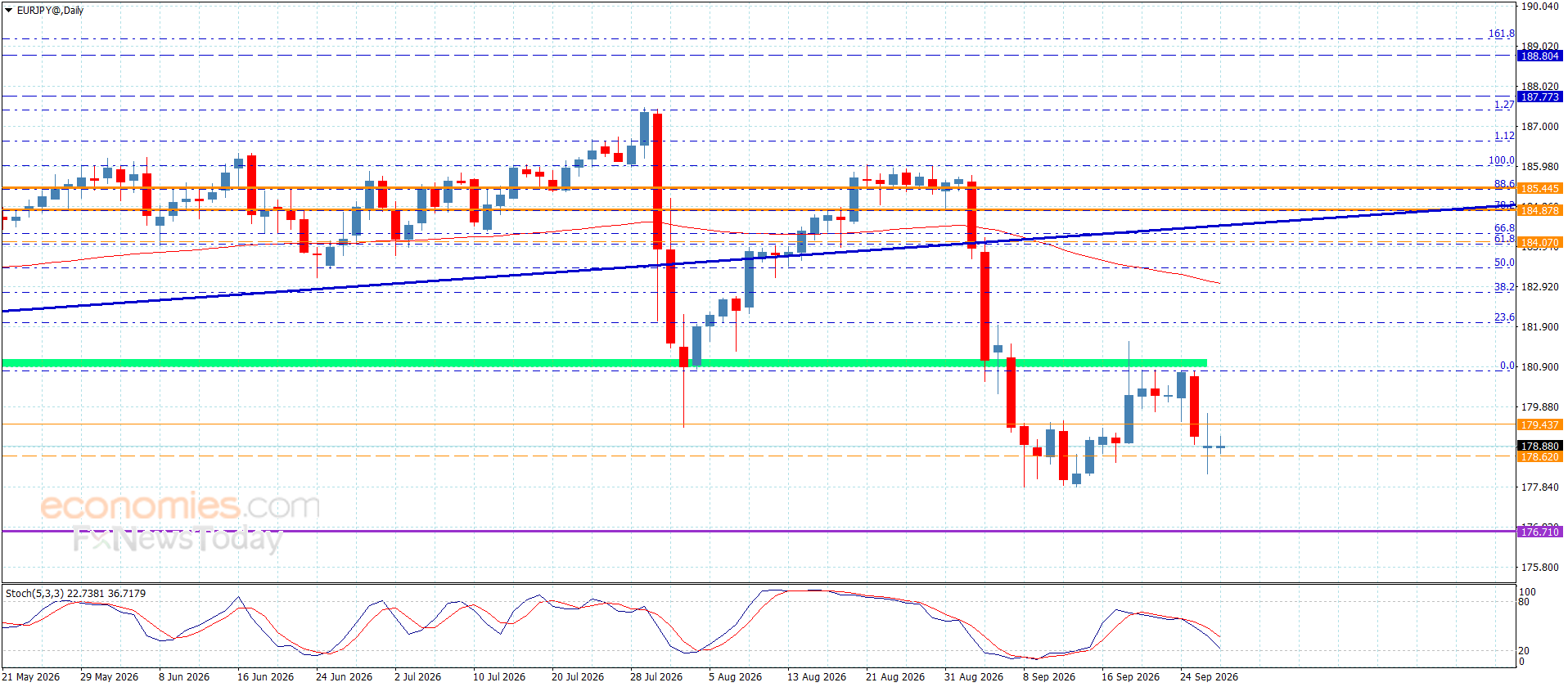
EURJPY maintained its negative stability since yesterday’s trading below the additional resistance barrier at 179.45, approaching the downside target at 178.00 by a narrow margin before being forced into some sideways trading in an attempt to gather additional negative momentum.
In general, the bearish bias will remain valid as long as the resistance level at 180.80 holds, keeping the way open for further bearish waves that could soon extend toward 177.80, followed by the next target near 176.70.
The expected trading range for today is between 177.80 and 179.50
Trend forecast: Bearish
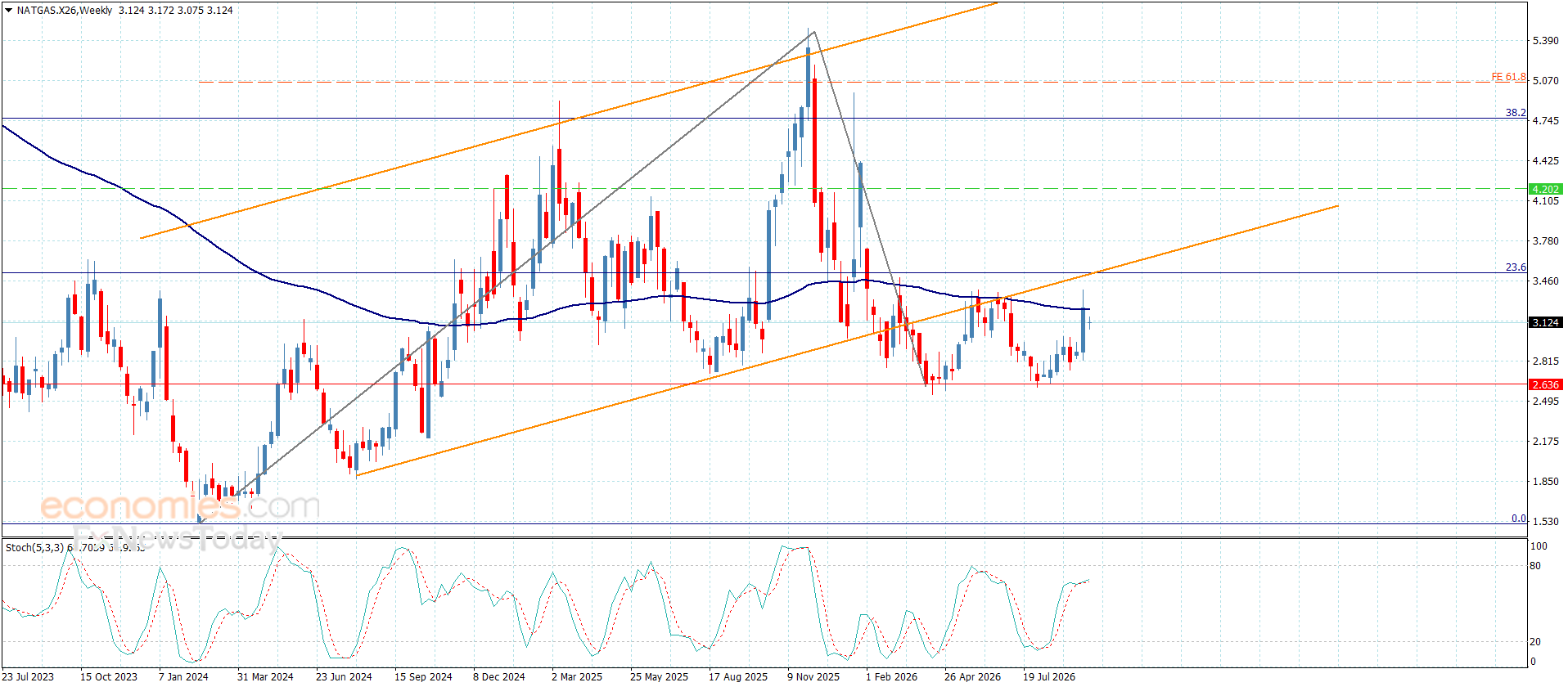
Natural gas price remains stable within the bullish trend, fluctuating near $3.120 while maintaining its stability above the additional support at $2.830. The current sideways movement is attributed to conflicting signals from the main indicators. Therefore, we will continue waiting for the price to successfully break above the 55-period moving average at $3.240, which would open the way toward the next bullish targets, starting at $3.320 and extending toward $3.520, respectively.
The expected trading range for today is between $3.000 and $3.320.
Trend forecast: Bullish.
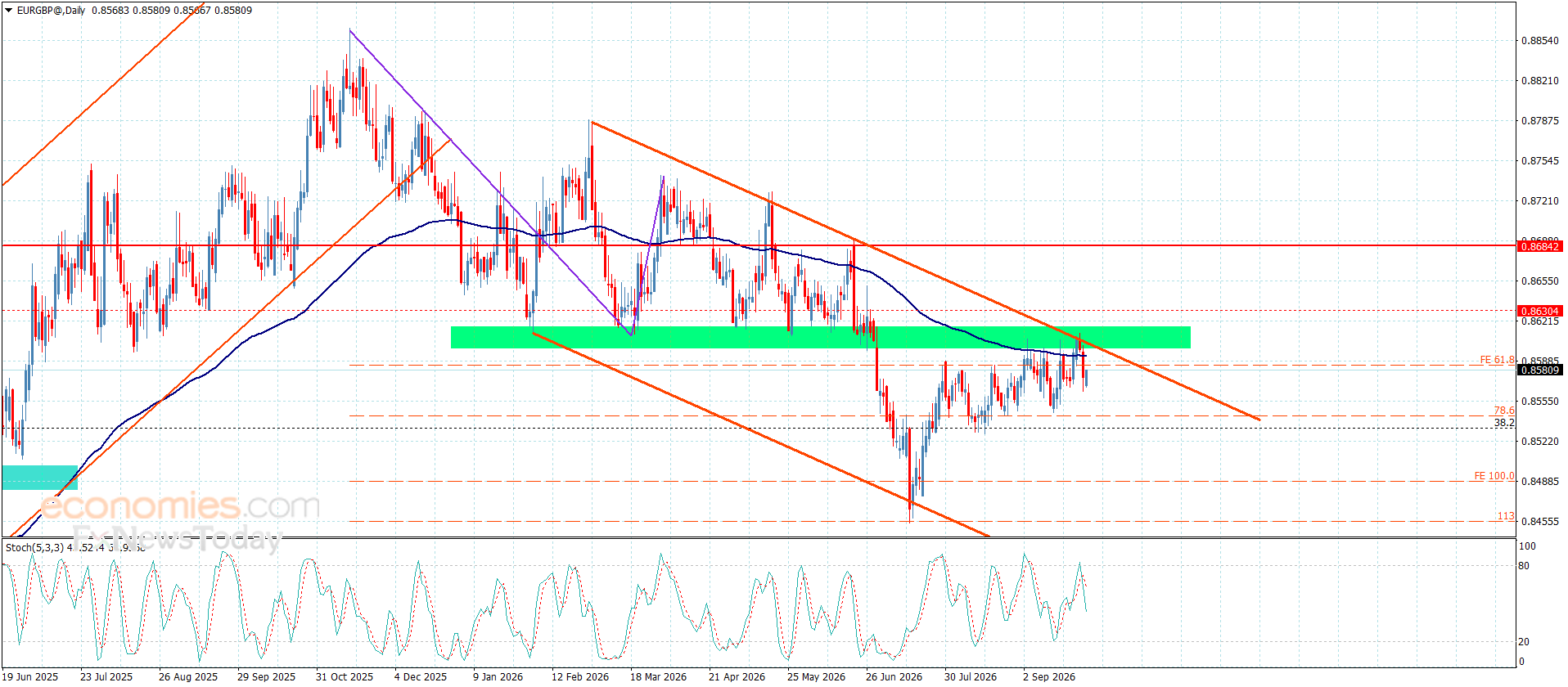
EURGBP ended its bullish corrective rebound after facing the resistance of the descending channel at 0.8605, forming a quick bearish reversal that pushed the price to stabilize below the 55-period moving average, targeting 0.8565.
Currently, stochastic provides additional bearish momentum, the effectiveness of the bearish path is expected to increase, waiting for the price to target the next downside levels, which may start at 0.8535 and 0.8510.
The expected trading range for today is between 0.8535 and 0.8590.
Trend forecast: Bearish
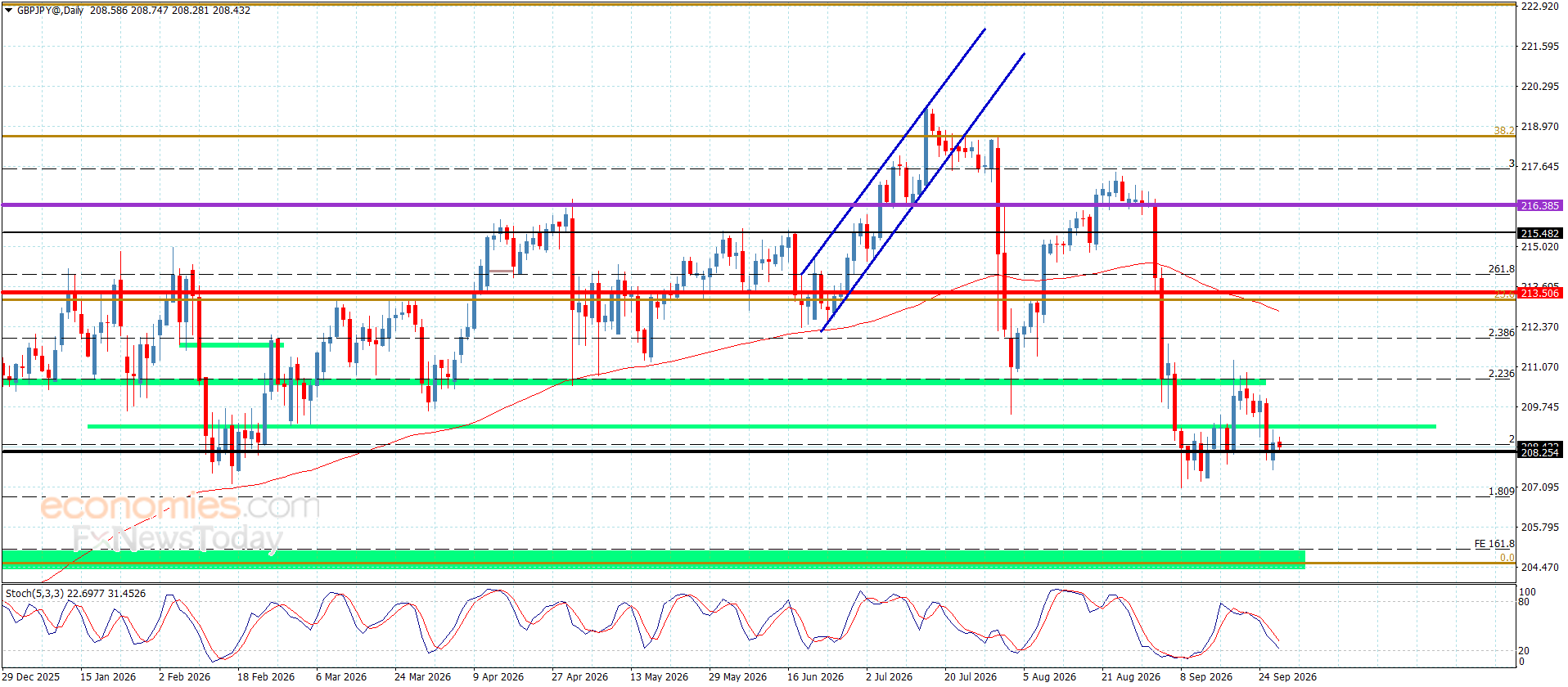
GBPJPY has been moving sideways recently, fluctuating again above the support level at 208.10 while attempting to gather the additional negative momentum required to confirm the bearish continuation previously suggested.
Currently, with the Stochastic indicator slipping below the 50 level, the chances of confirming a break below the current support are increasing, which would open the way toward the next downside targets at 207.40 and 206.80, respectively. However, failure to break the support could force the pair into further mixed trading, with a potential retest of the resistance barrier near 210.45.
The expected trading range for today is between 206.80 and 209.30.
Trend forecast: Bearish