The main category of Forex News.
You can use the search box below to find what you need.
[wd_asp id=1]
The main category of Forex News.
You can use the search box below to find what you need.
[wd_asp id=1]
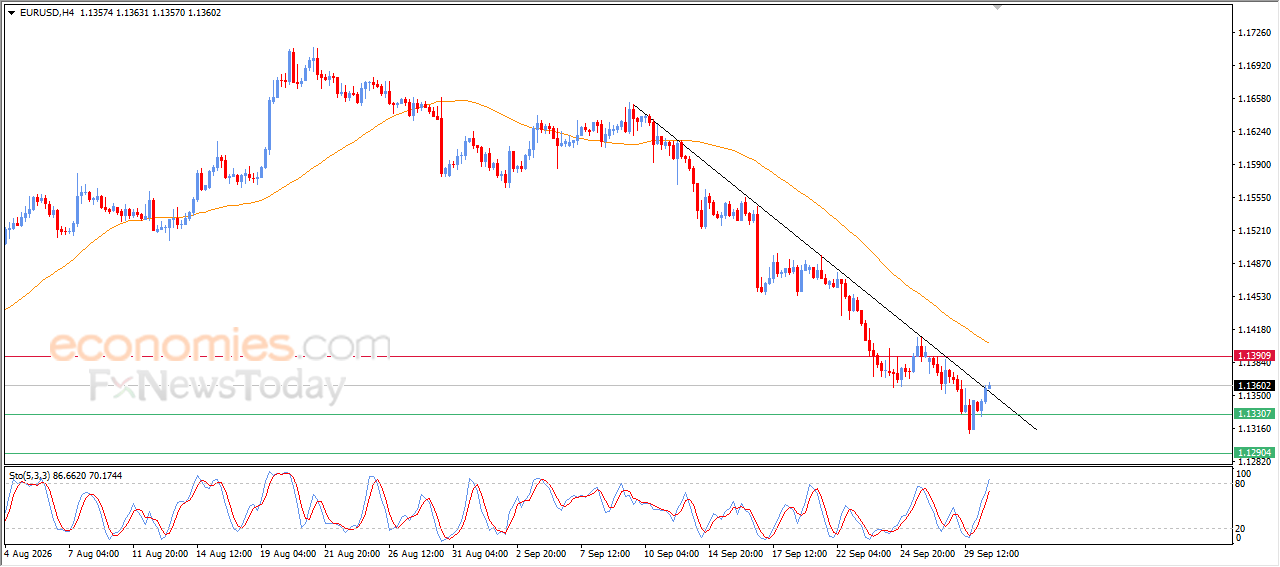
The EURUSD price extended its gains during recent intraday trading, driven by positive signals from the relative strength indicators, as the pair attempts to recover some of its previous losses. However, these indicators have reached extremely overbought levels relative to the pair’s price action, signaling that the positive momentum surrounding the pair is fading. This comes as the main bearish trend remains dominant in the short term, with the price moving along a minor trend line supporting this path. In addition, continued negative pressure is evident as the pair trades below EMA50, reducing the chances of a full recovery in the near term.
The British Pound (GBP) is bouncing strongly against the Japanese Yen (JPY) in Wednesday’s early London session, supported by the upward revision of the UK’s Gross Domestic Product (GDP) and a positive surprise in the Current Account. The GBP/JPY has regained most of the ground lost during the early Asian session, trading at 208.00 at the time of writing, after hitting a fresh year-to-date (YTD) low at 206.89.
TMGM Analysis: Financial Market News, Economic Calendar & Market Insights
The UK economy grew at a 0.5% pace in the second quarter, instead of the 0.4% previously estimated, according to final Gross Domestic Product (GDP) figures released earlier in the day. Likewise, the year-on-year (Y-o-Y) reading has been revised up to 1.4% from the 1.2% preliminary reading.
Beyond that, UK Current Account data released at the same time showed that the deficit narrowed unexpectedly to GBP 19.932 billion in Q2 from a downwardly revised GBP 21.12 billion in Q1, against market expectations of a widening gap of GBP 25.6 billion.
Data from Japan has failed to support the Yen on Wednesday. Retail Trade contracted 1.2% in August, after growing 2.1% in July. Industrial Production also disappointed as preliminary data showed a 4.8% decline in August, against the 1.7% growth anticipated by the market consensus and following a 0.5% increase in July,

GBP/JPY has bounced up to 207.90, but the near-term bias remains bearish, with price action holding below a previous trendline support, which will likely act as resistance now. Momentum indicators on 4-hour charts remain within negative territory, with the Relative Strength Index (14) below 40, despite the recent rebound, and the Moving Average Convergence Divergence (MACD) slightly negative, which suggests that the recovery is still frail.
Bulls are facing a cluster of resistances in the 208.30 area, where the mentioned trendline meets the intra-day high. A confirmation above here would boost confidence for bulls and expose the September 27 and 28 highs in the 209.00 area. Further up, the September 22 and 24 highs, near 210.15 seem out of reach for the coming sessions.
On the downside, the Pound has an important support area at 207.00. Below here, the 127.2% Fibonacci retracement of September’s rally, at the 206.00 area, seems like a plausible target.
(The technical analysis of this story was written with the help of an AI tool. Know more.)
The table below shows the percentage change of British Pound (GBP) against listed major currencies today. British Pound was the strongest against the Australian Dollar.
| USD | EUR | GBP | JPY | CAD | AUD | NZD | CHF | |
|---|---|---|---|---|---|---|---|---|
| USD | -0.10% | -0.37% | -0.31% | -0.06% | 0.11% | -0.32% | -0.12% | |
| EUR | 0.10% | -0.24% | -0.21% | 0.03% | 0.20% | -0.22% | -0.02% | |
| GBP | 0.37% | 0.24% | 0.02% | 0.29% | 0.45% | 0.04% | 0.24% | |
| JPY | 0.31% | 0.21% | -0.02% | 0.24% | 0.43% | -0.02% | 0.21% | |
| CAD | 0.06% | -0.03% | -0.29% | -0.24% | 0.18% | -0.25% | -0.04% | |
| AUD | -0.11% | -0.20% | -0.45% | -0.43% | -0.18% | -0.43% | -0.21% | |
| NZD | 0.32% | 0.22% | -0.04% | 0.02% | 0.25% | 0.43% | 0.21% | |
| CHF | 0.12% | 0.02% | -0.24% | -0.21% | 0.04% | 0.21% | -0.21% |
The heat map shows percentage changes of major currencies against each other. The base currency is picked from the left column, while the quote currency is picked from the top row. For example, if you pick the British Pound from the left column and move along the horizontal line to the US Dollar, the percentage change displayed in the box will represent GBP (base)/USD (quote).
Thursday’s Energy Information Administration storage report is expected to show a 55 to 65 Bcf injection for the week ended September 25. The last report had a 53 Bcf build, putting working gas at 3,351 Bcf. That left inventories 2.9% above the five-year seasonal average.
Short-covering off a light number is about the best buyers can hope for Thursday. The supply cushion doesn’t go anywhere. The EIA sees end-of-October inventories near 3,985 Bcf, the highest level in a decade and 5% above the five-year average.
Thursday’s storage report is the next thing on the calendar. The weather models are going to matter more. Buyers need a colder forecast or another Appalachian supply problem to get back in, and right now they don’t have either one. Sellers are working with low demand and plenty of gas in storage.
The main trend is down on the daily swing chart, with the bias leaning bearish. Buyers came in under $3.00 and pushed the contract through the 50-day moving average at $3.039 during the session. They couldn’t hold it. At 17:10 GMT, November natural gas was back under it and well short of the broken retracement zone. $3.087 is the level buyers have to take back.
More Information in our Economic Calendar.
– Written by
Frank Davies
STORY LINK GBP/USD Forecast: Pound Sterling Hits 1.33 as Fed Rate Expectations Collapse
The Pound US Dollar (GBP/USD) exchange rate climbed on Wednesday as the US Dollar came under renewed pressure following softer-than-expected inflation figures.
At the time of writing, GBP/USD was trading at around $1.3281, up roughly 0.4% from Wednesday’s opening levels.
The US Dollar (USD) faced heavy selling pressure on Wednesday after the latest core PCE price index pointed to a weaker inflationary backdrop than markets had anticipated.
The Federal Reserve’s preferred measure of inflation eased to 3% in August, falling well short of forecasts for a reading of 3.3%.
July’s figure was also revised lower, from 3.3% to 3%.
August’s softer figures prompted a sharp reassessment of Federal Reserve interest rate expectations, with CME’s FedWatch tool showing the probability of an October hike falling to around 37%, having stood above 70% earlier in the week.
The inflation data more than offset the impact of the latest US GDP figures, which showed the pace of economic growth in the second quarter had been revised significantly higher.
Get better rates and lower fees on your next international money transfer.
Compare TorFX with top UK banks in seconds and see how much you could save.
The Pound (GBP) also found support on Wednesday after revised UK GDP figures offered further evidence that the domestic economy performed better than initially estimated during the second quarter.
Data released by the Office for National Statistics (ONS) confirmed quarterly growth had been revised up to 0.5%, from the previous estimate of 0.4%.
The stronger reading reinforced expectations that the Bank of England (BoE) could resume raising interest rates following its November policy meeting, providing an additional source of support for Sterling.
Looking ahead to Thursday, the next major catalyst for the Pound US Dollar (GBP/USD) exchange rate is likely to be the release of the latest ISM manufacturing PMI.
A stronger-than-expected reading for September could point to continued momentum in the US factory sector and give the US Dollar an opportunity to recover some of its recent losses.
However, any reaction may prove relatively restrained as investors look ahead to Friday’s non-farm payroll figures, which are likely to provide a more important signal for the Federal Reserve’s policy outlook.

Meanwhile, with few major UK releases scheduled for the remainder of the week, Sterling could continue to take its direction from wider developments across global currency markets.
International Money Transfer? Ask our resident FX expert a money transfer question or try John’s new, free, no-obligation personal service! ,where he helps every step of the way,
ensuring you get the best exchange rates on your currency requirements.
TAGS: Pound Dollar Forecasts
According to the latest IndexBox report on the global Coffee market, the market enters 2026 with broader demand fundamentals, more disciplined procurement behavior, and a more regionally diversified supply architecture.
The global coffee market is undergoing a fundamental transformation, splitting into a high-volume, commoditized utility segment and a premium, experience-driven segment. Consumer need states have evolved beyond simple caffeine delivery to encompass functional benefits, sensory exploration, ethical consumption, and convenience. This report provides a comprehensive analysis of the world coffee market, covering the period from 2012 to 2025 with forecasts to 2035. It examines market size, consumption patterns, trade flows, and key trends shaping the industry.
The market is defined as roasted coffee beans, ground coffee, and single-serve formats (pods/capsules) for at-home and out-of-home consumption, excluding ready-to-drink beverages and unroasted green coffee. The report segments the market by product type, need state, usage occasion, channel, price tier, and brand positioning. It also profiles major companies, analyzes regional dynamics, and identifies growth drivers and restraints. The global coffee market is projected to grow at a CAGR of 4.2% from 2026 to 2035, reaching a market index of 152 (2025=100). This growth will be driven by premiumization, convenience, and the expansion of coffee culture in emerging markets.
However, challenges such as climate change, price volatility, and regulatory pressures may hinder growth. The report offers strategic insights for brand owners, retailers, distributors, and investors seeking to navigate this dynamic market.
The global coffee market is expected to grow steadily over the forecast period 2026-2035, with a projected CAGR of 4.2%, reaching a market index of 152 by 2035 (2025=100). This baseline scenario assumes moderate global economic growth, continued urbanization, and increasing coffee consumption in emerging markets. The market will be driven by premiumization, as consumers increasingly seek high-quality, single-origin, and specialty coffees. Convenience formats, such as single-serve pods and capsules, will continue to gain share, particularly in developed markets.
The out-of-home segment is expected to recover and grow, supported by the expansion of coffee shop chains and the return of office-based work. However, the market faces restraints including climate change affecting coffee production, price volatility, and increasing regulatory pressures on packaging and labeling. The Asia-Pacific region will be the fastest-growing market, driven by rising disposable incomes and changing lifestyles. North America and Europe will remain the largest markets, with growth driven by premiumization and innovation. Latin America and the Middle East & Africa will also contribute to growth, albeit at a slower pace.
The competitive landscape will intensify, with private label gaining share in the value segment and national brands focusing on premium innovation. Overall, the market outlook is positive, with opportunities for players who can adapt to changing consumer preferences and navigate supply chain challenges.
At-home consumption remains the largest segment of the coffee market, accounting for approximately 70% of global volume. This segment includes coffee prepared and consumed at home, whether from whole beans, ground coffee, or single-serve pods. The demand is driven by the daily ritual of coffee drinking, with consumers increasingly seeking high-quality, convenient options. The COVID-19 pandemic accelerated the shift towards at-home consumption as consumers spent more time at home and invested in home brewing equipment. This trend is expected to continue through 2035, albeit at a slower pace, as hybrid work models persist.
Key demand-side indicators include household penetration of coffee makers, especially single-serve machines, and the growth of e-commerce for coffee purchases. Premiumization is a major trend, with consumers willing to pay more for specialty, single-origin, and ethically sourced coffees. Private label has gained share in the value segment, while national brands focus on innovation to justify price premiums. The at-home segment is expected to grow at a CAGR of 3.8% from 2026 to 2035, driven by emerging markets and product innovation. Current trend: Growing steadily, driven by premiumization and convenience.
Major trends: Rising adoption of single-serve coffee machines, Growth of subscription services and direct-to-consumer brands, Increasing demand for sustainable and ethically sourced coffee, and Premiumization and trading up in developed markets.
Representative participants: Nestlé S.A, JDE Peet’s, The J.M. Smucker Company, Keurig Dr Pepper, and Lavazza.
Out-of-home consumption, which includes coffee purchased and consumed away from home at cafes, restaurants, offices, and other foodservice outlets, represents about 20% of the global coffee market. This segment was significantly impacted by the COVID-19 pandemic due to lockdowns and remote work, but it has been recovering as restrictions eased and consumers return to offices and social activities. The growth is driven by the expansion of coffee shop chains, especially in emerging markets, and the increasing popularity of specialty coffee. Demand-side indicators include foot traffic in urban areas, employment rates in office-based sectors, and consumer spending on foodservice.
The segment is expected to grow at a CAGR of 4.5% from 2026 to 2035, outpacing at-home consumption. Key trends include the rise of drive-thru and mobile ordering, sustainability initiatives, and the integration of technology for loyalty programs. Major players are investing in new store formats and menu innovation to capture demand. However, competition from at-home premium options and economic uncertainties may pose challenges. Current trend: Recovering and growing, driven by coffee shop expansion.
Major trends: Expansion of coffee shop chains in emerging markets, Growth of drive-thru and mobile ordering, Focus on sustainability and ethical sourcing, and Menu innovation and premiumization.
Representative participants: Starbucks Corporation, Dunkin’ Brands, Costa Coffee, Tim Hortons, and McCafé.
The office and institutional segment, which includes coffee consumed in workplaces, hospitals, schools, and other institutions, accounts for about 5% of the global coffee market. This segment is driven by the need to provide coffee as a perk or convenience for employees and clients. The demand is relatively stable, but there is a growing trend towards premium office coffee solutions, such as single-serve machines and specialty coffee, as employers seek to enhance workplace satisfaction. The return to office work post-pandemic has supported demand, but hybrid work models may temper growth. Demand-side indicators include office occupancy rates and corporate spending on employee amenities.
The segment is expected to grow at a CAGR of 3.0% from 2026 to 2035. Key trends include the adoption of sustainable packaging and fair trade coffee, as well as the integration of smart coffee machines. Major companies in this segment include office coffee service providers and coffee roasters that supply institutions. Current trend: Stable, with a shift towards premium office coffee solutions.
Major trends: Adoption of single-serve and premium coffee solutions, Focus on sustainability and ethical sourcing, Integration of smart technology in coffee machines, and Hybrid work models impacting office coffee demand.
Representative participants: Aramark, Compass Group, Sodexo, Nestlé Professional, and JDE Professional.
The travel and hospitality segment, which includes coffee consumed in hotels, airlines, trains, and other travel-related venues, represents about 3% of the global coffee market. This segment is driven by the recovery of the travel and tourism industry, which has rebounded strongly after the pandemic. Demand-side indicators include passenger traffic, hotel occupancy rates, and tourism spending. The segment is expected to grow at a CAGR of 4.0% from 2026 to 2035, supported by increasing global travel and the expansion of hospitality services. Key trends include the demand for premium and specialty coffee in hotels and airlines, as well as sustainable packaging.
Major companies include hotel chains, airlines, and catering companies that partner with coffee brands to offer quality coffee. However, economic uncertainties and geopolitical tensions may pose risks to travel demand. Current trend: Growing, driven by tourism and travel recovery.
Major trends: Recovery of global travel and tourism, Demand for premium and specialty coffee in hospitality, Sustainability and ethical sourcing initiatives, and Partnerships between coffee brands and travel companies.
Representative participants: Marriott International, Hilton Worldwide, Delta Air Lines, Emirates, and Accor.
The other end uses segment includes niche applications such as coffee used in food and beverage flavoring, cosmetics, and pharmaceuticals. This segment accounts for about 2% of the global coffee market and is characterized by small volumes but high value. The demand is driven by the unique flavor and properties of coffee, as well as the growing popularity of coffee-based ingredients in various products. Demand-side indicators include innovation in food and beverage products, and the expansion of the cosmetics and pharmaceutical industries. The segment is expected to grow at a CAGR of 3.5% from 2026 to 2035, driven by new product development and increasing consumer interest in natural ingredients.
Key trends include the use of coffee extracts in skincare products and the incorporation of coffee flavors in snacks and desserts. Major companies include food ingredient suppliers and cosmetic manufacturers. Current trend: Niche applications, stable growth.
Major trends: Growing use of coffee extracts in cosmetics and skincare, Incorporation of coffee flavors in food and beverages, Rising demand for natural ingredients, and Innovation in coffee-based products.
Representative participants: Cargill, Kerry Group, Symrise, Givaudan, and L’Oréal.
Interactive table based on the Store Companies dataset for this report.
| # | Company | Headquarters | Focus | Scale | Note |
|---|---|---|---|---|---|
| 1 | Nestlé | Switzerland | Manufacturing & Retail | Global | World’s largest coffee company (Nescafé, Nespresso). |
| 2 | JDE Peet’s | Netherlands | Manufacturing & Retail | Global | Major packaged coffee (Jacobs, Peet’s, L’Or). |
| 3 | Starbucks | USA | Retail & Roasting | Global | Leading global coffeehouse chain and brand. |
| 4 | Lavazza | Italy | Manufacturing & Retail | Global | Major Italian roaster and global brand. |
| 5 | Strauss Group | Israel | Manufacturing & Retail | Global | Owns Strauss Coffee and Três Corações (Brazil). |
| 6 | Tchibo | Germany | Retail & Manufacturing | Global | Major German coffee retailer and roaster. |
| 7 | JM Smucker | USA | Manufacturing | North America | Owns Folgers, Café Bustelo, Dunkin’ retail. |
| 8 | UCC Holdings | Japan | Manufacturing & Retail | Global | Major Japanese coffee roaster and distributor. |
| 9 | Melitta | Germany | Manufacturing | Global | Major coffee and filter manufacturer. |
| 10 | Massimo Zanetti Beverage Group | Italy | Manufacturing | Global | Owns Segafredo, Hills Bros, Chase & Sanborn. |
| 11 | Dunkin’ Brands | USA | Retail | Global | Global QSR chain (now part of Inspire Brands). |
| 12 | Tim Hortons | Canada | Retail | Global | Major Canadian QSR chain, owned by RBI. |
| 13 | Costa Coffee | UK | Retail | Global | Major UK coffeehouse chain, owned by Coca-Cola. |
| 14 | Illycaffè | Italy | Manufacturing & Retail | Global | Premium Italian roaster and global brand. |
| 15 | Cooxupé | Brazil | Cooperative/Producer | Global | One of world’s largest coffee cooperatives. |
| 16 | ECOM Agroindustrial | Switzerland | Trading & Processing | Global | Major global coffee trader and processor. |
| 17 | Volcafe | Switzerland | Trading | Global | Major global coffee trader, part of ED&F Man. |
| 18 | Sucafina | Switzerland | Trading & Processing | Global | Major sustainable coffee trader and processor. |
| 19 | Olam Food Ingredients (ofi) | Singapore | Trading & Processing | Global | Major agri-trader with large coffee business. |
| 20 | Louis Dreyfus Company | Netherlands | Trading | Global | Major commodity trader with coffee division. |
| 21 | J.M. Smucker | USA | Manufacturing | North America | Owns Folgers, Café Bustelo, Dunkin’ retail. |
| 22 | Keurig Dr Pepper | USA | Manufacturing & Retail | North America | Dominant in single-serve (K-Cup) systems. |
| 23 | Tata Consumer Products | India | Manufacturing & Retail | Global | Owns Tata Coffee and Eight O’Clock Coffee. |
| 24 | Café Britt | Costa Rica | Roasting & Retail | Americas | Leading specialty roaster in Latin America. |
| 25 | Blue Bottle Coffee | USA | Retail & Roasting | Global | Major specialty chain, owned by Nestlé. |
Asia-Pacific is the fastest-growing region, driven by rising disposable incomes, urbanization, and the expansion of coffee culture in countries like China, India, and Vietnam. The region is expected to gain share, reaching 30% by 2035. Premiumization and convenience trends are key drivers. Direction: Growing.
North America remains a mature but innovative market, with growth driven by premiumization, single-serve formats, and cold brew. The US is the largest market, with a strong coffee culture and high penetration of coffee shops. Private label is significant in retail. Direction: Stable.
Europe is a mature market with high per capita consumption, especially in Western Europe. Growth is driven by premium and specialty coffee, as well as sustainability trends. Eastern Europe offers growth potential. The region is expected to maintain its share. Direction: Stable.
Latin America is a major coffee producer and consumer, with growing domestic demand. Brazil is the largest market. The region is expected to grow steadily, driven by urbanization and coffee culture. However, economic volatility may impact growth. Direction: Growing.
The Middle East & Africa region is a smaller but growing market, with increasing coffee consumption in urban areas. The region benefits from a young population and growing coffee shop culture. Challenges include political instability and economic constraints. Direction: Growing.
In the baseline scenario, IndexBox estimates a 4.2% compound annual growth rate for the global coffee market over 2026-2035, bringing the market index to roughly 152 by 2035 (2025=100).
Note: indexed curves are used to compare medium-term scenario trajectories when full absolute volumes are not publicly disclosed.
For full methodological details and benchmark tables, see the latest IndexBox Coffee market report.
Traders also focused on dynamics of debt markets. The yield of 30-year Treasuries tested new highs, climbing above the 5.64% level. The yield of 10-year Treasuries moved above the 5.28% level.
The technical picture remains unchanged as USD/JPY is stuck below the 50 MA at 157.56. If USD/JPY moves above the 50 MA, it will head towards the nearest resistance level at 158.00 – 158.50. A successful test of this level will push USD/JPY towards the next resistance at 160.00 – 160.50.
If you’d like to know more about how to trade forex, please visit our educational area.
Spot Gold is trading higher Wednesday, however, the main trend remains down according to the daily swing chart. A trade through the lower top at $4,399.67 will change the main trend to up. Monday’s low at $4,110.87 is the immediate downside trigger. A trade through that price will signal a resumption of the downtrend.
The long-term retracement zone is $4,319.61 to $4,230.51. Gold broke through the lower boundary Monday, turning the zone into resistance. The 50-day moving average at $4,323.00 is also nearby.
The 200-day moving average at $4,539.29 is providing long-term resistance and trend direction. Gold is trading below both moving averages.
Wednesday’s high at $4,202.39 is only a high at this point. It does not establish a new top or change the swing-chart structure. The next major support is the August swing bottom at $3,996.06, followed by the main bottom at $3,942.10.
The PCE report hits with the October hike trade already pulled back and a December increase still heavily priced. Williams bought the market some time. Barr isn’t convinced the Fed can afford it. Non-Farm Payrolls follow on Friday, so whatever PCE starts, the jobs data gets to finish.
A softer core PCE number could extend the pullback in yields and give buyers a shot at $4,230.51. A firm reading would leave Wednesday’s rally looking like short-covering and put Monday’s low back in play.
The bias leans bearish with the main trend down on the daily swing chart. Buyers came in off Monday’s $4,110.87 low. Wednesday morning’s rally remains well short of the level gold broke through Monday. Sellers are still sitting there, untouched by the bounce. Buyers haven’t touched $4,230.51 yet.
Elevated U.S. inflation and frequent issuance of U.S. Treasuries have driven the 10-year U.S. Treasury note yield above 3.6% and put a lid on bonds, supporting the greenback. The U.S. Dollar is set for a strong month.
It is true that major rises in energy costs as a result of the conflict in Iran have hurt the euro recently. Along with rising geopolitical tensions, French bonds are once again far less attractive than their German counterparts, pushing yields up by 115 basis points. The euro looks set for its worst monthly performance against the dollar in over a year.
Looking at sterling, Britain’s budget deficit remains large, but recent actions by the government have signaled a greater commitment to reigning in spending. Along with signs of tighter spending, Bank of England data has shown that unsecured consumer lending picked up in August. This raises concerns about the health of the UK labor market, and further complicates the challenges posed by the Bank’s efforts to control inflation.
Looking at these factors, the dollar has a moderately bullish bias against the euro and a bearish bias against the pound. Major moves in either currency are expected to come from the release of the U.S. PCE report and the jobs report on Friday.
Natural Gas (NG) is currently trading at $3.03 on the 1-hour chart. It recently broke below a rising trendline and both the 50 and 100 hour moving averages, and is now trading below all three. Currently, NG is attempting to find support near the $3.00 level. However, as the rising trendline has recently been broken, the 100 hour moving average has crossed below the 50 hour moving average, and the 50 hour moving average is below the 200 hour moving average, the recent price action shows that the market structure is bearish and further work is needed by buyers to change the overall trend.
Initially, I would expect resistance to be found near the $3.10 level. Above $3.10, expect additional resistance to be found near the $3.20 and $3.27 levels. As mentioned previously, further support is found near the $3.00 level, with additional support expected near the $2.95 and $2.86 levels.
Rising timeframes of lower trading volume have been dominated by the bearish trend, and the RSI has recently been trending lower. Until $3.10 is reclaimed, I expect further bearish price action. I would expect resistance to be found near the $3.20 level and support to be found near the $3.00 level. A move below $3.00 would open further bearish price action near the $2.86 and $2.95 levels.
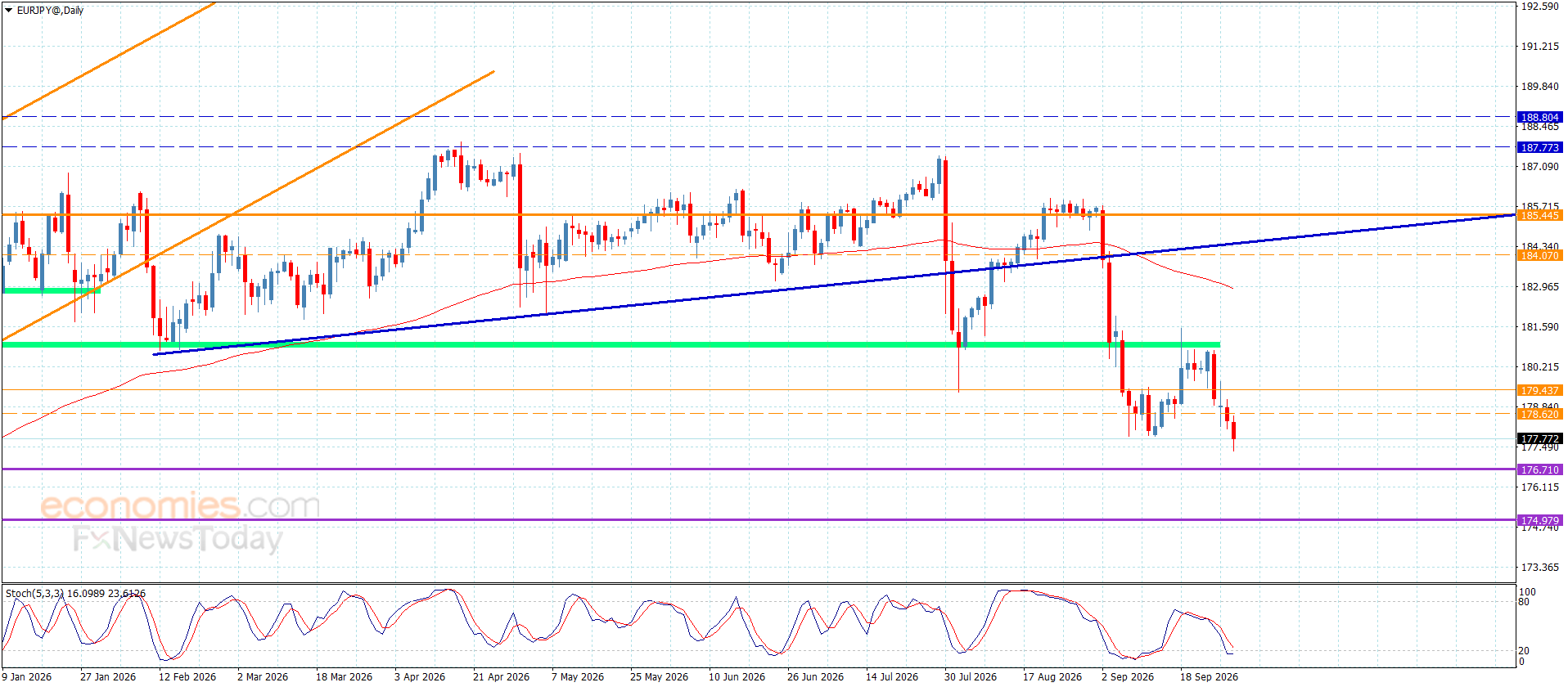
The pair’s price took advantage of the recurring negative pressure to confirm the bearish scenario previously suggested, continuing to form bearish waves and currently reaching 177.35, surpassing the first additional target proposed in the previous report.
The stability below the additional barrier at 179.45, combined with the main indicators maintaining negative momentum, these factors make us prefer more negative attempts, which could target 176.75. A break below this level could extend the losses toward 175.00 in the near term.
The expected trading range for today is between 176.75 and 178.50.
Trend forecast: Bearish