The main category of Forex News.
You can use the search box below to find what you need.
[wd_asp id=1]
The main category of Forex News.
You can use the search box below to find what you need.
[wd_asp id=1]
Important DisclaimersThe content provided on the website includes general news and publications, our personal analysis and opinions, and contents provided by third parties, which are intended for educational and research purposes only. It does not constitute, and should not be read as, any recommendation or advice to take any action whatsoever, including to make any investment or buy any product. When making any financial decision, you should perform your own due diligence checks, apply your own discretion and consult your competent advisors. The content of the website is not personally directed to you, and we does not take into account your financial situation or needs.The information contained in this website is not necessarily provided in real-time nor is it necessarily accurate. Prices provided herein may be provided by market makers and not by exchanges.Any trading or other financial decision you make shall be at your full responsibility, and you must not rely on any information provided through the website. FX Empire does not provide any warranty regarding any of the information contained in the website, and shall bear no responsibility for any trading losses you might incur as a result of using any information contained in the website.The website may include advertisements and other promotional contents, and FX Empire may receive compensation from third parties in connection with the content. FX Empire does not endorse any third party or recommends using any third party’s services, and does not assume responsibility for your use of any such third party’s website or services.FX Empire and its employees, officers, subsidiaries and associates, are not liable nor shall they be held liable for any loss or damage resulting from your use of the website or reliance on the information provided on this website.Risk DisclaimersThis website includes information about cryptocurrencies, contracts for difference (CFDs) and other financial instruments, and about brokers, exchanges and other entities trading in such instruments. Both cryptocurrencies and CFDs are complex instruments and come with a high risk of losing money. You should carefully consider whether you understand how these instruments work and whether you can afford to take the high risk of losing your money.FX Empire encourages you to perform your own research before making any investment decision, and to avoid investing in any financial instrument which you do not fully understand how it works and what are the risks involved.
Overall, the EUR/USD pair rally makes it overbought according to the Relative Strength Index (RSI), which is now at 70. Technically, the exchange rate was certainly overbought last week. Also, the relatively flat trading in the EUR/USD pair on Monday and into Tuesday allowed some overbought conditions to ease.
Consequently, this serves as a reminder that the RSI can reverse from overbought at a stable exchange rate and does not necessarily signal a pullback. The overarching theme we’re looking for at the end of the month is a more subdued EUR/USD price action, with recent highs likely to be out of reach for now.

Commenting on the performance of the most traded pair in the forex market, analyst Sean Osborne at Scotia Bank sees another technical signal indicating near-term exhaustion. Although his thesis is that the near-term weakness will prove limited. The analyst said, “Short-term trading patterns suggest that the euro price may have peaked in overnight trading after forming a bearish ‘evening star’ pattern on the 6-hour charts. Minor losses through quiet European trading tend to confirm this development. But losses are likely to remain limited in the near term at least.”
According to reliable trading platforms, the Euro rose sharply against the US Dollar on Friday after Federal Reserve Chairman Jerome Powell effectively gave the green light to cut US interest rates in September: Powell said in a speech at the Jackson Hole symposium, “The time has come to adjust policy.”
The speech was a surprise because it repeatedly pointed to concerns that the Labor market was at risk of deterioration, suggesting that the Fed needed to cut US interest rates to protect jobs. Furthermore, Financial markets had raised expectations that the Fed could start the US rate-cutting cycle with a large 50 basis point cut.
Overall, the US dollar’s trading this week will be determined by the evolution of expectations for a 50-basis point rate cut: if expectations increase, the euro could rise against the US dollar (EUR/USD). If expectations fade, the exchange rate could fall again. The highlight of the economic data will be the release of the personal consumption expenditures deflator on Friday, a measure of inflation that affects consumers. The US Federal Reserve tends to watch it closely, but we think there is limited opportunity for some kind of surprise that could change the broader narrative.
In his speech at Jackson Hole, Jerome Powell added that he is confident that US inflation will not return suddenly and that it is now more focused on the Labor market. Obviously, this suggests that the release of the US Non-Farm Payrolls report in early September will be the next major event for the US dollar.
The next major data release in the US will be the US jobs report on Friday. However, be aware that we are also approaching the end of the month. This can lead to some unusual non-news Forex market movements, and we will not see any unusual moves as a sign that current trends are changing.
On the stock exchanges front, European stocks were generally higher on Tuesday, recovering from yesterday’s subdued session as financial markets continued to assess the latest economic data and gauge potential responses from major central banks. According to trading, the euro zone’s STOXX 50 index rose 0.2% to more than 4,900, while the pan-European STOXX 600 index added 0.3% to approach the 520 thresholds, its highest level in more than a month. Recently, it has been supported by major mining stocks in the broader index as the London Stock Exchange reopened after a longer weekend.
According to an economic announcement, German consumer confidence as measured by GfK unexpectedly fell to its lowest level since May, underscoring the weak sentiment in the currency bloc’s largest economy after yesterday’s poor Ifo results. However, financial stocks rebounded with Santander, BNP Paribas, Munich Re and Allianz adding between 1.3% and 0.5%. Automakers also rose, led by Stellantis, BMW and Mercedes. Elsewhere, technology stocks continued to fall, with ASML down 0.5% ahead of Nvidia earnings today.
Ready to trade our daily Forex forecast? Here’s a list of some of the top forex brokers in Europe to check out.
The GBP/USD forecast shows a slight pullback in a bullish trend, with the pound near a two-year high hit in the previous session. The rally to this peak came as markets bet on more rate cuts by the Fed than the Bank of England. Meanwhile, markets awaited US GDP and inflation data.
-Are you interested in learning about forex live calendar? Click here for details-
Sterling eased slightly on Wednesday after reaching a new peak. Market focus is squarely on the rate cut outlook in the US and the UK. According to bets, the Fed might implement 100 bps in cuts this year. Meanwhile, the Bank of England might cut by 40 bps after a 25 bps cut in August. At the same time, the UK economy is doing better than expected, boosting the pound.
On Friday, the BoE Governor and Fed Chair spoke about rate cuts. Powell indicated it was time for the Fed to start lowering borrowing costs because the labor market had shown weakness. As a result, bets for a September cut rose, sinking the dollar.
On the other hand, Andrew Bailey cautioned against rushing to cut rates. He noted that it was too early to know if the fight to tame inflation was done. Consequently, rate cut expectations fell, and the pound rose.
However, incoming data might shift the outlook for UK and US policy. The US will release GDP and PCE data this week, which might alter expectations.
Trading will likely remain this as neither Britain nor the US will release major reports.
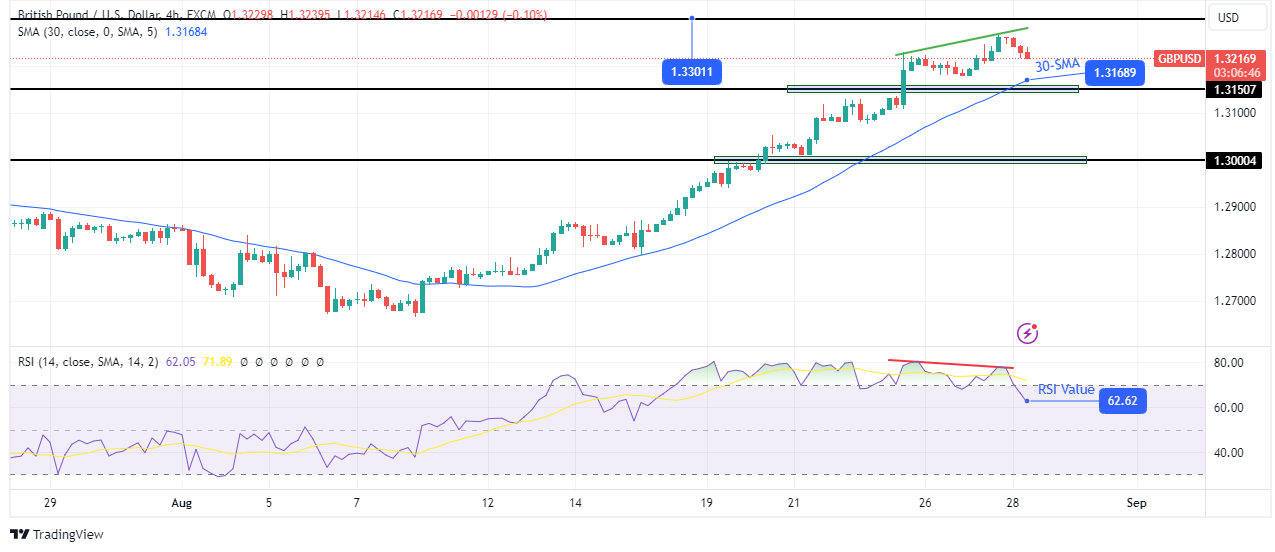
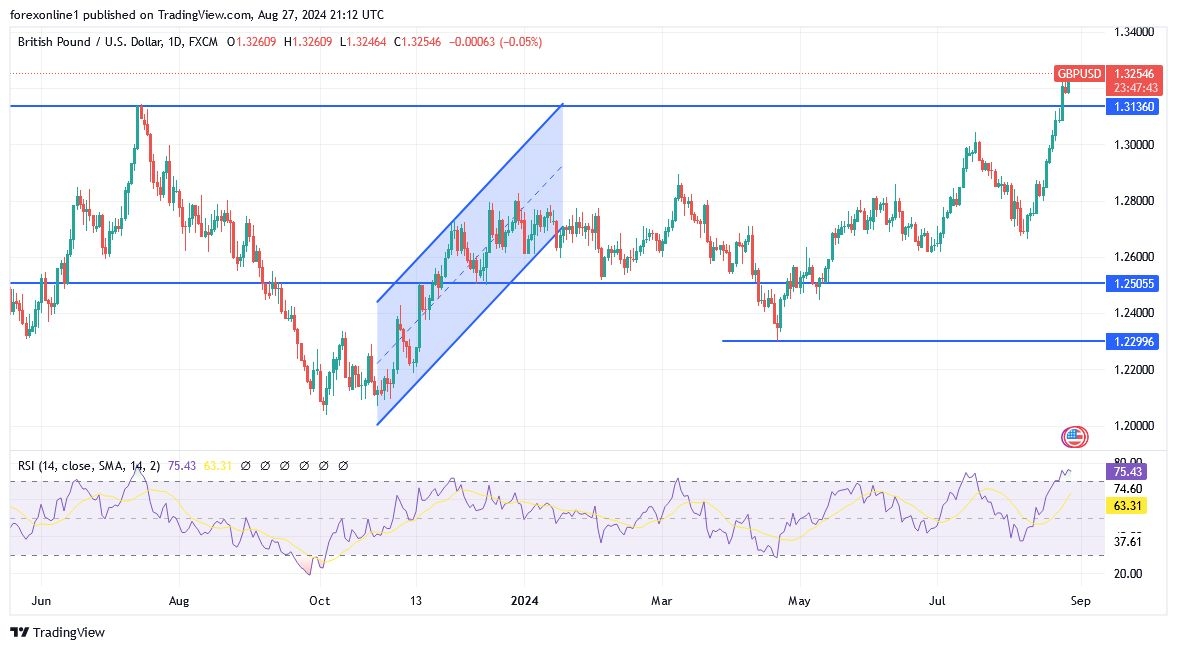
On the technical side, the GBP/USD price is retreating after making a higher high. Nevertheless, the bias remains bullish, with the price above the 30-SMA and the RSI over 50. Bulls have maintained a steep price trend above the SMA. It recently broke above the 1.3150 resistance level and was heading for the 1.3301 critical level. However, the journey to the 1.3150 level was difficult.
-Are you interested in learning about forex signals? Click here for details-
The RSI showed a slight bearish divergence, indicating exhaustion. As a result, bears have taken over. However, the bullish trend will continue if the price stays above the SMA.
Looking to trade forex now? Invest at eToro!
68% of retail investor accounts lose money when trading CFDs with this provider. You should consider whether you can afford to take the high risk of losing your money.
The GBP/USD forecast shows a slight pullback in a bullish trend, with the pound near a two-year high hit in the previous session. The rally to this peak came as markets bet on more rate cuts by the Fed than the Bank of England. Meanwhile, markets awaited US GDP and inflation data.
-Are you interested in learning about forex live calendar? Click here for details-
Sterling eased slightly on Wednesday after reaching a new peak. Market focus is squarely on the rate cut outlook in the US and the UK. According to bets, the Fed might implement 100 bps in cuts this year. Meanwhile, the Bank of England might cut by 40 bps after a 25 bps cut in August. At the same time, the UK economy is doing better than expected, boosting the pound.
On Friday, the BoE Governor and Fed Chair spoke about rate cuts. Powell indicated it was time for the Fed to start lowering borrowing costs because the labor market had shown weakness. As a result, bets for a September cut rose, sinking the dollar.
On the other hand, Andrew Bailey cautioned against rushing to cut rates. He noted that it was too early to know if the fight to tame inflation was done. Consequently, rate cut expectations fell, and the pound rose.
However, incoming data might shift the outlook for UK and US policy. The US will release GDP and PCE data this week, which might alter expectations.
Trading will likely remain this as neither Britain nor the US will release major reports.
On the technical side, the GBP/USD price is retreating after making a higher high. Nevertheless, the bias remains bullish, with the price above the 30-SMA and the RSI over 50. Bulls have maintained a steep price trend above the SMA. It recently broke above the 1.3150 resistance level and was heading for the 1.3301 critical level. However, the journey to the 1.3150 level was difficult.
-Are you interested in learning about forex signals? Click here for details-
The RSI showed a slight bearish divergence, indicating exhaustion. As a result, bears have taken over. However, the bullish trend will continue if the price stays above the SMA.
Looking to trade forex now? Invest at eToro!
68% of retail investor accounts lose money when trading CFDs with this provider. You should consider whether you can afford to take the high risk of losing your money.
Last week, Bank of Japan Governor Kazuo Ueda told parliament that the Japanese central bank may adjust monetary policy if its economic forecasts prove correct, indicating its readiness to raise interest rates again. On the other hand, US Federal Reserve Chairman Jerome Powell said in his speech in Jackson Hole that it is time to adjust policy amid increasing risks to the Labor market, while expressing confidence that inflation will return to the US central bank’s 2% target.
According to economic analysts, investors are now looking to July industrial production, retail sales, and unemployment figures, as well as August Tokyo inflation figures to guide economic and interest rate expectations in Japan.
On the stock trading front, Japanese stocks rose in a broad-based advance. According to trading, the Nikkei 225 index of Japanese stocks rose by 0.47% to close at 38,289 points. Meanwhile the broader TOPIX index rose by 0.73% to close at 2,681 points on Tuesday, erasing losses incurred earlier in the session, with all sectors participating in the advance. In general, the decline in the yen helped Japanese stocks as investors continued to assess the divergent monetary policies between the Bank of Japan and the Federal Reserve.
Also, hopes that Nvidia’s earnings this week will boost AI helped. Index heavyweights such as Mitsubishi Heavy Industries (4%), Mitsui E&S (8.7%), Seven & I Holdings (4.1%), Toyota Motor (1.8%) and Sony Group (2.8%) were strong performers. Meanwhile, technology stocks were mostly lower including LaserTech (-4.3%), Disco Corp (-2.1%) and Tokyo Electron (-0.9%).
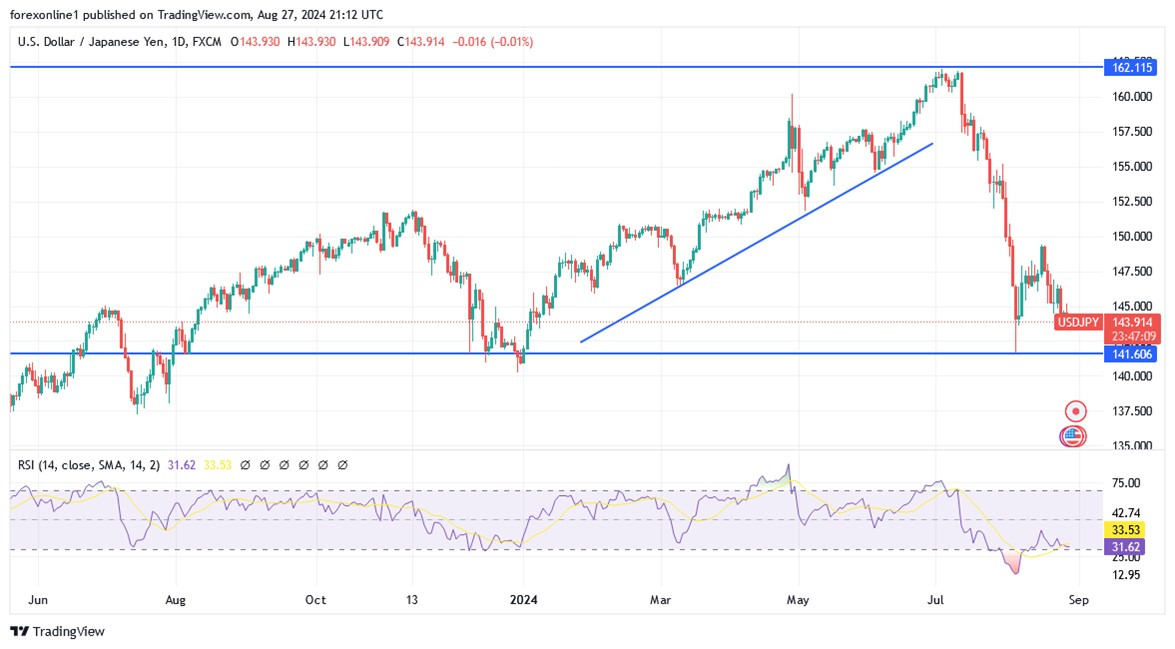
Based on the daily chart, the USD/JPY exchange rate is still in its broader downtrend and the next support levels will be 141.65 and 140.00 respectively which will move the technical indicators towards strong oversold levels. On the other hand, and for the same time frame, the psychological resistance of 150.00 will remain the most important for bulls to regain control of the trend. Obviously, the USD/JPY rate will continue to be influenced by the path of global central bank policies as well as investors’ appetite for risk or lack thereof.
Ready to trade our USD/JPY Forex forecast? Here’s a list of some of the best regulated forex brokers to check out.
The EUR/USD pair is in retreat mode on Wednesday, as the US Dollar finally found some near-term demand, approaching the 1.1100 threshold ahead of Wall Street’s opening. The USD advance seems to be the result of some profit-taking after the Dollar Index (DYX) neared the 100 level for the first time in over a year.
Market players are turning more cautious ahead of first-tier data and upcoming earnings reports. Both the Eurozone and the United States (US) will release inflation updates by the end of the week, while NVIDIA, the AI giant, will unveil its results after the closing bell.
Meanwhile, the macroeconomic calendar had nothing relevant to offer. The EU released M3 Money Supply figures, which rose 2.3% YoY in July, missing the 2.7% expected. Across the pond, the US published MBA Mortgage Applications for the week ended August 23, up 0.5% after declining 10.1% in the previous week.
From a technical point of view, the daily chart for EUR/USD shows the bearish momentum is building up, although given that the pair has already lost roughly 100 pips, the odds for additional slides seem limited. Technical indicators head firmly south within positive levels, retreating from overbought readings but still above their midlines, supporting a downward extension but far from indicating the pair has set an interim top. Finally, EUR/USD keeps developing far above a bullish 20 Simple Moving Average (SMA), while the 100 and 200 SMAs offer modest upward slopes well below the shorter one, suggesting bulls are still dominating the wider perspective.
In the near term, and according to the 4-hour chart, the risk skews to the downside. Technical indicators have pierced their midlines with strength and are currently approaching oversold readings. At the same time, the pair has broken below a flat 20 SMA, while the longer ones are losing their upward momentum far below the current level. A clear break below the 1.1100 mark could spur additional selling, although it is possible bulls will take their chances around the level.
Support levels: 1.1100 1.1065 1.1020
Resistance levels: 1.1150 1.1190 1.1240
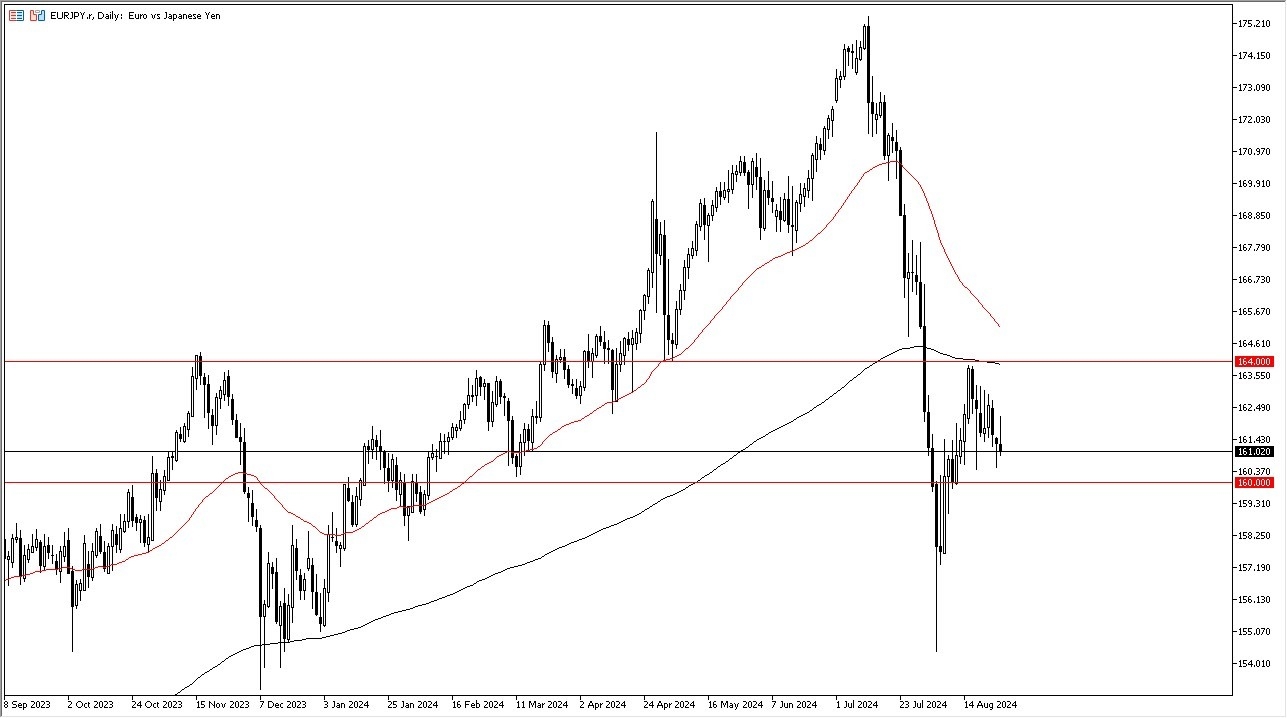
On the other hand, if we turn around and break above the 164 Yen level then we would not only clear the most recent consolidation, but we would also clear the 200 day EMA both of which would capture a lot of attention. Keep in mind that this is more or less about the Japanese Yen.
With that being the case, I think you’ve got a situation where you need to watch other pairs such as the US dollar against the Japanese yen or the New Zealand dollar against the Japanese yen. Granted, I think the euro’s overbought against several currencies right now. So, it may not be the big mover when it comes to a reverse the Japanese yen’s fortunes. But really, at this point, it should move in the same direction.
All things being equal, this is a market that I think continues to see a lot of back and forth and choppiness and this 400 point range. Keep in mind we recently sold a massive number of positions in the market. So, I think it makes a lot of sense that we have to stabilize and probably see a lot of trouble between now and any type of recovery as far as hanging on to a position. This is a very noisy thing to go through. That being said, if we break down below the 160 yen level, then it’s likely that we go to the 155 yen level underneath.
Ready to trade our daily Forex analysis? We’ve made a list of the best forex demo accounts worth trading with.
According to reliable trading companies’ platforms, the pound received help from the Governor of the Bank of England, Andrew Bailey, who said that it is “too early to declare victory” over inflation, confirming market bets that the bank will ignore another interest rate cut in September. In general, both the European Central Bank and the US Federal Reserve are expected to cut interest rates in September, with more cuts likely from both before the end of the year. In contrast, the Bank of England appears set to deliver just one more cut before the end of the year. This suggests a slower path for cuts from the BoE, providing a key source of support for the pound against both the euro and the US dollar.
Overall, the constructive global market sentiment remains the other main driver behind the Pound Sterling’s recent outperformance. The jump in equity markets on Friday pushed the British currency to new highs against the dollar while also boosting its recovery against the euro. According to forex trading, the GBP/EUR exchange rate rose above 1.18, while the GBP/USD pair reached above the resistance of 1.32. When examined over a one-week period, the Pound Sterling is the best-performing currency among G10 currencies and remains the best performer for 2024.
Certainly, financial markets gave up some of the recent gains on Monday, weakening the Pound Sterling’s advance, especially against the US dollar. Losses were concentrated in the US technology sector, which showed tension ahead of the mid-week Nvidia results announcement. Much depends on the performance of the leading artificial intelligence company, and any disappointments could lead to a broader decline in the technology sector. Therefore, disappointment here could strengthen the US dollar from its recent levels, but we do not see this significantly affecting Pound Sterling prices. Furthermore, declines in the GBP/USD pair are likely to be superficial as long as the markets believe that the Federal Reserve is ready to deliver several US interest rate cuts in the coming months.
Fed Chairman Jerome Powell said in a speech at Jackson Hole, “It is time to adjust policy… Downside risks to employment have increased… We do not seek or welcome further easing in labor market conditions,” .
Obviously, this showed that the president is now less concerned about inflation and his focus is shifting to the labor market, where he fears a slowdown in the economy could lead to higher unemployment. This would require a US rate cut and raise market expectations for a 50bp rate hike by the Fed in September, although the odds of this receded somewhat on Monday, helping the US dollar recover somewhat.
San Francisco Fed President Mary Daly reiterated the message on Monday, saying: “It is time to adjust policy.”
Looking ahead, we expect sterling to be more subdued, with GBP/USD likely to be capped at 1.32 resistance in the near term. Also, we note that the exchange rate has become overbought in the near term and some pullback is necessary. The losses in GBP/USD on Monday, linked to the US tech sector sell-off, suggest that the broader market pullback will only temporarily weigh on the British currency.
Concurrently, GBP/EUR is advancing for a fifth consecutive day, which is unusual for this exchange rate. The GBP/EUR pair is moving slowly with a tendency to return to the mean, and the pair could also decline if global markets face a setback. In general, we will be watching the inflation data from the Eurozone this week (Germany on Thursday and the whole Eurozone on Friday). Any decline in these data could strengthen expectations of a rate cut by the European Central Bank, which in turn could weigh on the Euro.
Ready to trade our Forex daily forecast? We’ve shortlisted the best regulated forex brokers UK in the industry for you.
Gold price has returned to the red but remains within this week’s familiar range above $2,500 early Wednesday. Gold price replicates the negative action seen during Tuesday’s Asian session, awaiting speeches from US Federal Reserve (Fed) policymakers for fresh hints on the interest-rate outlook.
Further, a sense of caution prevails, as markets remain wary ahead amid looming Middle East geopolitical risks ahead of the highly anticipated Nvidia earnings due later this Wednesday and Friday’s US inflation data.
Amidst a risk-off mood, the US dollar (USD) finds fresh haven demand, which acts as a heading for the Gold price. However, sluggish US Treasury bond yields could limit the US Dollar’s uptick, cushioning the Gold price downside.
Meanwhile, dovish Fed expectations and simmering Middle East geopolitical tensions will continue to lend support to Gold price. White House spokesman John Kirby said on Tuesday that the US believes Iran is postured and poised to deliver an attack on Israel.
Additionally, the Israeli army mobilized thousands of soldiers from special units in preparation for the large-scale operation in the northern West Bank, lasting a long time.
Despite the bullish sentiment around Gold price, the upcoming Fedspeak will provide a fresh trading impetus to Gold price. Markets are currently pricing in a 32% probability of 50 basis points (bps) rate reduction in September while the odds of a 25 bps cut stand at 68%, the CME Group’s FedWatch Tool showed on Wednesday.
On Tuesday, Gold price witnessed a good two-way price movement, initially correcting slightly from near the record high of $2,532 on haven demand for the US Dollar. However, the Greenback came under intense selling pressure in sync with the US Treasury bond yields after a strong US 2-year note auction results of the $69 billion sale.
The USD failed to find any inspiration from an improvement in the US Conference Board (CB) Consumer Confidence data and a tech sell-off in the US and Chinese equities.
Nothing has changed for the Gold price from a short-term technical perspective, with the upside risks intact so long as buyers defend the triangle resistance-turned-support at $2,466.
The 21-day Simple Moving Average (SMA) closes in on that level, making it a strong support.
It’s worth mentioning that Gold price consolidates its upside break from a symmetrical triangle confirmed a couple of weeks ago.
Meanwhile, the 14-day Relative Strength Index (RSI) turns lower but holds comfortably above 50, currently near 61, justifying the bullish outlook.
Gold buyers need to recapture the record high of $2,532 to take on the next key barrier at the $2,550 level.
Acceptance above the latter could challenge the $2,600 round level en route to the triangle target, measured at $2,660.
On the flip side, the initial demand area is seen at the $2,500 threshold for Gold buyers, below which Friday’s low of $2,485 will be challenged.
A sustained breach of the latter could expose the downside toward the abovementioned triangle resistance-turned-support at $2,466.
Gold has played a key role in human’s history as it has been widely used as a store of value and medium of exchange. Currently, apart from its shine and usage for jewelry, the precious metal is widely seen as a safe-haven asset, meaning that it is considered a good investment during turbulent times. Gold is also widely seen as a hedge against inflation and against depreciating currencies as it doesn’t rely on any specific issuer or government.
Central banks are the biggest Gold holders. In their aim to support their currencies in turbulent times, central banks tend to diversify their reserves and buy Gold to improve the perceived strength of the economy and the currency. High Gold reserves can be a source of trust for a country’s solvency. Central banks added 1,136 tonnes of Gold worth around $70 billion to their reserves in 2022, according to data from the World Gold Council. This is the highest yearly purchase since records began. Central banks from emerging economies such as China, India and Turkey are quickly increasing their Gold reserves.
Gold has an inverse correlation with the US Dollar and US Treasuries, which are both major reserve and safe-haven assets. When the Dollar depreciates, Gold tends to rise, enabling investors and central banks to diversify their assets in turbulent times. Gold is also inversely correlated with risk assets. A rally in the stock market tends to weaken Gold price, while sell-offs in riskier markets tend to favor the precious metal.
The price can move due to a wide range of factors. Geopolitical instability or fears of a deep recession can quickly make Gold price escalate due to its safe-haven status. As a yield-less asset, Gold tends to rise with lower interest rates, while higher cost of money usually weighs down on the yellow metal. Still, most moves depend on how the US Dollar (USD) behaves as the asset is priced in dollars (XAU/USD). A strong Dollar tends to keep the price of Gold controlled, whereas a weaker Dollar is likely to push Gold prices up.
The US dollar has been very noisy during the early hours on Tuesday against the Japanese yen. As we continue to see the market test this uptrend line, all things being equal, the market is likely to continue to question where we’re going next. All things being equal, if we could break to the upside, then the market could go looking to the 148.50 yen level. This is an area that has been important previously and should continue to attract attention if we revisit it again.
It is that in that area, we would be the top of the consolidation area. And then if we can break above there, we would challenge the 150 yen level. On the other hand, if we were to break down below the 143 yen level, then underneath there could be a bit of a trap door, and we could see a bigger move lower. In general, I think this is a situation where you have a market that is trying to decide whether or not the carry trade can return.
I think there are a lot of questions out there, but it is worth noting that the so-called death cross is going on as the 50-day EMA just crossed below the 200-day EMA, but that’s generally a very late indicator anyway. So, I think you’re going to see more sideways and choppiness at least until the Friday session where we get the core PCE Index figures, as it gives the Fed a solid look at the overall inflation situation.
For a look at all of today’s economic events, check out our economic calendar.
This article was originally posted on FX Empire