The main category of All News Articles.
You can use the search box below to find what you need.
[wd_asp id=1]
The main category of All News Articles.
You can use the search box below to find what you need.
[wd_asp id=1]
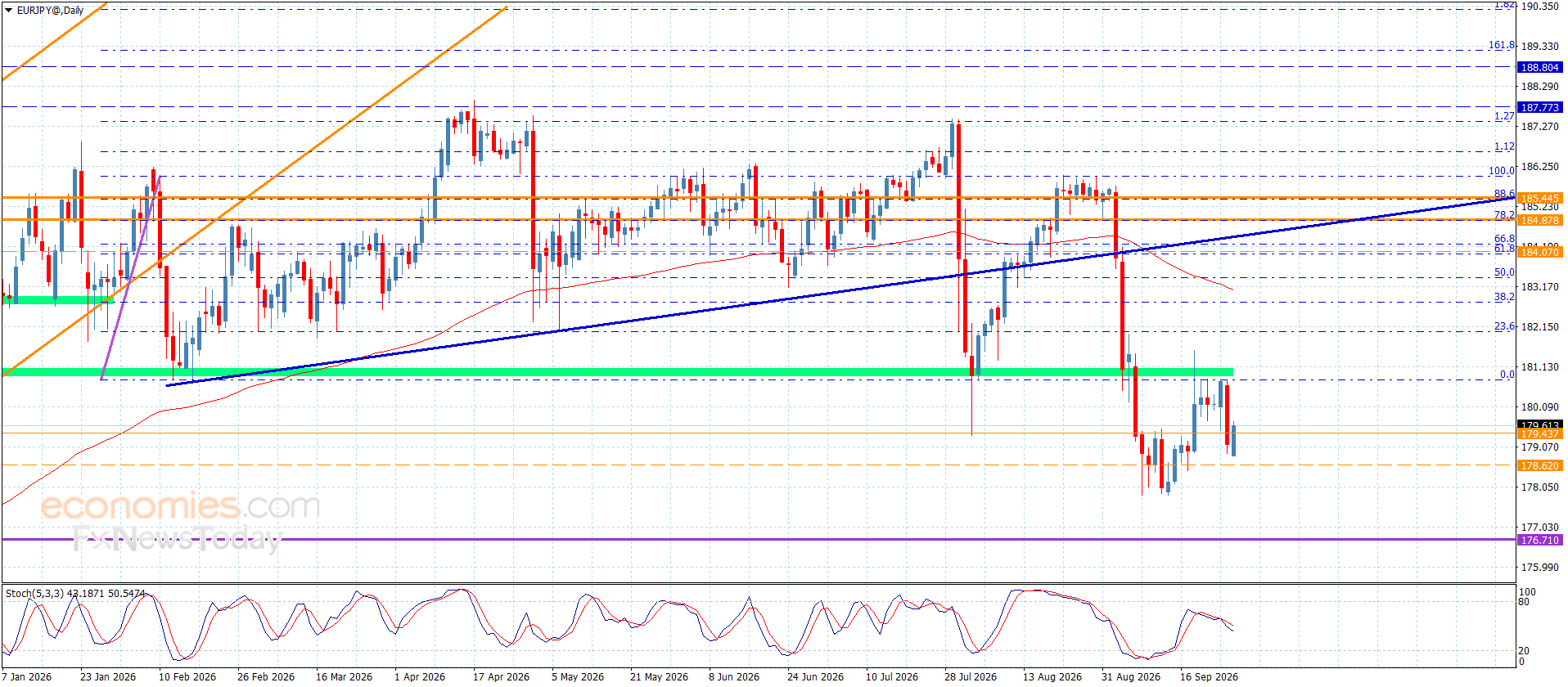
EURJPY confirmed its commitment to the bearish scenario by recently closing below the resistance level at 180.80. During Friday’s trading, the pair posted a sharp decline, approaching the first additional target at 178.60.
The price now needs to gather further negative momentum to remain below 179.40, allowing it to renew pressure on the target at 178.60. A break below this level could extend the decline directly toward the next bearish target around 177.40.
The expected trading range for today is between 178.00 and 180.00
Trend forecast: Bearish
Gold is trading at about $4,182. I’m looking at the 2-hour chart and the drop below the support at $4,199 stands out. Prior to this, Gold had also broken down from the support range at $4,244 to $4,257. The more recent candles are below both the 20 and 50 moving averages, and also the downsloping trendline.
There is support at $4,173. Breaking below that would make the next support at $4,152 and then $4,128 and $4,100 coming into play. The resistance at $4,199 is the first of the range, with the next at $4,225, $4,244, and $4,257.
EUR/USD extended its range to the downside in a choppy week. PMIs, another German survey and inflation data will be watched. Here is an outlook for the highlights of this week and an updated technical analysis for EUR/USD. Euro-zone inflation edged up, but the euro didn’t really react. Draghi took advantage of his public appearance to weigh on the euro and also the meeting minutes of the ECB continue paving the way for more monetary stimulus. On the other side of the Atlantic, the minutes from the Fed, did not tell us anything we didn’t know: they indeed wanted to tell us that a hike is on the table for December, … (full story)
EUR/USD extended its range to the downside in a choppy week. PMIs, another German survey and inflation data will be watched. Here is an outlook for the highlights of this week and an updated technical analysis for EUR/USD. Euro-zone inflation edged up, but the euro didn’t really react. Draghi took advantage of his public appearance to weigh on the euro and also the meeting minutes of the ECB continue paving the way for more monetary stimulus. On the other side of the Atlantic, the minutes from the Fed, did not tell us anything we didn’t know: they indeed wanted to tell us that a hike is on the table for December, … (full story)
Crédit Agricole expects the US Dollar to Japanese Yen (USD/JPY) exchange rate to climb to 163 by December 2026, even as JPMorgan identifies signs of Japanese buying interest in the Yen.
Friday’s close of 157.29 leaves Crédit Agricole’s year-end forecast around 3.6% above the market.
USD/JPY fell 0.97% that day, surrendering most of its weekly advance as the Yen recovered following fresh comments from Finance Minister Satsuki Katayama about US concerns over Yen weakness.
Crédit Agricole’s path falls from 163 in December to 162 in March 2027, 161 in June, 158 in September and 156 in December 2027.
It argues that official currency support needs stronger backing from monetary policy:
“Record levels of intervention have capped USD/JPY’s rally at 164, but for the JPY to stage a sustainable rally, the BoJ needs to accelerate the pace of its rate hikes, reducing the currency’s appeal as a carry funder.”
JPMorgan’s earlier assessment identified two support levels:
“Rate check pivot around 157.80 will provide some short term support with 156.50/60 below”
Friday’s close was beneath that first level, leaving 156.50-156.60 as the next lower area to watch.
The desk saw more local Yen demand near recent USD/JPY highs, although overseas institutional investors had increased Yen selling during the week.
It also questioned how effectively intervention could offset broader pressures:
“As you know I really do not doubt the intentions but I am starting to worry about the efficacy of the actions so far in the face of what is a huge energy and fixed income shock.”
Crédit Agricole similarly cites elevated oil prices and Japanese fiscal concerns as obstacles to lasting Yen gains.
The 156 end-2027 forecast is less than 1% below Friday’s close, but the intervening path includes renewed Yen weakness towards 163 before that recovery.
Our currency coverage draws on live market data, official economic releases and published bank research.
Natural Gas (NATGAS) Moved Sharply on Sep 7: Inventories, the Dollar, or Geopolitics?
• Natural gas futures advanced due to projected above-average late-summer temperatures.
• LNG feedgas intake rebounded strongly, driven by firm international winter demand.
• Technical indicators show a MACD buy signal and overbought Williams %R conditions.
TradingKeyMon, Sep 7
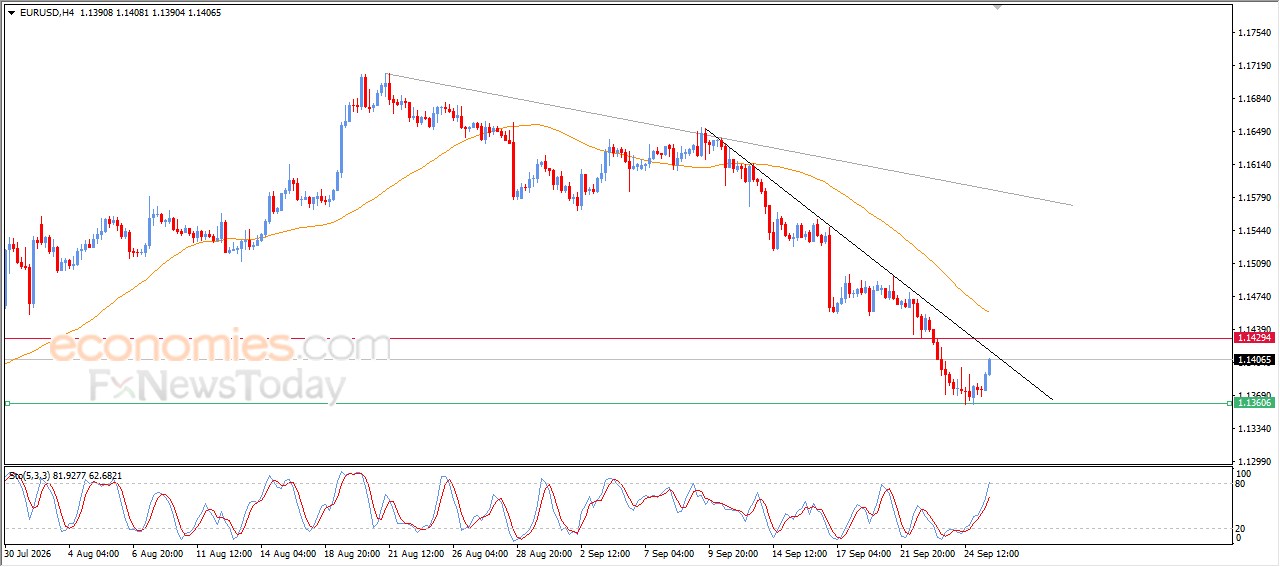
The EURUSD price rose in its latest intraday trading, benefiting from the emergence of the positive signals from the relative strength indicators, attempting to recover some of its previous losses, amid the dominance of the main bearish trend on the short-term basis, with its trading alongside minor trend line that supports this path, besides the continued negative pressure due to its trading below EMA50, which represents a dynamic resistance that reduces the chances of a full recovery on the near-term basis, especially with the relative strength indicators entering exaggerated overbought levels compared to the price move, indicating a quick pullback for the positive momentum.
Today’s platinum prices in Arcot are ₹54,600 (10g), ₹5,46,000 (100g),
and ₹54,60,000 (1kg). Throughout September, rates moved considerably. The highest
value for 100g was ₹5,76,000, and the lowest
₹5,25,300. For 1kg, prices were within
₹52,53,000 to ₹57,60,000.
A variety of factors drive platinum prices, such as production volumes, demand trends,
and global political developments. The metal’s industrial role, especially in cars and
electronics, adds pressure. Currency fluctuations, notably involving the US dollar, as
well as inflation and central bank policy, also steer market movements.
The article covers the following subjects:
Consider long positions from corrections above 88.00 with a target of 115.50–125.50.
Breakout and consolidation below 88.00 will allow the asset to continue declining to the levels of 79.30–67.00.
On the weekly chart, a descending correction has likely finished developing as the second wave of larger degree (2) and an ascending third wave (3) is forming. On the daily chart, apparently, the first wave of smaller degree 1 of (3) has formed, a local correction has been completed as wave 2 of (3), the third wave 3 of (3) is unfolding, and wave i of 3 continues to form. Wave (iii) of i is forming on the H4 chart, within which wave v of (iii) is unfolding. If the presumption is correct, WTI will continue to rise to 115.50–125.50. The level of 88.00 is critical in this scenario as a breakout below it will enable the asset to continue declining to the levels of 79.30–67.00.
This forecast is based on the Elliott Wave Theory. When developing trading strategies, it is essential to consider fundamental factors, as the market situation can change at any time.
The content of this article reflects the author’s opinion and does not necessarily reflect the official position of LiteFinance broker. The material published on this page is provided for informational purposes only and should not be considered as the provision of investment advice for the purposes of Directive 2014/65/EU.
According to copyright law, this article is considered intellectual property, which includes a prohibition on copying and distributing it without consent.
The article covers the following subjects:
Consider long positions from corrections above 3,960.00 with a target of 4,900.00–5,610.00.
Breakout and consolidation below 3,960.00 will allow the asset to continue declining to the levels of 3,720.00–3,290.62.
An ascending third wave of larger degree (3) is presumably developing on the weekly chart. Within it, a descending correction has been completed as the fourth wave of smaller degree 4 of (3). Apparently, the fifth wave 5 of (3) has started developing on the daily chart, with wave i of 5 forming as its part. The H4 chart shows that wave (iii) of i of 5 has formed, a local correction is complete as wave (iv) of i, and wave (v) of i has likely started unfolding. If the presumption is correct, XAU/USD will continue to rise to 4,900.00–5,610.00. The level of 3,960.00 is critical in this scenario as a breakout below it will enable the asset to continue declining to the levels of 3,720.00–3,290.62.
This forecast is based on the Elliott Wave Theory. When developing trading strategies, it is essential to consider fundamental factors, as the market situation can change at any time.
The content of this article reflects the author’s opinion and does not necessarily reflect the official position of LiteFinance broker. The material published on this page is provided for informational purposes only and should not be considered as the provision of investment advice for the purposes of Directive 2014/65/EU.
According to copyright law, this article is considered intellectual property, which includes a prohibition on copying and distributing it without consent.