The main category of All News Articles.
You can use the search box below to find what you need.
[wd_asp id=1]
The main category of All News Articles.
You can use the search box below to find what you need.
[wd_asp id=1]
Dogecoin (DOGE) has been one of the top performers in the crypto market since the beginning of the new year. The number one memecoin gained nearly 30% over the past four days, outperforming major cryptos amid a rise in the broader market sentiment.
The move is reflected in the 21Shares 2x Dogecoin ETF (TXXD), which is one of the best-performing ETFs to start 2026, according to Bloomberg ETF analyst Eric Balchunas.
The speculative interest in Dogecoin also improved slightly in the traditional crypto market, with its open interest (OI) rising to 13.47 billion DOGE on January 2 — its highest level since the October 10 leverage flush, per Coinglass data. However, that figure has slightly retreated to 12.68 billion DOGE despite a steady price rise, indicating some scepticism among traders.
Meanwhile, the rise isn’t limited to Dogecoin as the broader memecoin category has seen its market capitalization rise over 30% to $47.8 billion in the past four days.
The move follows months of underperformance, with the memecoin to altcoin dominance ratio plunging to historic lows of 0.032 in December. This means that memecoins accounted for only 3% of the general altcoins market cap. However, a massive memecoin season kicked off following the last time the metric reached such levels.
With recent gains across several memecoins, the sector could be hinting at a comeback, according to CryptoQuant contributor Darkfost.
DOGE has risen above the 50-day Exponential Moving Average (EMA) and is looking to tackle the $0.166 resistance near the 100-day EMA. A rise above could push the top memecoin to tackle the $0.181 hurdle near the 200-day EMA.
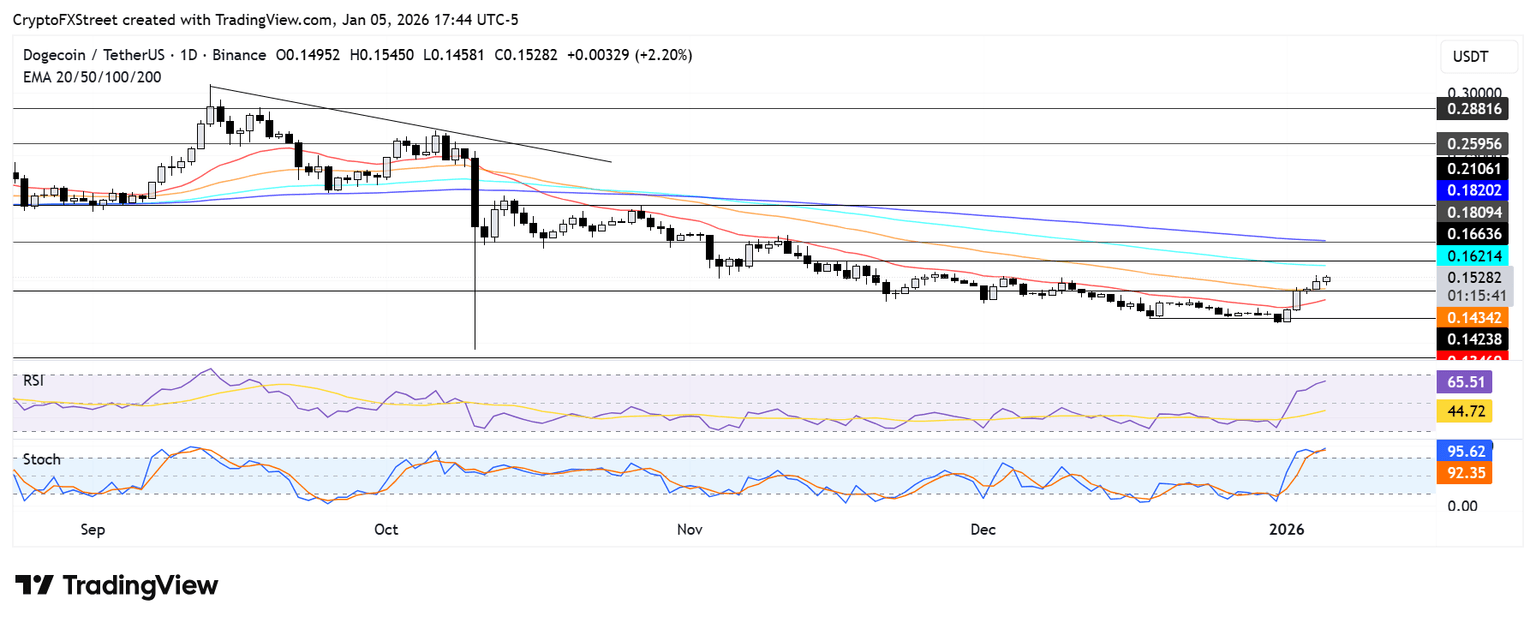
On the downside, Dogecoin could find support at $0.142. A decline below $0.142 and eventually the 20-day EMA could push its price toward $0.121.
The Relative Strength Index (RSI) is above its neutral level, while the Stochastic Oscillator (Stoch) is in its overbought region, indicating a rising bullish momentum. Sustained overbought conditions in the Stoch could spark a pullback.
Spot Gold trades around the $4,450 level on Monday, sharply up on a daily basis amid broad US Dollar (USD) weakness. The bright metal found support throughout the first half of the day on geopolitical turmoil, extending its advance afterwards on the back of poor United States (US) data.
The world found out on Saturday that US President Donald Trump ordered a strike on Venezuela, capturing President Nicolás Maduro and his wife and bringing them to the US to be judged on narco-terrorism, among other charges. The news triggered global noise and boosted demand for the safe-haven metal, as caution rules.
Early in the American session, the USD suffered a setback following the release of the December Institute for Supply Management (ISM) Manufacturing Purchasing Managers’ Index (PMI). The index came in at 47.9, below the expected 48.3, and worse than the 48.2 posted in November. The report also showed that the Employment Index improved slightly to 44.9 from 44 in November, while the Prices Paid Index, the inflation component, remained unchanged at 58.5.
The US labor market will take centre stage this week, as the country will release multiple employment-related figures. The ADP employment Change report for December and November JOLTS Job Openings will be out on Wednesday, while weekly unemployment data will be released on Thursday, and the all-mighty Nonfarm Payrolls (NFP) report will be out on Friday.
From a technical point of view, the 4-hour chart shows XAU/USD trades at $4,445.56, roughly $45.50 up for the day. The same chart shows the 20-period Simple Moving Average (SMA) has turned higher but still trails the rising 100-period SMA, both around the $4,370 level. The 200-period SMA, in the meantime, advances at $4,267 underpinning the broader structure. Also, the Momentum indicator stands above 0 and expands, signaling strengthening buying interest. Finally, the Relative Strength Index (RSI) indicator is heading north around 60, in line with the dominant bullish trend.
In the daily chart, XAU/USD bounced after testing a bullish 20-day SMA at $4,343, which also rose above the bullish 100- and 200-day SMAs, all of which reinforce the bullish bias. The Momentum indicator advances above its midline, while the RSI indicator has partially lost its upward strength at around 63, underpinning the broader uptrend.
(The technical analysis of this story was written with the help of an AI tool)
The Australian dollar spent the first part of the session on Friday rallying against the Japanese yen and even piercing the 105 yen level yet again. That being said, this is a market that continues to see a lot of noise above there, and it should be no surprise that we have, in fact, turned right back around after that move.

All things being equal, this is a market that I still believe in the upside, and it is worth noting that you get paid to hold onto it at the end of every session. We’ve been in an uptrend for a while, and despite the fact that we have flipped the calendar into 2026, I don’t think anything has truly changed.
Short-term pullbacks are buying opportunities as we wait for some type of value. Keep in mind that the Japanese yen is considered to be a safety currency, and the Australian dollar, of course, is considered to be more of a risk-on commodity type of currency.
The 104 yen level should continue to be support and with that being said, I think we have a buy on the dip scenario. The 50-day EMA is all the way down at the 102.26 yen level and rising, so I think that is also dynamic support.
To the upside, if we can finally clear the 105 yen level, it’s likely that we go much higher, perhaps looking to the 107 yen level based on a measured move of the recent consolidation. Keep in mind that the Bank of Japan did recently raise rates, but they can only tighten monetary policy so much as the debt level in Japan is dire, to say the least. With that being the case, I look at this as a market that should continue to pay you over time if you hold it to the long side. I’ve got no interest in getting short, unless of course we get some type of external factor.
Ready to trade our Forex daily analysis and predictions? Check out the largest forex brokers in Australia worth using
Christopher Lewis has been trading Forex and has over 20 years experience in financial markets. Chris has been a regular contributor to Daily Forex since the early days of the site. He writes about Forex for several online publications, including FX Empire, Investing.com, and his own site, aptly named The Trader Guy. Chris favours technical analysis methods to identify his trades and likes to trade equity indices and commodities as well as Forex. He favours a longer-term trading style, and his trades often last for days or weeks.
When I arrived in China to teach law, I didn”t expect to come home with so much tea. Nor did I expect what the tea would come to mean.
In my first week at China University of Political Science and Law in Beijing, my teaching assistant handed me a small package. It was tea from her home province of Yunnan. Later, a student gave me tea her parents had just mailed from Zhejiang province. And on my final day at East China University of Political Science and Law in Shanghai, a student brought me tea from Henan province, specially sourced by her grandfather’s friend and sent overnight by her father so she could present it before I returned to the United States. These weren’t performative gestures. Classes were over. Grades had been turned in. These were gifts from the heart — students offering pieces of their heritage, linking their present to their past.
In a country where so many students live and study far from home, tea becomes more than a beverage. It becomes a bridge. A thread to childhood and family and place. A portable form of belonging. And so, in classrooms and train stations, offices and airport lounges, I drank tea not as a tourist, but as a guest.
Some of the most memorable moments of my time in China happened with a teacup in hand. In Chengdu, Sichuan province, two students had won the prize I donated to a public-interest charity auction: a day trip with me anywhere in China that we could reach and return from in 24 hours. They chose Chengdu for the pandas and the spice, but before lunch we sat for tea in Daci Temple. The students brewed it carefully, performing each step from memory. When I asked why they rinsed the cups and discarded the first brew — what looked to me like perfectly good tea — they hesitated. It’s what their parents and grandparents do, they said. And they learned it from their parents, and so on. The ritual wasn’t about cleanliness or flavor. It was about continuity — performing a gesture as countless hands had done before. A quiet ceremony of connection.
In Beijing, Professor Ding Wenwen took me to a traditional teahouse and asked the hostess to lead me through the full ceremony. She explained every step with patience. When it was my turn to take over, I fumbled a little, spilled a little, forgot the sequence. No one corrected me. The point, I realized, wasn’t mastery — it was mindfulness. It was being present, paying attention, offering your full self to the moment.
In Quanzhou, Fujian province, I was exploring the historical district with a teaching assistant from the Peking University School of Transnational Law, when we wandered into a tiny studio. Inside, a husband and wife made porcelain teapots and cups so fine they were nearly translucent. They invited us to sit for tea, and we talked for more than an hour — not about the wares or prices, but about life, family, travel, and dreams. It was a reminder that tea, in China, is as much a language of friendship as it is a drink.
You don’t rush it. You let it steep.
And then there are the teahouses themselves. You find them not just in scenic areas or historical quarters, but in the heart of cities. In a culture that moves fast — where workdays are long and public transit is swift — teahouses offer something rare: a reason to slow down. No one checks their phone. Conversations unfold without interruption. The layout helps: guests sit beside each other rather than across a table. No one plays host. The tea does that.
Over time, tea has become my go-to gift for friends and family on every trip I make to China. Before I even board the plane home, I receive text messages with requests — Longjing (Dragon Well green tea) from Hangzhou, Zhejiang province, jasmine pearls from Fujian, Pu’er from Yunnan. What began as something I didn’t understand has become something I am trusted to curate. These are no longer just souvenirs. They’re tokens of a shared journey.
In all these moments, I saw something I rarely encounter in the US — a beverage that commands respect not just because of its flavor, but because of its meaning. In the West, we often treat tea as functional: something to energize or soothe. In China, tea is relational. It is ancestral. It is ceremonial. Even when shared casually between friends, it carries an unspoken reverence.
And this brings me to the larger point: it’s time for the rest of the world to catch up. For too long, tea has been reduced in global consciousness to a commodity — leaf grades, caffeine levels, steeping temperatures. But Chinese tea is a cultural treasure, deserving the same reverence given to French wine or Scotch whisky. It has terroir. It has lineage. It has rules and rituals and regional identities. It is not a mere export. It is a heritage.
As China becomes more central to global cultural conversations, its tea traditions — long appreciated domestically — deserve the same global attention. Not just as a drink, but as an expression of history, hospitality, and human connection. When a student gives you tea from their home province, what they’re really giving you is a glimpse of who they are, where they’re from, and how they stay connected to it.
And so, I’ve learned to accept tea slowly. Not just to sip it, but to listen to it. To share its stories, one cup at a time.
The author is a law professor at Ohio Northern University in the United States, and a visiting faculty member at CUPL in Beijing and ECUPL in Shanghai.
Dogecoin (DOGE) price opened 2026 with signs of stabilization following a volatile correction in late 2025. Multiple technical studies suggest downside pressure is easing as price holds key support zones. Analysts now point to recovery structures that could guide Dogecoin toward higher levels if momentum continues to build.
According to analyst Trader Tardigrade, the three-month Dogecoin price against USD chart outlines a clear cyclical structure. Price action moved through alternating phases of advances, recoveries, and declines between July 2025 and January 2026. The most recent segment shows a mild upward shift after the drop toward $0.12.
This phased behavior reflects Dogecoin’s tendency to rotate through sentiment-driven cycles. The latest green recovery bars indicate reduced downside pressure compared to prior red phases. Stabilization near $0.125 suggests buyers are beginning to absorb the remaining supply.
Moreover, the structure implies a potential transition toward an uptrend if support remains intact. Sustained price action above the current range could open the door to a move toward $0.15. Failure to hold the range would instead extend consolidation.
Additionally, analyst BitGuru analyzed the DOGE price chart covering mid-2025 through early 2026. The chart highlights a sharp liquidity sweep in November that pushed the price briefly below $0.12. That move was followed by a tight consolidation range into the new year.
 SOURCE: X

This consolidation phase shows narrowing candles and fading selling pressure. Such behavior often points to accumulation after forced liquidations. Price has continued to respect the $0.12 to $0.13 band, suggesting a balance between buyers and sellers.
In addition, the structure reflects a classic reset following a strong rally earlier in the cycle. A confirmed break above $0.13 would indicate renewed upside momentum. A move below $0.115 would reopen downside risk.
Meanwhile, according to analyst Berke Oktay, the long-term Dogecoin price chart places current price action within a descending wedge spanning more than a decade. DOGE price has compressed into a major support zone between $0.10 and $0.12. This zone has historically acted as a defensive level.
 SOURCE: X
The chart also highlights developing divergences as price holds support despite prior declines. Such conditions often precede trend shifts when selling momentum weakens. Holding this zone prevents a deeper structural breakdown.
Furthermore, the wedge formation suggests energy is building as price compresses. A sustained defense of support could allow Dogecoin to challenge higher resistance levels over time. A breakdown below the zone would invalidate the reversal scenario.
There are two indicators to note when looking to see if there is some significance to Monday’s new retracement low. An internal uptrend line was close to Monday’s low and marked potential dynamic support. More significant is the relationship to the 78.6% Fibonacci retracement at $3.45. It was broken to the downside earlier in Monday’s session but has since been recovered. Natural gas is on track to end the day with a bull hammer candle and a recovery of the 78.6% retracement, which will confirm with a daily close above the level. So, the daily close is set to show support near the Fibonacci level.
Despite the minor short-term signs of strength, today’s decline put natural gas below the 200-day moving average for the first time since late October, and it is set to close in a similar, relatively bearish position. Signs of strong support was possible near the 200-day line since it had not been tested as support after it was reclaimed at the end of October. The bearish failure confirmed by a daily close below the 200-day average today will suggest that downside pressure may yet remain.
The 200-day line is now at $3.57, and Friday’s lower daily high is at $3.70. Although a reclaim of the 200-day average will show improving demand, a sustained breakout above a lower daily high will provide greater assurance that demand is continuing to improve and that the reclaim of the 200-day line may be sustainable.
If sellers remain in charge before a bounce, there is another potential target a little lower than what has been seen so far, at $3.26. That target is the 78.6% projection for a falling ABCD pattern that defines the measured moves of the bearish correction that followed the $5.50 peak in early-December.
For a look at all of today’s economic events, check out our economic calendar.
The interest rate differential between the two currencies is negligible at best now, so we’re not even playing along those lines. We’re just trying to figure out whether or not the Bank of England is going to start a larger rate-cutting cycle or not. We already know that the Federal Reserve is likely to cut rates again once or twice, but there are also a lot of questions as to when.
I think you’ve got a lot of concern here playing out, but the British pound has outperformed most of its contemporaries against the US dollar for some time now, be it up or down. It seems to be either stronger or less bad than other currencies, so I expect the dollar to have more of a fight here than it will against other currencies.
The Euro has fallen pretty significantly against the British pound early in the session as we look like we are rolling over at a major resistance barrier. At this point, I think you have to look at this through the prism of a market that is just simply reflecting the reality that the Euro is a lot weaker than the pound against most currencies. So, when you match the two together, this trade makes perfect sense.
We have smashed through a short-term trendline and we’ve smashed through significant support. At this point, I anticipate that this market will continue to go lower, probably down to the 0.86 level initially, and then possibly even lower than that. We’ll just have to wait and see, but this is a pair that I am most certainly interested in shorting, and as a result, I think you have to look at this as an opportunity.
For a look at all of today’s economic events, check out our economic calendar.
XRP is showing signs of renewed strength, as technical patterns and smart money accumulation hint at a potential breakout toward the $2.80–$3 range.
The cryptocurrency has recently demonstrated increased buying interest, with momentum building after tracing key support levels. Analysts point to Wyckoff reaccumulation patterns and long-term Elliott Wave structures, suggesting that XRP may be preparing for a sustained bullish phase in the near term. Current trading sits around $2.15, up 2.86% in the last 24 hours, with a daily trading volume of 3.63 billion XRP, highlighting growing market activity.
Recent observations indicate that XRP/USD is tracing a Wyckoff reaccumulation pattern, a technical structure often interpreted as a period of strategic accumulation before upward movement. @ChartingGuy, a market analyst with a focus on XRP charts, notes: “$XRP is following the Wyckoff reaccumulation phases closely, with a spring low near $1.61 in late 2025. The pattern points to accumulation by smart money before a potential markup.”
XRP/USD traces a Wyckoff reaccumulation pattern, with a “spring” low near $1.61 signaling smart money accumulation before potential markup. Source: @ChartingGuy via X
It is important to clarify that “smart money accumulation” in this context refers to volume and price behavior suggestive of institutional buying, such as:
The Wyckoff phases observed include:
Price activity around $1.68 aligns with this structure, though a daily close below $1.60 could invalidate the pattern and suggest additional consolidation. Analysts now view a breakout scenario toward $2.80–$3 as a probabilistic, not guaranteed, outcome.
Long-term charts analyzed by @MaeliusCrypto apply an Elliott Wave count, mapping XRP’s historical price movements. Maelius commented, “Current price action is in the final stages of wave (4) within a larger impulse. Only one subwave remains before wave (5) could push XRP higher.”

XRP RSI signals a breakout in Q1, pointing to a potential upward price move with a conservative one-week count. Source: @MaeliusCrypto via X
The breakdown includes:
Wave I: Initial rise (2013 onward)
Wave II: Market correction
Wave III: Peak around $3.84 in 2018
Wave IV: Extended multi-year correction
The RSI (14-period) is testing a long-term descending trendline from the 2018 overbought peak. A breakout here, potentially in Q1 2026, could indicate a momentum shift. Conservative projections suggest XRP may initially target $2.80–$3, while more optimistic scenarios extend toward $10, but these long-term estimates are contingent on broader market health and Bitcoin’s trend. A failure to hold key support around $2.00 would invalidate the Elliott Wave setup.
TradingView analyst BTC-HONDA notes that XRP is forming a long-term falling wedge, characterized by declining volume and multiple breakout attempts. He observes, “The setup is remarkably clean. Price has teased upside potential several times, and a bullish resolution appears probable, especially if Bitcoin confirms strength.”

XRP forms a clean falling wedge, teasing $2.40–$2.80 upside, with BTC strength key to confirming the bullish breakout. Source: BTC-HONDA on TradingView
The wedge implies an initial target zone of $2.40–$2.80, with potential for higher gains if the broader crypto market strengthens. XRP’s near-term movement remains closely correlated with BTC performance, making confirmation from Bitcoin critical for sustaining any breakout.
XRP appears positioned for a potential breakout, supported by Wyckoff reaccumulation, Elliott Wave patterns, and a falling wedge. The technical structure suggests accumulation and a higher probability of upward momentum, but market conditions, Bitcoin performance, and regulatory developments remain critical factors.

XRP was trading at around 2.15, up 2.86% in the last 24 hours at press time. Source: XRP price via Brave New Coin
Short-term projections point to $2.80–$3, while long-term scenarios could extend toward $10, contingent on favorable conditions. Traders and investors are advised to monitor volume expansion, daily closes, and key support/resistance levels to gauge the validity of these setups and manage potential risks effectively.
BOCA RATON, FL, Jan. 05, 2026 (GLOBE NEWSWIRE) — DeFi Development Corp. (Nasdaq: DFDV) (the “Company”), the first public company with a treasury strategy built to accumulate and compound Solana (“SOL”), today announced the publication of a comprehensive analysis detailing Solana’s industry-leading performance across the most important onchain metrics in 2025. The full report is available here: https://defidevcorp.beehiiv.com/p/solana-2025
With 2025 now in the rear-view, the smart contract war has entered its second decade. For a second consecutive year, Solana not only outperformed every major smart contract platform but extended and compounded its lead across real demand and economic activity. The data shows Solana decisively ahead of Ethereum, BNB Chain, and all other competitors across usage, growth, and economic gravity.
Key highlights from the report include:
• Transactions & Throughput: Solana processed approximately 33.1 billion transactions in 2025, up 28% YoY, more than all other major blockchains combined. Solana also averaged over 1,100 transactions per second, a 34% increase from 2024.
• User Growth: Solana added approximately 1 billion new wallets in 2025, a ~50% year-over-year increase and more than every other major chain combined.
• Developer Ecosystem: Solana hosted approximately 10,753 active developers in 2025 (+41% YoY), surpassing Ethereum’s developer count.
• Onchain Economic Activity: Decentralized exchange (DEX) volume on Solana surged to $1.57 trillion, up 126% YoY, and eclipsed Ethereum’s ~ $946 billion total.
• Network Revenue: Solana generated approximately $1.41 billion in onchain fees, surpassing Ethereum even as fee levels remained dramatically lower.
• Fee Stability: Using DeFi Development Corp.’s Fee Stability Ratio (FSR), Solana scored roughly 743, signaling astronomically lower median transaction fees and median transaction fee volatility than peers.
• Tokenized Markets: In just six months following the launch of tokenized equities on Solana, the network processed approximately $2.9 billion in tokenized stock volume, more than any other chain.
The 2025 Solana Dominance Report is data-driven and transparent, drawing on publicly available metrics across transactions, wallet growth, throughput, developer activity, economic volume, revenue, fee reliability, and emerging markets such as tokenized securities.
To read the full analysis, visit: https://defidevcorp.beehiiv.com/p/solana-2025
About DeFi Development Corp.
DeFi Development Corp. (Nasdaq: DFDV) has adopted a treasury policy under which the principal holding in its treasury reserve is allocated to SOL. Through this strategy, the Company provides investors with direct economic exposure to SOL, while also actively participating in the growth of the Solana ecosystem. In addition to holding and staking SOL, DeFi Development Corp. operates its own validator infrastructure, generating staking rewards and fees from delegated stake. The Company is also engaged across decentralized finance (“DeFi”) opportunities and continues to explore innovative ways to support and benefit from Solana’s expanding application layer.
The Company is an AI-powered online platform that connects the commercial real estate industry by providing data and software subscriptions, as well as value-add services, to multifamily and commercial property professionals, as the Company connects the increasingly complex ecosystem that stakeholders have to manage.
The Company currently serves more than one million web users annually, including multifamily and commercial property owners and developers applying for billions of dollars of debt financing per year, professional service providers, and thousands of multifamily and commercial property lenders, including more than 10% of the banks in America, credit unions, real estate investment trusts (“REITs”), debt funds, Fannie Mae® and Freddie Mac® multifamily lenders, FHA multifamily lenders, commercial mortgage-backed securities (“CMBS”) lenders, Small Business Administration (“SBA”) lenders, and more. The Company’s data and software offerings are generally offered on a subscription basis as software as a service (“SaaS”).
Forward Looking Statements
This release contains “forward-looking statements” within the meaning of the safe harbor provisions of the U.S. Private Securities Litigation Reform Act of 1995, including concerning the warrant distribution; the anticipated record date and distribution date for the warrant; the anticipated gross proceeds from the exercise of warrants; the expected use of proceeds; the acceptance to trading of the warrants on the Nasdaq Capital Market; the prices of the warrants; and the existence of a market for those warrants. Forward-looking statements can be identified by words such as: “anticipate,” “intend,” “plan,” “believe,” “project,” “estimate,” “expect,” strategy,” “future,” “likely,” “may,”, “should,” “will” and similar references to future periods. Forward-looking statements are neither historical facts nor assurances of future performance. Instead, they are based only on our current beliefs, expectations and assumptions regarding the future of our business, future plans and strategies, projections, anticipated events and trends, the economy and other future conditions. Because forward-looking statements relate to the future, they are subject to inherent uncertainties, risks and changes in circumstances that are difficult to predict and many of which are outside of our control, including market risks, trends and uncertainties, and other risks and uncertainties more fully in the section captioned “Risk Factors” in the Company’s most recent Annual Report on Form 10-K, subsequent Quarterly Reports on Form 10-Q and other reports we file with the SEC. As a result of these matters, changes in facts, assumptions not being realized or other circumstances, the Company’s actual results may differ materially from the expected results discussed in the forward-looking statements contained in this press release. Forward-looking statements contained in this announcement are made as of this date, and the Company undertakes no duty to update such information except as required under applicable law.
Investor Contact:
ir@defidevcorp.com
Media Contact:
press@defidevcorp.com