The main category of All News Articles.
You can use the search box below to find what you need.
[wd_asp id=1]
The main category of All News Articles.
You can use the search box below to find what you need.
[wd_asp id=1]
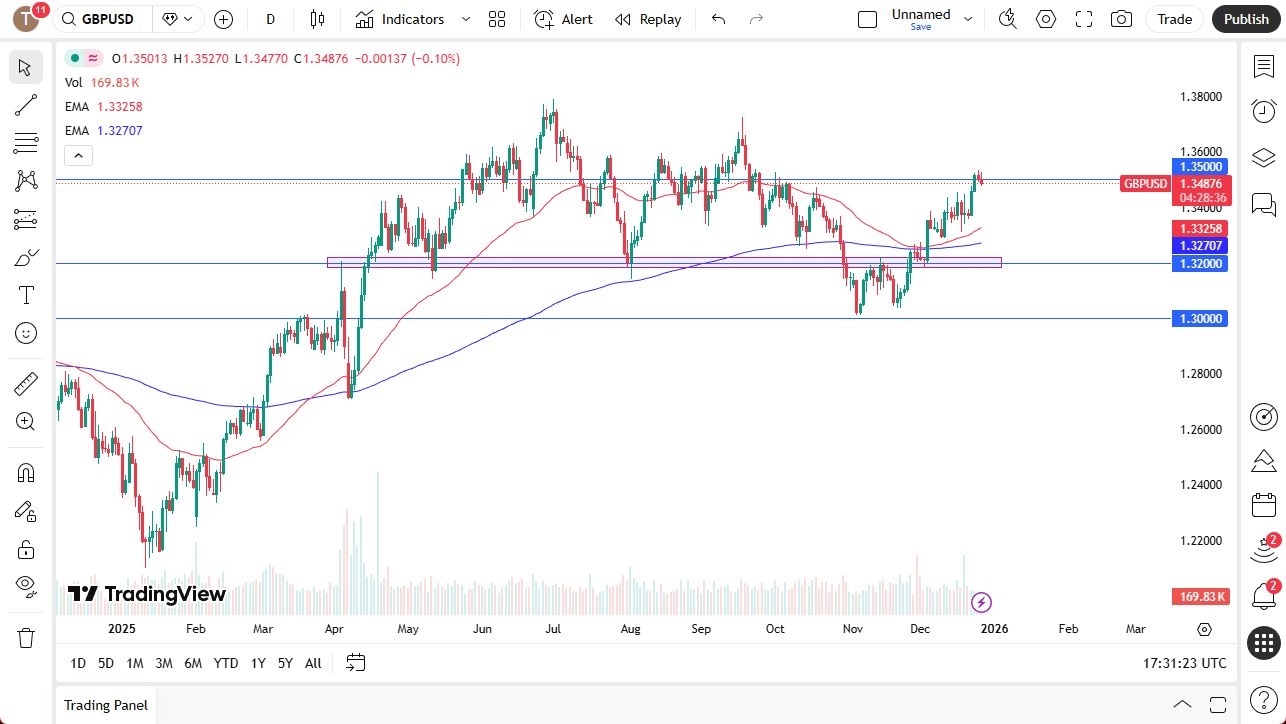
I do believe that in the next couple of weeks we will make a significant decision, but as things stand right now, it looks very much like a market that I think is going to continue to see a lot of questions asked of it near the 1.35 level.

The 1.35 level is a level that I think has been important multiple times. If we pull back from here, and I think we could, the 1.34 level is an area that would be your initial target. Breaking down below there, then opens up the possibility of a drop down to the 1.32 level. All things being equal, I suspect that might be the initial move to a bigger pullback.
However, we have to understand that the US dollar will probably move in the same direction against most currencies and not just this one. So, with this, I think you have a scenario where if we were to break above the 1.36 level, then it is obvious that we have a much bigger move to the upside waiting to happen, perhaps to the 1.38 level. I do expect a lot of choppy and noisy behavior, but I also recognize that the British Pound has outperformed most of its contemporaries against the US dollar. We are at a major point of inflection that we need to be watching.
Ready to trade our daily GBP/USD Forex forecast? Here’s some of the best forex broker UK reviews to check out.
Christopher Lewis has been trading Forex and has over 20 years experience in financial markets. Chris has been a regular contributor to Daily Forex since the early days of the site. He writes about Forex for several online publications, including FX Empire, Investing.com, and his own site, aptly named The Trader Guy. Chris favours technical analysis methods to identify his trades and likes to trade equity indices and commodities as well as Forex. He favours a longer-term trading style, and his trades often last for days or weeks.
usatoday.com wants to ensure the best experience for all of our readers, so we built our site to take advantage of the latest technology, making it faster and easier to use.
Unfortunately, your browser is not supported. Please download one of these browsers for the best experience on usatoday.com
BitcoinWorld
Cardano Price Prediction 2026-2030: The Critical Analysis Behind ADA’s Potential $2 Surge
As the broader cryptocurrency market continues its evolution in 2025, analysts and investors globally are scrutinizing long-term projections for major blockchain assets. This analysis provides a detailed, evidence-based examination of Cardano’s (ADA) potential price trajectory from 2026 through 2030, specifically evaluating the feasibility of its native token reaching the $2 threshold. We will dissect technological milestones, historical market cycles, and prevailing macroeconomic factors to build a comprehensive forecast.
Forecasting cryptocurrency prices requires a multi-faceted approach. Consequently, this Cardano price prediction for 2026 to 2030 integrates several core methodologies. First, we consider fundamental analysis of the Cardano network’s development roadmap. Second, we examine technical analysis patterns from ADA’s historical price action. Finally, we contextualize these findings within the anticipated regulatory and macroeconomic landscape of the late 2020s. This structured framework aims to move beyond mere speculation.
Cardano’s development, led by Input Output Global (IOG), follows a peer-reviewed, research-driven approach. Upcoming network upgrades, including continued optimization of its Hydra scaling solution and advancements in its smart contract platform, Plutus, form a critical foundation for future utility and demand. Network adoption metrics, such as the growth of decentralized applications (dApps) and total value locked (TVL), will directly influence ADA’s valuation. Therefore, any serious price prediction must anchor itself in these tangible progress indicators.
ADA’s price history reveals distinct patterns aligned with broader crypto market cycles and its own development phases. For instance, its all-time high near $3.10 in September 2021 coincided with the launch of smart contract functionality. Analyzing these cycles, alongside Bitcoin’s halving events typically preceding bull markets, provides a temporal context for the 2026-2030 window. Market data from sources like CoinMarketCap and Messari shows that ADA has demonstrated resilience and a capacity for significant rallies following periods of consolidation and technological delivery.
The period from 2026 to 2027 will likely be decisive for Cardano’s medium-term price direction. Several catalysts could emerge during this timeframe. Primarily, the full maturation and widespread implementation of layer-2 scaling solutions could dramatically increase transaction throughput and reduce costs. Furthermore, potential regulatory clarity in major economies like the United States and the European Union may reduce systemic risk for institutional investors considering ADA.
Based on projected adoption curves and assuming successful execution of its technical roadmap, analysts suggest a potential price range for ADA. The following table outlines a consensus view from aggregated model data, emphasizing that these are projections, not guarantees.
| Year | Conservative Target | Moderate Target | Optimistic Target | Key Catalyst |
|---|---|---|---|---|
| 2026 | $0.85 – $1.10 | $1.10 – $1.40 | $1.40 – $1.70 | Scalability Suite Completion |
| 2027 | $1.20 – $1.50 | $1.50 – $1.85 | $1.85 – $2.20 | Mass dApp Ecosystem Growth |
Reaching the upper bounds of the 2027 forecast would place ADA tantalizingly close to, or even above, the $2 mark. However, this outcome hinges on several concurrent factors:
Looking further ahead to the 2028-2030 period, the analysis shifts from specific upgrade timelines to broader value drivers. By this time, blockchain technology is expected to see deeper integration into global financial and social systems. Cardano’s focus on sustainability, formal verification, and governance through its Voltaire era could position it favorably for enterprise and governmental adoption. This long-term utility is a primary factor in any price prediction extending to 2030.
Potential applications in supply chain management, digital identity, and secure voting mechanisms represent multi-trillion-dollar addressable markets. If Cardano captures even a small fraction of this value, the network effect on ADA demand could be substantial. Moreover, the deflationary pressure from staking—where over 70% of ADA’s supply is typically staked—could reduce liquid supply, creating upward price pressure if demand increases.
Industry researchers from firms like Galaxy Digital and ARK Invest often highlight the importance of protocol security and decentralization in long-term valuations. Cardano’s Ouroboros proof-of-stake consensus is frequently cited as a robust and energy-efficient model. Conversely, experts also caution about risks, including intense competition from other smart contract platforms, potential regulatory hurdles, and the inherent volatility of the crypto asset class. A balanced Cardano price prediction must acknowledge these countervailing forces.
This comprehensive Cardano price prediction illustrates that reaching a $2 valuation for ADA by 2030 is a plausible scenario, though not a predetermined outcome. The path depends critically on the successful execution of its technological roadmap, measurable growth in real-world use cases, and a conducive macro-financial environment. While short-term volatility is inevitable, the long-term thesis for Cardano rests on its methodical, research-centric approach to building a scalable and sustainable blockchain. Investors should base decisions on continuous research, diversification, and a clear understanding of the underlying technology’s progress, rather than on price targets alone.
Q1: What is the most important factor for Cardano’s price to reach $2?
The single most critical factor is the demonstrable, large-scale adoption of its blockchain for decentralized applications and real-world solutions, which drives fundamental demand for the ADA token beyond speculative trading.
Q2: How does Cardano’s staking mechanism affect its price prediction?
Cardano’s high staking participation rate locks up a significant portion of the circulating supply. This reduction in readily available sell pressure can support price stability and potential appreciation, especially if new demand enters the market.
Q3: Could regulatory changes impact this ADA price prediction?
Absolutely. Positive, clear regulation could boost institutional investment and mainstream adoption. Conversely, restrictive policies in major economies could hinder growth and negatively impact the price trajectory outlined in any prediction.
Q4: What are the main competitors that could challenge Cardano’s growth?
Cardano faces significant competition from other smart contract platforms like Ethereum, Solana, and Avalanche. Its ability to differentiate through superior security, lower costs, or unique governance will be crucial for its market position.
Q5: Is the $2 target for ADA based solely on past performance?
No. While historical analysis informs market cycle understanding, the $2 scenario is primarily forward-looking. It is based on projected network utility, technological milestones, and broader crypto market capitalization trends, not simply extrapolation of past prices.
This post Cardano Price Prediction 2026-2030: The Critical Analysis Behind ADA’s Potential $2 Surge first appeared on BitcoinWorld.
The GBPJPY pair continued providing negative closes below 211.30 level, to confirm its surrender to the previously suggested bearish corrective bias dominance, reaching 210.40 taking advantage of stochastic exit from the overbought level.
We will keep our corrective expectations in the near trading, reminding you that the stability of the initial targets near 209.75 and 209.30, while the price success to step above the barrier and providing positive close will turn the bullish bias back, to expect its rally towards the next positive target near 212.65.
The expected trading range for today is between 209.75 and 211.20
Trend forecast: Bearish
USD/JPY retraces its recent gains registered in the previous session, trading around 156.10 during the European hours on Monday. On the daily chart, technical analysis indicates the 14-day Relative Strength Index (RSI) sitting at 52.80 (neutral) after easing from recent readings. A turn higher in RSI would strengthen bullish conviction, while a drift toward 50 would keep range-bound conditions in place.
The 50-day Exponential Moving Average (EMA) rises, supporting the broader uptrend. The nine-day EMA is flat with price hovering around it, pointing to near-term consolidation. The setup keeps a modest bullish bias while above the rising 50-day EMA.
Upside momentum would re-accelerate on a daily close above the immediate barrier at the nine-day EMA of 156.19, opening the path toward the next resistance around the 11-month high of 157.90. Further advances would support the USD/JPY pair to test the 158.88, the highest since July 2024.
On the downside, a rejection at the nine-day EMA and a break beneath the nearest support at the upside trendline around 155.10 would shift focus to the secondary floor and risk a deeper pullback toward the 50-day EMA at 154.72.
The table below shows the percentage change of Japanese Yen (JPY) against listed major currencies today. Japanese Yen was the strongest against the New Zealand Dollar.
| USD | EUR | GBP | JPY | CAD | AUD | NZD | CHF | |
|---|---|---|---|---|---|---|---|---|
| USD | -0.00% | 0.14% | -0.20% | 0.18% | 0.18% | 0.37% | -0.02% | |
| EUR | 0.00% | 0.15% | -0.18% | 0.19% | 0.19% | 0.35% | -0.02% | |
| GBP | -0.14% | -0.15% | -0.32% | 0.04% | 0.03% | 0.22% | -0.17% | |
| JPY | 0.20% | 0.18% | 0.32% | 0.36% | 0.38% | 0.55% | 0.11% | |
| CAD | -0.18% | -0.19% | -0.04% | -0.36% | 0.00% | 0.19% | -0.21% | |
| AUD | -0.18% | -0.19% | -0.03% | -0.38% | -0.00% | 0.18% | -0.21% | |
| NZD | -0.37% | -0.35% | -0.22% | -0.55% | -0.19% | -0.18% | -0.39% | |
| CHF | 0.02% | 0.02% | 0.17% | -0.11% | 0.21% | 0.21% | 0.39% |
The heat map shows percentage changes of major currencies against each other. The base currency is picked from the left column, while the quote currency is picked from the top row. For example, if you pick the Japanese Yen from the left column and move along the horizontal line to the US Dollar, the percentage change displayed in the box will represent JPY (base)/USD (quote).
(The technical analysis of this story was written with the help of an AI tool.)
Across social media platforms, videos and content promise relief from bloating, fatigue, itching and unexplained gut discomfort through ‘parasite cleanses’ — herbal powders, detox teas and DIY remedies that claim to flush out hidden worms. For many, this sort of content offers a simple explanation for complex symptoms. For doctors however, this represents a growing clinical concern.
“There is a fundamental misunderstanding about what parasites are and how common they actually are,” says Madhumitha R., senior consultant in infectious diseases and infection control at MGM Healthcare, Chennai. “Parasites are medical conditions. They require testing, diagnosis and evidence-based treatment, not guesswork.”
Medically, parasites are organisms that live in or on a host and derive benefits at the host’s expense. In humans, this includes intestinal worms, protozoa such as amoeba and giardia, and, less commonly, parasites that affect blood or tissues. “They spread through contaminated food or water, poor hand hygiene, walking barefoot in contaminated soil, undercooked meat, overcrowding and travel to endemic regions,” Dr. Madhumitha explains. “They are not universally present in everyone.”
Yet the idea that ‘everyone has parasites’ has become one of the most persistent myths circulating online. “The biggest myth I hear is that everyone needs regular cleansing,” she says. “That is simply not true.”
Experts say patients now arrive convinced they have parasites often without any medical evidence, even when their blood work and stool tests are normal. “In the emergency room, patients commonly tell us they are using so-called parasite cleansers sold online as herbal supplements or detox routines,” says Syed Harris, consultant emergency physician at SIMS Hospital, Chennai. “They assume these products are safe because they are labelled ‘natural’.”
Symptoms such as bloating, fatigue, itching, weight changes or irregular bowel movements are frequently attributed to parasites, even though they are far more commonly caused by acidity, irritable bowel syndrome (IBS), food intolerance or anxiety. “Sometimes, the symptoms actually worsen after the cleanse, and patients don’t realise the product itself is causing the problem.”
According to Pandurangan Basumani, senior consultant Interventional gastroenterologist and director at the Kauvery Institute of Digestive Sciences, this pattern is now routine. “Many patients come in absolutely certain parasites are the cause,” he says. “But once we test, it turns out to be acidity, IBS, food-related issues or stress affecting digestion. Actual parasitic infections are far less frequent than people expect, especially in city-based patients.”

One reason these beliefs persist is visual misinterpretation. “People often mistake mucus, undigested food or normal gut lining for worms after a cleanse,” says Dr. Madhumitha. “These are normal physiological products that the body excretes, not an infestation.” A. Sangameswaran, senior consultant in gastroenterology and hepatology at Apollo Speciality Hospitals, Vanagaram, sees this repeatedly. “Many people think a worm is whatever abnormality they see in their stool,” he says. “In most cases, it is just mucus or undigested food.”
Doctors emphasise that parasite cleansers are not risk-free. “Possible complications include liver injury, electrolyte imbalance, severe diarrhoea, dehydration, drug interactions and delayed diagnosis of the real problem,” says Dr. Madhumita.
The consequences can be severe. “We have seen abnormal liver tests, severe abdominal pain, electrolyte imbalance, dizziness and weakness after repeated cleansing,” says Dr. Harris. “With prolonged use, people may develop nutrient deficiencies or general malnutrition.” Some products act like strong laxatives, disrupting the gut microbiome– the bacteria essential for digestion and immunity. “Once this balance is disturbed, patients may experience repeated stomach issues or worsening of existing digestive conditions,” Dr. Harris adds.
Bimal Kumar Sahu, senior consultant in gastroenterology and gastrointestinal surgery at Artemis Hospitals, Gurugram, says the risks increase with prolonged or unsupervised use. “Some herbs can harm the stomach, liver or kidneys, especially if taken in large amounts or for long periods,” he explains.

One of the most serious consequences doctors point to is delayed diagnosis. “When people keep ‘cleansing’ instead of testing, real conditions are missed,” Dr. Madhumitha says. “We have seen cases of acute hepatitis, worsening anaemia and malnutrition because patients kept treating a disease they didn’t have.” Dr. Sahu highlights this concern. “Patients who relied on cleanses instead of medical care have missed real problems like ulcers or infections,” he says. Dr. Harris adds that self-treatment can even mask genuine parasitic infections. “Random cleansing is unnecessary and can be harmful,” he says. “True parasitic infections are diagnosed with specific tests and treated with targeted medicines.”
Doctors say the correct approach is straightforward. “If you have symptoms, under the guidance of a healthcare professional, do stool tests or blood tests,” Dr. Madhumitha adds. “Get the right diagnosis and targeted treatment.” Prevention, she says, is far less dramatic than online detox routines: handwashing, safe drinking water and proper cooking. “‘Natural’ does not always mean safe,” she says.
“Treating a disease you don’t have can harm the body you do have.”Dr. Sangameswaran says, “When someone presumes they have parasites, a medical check-up is the most guaranteed way to establish if this is true.”
Dcotors also emphasise that as digestive discomfort becomes medicalised online, fear amplified by misinformation is increasingly driving health decisions. “Stress and wrong information make fear worse,” says Dr. Sahu. “Once tests rule out parasites, patients often feel immediate relief.”
Experts emphasise — parasites exist, but they are not as common as social media suggests and cleansing without diagnosis carries real risks.
Published – December 29, 2025 02:08 pm IST
Exness Broker Review 2025: Regulation, Platforms & Trading Conditions Explained | Finance Magnates
Exness Broker Review 2025: Regulation, Platforms & Trading Conditions Explained | Finance Magnates
Exness Broker Review 2025: Regulation, Platforms & Trading Conditions Explained | Finance Magnates
We break down Exness’s regulatory framework, supported trading platforms including MetaTrader 4, MetaTrader 5, Exness Terminal, and the Exness Trade App, as well as available account types such as Standard, Pro, Zero, and Raw Spread.
You’ll also learn about Exness’s leverage options, fees and commissions, swap-free trading, available instruments across forex, commodities, indices, stocks, and cryptocurrencies, and what traders can expect in terms of execution, funding speed, and customer support.
Watch the full review to see whether Exness aligns with your trading goals and strategy.
👉 Explore Exness’s full broker listing on the Finance Magnates Directory:
https://directory.financemagnates.com/multi-asset-brokers/exness/
📣 Stay up to date with the latest in finance and trading. Follow Finance Magnates for industry news, insights, and global event coverage.
Connect with us:
🔗 LinkedIn: /financemagnates
👍 Facebook: /financemagnates
📸 Instagram: https://www.instagram.com/financemagnates
🐦 X: https://x.com/financemagnates
🎥 TikTok: https://www.tiktok.com/tag/financemagnates
▶️ YouTube: /@financemagnates_official
#Exness #ExnessReview #Forex #FinanceMagnates #ForexBroker #BrokerReview #CFDTrading #OnlineTrading #MarketInsights
In this video, we take an in-depth look at @Exness , a global multi-asset broker operating since 2008, known for fast withdrawals, flexible account types, and strong regulatory coverage across multiple regions.
We break down Exness’s regulatory framework, supported trading platforms including MetaTrader 4, MetaTrader 5, Exness Terminal, and the Exness Trade App, as well as available account types such as Standard, Pro, Zero, and Raw Spread.
You’ll also learn about Exness’s leverage options, fees and commissions, swap-free trading, available instruments across forex, commodities, indices, stocks, and cryptocurrencies, and what traders can expect in terms of execution, funding speed, and customer support.
Watch the full review to see whether Exness aligns with your trading goals and strategy.
👉 Explore Exness’s full broker listing on the Finance Magnates Directory:
https://directory.financemagnates.com/multi-asset-brokers/exness/
📣 Stay up to date with the latest in finance and trading. Follow Finance Magnates for industry news, insights, and global event coverage.
Connect with us:
🔗 LinkedIn: /financemagnates
👍 Facebook: /financemagnates
📸 Instagram: https://www.instagram.com/financemagnates
🐦 X: https://x.com/financemagnates
🎥 TikTok: https://www.tiktok.com/tag/financemagnates
▶️ YouTube: /@financemagnates_official
#Exness #ExnessReview #Forex #FinanceMagnates #ForexBroker #BrokerReview #CFDTrading #OnlineTrading #MarketInsights
We break down Exness’s regulatory framework, supported trading platforms including MetaTrader 4, MetaTrader 5, Exness Terminal, and the Exness Trade App, as well as available account types such as Standard, Pro, Zero, and Raw Spread.
You’ll also learn about Exness’s leverage options, fees and commissions, swap-free trading, available instruments across forex, commodities, indices, stocks, and cryptocurrencies, and what traders can expect in terms of execution, funding speed, and customer support.
Watch the full review to see whether Exness aligns with your trading goals and strategy.
👉 Explore Exness’s full broker listing on the Finance Magnates Directory:
https://directory.financemagnates.com/multi-asset-brokers/exness/
📣 Stay up to date with the latest in finance and trading. Follow Finance Magnates for industry news, insights, and global event coverage.
Connect with us:
🔗 LinkedIn: /financemagnates
👍 Facebook: /financemagnates
📸 Instagram: https://www.instagram.com/financemagnates
🐦 X: https://x.com/financemagnates
🎥 TikTok: https://www.tiktok.com/tag/financemagnates
▶️ YouTube: /@financemagnates_official
#Exness #ExnessReview #Forex #FinanceMagnates #ForexBroker #BrokerReview #CFDTrading #OnlineTrading #MarketInsights
In this video, we take an in-depth look at @Exness , a global multi-asset broker operating since 2008, known for fast withdrawals, flexible account types, and strong regulatory coverage across multiple regions.
We break down Exness’s regulatory framework, supported trading platforms including MetaTrader 4, MetaTrader 5, Exness Terminal, and the Exness Trade App, as well as available account types such as Standard, Pro, Zero, and Raw Spread.
You’ll also learn about Exness’s leverage options, fees and commissions, swap-free trading, available instruments across forex, commodities, indices, stocks, and cryptocurrencies, and what traders can expect in terms of execution, funding speed, and customer support.
Watch the full review to see whether Exness aligns with your trading goals and strategy.
👉 Explore Exness’s full broker listing on the Finance Magnates Directory:
https://directory.financemagnates.com/multi-asset-brokers/exness/
📣 Stay up to date with the latest in finance and trading. Follow Finance Magnates for industry news, insights, and global event coverage.
Connect with us:
🔗 LinkedIn: /financemagnates
👍 Facebook: /financemagnates
📸 Instagram: https://www.instagram.com/financemagnates
🐦 X: https://x.com/financemagnates
🎥 TikTok: https://www.tiktok.com/tag/financemagnates
▶️ YouTube: /@financemagnates_official
#Exness #ExnessReview #Forex #FinanceMagnates #ForexBroker #BrokerReview #CFDTrading #OnlineTrading #MarketInsights
We break down Exness’s regulatory framework, supported trading platforms including MetaTrader 4, MetaTrader 5, Exness Terminal, and the Exness Trade App, as well as available account types such as Standard, Pro, Zero, and Raw Spread.
You’ll also learn about Exness’s leverage options, fees and commissions, swap-free trading, available instruments across forex, commodities, indices, stocks, and cryptocurrencies, and what traders can expect in terms of execution, funding speed, and customer support.
Watch the full review to see whether Exness aligns with your trading goals and strategy.
👉 Explore Exness’s full broker listing on the Finance Magnates Directory:
https://directory.financemagnates.com/multi-asset-brokers/exness/
📣 Stay up to date with the latest in finance and trading. Follow Finance Magnates for industry news, insights, and global event coverage.
Connect with us:
🔗 LinkedIn: /financemagnates
👍 Facebook: /financemagnates
📸 Instagram: https://www.instagram.com/financemagnates
🐦 X: https://x.com/financemagnates
🎥 TikTok: https://www.tiktok.com/tag/financemagnates
▶️ YouTube: /@financemagnates_official
#Exness #ExnessReview #Forex #FinanceMagnates #ForexBroker #BrokerReview #CFDTrading #OnlineTrading #MarketInsights
In this video, we take an in-depth look at @Exness , a global multi-asset broker operating since 2008, known for fast withdrawals, flexible account types, and strong regulatory coverage across multiple regions.
We break down Exness’s regulatory framework, supported trading platforms including MetaTrader 4, MetaTrader 5, Exness Terminal, and the Exness Trade App, as well as available account types such as Standard, Pro, Zero, and Raw Spread.
You’ll also learn about Exness’s leverage options, fees and commissions, swap-free trading, available instruments across forex, commodities, indices, stocks, and cryptocurrencies, and what traders can expect in terms of execution, funding speed, and customer support.
Watch the full review to see whether Exness aligns with your trading goals and strategy.
👉 Explore Exness’s full broker listing on the Finance Magnates Directory:
https://directory.financemagnates.com/multi-asset-brokers/exness/
📣 Stay up to date with the latest in finance and trading. Follow Finance Magnates for industry news, insights, and global event coverage.
Connect with us:
🔗 LinkedIn: /financemagnates
👍 Facebook: /financemagnates
📸 Instagram: https://www.instagram.com/financemagnates
🐦 X: https://x.com/financemagnates
🎥 TikTok: https://www.tiktok.com/tag/financemagnates
▶️ YouTube: /@financemagnates_official
#Exness #ExnessReview #Forex #FinanceMagnates #ForexBroker #BrokerReview #CFDTrading #OnlineTrading #MarketInsights
The decentralized finance (DeFi) industry is constantly changing, particularly in developer engagement and market trends. Santiment’s latest data indicates that many well-known platforms like Aave and Uniswap are moving from a phase of rapid growth towards a more stable focus on maintaining their existing protocols. It appears that development efforts are concentrating more on established platforms, particularly those supplying important infrastructure, such as Chainlink.
As DeFi advances, the importance of adhering to regulations and creating products centered around user needs becomes significant. Fintech startups can take important insights from these developments as they look to navigate the DeFi landscape.
Chainlink has taken a prominent lead in the DeFi sector, significantly outpacing other projects in terms of development engagement. This decentralized oracle network is essential for providing accurate data feeds that facilitate the integration of tokenized real-world assets (RWAs) and bolster the security of smart contracts. Chainlink’s firm grasp on the oracle market—around 60-70%—highlights its role as a foundational element for crypto banking.
The consequences of Chainlink’s leadership are critical for fintech startups. Utilizing Chainlink’s technology can enhance the trustworthiness of financial products, making them more appealing to heavy-hitting institutional investors. Additionally, as regulatory frameworks like the EU’s MiCA become more prevalent, startups that utilize Chainlink’s infrastructure may find themselves in a stronger position to manage compliance requirements.
In the face of all sorts of market fluctuations, mid-tier DeFi projects like DeFiChain and DeepBook remain popular among developers, thanks mainly to their consistent innovation and community focus. These projects not only gain traction due to their technological offerings, but also their focus on niche sectors and specialized solutions.
For example, DeFiChain has shown a commitment to ongoing development and community involvement, resulting in higher activity in developer engagement rankings. DeepBook has also benefitted from its quick order book and its place within the Sui ecosystem, making it appealing for developers seeking to create decentralized applications (dApps) and trading utilities.
The strategies of these mid-tier projects provide practical models for fintech startups. Emphasizing community involvement and user needs can lead to the creation of successful products that genuinely resonate with potential users.
With 2025 on the horizon, established DeFi platforms are likely to pivot towards fine-tuning their current offerings rather than pushing for rapid expansion. Platforms like Lido, Aave, and Uniswap are focusing on enhancing user experience, bolstering security features, and adapting to the evolving financial market demands.
For instance, Lido is concentrating on its liquid staking models, reflecting the increasing demand for more fluid staking solutions. Likewise, Aave’s development of flash loan capabilities and its multi-chain functions illustrate its intent on providing users with various financial tools.
Fintech startups should also consider using these principles in their framework. Concentrating on user experience, security, and adaptability will be vital in remaining relevant in the ever-changing finance industry.
The insights gained from the current DeFi development state carry substantial implications for fintech startups. Here are some important points to reflect on:
Regulatory Compliance is Key: Startups need to be ready for regulatory frameworks like MiCA so they can draw in institutional investment. This entails constructing compliant models centered on transparency and risk mitigation.
Interoperability for the Win: The ability to seamlessly integrate various platforms can enhance user experience. By constructing aggregators that fuse several services together, fintechs can attract a wider customer base.
Hybridization is the Future: Blending the efficiency of DeFi with the security of traditional finance can yield strong financial products. Startups should explore how blockchain solutions can enhance transparency and drive down costs.
AI is a Valuable Tool: Embracing AI for fraud detection, personalization, and task automation can drastically improve user experience. Financial startups should consider how best to leverage AI in conjunction with DeFi protocols.
User-Centric Development: Prioritizing mobile-first products, tokenization, and embedded finance can attract a broad customer base. By focusing on real user needs, fintechs can craft products that resonate with the target demographic.
In summary, the shifting state of DeFi development presents both hurdles and opportunities for fintech startups. Learning from both established platforms and mid-tier projects can help startups find their footing in this competitive environment. The keys to thriving will be innovation, regulatory alignment, and user-centered designs.
EUR/USD stays in a consolidation phase and moves sideways above 1.1750 early Monday after registering marginal losses on Friday. In the absence of fundamental drivers and key macroeconomic data releases, the pair could have a difficult time finding direction heading into the New Year holiday.
Following the Christmas break, the US Dollar (USD) held its ground but failed to gather recovery momentum as trading volumes remained thin.
On Monday, the Federal Reserve Bank of Dallas’ Texas Manufacturing Survey and November Pending Home Sales data will be featured in the US economic calendar, which are likely to be ignored by market participants. On Tuesday, the minutes of the Federal Reserve’s December policy meeting will be scrutinized by investors but the actual market impact could be hard to see until trading conditions normalize later this week or early next week.
The 20-period Simple Moving Average (SMA) climbs above the 50-, 100-, and 200-period ones, signaling bullish alignment. Price holds over the 50-, 100-, and 200-period SMAs but remains capped by the 20-period SMA at 1.1782.
The Relative Strength Index (RSI) prints 49.8, neutral as momentum cools. The lower limit of the ascending regression channel and the 50-period SMA align as the initial support level at 1.1750. Measured from the 1.1501 low to the 1.1800 high, the 23.6% retracement at 1.1730 could be seen as the next support level, followed by the 100-SMA at 1.1715 and the 38.2% retracement at 1.1685.
On the upside, 1.1780 (20-period SMA) could act as an interim resistance level before 1.1800 (static level, mid-point of the ascending channel) and 1.1855 (upper limit of the ascending channel).
(The technical analysis of this story was written with the help of an AI tool)
The Euro is the currency for the 20 European Union countries that belong to the Eurozone. It is the second most heavily traded currency in the world behind the US Dollar. In 2022, it accounted for 31% of all foreign exchange transactions, with an average daily turnover of over $2.2 trillion a day.
EUR/USD is the most heavily traded currency pair in the world, accounting for an estimated 30% off all transactions, followed by EUR/JPY (4%), EUR/GBP (3%) and EUR/AUD (2%).
The European Central Bank (ECB) in Frankfurt, Germany, is the reserve bank for the Eurozone. The ECB sets interest rates and manages monetary policy.
The ECB’s primary mandate is to maintain price stability, which means either controlling inflation or stimulating growth. Its primary tool is the raising or lowering of interest rates. Relatively high interest rates – or the expectation of higher rates – will usually benefit the Euro and vice versa.
The ECB Governing Council makes monetary policy decisions at meetings held eight times a year. Decisions are made by heads of the Eurozone national banks and six permanent members, including the President of the ECB, Christine Lagarde.
Eurozone inflation data, measured by the Harmonized Index of Consumer Prices (HICP), is an important econometric for the Euro. If inflation rises more than expected, especially if above the ECB’s 2% target, it obliges the ECB to raise interest rates to bring it back under control.
Relatively high interest rates compared to its counterparts will usually benefit the Euro, as it makes the region more attractive as a place for global investors to park their money.
Data releases gauge the health of the economy and can impact on the Euro. Indicators such as GDP, Manufacturing and Services PMIs, employment, and consumer sentiment surveys can all influence the direction of the single currency.
A strong economy is good for the Euro. Not only does it attract more foreign investment but it may encourage the ECB to put up interest rates, which will directly strengthen the Euro. Otherwise, if economic data is weak, the Euro is likely to fall.
Economic data for the four largest economies in the euro area (Germany, France, Italy and Spain) are especially significant, as they account for 75% of the Eurozone’s economy.
Another significant data release for the Euro is the Trade Balance. This indicator measures the difference between what a country earns from its exports and what it spends on imports over a given period.
If a country produces highly sought after exports then its currency will gain in value purely from the extra demand created from foreign buyers seeking to purchase these goods. Therefore, a positive net Trade Balance strengthens a currency and vice versa for a negative balance.
The global oats market is on a steady upward trajectory, reflecting a broader shift toward healthier, plant-based, and sustainable food choices. Market valuation is projected to rise from approximately USD 9.8 billion in 2025 to about USD 18.8 billion by 2035, expanding at a value-based CAGR of 6.6% over the forecast period. This growth underscores oats’ transformation from a traditional breakfast staple into a multifunctional ingredient across food, nutrition, and lifestyle applications.
Demand momentum is largely driven by rising consumer awareness of the nutritional benefits of oats, particularly their high dietary fiber and beta-glucan content, which is clinically associated with cholesterol reduction and cardiovascular health. At the same time, increasing adoption of health-conscious, plant-based, and gluten-free diets is positioning oats as a preferred grain for modern consumers seeking functional and clean-label foods.
Get Exclusive Access To Data Tables, Market Sizing Dashboards, And Analyst Insights. Request Sample Report! https://www.futuremarketinsights.com/reports/sample/rep-gb-12362
Expanding Applications Across Food and Beverage Sectors
The food and beverage industry remains the dominant end user, accounting for the majority of global oat consumption. Oats are widely incorporated into breakfast cereals, oatmeal, granola, bakery products, snacks, and increasingly into dairy alternatives such as oat milk and yogurt substitutes. Innovation is accelerating, with manufacturers introducing oat-based protein bars, functional beverages, and fortified snacks that extend usage beyond conventional breakfast occasions.
Clean-label positioning continues to resonate strongly with consumers. Oats’ natural profile, minimal processing requirements, and compatibility with organic formulations align well with evolving preferences for transparency and simplicity in ingredient sourcing.
Market Snapshot
• Estimated Market Size (2025): USD 9.8 billion
• Projected Market Size (2035): USD 18.8 billion
• CAGR (2025-2035): 6.6%
Regional Dynamics Highlight Uneven but Promising Growth
North America and Europe currently lead the oats market due to established wellness trends, high per capita consumption, and advanced food processing capabilities. Countries such as Finland exemplify oat-centric consumption patterns, with per capita intake reaching 12 kg in 2024, supported by a wide variety of oat-based foods.
Canada has also seen a notable rise, with per-person availability of oatmeal and rolled oats increasing to 1.6 kg in 2024, more than double the previous year. In contrast, U.S. consumption remains more fragmented, with about 6% of the population consuming cooked oatmeal on a given day, translating to roughly 0.9 kg of dry oats per capita annually from hot oatmeal alone.
Asia Pacific is expected to witness the fastest growth through 2035, driven by rising disposable incomes, rapid urbanization, and growing awareness of preventive nutrition in markets such as China, India, and Japan.
Investment Hotspots by Segment
Rolled oats continue to dominate by product type, projected to hold 35.1% market share in 2025. Their versatility, affordability, and strong association with heart health make them a preferred choice for both consumers and manufacturers.
By end use, breakfast cereals account for approximately 41% of total market share, reflecting sustained global demand for convenient, high-fiber morning meals. Growth in ready-to-eat and instant cereal formats is reinforcing oats’ central role in daily nutrition.
Sustainability, Personalization, and New Frontiers
Sustainability is emerging as a strategic differentiator. Oats are considered a relatively eco-friendly crop due to lower water and pesticide requirements, prompting manufacturers to invest in responsible sourcing and carbon footprint reduction initiatives. These efforts are increasingly influencing purchasing decisions, particularly in Europe.
Beyond food, oats are making inroads into pet nutrition, where demand for premium, health-focused pet food is rising, and into beauty and personal care, leveraging oats’ soothing and anti-inflammatory properties in skincare formulations.
Manufacturers are also capitalizing on personalization trends by offering customizable oat blends with added flavors, nutrients, and functional boosters, strengthening direct-to-consumer engagement and brand loyalty.
Competitive Landscape and Recent Developments
The market is moderately consolidated, led by established players such as Quaker Oats Company, General Mills, and Kellogg Company, supported by agile brands focusing on organic, gluten-free, and specialty oats. Competition is increasingly shaped by sustainability commitments, product diversification, and expansion into snacks and beverages.
Recent launches highlight this momentum. In October 2023, Quaker introduced Quaker Chewy Granola, its first cereal under the Chewy brand, while in India, Saffola expanded its Masala Oats portfolio with the “Karara Crunch” variant, tapping into strong snacking demand.
Subscribe for Year-Round Insights → Stay ahead with quarterly and annual data updates! https://www.futuremarketinsights.com/reports/green-tea-supplements-market
Outlook: A Resilient and Evolving Market
Historically, the oats market grew at a 6.3% CAGR between 2020 and 2024, and the forecast outlook signals further acceleration. Continued innovation, rising wellness awareness, expanding e-commerce channels, and diversification into functional foods position oats as a resilient grain with long-term relevance across industries.
Why FMI: https://www.futuremarketinsights.com/why-fmi
Browse Related Insights
Green Tea Polyphenols Market: https://www.futuremarketinsights.com/reports/green-tea-polyphenols-market
Green Tea Extracts Market: https://www.futuremarketinsights.com/reports/green-tea-extracts-market
United States Green Tea Supplement Market: https://www.futuremarketinsights.com/reports/united-states-green-tea-supplement-market
Contact Us:
Future Market Insights Inc.
Christiana Corporate, 200 Continental Drive,
Suite 401, Newark, Delaware – 19713, USA
T: +1-347-918-3531
Website: https://www.futuremarketinsights.com
About Future Market Insights (FMI)
Future Market Insights, Inc. (ESOMAR certified, recipient of the Stevie Award, and a member of the Greater New York Chamber of Commerce) offers profound insights into the driving factors that are boosting demand in the market. FMI stands as the leading global provider of market intelligence, advisory services, consulting, and events for the Packaging, Food and Beverage, Consumer Technology, Healthcare, Industrial, and Chemicals markets. With a vast team of over 400 analysts worldwide, FMI provides global, regional, and local expertise on diverse domains and industry trends across more than 110 countries.
This release was published on openPR.