The main category of All News Articles.
You can use the search box below to find what you need.
[wd_asp id=1]
The main category of All News Articles.
You can use the search box below to find what you need.
[wd_asp id=1]
The article covers the following subjects:
Consider long positions from corrections above 91.50 with a target of 115.70–126.00.
Breakout and consolidation below 91.50 will allow the asset to continue declining to the levels of 78.70–65.00.
A descending correction appears to have formed as the second wave of larger degree (2) on the weekly chart, with wave C of (2) completed as its part. On the daily timeframe, the ascending third wave (3) has started unfolding, with the first wave of smaller degree 1 of (3) still developing as its part. On the H4 chart, wave iii of 1 has likely formed, a local correction iv of 1 has been completed, and wave v of 1 continues to unfold. If the presumption is correct, WTI will continue to rise to 115.70–126.00. The level of 91.50 is critical in this scenario as a breakout below it will enable the asset to continue to decline to the levels of 78.70–65.00.
This forecast is based on the Elliott Wave Theory. When developing trading strategies, it is essential to consider fundamental factors, as the market situation can change at any time.
The content of this article reflects the author’s opinion and does not necessarily reflect the official position of LiteFinance broker. The material published on this page is provided for informational purposes only and should not be considered as the provision of investment advice for the purposes of Directive 2014/65/EU.
According to copyright law, this article is considered intellectual property, which includes a prohibition on copying and distributing it without consent.
GBP/JPY stages a modest rebound on Friday after coming under selling pressure earlier in the day amid suspected intervention by Tokyo for a second straight day to curb excessive weakness in the Japanese Yen (JPY). At the time of writing, the cross is trading around 213.42, recovering from an intraday low of 211.81 and poised to end the week in negative territory for the first time in four weeks.
However, there has been no official confirmation of intervention by Japanese authorities so far, though officials issued a “final” warning on Thursday after USD/JPY briefly moved past the 160 level, a threshold that has previously triggered action. This move spilled across Yen crosses, with GBP/JPY posting a sharp pullback from a multi-year high near 216.60 to around 210.45 the previous day.
Although underlying fundamentals, including wide interest rate differentials between the Bank of Japan (BoJ) and other major central banks, continue to weigh on the Yen, the latest leg lower suggests near-term downside pressure on the cross as momentum indicators turn negative.
In the daily chart, GBP/JPY holds a constructive bias while consolidating above its key trend filters. The 100-day Simple Moving Average (SMA) and the 200-day SMA sit comfortably below the spot, suggesting underlying demand despite the recent pullback.
However, momentum has cooled, with the Relative Strength Index easing toward the mid-40s and the Moving Average Convergence Divergence (MACD) slipping into negative territory, hinting that upside attempts may lack follow-through in the very near term.
On the topside, immediate resistance is located at the horizontal barrier near 214.50, where a daily close above would reopen the path toward the recent peak of 216.60 and signal renewed bullish impulse.
On the downside, initial support is provided by the 100-day SMA at 211.89, with a break there exposing deeper retracement toward the 200-day SMA at 206.74, where buyers would be expected to defend the broader uptrend.
(The technical analysis of this story was written with the help of an AI tool.)
The table below shows the percentage change of Japanese Yen (JPY) against listed major currencies today. Japanese Yen was the strongest against the New Zealand Dollar.
| USD | EUR | GBP | JPY | CAD | AUD | NZD | CHF | |
|---|---|---|---|---|---|---|---|---|
| USD | -0.19% | -0.14% | 0.02% | -0.19% | -0.06% | 0.12% | -0.11% | |
| EUR | 0.19% | 0.04% | 0.18% | -0.01% | 0.15% | 0.30% | 0.08% | |
| GBP | 0.14% | -0.04% | 0.15% | -0.04% | 0.09% | 0.26% | 0.06% | |
| JPY | -0.02% | -0.18% | -0.15% | -0.20% | -0.08% | 0.07% | -0.12% | |
| CAD | 0.19% | 0.01% | 0.04% | 0.20% | 0.12% | 0.29% | 0.10% | |
| AUD | 0.06% | -0.15% | -0.09% | 0.08% | -0.12% | 0.16% | -0.02% | |
| NZD | -0.12% | -0.30% | -0.26% | -0.07% | -0.29% | -0.16% | -0.20% | |
| CHF | 0.11% | -0.08% | -0.06% | 0.12% | -0.10% | 0.02% | 0.20% |
The heat map shows percentage changes of major currencies against each other. The base currency is picked from the left column, while the quote currency is picked from the top row. For example, if you pick the Japanese Yen from the left column and move along the horizontal line to the US Dollar, the percentage change displayed in the box will represent JPY (base)/USD (quote).
There is a study by McKinsey that shows commodities spent the vast majority of their time in mean-reverting or range-bound states. It claims that commodities tend to trend about 20 to 30% of the time and trade sideways about 70 to 80%.
Studies by organizations like the World Gold Council show that gold’s volatility isn’t evenly distributed. It often enters “sleep” cycles where it moves sideways for years, followed by “vertical” cycles.
Last year, gold outperformed the S&P 500 significantly during months of high geopolitical stress, while moving sideways during risk-on periods. This year, it broke out of the long-term consolidation phase. That may have been the 30% trending phase. So brace yourself because we may be in the consolidation phase, but that doesn’t mean it’s untradeable.
Since the spike bottom on March 23 established support at $4,099.12 on the 200-day MA, I think that sends a signal that this indicator is support. Since it was rejected by the 50-day MA at $4,891.54 on April 17, we can say that it is resistance.
The price action this week shows it can still find support inside the moving averages. The current two-day rally may be telling us that we are in buy-the-dip mode. The recent reaction to the 50-day MA certainly told us that traders are selling rallies.
Once again, the market is giving you two choices: be active and take out offers, hoping for the breakout, or be passive and wait for the dip into value areas. I understand that traders like the “set it and forget it” trade, but that’s not happening now.
The way I see it, gold is still in sell-the-rally mode. Support is holding but buyers are not committing at these levels. The 10-Year U.S. Treasury yield and Fed rate expectations are the two levers that will decide this. Until one of them breaks in gold’s favor, this market grinds lower or goes nowhere. That is where we are.
If you’d like to know more about how to trade gold, please visit our educational area.
Natural gas price repeated their fluctuation above the extra support at $2.620, to begin forming some corrective wave, to settle near $2.800, affected by stochastic attempt to exit the oversold level.
The price may record intraday gains by its rally towards $3.000 reaching $3.180 resistance, while reaching below the extra support and providing negative close will confirm its readiness to resume the negative trend, reminding you that the stability of the negative targets near $2.390 reaching $2.250.
The expected trading range for today is between $2.620 and $3.000
Trend forecast: Fluctuating within the bearish trend
Natural gas price repeated their fluctuation above the extra support at $2.620, to begin forming some corrective wave, to settle near $2.800, affected by stochastic attempt to exit the oversold level.
The price may record intraday gains by its rally towards $3.000 reaching $3.180 resistance, while reaching below the extra support and providing negative close will confirm its readiness to resume the negative trend, reminding you that the stability of the negative targets near $2.390 reaching $2.250.
The expected trading range for today is between $2.620 and $3.000
Trend forecast: Fluctuating within the bearish trend
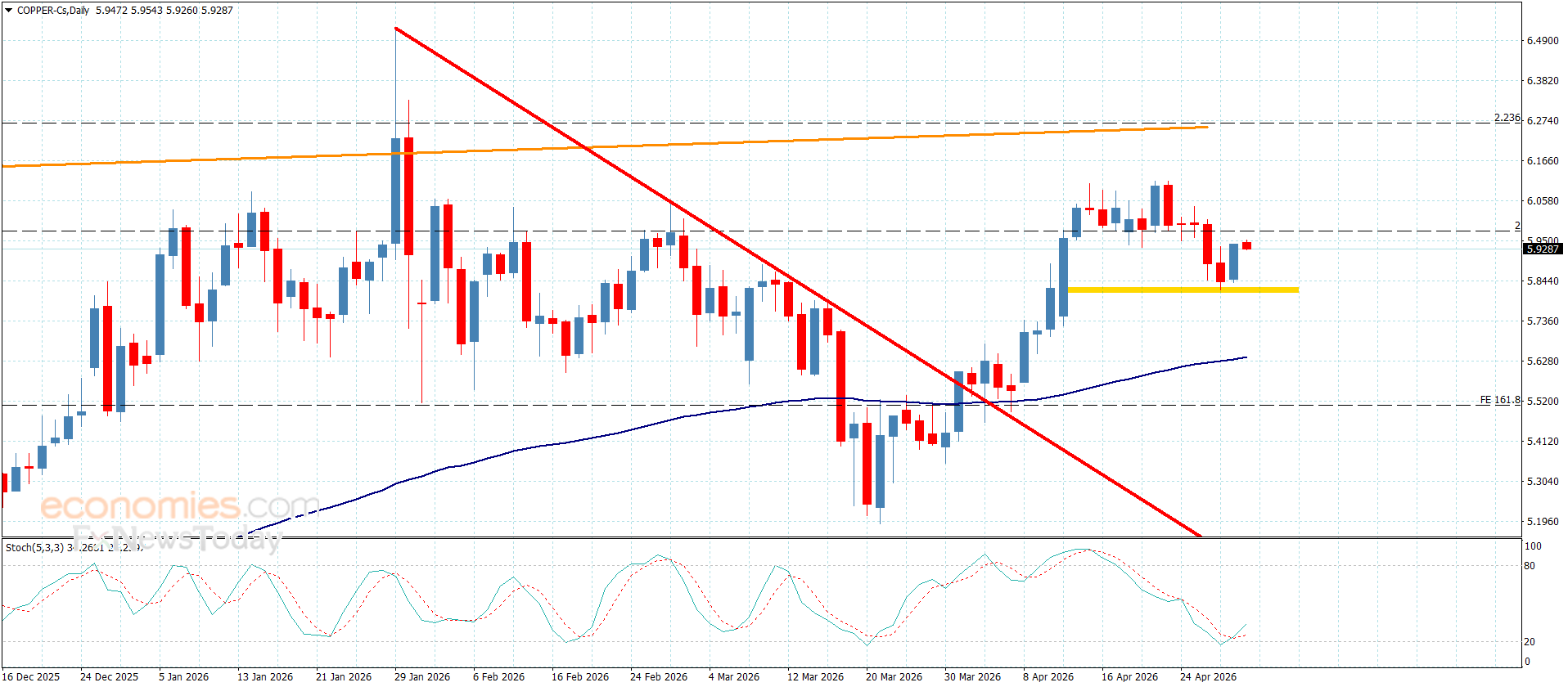
Copper price kept its stability above the initial support at $5.8100, attempting to surpass the dominance of the bearish corrective trend, to notice its rally to the upside to settle near $5.930.
Despite stochastic attempt to provide positive momentum. Waiting to surpass $6.0500 and hold above it is important to reinforce the chances of forming bullish waves to reach positive stations that might begin at 6.1200, while the price decline below $5.8100 will open the way for resuming the corrective trend, to expect reaching $5.7000 and $5.5900.
The expected trading range is between $5.8100 and $6.0500
Trend forecast: Bearish by the stability of $6.0500
– Written by
Tim Boyer
STORY LINK Pound Sterling to Dollar Forecast: GBP Hits 1.36 Ahead of Key US PMI Data
The Pound to Dollar exchange rate (GBP/USD) has pushed higher to around 1.3600, marking fresh upside momentum as the dollar remains under pressure following the Federal Reserve decision and cautious policy signals.
Markets are now turning their focus to the upcoming US ISM Manufacturing PMI release, with expectations for a modest improvement. The data will be crucial in determining whether GBP/USD can sustain gains above 1.36 or faces renewed dollar support.
The Pound to Dollar (GBP/USD) exchange rate found support just above 1.3450 and rallied to above 1.3500 as the dollar failed to hold gains.
GBP/USD failed to hold peak levels, however, as the BoE played down the likelihood of a series of rate hikes.
According to Scotiabank; “The local range is bound between support around 1.3450 and resistance in the upper-1.35s. The longer-term trend from January 2025 is bullish.”
Oil prices surged to 4-year highs late on Wednesday following concerns that the US could engage in renewed attacks against Iran.
Get better rates and lower fees on your next international money transfer.
Compare TorFX with top UK banks in seconds and see how much you could save.
ING commented; “All this is raising upside risks for USD, and the end of month-end flows could unlock further upside for the greenback.” It expects GBP/USD to retreat to 1.33.
The BoE Monetary Policy Committee (MPC) held interest rates at 3.75%, in line with market expectations. There was an 8-1 vote for the decision with Pill voting for an increase to 4.00%.
The committee outlined three scenarios for the outlook with very little, limited or substantial second-round effects.
Most members were hopeful that there would be only limited second-round effects, but they did not want to dismiss the potential for much higher inflation which would require a forceful stance.
It warned that a worse-case scenario, inflation could jump to 6.2% by the first quarter of 2027.
The statement added; “Some MPC members “might prefer to act early” to stave off the risk of inflation getting stuck too high while others could prefer waiting for more evidence of that risk crystallising.”
Governor Bailey summarised; “Where we go depends on size and duration of energy shock.”

Following the statement, markets were very close to pricing in three rate hikes by the end of 2026.
Schroders Head Of Global Economics David Rees expressed some scepticism; “With some slack emerging in the labour market and growth likely to weaken if disruption drags on, we doubt the Bank will tighten unless economic activity stays strong enough to absorb it.”
The Federal Reserve held interest rates at 3.75% at the latest policy meeting, in line with consensus forecasts.
There was, however, a 8-4 vote for the decision as Miran voted for a cut while three regional Fed Presidents protested against the underlying policy easing bias.
Chair Powell stated that there was no majority for moving to a neutral bias at this time, but risks were increasing.
According to Commerzbank forex strategist Michael Pfister; “Now would be a good time to cut interest rates and Warsh should convince his colleagues on the FOMC to take such action.”
Nevertheless he added; “Yesterday’s dissenters show that this will not be easy, if he even wants to.”
International Money Transfer? Ask our resident FX expert a money transfer question or try John’s new, free, no-obligation personal service! ,where he helps every step of the way,
ensuring you get the best exchange rates on your currency requirements.
TAGS: Pound Dollar Forecasts
The precious metals may take much longer to challenge record prices set at the top of the year.
The US-Iran conflict is set to become a protracted war as leaders dig in their heels on any agreement. This week, the US rejectes an Iranian proposal to reopen the Strait of Hormuz in exchange for nuclear talk delays.
The fallout of a much longer war than expected is bound to exacerbate what the International Energy Agency has already called the largest energy supply shock on record.
This week’s US Federal Reserve rate decision also has the precious metals markets spooked that interest rates will remain in a holding pattern. Palladium was the only metal to post gains for the past week.
Let’s take a look at what’s got the precious metals moving over the past week.
Gold price news
The gold price faced headwinds from multiple directions between April 23 and Thursday (April 30).
The war in the Middle East and this week’s Fed decision were the primary factors. After trying to consolidate around the US$4,700 level, gold has retreated into the US$4,600 to US$4,650 per ounce range.
The yellow metal lost more than 1.95 percent compared to the same time last week, and remains down about 17 percent from the US$5,589.38 all-time high that it reached on January 28.
Tuesday (April 28) brought the sharpest correction for the week.
With US-Iran peace talks effectively going nowhere, the continued closure of the Strait of Hormuz has many investors accepting that central banks will likely keep interest rates higher for longer.
After ending the trading session on Monday at US$4,681.86, by early morning the next day the price of gold had fallen to a four week low of US$4,555.49. While it picked up more than US$40 by closing, gold failed to retake US$4,600.
Wednesday’s (April 29) Fed interest rate announcement brought home the realization that global energy prices are on their way up and higher interest rates will likely remain in place.
The price of gold hit its lowest point of the week, at US$4,510.62 in the morning trade.
“Jerome Powell’s comments did nothing to revive hopes of an interest rate cut this year, and there remains an 80% probability that rates will end the year within their current range, according to the CME Group (NASDAQ:CME) FedWatch Tool,” Simon-Peter Massabni, head of business development at XS.com, stated in a market commentary shared with the Investing News Network (INN). “This helped US Treasury yields strengthen their upward trend, with the yield on 10-year bonds rising to 4.43 percent, close to the highest level since July of last year, enhancing the appeal of fixed-income, yield-generating assets and posing a further threat to gold and hindering its recovery.”
Massabni also pointed to net outflows of more than US$1.1 billion from the SPDR Gold Shares ETF (ARCA:GLD), the largest gold exchange-traded fund, and meager inflows of only about US$51 million into the iShares Gold Trust ETF (ARCA:IAU) this week as factors working against gold.
By Thursday, gold had rebounded slightly to overtake the US$4,600 level, rising as high as US$4,645 in the early morning. As of 11:00 a.m. PDT on Thursday, the price of gold was trading at US$4,616.99.
Gold price chart, April 23 to April 30, 2026.
Chart via the Investing News Network.
What direction could gold take in the coming weeks? Here are the gold price’s potential near-term catalysts:
For more insight into what’s moving the gold market, check out INN’s recent interviews:
In other gold market news, in its April Commodity Market Outlook, the World Bank says that given the current geopolitical and economic environment, it sees gold prices averaging US$4,700 for 2026.
In gold-mining news, Ecuador is becoming an emerging gold mining jurisdiction in Latin America. This month, the Ecuadorian government inked a US$1.7 billion mining contract with China’s CMOC Group (OTCPL:CMCLF) to develop the Los Cangrejos gold deposit. The largest primary gold deposit in the country, once in production Los Cangrejos will be Ecuador’s third large-scale mining operation.
Silver price news
The silver price has lost more than 2.8 percent over the course of the last week, and is down nearly 40 percent from its all-time high of US$121.62 per ounce, which it set on January 29. As the white metal battles the same downward pressures as gold, silver has traded in the US$72 to US$78 range for the last seven days.
Along with the other precious metals, silver slid near the end of last week and hung in wait-and-see mode for much of Monday before slipping once again on Tuesday in anticipation that the Fed would hold rates steady.
After a close of US$77.72 on Thursday, silver had lost nearly 3 percent by the end of Friday’s session at US$75.42. Monday saw the silver price remain rangebound around the US$75 level.
However, the next day the price of silver had fallen to an intraday low of US$72.04 before a close of US$73.11. Silver tracked gold downward on Wednesday following the Fed rate announcement to as low US$70.89.
Thursday’s early morning session saw the silver price regaining ground to nearly the US$74 level; however, that didn’t last long, and by 11:00 a.m. PDT the price of silver was trading at US$73.67.
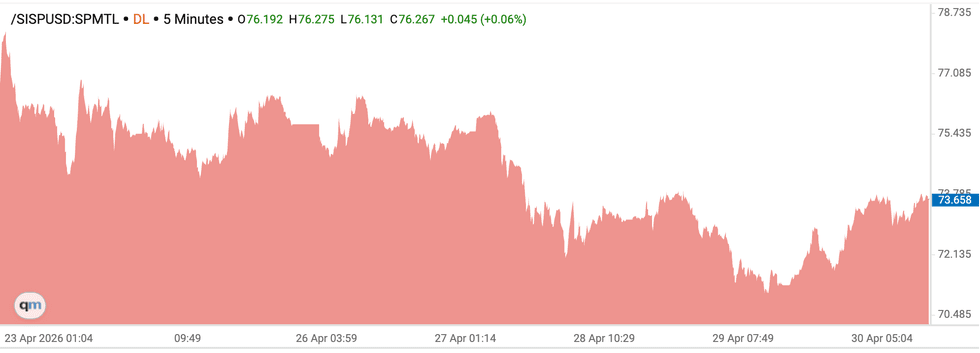
Silver price chart, April 23 to April 30, 2026.
Chart via the Investing News Network.
While silver often follows gold’s lead, it is highly sensitive to industrial data that does not typically affect gold. The metal also experiences tighter supply fundamentals, so mine supply data can also have an impact.
Here’s a look at the silver market’s potential near-term catalysts:
For more on what’s developing in the silver market, check out INN’s article on AI data center and Bitcoin-mining company Hyperscale Data (ARCA:GPUS) finalizing a supply partnership with Scottsdale Mint to expand its corporate treasury strategy beyond digital assets and into precious metals; it includes the buildout of a silver reserve program.
Interested in silver-mining stocks? Check out INN’s list: ASX Silver Stocks: 5 Biggest Companies in 2026.
In other silver market news, the World Bank expects silver to average around US$70 for 2026.
Platinum price news
The platinum price fell more than 2.1 percent over the period, and remains well off its January 2026 all-time high near US$2,924 per ounce. In line with the precious metals complex, platinum experienced a volatile downtrend.
Platinum finished last week at US$2,017.40, and has not closed above the US$2,000 level since.
The negative pressure continued on Monday as stalled US-Iran peace talks and the continued blockage of the Strait of Hormuz hyped concerns that central banks will keep interest rates higher for longer. The price of platinum dropped as low as US$1,984.60 in the early morning before a close of US$1,991.80.
Along with the broad selloff in the precious metals market, the platinum price plunged further on Tuesday morning to reach US$1,917.40, its lowest level in four weeks.
The bloodbath for platinum continued on Wednesday, with the metal falling below the US$1,900 level in the morning; it couldn’t manage to retake that level at closing, ending at US$1,884.90.
However, on Thursday platinum took a turn as traders bought the dip on tight supply and healthy industrial demand. By 11:00 a.m. PDT, the price of platinum was trading at US$1,986.90.
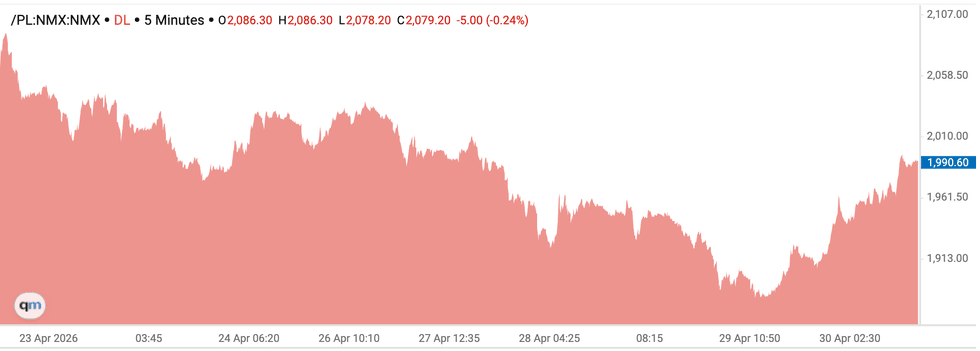
Platinum price chart, April 23 to April 30, 2026.
Chart via the Investing News Network.
As for potential near-term catalysts for platinum, a few key industry reports are on the horizon:
Palladium price news
The price of palladium faced a sharp decline late last week before mounting a V-shaped recovery on Thursday, achieving a gain of 4 percent over the course of the past week.
Palladium has performed rather well up against its precious metal peers this year. However, its price remains well below the 2022 palladium peak of around US$3,440 per ounce.
The price of palladium was trading as high as US$1,585.50 on April 23, but by the following day its value had sunk to a close of US$1,473.50 on a deep selloff in precious metals.
On Monday, palladium remained below the critical US$1,500 level for a close of US$1,478.50. Over the following two days, the metal remained rangebound between US$1,450 and US$1,490.
On Thursday, palladium bounced back above the US$1,500 level, rising as high as US$1,549 in the late morning as investors reassessed palladium supply/demand dynamics for 2026.
As of 11:00 a.m. PDT that day, the metal was trading at US$1,536.50.
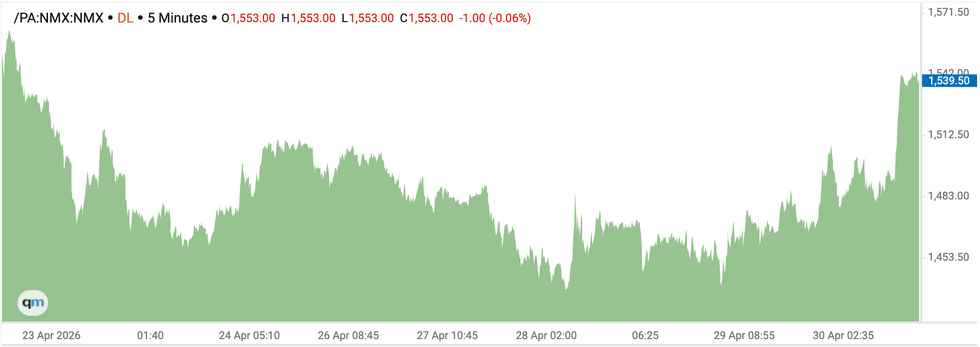
Palladium price chart, April 23 to April 30, 2026.
Chart via the Investing News Network.
Russia-based Nornickel, which controls approximately 40 percent of global palladium supply, reported that its Q1 palladium production fell by 18 percent year-on-year. The company said it expects its output to drop from 2.725 million ounces produced in 2025 to a projected range of 2.415 million to 2.465 million ounces for 2026.
Don’t forget to follow us @INN_Resource for real-time updates!
Securities Disclosure: I, Melissa Pistilli, hold no direct investment interest in any company mentioned in this article.
Editorial Disclosure: The Investing News Network does not guarantee the accuracy or thoroughness of the information reported in the interviews it conducts. The opinions expressed in these interviews do not reflect the opinions of the Investing News Network and do not constitute investment advice. All readers are encouraged to perform their own due diligence.
From Your Site Articles
Related Articles Around the Web
The USD/JPY pair builds on the previous day’s late rebound from the vicinity of mid-155.00s, or over a two-month trough, and gains some positive traction during the Asian session on Friday. Spot prices touched a daily high near the 157.55 region, though the lack of follow-through buying warrants some caution for bullish traders.
The Japanese Yen (JPY) weakens across as softer consumer inflation figures from Tokyo – Japan’s capital city – give the Bank of Japan (BoJ) reasons to pause amid economic concerns due to Middle East tensions. Apart from this, a modest US Dollar (USD) uptick turns out to be another factor offering support to the USD/JPY pair. Meanwhile, Japan’s top foreign exchange diplomat, Atsushi Mimura, reiterated that officials are in close contact with the US on currency. This keeps intervention risks in play and limits JPY losses, capping the currency pair.
From a technical perspective, Thursday’s steep intraday decline from the 160.75 area, or the highest level since July 2024, stalled near the 61.8% Fibonacci retracement level of the February-April upswing. Moreover, the USD/JPY pair, so far, has held above the 200-day Exponential Moving Average (EMA), which, in turn, keeps bearish traders on the back foot. However, a softening Relative Strength Index (RSI) near 40, alongside a negative Moving Average Convergence Divergence (MACD) reading below zero, suggests downside pressure persists.
Hence, recovery attempts are likely to face supply on further rise towards initial resistance at the 38.2% retracement near 157.48. That said, a sustained strength beyond would expose the 23.6% retracement at 158.73 and then the 160.75 cycle high.
On the downside, immediate support emerges at the 50.0% retracement near 156.47, followed by the 61.8% retracement at 155.47 and the 200-day EMA at 155.21. A clear loss of this area would open the way toward deeper Fibonacci support at 154.03 and the 152.20 swing low.
(The technical analysis of this story was written with the help of an AI tool.)
The table below shows the percentage change of Japanese Yen (JPY) against listed major currencies today. Japanese Yen was the strongest against the New Zealand Dollar.
| USD | EUR | GBP | JPY | CAD | AUD | NZD | CHF | |
|---|---|---|---|---|---|---|---|---|
| USD | 0.03% | 0.05% | 0.39% | 0.03% | 0.13% | 0.24% | 0.07% | |
| EUR | -0.03% | 0.00% | 0.37% | -0.02% | 0.11% | 0.20% | 0.04% | |
| GBP | -0.05% | -0.01% | 0.34% | 0.00% | 0.08% | 0.18% | 0.05% | |
| JPY | -0.39% | -0.37% | -0.34% | -0.36% | -0.27% | -0.18% | -0.31% | |
| CAD | -0.03% | 0.02% | 0.00% | 0.36% | 0.09% | 0.21% | 0.05% | |
| AUD | -0.13% | -0.11% | -0.08% | 0.27% | -0.09% | 0.11% | -0.02% | |
| NZD | -0.24% | -0.20% | -0.18% | 0.18% | -0.21% | -0.11% | -0.15% | |
| CHF | -0.07% | -0.04% | -0.05% | 0.31% | -0.05% | 0.02% | 0.15% |
The heat map shows percentage changes of major currencies against each other. The base currency is picked from the left column, while the quote currency is picked from the top row. For example, if you pick the Japanese Yen from the left column and move along the horizontal line to the US Dollar, the percentage change displayed in the box will represent JPY (base)/USD (quote).