The main category of All News Articles.
You can use the search box below to find what you need.
[wd_asp id=1]
The main category of All News Articles.
You can use the search box below to find what you need.
[wd_asp id=1]
BitcoinWorld
EUR/GBP Price Forecast: Bearish Hesitation Above 0.8655 Signals Persistent Downside Risk
The EUR/GBP price forecast reveals a market stuck in hesitation above the 0.8655 support level. Despite this pause, bears retain firm control over the pair. This technical standoff raises critical questions for traders monitoring the Euro and Pound Sterling. Understanding the forces behind this stalemate is essential for navigating the current landscape.
The EUR/GBP price forecast hinges on the 0.8655 mark. This level has acted as a floor since early December. However, repeated tests show weakness. The pair struggles to hold gains above this point. Each bounce lacks momentum. This pattern signals seller dominance.
Bears push the price down quickly after any minor rally. The 0.8655 level now faces increasing pressure. A break below this support would confirm the bearish outlook. Such a move could target the next floor near 0.8600. The current hesitation does not indicate strength. It reflects a market waiting for a catalyst.
For the EUR/GBP bearish outlook to change, bulls must reclaim 0.8700. This level now acts as strong resistance. The 20-day moving average sits near 0.8685. It adds another barrier to upside moves. The 50-day moving average at 0.8725 reinforces the bearish structure.
Traders watch these levels closely. A failure to break above 0.8700 keeps the pressure on. The EUR/GBP price forecast suggests more downside if resistance holds. Volume analysis supports this view. Selling volume increases on dips. Buying volume remains weak on rallies.
The Relative Strength Index (RSI) stays below 50. This reading confirms bearish momentum. The Moving Average Convergence Divergence (MACD) sits below its signal line. Both indicators align with the EUR/GBP bearish outlook. They show no signs of a reversal yet.
The stochastic oscillator recently entered oversold territory. This condition could trigger a short-term bounce. However, such bounces typically fail in strong downtrends. The EUR/GBP price forecast warns against chasing these moves. Wait for confirmation before entering long positions.
Fundamental factors support the EUR/GBP bearish outlook. The Bank of England (BoE) maintains a hawkish stance. It keeps interest rates higher for longer. This policy supports the Pound. In contrast, the European Central Bank (ECB) signals potential rate cuts. This divergence weighs on the Euro.
Economic data reinforces this gap. UK inflation remains sticky. UK services PMI stays above 50. Eurozone data shows slower growth. German industrial production contracts. These trends favor the Pound over the Euro.
The EUR/GBP price forecast reflects this fundamental reality. The market prices in a weaker Euro outlook. Any ECB dovish comment could accelerate the decline. Traders should monitor central bank speeches closely.
Risk sentiment also affects the EUR/GBP bearish outlook. The Euro often suffers during risk-off periods. Recent geopolitical tensions increase safe-haven demand for the Pound. This dynamic adds to the pair’s downside pressure.
Brexit-related headlines occasionally cause volatility. However, their impact has diminished. The market now focuses on monetary policy divergence. The EUR/GBP price forecast will likely follow this trend for weeks.
Develop a clear strategy based on the EUR/GBP price forecast. Short positions offer the best risk-reward ratio. Enter near resistance levels around 0.8680-0.8700. Place stops above 0.8725. Target the 0.8600 area for initial profits.
Consider these key points for your trading plan:
A break below 0.8655 triggers additional selling. This move could accelerate the decline. The EUR/GBP price forecast supports a bearish bias until key resistance breaks.
Risk management remains crucial. The EUR/GBP bearish outlook includes potential for sharp reversals. News events can trigger sudden moves. Keep position sizes small. Use trailing stops to protect profits.
Avoid adding to losing positions. The market may consolidate before breaking lower. Patience pays in this environment. Wait for clear signals before acting. The EUR/GBP price forecast does not guarantee immediate movement.
The EUR/GBP bearish outlook contrasts with other Euro pairs. EUR/USD shows more range-bound behavior. EUR/JPY benefits from Yen weakness. This comparison highlights the Pound’s relative strength.
Traders can use this information for pair selection. Focus on EUR/GBP for directional bearish trades. Other pairs may offer different opportunities. The EUR/GBP price forecast provides a clear bearish signal not seen elsewhere.
The 0.8655 level has historical significance. It acted as resistance in August 2022. It later became support in March 2023. The price respected this level multiple times. This history adds weight to its importance.
A break below 0.8655 would mark a major shift. It would open the door to levels not seen since 2022. The EUR/GBP price forecast considers this possibility. Traders should prepare for such a scenario.
Market analysts share a cautious view. Most expect the EUR/GBP bearish outlook to persist. They cite the interest rate differential as the main driver. The BoE-ECB policy gap will likely widen further.
Some experts note the potential for a short-term squeeze. Positioning data shows heavy short bets. A sudden reversal could trigger a sharp rally. However, this scenario remains unlikely without a catalyst. The EUR/GBP price forecast leans bearish for now.
Key events could shift the EUR/GBP price forecast. The BoE meeting in February may provide clarity. Any hints of rate cuts would weaken the Pound. The ECB meeting in March could confirm or delay cuts.
UK GDP data releases also matter. Strong growth supports the Pound. Weak data could change the outlook. Eurozone inflation figures will influence ECB decisions. Traders should mark these dates on their calendars.
The EUR/GBP price forecast highlights hesitation above 0.8655 with bears firmly in control. Technical indicators, fundamental factors, and market sentiment all point lower. A break below support could trigger significant downside. Traders should maintain a bearish bias while managing risks carefully. The pair’s direction depends on central bank policies and economic data. Stay informed and trade accordingly.
Q1: What does hesitation above 0.8655 mean for the EUR/GBP price forecast?
It means the pair struggles to move higher despite holding support. This indicates seller dominance and potential for a breakdown.
Q2: Why do bears remain in control of EUR/GBP?
Bears control the pair due to interest rate divergence. The BoE keeps rates high while the ECB signals cuts. This supports the Pound over the Euro.
Q3: What is the next key support level below 0.8655?
The next major support lies near 0.8600. A break below 0.8655 targets this level. Further downside could reach 0.8550.
Q4: How can I trade the EUR/GBP bearish outlook?
Sell near resistance at 0.8680-0.8700. Place stops above 0.8725. Target 0.8600 initially. Use proper risk management.
Q5: What could reverse the EUR/GBP price forecast?
A hawkish ECB surprise or a dovish BoE shift could reverse the outlook. Strong Eurozone data or weak UK data might also change the trend.
This post EUR/GBP Price Forecast: Bearish Hesitation Above 0.8655 Signals Persistent Downside Risk first appeared on BitcoinWorld.
– Written by
David Woodsmith
STORY LINK Pound Sterling to Dollar Forecast: GBP Below 1.35 After Fed Holds Rates
The Pound to Dollar exchange rate (GBP/USD) has edged lower to around 1.3485 after the Federal Reserve held interest rates steady, with markets reacting to a cautious tone and ongoing uncertainty surrounding the Iran situation.
Sterling struggled to hold recent highs near 1.36 as the dollar found modest support following a split policy signal from the Fed, while investors remain wary over whether GBP/USD can sustain upside momentum amid lingering geopolitical and economic risks.
The Pound to Dollar (GBP/USD) exchange rate found support close to 1.3460 on Tuesday and moved back to the 1.3500 area with caution ahead of key central bank meetings and an on-going focus on energy prices.
Scotiabank commented; “We remain neutral absent a break of the local range roughly bound between 1.3450 and the mid/ upper-1.35s.
Nevertheless, the bank added; “The recent widening of UK-US spreads is extending and threatening fresh highs, offering fundamental support to the GBP. The longer-term trend from January 2025 remains bullish.”
There has been further upward pressure on oil prices with Brent hitting 3-week highs near $107 p/b. There has been no headway in re-opening the Strait of Hormuz which will have a growing impact in squeezing global supply as inventories continue to decline.
Get better rates and lower fees on your next international money transfer.
Compare TorFX with top UK banks in seconds and see how much you could save.
Higher energy prices will tend to hamper GBP/USD.
The Federal Reserve will announce the latest policy decision on Wednesday. There are very strong expectations that interest rates will be held at 3.75%.
There will be no updated economic forecasts at this meeting with the focus on the statement and Chair Powell’s comments.
ING commented; “The latest signs from the Middle East are not encouraging. While Powell’s signals may be taken with some caution, given that this should be his last press conference, the risks are that he errs on the hawkish side.”
This is Powell’s last scheduled meeting as Chair with nominee Warsh due to take charge at the next meeting, assuming that he is confirmed in time.
Powell, however, still has a position as Governor. Commonwealth Bank of Australia currency strategist Carol Kong commented; “The question is what Powell is going to do, because he still holds the governor seat until 2028.”
She added; “Powell has previously said that he will stay on if he thinks that Fed independence is under threat, so I think his decision will depend on his perception of Fed independence.”

International Money Transfer? Ask our resident FX expert a money transfer question or try John’s new, free, no-obligation personal service! ,where he helps every step of the way,
ensuring you get the best exchange rates on your currency requirements.
TAGS: Pound Dollar Forecasts
Ethereum (ETHUSD) declined in recent intraday trading, preparing to break below the key support level at $2,250, which previously acted as our price target. This comes amid the dominance of a short-term bearish corrective wave, with continued downside pressure as the price remains below EMA50, beside the emergence of bearish signals from the relative strength indicators.
Accordingly, our expectations point to a decline in Ethereum during the upcoming intraday trading, especially if it breaks below the mentioned $2,250 support level, targeting the next support at $2,175.
The USD/JPY pair builds on the previous day’s breakout momentum beyond the 160.00 psychological mark, hitting a fresh high since July 2024 on Thursday. Economic concerns stemming from Middle East tensions counter the Bank of Japan’s (BoJ) hawkish pause and continue to undermine the Japanese Yen (JPY). Adding to this, sustained US Dollar (USD) strength provided an additional boost to the currency pair. The momentum, however, runs out of steam during the early part of the European session amid speculations that Japanese authorities will step in to stem further JPY weakness.
The BoJ decided to keep its benchmark interest rate unchanged at 0.75% on Tuesday. However, the 6-3 vote split, with three BoJ board members calling for a rate hike, along with upward revision of inflation forecasts, left the door open for a June or July rate hike. The initial market reaction, however, turned out to be short-lived amid worries that Japan’s economy will come under strains in the foreseeable future due to the continued disruption of supplies through the Strait of Hormuz. In fact, shipping traffic through the strategic waterway has seen a sharp decline recently due to Iran’s restrictions on movements and the US naval blockade of Iranian ports. Furthermore, US President Donald Trump said on Wednesday that the blockade will continue till Iran agrees to a deal.
Meanwhile, Japan’s Finance Minister Satsuki Katayama said that they are moving closer to taking decisive action in the foreign exchange markets. Adding to this, Japan’s top currency diplomat, Atsushi Mimura, said that they are coordinating with the US, based on their FX agreement in September last year, prompting some intraday short-covering around the JPY. The US Dollar (USD), on the other hand, retreats from its highest level since April 13. This turns out to be another that contributed to the USD/JPY pair’s sharp intraday downfall of over 100-pips from the 160.70-160.75 region. Any meaningful USD depreciation, however, seems elusive in the wake of stalled US-Iran peace talks and the US Federal Reserve’s (Fed) hawkish tilt on Wednesday.
US President Donald Trump rejected Iran’s proposal to end the two-month conflict and reiterated that there will be no peace deal unless the Islamic Republic agrees to give up its nuclear program. Trump added that the US naval blockade of Iranian ports will continue. This remains supportive of elevated Crude Oil prices, reviving inflationary concerns. Adding to this, the Fed’s decision to hold its key policy rate unchanged at 3.50%-3.75% saw the highest number of dissents since 1992, with three policymakers voting against the accommodative tone in the policy statement. Traders were quick to react and sharply reduced their bets on any further easing by the Fed in 2026, instead they are now pricing in over a 10% chance of a rate increase, which, in turn, favors the USD bulls.
The aforementioned fundamental backdrop makes it prudent to wait for strong follow-through selling before confirming that the USD/JPY pair has topped out in the near term and positioning for any further depreciating move. Traders now look to the US economic docket, featuring the release of the Advance Q1 GDP report and the Personal Consumption Expenditures (PCE) Price Index. The crucial data will play a key role in influencing the near-term USD price dynamics and provide a fresh impetus to the USD/JPY pair later during the North American session.
The sharp intraday pullback drags spot prices to the 159.50-159.40 confluence – comprising the 38.2% Fibonacci retracement level of the recent move up from the monthly swing low and the 200-hour Simple Moving Average (SMA). Meanwhile, the Relative Strength Index (RSI) reading around 34 hints at weak demand after the latest unwind. Moreover, the Moving Average Convergence Divergence (MACD) has turned negative, reinforcing soft downside pressure.
A clean break below the 159.50-159.40 confluence would expose the 50.0% retracement at 159.15, followed by deeper Fibonacci supports at 158.79 and 158.27, before a more solid floor appears near the 157.60 region. On the topside, initial resistance is aligned at the 38.2% retracement at 159.52, with further barriers at the 23.6% retracement near 159.97 and the recent swing high around 160.70, where selling interest could re-emerge.
(The technical analysis of this story was written with the help of an AI tool.)
Ethereum (ETHUSD) declined in recent intraday trading, preparing to break below the key support level at $2,250, which previously acted as our price target. This comes amid the dominance of a short-term bearish corrective wave, with continued downside pressure as the price remains below EMA50, beside the emergence of bearish signals from the relative strength indicators.
Accordingly, our expectations point to a decline in Ethereum during the upcoming intraday trading, especially if it breaks below the mentioned $2,250 support level, targeting the next support at $2,175.
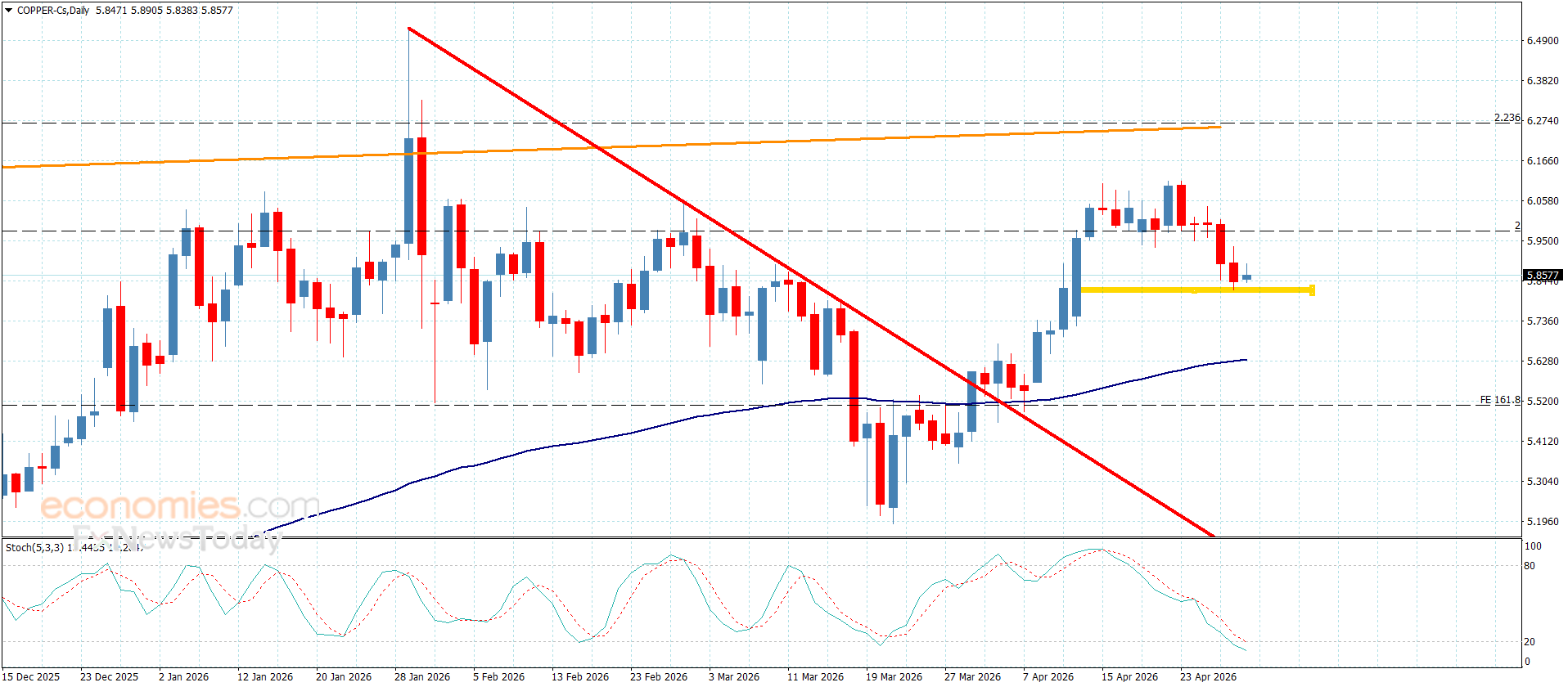
Copper price ended the last corrective decline by reaching the target at $5.8100, forming an obstacle against the negative trading, to notice its sideways fluctuation near $5.8500.
The contradiction of the main indicators might reduce the chances of forming bullish waves, specifically by forming extra barrier at $5.9700 level, while providing negative momentum by stochastic might push the price to break $5.8100 level, which forces it to suffer extra losses that might extend towards $5.7000 and $5.5900.
The expected trading range for today is between $5.7000 and $5.9100
Trend forecast: Bearish
Welcome, my fellow traders! I have prepared a price forecast for the USCrude, XAUUSD, and EURUSD using a combination of the margin zones method and technical analysis. Based on the market analysis, I suggest entry signals for intraday traders.
The euro price continues to test the key support of the short-term uptrend.
The article covers the following subjects:
Yesterday, oil extended its short-term uptrend, piercing the Gold Zone of 100.97–100.43. Today, the price has reached the Target Zone 2 of 106.90–105.82. If the asset breaks above this zone, the next buy target will be the Gold Zone 2 of 111.75–111.21.
If bears defend the Target Zone 2, a downward correction may begin. In this case, the oil price may test the support A of 101.93–101.39. Once this zone is tested, long trades can be considered.
Buy near support A of 101.93–101.39. TakeProfit: 104.39, 107.32. StopLoss: 99.99.
Yesterday, the gold price continued to fall and broke below the April 28 low. Today, the metal is undergoing a correction. During this correction, the price may test the resistance A of 4,666–4,651. Once it is tested, consider short trades, with the first target at 4,588 and the second one around 4,510.
If the price breaks above the resistance A today, the correction will continue toward the resistance B at 4,743–4,722.
Sell near resistance A at 4,666–4,651. TakeProfit: 4,588, 4,510. StopLoss: 4,700.
The euro price keeps testing the key support of the short-term uptrend at 1.1687–1.1670. So far, bulls are holding this zone. Therefore, consider holding long trades open today, targeting 1.1760. The second buy target will be the April high of 1.1849.
If the EURUSD pair settles below the support B of 1.1687–1.1670, the short-term trend will turn bearish. In this case, one may consider selling the euro on the next trading day, targeting the lower Target Zone of 1.1525–1.1492.
Hold long trades opened at support B at 1.1687–1.1670. TakeProfit: 1.1760, 1.1849. StopLoss: 1.1629.
Would you like to learn more about technical analysis methods and principles? Explore our comprehensive guide.
P.S. Did you like my article? Share it in social networks: it will be the best “thank you” 🙂
Useful links:
The content of this article reflects the author’s opinion and does not necessarily reflect the official position of LiteFinance broker. The material published on this page is provided for informational purposes only and should not be considered as the provision of investment advice for the purposes of Directive 2014/65/EU.
According to copyright law, this article is considered intellectual property, which includes a prohibition on copying and distributing it without consent.
Image © Adobe Stock
The euro-dollar exchange rate will find little support from the European Central Bank (ECB) owing to a deterioration in geopolitical sentiment and oil markets.
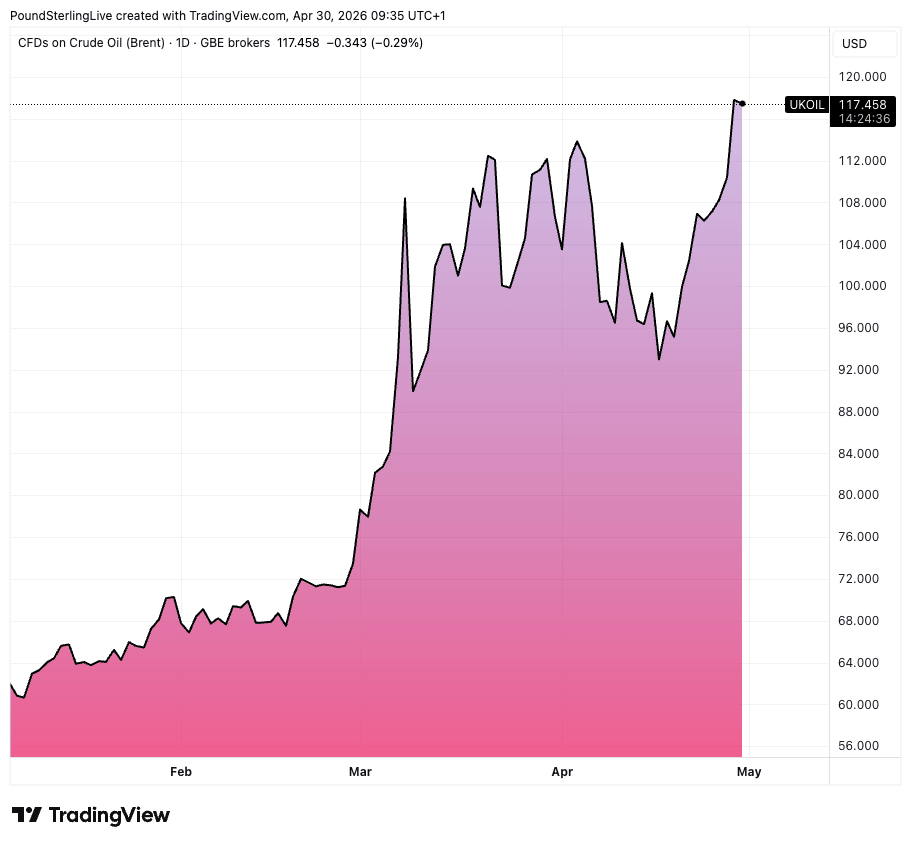
The ECB is expected to strike a ‘hawkish’ tone later today and hint at rate rises, which would usually benefit euro-dollar. However, ahead of the event brent crude oil prices are trading at four-year highs at $126 a barrel.
It’s reported Thursday that U.S. President Donald Trump will soon receive a briefing on new military options for action in Iran as negotiations are apparently going nowhere.
The rise in oil prices signals markets are positioning for fresh escalation and the realisation that there’s no imminent reopening of the Strait of Hormuz, the key shipping lane through which about a fifth of the world’s oil and natural gas flows.
“With the latest deterioration in market sentiment about the Middle East conflict, we don’t think the ECB will be hawkish enough to lift EUR/USD on its own,” says Francesco Pesole, FX Strategist at ING Bank. “Unless oil starts turning lower today, risks remain towards a move to 1.160.”
The U.S. President has made it clear he wants Iran to completely abandon ambitions to build a nuclear weapon, which Tehran’s leadership – now dominated by the military – refuses to do.
“The oil market has moved from ignoring headlines and hoping for resolution to fixating squarely on the physical scarcity and long-term threat to supply with the possible escalation of conflict now looming,” says Neil Wilson, UK Investor Strategist at Saxo Bank.
The Eurozone is a net importer of oil and gas, meaning its economy is particularly exposed to higher import prices. The U.S. is a net exporter of oil, and is now the primary supplier to the Eurozone.
For euro-dollar, that dynamic is a headwind.
“The higher oil climbs, the more it weighs on European assets and the EUR/USD outlook,” says Fawad Razaqzada, Market Analyst at City Index.
This morning saw the push further higher ahead of the FOMC meeting, as crude oil prices climbed even more with contract breaking the $115 handle. This greenback is looking strong as investors price out the odds of rate cuts from the Fed because of concerns about sticky inflation. The mild risk-off tone is also adding some upward pressure on USD, especially against the more risk-sensitive commodity dollars.
The USD/JPY currency pair, which has been confined to a relatively narrow range through much of April, could now stage a breakout. With the BoJ refusing to hike yesterday and oil continuing to push higher, the pressure is building for a potential break above 160.00, which, in turn, is raising the risk of government intervention to stem the drop.
Investors will keep a close eye on oil prices as they show no desire to fall amid stalled US-Iran talks. Also in focus will be the FOMC rate decision later on Wednesday as well as key US tech earnings and economic data on Thursday. For now, it is all about oil prices, and after we didn’t get any major surprises from the Japanese central bank, the risks remain tilted to the upside for the USD/JPY.
This was always going to be a busy week for the yen. As well as renewed gains for crude oil prices and the Bank of Japan meeting, we also have the set to announce it policy decision this week, alongside several other major central banks, while it is also a heavy earnings and data calendar week for the USD.
A slightly dollar-supportive Fed outcome combined with rising oil prices could tilt USD/JPY above recent resistance in the 159.50 to 160.00 region.
In fact, a move back towards 160.46, this year’s high, looks quite plausible. And if it gets there, why stop rising? The pair could extend even more. That said, any sharp move higher would likely bring increased volatility, as markets remain alert to the risk of Japanese FX intervention.
Support levels to watch include 159.00, 158.50 and 158.00.
As mentioned, the Bank of Japan left rates unchanged yesterday, pointing to ongoing uncertainty in the Middle East as a key reason for standing pat. Even so, pressure for another hike is clearly building, with three board members dissenting in favour of tighter policy.
On paper, the meeting carried a fairly hawkish feel. Both the statement and the quarterly outlook report pointed to mounting inflation concerns and a growing willingness within the Board to keep normalising policy. But Governor Ueda struck a more measured tone in his press conference, stopping short of giving markets a clear hawkish steer. That softer messaging allowed USD/JPY to recover after the initial reaction.
Ueda stressed that the situation in the Middle East remains highly fluid and said the BoJ would rather avoid committing to a firm timetable for the next move. Instead, he reiterated the broader message that the Bank remains on a gradual path towards a more neutral policy setting. As long as the economy avoids a material slowdown, further rate hikes remain on the table.
The updated macro outlook underlines the Bank’s growing concern over inflation, although Ueda again avoided signalling when the next increase could come. My base case is for the next hike in June, possibly followed by one more in the fourth quarter.
Going into the meeting, there had been some speculation that the BoJ might spring a surprise after a run of stronger inflation data, persistently deep negative real rates, and robust wage negotiations. Today’s outcome suggests that while inflation concerns are clearly intensifying, most policymakers still favour a cautious wait-and-see approach.
***
1,200+ Financial Metrics at Your Fingertips: From debt ratios and profitability to analyst earnings revisions, you’ll have everything professional investors use to analyze stocks in one clean dashboard.
Institutional-Grade News & Market Insights: Stay ahead of market moves with exclusive headlines and data-driven analysis.
A Distraction-Free Research Experience: No pop-ups. No clutter. No ads. Just streamlined tools built for smart decision-making.
Vision AI: InvestingPro’s newest addition. It analyzes any asset’s chart with professional-grade market intelligence, identifying key timeframes, technical patterns, and indicators — then delivers a clear trading playbook with the levels, scenarios, and risks that matter most in under a minute.
Not a Pro member yet?
Disclaimer: This article is written for informational purposes only; it does not constitute a solicitation, offer, advice, counsel or recommendation to invest as such it is not intended to incentivize the purchase of assets in any way. I would like to remind you that any type of asset, is evaluated from multiple perspectives and is highly risky and therefore, any investment decision and the associated risk remains with the investor.
The Pound to Dollar (GBP/USD) exchange rate edged lower on Wednesday as concerns over prolonged disruption to Middle East energy supplies supported the US Dollar.
At the time of writing, GBP/USD was trading around $1.3491, down close to 0.2% on the day.
DAILY RECAP:
The US Dollar (USD) firmed on Wednesday as markets reacted to reports suggesting the US is preparing for a prolonged blockade involving Iran.
Rising concerns over extended disruption to Middle East energy exports unsettled investors, boosting demand for safe-haven assets such as the ‘Greenback’.
However, gains in the US Dollar were tempered by caution ahead of the Federal Reserve’s latest interest rate decision, with markets awaiting signals on the future path of monetary policy.
Meanwhile, the Pound (GBP) remained under pressure amid growing concerns over the UK’s fiscal outlook.
UK borrowing costs climbed to their highest levels since 2008, with benchmark gilt yields holding above 5%, reflecting persistent inflation worries and unease around public finances.

Investors are increasingly concerned that elevated borrowing costs could constrain fiscal flexibility, limiting the government’s ability to support households in the face of rising energy prices.
Looking ahead, attention will turn to the Bank of England’s (BoE) interest rate decision.
While policymakers are expected to leave rates unchanged, forward guidance will be key, with a more cautious tone potentially weighing on Sterling.
Following the BoE announcement, the latest US GDP figures will also be in focus.
A stronger-than-expected reading could reinforce demand for the US Dollar, particularly if it supports expectations that US economic momentum remains intact despite rising energy costs.