The main category of All News Articles.
You can use the search box below to find what you need.
[wd_asp id=1]
The main category of All News Articles.
You can use the search box below to find what you need.
[wd_asp id=1]
Natural gas price kept forming weak sideways trading, holding above $2.620 support, but the main indicators contradiction and the continuation of forming an initial resistance at $3.160 obstructs the chances of forming new bullish waves by its fluctuations near $2.720 level.
The continuation of forming sideways trading in the current period, reaching below the current support will confirm its readiness to form new bearish waves, to expect targeting $2.390 and $2.250 level.
The expected trading range for today is between $5.250 and $2.820
Trend forecast: Fluctuated within the bearish trend
The USD/JPY pair extends its four-day upside to near 159.75 during the European trading session on Thursday. The pair reflects strength as the US Dollar (USD) outperforms its peers due to rising oil prices amid the prolonged closure of the Strait of Hormuz.
The table below shows the percentage change of US Dollar (USD) against listed major currencies today. US Dollar was the strongest against the New Zealand Dollar.
| USD | EUR | GBP | JPY | CAD | AUD | NZD | CHF | |
|---|---|---|---|---|---|---|---|---|
| USD | 0.20% | 0.10% | 0.16% | 0.03% | 0.32% | 0.48% | 0.11% | |
| EUR | -0.20% | -0.08% | -0.06% | -0.17% | 0.11% | 0.28% | -0.11% | |
| GBP | -0.10% | 0.08% | 0.04% | -0.09% | 0.21% | 0.37% | -0.03% | |
| JPY | -0.16% | 0.06% | -0.04% | -0.14% | 0.17% | 0.29% | -0.06% | |
| CAD | -0.03% | 0.17% | 0.09% | 0.14% | 0.31% | 0.45% | 0.06% | |
| AUD | -0.32% | -0.11% | -0.21% | -0.17% | -0.31% | 0.16% | -0.27% | |
| NZD | -0.48% | -0.28% | -0.37% | -0.29% | -0.45% | -0.16% | -0.40% | |
| CHF | -0.11% | 0.11% | 0.03% | 0.06% | -0.06% | 0.27% | 0.40% |
The heat map shows percentage changes of major currencies against each other. The base currency is picked from the left column, while the quote currency is picked from the top row. For example, if you pick the US Dollar from the left column and move along the horizontal line to the Japanese Yen, the percentage change displayed in the box will represent USD (base)/JPY (quote).
As of writing, the US Dollar Index (DXY), which tracks the Greenback’s value against six major currencies, trades 0.2% higher to near 98.80, the highest level seen in over a week.
Higher oil prices have boosted United States (US) inflation expectations, a scenario that discourages the Federal Reserve (Fed) from easing its monetary policy. According to the CME FedWatch tool, the odds of the Fed holding interest rates steady in the current range of 3.50%-3.75% in the December meeting are 76.8%.
In Thursday’s session, investors will focus on the preliminary US S&P Global Purchasing Managers’ Index (PMI) data for April, which will be published at 13:45 GMT. The US private sector business activity growth is expected to have increased due to improvement in both the manufacturing and the services sector output.
Meanwhile, the Japanese Yen (JPY) trades mixed against its major currency peers, as investors shift focus to the Bank of Japan’s (BoJ) monetary policy announcement on April 28, Tuesday.
USD/JPY trades higher at around 159.75 at the press time. The pair holds a bullish near-term bias amid the sustainability of a Descending Triangle breakout/ Also, rising 20-day Exponential Moving Average (EMA) at 159.11 bollters the near-tem bullish tone. This positioning suggests dips are still being bought, while the Relative Strength Index (RSI) near 57 stays in positive but not overbought territory, hinting that upside momentum is constructive yet controlled.
Looking up, the pair could extend its upside towards an over 21-month high at 160.46; a sustained move above that level would widen the scope for further upside towards 161.00. On the downside, immediate support is seen at the former resistance trend line around 159.41, followed by the 20-day EMA at 159.11. A deeper pullback could challenge the horizontal support of the triangle formation near 157.64.
(The technical analysis of this story was written with the help of an AI tool.)
(This story was corrected on April 23 at 11:59 GMT to say that the USD/JPY pair extends its four-day upside to near 159.75, not its two-day upside.)
The US Dollar (USD) is the official currency of the United States of America, and the ‘de facto’ currency of a significant number of other countries where it is found in circulation alongside local notes. It is the most heavily traded currency in the world, accounting for over 88% of all global foreign exchange turnover, or an average of $6.6 trillion in transactions per day, according to data from 2022.
Following the second world war, the USD took over from the British Pound as the world’s reserve currency. For most of its history, the US Dollar was backed by Gold, until the Bretton Woods Agreement in 1971 when the Gold Standard went away.
The most important single factor impacting on the value of the US Dollar is monetary policy, which is shaped by the Federal Reserve (Fed). The Fed has two mandates: to achieve price stability (control inflation) and foster full employment. Its primary tool to achieve these two goals is by adjusting interest rates.
When prices are rising too quickly and inflation is above the Fed’s 2% target, the Fed will raise rates, which helps the USD value. When inflation falls below 2% or the Unemployment Rate is too high, the Fed may lower interest rates, which weighs on the Greenback.
In extreme situations, the Federal Reserve can also print more Dollars and enact quantitative easing (QE). QE is the process by which the Fed substantially increases the flow of credit in a stuck financial system.
It is a non-standard policy measure used when credit has dried up because banks will not lend to each other (out of the fear of counterparty default). It is a last resort when simply lowering interest rates is unlikely to achieve the necessary result. It was the Fed’s weapon of choice to combat the credit crunch that occurred during the Great Financial Crisis in 2008. It involves the Fed printing more Dollars and using them to buy US government bonds predominantly from financial institutions. QE usually leads to a weaker US Dollar.
Quantitative tightening (QT) is the reverse process whereby the Federal Reserve stops buying bonds from financial institutions and does not reinvest the principal from the bonds it holds maturing in new purchases. It is usually positive for the US Dollar.
Silver price (XAG/USD) is down almost 2.3% to near $76.00 during the European trading session on Thursday. The white metal faces selling pressure as oil prices extends its winning streak for the third trading day on Thursday.
WTI Oil price jumps to near $95.80 during the day, the highest level in a week, as the Strait of Hormuz, a vital passage to almost 20% of global energy supply, remains closed, despite a ceasefire extension between the United States (US) and Iran.
Tehran remains firm on its vow that the Hormuz will remain closed until the US lifts the blockade on Iranian sea ports, a move that has frozen Iranian business activity.
Higher oil prices result in a sharp increase in inflation expectations globally, a scenario that discourages central banks from reducing interest rates, which eventually diminishes the demand for non-yielding assets, such as Silver.
Meanwhile, a higher US Dollar (USD) due to hopes that the Federal Reserve (Fed) will not cut interest rates this year has also weighed on the Silver price. According to the CME FedWatch tool, the possibility of the Fed holding interest rates steady in the current range of 3.50%3.75% in the December meeting is 76.8%.
During the day, the US Dollar Index (DXY), which tracks the Greenback’s value against six major currencies, posts a fresh weekly high at around 98.70.
XAG/USD trades lower at around $76 as of writing. The overall trend of the white metal appears to be uncertain as it is on the verge of an Ascending Triangle breakdown. The 20-day Exponential Moving Average (EMA) at $76.84 caps the upside as immediate resistance.
The Relative Strength Index (RSI) at 47.85 sits just below the neutral 50 line, hinting at fading bullish momentum rather than outright oversold conditions.
On the topside, the horizontal barrier of the Ascending Triangle formation at around $83.00 is the key resistance for the price. A daily close above $83 would extend the rally towards the psychological level of $90.00. Until those levels are recovered, the metal remains vulnerable to further downside towards the April 13 low at around $72.60, followed by the April 7 low of $68.28.
(The technical analysis of this story was written with the help of an AI tool.)
Silver is a precious metal highly traded among investors. It has been historically used as a store of value and a medium of exchange. Although less popular than Gold, traders may turn to Silver to diversify their investment portfolio, for its intrinsic value or as a potential hedge during high-inflation periods. Investors can buy physical Silver, in coins or in bars, or trade it through vehicles such as Exchange Traded Funds, which track its price on international markets.
Silver prices can move due to a wide range of factors. Geopolitical instability or fears of a deep recession can make Silver price escalate due to its safe-haven status, although to a lesser extent than Gold’s. As a yieldless asset, Silver tends to rise with lower interest rates. Its moves also depend on how the US Dollar (USD) behaves as the asset is priced in dollars (XAG/USD). A strong Dollar tends to keep the price of Silver at bay, whereas a weaker Dollar is likely to propel prices up. Other factors such as investment demand, mining supply – Silver is much more abundant than Gold – and recycling rates can also affect prices.
Silver is widely used in industry, particularly in sectors such as electronics or solar energy, as it has one of the highest electric conductivity of all metals – more than Copper and Gold. A surge in demand can increase prices, while a decline tends to lower them. Dynamics in the US, Chinese and Indian economies can also contribute to price swings: for the US and particularly China, their big industrial sectors use Silver in various processes; in India, consumers’ demand for the precious metal for jewellery also plays a key role in setting prices.
Silver prices tend to follow Gold’s moves. When Gold prices rise, Silver typically follows suit, as their status as safe-haven assets is similar. The Gold/Silver ratio, which shows the number of ounces of Silver needed to equal the value of one ounce of Gold, may help to determine the relative valuation between both metals. Some investors may consider a high ratio as an indicator that Silver is undervalued, or Gold is overvalued. On the contrary, a low ratio might suggest that Gold is undervalued relative to Silver.
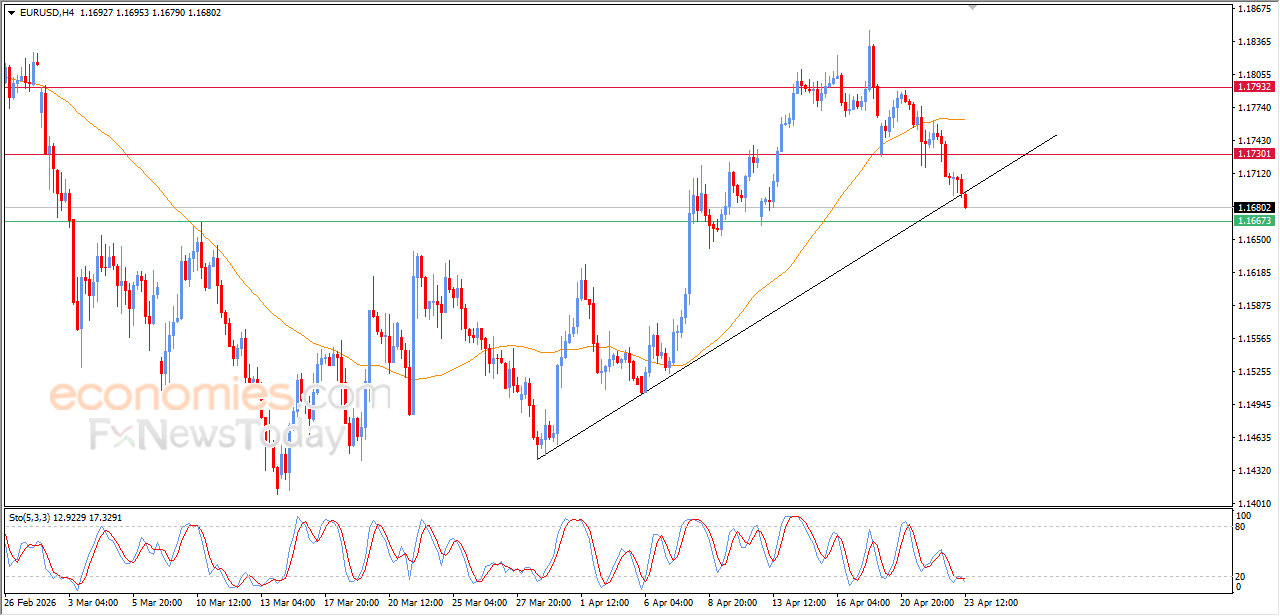
Overall Trend: Beginning of a bearish tilt.
Support Levels for EUR/USD Today: 11.1690 – 1.1620 – 1.1550
Resistance Levels for EUR/USD Today: : 1.1770 – 1.1820 – 1.1880
The EUR/USD pair witnessed a decline during today’s trading as fears of persistent global inflationary pressures grew. This bolstered demand for the US Dollar as a safe haven, pushing the pair to test significant technical support levels.

This decline came amid a renewed rise in oil prices, coinciding with stalled efforts to calm geopolitical tensions. This has reignited fears of a new inflationary wave that might force central banks to maintain tight monetary policies for longer, providing additional support to the USD at the expense of the European currency.
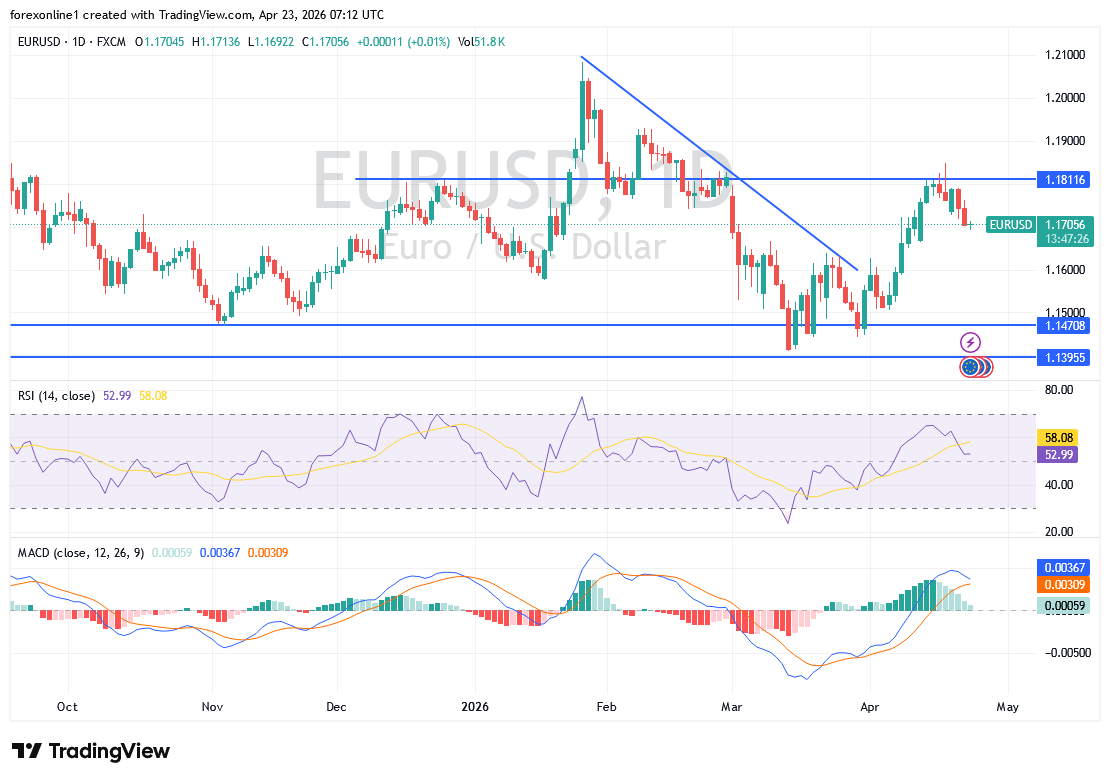
According to top trading platforms, the pair recorded losses extending to 1.1703, settling near the psychological support level of 1.1700. This indicates increasing selling pressure and the likelihood of a continued downward correction in the short term, especially given the diminished risk appetite in the markets.
The euro came under increased pressure after data showed a decline in eurozone consumer confidence to -20.6 in April, compared to -16.4 in March. This indicates continued caution among European households regarding spending, amid concerns about the ongoing repercussions of geopolitical tensions and rising energy costs.
This decline reflects the fragility of the eurozone’s economic recovery, which could limit the euro’s ability to make significant gains against the dollar in the current period, especially given the continued relative strength of the US economy.
Despite continued US political pressure to lower interest rates, the US dollar continues to benefit from safe-haven flows amid rising global uncertainty. In this context, analysts believe that any further escalation of geopolitical tensions could further support the dollar, while a reduction in risks could pave the way for a gradual recovery of the euro in the coming weeks.
Technically, the EUR/USD pair is moving near a key support zone at 1.1700. A clear break below this level could open the way for further declines towards 1.1660 and then 1.1620. The Relative Strength Index (RSI) is showing a gradual decline towards neutral levels, reflecting the weakening of previous upward momentum, while the MACD is trending negatively, which supports the likelihood of continued short-term selling pressure.
Conversely, the pair needs to break above 1.1800 to return to an upward trend and target 1.1820 and then 1.1880.
Dear TradersUp trader, we still prefer selling the EUR/USD pair on every strong upward bounce, but without risk. Be cautious of trading when price movements are within extremely narrow ranges.
Ready to trade our daily Forex analysis? We’ve made this forex brokers list for you to check out.
Natural gas price kept forming weak sideways trading, holding above $2.620 support, but the main indicators contradiction and the continuation of forming an initial resistance at $3.160 obstructs the chances of forming new bullish waves by its fluctuations near $2.720 level.
The continuation of forming sideways trading in the current period, reaching below the current support will confirm its readiness to form new bearish waves, to expect targeting $2.390 and $2.250 level.
The expected trading range for today is between $5.250 and $2.820
Trend forecast: Fluctuated within the bearish trend
Platinum price continued to provide weak sideways trading by its continued fluctuation near $2040.00 level, affected by the continuation of the main indicators, to obstruct the chances of resuming the previously bullish trend.
Stochastic reach below 50 level might increase the intraday negative pressures on the trading, to expect reaching the moving average level 55 at $1990.00, attempting to test the extra support near $1950.00, while holding above $2110.00 will motivate the bullish trend, to keep waiting for recording the extra target near $2155.00 and $2205.00.
The expected trading range for today is between $1990.00 and $2100.00
Trend forecast: Fluctuating
As of April 22, 2026, the brent crude oil price is trading around $98 per barrel, after briefly surging above $100 due to escalating tensions in the Strait of Hormuz. Prices eased following a temporary ceasefire extension, but the oil price today remains volatile amid ongoing supply risks.
The brent crude price has once again demonstrated how quickly sentiment can shift in global energy markets. Within 24 hours, prices surged past $100—triggering fears of a renewed energy shock—before slipping back toward $98.
For anyone tracking the crude oil price today or broader oil price trends, this is more than a short-term fluctuation. It reflects a market increasingly driven by geopolitical uncertainty rather than stable fundamentals, with traders reacting instantly to developments around the Strait of Hormuz.
The rally in brent crude oil price was not accidental—it was triggered by a sharp escalation in geopolitical risk.
Tensions intensified after Iran reportedly seized vessels attempting to pass through the Strait of Hormuz, while the United States maintained a naval blockade despite extending a temporary ceasefire. That combination created a dangerous signal for global oil supply: disruption without resolution.
Because the Strait of Hormuz handles a significant share of global oil shipments, even the perception of restricted flow can push prices sharply higher. In this case, markets reacted immediately, pricing in a potential supply shock and driving oil price today above the key $100 mark.
Yet, the rally proved fragile.
Despite the spike, the brent crude price could not hold above $100. The easing came after signals that the ceasefire would continue—at least temporarily—reducing the immediate risk of full-scale military escalation.
However, this is not a return to stability. It is a pause in a highly fragile environment.
Shipping activity remains cautious, military presence is still elevated, and diplomatic progress remains uncertain. In effect, the market has moved from panic to cautious watchfulness—keeping the crude oil price today elevated but not runaway.
The broader oil market reflects this mixed sentiment, with different benchmarks reacting in varied ways:
| Benchmark | Price ($) | Change (%) | Interpretation |
|---|---|---|---|
| Brent Crude | 98.34 | -0.14% | Cooling after $100 spike |
| WTI Crude | 89.42 | -0.25% | Softer U.S. outlook |
| Murban Crude | 96.29 | +3.25% | Regional strength |
| OPEC Basket | 99.60 | -5.19% | High volatility |
| Dubai Crude | 100.45 | -4.49% | Gulf sensitivity |
| Indian Basket | 100.41 | -9.24% | Demand pressure |
What stands out in this table analysis is the divergence. While Brent—the global benchmark—has cooled slightly, other grades show sharper swings, indicating that the oil price is being shaped by localized demand patterns and geopolitical exposure.
The current movement in brent crude oil price is not being driven by traditional supply-demand balance alone. Instead, it reflects a risk premium environment.
Markets are pricing in:
This explains why prices surged quickly but failed to sustain above $100—the market is uncertain, not convinced.
The implications of the current oil price today extend across the global economy.
Higher oil prices feed directly into inflation, increasing transportation and production costs worldwide. Central banks, already navigating fragile recoveries, may face renewed pressure to tighten monetary policy.
For emerging economies, including Nigeria, the impact is even more immediate. Rising crude oil price today can translate into higher fuel costs, currency pressure, and fiscal strain—especially in economies sensitive to imported refined products.
At the same time, equity markets tend to react negatively to sustained oil spikes, as higher energy costs compress corporate margins and reduce consumer spending power.
Looking ahead, the direction of the brent crude price will depend on three key scenarios:
The market is effectively in a wait-and-see mode, reacting to headlines rather than fundamentals.
Brent crude oil price is around $98 per barrel on April 22, 2026, after briefly rising above $100 due to tensions in the Strait of Hormuz. Prices eased following a ceasefire extension, but oil markets remain volatile due to ongoing geopolitical risks.
The brent crude oil price tells a clear story: this is a market driven by uncertainty.
The brief surge above $100—and the swift retreat—highlight how fragile global oil pricing has become. With geopolitical risks centered around the Strait of Hormuz, the crude oil price today will remain highly sensitive to every diplomatic and military development.
For decision-makers, investors, and consumers, the takeaway is straightforward:
Volatility is back—and it is being driven by geopolitics, not just supply and demand.
Platinum price continued to provide weak sideways trading by its continued fluctuation near $2040.00 level, affected by the continuation of the main indicators, to obstruct the chances of resuming the previously bullish trend.
Stochastic reach below 50 level might increase the intraday negative pressures on the trading, to expect reaching the moving average level 55 at $1990.00, attempting to test the extra support near $1950.00, while holding above $2110.00 will motivate the bullish trend, to keep waiting for recording the extra target near $2155.00 and $2205.00.
The expected trading range for today is between $1990.00 and $2100.00
Trend forecast: Fluctuating
World oil prices today
World gasoline and oil prices at the end of yesterday’s trading session (April 22), WTI and Brent oil prices increased by 3.67% and 3.48% respectively.
By this morning’s session, both oil commodities continued the upward trend. At 7:16 am (Vietnam time), WTI crude oil price was at 96.54 USD/barrel, up 3.58 USD/barrel, equivalent to an increase of 3.85%. WTI oil closed the previous trading session at 92.96 USD/barrel and opened today’s session at 92.69 USD/barrel.
Brent oil price was at 105.64 USD/barrel, up 3.86 USD/barrel, equivalent to an increase of 3.79%. Brent oil price closed the previous trading session at 101.78 USD/barrel and opened today’s session at 101.79 USD/barrel.
According to analysts, world gasoline prices surged sharply as the market reacted to inventory data in the US, in which the amount of gasoline and distillate products fell much deeper than forecast. At the same time, increased tensions in the Strait of Hormuz after gunings targeting container ships also raised concerns about supply, in the context of deadlock in peace negotiations between the US and Iran.
Data from the US Energy Information Administration (EIA) shows that in the week ending April 17, crude oil inventories increased by 1.9 million barrels, to 465.7 million barrels. Conversely, gasoline inventories decreased sharply by 4.6 million barrels, to 228.4 million barrels, much higher than the decrease of 1.5 million barrels forecast by analysts. Distillate inventories also decreased by 3.4 million barrels, to 108.1 million barrels, exceeding the forecast of a decrease of 2.5 million barrels.
Geopolitical factors continue to increase pressure on oil prices, as the Hormuz Strait – the route that transports about 20% of global oil and liquefied gas supplies – becomes unstable.
On April 22, at least 3 container ships were attacked with guns in this area. Iranian media reported that the Navy of the Islamic Revolutionary Guard of Iran arrested 2 ships on charges of violating maritime regulations and brought them back to the country’s territorial waters.
Peace talks between the US and Iran have also made no progress. The meeting scheduled in Pakistan did not take place due to the absence of both sides, increasing concerns about the risk of supply disruption in the near future.
Domestic gasoline prices today
On April 23, retail gasoline and oil prices according to the price list announced by Petrolimex in region 1 and region 2 are as follows:
The above-mentioned domestic retail gasoline and oil prices were adjusted by the inter-ministry of Industry and Trade – Finance from 4 pm on April 21.
Accordingly, the price of E5RON92 gasoline decreased by 658 VND/liter; RON95 gasoline decreased by 719 VND/liter; diesel oil 0.05S decreased by 3,185 VND/liter; mazut oil decreased by 701 VND/kg.
Gasoline and oil discount today
– Hoang Trong General Trading Co., Ltd.:
+ Hai Linh Warehouse, Petec, Dinh Vu, K99: Diesel oil 0.05S: 3,000 VND/liter; Gasoline RON 95 – III: 1,500 VND/liter.
+ Bac Ninh Warehouse: Diesel oil 0.05S: 2. 850 VND/liter; Gasoline RON 95 – III: 1. 300 VND/liter.
+ Nghi Son Warehouse: Diesel oil 0.05S: 3,000 VND/liter; Gasoline RON 95 – III: 1,500 VND/liter.
– Tu Luc Petroleum Joint Stock Company 1:
+ Diesel oil 0.05S – II: 1,600 VND/liter;
+ Diesel oil 0.001S-V: 1. 100 VND/liter;
+ RON 95 – III gasoline: 900 VND/liter;
+ E5 gasoline: 900 VND/liter.
– MIPEC Petroleum Trading and Trading Co., Ltd. – MIPEC Petro (applied to the Northern region):
+ RON 95 – III gasoline: 1,000 VND/liter.
+ Diesel oil 0.05S-II: 1,600 VND/liter.
Today’s gasoline and oil prices are for reference only and may change according to market developments.
Refer to more articles about gasoline and oil prices HERE.
– Written by
Ben Hughes
STORY LINK GBP/USD Forecast: Dollar Softens on Iran Ceasefire Extension News
The Pound to US Dollar (GBP/USD) exchange rate moved higher during Wednesday’s trading session, supported by easing geopolitical tensions.
At the time of writing, GBP/USD was trading close to $1.3528, up roughly 0.2% from the start of the day.
The US Dollar (USD) weakened on Wednesday as a slight improvement in market sentiment reduced demand for the safe-haven currency.
This shift followed an announcement from US President Donald Trump confirming an extension to the existing ceasefire with Iran.
Despite this, the downside in the ‘Greenback’ was limited, as uncertainty still lingers. The US continues to enforce restrictions on Iranian shipping, while Tehran has yet to formally agree to the extended truce, leaving investors cautious.
The Pound (GBP) found some support against the US Dollar but remained largely directionless versus other currencies after the release of the UK’s latest inflation figures.
Data from the Office for National Statistics indicated that headline inflation rose from 3% to 3.3% in March, marking its first increase in several months and reflecting higher global energy costs.
Get better rates and lower fees on your next international money transfer.
Compare TorFX with top UK banks in seconds and see how much you could save.
However, core inflation unexpectedly eased from 3.2% to 3.1%, suggesting that underlying price pressures may be softening.
This mixed picture limited Sterling’s upside, as investors judged that the figures are unlikely to prompt an immediate change in policy from the Bank of England (BoE), with policymakers expected to maintain a wait-and-see approach on interest rates.
Looking ahead, the next potential driver for the Pound to US Dollar exchange rate will be the UK’s upcoming PMI releases.
Early estimates for April are forecast to show a slowdown in private sector activity, with the impact of geopolitical tensions and higher energy costs weighing on business conditions.
At the same time, the US Dollar is expected to remain sensitive to broader market sentiment.
If confidence continues to improve on the back of Middle East developments, the US Dollar may face further pressure, while any renewed tensions could quickly restore demand for the safe-haven currency.

International Money Transfer? Ask our resident FX expert a money transfer question or try John’s new, free, no-obligation personal service! ,where he helps every step of the way,
ensuring you get the best exchange rates on your currency requirements.
TAGS: Pound Dollar Forecasts