The main category of All News Articles.
You can use the search box below to find what you need.
[wd_asp id=1]
The main category of All News Articles.
You can use the search box below to find what you need.
[wd_asp id=1]
Silver (XAG/USD) prices jumped on February 23, 2026, rising 6% in one day to $87.30 and outpacing gold. This surge comes after President Trump’s 15% global tariffs and another year of market deficits. Analysts are now watching for a possible move back to $100. Key technical levels and strong demand from AI industries are helping drive this rally.
Gold is still rising steadily, but today silver took center stage with a sharp 6% jump, reaching $87.30. This is a strong comeback after some early February swings, when silver briefly dropped after a speculative spike.
Silver is both a safe-haven investment and an important industrial metal, which is causing a special supply and demand crunch.
Uncertainty is the main reason for today’s price jump. After the U.S. Supreme Court ended “reciprocal tariffs,” President Trump responded with a 15% global tariff by executive order. This change has brought back worries about trade wars and inflation, pushing investors toward hard assets to protect against a possibly unstable U.S. dollar.
Washington has given Iran a strict 10-to-15-day deadline on nuclear enrichment, which has added a big risk premium to metals. Because silver is more volatile, it tends to react strongly to this kind of news, which explains today’s large gains.
The Silver Institute says the market will face its sixth year in a row of shortages in 2026, with a shortfall of 67 million ounces expected. Even though solar companies are using less silver per panel, strong demand from AI data centers, electric vehicles, and advanced semiconductors is making up for it.
[[XAG/USD-graph]]
Looking at the 4-hour chart, XAG/USD has moved above the $84.91 resistance level, breaking a long-term downward trend.
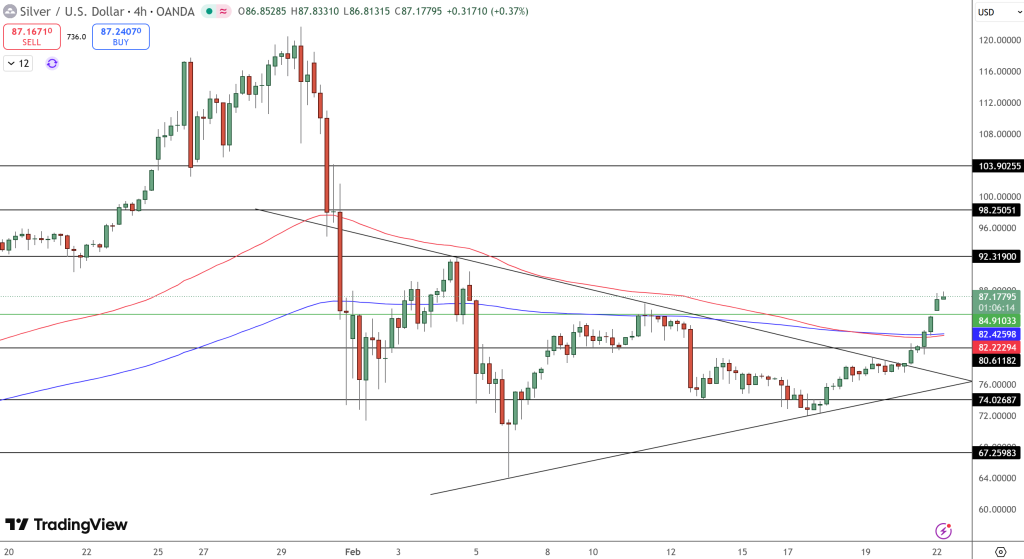
Analysts disagree on whether silver will reach its $120 all-time high again this year, but most agree that prices are unlikely to fall much lower.
| Scenario | Target Price | Key Catalyst |
| Bullish Case | $100 – $133 | Escalating trade wars & sustained AI industrial demand |
| Base Case | $81 – $92 | Steady industrial growth offsetting solar substitution |
| Bearish Case | $64 – $72 | Swift resolution of tariffs & global economic slowdown |
The Bottom Line: In summary, silver is acting both as a safe investment during uncertain times and as an important material for green energy and AI. Even though prices are still volatile, the strong momentum shows that support above $80 is solid, and buyers are leading the market between $87 and $92.
Trade Idea: Consider buying if silver pulls back toward $85.00, aiming for a target of $92.30 and using a stop-loss below the 50-period moving average at $82.20.

Arslan Butt
Lead Markets Analyst – Multi-Asset (FX, Commodities, Crypto)
Arslan Butt serves as the Lead Commodities and Indices Analyst, bringing a wealth of expertise to the field. With an MBA in Behavioral Finance and active progress towards a Ph.D., Arslan possesses a deep understanding of market dynamics.
His professional journey includes a significant role as a senior analyst at a leading brokerage firm, complementing his extensive experience as a market analyst and day trader. Adept in educating others, Arslan has a commendable track record as an instructor and public speaker.
His incisive analyses, particularly within the realms of cryptocurrency and forex markets, are showcased across esteemed financial publications such as ForexCrunch, InsideBitcoins, and EconomyWatch, solidifying his reputation in the financial community.
Platinum price took advantage by the positive factors that are represented by providing bullish momentum by the main indicators, besides forming extra support level at $2020.00, forming new bullish waves to settle near $2190.00.
We expect reaching $2245.00 barrier soon, and surpassing it will confirm its move to a new positive station, to reinforce the chances of recording extra gains that might begin at $2315.00 and $2425.00, while the failure to breach will reinforce the dominance of the sideways bias in the near-period, and there is chance to activate the bearish corrective track.
The expected trading range for today is between $2110.00 and $2245.00
Trend forecast: Bullish
Given the mixed inflation numbers, USD/JPY is likely to be more sensitive to Bank of Japan monetary policy cues. The BoJ may view last week’s CPI report as favorable for households and the domestic demand outlook. Typically, softer consumer price inflation boosts households’ purchasing power and consumer confidence, fueling private consumption. An upswing in consumption would raise demand-driven inflation and contribute to GDP growth.
East Asia Econ remarked on last week’s PMI and inflation numbers, stating:
“Manufacturing sentiment is up, and falling headline inflation should further boost the mood of households too. For the BOJ, the critical issue will be whether these improvements in soft data feed into real aggregate demand, in turn supporting its confidence about the trend in underlying inflation.”
Ongoing expectations of a BoJ rate hike continue to support the bearish short- to medium-term outlook for USD/JPY.
While market bets on a BoJ rate hike linger, Trump’s tariff policies, US economic data, and Fed chatter will influence buying interest in the US dollar.
Later on Monday, factory orders, the Dallas Fed Manufacturing Index, and the Chicago Fed National Activity Index will provide insights into the US economy. Given that the factory order numbers are for December, the Dallas Fed and Chicago Fed data will likely have more influence on the Fed rate path. Softer numbers would raise expectations of a June Fed rate cut, weakening the US dollar.
Beyond the numbers, President Trump’s tariff policies, US-Iran-related headlines, and Fed chatter will also influence USD/JPY trends.
According to the CME FedWatch Tool, the probability of a June cut fell from 68.6% on February 13 to 51.1% on February 23, strengthening the US dollar.
Nevertheless, market expectations of multiple Fed rate cuts and the BoJ’s more hawkish policy outlook remain key to the negative short- to medium-term outlook for USD/JPY.
For USD/JPY price trends, traders should closely assess technical indicators, key economic data, government policies, and central bank rhetoric.
On the daily chart, USD/JPY remains below its 50-day Exponential Moving Average (EMA), but holds above the 200-day EMA. The EMA positions indicate a bearish near-term but bullish longer-term bias. Despite a bullish longer-term bias, favorable yen fundamentals align with the short-term technical. These fundamentals offset the longer-term technical, supporting a bearish medium-term outlook.
A drop below 153 would expose the 200-day EMA. A sustained fall through the 200-day EMA would indicate a bearish trend reversal, exposing the 150 support level. If breached, 145 would be the next key support level.
Importantly, a sustained fall through the EMAs would reaffirm the negative medium- to longer-term price outlook.
Weekly Forex Forecast – USD/JPY, AUD/USD, WTI Crude Oil, S&P 500 Index, Bitcoin, Gold
WTI Crude Oil tested long-term highs as the outbreak of war looms over the Persian Gulf, while the Japanese Yen gave up some of its gains and precious metals continued their recovery.
Fundamental Analysis & Market Sentiment
I wrote on the 15th February that the best trades for the week would be:
Long of the S&P 500 Index following a daily (New York) close above 7,025. This did not set up.
Long of any JPY currency cross except CHF/JPY. This produced several winning trades:
AUD/JPY = +1.73%
CAD/JPY = +1.10%
CHF/JPY = +0.51%
EUR/JPY = +0.83%
GBP/JPY = +0.24%
The gave a total win of 4.31%, which averages to 0.72% per asset.
A summary of last week’s most important data in the market:
US Core PCE Price Index – slightly higher than the expected 0.3% month-on-month increase at 0.4%, suggesting that the Fed will have to remain cautious on the pace of rate cuts, which strengthened the US Dollar.
US Advance GDP – this came in much lower than expected at only 1.4%, although the undershoot was largely discounted by analysts as due to the recent government shutdown.
US FOMC Meeting Minutes – there were no surprises.
UK CPI (inflation) – as expected, the annualized rate fell to 3.0%.
Canadian CPI (inflation) – came in just a tick lower than expected, with no month-on-month change in the index.
RBNZ Official Cash Rate / Rate Statement / Monetary Policy Statement – the Bank made a dovish rate hold, pushing back expectations for the next rate hike, which weakened the Kiwi.
US / German / UK Flash Services & Manufacturing PMI – these were below expectations in the USA but above expectations in Germany and the UK, suggesting that the US economy may be slowing.
UK Retail Sales – this was considerably stronger than expected, showing a monthly increase of 1.8%, suggesting a more buoyant consumer demand. This helped the British Pound firm a little, but not by much.
US Unemployment Claims – this was slightly better than expected.
Australian Unemployment Rate – this fell unexpectedly to 4.1%, although the outperformance was very small.
UK Claimant Count Change – very slightly worse than expected, but it had no effect.
The only significant effects last week’s economic data had was the stronger USD after the PCE Price Index release which is seen as an inflation indicator by the Fed, and the weaker NZD after the RBNZ’s dovish rate hold. Overall, the CME FedWatch tool has moved firmly in favour of expecting only two rate cuts in 2026 of 0.25% (June and October), which is a hawkish change for the US Dollar.
Prediction markets are indicating an increased possibility of a US attack on Iran after the US administration appears to have been surprised by Iran’s reluctance to offer more substantial concessions on its nuclear weapon program and its refusal to even discuss its ballistic missile program, both of which were attacked by the USA and/or Israel in June 2025. Polymarket is currently indicating a 17% chance of war within one week, a 46% chance of war by mid-March, and a 57% chance of war by the end of March. Comments from US Secretary Witkoff earlier today suggest the US is still indicating it hopes for a deal. In my opinion, war is inevitable within a few weeks, the Islamic Republic of Iran will not decisively mothball its nuclear program under any circumstances, and the comments of Witkoff just show how little even President Trump’s diplomats truly understand the reality of the Iranian regime. Iran’s strongest card is the fact that the American public is far more interested in bread and circuses than it is in dismantling Iran’s nuclear program, let alone in its ballistic missiles or overthrowing the regime, even though a more normal government in Iran would almost certainly bring significant economic benefits to both the Middle East and the USA.
The prospect of imminent war is raising the price of crude oil and may be suppressing US stock markets to some extent. Neither side is likely to attack oil facilities, but if the Iranian regime thinks its survival is seriously threatened, it would probably do so if it could. This could see crude oil prices spike much higher, having already kissed a new 6-month high price last week. President Trump will be extremely reluctant to see oil prices rise further, but he may also feel he will not get a deal without showing he is willing and able to kill very senior Iranian politicians, which creates a risky situation for crude oil.
The Week Ahead: 23rd – 27th February
The coming week’s most important data points, in order of likely importance, are:
US PPI
US President Trump State of the Union speech
Australian CPI (inflation)
Canadian GDP
US Unemployment Claims
Monday will be a public holiday in Japan and China.
Monthly Forecast February 2025
Currency Price Changes and Interest Rates
For the month of February, I forecasted that the EUR/USD currency pair would rise in value.
Currency Pair |
Forecasted Direction |
Interest Rate Differential |
Performance to Date |
|
EUR/USD |
Long ↑ |
-1.50% (2.15% – 3.75%) |
-0.60% |
February 2026 Monthly Forecast Performance to Date
Weekly Forecast 22nd February 2026
Last week saw no currency crosses with excessive volatility, so I am making no forecast for the coming week.
Last week’s forecast produced several winning trades (see the intro to this item above for details).
The Australian Dollar was the strongest major currency last week, while the Japanese Yen was the weakest. Directional volatility fell slightly last week, with just one third of all major pairs and crosses changing in value by more than 1%.
Next week’s volatility is likely to be lower unless war breaks out in the Middle East, which might generate volatility in the US Dollar, the Japanese Yen, and the Canadian Dollar.
You can trade these forecasts in a real or demo Forex brokerage account.
Technical Analysis
Key Support/Resistance Levels for Popular Pairs
Currency Pair |
|
|
AUD/USD |
Support: 0.7067, 07004, 0.6991, 0.6947 Resistance: 0.7098, 0.7120, 0.7213, 0.7248 |
|
EUR/USD |
Support: 1.1774, 1.1760, 1.1672, 1.1633 Resistance: 1.1805, 1.1828, 1.1856, 1.1887 |
|
GBP/USD |
Support: 1.3432, 1.3402, 1.3332, 1.3307 Resistance: 1.3549, 1.3603, 1.3636, 1.3666 |
|
USD/JPY |
Support: 154.44, 153.63, 152.15, 151.61 Resistance: 155.17, 155.60, 156.29, 157.74 |
|
AUD/JPY |
Support: 108.86, 108.62, 108.26, 106.58 Resistance: 110.02, 111.00, 112.00, 113.00 |
|
EUR/JPY |
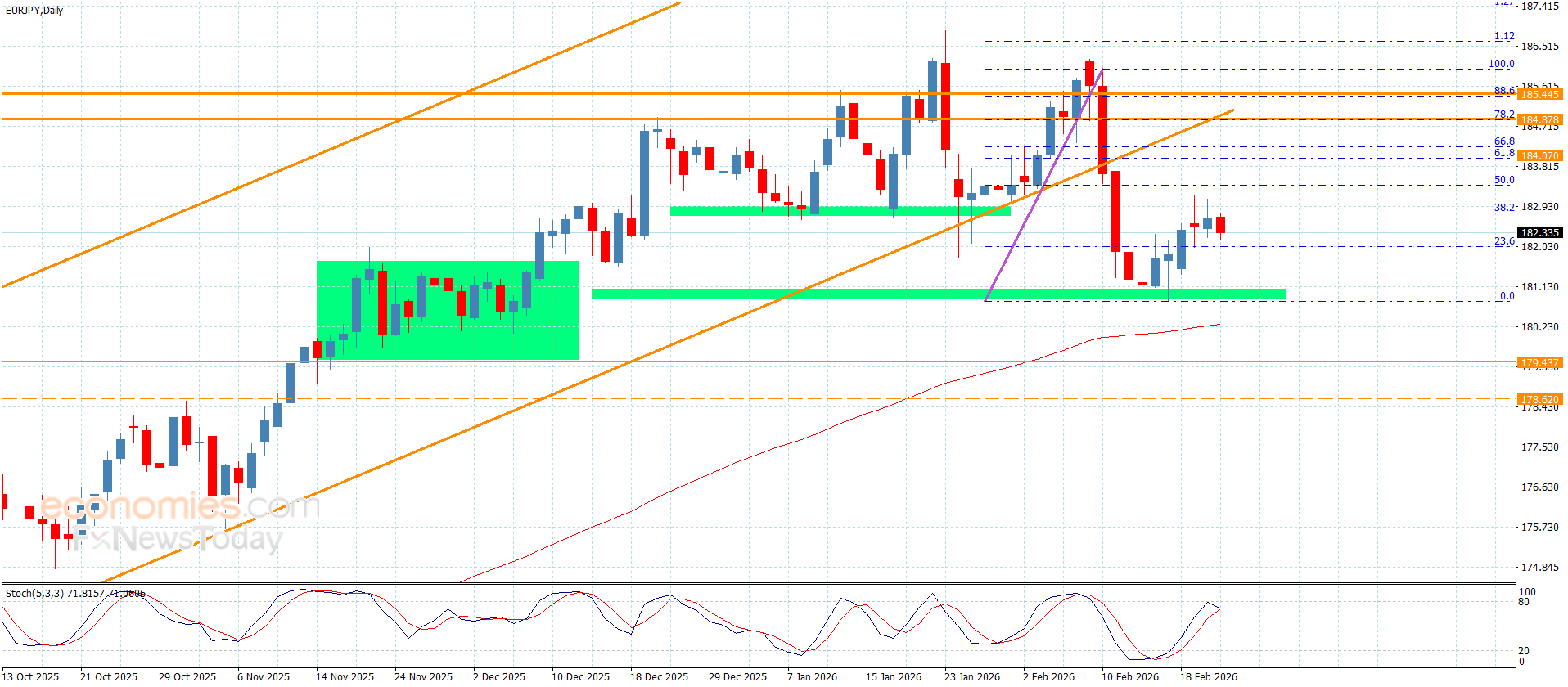
Support: 182.02, 181.72, 181.41, 180.83 Resistance: 183.14, 183.78, 184.85, 185.32 |
|
USD/CAD |
Support: 1.3668, 1.3626, 1.3596, 1.3554 Resistance: 1.3724, 1.3748, 1.3797, 1.3815 |
|
USD/CHF |
Support: 0.7667, 0.7600, 0.7500, 0.7400 Resistance: 0.7730, 0.7741, 0.7793, 0.7869 |
Key Support and Resistance Levels
US Dollar Index
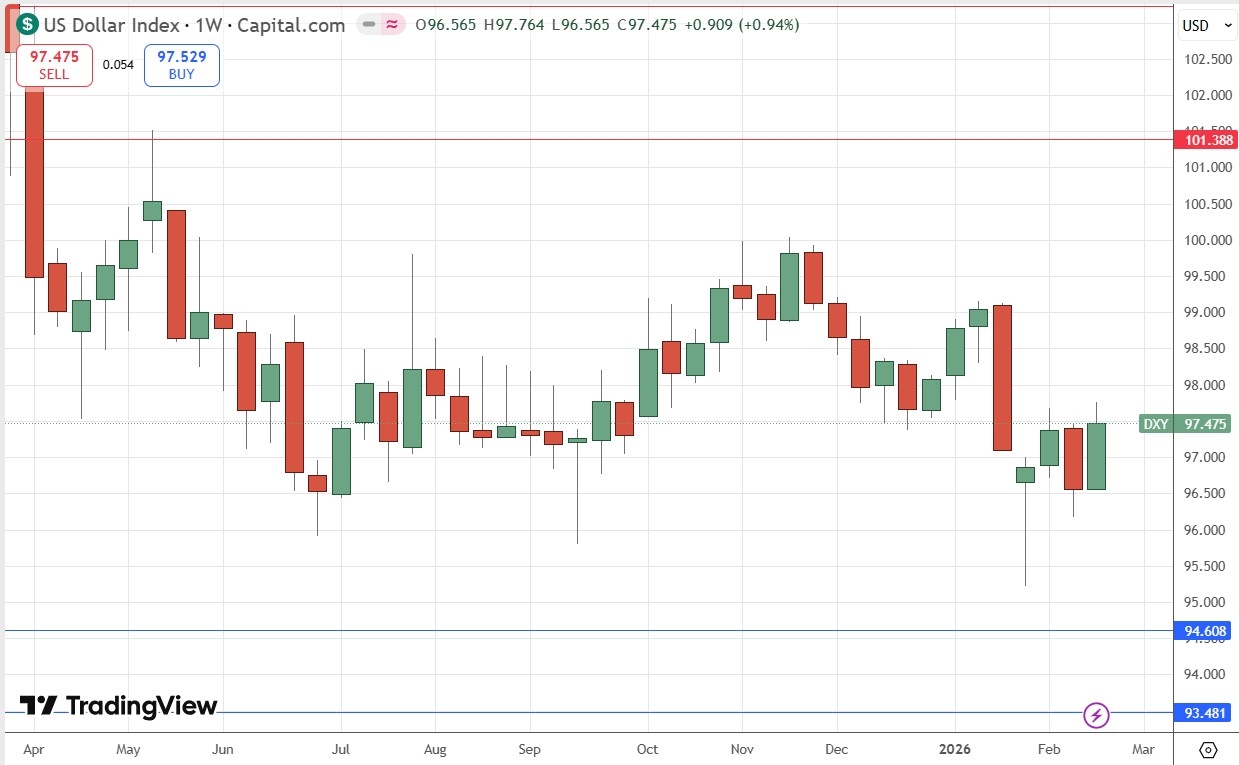
Last week, the US Dollar printed a bullish candlestick which engulfed the real body of the previous candlesticks.
Zooming out, we can see that although the price action of recent months suggests a bearish consolidation pattern, the most recent price action has been bullish over recent weeks. The long-term trend is mixed, with the price below its level of 3 months ago but above its level of 6 months ago.
We certainly saw the interest rate outlook turn more bullish last week on the greenback, with markets now pricing in only two rate cuts of 0.25% over the course of 2026 instead of the three that were expected in the previous week.
All in all, a weakly bullish bias looks sensible, as it is supported by sentiment / fundamental outlook and the most recent price action. However, as it is only weak, there is still a case to be long of especially strong currencies or assets that are priced in greenbacks – just don’t expect any miracles.
US Dollar Index Weekly Price Chart
USD/JPY
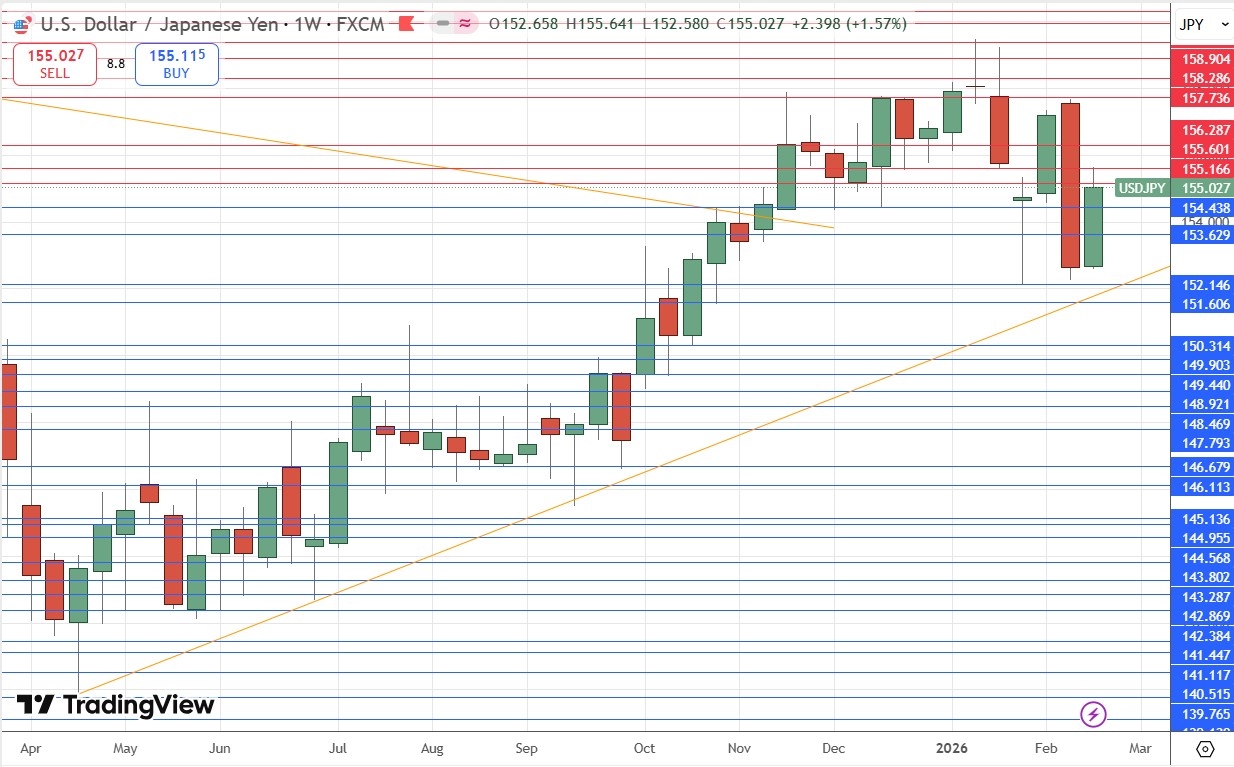
The USD/JPY currency pair saw a predictable bounce back higher over the past week, after making a huge downwards move the previous week which ended not far from the supportive trend line shown in the price chart below. This behaviour is typical of currencies other than the US Dollar. The Yen fell over the week against every other major currency, and the US Dollar was strengthened as economic data strengthened the case for a more cautious Fed timeline for further rate cuts, with only two cuts now expected over the course of 2026.
Despite the strong bullish move, and the general trend higher, I am far from certain there will be much more upside over the near term, mainly because the prospect of war in the Middle East could cause a market shock which might see the Yen strengthen.
If you do want to be short of the Japanese Yen, it might be wise to do it with a basket of the relatively strong currencies, which might include the Australian as well as the US Dollar.
USD/JPY Weekly Price Chart
AUD/USD
The AUD/USD currency pair is very interesting right now, as the Australian Dollar is even stronger than the US Dollar, being one of the few currencies that moved higher against it last week, trading at long-term high prices two weeks ago.
The Australian Dollar is one of three major currencies whose central banks are on a path of rate hikes rather than cuts, and its path is the strongest and most convincing.
I think the Australian Dollar is an excellent long prospect, although it might not gain very much over the near term here. It might be best to trade the Aussie long against a basket of the weaker currencies, like the Euro and the British Pound.
Technically, last week’s candlestick looks bullish as an inside and pin candlestick, so if last week’s high price is broken convincingly, a further rise would look likely. The round number at $0.7100 might be a superior marker.
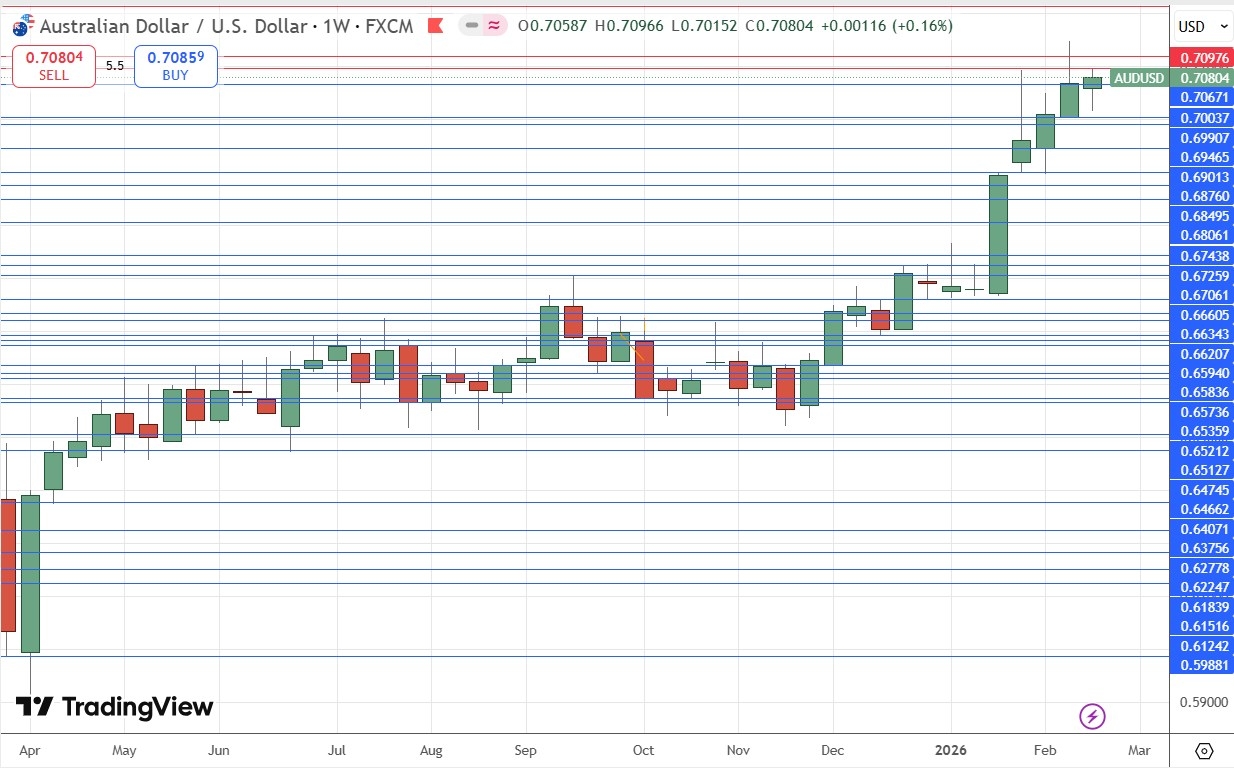
AUD/USD Weekly Price Chart
WTI Crude Oil
WTI Crude Oil rose strongly last week, especially on Thursday when the prospect of an American attack on Iran seemed to grow, giving a rise of almost 5% on the day. The price briefly kissed a new 6-month high before retreating a bit on Friday, but the weekly closing was not very far from the high of the range.
An all-out war between the USA and Iran tends to be seen as a doomsday scenario for crude oil, as about 25% of all petroleum products pass through the strait. Prediction markets see a war as likely to happen by the end of next month, and it seems the USA is prepared sufficiently to attack.
However, both Iran and nearby US allies export oil and the USA has no interest in sending the price of crude oil higher, so there may be a tacit agreement not to attack oil facilities. On the other hand, if the Iranian regime began to crumble it might decide to bring the house down with it. In any case, the outbreak of war will likely see a spike higher, which is likely to be short-lived.
Many trend traders will have gone long of WTI Crude Oil last week but are vulnerable to massive losses if there is a sudden deal averting war, or to a spike higher which quickly dramatically reverses as it becomes clear oil facilities will not be touched. For these reasons, if you must go long here, do it with great caution. Intraday stop losses and closing positions before weekends can help to reduce rise. I personally am long but with only a small position, and I will try to close it out on the first or second day of the war (which I expect to happen) unless the war immediately spins wildly out of control leading to Iranian (possible but unlikely) or Israeli (highly unlikely unless Iran inflicts very serious damage on Israel) attacks on oil facilities.
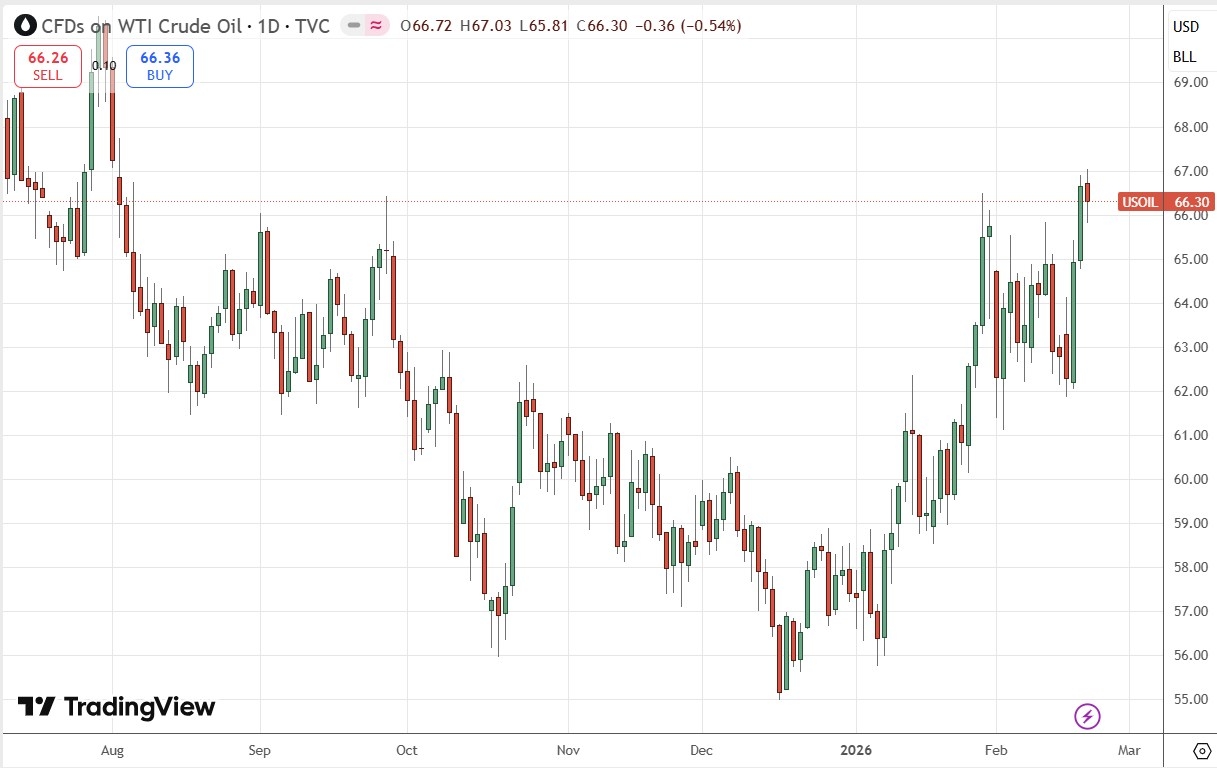
WTI Crude Oil Daily Price Chart
S&P 500 Index
The S&P 500 Index has been in a strong bull market for a long time. However, although we did see a new record high price just three weeks ago, a look at the weekly chart below shows that the price has been consolidating, or topping out, for about the last 10 weeks. The support below at 6737 looks pivotal, and the support below that near 6,500 looks even more so, especially when you consider the 200-day simple moving average is confluent with that major half-number.
It is still technically a bull market, and I would go long if we got a record high daily close above 7,025, but the choppiness and reluctance to make new highs suggests that this might not happen.
If war breaks out between the USA and Iran and it escalates quickly, this could well chill this Index towards the downside.
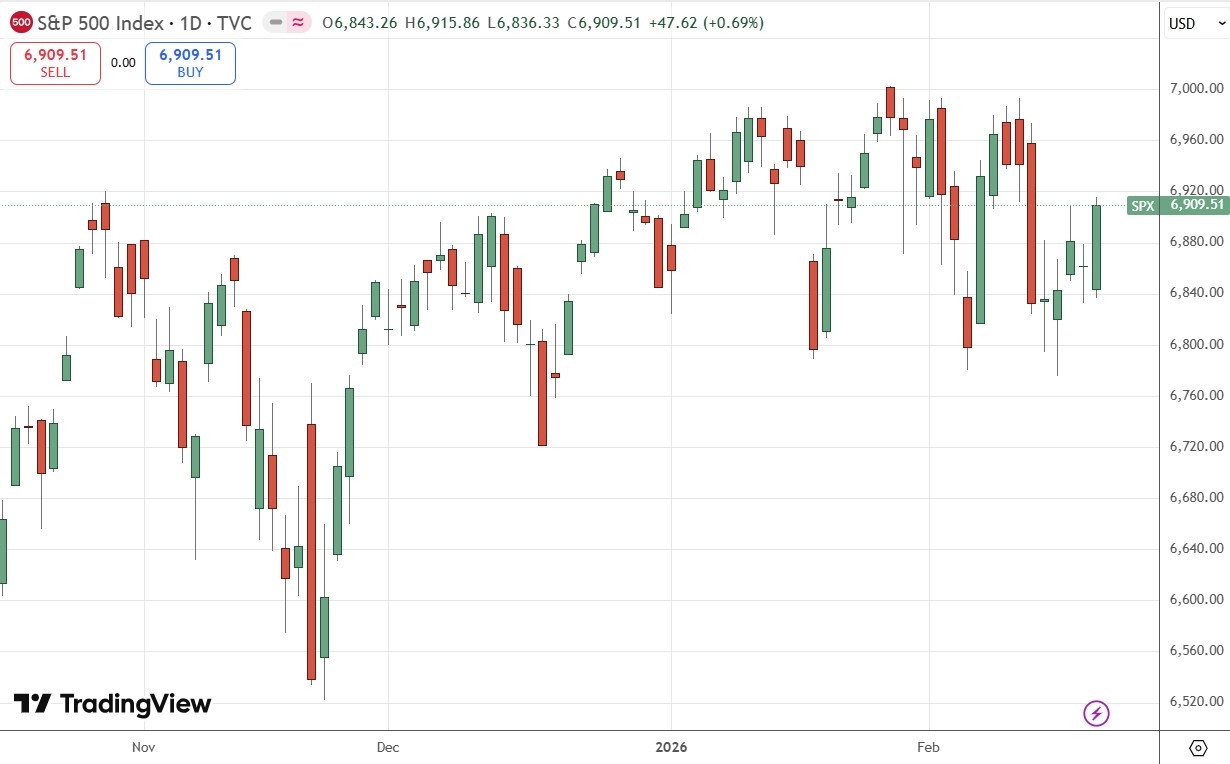
S&P 500 Index Daily Price Chart
Bitcoin
BTC/USD is starting to show a very textbook range consolidation between $66,773 and $71,762. The rice chart below shows that a break of this range could be very significant technically. Although there has been lots of bearish pressure on Bitcoin, it may be that long-term investors see it as cheap in this range and are buying it. A convincing bullish breakout above $71,762 could trigger a fast rise to $81,203. This feels the more likely scenario.
A bearish breakdown below $66,773 will then face the very pivotal long-term low at $61,229.
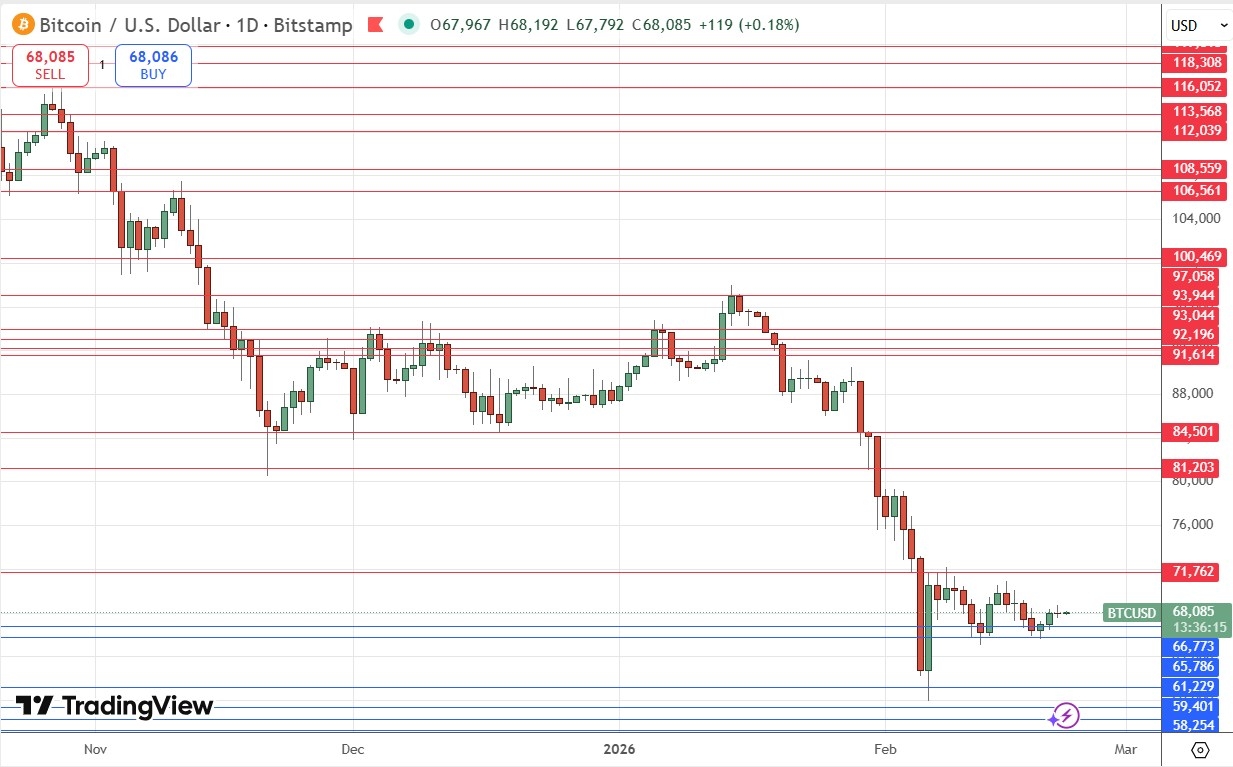
Bitcoin Daily Price Chart
XAU/USD
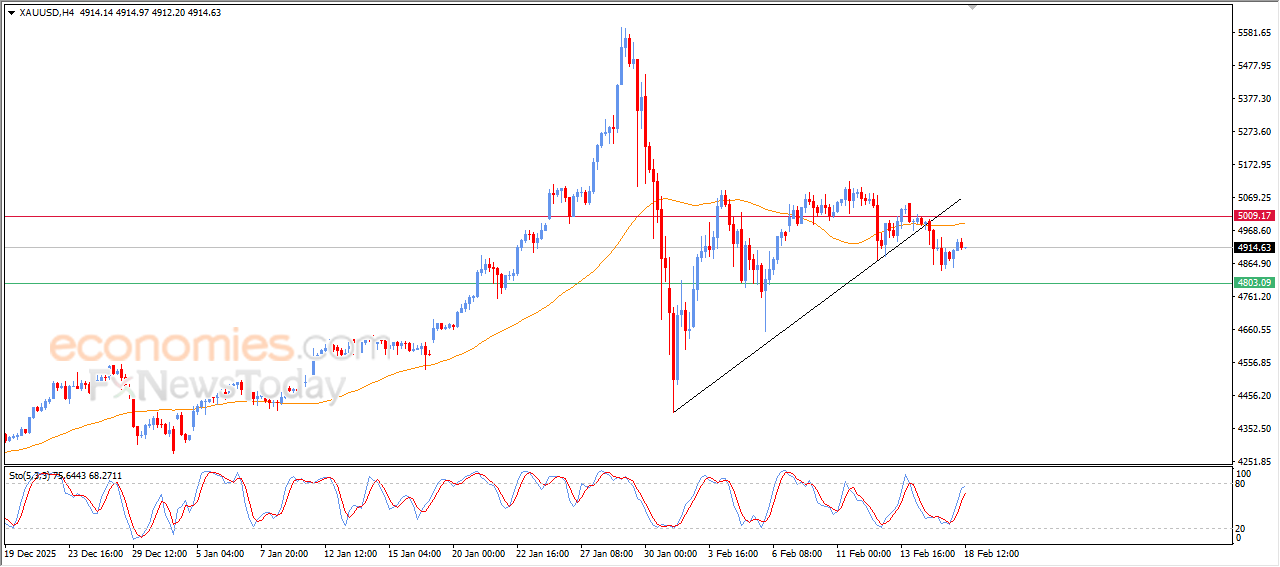
Gold has started to rise convincingly again, although it is still a meaningful way off its record high which it made a few weeks ago. The daily chart below shows that Friday’s rise was especially impressive, with the price closing right on the high of the day and the week.
It looks as if Gold will continue to go higher, and the rise seems to be changing from a grind higher into a firmer upwards move.
The price is now well above the 50% Fib retracement level of the recent sharp crash in value, which is another bullish sign.
Trend and momentum traders who do not want to wait for long-term breakouts will probably want to be long here already. I prefer to wait for long-term new high prices, so I will wait for a daily close above $5,418.55 before I enter a long trade.
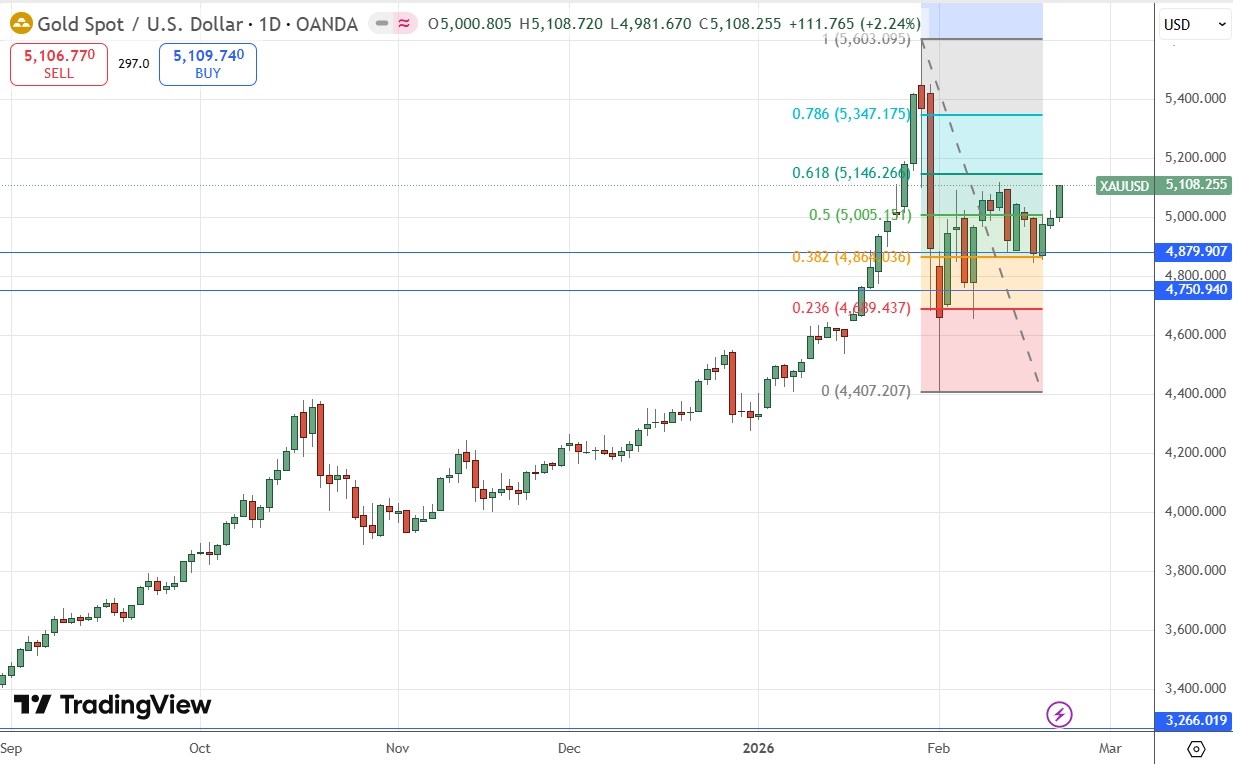
Gold Daily Price Chart
Bottom Line
I see the best trades this week as:
Long of the S&P 500 Index following a daily (New York) close above 7,025.
Long of Gold following a daily (New York) close above $5,418.55.
Long with a small position in WTI Crude Oil on short-term bullish price action while New York is open but be quick to take profits once war breaks out or if an agreement is reached.
Ready to trade our Forex weekly forecast? Check out our list of the best Forex brokers in the world.
The EUR/USD exchange rate remained in a narrow range after a series of important events and macro data. It was trading at 1.1780, down from the year-to-date high of 1.2095.

The EUR/USD pair retreated after the Supreme Court ruled against Donald Trump’s tariffs on Friday. In a 6-3 ruling, the court said that Trump erred in using emergency powers to implement global tariffs last year.
The ruling ended Trump’s most important policy, which he has used to remake how the US trades with other countries. However, the president has more options to impose tariffs, some of which have been tested by the Supreme Court.
In a statement, Trump announced a new 15% tariff as he works on a more comprehensive plan to achieve the same goal.
The EUR/USD pair also remained under pressure after the US released the latest GDP and inflation report. Data showed that the economy grew by 1.4% in the fourth quarter, down by 4.4% in the third quarter.
The growth was much lower than the median estimate of 3%, with the government shutdown contributing to the slowdown.
Another report showed that the personal consumption expenditure (PCE) rose to 2.9% in December from the previous 2.8%. Core PCE, which strips the volatile food and energy prices, rose to 3% from 2.8%. On the positive side, a recent report showed that consumer inflation retreated to 2.4% in January.
The EUR/USD pair will react to the potential war between the United States and Iran, which will likely lead to higher inflation in the United States and Europe.
Looking ahead, the next important catalysts for the EUR/USD pair will be statements by Christine Lagarde and several Federal Reserve officials like Christopher Waller, Lisa Cook, Raphael Bostic, and Susan Collins.
There will be several key macro data, including the upcoming US consumer confidence report and European inflation.
The three-day chart shows that the EUR/USD exchange rate has pulled back in the past few days, moving from a high of 1.2093 in January to the current 1.1781. This retreat happened as geopolitical tensions rose and the US dollar rebounded.
The pair has remained slightly above the 50-day Weighted Moving Average (WMA). It has remained inside the ascending channel, while the two lines of the MACD indicator have retreated.
Therefore, the bullish outlook will likely remain as long as it is above the 50-day WMA and as long as the Supertrend indicator remains in the green. The key target to watch will be at 1.200.
Crispus Nyaga is a financial analyst, coach, and trader with more than 8 years in the industry. He has worked for leading companies like ATFX, easyMarkets, and OctaFx. Further, he has published widely in platforms like SeekingAlpha, Investing Cube, Capital.com, and Invezz. In his free time, he likes watching golf and spending time with his wife and child.
Coffee price continued forming strong bearish trading, affected by forming solid barrier at 330.00 level in the last trading, to notice reaching 283.00 to record the suggested targets in the previous reports.
Stochastic attempt to exit the oversold level might push the price to form mixed trading, but it will not affect the negative scenario, to expect reaching 275.80 level, and breaking it will open the way for reaching extra negative stations that might begin at 264.60 and 241.40.
The expected trading range for today is between 264.00 and 298.00
Trend forecast: Bearish
A rising ABCD pattern on the chart marks recent swings, but considers the $4,842 swing low to be contained within the CD leg of the formation. This is a judgement call, based on the decisiveness expressed in the first leg up from the bottom. With the measurement, an initial upside target is shown at $5,345. That is where the CD advance matches the rise in price seen in the AB leg.
Once that occurs, a potential pivot is identified. This target has greater significance in addition to a 100% ABCD target. The price matches a 78.6% Fibonacci retracement of the bearish correction. When two indicators identify a similar price level, that price area takes on greater significance as support or resistance. In this case, it is resistance.
Could gold continue to rise towards the $5,598 record high? Certainly, the reclaim of the moving averages indicates a recovery of those averages as support. The relationship shows demand improving as higher prices are recovered.
It could be argued that the recent sharp 21.4% bearish correction has reached a bottom. Support was seen at the confluence of the 50-day moving average and the top of a long-term rising channel. A bounce from $4,402 confirmed support at prior resistance from the channel. Together, the bullish response from these indicators suggests the correction may be complete, reinforcing the potential for further upside.
If you’d like to know more about how to trade gold and silver, please visit our educational area.
Silver (XAG/USD) builds on its recent recovery on Friday, with prices climbing for a third consecutive day as lingering geopolitical risks fuel safe-haven flows. At the time of writing, XAG/USD is trading near $82.80, on track to post a weekly gain of more than 5%.
The white metal has regained bullish traction after sliding to nearly two-week lows earlier in the week and continues to advance despite a broadly stronger US Dollar, suggesting dip buyers remain active.
The latest leg higher comes as tensions between the United States and Iran escalate, with fears mounting over potential US military action amid a significant American military buildup in the Middle East.
On Friday, US President Donald Trump said he is considering a limited strike on Iran. The remarks followed his warning on Thursday that Tehran must reach a “meaningful deal” or face “bad things,” adding that he expects clarity on a new nuclear agreement within the next 10 to 15 days.
Beyond geopolitics, underlying fundamentals remain constructive. Steady institutional inflows and resilient industrial demand, along with sustained expectations of lower interest rates in the United States later this year, keep the broader outlook for Silver tilted to the upside.
From a technical perspective, the 4-hour chart points to improving short-term momentum. Price is hovering near the upper Bollinger Band as the bands begin to widen, signaling rising volatility and building bullish pressure following a prior period of contraction.
The Moving Average Convergence Divergence (MACD) extends above the Signal line and stands in positive territory, with a widening histogram suggesting strengthening bullish momentum.
Meanwhile, the Relative Strength Index (RSI) is holding near 66, reflecting firm upside traction while remaining below overbought territory, leaving room for further gains.
On the upside, a sustained break above the upper Bollinger Band near $82.39 could pave the way for a continuation toward the $86.00 region, with the next key resistance seen around $92.00.
On the downside, the 20-period SMA (Bollinger middle band) at $77.34 provides immediate support. A decisive break below this level would expose the lower Bollinger Band around $72.16, followed by the February swing low near $64.00
Silver is a precious metal highly traded among investors. It has been historically used as a store of value and a medium of exchange. Although less popular than Gold, traders may turn to Silver to diversify their investment portfolio, for its intrinsic value or as a potential hedge during high-inflation periods. Investors can buy physical Silver, in coins or in bars, or trade it through vehicles such as Exchange Traded Funds, which track its price on international markets.
Silver prices can move due to a wide range of factors. Geopolitical instability or fears of a deep recession can make Silver price escalate due to its safe-haven status, although to a lesser extent than Gold’s. As a yieldless asset, Silver tends to rise with lower interest rates. Its moves also depend on how the US Dollar (USD) behaves as the asset is priced in dollars (XAG/USD). A strong Dollar tends to keep the price of Silver at bay, whereas a weaker Dollar is likely to propel prices up. Other factors such as investment demand, mining supply – Silver is much more abundant than Gold – and recycling rates can also affect prices.
Silver is widely used in industry, particularly in sectors such as electronics or solar energy, as it has one of the highest electric conductivity of all metals – more than Copper and Gold. A surge in demand can increase prices, while a decline tends to lower them. Dynamics in the US, Chinese and Indian economies can also contribute to price swings: for the US and particularly China, their big industrial sectors use Silver in various processes; in India, consumers’ demand for the precious metal for jewellery also plays a key role in setting prices.
Silver prices tend to follow Gold’s moves. When Gold prices rise, Silver typically follows suit, as their status as safe-haven assets is similar. The Gold/Silver ratio, which shows the number of ounces of Silver needed to equal the value of one ounce of Gold, may help to determine the relative valuation between both metals. Some investors may consider a high ratio as an indicator that Silver is undervalued, or Gold is overvalued. On the contrary, a low ratio might suggest that Gold is undervalued relative to Silver.
So for now, the gold price is effectively in limbo, with traders looking to see what the next set of US economic data really says before deciding which way to bet.
It’s worth remembering that the Federal Reserve minutes from their January meeting made it pretty clear that the central bank is under no pressure to slash interest rates anytime soon. In fact, some officials were even talking up the possibility of raising rates again if inflation doesn’t start to slow down like they think it should.
On top of that we’ve just seen yet more economic data showing the US job market is still going strong. Put all that together with more hawkish comments from Fed officials and investors are now starting to rethink their expectations for a serious rate cut.
As a result, the US dollar has gone from strength to strength and has now reached its highest level in months – and that’s all bad news for gold.
On the geopolitical front, President Donald Trump sent out a pretty stern warning to Iran on Thursday – telling them they have to get a nuclear deal sorted within 10 to 15 days or else. Iran’s response to UN Secretary General Antonio Guterres was that they don’t want war but that if anyone attacks them, then Iran will hit back – and they might even hit some key military targets in the region.
Which of course, just increases the chances of a wider conflict breaking out in the Middle East, and that’s good news for Gold, because we all know how well it tends to do when tensions start to rise.
BitcoinWorld
Silver Price Forecast: XAG/USD Consolidates Below $78.50 with Bullish Momentum Intact
Global precious metals markets witnessed significant movement this week as silver prices consolidated below the critical $78.50 resistance level. The XAG/USD pair maintained its bullish structure despite recent consolidation, according to technical analysis from multiple trading platforms. Market analysts observe this consolidation as a healthy pause within a broader upward trend that began in early 2025. Industrial demand fundamentals continue supporting silver’s long-term valuation while short-term technical factors drive daily price action.
Technical charts reveal XAG/USD trading within a defined range between $77.80 and $78.50 throughout the past five sessions. This consolidation follows a substantial rally from the $72.30 support level established in February 2025. The 50-day moving average currently provides dynamic support at $76.45 while the 200-day moving average trends upward at $74.20. Furthermore, the Relative Strength Index (RSI) maintains a neutral reading of 58, indicating neither overbought nor oversold conditions.
Market technicians identify several key technical patterns developing simultaneously. First, a symmetrical triangle formation appears on the four-hour chart with converging trendlines. Second, the weekly chart shows higher lows established since December 2024. Third, Fibonacci retracement levels from the recent swing high to low indicate strong support clusters. These technical factors collectively suggest the consolidation represents accumulation rather than distribution.
| Level Type | Price | Significance |
|---|---|---|
| Immediate Resistance | $78.50 | Previous swing high & psychological level |
| Primary Support | $77.80 | Current consolidation low |
| Secondary Support | $76.45 | 50-day moving average |
| Major Support | $74.20 | 200-day moving average |
| Year-to-Date High | $79.85 | 2025 peak established March 15 |
Multiple fundamental factors contribute to silver’s current price action and future trajectory. Industrial demand remains robust as global manufacturing indices show expansion in key sectors. The photovoltaic industry continues consuming record silver volumes for solar panel production. Additionally, electronics manufacturing maintains strong silver consumption for conductive components. These industrial applications create consistent baseline demand regardless of investment flows.
Monetary policy developments significantly impact precious metals pricing. The Federal Reserve’s recent communication suggests a measured approach to interest rate adjustments. Historically, silver performs well during periods of moderate inflation with stable interest rates. Central bank diversification into precious metals provides additional structural support. Several emerging market central banks increased their silver reserves during the first quarter of 2025 according to IMF data.
Commodity analysts from leading financial institutions provide context for silver’s current consolidation phase. “Silver often experiences consolidation periods after significant rallies,” notes Dr. Elena Rodriguez, Senior Commodity Strategist at Global Markets Research. “The current pause below $78.50 represents healthy profit-taking rather than trend reversal. Industrial demand fundamentals remain exceptionally strong.”
Technical analyst Michael Chen observes specific chart patterns. “The symmetrical triangle formation typically resolves in the direction of the preceding trend,” Chen explains. “With silver’s underlying trend clearly bullish, this consolidation likely precedes another upward movement. Key resistance at $78.50 represents the immediate hurdle.” Historical data supports this analysis, showing similar consolidation patterns in 2021 and 2023 preceding substantial rallies.
Market sentiment indicators provide additional insight. The Commitments of Traders report shows commercial hedgers maintaining substantial long positions. Meanwhile, speculative positioning remains balanced without extreme readings. Volatility measures indicate normal market conditions rather than distressed trading. These factors collectively suggest sustainable price action rather than speculative excess.
Silver’s performance relative to gold provides important context for understanding its market dynamics. The gold-silver ratio currently trades at 82:1, slightly above its five-year average of 80:1. This ratio measures how many ounces of silver purchase one ounce of gold. Historically, ratios above 80 indicate potential silver outperformance relative to gold. The ratio peaked at 92:1 in late 2024 before beginning its current descent.
Platinum and palladium markets show different dynamics than silver. Platinum maintains stronger industrial connections to automotive catalysts while palladium faces substitution pressures. Silver’s unique dual role as both industrial metal and monetary asset creates distinct price drivers. Unlike platinum group metals, silver benefits from both manufacturing demand and investment flows. This diversification supports price stability during sector-specific downturns.
Several key differences distinguish silver from other precious metals:
Current silver price action mirrors historical consolidation patterns observed during previous bull markets. The 2009-2011 bull market featured multiple consolidation periods between major advances. Similarly, the 2019-2020 rally included several pauses around psychological resistance levels. These historical precedents suggest consolidation represents normal market behavior rather than weakness.
Seasonal patterns also influence silver price movements. Historically, April through June represents a seasonally strong period for precious metals. This seasonal strength coincides with increased industrial activity and jewelry manufacturing. The current consolidation occurs during this traditionally favorable period, potentially amplifying any breakout that follows. Historical data shows silver posting positive returns in 70% of April-June periods since 2000.
Long-term chart analysis reveals important support and resistance zones. The $78.50 level represents not only recent resistance but also a historical congestion area from 2023. Successful breach of this level would open technical targets near $82.00 and eventually $85.00. Conversely, breakdown below $76.45 would signal deeper correction potential toward $74.20. The symmetrical triangle pattern typically resolves within two to three weeks of formation.
Several risk factors warrant consideration despite the generally bullish outlook. First, unexpected Federal Reserve policy shifts could strengthen the US dollar, pressuring precious metals. Second, global economic slowdown could reduce industrial silver demand. Third, technological substitution in certain applications might decrease long-term consumption. Fourth, increased mining production could alter supply-demand balances.
Market participants monitor specific indicators for trend confirmation. Sustained trading above $78.50 would confirm breakout from consolidation. Increasing trading volume during upward moves would validate buyer conviction. Continued expansion in manufacturing PMI readings would support industrial demand fundamentals. Conversely, breakdown below the 50-day moving average would suggest weakening technical structure.
The silver price forecast remains cautiously optimistic as XAG/USD consolidates below the $78.50 resistance level. Technical analysis suggests this consolidation represents a pause within a broader bullish trend rather than reversal. Fundamental factors including industrial demand and monetary policy continue supporting silver’s valuation. Historical patterns indicate similar consolidation phases often precede further advances. Market participants should monitor the $78.50 resistance and $76.45 support levels for directional clues. The silver price forecast ultimately depends on both technical breakout confirmation and sustained fundamental support.
Q1: What does consolidation below $78.50 mean for silver prices?
Consolidation represents a pause in price movement as markets digest recent gains. Technical analysis suggests this is normal behavior within an uptrend rather than bearish reversal.
Q2: What technical levels should traders watch for silver?
Key levels include immediate resistance at $78.50, primary support at $77.80, and the 50-day moving average at $76.45. Break above $78.50 would signal continuation higher.
Q3: How does industrial demand affect silver prices?
Industrial applications account for approximately 50% of silver demand. Strong manufacturing activity, particularly in solar panel and electronics production, provides fundamental price support.
Q4: What is the current gold-silver ratio and its significance?
The ratio currently trades near 82:1, slightly above its five-year average. Ratios above 80 historically indicate potential for silver outperformance relative to gold.
Q5: What risk factors could negatively impact silver prices?
Potential risks include stronger US dollar from Fed policy, reduced industrial demand from economic slowdown, technological substitution, and increased mining production.
This post Silver Price Forecast: XAG/USD Consolidates Below $78.50 with Bullish Momentum Intact first appeared on BitcoinWorld.